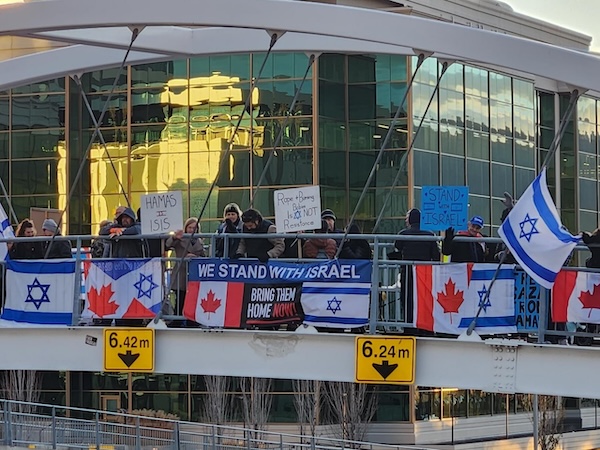
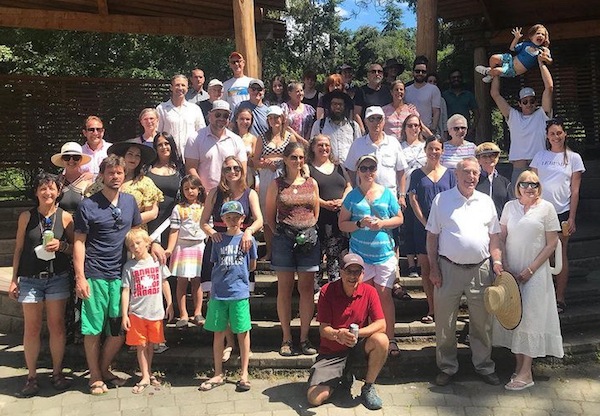
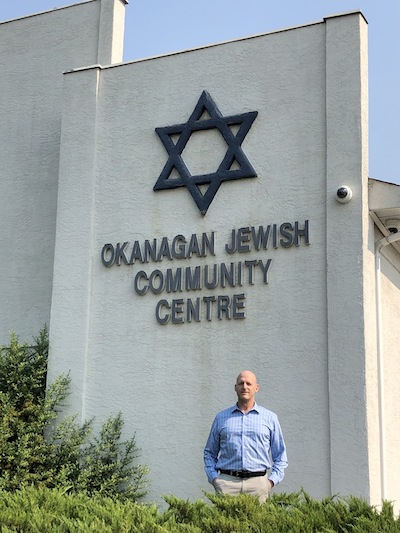
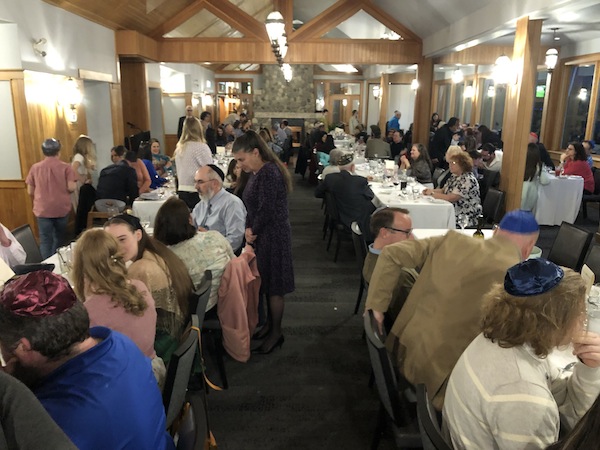
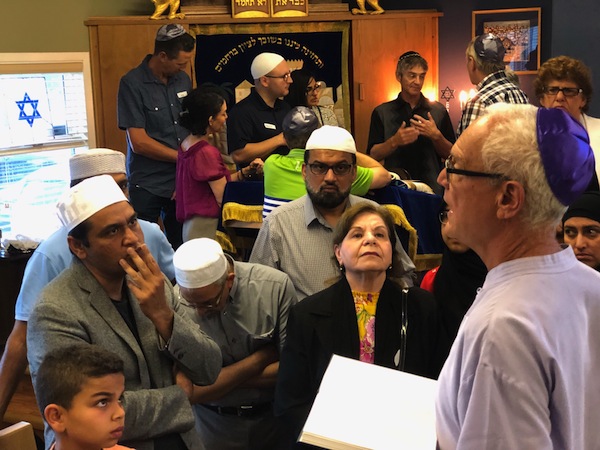
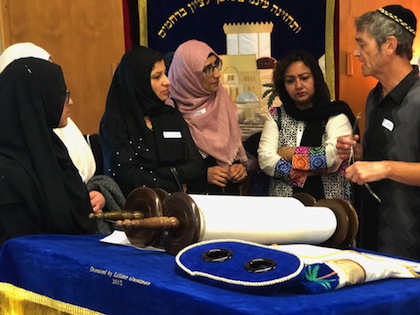
On the weekend of Oct. 11-12, the Okanagan Jewish Community Centre hosted a memorial exhibit to mark two years since Oct. 7. It was designed as a series of information booths, to allow visitors to engage with the material at their own pace. (photo from OJC)
On the weekend of Oct. 11-12, the Okanagan Jewish Community Centre (OJC) hosted a memorial exhibit to mark two years since the Oct. 7, 2023, massacre in Israel. The program brought together Kelowna, West Kelowna and Okanagan area residents, the Jewish community, other faith groups and allies, as well as local, provincial and federal elected representatives and some of their staff.
The exhibit, created by Mila Shapiro and Harley Kushmier, was designed as a series of information booths, to allow visitors to engage with the material at their own pace. Each station explained different parts of the story: the historical context, the scale of the violence and the hatred that drove it. Displays showed how people from all backgrounds – left or right, foreign nationals or Israelis – were targeted and suffered the same nightmare.
One of the most difficult-to-view sections showed video footage recorded by the Hamas terrorists during the attacks. The reaction from visitors was intense, with many saying it was overwhelming, but also something they needed to see to understand the scale of the cruelty.

On the Saturday evening, the guest speaker, Nitzan, shared her story of Oct. 7 to a room filled to capacity.
Nitzan, who preferred to go by her first name for this article, grew up in a small northern town in Israel, where having to take refuge in a shelter wasn’t necessarily a scary experience.
“Back then, we didn’t have Iron Dome, we didn’t have an alarm system,” she said. “We heard the whistle and then the boom.
“As we grew older, my sister moved to the south of Israel, where she fell in love and built her life in Kibbutz Be’eri, an amazing peaceful, community. Be’eri made the desert bloom.”
On Oct. 7, Nitzan’s sister sent a photo of her and her family in their safe room. “I called her, asking why they were in the safe room, what’s happening. She said the amount of rockets is insane. We’re in the safe room, but I’m not sure what’s going to happen to the people partying at the music fest – they have nowhere to go.”
A few minutes later, “She was outside with the kids and, on a video call, I said to her, what if they come?”
The family returned to their safe room, said Nitzan. But the doors to safe rooms don’t lock. “You have to hold the handle up,” she explained.
Fifteen minutes later, texts started flooding in – attackers were in the kibbutz, they were breaking into people’s homes.
“As the night went on,” said Nitzan, “they, Hamas, were burning the houses, smoking people out of their homes, shooting, killing, murdering whoever they could. They broke into my sister’s house five times. She and her husband held onto the door, not letting go, not letting them in.
“As the night went on, her texts were begging for help, saying goodbye, not thinking they were going to make it through the night.
“Her husband’s family all live in the kibbutz – his two sisters and his mom. His mom was hosting her sister, her husband and son. They didn’t make it,” said Nitzan. His mom, Pessi, her sister Hanna, husband Zizi and son Tal were all killed.
“My friend Abouya answered my texts, saying he’s holding onto the door and then he stopped reading my messages. They had shot him in the stomach, and he died at home. He was a close family friend…. His grandkids, two 12-year-old-year-olds, a boy and girl, Ynai and Liel, were being held in Pessi’s house. They were murdered with her. The terrorists gathered 15 neighbours, murdering 12 of them.”

Nitzan knew many others who were killed.
“I ended up in an emergency room,” she shared. “I couldn’t bear the horror. I was throwing up, sweating, shaking. When I got to emerg, the doctor told me he had to give me something to calm me down. I said, I can’t take it. If I need to make the decision to go home, I need to be able to make it. He looked at me and understood. When I saw him a few months after, he asked me, how are you doing? Did your family survive?
“They did, and I am so grateful for that.”
Nitzan spoke about the rising amount of antisemitism in Canada and around the world.
“We have to stick together, we have to find each other, support each other and find why,” she said, mentioning former hostage Eli Sharabi’s book, Hostage, in which he describes meeting Hersh Goldberg-Polin, another hostage, who was murdered in the tunnels of Gaza with five others in August 2024. Goldberg-Polin told Sharabi, “If you have the why, you’ll find the how” to survive. Sharabi talks about how this idea, also expressed by Friedrich Nietzsche (“he who has a why to live for can bear almost anything”) helped him survive 491 days in captivity.
“It has been two long years, years of hurt, of pain,” said Nitzan. “I wish for all our hostages to come home … victims’ bodies are still there. I wish for us to be united, to know that we are stronger together, that we have many friends that support us and that we are not alone.”

The evening concluded with a Q&A session. Questions and comments ranged from the sharing of personal experiences, to questions for Nitzan, to concerns about antisemitism and the growing fear that many Jewish Canadians are now living with.
On Sunday, Liel, who also didn’t want her surname used for this article, shared her story about Oct. 7. She spoke about the loss of someone very close to her and the continuing impact that day has had on her perspective and sense of community. As well, she discussed the challenges on Canadian and American university campuses, describing how painful it has been to witness the reactions and divisions that have emerged.
“We can’t stop talking about the victims of the seventh of October,” said Liel, the more than 1,200 “innocent people who lost their lives in senseless violence,” and those who were kidnapped.
“We can’t forget about the heroes of that day,” she said, talking about the soldiers and civilians who fought hard that day, the “heroes that saved countless lives by sacrificing themselves. We must keep all of their memories alive by continuing to remember them and talk about them, and share their stories.”
“As a Jew, I carry the weight of my ancestors’ pain and resilience. Our voice must never be silent,” said Kushmier about why it was important for him to help create this exhibit. “The pain in Israel and in the Jewish diaspora has been profound, yet we rise above the hate. We stand as ourselves, stronger and united, showing the world that we will endure, heal and continue to thrive.
“Every generation of our people has faced hardship, but we have never been broken,” he said. “Through centuries of persecution, we have built communities, told our stories, and held onto our faith. Our people are strong, and our unity is our power. In the face of hatred, we choose love and life.”
Shapiro said the Oct. 7 massacre hit very close to home, and her family lost someone very close to them at the Nova music festival.
“My land and my people are suffering and I believe it’s critical to bring historical facts and context to the forefront, so others can truly understand the roots of this conflict,” she said. “Only through education and awareness can we make change toward truth and justice.
“In addition, in the aftermath of such a horrific tragedy, I believe it can be deeply healing to come together in mourning – to honour and remember those who were brutally murdered, massacred, burned and tortured. Their lives were taken in unimaginable ways, and we owe it to them and to ourselves to remember their names, their stories and their humanity. Mourning together is not just an act of remembrance – it’s an act of resistance against forgetting.”
In a city where the Jewish community is small but strong, the exhibit was a chance to learn, to bear witness and to connect, said Kushmier and Shapiro, who thank Nitzan for sharing her story.
They also thank their families and the volunteers, including Bitachon (security) members, who assisted with the two-day exhibit, which was funded by donations from the Okanagan Jewish Community Centre and the Jewish Federation of Greater Vancouver, and included material from StandWithUs.
Samantha Kushmier is a member of the Okanagan Jewish Community, and mother of exhibit organizer Harley Kushmier.