Skip to content
  • Home
  • Subscribe / donate
  • Events calendar
  • News
    • Local
    • National
    • Israel
    • World
    • עניין בחדשות
      A roundup of news in Canada and further afield, in Hebrew.
  • Opinion
    • From the JI
    • Op-Ed
  • Arts & Culture
    • Performing Arts
    • Music
    • Books
    • Visual Arts
    • TV & Film
  • Life
    • Celebrating the Holidays
    • Travel
    • The Daily Snooze
      Cartoons by Jacob Samuel
    • Mystery Photo
      Help the JI and JMABC fill in the gaps in our archives.
  • Community Links
    • Organizations, Etc.
    • Other News Sources & Blogs
    • Business Directory
  • FAQ
  • JI Chai Celebration
  • JI@88! video

Recent Posts

  • Story of Israel’s north
  • Sheltering in train stations
  • Teach critical thinking
  • Learning to bridge divides
  • Supporting Iranian community
  • Art dismantles systems
  • Beth Tikvah celebrates 50th
  • What is Jewish music?
  • Celebrate joy of music
  • Women share experiences 
  • Raising funds for Survivors
  • Call for digital literacy
  • The hidden hand of hate
  • Tarot as spiritual ritual
  • Students create fancy meal
  • Encouraging young voices
  • Rose’s Angels delivers
  • Living life to its fullest
  • Drawing on his roots
  • Panama City welcoming
  • Pesach cleaning
  • On the wings of griffon vultures
  • Vast recipe & story collection
  • A word, please …
  • מארק קרני לא ממתין לטראמפ
  • On war and antisemitism
  • Jews shine in Canucks colours
  • Moment of opportunity
  • Shooting response
  • BC budget fails seniors
  • Ritual is what makes life holy
  • Dogs help war veterans live again
  • Remain vital and outspoken
  • An urgent play to see
  • Pop-up exhibit popular
  • An invite to join JWest

Archives

Follow @JewishIndie
image - The CJN - Visit Us Banner - 300x600 - 101625

Month: July 2024

Queer Jews are feeling isolated

Queer Jews are feeling isolated

Aviva Rathbone, chair of JQT Vancouver, finds hope in the fact that “[t]here are lots of people in the community coming together right now and finding connections to heal what they can in what is a very broken world and what is a very broken situation.” (photo from JQT)

Probably all Jews have experienced emotional and mental impacts from the events of Oct. 7 and since. For LGBTQ+ Jews, these effects are often magnified by the climates in their multiple communities.

JQT Vancouver (pronounced J-Cutie), a volunteer-run Jewish queer and trans nonprofit group whose mission is “‘queering’ Jewish spaces and ‘Jew-ifying’ queer spaces,” has released the results of a survey that indicates LGBTQ+ Jews are experiencing profound pain – regardless of where they stand on an apparently vastly diverse spectrum of opinions about the conflict in the Middle East.

Titled 2024 JQT Temperature Check Report, the document collates responses from 91 individuals, including narratives of their experiences, and the overview it paints is bleak.

“There are a lot of really sad commentaries,” Aviva Rathbone, chair of JQT, told the Independent. “A lot of the folks who responded to the survey are people who are really struggling right now.” 

She cautioned that the survey may not include the perspectives of others who may be having more positive experiences. 

“Some people are feeling really accepted into community right now, they are feeling like they found a place,” said Rathbone. “We didn’t hear from those folks, but that’s not to say that they don’t exist.”

The results are not surprising, she said.

“We knew people were struggling,” she said. “It was a surprise, I think, the depth of anger and sadness that was there.”

Fewer than half of survey respondents indicated that they felt safe and accepted in Jewish spaces and only about a quarter said they felt safe and accepted in queer spaces. Fewer still, 14%, said they felt comfortable in both.

Since Oct. 7, approximately half of respondents indicated that actions and/or statements of queer (57%) and Jewish organizations (51%) have had a negative impact on their mental health.

A majority (57%) of respondents indicated that their safety and security felt threatened since Oct. 7 because of their Jewish identity. More than two-thirds of respondents (68%) said they experienced antisemitism online or in-person since Oct. 7.

Much of the discomfort centres on divergent attitudes toward Israel and the war against Hamas, as well as opinions around the definitions of antisemitism and what some respondents describe as exclusivist attitudes in the Jewish community, often described as overwhelmingly pro-Israel, and in the LGBTQ+ community, described by many as unwelcoming to pro-Israel Jews.

One respondent said the Jewish community should “acknowledge that anti-Zionist Jews are still Jews and should be welcome in Jewish spaces” and that “queer Zionist Jews are still queer and should be welcome in queer spaces.”

JQT serves members who self-identify as Zionist and those who self-identify as anti-Zionist.

“When the mainstream Jewish community dismisses Jews who criticize Israeli actions, it makes me feel alienated from that community, more than before,” wrote one respondent.

Two among scores of examples illustrate the chasm between the narratives shared in the report. One respondent accuses “queers for Palestine” of trying “to turn Zionism into a dirty word” and making them feel “unwelcome as a Jewish Israeli in queer spaces when not hiding myself.” Another writer says, “It makes me unsafe when Jewish organizations […] make wildly racist statements about Palestine. Conflating Judaism with Israel makes it seem like I am complicit in this genocide.”

Said another respondent: “None of the synagogues or even [Jewish queer groups] have made any statements that humanize the struggle of non-Zionist Jews and how we’ve been systematically shut out of spiritual, social and cultural Jewish spaces for far too long. In fact, the current climate within these spaces promotes a pro-war and anti-Palestinian rhetoric that pushes me and my friends away from feeling security and belonging in our identities.”

The divergence in attitudes is typified by another survey response.

“People wearing an End the Occupation T-shirt or other such slogans signal to me that the wearers believe Hamas to be righteous rather than terrorist, that all lives are not equal, makes me uncomfortable, as does the aggressivity of protesters, including [queer groups that support] Palestine. Standing in solidarity with Israel and its absolute right to defend itself, while not recognizing the numbers of non-Hamas Palestinians killed and the living conditions in Gaza during the war is also not comfortable for me,” wrote a respondent.

If there is a clear takeaway from the study, Rathbone said, it can be summed up in one word.

“Empathy,” she said. “We have the ability to hold space for our own pain and anger and for other people’s pain and anger. I fully believe that humans are expansive and the Jewish community for sure is expansive and we have done this many times. We have been able to hold space for ourselves and for other people who are suffering, even when we don’t agree with them.”

Disagreements over politics, no matter how intensely and personally held, should not erase the empathy Jewish people have for one another, she said.

It is possible to have conversations across that divide, as JQT did recently in a “listen and be heard” event, facilitated by two professionals. 

That event was part of a major mental health initiative in collaboration with Jewish Family Services, with funding from the Jewish Community Foundation of Greater Vancouver, that was in the works even before Oct. 7. Among numerous projects rolled out in recent months addressing the challenges facing LGBTQ+ Jews is a 10-page resource issued last week, titled JQT Affirming Care: A Toolkit for Mental Health Providers. It was developed by care providers Hannah Zalmanowitz and Anat Kerelstein.

Carmel Tanaka, executive director of JQT, said the toolkit, which Jewish trans or queer people can give to healthcare providers, as well as friends or anyone else who might benefit from a deeper understanding of their experiences, is a direct response to expressed needs in the community. 
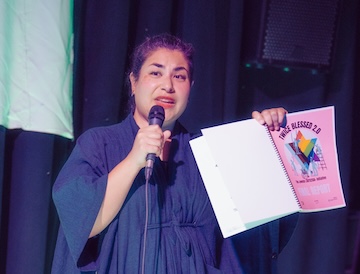
photo - JQT Vancouver executive director Carmel Tanaka talks about Twice Blessed 2.0 at a recent event. The 2022 needs assessment includes 13 calls for action, including mental health support and being open to those who have a spectrum of opinion on Israel/Palestine
JQT Vancouver executive director Carmel Tanaka talks about Twice Blessed 2.0 at a recent event. The 2022 needs assessment includes 13 calls for action, including mental health support and being open to those who have a spectrum of opinion on Israel/Palestine. (photo by Kathryn Nickford Photography)

“We kept hearing that one of the barriers to receiving mental health support was linked directly to the lack of provider knowledge, training and competence around working with Jewish queer and trans people,” Tanaka said. “So, we created this educational toolkit aimed at reducing the burden on JQTs of having to educate their mental health providers on their lived experiences and mental health needs.”

Along with the Temperature Check report, Tanaka said, the toolkit provides tangible evidence of both the challenges and steps to improving the isolation and difficulties faced by affected individuals.

“I just really hope that leaders in the Jewish community, as well as leaders in the queer community, do take a moment to seriously read this so that they can better understand why we are doing this and why there is a need to support our community,” Tanaka said, adding that JQT continues to remain open to those who are on a spectrum of opinion on Israel and Palestine. “It really hurts to not be included in Pride events or in queer spaces, to not feel included in Jewish spaces. It’s an impossible situation to feel like you don’t belong.”

Even amid a plethora of discouraging responses, Rathbone said there is reason for hope.

“I don’t want folks to read it and to become really depressed and hopeless, because there are lots of ways to find hope,” she said. “There are lots of people in the community coming together right now and finding connections to heal what they can in what is a very broken world and what is a very broken situation. That also gives me hope, to watch people recognize that they can come together in community and do their part to heal something.” 

Format ImagePosted on July 26, 2024July 25, 2024Author Pat JohnsonCategories LocalTags antisemitism, Jewish Family Services, Jewish Queer Trans Vancouver, JFS, JQT Vancouver, mental health, Oct. 7, Pride, Zionism
Enjoy Bach with a twist

Enjoy Bach with a twist

Alon Sariel is Early Music Vancouver’s artist in residence for this summer’s festival. (photo by Suzette Vorster-Van Acker)

‘We are thrilled to offer audiences an adventurous program of some of Bach’s seminal works, but with a twist,” said Early Music Vancouver artistic and executive director Suzie LeBlanc in a press release announcing this summer’s early music festival. “From traditional compositions reworked for unique instruments, such as mandolin and oud, to the introduction of vocal improvisation, inspired by Bach’s own customary practice of instrumental extemporization, Bach Untamed welcomes listeners to seek out new perspectives of Bach’s well-known and beloved classics.”

This year’s festival – which runs July 30-Aug. 8 at various venues – features almost 50 emerging and established early music artists from around the world, including mandolinist and multi-instrumentalist Alon Sariel, who is EMV’s 2024 Summer Festival Artist in Residence. 

In addition to headlining two concerts – Alon Sariel: Plucked Bach at Congregation Beth Israel on July 31, in which he will premiere his own Bach-inspired Mandolin Partita, and EMV’s festival finale at the Vancouver Playhouse, which features the Canadian premiere of Amit Weiner’s 2019 reconstruction of Bach’s Italian Concerto – Sariel will perform in several other festival concerts, as well as teach a workshop on Bach for plucked instruments.

Sariel, who was born and raised in Beersheba, Israel, met LeBlanc at the Utrecht Early Music Festival, in the Netherlands, last fall. 

“I was playing there with friends from Profeti della Quinta, an Israeli vocal ensemble based in Switzerland, who was already a guest of EMV in the past,” Sariel told the Independent. “Suzie and I had a chat and it turned out I had some very different programs to offer and that a residency could be a lovely idea to feature a few of those.”

Sariel’s first visit to Vancouver was more than 30 years ago, as a kid, with his family. He’s excited to return. He arrived July 24 and will be staying until Aug. 9 – “the final concert, Bach & the Mandolin, with the Pacific Baroque Orchestra, is on Aug. 8,” he said.

“The program looks really splendid (a huge shout out to Suzie!) and I’m very glad and proud to wear the artist-in-residence hat this summer – can’t wait really!” said Sariel.

LeBlanc started the artist-in-residence program in 2021 “to create more exchanges between EMV’s guests and the local community.”

“EMV has under its wing a local baroque orchestra – the Pacific Baroque Orchestra, led by Alexander Weimann – and a Baroque Mentorship Orchestra Program (BOMP) at UBC for students and community players,” she explained. “In addition to his own concerts in the summer festival, Alon will collaborate with these ensembles, working with professionals, students and community players, going beyond concert performances and delivering a collaborative and educational experience. 

“He will also lead a three-day course called ‘Unconventional Bach,’ which focuses on playing and arranging Bach’s works for different instruments,” she said, noting, “Alon is also a composer and his guiding principle is ‘giving new life to existing material, as well as creating completely new works.’ We’re excited to have an artist in residence who shares this philosophy with EMV and will be so present beyond the concert stage.”

LeBlanc described Sariel’s Bach solos on mandolin as “captivating and very personal.”

“He fully deserves his notoriety as one of the most versatile and gifted mandolin players, lutenists and ensemble directors of today,” she said.

A soloist, chamber player and artistic director, Sariel has performed more than 1,000 concerts in more than 35 countries, according to his bio. In his Plucked Bach recordings (Pentatone), he interprets Bach’s solo music and creates new arrangements for mandolin and lute, the baroque guitar and the oud. His album Telemandolin (Berlin Classics) was awarded an OPUS KLASSIK, making Sariel the first mandolinist to earn the honour. But the path to professional success hasn’t been easy and, said Sariel, “there are still many obstacles in the way of a mandolin player.”

“For any violinist, pianist, conductor, etc., there are many competitions which could serve as a jump step to a musical career – the mandolin has none,” he explained. “I attended several competitions which were open to all instruments and won them all and, even then, I kept getting lines like, ‘Thank you very much for getting in touch, we’ll contact you shall we be interested in the future.’ Booking agencies, record labels and concert halls can still be very suspicious when it comes to the mandolin, that’s why I feel a great responsibility in every concert that I play. It’s not only about me getting re-invited, but it’s about convincing this or that director and, of course, the audience, to give a chance to something new. The theatres could always go for another Rachmaninoff piano concerto or another Beethoven symphony, they don’t have to ‘take a risk’ with a mandolin player, that’s why I really have to stand out in my artistic profile in order to get the chance.”

LeBlanc first heard about Sariel from Renaud Loranger, the artistic director of the Festival de Lanaudière in Québec. When she met Sariel at the Utrecht Early Music Festival, she said, “Our meeting was very pleasant – his playing was fabulous – and I immediately saw that he would be a great and versatile artist in residence. Also, I knew that Vancouverites love the mandolin player Avi Avital, who has played many times in Vancouver. What perhaps they don’t know is that Alon has collaborated with Avi on a recording of Vivaldi’s concerto for two mandolins (Deutsche Grammophon, 2020). I hope all mandolin lovers will come out to hear Alon – he has brought to light many works for the mandolin from centuries past and commissioned composers to write new pieces for him.”

And to think that Sariel wanted to play the electric guitar when he was a kid.

“I wished to learn e-guitar, but I was much too young for that,” he recalled. “The director of the conservatory gave me a little basic test – I had to clap some rhythms and sing some tones, etc. She suggested I should take the violin, but I wasn’t excited. Then she said there’s also the mandolin – which I didn’t know at all – and that it’s in fact ‘very similar’ to the guitar, you hold it pretty much the same way, but the size would be perfect for an 8-year-old. She mentioned the mandolin orchestra and the fact it gets to represent the city occasionally, even abroad, so I agreed to give it a try and thought I’d shift to e-guitar later on. Very soon I forgot about the guitar and was all invested in the mandolin, I absolutely loved it!”

LeBlanc chooses EMV’s artists in residence “first and foremost for their great artistry, for their extensive knowledge of historical performance practice, and their ability to share their ideas and knowledge generously,” she said. Previous artists in residence have been Cree-Métis baritone Jonathon Adams (2021); Scottish Baroque specialists David Greenberg and David McGuiness, violin and keyboard (2022); and Catalina Vicens, keyboard and curator of the Tagliavini Collection of ancient musical instruments in Bologna, Italy (2023). 

“It has been extremely rewarding to watch the program grow over the past few years, and hear the enthusiastic audience feedback to our different artists in residence,” she said.

For more information about and tickets to this summer’s festival, visit earlymusic.bc.ca. 

Format ImagePosted on July 26, 2024July 25, 2024Author Cynthia RamsayCategories MusicTags Alon Sariel, Bach, Early Music Vancouver, festivals, mandolin, Suzie LeBlanc

World political theatre

Israel’s Prime Minister Binyamin Netanyahu visited Washington this week, coincidentally in the aftermath of US President Joe Biden’s decision to not seek reelection. There is certainly no shortage of topics on their minds – and there are doubtlessly some unspoken subtexts. Given that one man is now officially in the final months of office and the other seems likewise approaching an end, the significance to each man’s country of a tête-à-tête is inevitably minimized. 

This was hardly the only theatre happening in recent days. The Bibi-Biden meeting took place days after the International Court of Justice declared that Israel has perpetrated a “de facto annexation” and is preventing Palestinians from exercising their right to self-determination.

The decision by the World Court, as it is known, is “advisory,” rather than “binding,” which is effectively neither here nor there, since Israel will probably do whatever it chooses anyway. And so it should.

This is not to say the court’s decision is meaningless. But its impacts are not at all what the court or those trumpeting this decision think they are.

To be clear: the court is not wrong. Palestinians are experiencing human rights violations in the West Bank and East Jerusalem. They are being prevented from fulfilling their right to self-determination – for reasons well beyond Israel’s control, though Jewish settlements and other Israeli government decisions make a prospective Palestinian state more difficult to realize.

Two things, though, can be true at the same time. Palestinians are experiencing these violations. But, Israel will, and should, ignore the court’s ruling. The ICJ opinion was a political, rather than a judicial, expression, the culmination of a concerted campaign by some of the most despotic regimes in the world. Israel did not participate in the hearing, choosing not to legitimize the process. The decision deserves to be dismissed.

Likewise, the world should largely ignore a related provocation by Israel’s parliament.

The Knesset last week, for the first time, effectively voted against a two-state solution. The vote, which called the idea of a Palestinian state an “existential danger” to Israel, was every bit as much a political act as the ICJ decision. In fact, they are basically two sides of the same coin. The Knesset vote was a slap (along right-left party lines) against those who would presuppose an independent Palestine in the absence of what would be inevitably long and complex negotiations. 

The entire situation is a tragedy. The tragedy of the ICJ decision is, first and foremost, for the United Nations broadly, the World Court specifically and the millions, if not billions, of people worldwide whose legitimate need for human rights and a global voice for justice is diminished by the politicization of the ICJ. It is another nail in the coffin of the United Nations’ legitimacy.

Nawaf Salam, the chief judge who released the decision, is a two-time candidate for prime minister of Lebanon, having run with the imprimatur of the anti-Zionist and antisemitic terror group Hezbollah. His presence in this role is a mere illustration of a toxicity that has permeated some branches of the UN, not least the evidence that employees and leaders of UNWRA, the UN branch responsible for Palestinian refugees, were involved in the atrocities of Oct. 7. All of this is inevitable when a global parliament operating on democratic principles is made up primarily of autocratic member-states.

We must step back, though, and make a defence of the world body. Danny Danon, Israel’s former UN ambassador, who has undeniable Likud bona fides, is both a critic of the UN’s failures and a staunch defender of the necessity of its existence. He knows better than almost any other pro-Israel voice of the good work the UN does on too many fronts to abandon it. The idea of the UN is too important to terminate just because it is, in practice, falling woefully short.

Perhaps the best way to think of all these developments is as theatre. Like Netanyahu’s trip to Washington, the Knesset vote against a Palestinian state, the ICJ decision and all the hoopla around these events are just performances and, as Shakespeare said, all the people merely players. Only when all parties commit to laying the foundations for whatever form peace and coexistence might take, rather than simply making dramatic pronouncements, can substantive, positive change become reality. 

Posted on July 26, 2024July 25, 2024Author The Editorial BoardCategories From the JITags Binyamin Netanyahu, geopolitics, Joe Biden, politics, United Nations, World Court

We must keep asking “why?”

Our short Canadian summer is full of wonder. We try to spend lots of time outdoors, finding things to marvel at on dog walks and even on errands. While we might not be out in the bush too often, we still can spot foxes, deer, woodpeckers, butterflies and moths, as well as magnificent gardens, in our neighbourhood in Winnipeg’s city core. As toddlers and preschoolers, children go through a “why?” phase. Everything is a question. Parents must come up with meaningful but short answers every time. However, as our tweens transition to teens, I have been pleasantly surprised to discover there are still a lot of “whys” being asked.

On a practical level, sometimes I end up saying “that’s a Google question” because I cannot remember every detail of European history. If our resident biology professor dad isn’t home, we’re trying to figure out flora and fauna on our own. (Hint: there’s an app for everything now.) Most of all, I am thrilled that intellectual curiosity is still a thing. Our household still finds space to wonder about how things work, what things are called and why events evolved in one way or another. 

Just the other evening, I admonished our kid about being gracious about gifts. He didn’t know what I meant. We stopped to discuss the phrase “Don’t look a gift horse in the mouth” and take apart what it means. This kind of daily learning is an exciting part of life, and especially in summer, when we have hours at a stretch to talk and think about things, as well as seeing natural wonders, going to museums, meeting new people, reading and listening together. Pursuing this kind of informal learning makes a well-rounded education.

I continue to study Daf Yomi, a page of Talmud a day, and right now we’re studying the tractate of Bava Batra, one of the three Bavas (translated as “gates”) that deal in civil law. I find nuggets of wisdom in these tractates, even as some of them seem dry to other students. If you’re wondering, for instance, who pays for a fence, or making the decisions about erecting a fence across a shared courtyard? The beginning of Bava Batra will help you figure out whether this is possible, and how to get along with your neighbour in the process. Each issue is examined with a “why?” lens.

How does one decide where you’re from? If you’ve lived in many places (I have), this is a real question. Do you define home as where you were born? Where you lived the most years? Which kitchen or garden you liked best? This is examined on Bava Batra 11, which suggests that, if you’ve lived in a city for 12 months, you can be considered a resident. However, if you buy a house earlier than that, or even, according to Rabban Shimon ben Gamliel, land that would be suitable for building a house, you’re immediately considered a resident. This bit of ancient law discussion struck me as useful in an age where so many decisions are made based on where one lives: where one votes, gets health care, sends kids to school and other bureaucratic needs. Establishing residency is still often up for discussion.

There is an advantage to maintaining intellectual curiosity and nurturing critical thinking when it comes to negotiating the world. As recently as a year or two ago, I would have been upset to think that one should be getting news from social media or email newsletters. Now, however, I find access to multiple reports about the Israel-Gaza war in English and Hebrew, through Instagram and X (formerly Twitter). I then end up satiating my curiosity by clicking through to read from multiple other news sources, finding out about elections in Europe, antisemitism worldwide, or even locating (and avoiding) possibly violent protests in my own city. Asking “why? why? why?” becomes a daily necessity in trying to decipher both what’s happening and the political angle of those who write the articles, blogs or tweets.

A recent piece covering humanitarian aid distribution in Gaza on the CBC, for instance, used the word “Hamas” only once, when mentioning “Hamas-led militants” on Oct. 7. The word “Israel” could be found on the page 18 times. While 18 is a lucky number, in this case, it sounds like an uncritical reader could lay blame on one side simply through repetition. One might completely lose sight of why Gazans are in this mess in the first place. If, perhaps, Hamas chose to stop firing rockets into Israel? It might be easier to distribute supplies and return to normality. Also, the journalist mentioned Egypt only twice. Egypt also shares a border with Gaza. Egypt could choose to facilitate humanitarian aid. Whose responsibility is this? The article’s slant, and the journalist’s bio, made me suspect a bias. When examining the journalist’s X posts online, I saw only one side of this conflict emphasized. It didn’t reference anything about Oct. 7 or Israel’s experience.

It can be hard right now to maintain an even keel while facing the barrage of information about the Gaza war, Russia’s war on Ukraine, politics in Canada, the United States and Europe, and the famines and violent conflicts elsewhere in the world. Unplugging and getting out to see and do things with family, taking a vacation, exploring wild places, helps us recalibrate. It can also boost our “why?” skills so we can return refreshed, with energy to analyze all the new craziness as it erupts.

I’ve just begun Bava Batra, but one topic hit early on is where and how to donate charity to do the most good. Bava Batra 8b reminds us that money donated towards “saving captives” is a great mitzvah, the biggest commandment/good deed that one can do. Sometimes, an ancient text can remind us to readjust our priorities. Reading critically and asking “why?” are essential to Talmud and rabbinic discourse. It’s also essential for us. We must keep helping our children ask “why?” We ourselves must maintain the wonder that enables us to stay curiously critical thinkers. 

Joanne Seiff has written regularly for the Winnipeg Free Press and various Jewish publications. She is the author of three books, including From the Outside In: Jewish Post Columns 2015-2016, a collection of essays available for digital download or as a paperback from Amazon. Check her out on Instagram @yrnspinner or at joanneseiff.blogspot.com.

Posted on July 26, 2024July 25, 2024Author Joanne SeiffCategories Op-EdTags bias, critical thinking, Israel-Hamas war, Judaism, lifestyle, Oct. 7, questioning, Talmud
Inclusion, but not for Jews

Inclusion, but not for Jews

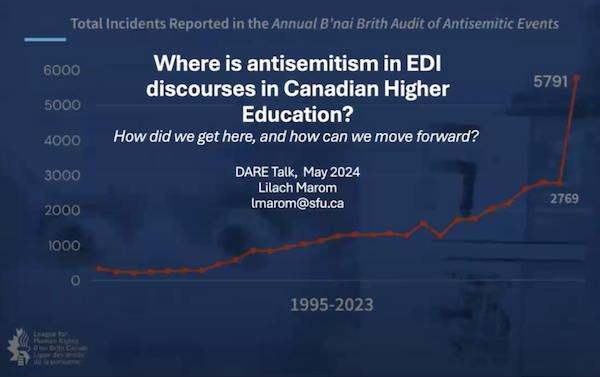
Simon Fraser University assistant professor Dr. Lilach Marom gave a lecture May 27 called Where is Antisemitism in EDI Discourses in Canadian Higher Education? How Did We Get Here, And How Can We Move Forward?

Prevailing trends in equity, diversity and inclusion on campuses and elsewhere often exclude Jewish people and discount antisemitism, according to a Simon Fraser University academic.

Despite extensive policies around racism, discrimination and related topics, many universities and academic organizations have no explicit references in policy to antisemitism, says Dr. Lilach Marom, an assistant professor at SFU, who focuses on anti-racism and inclusion in education with a focus on structural and institutional barriers to access.

“When we look at references to antisemitism and Jewish identity across EDI policies and action plans, we see that there is not much reference,” she said during a lecture May 27 that was part of Diverse Approaches to Research in Education, a seminar series co-hosted by Faculty of Education’s Research Hub and the Research Advisory Working Group. For example, resources from the Canadian Association of University Teachers include a self-identification survey, but under the category of race and ethnicity, there is no option to select “Jewish.”

In addition to Jewish identity, the experiences of Jewish people with antisemitism are often not specifically addressed. “Sometimes, it is not named when there are other forms of oppression and racism that are named,” she said.

EDI stands for equity, diversity and inclusion (in the United States, Marom noted, it is reordered as DEI). Equity, she said, is the removal of systemic barriers and enabling all individuals to have equitable opportunity and access to benefit from higher education. Diversity is about the variety of unique dimensions, identities, qualities and characteristics individuals possess along with other identity factors. Inclusion is defined as the practice of ensuring that all individuals are valued and respected for their contributions and are supported equitably.

EDI has become the prevalent framework to address issues of social justice and equity in Canadian higher education, said Marom. Fully 90% of higher educational institutions in Canada reference EDI in their strategic planning and 91% have an EDI task force or are developing one, according to a Universities Canada survey of members in 2022.

photo - Dr. Lilach Marom
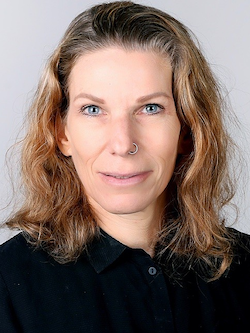
Dr. Lilach Marom  (photo courtesy)

Marom sees a number of reasons why antisemitism is excluded. Antisemitism is often categorized as religious-based discrimination, which reclassifies it outside the realm of anti-racism. 

“Jewish people see themselves as a people, which means they have shared culture, language, history, religious texts and rituals,” said Marom. “But, within the North American context, Jewishness is conceptualized as a form of religion.”

This is specifically the case in Canadian law, where antisemitism is categorized under religious discrimination and reported under hate crimes motivated by religion.

This creates a disconnect when it comes to EDI, said Marom. “In most cases, EDI typically does not centre on religious-based discrimination,” she said. “So those things are on the margins, they’re not core to the EDI discourses.”

Settler-colonialism and decolonization are core concepts in EDI discourse, which presents challenges around the way Israel and Palestine are considered.

“I’m worried about the new antisemitism that emerges at the intersection of anti-racism and settler-colonial discourses,” she said. “Both those discourses are insufficient and incomplete to understand Jewishness, the Jewish condition or the situation in Israel-Palestine.… They create this forced binary between Jewish people as the embodiment of white privilege and colonial oppression, and Palestinians as racialized and indigenous. I think this binary is not only inaccurate, it also feeds into new forms of antisemitism.”

Settler-colonialism is a leading framework for analyzing Canadian history, said Marom. Applying that framework to Zionism and the formation of Israel in a simplistic way overlooks the long and complex history of that land and creates a false dichotomy between Jewish people as the embodiment of oppression and Palestinians as indigenous, she said.

These constructions fail to acknowledge the historical, cultural and religious ties of Jews to the land dating back millennia. They also don’t acknowledge that there could be places in which there are coexisting claims to indigeneity in Israel-Palestine.

Meanwhile, the construction of Jews as white and privileged, she said, reflects a “legal and cultural whitening of Jews in North America.”

“This is not to ignore the fact that Jews definitely have gained some privileges from their ability to assimilate and integrate in this mainstream North American culture and those possibilities were not open to members of other racialized groups,” she said. “Jews have definitely gained some privileges from this ability. However, this also feeds into some antisemitic tropes or stereotypes – Jews as a ‘model minority’ or ‘super powerful’ – and have put them in a position that is not really in and not really out. These in-between spaces [mean] they can be targeted on one hand by conspiracies from the right like the Great Replacement Theory, but also pushed against from the left as an embodiment of white privilege.”

The construction of Jews as white overlooks the self-identification of Jewish people, she said, and it doesn’t recognize the diversity of Jewish people. While in North America many Jewish people are Ashkenazi, in places like Israel, the majority of people are from Asian, Middle Eastern and North African backgrounds.

“In critical discourses, we don’t talk about race as skin pigmentation nor as biological constructs,” Marom said. “We talk about it as a form of social construct. If you think about race as a social construct, looking at the history of Jewish people with marginalization, exclusion and genocide, they cannot be put aside from anti-racism discourses and be absorbed into whiteness.”

It is not useful, she said, to participate in “any form of oppression Olympics. But I think we need to acknowledge that antisemitism is not following the typical path of other racialized groups, where hopefully there is less exclusion and more integration with time,” she said. “With Jewish people, many times when they thought they were most integrated and most included, this is when they faced the most extreme forms of exclusion and marginalization.”

Marom clarified that discussion about antisemitism and the protection and safety of Jewish people should not be confused with “protection” from challenging ideas.

“We need to be willing to step into risky discussions,” she said. “But I think what EDI does is really talk about impact. It talks about how can we be engaging in those difficult spaces while still feeling that we are being seen as human, that we are included, that we have space. I speak only on my behalf [but] I think this is the case with many Jewish faculty that I know. I don’t think that this is the way many of us [have felt] since Oct. 7.”

There is a balance to be found between academic freedom and protection of minority communities, said Marom – but the approach to this balance when it comes to Jews and antisemitism seems different than in other cases.

“I just find it very peculiar that a lot of my colleagues who usually are very sensitive toward issues of inclusion and belonging all of a sudden become the strongest supporters of academic freedom when it comes to the issues of antisemitism,” said Marom. “Not that academic freedom is not important – it is really important – I’m just curious to hear how come it becomes so important now when the people in question are Jewish people.”

She also cited a seminar on antisemitism and anti-Zionism that was sponsored by about 40 organizations, most of them Muslim and Middle Eastern academic groups.

“This we would never see on other issues, in which people from the outside explained to people on the inside what they need to know about themselves,” she said. There were some Jewish speakers at the event, she noted, but they came from a very specific ideological perspective.

“I’m not saying that they are not legitimate,” she said. “I’m not even saying that they’re not important and I don’t think that we need to define who is in and who is out to speak on behalf of the Jewish people – there is enough space in the world to speak. But I am worried for the tendencies in progressive circles to adopt those voices and put them in and check the inclusion box, because that is not how we do inclusion in any other circles.”

The principle of “nothing about us without us,” the idea that no approach toward a group should be adopted without the full and direct participation of the affected people, should not be overlooked when it comes to antisemitism, she said.

A video of Marom’s full presentation is available at youtu.be/FQbGiySUetM. 

Format ImagePosted on July 26, 2024July 25, 2024Author Pat JohnsonCategories LocalTags antisemitism, DEI, diversity, EDI, equity, inclusion, Lilach Marom, SFU, Simon Fraser University

Upstanders toolkit launched

Upstanders Canada held a nationwide webinar last month to introduce a toolkit aimed at confronting antisemitism in the various forms it may manifest – particularly in the inherent biases people may not be aware they carry.

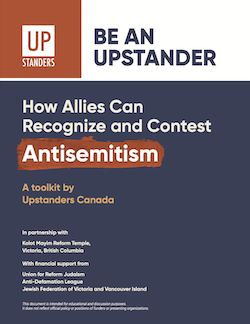
At the June 23 launch, Pat Johnson, the founder of Upstanders Canada, discussed the toolkit, called Be An Upstander: How Allies Can Recognize and Contest Antisemitism. Among those attending the online event were representatives of several faith-based organizations. Most attendees were not part of the Jewish community.

Johnson outlined how antisemitism works and the characteristics contained within antisemitism, such as “othering” (casting a group of people as different from the rest of society), victim-blaming, and inverting the victim and the perpetrator. 

The toolkit demonstrates how these characteristics of antisemitism can lead to projection – where a society places the blame for things it fears, hates or does not understand onto Jews. This can lead to conspiracy theories in which complex world problems are simplified into a clearcut package that frequently places the blame on Jews.

Antisemitism is a foundation of many conspiracy theories in that the theories usually rest on the belief that a powerful group of Jews controls events. The theories do not need to specify Jews as the people behind what is considered wrong, but rather can use references to “Hollywood,” “cosmopolitan elites” or “globalists,” which equally fulfil the purpose of implying that Jews are doing nefarious, self-serving deeds behind the scenes.

Feelings of envy and inferiority, the toolkit points out, may distinguish antisemitism from other forms of racism. Whereas many types of prejudice come from a sense of superiority, antisemitism is derived in part from the belief that Jews “think they are better than everyone else.” This, in turn, leads to “punching up,” or, as Johnson says, “the idea that attacking a perceived ‘superior’ is a way to advance social justice, though the person being punched is always a victim.”

Johnson offered a picture of what antisemitism may look like when it is not obvious.

“Blatant antisemitism is easy to recognize,” he said. “It is also the form of antisemitism most likely to turn violent and is, therefore, the most dangerous. But all people of goodwill recognize and condemn that form of antisemitism. More subtle, unconscious forms of antisemitism exist in inherent biases, stereotypes and tropes that people may carry without even recognizing them.”

The stereotype of affluent, high-ranking or privileged Jews, for example, brings with it a specific danger, one that may not be violent but is nonetheless harmful. Antisemitism, Johnson explained, becomes the “perfect prejudice” because the concept of powerful Jews renders the notion of taking antisemitism seriously invalid as their supposed power makes them immune to discrimination.

The toolkit touches upon some historical tropes about Jews, such as an alleged “persecution complex” and Jewish “untrustworthiness and disloyalty” in business settings, citizenship and elsewhere. It also discusses blood libels, the Holocaust and blaming the killing of Jesus on Jews.

Regarding equating anti-Zionism with antisemitism, Johnson notes that Zionism is the manifestation of Jewish self-determination in a state and that “anti-Zionism is not criticism of Israel, it is opposition to the existence of the state of Israel.” He discounts the idea that pre-existing biases against Jews have no impact on opinions about the Jewish state and admonishes those who accuse Israel of using historical discrimination for political advantage. The toolkit references the three Ds developed by Israeli politician and human rights activist Natan Sharansky to determine if anti-Zionism is antisemitism: demonization, double standards and delegitimization.

image - Be An Upstander coverThe toolkit adds, “Zionism does not preclude Palestinian self-determination. Coexistence is the only path to peace and it is the responsibility primarily of the people who live there. The responsibility of overseas observers should be to encourage that coexistence – not to exacerbate the conflict by stoking intolerance, here or abroad.”

One of the problems well-intentioned individuals have when contesting antisemitism is not feeling adequately prepared to respond. For this, the toolkit not only provides many strategies for preparing, but offers encouragement and empowerment. 

Be An Upstander, a 20-page pdf document available online, comes with numerous links that allow readers to explore in greater depth subjects surrounding antisemitism and ways of responding appropriately to it. 

In addition to Johnson speaking about the toolkit, the launch event featured short speeches from Deborah Lyons, Canada’s special envoy on antisemitism; Zara Nybo, a campus media fellow for HonestReporting Canada and Allied Voices for Israel at the University of British Columbia; and Rabbi Lynn Greenhough of Kolot Mayim Reform Temple in Victoria, which hosted the event. Television personality Shai DeLuca emceed from Toronto.

The Upstanders toolkit was created in partnership with Kolot Mayim, with financial support from the Union for Reform Judaism, the Anti-Defamation League and the Jewish Federation of Victoria and Vancouver Island.

Upstanders is a movement of mainly non-Jewish people standing up against antisemitism. It is a nonpartisan, non-denominational organization, open to Canadians across all differences of identity, orientation, outlook and ability. To find out more and to view the toolkit, visit upstanderscanada.com. 

Sam Margolis has written for the Globe and Mail, the National Post, UPI and MSNBC.

Posted on July 26, 2024July 25, 2024Author Sam MargolisCategories LocalTags antisemitism, education, Kolot Mayim, Upstanders Canada
JACS and JFS integrate

JACS and JFS integrate

Jewish Addiction Community Services (JACS) and Jewish Family Services (JFS) have accepted bylaw changes allowing for service integration, in order to expand addiction support and services within the Jewish community.

“JACS and JFS have a long history of collaboration in serving our community, and it just made good sense to form an even tighter relationship that leverages the relative strengths of each organization,” said Howard Harowitz, JACS board chair. “This move is driven by a shared commitment to improving service delivery, integrating substance use services with other supports, and utilizing the established expertise of both agencies.”

The strategic rationale behind this integration is clear: combining resources will enhance service effectiveness and accessibility, ultimately creating a more significant impact. This aligns with JFS’s long-term vision of becoming a leader in social services.

“This integration aligns with our strategic vision to enhance our service portfolio and provide more holistic support that meets the needs of our clients,” said Tanja Demajo, JFS chief executive officer. “We are excited to embark on this new chapter of community service together!”

This integration will provide the community:

• Increased accessibility to addiction services for clients and their families.

• Enhanced capacity to serve a greater number of individuals in need.

• A holistic approach to addressing clients’ diverse needs.

• Greater community awareness of where and how to access addiction services. 

For more on the resources and services JFS provides, visit jfsvancouver.ca. 

– Courtesy Jewish Family Services Vancouver

Format ImagePosted on July 26, 2024July 25, 2024Author Jewish Family Services VancouverCategories LocalTags addiction, Howard Harowitz, JACS, JFS, social services, Tanja Demajo
RJDS and JFS grow together

RJDS and JFS grow together

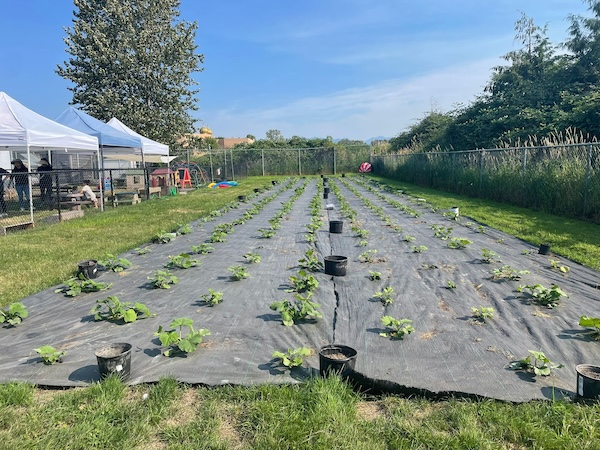
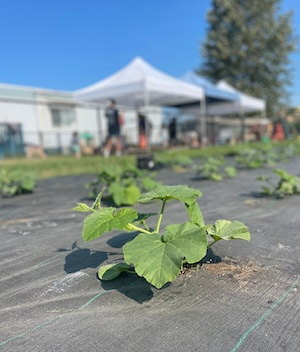
The JFS Moishe Farm Project garden at Richmond Jewish Day School. (photo from RJDS)

Richmond Jewish Day School and Jewish Family Services have embarked on a new initiative, the JFS Moishe Farm Project. At the back of the school, there is now a garden, growing a variety of fruits and vegetables, such as squash, butternut squash and zucchini. The project aims to increase food security in the Lower Mainland by providing fresh produce to RJDS families and JFS clients. 

Food security is an essential aspect of this initiative. It means that all people, at all times, have access to nutritious, safe and sufficient food that meets their dietary needs and preferences for an active and healthy life. With prices of fresh food and produce increasing, food security has become an increasingly difficult goal to achieve. Ensuring access to fresh and healthy produce is a fundamental part of this project. 

photo - The JFS Moishe Farm Project garden
The JFS Moishe Farm Project garden. (photo from RJDS)

Teaching students about proper nutrition and its effects on learning, brain function and mental health is essential. Proper nutrition is not just about having enough food, it’s about having the right kind of food that fuels bodies and minds. A balanced diet rich in fruits and vegetables can significantly enhance cognitive function and overall well-being. By engaging in this gardening project, RJDS is not only providing fresh produce but also educating students about the importance of nutrition, sustainability and community involvement.

Larry and Marcy Vinegar and Glenn Laufer donated the ground cover and irrigation system for the garden, Daniel Garfinkel donated the seeds and plants. Volunteers have planted, harvested and coordinated this project and helped the school use its land to produce and give back to community in sustainable and helpful ways. Through this objective, RJDS students and community can see firsthand the fruits of their labour and understand the value of hard work, patience and teamwork.

RJDS is planning various activities and workshops around the garden. Students will participate in planting, tending and harvesting. They will learn about different fruits and vegetables, their nutritional benefits, and how to prepare the produce in healthy and delicious ways. These activities will be complemented by lessons on the environmental impact of food production and the importance of sustainable farming practices.

The long-term vision for this project includes expanding the garden and increasing the variety of produce. RJDS hopes to eventually supply a significant portion of its community’s fresh produce needs and possibly even create a surplus that could be shared with other organizations.

This project is more than just a garden. It is a symbol of RJDS’s and JFS’s commitment to the community’s health, well-being and future. By working together, a sustainable, healthy and connected community can be created. 

– Courtesy Richmond Jewish Day School

Format ImagePosted on July 26, 2024July 25, 2024Author Richmond Jewish Day SchoolCategories LocalTags education, environment, food security, Jewish Family Services, JFS, Richmond Jewish Day School, RJDS
Music for better world

Music for better world

Novelist Milan Kundera said of Jews in the 20th century that they “were the principal cosmopolitan, integrating element in Central Europe: they were its intellectual cement, a condensed version of its spirit, creators of its spiritual unity. That’s why I love Jews and cling to their heritage with as much passion and nostalgia as though it were my own.”

I love reading these words, it helps me keep my head up. And motivated. I think of them often as I work on two major concerts which celebrate multiple aspects of Jewish heritage and history, the devastating impacts of hate, and the need for more love and compassion in the world today. 

You may remember my last endeavour, Project Tehillim, which was about the salvation of the Bulgarian Jews during the Second World War. (See jewishindependent.ca/music-to-say-thank-you.) I grew up in Bulgaria and, while I never experienced the antisemitism, I knew about it from history books. This is why I am shocked and horrified at what is going on around the world, including here in Vancouver. One of my friends said: “The evil is shocking. The willingness of this evil to parade itself is even more shocking.” 

I can only respond with what I know best: the power of music and art. The arts have the incredible ability to affect people more profoundly than plain facts. It is personal stories, artistically presented, that have an emotional impact.

I am the artistic director, with fellow pianist Jane Hayes, of Yarilo Contemporary Music Society, which is dedicated to high-quality professional music performances. The Yarilo ensemble has performed in Zurich, Moscow, Sofia and Tel Aviv, and the society has commissioned a number of Canadian composers: Jocelyn Morlock, Kelly-Marie Murphy, Jordan Nobles, John Burke, Colin MacDonald, Michael Conway Baker and Farangis Nurulla-Khoja. We work with members of the Vancouver Symphony Orchestra and we collaborate with Leslie Dala, the conductor of the Vancouver Opera and the Bach Choir.

Because government and other funding for the arts is in huge decline, I am turning to you, my fellow Jewish community members, for help in realizing Yarilo’s next project: Compassion Above All.

The first concert of the project, To Hope and Back, is a chamber music event that will take place this year on Nov. 10, 2 p.m. and 7:30 p.m., at Orpheum Annex. The budget is $10,000.

To Hope and Back is based on the book of the same name by Kathy Kacer, the daughter of a Holocaust survivor. The book tells the story of the SS St. Louis through the eyes of two children on board the ship that sailed from Germany in 1939 carrying nearly 1,000 Jewish refugees and was refused the right to land by every country, including Canada, forcing it to return to Europe, where many of the passengers were murdered in the Holocaust. The November concert will include two child actors reading excerpts from the book and Kacer has confirmed that she would like to come for the event from Toronto. It will include the music of Philip Glass, Steve Reich, Iman Habibi and Gheorghi Arnaoudov. Steve Reich’s work, “Different Trains,” includes archival recordings from the trains going to Auschwitz.

The second concert, The Tale of Esther in Our Time, is a symphony music concert conducted by Dala, and it will take place in 2025, on March 29, 7:30 p.m., at Christ Church Cathedral. Its budget is between $60,000 and $80,000.

The featured work of The Tale of Esther in Our Time is Iman Habibi’s “Shāhīn-nāmeh,” which was nominated for a Juno and won the Azrieli Foundation award for Jewish music in 2022. Based on the poetry of 14th-century Judeo-Persian poet Shahin Shirazi, the composition depicts the tale of Esther and delves into the themes of love, spiritual struggle and devotion. “Shāhīn-nāmeh” calls out for love and compassion; it brings the heart of humanity into focus.

Also on the program will be Arvo Part (“Tabula Raza”), Peteris Vasks (“The Message”) and Kelly-Marie Murphy (“En El Escuro Es Todo Uno,” “In the Darkness We Are One”).

Please feel free to ask any questions. I will also happily take any advice for funding opportunities. Any donation, even the smallest one, is a great support, financial and moral.

For more information about Yarilo, visit yarilomusic.com. To donate, go to gofundme.com.

Format ImagePosted on July 26, 2024July 25, 2024Author Anna LevyCategories MusicTags concerts, fundraiser, Holocaust, Jewish history, Kathy Kacer, Leslie Dala, Yarilo Contemporary Music Society

Name inspires artist’s work

Growing up in Vancouver during the 1960s and ’70s, I was the dancer, my brother was the guitarist and my sister was the writer, soon to blossom into a visual artist as well.

Devorah Stone, my sister, is one of the contributors to this year’s Calling All Artists exhibit, which opens at Victoria’s Congregation Emanu-El on Aug. 26. Since the early 2000s, the mostly annual event has celebrated artists of many kinds – sculpture, ceramics, textile, poetry, mixed media, fabric, music – who offer their interpretation of a rabbinical or biblical text that they’ve studied with the synagogue’s spiritual leader, Rabbi Harry Brechner.

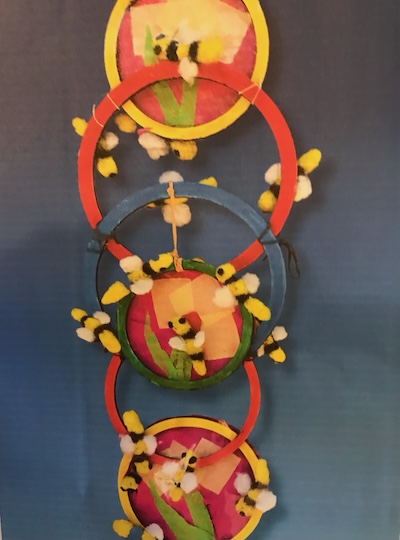
photo - Devorah Stone created a honeybee circle for this year’s Calling All Artists exhibit, which opens at Congregation Emanu-El Aug. 26
Devorah Stone created a honeybee circle for this year’s Calling All Artists exhibit, which opens at Congregation Emanu-El Aug. 26. (photo from Devorah Stone)

“This year’s theme is ‘animals’ and since my name means ‘Honeybee’ in Hebrew, I went with that,” Devorah told me. “The bees in my work are all hand-felted, a technique that involves pocking at wool and shaping the form. I decided to present the bees in circles because they are so crucial to the circle of life.”

The artists’ works are up for six months in the shul’s social hall. Devorah has been involved with the event for the last 10 years. Rabbi Brechner gives a lecture on the theme and how it pertains to Jewish traditions, sacred writings and thought once a month for five months before the celebration. This year, his teaching focused on the significant symbolic and ritual roles animals play in Jewish texts.

“I’ve learnt so much about both art and Judaism attending the rabbi’s lectures,” said Devorah. “Anyone can join … you don’t even need to be Jewish.” 

The Calling All Artists project is run by self-proclaimed “den mother” Barbara Pelman. She said there is a chapbook written every year with an explanation of each artist’s creative process and a copy of that is given out to guests.

“In last year’s Calling All Artists, I did the kohain gadol’s (high priest’s) breastplate with references to all the various colour and gem stones as described in the Torah,” said Devorah. “The only difference was the mannequin I used was a woman’s so I pretended that there might have been female priests at the time of the Temple!

“I’ve also done a collage of a person wearing a tallit and the burning bush, a three-dimensional piece of the Rosh Hashanah dinner, and another collage on a wooden cradle of the story of Abraham and Isaac.” 

Devorah has always been fascinated with art.

“As a child, there was nothing better than a box of crayons and endless paper,” she said. “I drew space ships, planets and alien worlds. I also drew castles and princesses. I loved it. My imagination had no limits.” 

In her 20s, Devorah spent four years at the University of Victoria, earning a bachelor of fine arts. All the while, she felt inspired by Emily Carr and Indigenous art.

“I loved the way Carr personified nature and her magnificent trees,” she shared. “I marveled at the complexities, elegance and craftsmanship of the First Peoples of the land.”

Our parents also brought us up with a strong Jewish identity.

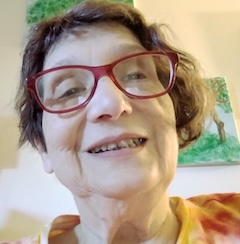
photo - Devorah Stone
Devorah Stone (photo courtesy)

“Being Jewish, I was taken by the imaginative work of Chagall, his goats and houses and how everything seemed to be floating or suspended,” said my sister. “Later on, I began to be influenced by the school of Bauhaus design, especially Kandinsky, his calculated and yet whimsical designs.” 

After Devorah moved to Victoria 20 years ago, she joined the Pandora Arts Collective Society. The group exhibits its works at the Little Fernwood Gallery twice a year and Devorah recently sold a painting there.

The collective is a community of people whose mandate is to facilitate and support mental health through the social and educational benefits of a free and welcoming creative arts space. The studio is open to everyone: professionals, students and beginners. The atmosphere is especially sensitive to people who are using art therapeutically. Devorah is on their board and has planned events for them in the past.

“We inspire and mentor each other,” she said. “I have learnt so much about art from that group. I’ve been introduced to many different kinds of art and artists, as well as being influenced by so many artists in our synagogue. The joke is that you can’t throw a rock without hitting an artist in Victoria!” 

When she was living in and around Vancouver, Devorah brought up three children, two of whom live in the Lower Mainland. She visits all of us frequently and spends a lot of time on the ferry.

“I love doing fast sketches of the scenery as it goes by,” she said. “I also do fast sketches at outdoor concerts and festivals, which Victoria has so many of.” 

Devorah uses pencil crayons, acrylic paint and watercolours, creates collages and sometimes three-dimensional art made out of whatever she can find.  

“I love experimenting and I feel that all my art is influenced by being Jewish,” she said. “It all has a profoundly Jewish way of seeing nature and of being.”

The best way to view Devorah’s art is through Instagram @devlovesart. 

Cassandra Freeman is a journalist and improviser who lives in East Vancouver.

Format ImagePosted on July 26, 2024July 25, 2024Author Cassandra FreemanCategories Visual ArtsTags art, Calling All Artists, collage, Devorah Stone, education, Emanu-El, Harry Brechner, identity, Judaism, multimedia, painting

Posts pagination

Page 1 Page 2 … Page 4 Next page
Proudly powered by WordPress