Skip to content
  • Home
  • Subscribe / donate
  • Events calendar
  • News
    • Local
    • National
    • Israel
    • World
    • עניין בחדשות
      A roundup of news in Canada and further afield, in Hebrew.
  • Opinion
    • From the JI
    • Op-Ed
  • Arts & Culture
    • Performing Arts
    • Music
    • Books
    • Visual Arts
    • TV & Film
  • Life
    • Celebrating the Holidays
    • Travel
    • The Daily Snooze
      Cartoons by Jacob Samuel
    • Mystery Photo
      Help the JI and JMABC fill in the gaps in our archives.
  • Community Links
    • Organizations, Etc.
    • Other News Sources & Blogs
    • Business Directory
  • FAQ
  • JI Chai Celebration
  • JI@88! video

Recent Posts

  • Supporting the Iranian people
  • The power of photography
  • A good place to start
  • When boundaries have shifted
  • Guitar virtuosos play
  • Different concepts of home
  • Broadway’s Jewish storylines
  • Sesame’s breadth and depth
  • Dylan Akira Adler part of JFL festival
  • Mortality learning series
  • A new strategy to brighten up BC
  • Sharing latkes and light
  • Johnson awarded for human rights work
  • Cherished tradition ensured … Silber Family Agam Menorah
  • Nothing as lovely as a tree
  • Camp welcomes new director
  • Popular family camp expands
  • A life-changing experience
  • Benefits of being a counselor
  • Camper to counselor
  • האלימות בישראל מורגשת בהרבה מגזרים
  • טראמפ עוזר דווקא לנושא הפלסטיני
  • New rabbi settles into post
  • A light for the nations
  • Killed for being Jewish 
  • The complexities of identity
  • Jews in time of trauma
  • What should governments do?
  • Annie will warm your heart
  • Best of the film fest online
  • Guitar Night at Massey
  • Partners in the telling of stories
  • Four Peretz pillars honoured
  • History as a foundation
  • Music can comfort us
  • New chapter for JFS

Archives

Follow @JewishIndie
image - The CJN - Visit Us Banner - 300x600 - 101625

Tag: equity

Advocating for girls’ rights

Advocating for girls’ rights

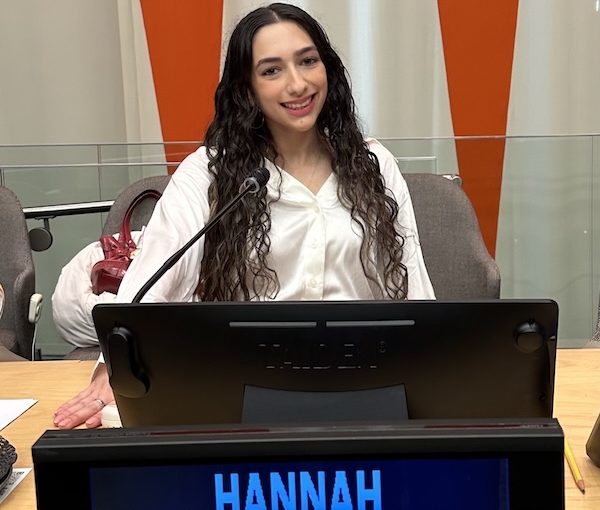
Hannah Presman Chikiar spoke and moderated at the United Nations headquarters in New York City, on Oct. 10, as part of Girls Speak Out 2025, held in celebration of the International Day of the Girl. (photo from Hannah Presman Chikiar)

At the start of this year, I was doing what any average 15-year-old would be doing: studying, playing sports, hanging out with friends, counting down the days until summer and, yes, waiting to turn 16 to get my driver’s licence! I never imagined I would be speaking and moderating at the United Nations headquarters in New York City, in front of hundreds of global leaders, delegates and young people. On Oct. 10, 2025, I had the honour of doing exactly that at Girls Speak Out 2025, held in celebration of the International Day of the Girl. 

I happened to be seated beside Annalena Baerbock, the president of the UN General Assembly. The room filled with hundreds of people, while many others joined online. Girls Speak Out 2025 was not only a celebration; it was a policy platform where commitments were made, with the expectation that they will be fulfilled. The event highlighted real stories and actionable solutions, emphasizing that girls’ rights must be recognized, supported and acted upon without delay. The energy in the room, the stories shared and the voices of girls from around the world showed everyone the power of youth advocacy and the importance of taking action rather than waiting for permission.

My connection to Judaism has always guided me, particularly the principle of tikkun olam (repairing the world), which inspires me to act for justice and equality wherever I can. It was this commitment to advocacy and making a positive impact that aligned with the mission of the Vancouver section of the National Council of Jewish Women of Canada (NCJWC), which nominated me for this amazing opportunity with the UN.

From June through October, I worked with nine other girls: they were from Liberia, Bolivia, Ghana, the United Kingdom and the United States. I woke up every Saturday at 4:30 a.m. Vancouver time to meet with them and plan, with the support of the Working Group on Girls, a fully girl-led UN event shaped around our theme: “We Are Here: Bold, Diverse and Unstoppable – Demanding Action for Girls’ Rights.” Together, we co-designed two panels: “Girls on the Frontline of Crisis: Protection, Peace & Power” and “From Margins to Power: Girls Defying Discrimination and Reclaiming Identity.” Collaborating with this diverse team of girls was inspiring and gave me the chance to learn from experiences vastly different from my own.

On the day of the event, I had the privilege of being one of the four moderators leading the discussions and sharing information about what girls around the world are facing. As I proudly wore my Magen David necklace, I spoke about how, in many crisis settings, child marriage rates are nearly double the global average and millions of girls face heightened risks of sexual violence with little or no support. Globally, 12 million girls are married every year, more girls than boys remain out of school in parts of sub-Saharan Africa, and anemia rates continue to worsen in several countries. Nearly one in four girls – about 150 million girls – live in countries where they do not have equal inheritance rights, and girls in fragile or conflict-affected regions are 90% more likely to be out of secondary school than those in stable environments.

These realities underscored the urgency of the issues, and we opened the floor for a recommitment discussion, inviting member-states and UN agencies to share their reaffirmations on advancing the rights of girls.

Over the past few years, I’ve been deeply involved in leadership and advocacy programs that shaped my understanding of social responsibility and community engagement. Last year, I completed the StandWithUs Teen Leadership Council and the Canadian Jewish Political Affairs Committee (CJPAC) Generation program. This year, I am a part of the StandWithUs Kenneth Leventhal Internship, and I am continuing my involvement with CJPAC. I also serve on the Multi-Faith Summit Council of British Columbia committee. These experiences have taught me, and continue to teach me, how to work with people from different backgrounds, speak up for causes I care about, and translate values into action.

I have been invited to participate in the 70th session of the Commission on the Status of Women (CSW70) Girls’ Statement Writing Group, which will take place at UN headquarters in New York in March 2026. In this program, girl delegates from around the world collaborate to write and refine the annual Girls’ Statement, share perspectives on justice and empowerment, and learn more about advocacy and policy writing. 

Reflecting on my recent journey, I am deeply thankful for the support that made it possible, notably the help and encouragement of NCJWC Vancouver and its chair, Jordana Corenblum, the International Council of Jewish Women, and my family. Their encouragement gave me the strength and confidence to fully engage in this work and to represent the Jewish community while advocating for girls’ rights.

Girls Speak Out 2025 reminded me that change is possible when young people speak boldly, collaborate widely and demand accountability. I hope to carry these lessons forward, continuing to act for justice, equity and opportunity for all girls, wherever I can. 

Hannah Presman Chikiar is a Grade 11 student at King David High School. She is part of the StandWithUs Kenneth Leventhal Internship, is involved with the Canadian Jewish Political Affairs Committee, serves on the Multi-Faith Summit Council of British Columbia committee and is working on the Commission of the Status of Women..
Format ImagePosted on December 5, 2025December 3, 2025Author Hannah Presman ChikiarCategories WorldTags advocacy, equity, girl, Girls Speak Out, justice, National Council of Jewish Women, NCJWC Vancouver, policy, politics, United Nations, women

Cheshvan a great month, too

The Hebrew month of Cheshvan, or “Mar Cheshvan,” is the second month on the calendar after Tishrei. It comes right after all the fall holidays end. The rabbis called it “mar,” or bitter, because it doesn’t have any holidays or special mitzvot (commandments). This mom has an entirely different take. I’m very tired … and relieved. 

This doesn’t take away from any of the meaning, pomp or special parts of the fall Jewish holidays, which are all fantastic. I’m still holding one moment as dear: sitting in my sukkah, I could see the clear sky, with a few clouds floating past, see and hear the migrating birds, smell and see the fall leaves, and embrace the chill in the air. It was a fabulous family meal moment, only topped by the solitary lunch I ate on the back porch, in the sukkah sunshine. I had the newspaper, along with a big plate of food. I was warm. There were no wasps. A true triumph, considering it often rains or snows in Winnipeg during this harvest holiday.

Yet, I’m also worn out, and not just from two years of worry about the war. If you live outside big Jewish population centres and you want celebratory holiday meals, the options are limited. In Winnipeg, if you want kosher food, there’s only catering from two or three places. If you’re OK with kosher-style food, there are more options, but, for instance, a beautiful big challah is not always easy to procure at the last moment. Even if you’re not strictly traditional, purchasing and putting together a holiday meal can be expensive and time consuming, even if you don’t cook it.

Challah is a good example. If you want a buy a single challah, it costs somewhere between $6 and $12 in Winnipeg. I like to cook and bake. From what we’ve observed, my recipe is richer and has a higher food cost than these commercially produced challahs. In the past, I used to make one batch (about three pounds) using my bread machine and produce three loaves. One would go into the freezer for a future Shabbat or holiday. Two would go out on the table and last the weekend. I now have twin teenage boys. All three challahs might last through Sunday lunch. Doubling the recipe and doing it all by hand results in more loaves to freeze for another day, but I receive grumbling from the peanut gallery because it doesn’t taste the same.

The person in charge of food prep in your household is well-aware of the grocery planning and food preparation time needed. They’ll even know the time it takes to set a holiday table and get everything out onto it before a holiday starts. Yes, it’s sometimes easier if others help, but sometimes it results in bellyaching and goes slower than if the most efficient person does it all by themselves.

In recent years, this effort has been given a few names: mental load is one. I’ve carefully tried not to gender this task. However, just as women’s pay rates in Canada still don’t equal men’s, it’s also true that women tend to shoulder much of this unpaid burden. Yes, there are exceptions, absolutely. There are women who’ve never left the workforce to have children, haven’t married or compromised in any way for a man’s career, and never been a caretaker. These women might make an equal wage for their work, and that’s great. It’s also true that there are men who shoulder most household tasks. Just like the example of Golda Meir as Israel’s prime minister, simply because an exceptional woman has achieved equity or high office doesn’t mean we’re “there” yet in terms of equality and equity for everybody.

I recently pitched a class for Limmud (an international program offering Jewish learning, where everyone pays to attend and shares the cost) about positive tips for raising Jewish kids. Many of the tips I thought of relate to this situation: special foods or cooking together, holiday celebrations, Jewish stories, activities or events, and Jewish learning and home life. Again, many of these tasks often fall to women, even though there’s no essentialist reason why they should. If a mom wants to do some quiet quitting and pull back to regain some time for herself, her work life or other pursuits, it doesn’t always follow that the other partner will jump into action to fill the void.

While mainstream Jewish organizations bemoan the cost of Jewish life, it’s rare that the supports exist to make this kind of unpaid labour easier. One exceptional example is when Jewish preschools provide parents with a way to order challah for Shabbat. Every Friday or holiday when school was in session, we were able to bring home challah affordably. It made a huge difference.

This isn’t, of course, a new phenomenon. I recently read about the requirements of the priests’ clothing in the Babylonian talmudic tractate Zevachim. Essentially, in the days of the Temple in Jerusalem, if the priests’ clothing wasn’t appropriate, it could make a person’s animal sacrifice invalid. To do a sacrifice, a person incurred a lot of costs: raising or purchasing an animal, getting to Jerusalem, and more. An invalid sacrifice could result in a horrible outcome for the person and their family, the priest and the community. Yet, no one discussed in this section how the priests got the clothing in the first place. Other information indicates that predominantly women spun all this yarn (on spindles, by hand) and wove the fabric and likely sewed it all together for the priestly garb. This effort was thousands of hours of unpaid work behind the scenes.

I’m looking forward to a hopefully peaceful and easier Cheshvan ahead. It’s a time that some may find bitter, but, like a bitter coffee served with dessert, sometimes a little less hoopla might be a nice, restful contrast. It also might give families time to reflect on who provides all that planning and labour to make your home celebrations special and your holidays a reality – there are many ways to alleviate that burden. Further, we should stop using examples of truly exceptional cases – that woman with nine kids who works full time and makes all the meals – to shame everyone else. A better outcome would be more equitable distribution of these Jewish tasks – to increase holiday or Shabbat joy in every household. 

Joanne Seiff has written regularly for the Winnipeg Free Press and various Jewish publications. She is the author of three books, including From the Outside In: Jewish Post Columns 2015-2016, a collection of essays available for digital download or as a paperback from Amazon. Check her out on Instagram @yrnspinner or at joanneseiff.blogspot.com.

Posted on October 24, 2025October 23, 2025Author Joanne SeiffCategories Op-EdTags equity, High Holidays, Judaism, lifestyle, Talmud, unpaid labour

Reviving civil discourse

Heterodox Academy is a nonprofit organization dedicated to promoting viewpoint diversity, open inquiry and constructive debate in higher education. It works to counter ideological conformity on campuses by providing research, resources and programming that foster an environment where diverse perspectives are welcomed and critically examined.

If that sounds like what a university is intended to be, says one local professor, it’s a commentary on the state of contemporary campuses that such an organization is necessary to encourage the academy to live up to its principles.

Dr. Rachel Altman, associate professor in the statistics and actuarial science department at Simon Fraser University, is one of the campus co-chairs of the Heterodox Academy chapter at SFU.

“Heterodox Academy is an organization that fosters free, open inquiry and free discussion even about controversial issues,” she said. “It’s not just about freedom of speech. It’s also about our conduct, the way we have these conversations. I think that’s what really distinguishes it from the general free speech advocacy groups.”

photo - Dr. Rachel Altman  is one of the campus co-chairs of the Heterodox Academy chapter at Simon Fraser University
Dr. Rachel Altman  is one of the campus co-chairs of the Heterodox Academy chapter at Simon Fraser University. (photo from SFU)

Heterodox Academy provides guidelines that urge interlocutors to present their case with evidence, bring data when possible, assume the best of one’s opponent and be intellectually humble, among other principles.

HxA, as it is shorthanded, offers events, conferences, resources and other materials that “try to teach our society, especially within academia, how to interact in a productive and civilized way, even when we disagree,” she said.

These tools are intended to help bridge the divide between the ideal of a university and the reality of creating a dynamic marketplace of ideas.

“Just because we have it in our head that in the academy we should be able to discuss anything in a civilized way doesn’t mean we actually know how to do it,” she said. “They provide tools and modeling of those tools to actually teach people how to be civilized.”

The HxA chapter at SFU emerged after a group of scholars got together because they were concerned about the state of academic freedom at the university. They founded the SFU Academic Freedom Group. 

Within a few months of that group’s founding, Heterodox Academy launched its Campus Community Program, recognizing chapters on individual campuses. Some SFU professors applied and were accepted among the first chapters chartered.

“We hosted a so-called Heterodox Conversation event this past September,” she said. “That’s a model developed by HxA where you invite two people who have different views on a topic and they sit down and have a conversation with the model [called] the Heterodox Way and then the audience gets involved and we have a group discussion.”

The topic of that dialogue was “The purpose of today’s Canadian universities.”

“The timing was perfect because, just the previous week, our president had issued a statement on institutional neutrality,” she said, referring to an announcement by SFU’s president, Joy Johnson, on maintaining an environment where scholarly inquiry remains unbiased by partisan agendas. “For me, I was celebrating like crazy, but there were others on campus who were very unhappy.”

Altman can’t say whether the Heterodox Academy chapter or the SFU Academic Freedom Group deserve credit for the president’s statement or for other recent developments she and her colleagues view as positive.

“I’m a statistician, so I rarely claim causation,” she said wryly. “I’m very conservative that way. But I think so.”

The groups are comparatively small, but they may be having an outsized impact.

“Everybody knows about us,” she said. “The administration clearly knows and it’s just been so gratifying to see the change in the whole tenor of the administration’s approaches over the last couple of years. It’s a clear change.”

Numbers may remain relatively small, Altman suspects, because of a false perception of their group. 

“We are consistently being cast as this right-wing, conservative group and it’s not true,” she said. “We have people across the political spectrum in the group. It is a nonpartisan group.”

The idea that academic freedom and institutional neutrality are right-wing positions, she said, is belied, for example, by the gay rights movement, which emerged in the 1960s, in part thanks to the viewpoint diversity of campuses.

It is not a coincidence, Altman believes, that several HxA members, including herself, are Jewish.

“Jews have a long tradition of arguing and debating in a civilized way, the whole ‘two Jews, three opinions’ thing,” she said. “Jews are just a natural fit with the HxA model.”

In contrast, the equity, diversity and inclusion (EDI) model that has become increasingly prevalent on North American campuses in recent years is antithetical both to the academic ideal and to Jews, she argued.

“For some Jews like myself, I realized very early on that the EDI ideology that’s become so predominant in academia and elsewhere, that it was terrible for Jews,” she said. “This model of the oppressed and the oppressor, it didn’t work. Jews did not fit into that mold.” 

EDI is the opposite of what it claims to be, said Altman. 

“I think it’s exclusionary, it discriminates against groups,” she said. “It’s antithetical to everything I believe in because I truly believe in inclusion and anti-discrimination.… I was very unhappy about the rise of the EDI ideology and, in my groups of people who are also similarly concerned about that ideology, I think Jews are overrepresented. That would suggest I’m not the only Jewish person who sees the fundamental conflict, the contradictions in the EDI ideology.”

Altman said few people would openly admit they oppose academic freedom.

“Really, it becomes about the definition of academic freedom,” she said. “When I say I support academic freedom, that’s the end of my sentence. What I look for when I’m talking to people is the ‘but’ that can follow. ‘Of course, I support academic freedom, but … there are limits.’ Things like that.”

In some cases, Altman thinks, this equivocation comes from a lack of understanding around the core principles of academic freedom. 

“But then, there are some people who truly want to change the foundation of the term, the concept,” she said. “They truly believe that we should have limits on both our academic freedom and our freedom of expression more generally.”

In addition to the SFU branch, Heterodox Academy has a chapter at the University of British Columbia, Okanagan. While there are some HxA members at the Vancouver campus of UBC, Altman said, there is not yet an official chapter there.

For more information, visit heterodoxacademy.org. 

Posted on February 28, 2025February 27, 2025Author Pat JohnsonCategories LocalTags academic freedom, campuses, critical thinking, diversity, EDI, equity, free speech, Heterodox Academy, HxA, inclusion, SFU, Simon Fraser University
Inclusion, but not for Jews

Inclusion, but not for Jews

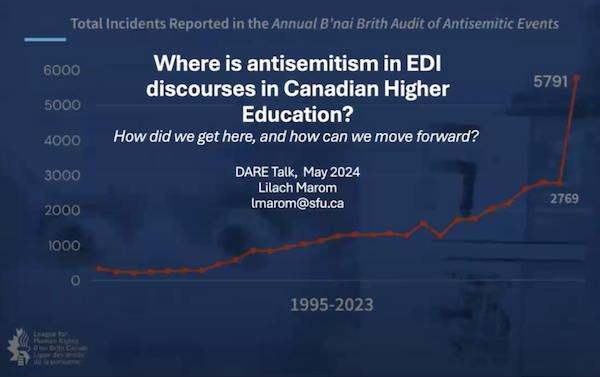
Simon Fraser University assistant professor Dr. Lilach Marom gave a lecture May 27 called Where is Antisemitism in EDI Discourses in Canadian Higher Education? How Did We Get Here, And How Can We Move Forward?

Prevailing trends in equity, diversity and inclusion on campuses and elsewhere often exclude Jewish people and discount antisemitism, according to a Simon Fraser University academic.

Despite extensive policies around racism, discrimination and related topics, many universities and academic organizations have no explicit references in policy to antisemitism, says Dr. Lilach Marom, an assistant professor at SFU, who focuses on anti-racism and inclusion in education with a focus on structural and institutional barriers to access.

“When we look at references to antisemitism and Jewish identity across EDI policies and action plans, we see that there is not much reference,” she said during a lecture May 27 that was part of Diverse Approaches to Research in Education, a seminar series co-hosted by Faculty of Education’s Research Hub and the Research Advisory Working Group. For example, resources from the Canadian Association of University Teachers include a self-identification survey, but under the category of race and ethnicity, there is no option to select “Jewish.”

In addition to Jewish identity, the experiences of Jewish people with antisemitism are often not specifically addressed. “Sometimes, it is not named when there are other forms of oppression and racism that are named,” she said.

EDI stands for equity, diversity and inclusion (in the United States, Marom noted, it is reordered as DEI). Equity, she said, is the removal of systemic barriers and enabling all individuals to have equitable opportunity and access to benefit from higher education. Diversity is about the variety of unique dimensions, identities, qualities and characteristics individuals possess along with other identity factors. Inclusion is defined as the practice of ensuring that all individuals are valued and respected for their contributions and are supported equitably.

EDI has become the prevalent framework to address issues of social justice and equity in Canadian higher education, said Marom. Fully 90% of higher educational institutions in Canada reference EDI in their strategic planning and 91% have an EDI task force or are developing one, according to a Universities Canada survey of members in 2022.

photo - Dr. Lilach Marom
Dr. Lilach Marom  (photo courtesy)

Marom sees a number of reasons why antisemitism is excluded. Antisemitism is often categorized as religious-based discrimination, which reclassifies it outside the realm of anti-racism. 

“Jewish people see themselves as a people, which means they have shared culture, language, history, religious texts and rituals,” said Marom. “But, within the North American context, Jewishness is conceptualized as a form of religion.”

This is specifically the case in Canadian law, where antisemitism is categorized under religious discrimination and reported under hate crimes motivated by religion.

This creates a disconnect when it comes to EDI, said Marom. “In most cases, EDI typically does not centre on religious-based discrimination,” she said. “So those things are on the margins, they’re not core to the EDI discourses.”

Settler-colonialism and decolonization are core concepts in EDI discourse, which presents challenges around the way Israel and Palestine are considered.

“I’m worried about the new antisemitism that emerges at the intersection of anti-racism and settler-colonial discourses,” she said. “Both those discourses are insufficient and incomplete to understand Jewishness, the Jewish condition or the situation in Israel-Palestine.… They create this forced binary between Jewish people as the embodiment of white privilege and colonial oppression, and Palestinians as racialized and indigenous. I think this binary is not only inaccurate, it also feeds into new forms of antisemitism.”

Settler-colonialism is a leading framework for analyzing Canadian history, said Marom. Applying that framework to Zionism and the formation of Israel in a simplistic way overlooks the long and complex history of that land and creates a false dichotomy between Jewish people as the embodiment of oppression and Palestinians as indigenous, she said.

These constructions fail to acknowledge the historical, cultural and religious ties of Jews to the land dating back millennia. They also don’t acknowledge that there could be places in which there are coexisting claims to indigeneity in Israel-Palestine.

Meanwhile, the construction of Jews as white and privileged, she said, reflects a “legal and cultural whitening of Jews in North America.”

“This is not to ignore the fact that Jews definitely have gained some privileges from their ability to assimilate and integrate in this mainstream North American culture and those possibilities were not open to members of other racialized groups,” she said. “Jews have definitely gained some privileges from this ability. However, this also feeds into some antisemitic tropes or stereotypes – Jews as a ‘model minority’ or ‘super powerful’ – and have put them in a position that is not really in and not really out. These in-between spaces [mean] they can be targeted on one hand by conspiracies from the right like the Great Replacement Theory, but also pushed against from the left as an embodiment of white privilege.”

The construction of Jews as white overlooks the self-identification of Jewish people, she said, and it doesn’t recognize the diversity of Jewish people. While in North America many Jewish people are Ashkenazi, in places like Israel, the majority of people are from Asian, Middle Eastern and North African backgrounds.

“In critical discourses, we don’t talk about race as skin pigmentation nor as biological constructs,” Marom said. “We talk about it as a form of social construct. If you think about race as a social construct, looking at the history of Jewish people with marginalization, exclusion and genocide, they cannot be put aside from anti-racism discourses and be absorbed into whiteness.”

It is not useful, she said, to participate in “any form of oppression Olympics. But I think we need to acknowledge that antisemitism is not following the typical path of other racialized groups, where hopefully there is less exclusion and more integration with time,” she said. “With Jewish people, many times when they thought they were most integrated and most included, this is when they faced the most extreme forms of exclusion and marginalization.”

Marom clarified that discussion about antisemitism and the protection and safety of Jewish people should not be confused with “protection” from challenging ideas.

“We need to be willing to step into risky discussions,” she said. “But I think what EDI does is really talk about impact. It talks about how can we be engaging in those difficult spaces while still feeling that we are being seen as human, that we are included, that we have space. I speak only on my behalf [but] I think this is the case with many Jewish faculty that I know. I don’t think that this is the way many of us [have felt] since Oct. 7.”

There is a balance to be found between academic freedom and protection of minority communities, said Marom – but the approach to this balance when it comes to Jews and antisemitism seems different than in other cases.

“I just find it very peculiar that a lot of my colleagues who usually are very sensitive toward issues of inclusion and belonging all of a sudden become the strongest supporters of academic freedom when it comes to the issues of antisemitism,” said Marom. “Not that academic freedom is not important – it is really important – I’m just curious to hear how come it becomes so important now when the people in question are Jewish people.”

She also cited a seminar on antisemitism and anti-Zionism that was sponsored by about 40 organizations, most of them Muslim and Middle Eastern academic groups.

“This we would never see on other issues, in which people from the outside explained to people on the inside what they need to know about themselves,” she said. There were some Jewish speakers at the event, she noted, but they came from a very specific ideological perspective.

“I’m not saying that they are not legitimate,” she said. “I’m not even saying that they’re not important and I don’t think that we need to define who is in and who is out to speak on behalf of the Jewish people – there is enough space in the world to speak. But I am worried for the tendencies in progressive circles to adopt those voices and put them in and check the inclusion box, because that is not how we do inclusion in any other circles.”

The principle of “nothing about us without us,” the idea that no approach toward a group should be adopted without the full and direct participation of the affected people, should not be overlooked when it comes to antisemitism, she said.

A video of Marom’s full presentation is available at youtu.be/FQbGiySUetM. 

Format ImagePosted on July 26, 2024July 25, 2024Author Pat JohnsonCategories LocalTags antisemitism, DEI, diversity, EDI, equity, inclusion, Lilach Marom, SFU, Simon Fraser University
Arts enhance inclusion

Arts enhance inclusion

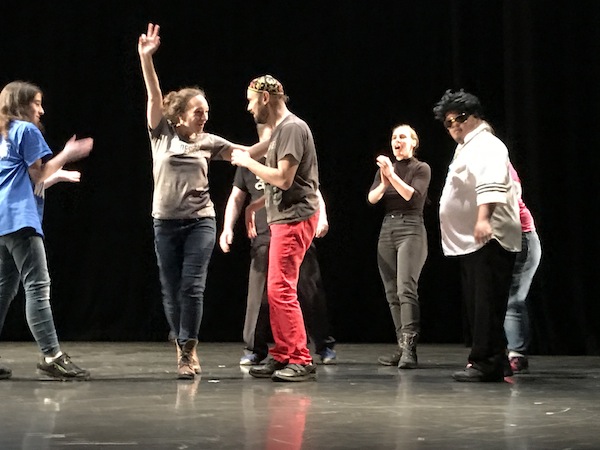
Matthew Tom-Wing, right, dressed as Elvis, was one of the participants in the 2019 Chutzpah! Festival finale. His mother, Elizabeth Tom-Wing, recalled it as a “standout moment for our community and for our son!” (photo from JCC)

February is Jewish Disability Awareness and Inclusion Month (JDAIM). It offers a wonderful time to look back at some of our community achievements in fostering inclusion at the Jewish Community Centre of Greater Vancouver; in particular, the 2019 Chutzpah! Festival’s Inclusion Project.

Mary-Louise Albert was artistic and managing director of Chutzpah! and the Rothstein Theatre for 15 years. Before she retired, she and I had many spirited conversations about the importance of creating access for local community members in all areas of Jewish communal life and at the JCC, which is the home of the festival and the theatre, and where I am the coordinator of inclusion services.

We believed that the arts are an important avenue for personal growth and skills development, and that they also bolster visibility and foster true belonging. We hoped that the JCC’s inclusion services and Chutzpah! could collaborate in some way and, through our conversations and Mary-Louise’s vision and expertise, the Chutzpah Inclusion Project crystalized.

After months of planning, in November 2019, members of the local community took to the Rothstein stage to participate in a first-ever Inclusion Project performance – an evening of dance and comedy with international inclusion advocate Pamela Schuller and professional dancers Troy Ogilvie and Rebecca Margolick. The event was the finale of the 2019 Chutzpah! Festival and a highlight of Albert’s final year with Chutzpah!

In preparation to take to the stage, participants had a yearlong introduction to theatre, including low-barrier and free classes with a specialist through the JCC’s Theatre Lab program. Participants attended many local productions through the JCC’s social club, and spent hours rehearsing and co-creating with Ogilvie, Margolick and Schuller over a series of workshops that would not have been possible without community partners and friends.

The 2019 performance received a standing ovation from the audience. The feeling of solidarity and acceptance between the audience and the performers was palpable. What was most amazing, Elizabeth Tom-Wing recalled, is that her son had the opportunity to “train and perform on stage with the professional dancers, along with his friends, and close off the three-week-long 2019 Chutzpah! Festival.” She recalled it as a “standout moment for our community and for our son!”

This project demonstrated that artists of mixed ability and skill can create a powerful and moving performance. Moreover, it reminds us that it is only through equity and action that belonging can be fostered. As diversity, equity and inclusion strategist Arthur Chan explains: “Diversity is a fact. Equity is a choice. Inclusion is an action. Belonging is the outcome.”

Leamore Cohen is inclusion services coordinator at the Jewish Community Centre of Greater Vancouver.

Format ImagePosted on February 26, 2021February 24, 2021Author Leamore CohenCategories Performing ArtsTags Chutzpah!, disability awareness, diversity, equity, inclusion, JCC, JDAIM, Mary-Louise Albert, theatre
Proudly powered by WordPress