מועצת הביטחון של האומות המאוחדות שהכריזה בשבוע שעבר כי ההתנחלויות של ישראל בשטחים אינן חוקיות. (צילום: UN/Manuel Elias)
ראש ממשלת קנדה לשעבר, סטיבן הרפר, יוצא נגד החלטת מועצת הביטחון של האומות המאוחדות שהכריזה ביום שישי בשבוע שעבר כי ההתנחלויות של ישראל בשטחים אינן חוקיות ויש לפנותן. כידוע ארה”ב נמנעה בהצבעה ולא הטילה וטו כך שנסללה הדרך לקבל את ההחלטה נגד ישראל וההתנחלויות. לעומת זאת ממשלת קנדה ברשות ג’סטין טרודו, בחרה עד כה שלא להגיב כלל להחלטת מועצת הביטחון. אם זאת סביר להניח שטרודו התומך בפתרון שתי המדינות בוודאי היה מישר קו עם מועצת הביטחון.
הרפר בעצם הגיב בחשבון הטוויטר שלו לתגובה של הנשיא הנבחר של ארה”ב, דונאלד טראמפ, שאמר בטוויטר כי לאור החלטת מועצת הביטחון את הדברים הבאים: “בנוגע לאו”ם – הדברים יראו אחרת אחרי ה-20 בינואר”. כידוע טראמפ יכנס לתפקידו בבית הלבן ב-20 בינואר 2017 (כ-90 אלף גולשים אהבו את דברי טראמפ). הרפר תמך בתגובת טראמפ להצבעה והודה על על התנגדותו הפומבית להחלטת מועצת הביטחון (כ-2,500 גולשים תמכו בדברי הרפר)”.
בתגובה לדברי הרפר הגולשים באינטרנט מיהרו להביע את עמדתם בעד ונגד. להלן שלוש תגובות “מעניינות ונאורות” התומכות בדברי הרפר, שמוכיחות שוב באיזה תקופה אנו נמצאים, כאשר אנשים מרשים לעצמם להגיד הכל. אחד הגולשים כתב: “קנדה צריכה מספר התקפות טרור מאסיביות. אולי זה יעורר את האידיוטים שיבינו עם מה ישראל צריכה להתמודד מדי יום מול האיסלאם”. גולש אחר: “אובמה מראה את צבעיו האמיתיים בנוגע לאו”ם המושחת והפוך. אני שמח שהוא עוזב”. ועוד גולש: “זו הנקמה של אובמה כיוון שמורשתו לא אומרת כלום אחרי ה-20 בינואר. טוב להרפר. עתה היכן טרודו עומד?”
משחקים בלגו: העירייה מצאה דרך להתקרב לתושבים
בוונקובר כמו בערים אחרות אין קשר חם בין העירייה לתושבים המקומיים, שממעטים להגיע למפגשים משותפים. בהנהלת העירייה של ונקובר הגיעו למסקנה שצריך למצוא דרך להתקרב אל תושבי העיר. לאחר בדיקות מקיפות שונות שכללו בין היתר משאל לתושבים באינטרנט, נמצא הפתרון המיוחל: קוביות לגו. מתברר שמשחק הלגו יוצר קשר בלתי אמצעי ומתמשך בין הצדדים שמשתתפים בו. מועדון הלוגו של ונקובר הובא בסוד העניין והפך לשותף מרכזי בפרוייקט החדש בין העירייה לתושבים. המועדון אחראי מעתה על אספקת חמישים סטים של קוביות למפגשים בין שני הצדדים. חברי המועדון בונים דגם ראשוני של נשוא הפגישה למשל מרכז קניות חדש, והמשתתפים שיושבים סביב שולחן גדול, ממשיכים בבניית הפרוייקט וכל מה שסביבו, תוך כדי שיחה. בהנהלת העייריה מציינים שהלוגו מאפשר לתושבים להיפתח יותר בקלות לנושאים שונים, ומספר התושבים שמגיע למפגשים הולך וגדל. בהם צעירים ובני נוער שהעייריה חפצה לשמוע גם את דעתם בנושאים שונים ובעיקר אלה הקרובים להם.
צים מרחיבה את השירותים באוקיאנוס האטלנטי כולל קנדה וארה”ב
חברת הספנות הישראלית צים החליטה להרחיב את שירותיה באזור האוקיאנוס האטלנטי, שכוללים גם את קנדה וארה”ב. כל זאת לשפר את שירותי הפריום בין החופים המזרחיים של קנדה וארה”ב עם ארצות הים התיכון – איטליה וצרפת.
השינויים שכוללים הוספת הקווים עם הפעלת חמש אוניות יבואו לידי ביטוי החל מחודש אפריל 2017. הנמלים בארה”ב אותם יפקדו האוניות הם: ניו יורק, נורפולק וסוואנה. ואילו בקנדה מדובר בנמל של הליפקס. הנמל בהפליקס נחשב לאחד החשובים ביותר בקנדה והוא משמש לנקודה המוצא המרכזית של קנדה לספינות שמפליגות לאירופה. אגב רבים מהמהגרים לקנדה נחתנו לראשונה בנמל הליפקס.
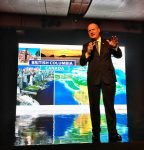
B.C. Finance Minister Michael de Jong speaks at the Canadian reception in Tel Aviv, kicking off the Nov. 13-17 trade mission to Israel. (photo from flickr.com/photos/bcgovphotos)
In November, B.C. Minister of Finance and House Leader Michael de Jong led a provincial trade mission to Israel. The invitation to delegates was sent by the minister and Dr. Moira Stilwell, MLA for Vancouver-Langara.
“A lot of the impetus for this [mission] derived from the tech sector, the health sciences sector, the cybersecurity sector itself here in B.C., who said, look, we are seeing increasing opportunities and we’d like to explore those further, is the government prepared to work with us?” de Jong told the Independent in a phone interview. “And that led to a conversation between myself and Moira – of course, she has been, for many years, a big proponent of growing the bilateral relationship – and, out of that emerged this formal trade delegation.”
It was de Jong’s second mission to Israel. His first was about five years ago, during his tenure as the province’s minister of health.
“The role the government and a minister can play is to help facilitate partnerships and contacts between people, and this particular group had done a lot of that work themselves,” he said. “So, for example, the Rick Hansen Institute had already created the beginnings of a partnership with Hadassah [Medical Centre] and we saw that go to the next level in terms of formalization. We went out to Technion University, which is this world-leading institute – in their hallway, they feature Nobel laureates the way other institutions feature alumni – it’s quite remarkable…. [On] the cybersecurity side, some of the folks who were with us are even now actively pursuing with colleagues in Israel opportunities for exchange and for trade and, ultimately, that’s what this is all about.”
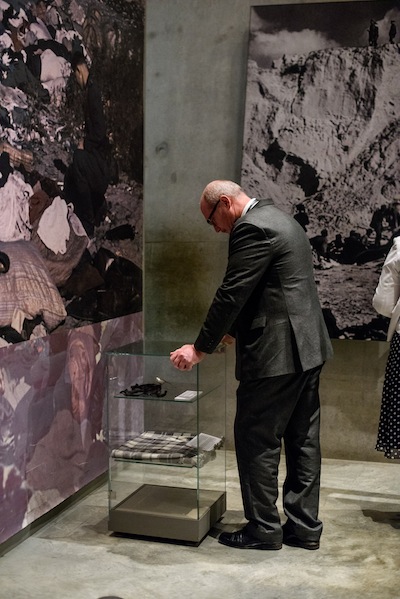
Finance Minister Michael de Jong at Yad Vashem during the November B.C. trade mission to Israel. (photo by Yuval Yosef)
Delegates on the Nov. 13-17 mission traveled to Tel Aviv, Jerusalem, Beersheva, Haifa and the West Bank to meet with various government, university and other stakeholders. Among those accompanying de Jong was Nico Slobinsky, director of the Centre for Israel and Jewish Affairs, Pacific Region. CIJA hosted an optional tour and Shabbat dinner on Nov. 18 for delegates who stayed after the mission was officially over, Slobinsky told the Independent.
“CIJA was delighted by the Government of British Columbia’s initiative to lead a trade delegation to Israel composed of B.C. entrepreneurs and professionals involved in life sciences and cybersecurity,” he said. “This mission assisted in cementing existing relationships, creating new partnerships and promoting opportunities in the province by deepening the economic, cultural and academic ties between Israel and B.C.”
One of those ties was with the Centre for Health Evaluation and Outcome Sciences (CHÉOS), a centre of the Providence Health Care Research Institute and the University of British Columbia faculty of medicine.
“Israel is viewed as a world exemplar in science, technology and commercialization – a place where we can learn, but also can share best practices from B.C.,” said Prof. Robert Sindelar, who, among other things, serves as an advisor to CHÉOS. He added, “Having participated in valuable and hugely beneficial B.C. trade missions previously to China and India, I said yes immediately when I had received the invitation to consider participating in a B.C. trade mission to Israel from the B.C. Ministry of International Trade.”
About the November trip, he said, “From our very first meeting in Israel to the very last meeting, I was continually impressed by our Israel hosts’ efforts to: 1) openly and candidly share valuable insight and details of their successes and endeavors with our delegation, and 2) the immediate connection in person or via email within 24 hours of an event to further explore potential opportunities and collaborations. Thus, we are already working together on several possible collaborations between Israel and B.C.”
Being a multidisciplinary health research centre, CHÉOS looks “to partner and collaborate with synergistic and like organizations researching at the cutting-edge of health and wellness,” said Sindelar. “Thus, true partnerships and collaborations with the best health-outcomes organizations in the world – sharing knowledge, skills and new methodologies – is a continuing goal for us. Each and every life-science event planned for the B.C. trade mission to Israel provided an opportunity and unique ideas for possible collaborations for CHÉOS health scientists and clinicians at a world-class level.”
Of course, the relationship with Israel extends beyond British Columbia to all of Canada.
“There is this very strong political and cultural tie,” said de Jong. “I think we still underachieve with respect to trade. I think there is genuine room for growth on the trade front. There are some emerging opportunities, as Israel begins to explore offshore energy potential.”
As well, “we have room to learn from the ‘start-up nation,’” said de Jong. “You go down to Beersheva, for example, and see how they have managed to create a technology hub in concert with the university there and the community there, and you see elements of that beginning to develop in British Columbia, in the Lower Mainland, in Victoria, but there are some real lessons to be learned.
“Frequently, the conversations began with the Israeli representatives reminding us of the unique challenges that they face and how innovation is borne out of necessity – smaller population base, smaller country, neighbors that aren’t always particularly friendly and, in some cases, are downright hostile, and, out of that, out of necessity, innovation has emerged. At one point, I replied to a group, acknowledged that and said I want you to think about another form of necessity. Imagine four-and-a-half million people in an area the size of Europe … well, that’s our circumstance. That breeds a different kind of innovation … 35 million people in a country that’s the second-largest country in the world. And so, we have to innovate in order to achieve a standard of living that is amongst the highest in the world, with vast distances and a very small population base, and we may have something to teach you about that. Different circumstances, both have required a degree of unique innovation, and two countries that have performed remarkably well economically.”
The cost of the trip, which included travel to Israel and England for the minister and his chief of staff, came in slightly below the ministry’s $25,000 estimate, said de Jong.
“It costs money,” he said. “You go to these hotels and, if you can find one that’s below $300 a night, you’re lucky. It’s not cheap.”
But, he explained, “It’s well spent if it facilitates business and trade. If it doesn’t, then it is not a sound investment. We try to track the trade stats and the partners that came with us and do the follow-up.”
Regarding that follow-up, he said, “Well, the trade ministry, who were also represented on the trip, will be following up with the members of the delegation; in some cases, providing additional information to folks we met in Israel. In a couple of cases, there are groups there who have indicated a desire to come here to follow-up. The ultimate test of success is the degree to which investment flows out of Israel into British Columbia and out of B.C. into Israel, and we see increased levels of commerce and trade in goods and services. We can dress it up any way we want, but that’s the measure of success. If, a year or two from now, our trade levels remain the same, then it hasn’t been a success.”
To those who support the boycott, divestment and sanction movement, de Jong said, “I disagree with the approach. I see benefits for British Columbia in developing and enhancing the trade relationship, benefits for Canada; I see benefits for Israel, I see benefits for the region. I met with the finance minister for the Palestinian Authority, went into Ramallah, had a conversation, obviously got a perspective on some of the economic challenges that they are facing. I had met earlier that day or the day previous with the Israeli health minister. There is a vexing challenge there, and I’m not going to pretend to have the recipe for resolution, but I do know that Canada and Canadians are well-regarded within Israel and, my impression was, amongst the Palestinian officials. To the extent that we can encourage or influence the prospect of negotiations and resolution, so much the better.”
After the mission to Israel, de Jong stopped in London, where British Columbia was honored by the London Stock Exchange for innovation in financial capital markets.
“As finance minister over the last five years, there’s a bit of a pattern,” said de Jong of his international travel in general. “After the budget, I’ll usually do a tour involving the North American markets, so Toronto, Montreal, New York, Boston, Chicago, that sort of triangle, if you will. We also have a lot of investors in Europe, so every second year, there will be a European show.
“As forestry minister, those were the years we were opening up the China market and were very active there, happily. It’s paying dividends now. And, more recently, we were the first government anywhere in the world to issue what are called ‘dim sum and panda bonds,’ one is offshore, one is onshore, Chinese currency bonds.
“Earlier, I mean just before I was in Israel, I was in India. We were the first government anywhere in the world to issue what are called ‘masala bonds,’ rupee-denominated bonds. We’re able to do these things because we’re triple-A … so we can go where no one has gone before … and break new ground. On the way back from Israel, I stopped in London, and the reason the stock exchange wanted to honor British Columbia was for creating an entire new trade through this masala bond. We issue it out of London and now, of course, others are following.”
According to Jewish Federation of Greater Vancouver chief executive officer Ezra Shanken, in his Nov. 18 e-newsletter, other local Jewish community members who joined the B.C.-Israel mission were Candace Kwinter, who is on Federation’s Israel and overseas affairs committee and CIJA-PR’s Local Partnership Council; Paul Goldman, who is CIJA’s immediate past chair; and Eli Mann, chief executive officer of Shield4UC, who also serves on Federation’s community security advisory committee.
The Vancouver skyline, photographed and painted by Sharon Tenenbaum.
Sharon Tenenbaum is celebrating her 10-year anniversary – since becoming an artist photographer – with a solo exhibition at Zack Gallery. The exhibit includes photographs from a number of different series, an eclectic selection reflecting the progressive stages of her artistic journey.
“It’s the hardest challenge for any artist to constantly reinvent herself, both business-wise and creative-wise,” Tenenbaum said in an interview with the Independent. “Everything has a shelf life, so we have to come up with something new every few years.”
In the decade since she began, Tenenbaum has reinvented herself several times, although she never abandons her previous endeavors. Her first love was architectural photography, and it is still an important part of her artistic output.
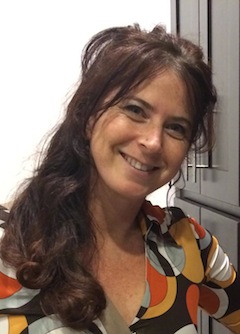
Sharon Tenenbaum (photo from Sharon Tenenbaum)
“Maybe because I was an engineer before I became an artist, I like architectural photography,” she said. “You can take your time with buildings and bridges, come to them again and again, see them from many angles and in different weather. With people, it is transitory: a moment, and it is gone.”
Tenenbaum’s architectural photography has won awards. The most recent one came last year, when her Musical Reflections Hoofddorp Bridge Series won first place in the 2015 International Photography Award, in the category of architecture, bridges. All three photographs in the series are on display at the Zack.
“These three bridges, with musical names Harp, Lute and Lyre, are located in the small town of Hoofddorp, Holland, on the outskirts of Amsterdam,” Tenenbaum explained. “They were designed by the Spanish engineer and architect Santiago Calatrava. I love his works and I photographed them before.”
Although her architectural photography started as black and white, a few years later, she began painting the photographs. Her painting phase started with trees.
“I started with one image of a tree, a photo from Portugal,” she said. “Then, there was a maple tree outside my window; it was gorgeous in the fall. I wanted to convey its beauty with my image, too.”
These works are the result of a two-step process. First, Tenenbaum prints her photos on canvas and then she paints the canvas with acrylics. People coming to Zack Gallery will see several of these painted photos in the show.
After her tree paintings proved successful, Tenenbaum moved to paint a different kind of photographic imagery – the Vancouver skyline.
“I was inspired to do this after I saw a painter in Jerusalem about two years ago, Adriana Naveh. Her abstract urban landscapes were amazing. I was blown away by her work,” said Tenenbaum. “But not every architectural image submits well to painting. Sometimes, I try to paint something but it doesn’t work out. It’s hard to explain what works and what doesn’t. I think if the image is too architecturally clean, it needs the black-and-white palette.”
The examples of Tenenbaum’s painted skylines in the Zack show combine the technical proficiency of the photographer with deep emotional undertones echoing through the color schemes. The skyline might be of the same place – Vancouver – but each image is different, reflecting different facets of the artist’s inner self.
Lions Gate and Stanley Park by Sharon Tenenbaum, from her Bike Art series.
The Vancouver skyline fascinates Tenenbaum. Recently, she started a new project showcasing her favorite subject. She creates photo images of the skyline assembled exclusively from spare bicycle parts. She calls this new project Bike Art.
“I love biking and I always look for new and original ways to depict Vancouver. This project is a melding of my two passions,” she explained. “I use the recycled bicycle parts from the bike shops, the parts the shops would throw away. It’s a very time-consuming process, lots of work, and my place resembles a bike garage now, but it is very rewarding. I only have three images for now and I would like to get a grant to continue this project.”
Tenenbaum’s unique skylines made with bicycle parts are charming, quaint and amazingly authentic. One can see the ocean and Stanley Park, the skyscrapers of downtown and the masts of the marina, all created with recycled screws and bolts. “The viewers could interpret the images anyway they like,” she said.
But certain images are harder to fathom, like the image of an airplane flying above the clouds. The photo is just across from the entrance to the gallery, greeting guests with its mystery. “Many people ask me how I did it,” said Tenenbaum. “I always tell them: take my class and find out.”
Tenenbaum is eager to share her extensive expertise. She teaches students to use a number of photographic techniques to create fine art, to express their souls, and not just document what they see. With two different classes at Langara College plus some private tutorships, her teaching schedule is extremely busy, but she finds time for international workshops as well. “I have one in Chicago next year,” she said.
The show Sharon Tenenbaum – Architectural Fine Art Photography opened on Dec. 15 and continues to Jan. 15. For more information on Tenenbaum and her work, visit sharontenenbaum.com.
Olga Livshinis a Vancouver freelance writer. She can be reached at olgagodim@gmail.com.
Can We Talk About … event committee, left to right: Karen Dana (event co-chair), Jenn Ritter (event co-chair), Harriet Zimmer, Rietta Floom, Einat Paz-Keynan (JCFS staff), Meytal Lavy (JCFS staff), Michael Landsberg, Sherry Lercher-Davis, Randee Pollock (JCFS staff), Danita Aziza (JCFS board chair), Pam Vine, Tara Greenberg and Jill Atnikov. (photo from Jewish Child and Family Service Winnipeg)
On Nov. 3, as part of Jewish Child and Family Service Winnipeg’s series Can We Talk About …, TSN celebrity Michael Landsberg spoke about Darkness and Hope – Depression, Sports and Me.
Landsberg has suffered from anxiety for as long as he can remember, and depression for the past 18 years.
“In 2009, I spoke about it publicly for the first time,” Landsberg shared with those gathered at Shaarey Zedek Synagogue. “I told everybody I knew. I just hadn’t used the platforms available to me to discuss it [until then], because I didn’t think it was relevant to anyone’s life.
“One day, when I was, by chance, interviewing someone who had suffered from depression, I asked him about it. I commented that I, too, had suffered. The next day changed my life.”
Landsberg received emails from people saying that the interview had been the first time they had heard two men discussing their struggles with depression; in particular, without sounding embarrassed or seeming weak.
“Because of that, they said their lives were changed,” said Landsberg. “Since that moment, I’ve tried to do exactly the same thing over and over again in as many venues as I can, including in Winnipeg.”
Landsberg tries to find ways to bring the topic to the fore whenever he feels it’s appropriate or thinks he has the opportunity to make a difference, whether it’s a public talk he’s headlining or a discussion on radio, TV or the internet.
“Every time I say I suffer from this illness and I’m not ashamed, embarrassed or weak, it changes someone’s life,” he said. “My coming out gave a purpose to this illness. It allowed me to take this poison that’s been inside me, that’s detracted from my life…. It allowed me to help someone else … so my poison is someone else’s medicine. That makes me feel good and makes me feel like I have a place in the world other than the one I was occupying before.”
According to Landsberg, before going public, his level of contribution to society was neutral, like most people’s. But, since coming out and talking about how his depression makes him feel and how it robs his self-confidence and self-esteem – yet he’s not ashamed of it – he’s no longer neutral.
“I think what I have to share most of all is me,” he said. “The more deep I go, the more details I give, the more of my struggles – not just that I’m struggling, but how my struggles feel – the more valuable it is to someone else. You want people to say, in the audience, ‘That’s me.’ And ‘Oh my gosh. My husband has that illness and I never knew that’s what was going on in his head. I understand better now.’
“I think we’re in a time now when every person is really deciding what side of history they’re on. Do you want to be on the side of history that’s changed the way we deal with mental health or do you want to be on the other side? I try to encourage people to get on the right side of it.”
Landsberg has always been a sharer and encourages others to share their struggles. As there is a deep sense of hopelessness and loneliness when it comes to depression, he said it is critical to encourage others to listen and realize they are not alone with the illness.
“More so than any event than I’ve ever been to, I was riveted and was really grabbed by several of the questions [posed to me in Winnipeg],” Landsberg told the Independent. “They weren’t so much questions as they were statements about audience members’ own situations.
“If you have a good night and you do it the right way, and there’s an audience that’s engaged that way, you’ll hear stories that have never before been shared – empowering people to share.
“My analogy is always, what I’d really like to do, is to have everyone in Canada who suffers from this illness [get together] – in the basement of a synagogue or a church, where Alcoholic Anonymous meetings take place – and [have] each of us draw from the collective strength and, at the same time, make deposits into that strength. When you turn to someone for help, you ultimately give them strength just by asking for it. That’s the spirit we felt in Winnipeg.”
One female audience member shared that she has had cancer and that it has come back, adding that she has suffered from depression for 15 years. Landsberg recalled, “She said, ‘You know, I have to be honest with you, I’ll take the cancer over the depression.’
“Also, an army veteran shared that he served in the army for 12 years and that, when he returned to Canada, there were 13 of them in his army group who had served and that, now, there are only two – the other 11 took their own lives. He said, ‘I was in the closet, so to speak, and felt desperately alone and unable to reach out. I watched a TV show you [Landsberg] did two years ago and thought, wow, if he can share, I can, too.’
“That’s enough reason to keep doing this for the rest of my life – just the knowledge that doing something that’s so easy for me, takes no effort, is a joy, [is helping]. To get up on stage and use my struggles for someone else’s benefit … it’s so easy, yet the payoff can be so massive.”
When it comes to helping a loved one who suffers from depression, Landsberg said one should start by admitting they cannot fully understand, as they have never had the disease. Then, they should ask their loved one what they want from them.
“That’s a huge thing – telling me what not to do,” said Landsberg. “The second thing is to reduce guilt. Many of us who have this illness like to please those around us. But, when we’re sick, we lose that ability, because we’re not ourselves – we can’t. I feel terribly guilty when I’m not the person I want to be.
“The people around me aren’t living their lives better because I’m there. Quite the opposite. I feel terrible that I’m actually worrying them, that I’m actually making the room worse because I’m in it. But, if you reduce my guilt, it will make a difference.”
As for someone who discovers they have the disease, Landsberg suggested education, as the more one knows about one’s illness, the more they can be an advocate and fight.
“Then, establish the thought that I will fight for my happiness,” he said. “And that’s incredibly difficult to commit to because the illness takes the life, the drive, out of us. It makes us apathetic. It makes us really incapable of doing stuff, or highly challenged to do stuff.
“If you commit to fighting for your happiness, that’s a big step. If you commit to sharing, that’s a big step. Sharing is incredibly difficult for most people because they feel shame and embarrassment. They feel like their illness is a weakness.
“You can overcome that, to some extent, by educating yourself. When you go on the internet and Google ‘depression’ and get five billion hits, you realize that 10% of the population right now may be feeling similar to you.
“People take their lives – 4,000 every year in Canada, 40,000 in the United States, and there are 25 attempts likely for every ‘successful’ suicide … that means 100,000 suicide attempts. We know there’s at least 10 to one that think about suicide, but don’t attempt it; suicide becomes appealing to them and plays out over and over in their brain.
“If you start realizing you’re just like a million other people in this country, then you’ll realize this is a sickness, not a weakness. All of these people, people that take their lives because they’re in so much pain, that’s not weakness.”
Landsberg added that speaking with someone who you know is struggling with depression is the easiest way to start sharing and healing, as you know they will not judge you and that they understand you.
“Winnipeg people liked what I did, so they went home with something,” said Landsberg. “But, I think I went home with more. I took away more than I left. What I took away were stories from people who I felt privileged to listen to…. I just loved it.”
In a rare venture into current events, the head of Yad Vashem has spoken out about the urgency of humanitarian disaster in Syria. After the forces backing Syrian dictator Bashir al-Assad succeeded in taking the rebel-controlled areas of Aleppo last week, murderous retribution unfolded and terrified residents fled for their lives.
Avner Shalev, chair of Yad Vashem, said “the global community must put a stop to these atrocities and avert further suffering, as well as provide humanitarian assistance to the victims seeking safe haven.”
It is not insignificant that the head of the world’s leading Holocaust museum and memorial would be moved to speak out on the subject. The atrocities the world is seeing stir memories of the past. No history is precisely like other history, obviously, and making direct comparisons can be unhelpful. Yet, after the Second World War, as the extent of the Holocaust became understood, international agencies, nations and individuals committed to a future free of those sorts of atrocities. Those promises have been betrayed too many times in the seven decades since, most recently in Syria.
When we look back in history, we ask, why didn’t this party or that country do more? Why was this or that allowed to happen? How did the world not step in sooner, when evidence began to mount about the rising danger of authoritarianism? Questions and answers are easier in hindsight. Yet there can be no doubt that Syria has presented especially difficult choices, even for actors who want to do the right thing.
U.S. President Barack Obama has insisted through the years of the Syrian civil war, which began at the time of the Arab Spring in 2011, that there was no military solution to the problem; that diplomacy had to prevail. He may have been correct that there was no military resolution. There are multiple bad guys in this fight – Assad’s regime, backed by Iran, Hezbollah and Russia, on one side, and al-Qaeda and ISIS on the other. And, on the third side – because this is, vexingly, a multiple-sided conflict – is an amalgam of defectors from the Syrian military, Kurdish militias, and other anti-Assad forces who may have democratic and pluralist intents. Or, were they to be victorious – which now seems unlikely in the extreme – they could split among themselves, their only cohesion perhaps being the glue of opposition to Assad. By one count, what we call the Syrian civil war is as many as 10 separate conflicts. The United States, Saudi Arabia, Turkey and Qatar have provided some support to the rebels, but it has been unreliable and uncoordinated. Estimates of the number of civilians and fighters killed range from 312,000 to more than 400,000.
Civilians casualties have been enormous, with all sides indiscriminately attacking civilian targets. Torture and extrajudicial killings typify the regime’s approach to war. Assad’s forces have also been accused of deliberately targeting medical installations and personnel. When the United Nations was able to secure humanitarian aid routes within Syria to provide food and medicine, the regime ensured that aid reached government-controlled areas and prevented aid from reaching rebel-controlled areas.
Negotiations have gone nowhere, because Assad is determined to hold on to power no matter how much of his population dies in the process, and he has powerful military friends in Russia and Iran who back his iron fist. The opposition is unequivocal that Assad must be deposed. There is no room for negotiation.
And so, the matter has come down to military might, with the last stronghold of the opposition crushed in recent days. Assad has now regained control of almost all the population centres of the country, with the rebels limited to peripheral enclaves.
In the process of the civil war, half of Syria’s population has been uprooted – six million people are displaced internally and another six million have been made refugees, with global implications, as European, American and other politicians have exploited fears of radicalization among refugees to advance their own xenophobic agendas. The effect may ultimately unravel the entire European Union.
Meanwhile, Hezbollah has been significantly strengthened and ISIS, which has suffered in Syria, will likely turn its attentions to more fertile ground elsewhere. The murderous Assad regime is more secure than it has been in years. Russia is ascendant in the region and globally. The United States has been chastened, and the incoming president is, characteristically, belligerent in rhetoric but anti-interventionist in expressed policy, which indicates nothing if not pandemonium in future U.S. approaches.
The world has failed the people of Syria – and, as a result, the world is a far more dangerous place.
Significant blame for this disaster must be placed on the United Nations, the primary bodies of which are hobbled by the control of despots who owe more to Assad’s governance style than to the vision of the idealists who founded the organization. While there are agencies under the UN umbrella that do superb work, its governance structures are so dysfunctional that talk of a replacement body must continue in earnest.
The least the world should be able to do now is pressure the emboldened government of Assad to allow humanitarian aid to reach those who need it and allow his citizens to move to places of safety. Then, the world should reflect on the lessons of this catastrophic experience and promise, yet again, not to let such a thing recur. What we’re doing isn’t working. To prevent recurrence, we need to stop pursuing the definition of insanity, which involves doing the same things and expecting a different result.
With gratitude and sadness, we share with readers the news that Alex Kliner’s Menschenings column will appear for the last time in this issue of the Jewish Independent. Alex is retiring and, while we are happy that he’s about to enjoy a well-deserved break, we’ll miss him.
After more than two decades of keeping our readers up-to-date with news, quips, culture, history, wordplay and trivia from the Jewish world, Alex has decided that the time has come to relax a little and give up the grind of a weekly column.
Alex has been a pillar of this newspaper and remains a pillar of this community, reflecting ourselves back to ourselves, with wit, Yiddishkeit and puns that he well knows are groaners. He has brought his unique character to these pages, built on the linguistic and comedic styles that are distinctively Jewish but which are also inimitably Klineresque.
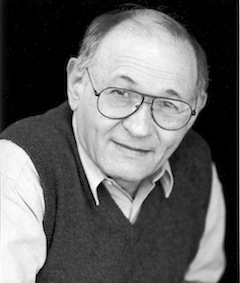
Reading Alex Kliner’s Menschenings has always been like spending time with a friend – a gossipy friend, but in the best sense. (photo from Alex Kliner)
Reading Menschenings has always been like spending time with a friend – a gossipy friend, but in the best sense. Lashon hara never, ever found a place in Alex’s column. His stories were always positive and joyfully told. Like Alex in person, Menschenings has been a cheery respite amid the world’s sometimes woeful events.
Alex has been able to pack an enormous amount into each column, covering news that matters and nuggets that entertain. He often notes the passing of figures of importance to Jewish life, many of whom were unsung heroes in their fields but little known to the general public. Goings-on around town, important new works of literature, tidbits from showbiz with a Jewish angle: there have not been many limits to the Menschenings beat.
His columns have also been filled with kavods and kudos for local and international figures about whom readers may otherwise have known nothing. Mazal tovs for simchot, recognitions of landmark events, notes on new cultural diversions and businesses opening and closing. Through these many years, week after week, Alex has curated stories of ordinary and extraordinary people, distilling a huge range of events and personalities into a tight package that is a pleasure to peruse. His chatty style has made our community feel a sense of togetherness, as though even people we do not know are linked with us through a mutual friend.
Importantly, each week Menschenings has featured a member of the local community, often someone whose contributions to the smooth running of communal organizations or a local business are crucial yet uncelebrated, an artist being introduced to new audiences, an author, a chef, an athlete, any number of people we were better for knowing about through Alex’s introduction. He has often been the first to identify rising stars in the local arts scene and there is no gauge to measure the careers he has helped along the way.
For 21 tireless years, and just two columns short of 1,000, Alex has been an irreplaceable and beloved voice of this newspaper and the community we serve. Together with Elaine, whose name has appeared frequently in Menschenings as a muse and a foil – El-Al, as they are collectively known – Alex has attended more community events, concerts, plays and other events than the most dogged culture vultures.
Thank you, Alex, for everything you have done to help build this community and tell our stories. Your name is, appropriately, inextricably connected with the word mensch.
I knew the printer wasn’t working when no typed pages flew out of its up-front opening where typed pages are supposed to fly out. Great! I spend a week feeding it $18 cartridges of yellow, magenta and black, and now that its appetite had been sated, no output. And, by the way, what marketing genius conceived of the scam where the color “black” demands yellow and magenta. It makes as much sense as filling your car with gas but the car won’t go unless you also buy a six pack of beer and two bags of potato chips.
Clearly, I needed a new printer. This clever machine announced its death in a dialect that even I understood. After some 10 years of service, it had gone to that junkyard in the sky where you could print black without magenta or yellow.
I needed a new printer. Even worse, I would have to properly introduce the printer to the computer. I’m a scribbler not an engineer. But then relief, as I thought of my great-grandchild in kindergarten. He was already 6 – he knew all about ’puters, as he called them. No, not a good idea – better my third-grade grandchild – much more experienced.
That thought cost me a quart of strawberry ripple ice cream, and alarm at his mature and loud vocabulary as failure followed failure. Then inspiration lightened the room as I thought of an engineering friend who loved key lime pie. My wife, who didn’t know a printer from a nuclear reactor either, had just made a key lime pie! What followed was the shortest marketing phone conversation on record.
“Henry, come on over and help me share a key lime pie.”
He came. Ate three pounds of key lime pie. We finished. The pie was as dead as the printer. Henry, though, full of pie, was – as I planned – in a jovial mood. I showed him around our house. And, somehow, we ended in the computer room.
“Hey Ted, the wire between the computer and printer isn’t connected.” (My third grader never noticed that! Public schools today are atrocious.) At this point, I hung my head and confessed the whole key lime pie inducement scheme. Nonetheless, my friend – what a friend! – jumped in the driver’s seat. He pushed buttons, tied wires, cursed, sweated. He condemned every printer you could imagine, as my chaste computer wouldn’t mate with the printer.
I didn’t get the whole picture but it had something to with it being a new printer and the ’puter having an old operating system. Such snobbery. It was age discrimination. That lousy printer should end up in court for rejecting the advances of my senior computer.
Not to worry, however. As in most fairytales – though this story is the absolute truth – we somehow found a happy ending. My friend, his forehead wet with frustration, mentioned that he saw another printer in my bedroom.
“Yeah, it’s an old one,” I said. “Somebody gave it to me.”
The word “old” rang in the room like a bell. His eyes lit up like he’d just drained a fifth of champagne.
“Go get it!” he screamed.
Sure enough, the old printer loved that old operating system. The two devices mated in front of our eyes. In fact, together they made this love story.
Ted Roberts is a freelance writer and humorist living in Huntsville, Ala. His website is wonderwordworks.com.
Jason Aginsky (photo from Centre for Judaism of the Lower Fraser Valley)
The Centre for Judaism of the Lower Fraser Valley has announced the recipient of its annual Lamplighter Award, which honors a child who has performed an outstanding act of community service.
Jason Aginsky, a 16-year-old Grade 11 student at McMath Secondary in Richmond, was the second-youngest participant in the B.C. Ride to Conquer Cancer in August 2016, when he rode the 250 kilometres from Surrey to Seattle over two days.
“He’d announced eight months earlier that it was a cause he was determined to support and no safety concerns raised by his worried mother could deter him,” said Mark Aginsky, Jason’s father.
Jason was motivated to do this ride after losing his grandmother, Shirley Kramer, to ovarian cancer in 2003, when he was just 3 years old. He joined the Village Idiots, a group of riders in the Steveston area, and, after raising close to $4,000 to support the B.C. Cancer Agency, powered through the race.
“We followed him on Day 1 by car and he was utterly exhausted, on the brink of admitting he’d ‘bitten off more than he could chew’ by participating,” his father recalled. “The winds were against the riders that day and it was hard going. But, when it comes to determination, Jason has it in spades and he pushed through on Day 2, waiting hours at the last stop so he could cross the finish line with other members of the group who were well behind him.”
In total, this year’s participants in the B.C. Ride to Conquer Cancer raised $7.1 million for cancer research.
Jason will receive the Lamplighter Award on Dec. 29 at the Semiahmoo Shopping Centre at a ceremony attended by Rabbi Falik and Simie Schtroks, directors of the Centre for Judaism, White Rock Mayor Wayne Baldwin, and representatives of the cities of Surrey, White Rock, Langley and Delta.
“Chanukah celebrates the victory of light over darkness and goodness over evil,” said Simie Schtroks. “This is a most appropriate opportunity to motivate and inspire young people to make this world a brighter and better place. By filling the world with goodness and kindness, that light can dispel all sorts of darkness.”
The World Health Organization has recognized Israel’s medical rescue teams and Israel Defence Forces’ field hospital as Type 3, the highest ranking for any foreign medical rescue team and field hospital in the world. (photo from United Hatzalah)
On Nov. 28, the World Health Organization (WHO) began a three-day meeting in Hong Kong, during which they recognized Israel’s medical rescue teams and Israel Defence Forces’ field hospital as Type 3, the highest ranking for any foreign medical rescue team and field hospital in the world. Israeli Deputy Minister of Foreign Affairs Tzipi Hotovely attended on behalf of Israel.
United Hatzalah, Israel’s national volunteer emergency medical services organization, and the Israelife Foundation, a conglomerate of Israel-based rescue organizations that respond to disasters worldwide, welcomed the award.
“We want to praise and thank all of the dedicated volunteers, staff and soldiers in all of the rescue services throughout the country. Their dedication and selfless acts of kindness in saving lives at home and abroad are officially being recognized on the world stage and, due to their efforts, Israel has become a world leader,” said Dov Maisel, United Hatzalah vice-president of international operations.
With the ceremony, Israel became the 17th foreign medical team to be classified by WHO, and it currently boasts the highest ranking. The process to achieve the ranking took nearly a year of in-depth reviews to ensure that Israel’s field hospitals met all of the criteria.
Besides the simple value of recognition, the Type 3 classification will also have some real ramifications. The classification ensures that Israeli rescue and medical teams will be the first allowed on the scene of future disasters regardless of where they happen and it will further cement Israel’s position as a world leader in emergency medicine.
Israel is not only the only Type 3 medical response team in the world, it is also the only one to be recognized by WHO that comprises a “military component” in the form of the IDF field hospital. Some aspects of the classification deal with the ethics of emergency care, and having a military branch receive the Type 3 classification highlights the ethical standing of that body.
The person behind the WHO classification system is Dr. Ian Norton, a specialist in emergency medicine and former head of his native Australia’s emergency response team. Norton developed the WHO system – which ranks foreign medical teams into Type 1, Type 2 and Type 3 – in 2013.
The different types refer to the number of patients that can be treated and the level of difficulty of the procedures that can be offered by a medical response team. Even with the high standards, Israel’s field hospital surpasses the requirements, offering more medical care than is required to be classified as Type 3. For example, the Times of Israel reported that a Type 3 field hospital needs 40 inpatient beds, whereas Israel’s has 86, and a Type 3 ranking requires the hospital to have two operating rooms, whereas Israel’s has four. Israel also qualified for the Type 3 category by employing teams that offer additional “specialized care,” such as burn units, dialysis units, obstetrics and gynecology teams, and reconstructive plastic surgery units. The IDF field hospital also received accolades for its abilities to provide exemplary levels of plastic surgery, and obstetrics and gynecology care. These latter qualifications establish the team as a “Type 3 plus.”
In addition to the field hospital, Israel was praised for the work done by its volunteer evacuation and emergency response teams, such as United Hatzalah, Zaka and Israelife. These teams of volunteer responders have conducted search and rescue operations and provided emergency medical services in disasters all over the world. Most recently, United Hatzalah sent Maisel, an emergency paramedic, to be a medical liaison and consultant as part of the Jet911 multinational response team that responded to the destruction caused by Hurricane Matthew in Haiti in October.
Other disasters to which the IDF field hospital and Israel medical response teams have responded include the earthquake in Turkey in 1999, the earthquake in Haiti in 2010, the typhoon in the Philippines in 2013 and the devastating earthquake that shook Nepal in 2015.
Kirkland Lake students paint a mural as part of the Indigenous Awareness project. (photo from Toronto Heschel School)
The Toronto Heschel School has announced the recipients of its first-ever social justice Prize for Teaching Excellence 2016. The top award goes to Erin Buchmann at the Kirkland Lake District Composite School in Ontario, which took first prize for its Indigenous Awareness program. Second prize goes to Todd Clauer at Hyman Brand Hebrew Academy, a Jewish day school in Overland Park, Kan., for its Upper School Social Justice Project.
Heschel, a Toronto Jewish school, invited educators around the world – including public, private and religious schools of all denominations – to share how they bring social justice into the classroom through heritage, culture or religion. The call was issued in THINK Magazine, Heschel School’s semi-annual educational thought publication, last November. It invited educators to submit their original class projects and school initiatives that met the following criteria: Is it rooted in heritage, culture or religion; does it inspire social responsibility in children; and has it been implemented successfully?
Toronto Heschel is committed to encouraging today’s youth to be citizens of the world by celebrating and recognizing teachers who use their students’ identity and cultural values to incorporate social justice learning as part of the everyday school curriculum. The award received entries from across Canada, the United States and Israel, and collected many inspiring stories of teachers and students committed to making positive change in the world.
The completed mural, which was painted by Kirkland Lake students as part of the Indigenous Awareness project. (photo from Toronto Heschel School)
Buchmann took top honors for the project Indigenous Awareness, based on the Seven Grandfathers’ teachings – core cultural values that teach responsibility to self-govern, take care of the land and one another by standing up for social justice. Students created a large mural in the school, installed an art installation called “Red Dress” around the school and dramatized the Seven Grandfathers’ teachings in a play. The project resulted in a 100% pass rate in the class, where there had been 50% failure level before. The school is also now expanding its aboriginal studies program to include a junior and senior course in 2016.
“We are so proud to win the Prize for Teaching Excellence,” said Buchmann. “The Truth and Reconciliation Commission calls on Canadians to act to promote equality and fairness. We are creating opportunities for students to explore and celebrate their individual identities and heritage while promoting social justice for all. By encouraging and supporting students to take action, we are taking steps towards reconciliation, promoting awareness of social issues and creating a more inclusive environment in our school and our community.”
The Upper School Social Justice Project, which won the second Prize for Teaching Excellence 2016, is implemented across three years of high school. Clauer teaches his students that their Jewish heritage teaches them to embrace and pursue justice through everyday advocacy for the dignity of all peoples, and all faiths.
The project saw Hyman Brand students focus their study and engagement on inequity in access to health care in their community; promoting voter engagement; and campaigning for free, universal, early childhood education. The project, conducted in partnership with a local charter school, also took students – Jewish and African-American, more advantaged and less advantaged, city centre and suburban – on a civil rights journey across the southern United States.
Named for Rabbi Abraham Joshua Heschel, the Toronto Heschel School was founded in 1996 to give children the spirit of awe and wonder as they learn. The school teaches social justice through the philosophy and social action leadership modeled by Heschel. It is a pluralistic Jewish day school, which means it welcomes all Jewish children; it now has more than 270 students (junior kindergarten through Grade 8) from Reform, Conservative, Reconstructionist, Orthodox and secular families. Jewish thinking and ethics are integrated throughout the curriculum to deepen learning, enrich school culture and inspire social responsibility. For more information, visit torontoheschel.org.