In August, Canadian Young Judaea visited two of CHW’s daycares in Israel, the Sandy Martin Alberta Daycare and the Judy Mandleman Vancouver Daycare. (photo from chwblog.tumblr.com)
Canadian Hadassah-WIZO (CHW) is one of the original feminist philanthropic organizations. Founded in 1917 and on the eve of celebrating its centennial, it remains an organization unique to Canada.
Only in Canada are Hadassah International, which supports medical centres in Israel, and Women’s International Zionist Organization, which has women in the Diaspora working for the welfare of women and children in Israel, combined. They were brought together by CHW founder, philanthropist and activist Lillian Freiman.
While the history is important, CHW continues to evolve, due in part to leaders like Vancouver’s Claudia Goldman and, on Nov. 5 at the Four Seasons Hotel, Vancouver CHW is hosting the national organization’s gala in honor of Goldman, who is the outgoing national president.
CHW leadership from across Canada will gather to celebrate Goldman’s achievements. In addition, World WIZO president Esther Mor will be here as part of her trip to Canada, and other special guests will include Zev Twito, director of the CHW-supported Hadassim Children and Youth Village, which is located east of Netanya and north of Tel Aviv. Twito will share information about some of the initiatives being undertaken at Hadassim.
“In 1947, CHW built Hadassim to provide housing for orphan children who were arriving in Israel after WWII,” explained Goldman. “In 2017, when CHW is celebrating its centennial, Hadassim will be celebrating its 70th birthday. For 70 years, CHW has been continuously saving children.
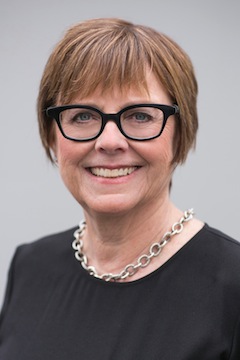
Claudia Goldman, outgoing national president of CHW, will be honored on Nov. 5. (photo from CHW)
“For, me personally, Hadassim has been like a second home. The relatives I am very close with in Israel sent all six of their children to Hadassim and our younger daughter volunteered at Hadassim. When you are at Hadassim, you really feel the impact that CHW has had on the school.”
While Hadassim has developed into an educational centre for all children living in the region, there are also dormitories for children in foster care, a special home for teenaged mothers and their babies, and group homes run by an Israeli family for younger foster children. Recently, there has been an influx of French teenagers, moving to Israel to escape antisemitism in France. Proceeds of the November gala will support Hadassim’s work.
Other visitors from Israel coming to Vancouver for the gala are connected directly to the village. Award-winning musicians Guy and Yahel are graduates of Hadassim, and they will provide the entertainment for the evening with their brand of rock-pop. These young performers, who were Voice of Israel finalists, have received numerous accolades, including a nomination by MTV Europe as the best Israeli act.
“I heard them play in Tel Aviv and I can promise you, they are really something special,” said Goldman. “As the lead volunteer for CHW, I feel that Guy and Yahel coming to Vancouver all the way from Israel to perform pro bono is a great message for CHW members and friends. Our Hadassim graduates are giving back to CHW for the loving support they received during their time at Hadassim.”
The gala will also focus on Goldman’s successes as president.
“I believe that so much more can be accomplished when people reach out and pull together as a team,” explained Goldman, whose presidency’s theme was “partnership.”
She has worked to strengthen the organization based on what she said CHW already does well. “CHW offers the magical mixture of camaraderie, while at the same time offering the opportunity to make positive change in the world,” she said. “It is empowering to help the most vulnerable citizens in our Jewish homeland. Sometimes, the world seems to be coming apart, but when you are able to fight back by helping strengthen Israel, while at the same time making friends with Jewish women and men from around the world, it feels incredibly empowering.”
Goldman has strong feelings about her work with CHW.
“I feel very proud that, over the last two years, I have been able to spread the enthusiasm and commitment I have for CHW,” she said. “With all of the problems in the world today, I am absolutely certain that the work we do is essential and that we are on the right track. CHW is strengthening the health services of Israel, supporting Israeli women and families, and rescuing Jewish children who are living under terrible antisemitism. We are making a huge difference, improving thousands of lives. Being CHW’s national president has been a very powerful experience.”
Chef Michael Solomonov samples the wonders of the Levinsky Market in Tel Aviv. (photo from israelicuisinefilm.com)
The 28th Vancouver Jewish Film Festival starts next week. New this year is an all-ages weekend of films at Rothstein Theatre, which follows the Nov. 3-10 festival screenings at Fifth Avenue Cinemas. Not new is the diverse selection of thought-provoking offerings.
With the festival opener, In Search of Israeli Cuisine, foodies will get their fix and then some. Guided by Michael Solomonov, the chef-owner of Philadelphia’s Zahav restaurant, the viewer is taken on a global food tour all within the confines of the tiny state of Israel.
Is there even an Israeli cuisine, the film asks. Yes, says food writer Janna Gur. “It’s perhaps a nascent cuisine, a baby cuisine, but a very precocious baby,” she says.
Israeli cuisine, Solomonov says, is made up of “traditions that were brought here and also that were born here.” He asks one market vendor how long he has had a spice shop. The reply: “Four hundred years.”
The food of Israel mirrors the history of the country, particularly its economy. In the years after independence, cuisine was defined by economical, modest recipes that incorporated the agricultural resources of the new state. In the 1980s, when the economy boomed, Israelis traveled more and wanted at home the kinds of flavors they found abroad.
Philosophically, Israeli food developed alongside the new identity the people were creating for themselves and their country. People were ashamed of the past and embarrassed by the foods of their parents. Israel’s “new Jew” was supposed to leave sad history behind and create a new post-galut civilization.
“In Israel, when you say Polish cooking, it’s another way of saying bland, boring, guilt-ridden kind of food,” says Gur.
Yet, the effort to abandon the past was both successful and, thankfully, unsuccessful. Tradition, in fact, integrates change through adaptive cookery. The centrality of Shabbat has defined Jewish and, therefore, Israeli cuisine, because of the necessity of developing recipes that can cook slowly for up to 16 hours. And, even though most Israelis are not religiously observant, Shabbat can still be a sacred family experience. One person explains that watching American TV, where families gather twice a year for Thanksgiving and Christmas, seems foreign, because every Jewish mother wants her daughters and sons with her every Shabbat.
Also unlike in most of North America, the film illustrates mouth-wateringly that a vegetarian in Israel can eat like royalty with endless options.
Politics also intervenes. During the Oslo peace process, Palestinian restaurants flourished in Israel. “Food makes peace,” says an Arab-Israeli chef. But there are also accusations of cultural appropriation.
“They often accuse us of stealing it,” chef Erez Komarovsky says of Israeli cuisine. But food knows no borders, he contends. “Food is not political. Food is what is grown on this land by the people who are living in it. If they are called Palestinians or Israelis, I don’t care. I don’t think the tomato cares.”
“Israeli salad is actually Arabic salad,” Gur admits. “What makes it Israeli is the way we use it.” That means eating it three meals a day and, for instance, stuffing it in pita with schnitzel.
The evidence about what defines Israeli cuisine is not entirely conclusive. Though Komarovsky claims to know.
“The essence of the Israeli taste is lemon juice, olive oil and the liquids from the vegetables,” he says. “And this is the taste that you miss after two or three days when you go abroad.”
– PJ
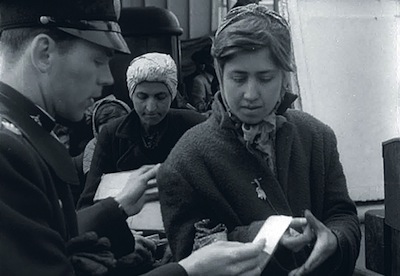
Liberation after the Holocaust was not unalloyed joy. It was complex, emotional terrain that involved coming to terms with the reality of the extent of the destruction of European Jewish civilization, individual family members and entire communities. This mix of emotions is clearly shown in Magnus Gertten’s documentary Every Face Has a Name.
Hinda Jakubowicz stepping off the ferry in Malmö on April 28, 1945. (photo from everyfacehasaname.com)
Gertten took a film that was shot of arrivals to Malmo, Sweden, on April 28, 1945, and obtained the list of 1,948 passengers who arrived that day. Then he set out to put names to faces.
Elsie Ragusin was an Italian-American New York girl visiting her grandparents in Italy when the war began and they could not return home. When the Nazis occupied Italy, she and her father were arrested as spies and she became, as she says, the only American girl in Auschwitz.
She looks at her face on the film and says: “There, I’m thinking: ‘Can this be true?’” The smiling people handing out food seemed unreal to her. No one had smiled at them in the camps.
Gertten, a Swede, was moved to make the film when he saw parallels with the faces in footage of refugees arriving in Europe today. “Who are they?” he asks.
Fredzia Marmur, now of Toronto, sees herself on film, at age 9, wearing the same cloth coat she wore when her family left the Lodz ghetto. “There I am again,” she says of a little girl beaming into the camera.
The other women in the screen were together with her in Ravensbruck and, while Marmur admits she didn’t know what was happening, she took a cue from those around her. “I saw that everybody seemed happy, so I decided to be happy too,” she says.
Siblings Bernhard Kempler and Anita Lobel, 8 and 10 in 1995, try to reconstruct their thoughts at the time. Bernhard survived dressed as a girl and the pair stuck together, avoiding all others through their time in hiding and at Ravensbruck.
“It looks to me like I’m somewhere between happy and frightened,” says Bernhard. “A mixture of hope, a mixture of relief, a mixture of ‘Can I trust this?’ and some fear.”
He recalls his reunion with his parents. He was in hospital and the staff gathered around to watch what they expected to be a joyful scene. It wasn’t. His response, he recalls of meeting his parents after years of separation was, “Who are these people?” He suspects his parents wondered, “Who is this child?”
“I didn’t know who I was for a long time after that,” he says.
The film intersperses images from 1945 with those of present-day refugees arriving (some alive, some dead) in Sicily. A small but disturbing 1945 scene is ostensibly happy – women receiving clothes in Sweden – but the camera shows their nakedness, as if, even on liberation, their right to privacy was not granted.
People couldn’t always tell who they were seeing in the film. Judith Popinsky recognized four of the five young women who formed her surrogate family in Auschwitz after their families were murdered on arrival there. Only after some self-convincing did she determine that the fifth woman must be her.
“You encountered so many nameless faces throughout that period in time,” she says. “No one remembers them anymore. They lived anonymously. They were buried anonymously. At least now some of them have their names restored.”
– PJ
In One Rock Three Religions, the rock in question represents the city of Jerusalem. The Temple Mount – which Muslims call Haram al-Sharif – is the literal rock, where the two historical Jewish temples existed and where al-Aqsa Mosque and the Dome of the Rock now stand. The film captures the glory of diversity and the tragedy of division that coexist in the holy city.
Divisibility in a political sense has been mooted several times. The 1947 Partition Resolution saw a Jerusalem under international governance. The city was divided, from 1948 until 1967, with East Jerusalem under Jordanian occupation and West Jerusalem in Israel. However, Kanan Makiya, author of The Rock, insists that, from a human standpoint, it cannot be separated. “How do you cut a rock?” he asks. “Jerusalem belongs to more than one faith. No one person, no one faith can claim it.”
When the Temple Mount was captured by Israel in the 1967 war, some soldiers raised an Israeli flag over the Dome of the Rock. Gen. Moshe Dayan ordered it taken down and handed the keys to the Wakf, the Muslim religious authority. This was both a symbolic and a practical decision, particularly in contrast with the exclusion experienced from 1948 to 1967, when Jews were forbidden from the holiest Jewish sites.
The documentary focuses on the contending claims and assertions of rights. The founder of the Muslim Public Affairs Council says he has not seen Jerusalem because he will not stop at checkpoints and be searched “by soldiers that I consider occupiers.”
Some religious Jews say that, because the Temple existed where al-Aqsa Mosque now stands, they should be able to pray there as well as at the Western Wall. A Palestinian diplomat calls this a provocation.
Former Israeli diplomat Dore Gold contends that Palestinian and other Arab leaders frequently incite their followers with allegations that Israel is attempting to undermine or destroy the mosque and its environs. And the film features the Palestinian ambassador to the United Nations repeating the incendiary falsehood that the Jews are trying to build the Third Temple in the place of the Dome of the Rock. Some Muslims are quoted denying any Jewish connection to the location.
This sort of denial, recently codified by UNESCO in a resolution that erases Jewish and Christian historical ties to the holy site, is evidence that strength through diversity in a place of such importance is often more wishful thinking than reality.
– PJ
AKA Nadia is far more complex and compelling than you might first assume. (photo from 2teamproductions.com)
When you read the sentence-long review of AKA Nadia on some sites – “A happily married mother of two seems to have the perfect life, until her hidden past comes to light” – you make a few assumptions. Namely, that the two-hour film is a fairly fast-moving tale of deception and drama. The opening scenes, in which a host of events happens, back this up: lively protagonist Nadia (Netta Shpigelman), a young Arab girl, graduates school in Jerusalem and secretly marries her lover, a PLO activist; they move to England where, fairly quickly, he’s caught by the authorities and she’s left alone, branded a terrorist and with no easy way of returning to Israel.
It’s not until half an hour in that the movie reveals its style – thoughtful and slow-moving, far more complex and compelling than you might first assume. When we were first introduced to Nadia, it was in East Jerusalem in 1987. We’re now reacquainted with her 20 years later, in the city’s west. Having fled England, thanks to a young Jewish woman’s passport, she’s completely (and secretly) rebuilt her life, as a Jew called Maya. And this is where the movie focuses the bulk of its time, perhaps too much time, on her new roles: successful dance choreographer, mother of two and wife to a Jewish official at the Ministry of Justice.
It’s only to be expected that this pleasant middle-class family life shatters when her past catches up with her. And every aspect of the subsequent relationship breakdown is well-acted and artistically produced. You feel for both husband and wife, and of, course, you’re forced to think of the bigger picture, too – religious identity in Israel and the ramifications of being Jewish versus Arab. Even after the movie ends – which it does a little abruptly – you’ll be left contemplating these issues for days.
– RS
My Home doesn’t shy away from its aim: showing how much minorities in Israel are typecast. It starts by stating that minorities (mostly Muslims, Christians, Bedouins and Druze) make up 20% of the population, but are often viewed by the outside world as all being Arabs who resent the Israeli “occupation” and the Jewish “apartheid state.” To show this is far from the case, the documentary follows the work of four people, one from each of the minority groups listed above.
A scene from My Home, in which Muhamed Kabiya undergoes an ID check in Jerusalem. (photo from ruthfilms.com)
The result is a slightly disjointed, but incredibly interesting portrayal of people who are all different, but united in their bravery. There’s a Greek Orthodox priest and a Lebanese Christian, both promoting integration by “others” into Israeli society. But the two people who really resonate are Wafa Hussein, a Muslim Zionist and school teacher preaching acceptance of all ethnicities, and Mohammad Ka’abiya, an Israeli Bedouin who prepares Bedouin teenagers in his village for Israel Defence Forces service, having served himself.
The latter two have been labeled traitors by their communities because of their activism, but persist in striving for coexistence. And this is an aspect of the documentary that must be applauded – there is no sugar-coating the discrimination minorities face: “as an Arab, you wake up in the morning and tell yourself, ‘I have a lot to deal with today.’” But, the film ultimately is a heartening look at the complexities, both good and bad, of calling Israel “home.”
– RS
For tickets to the festival, visit vjff.org or call 604-266-0245.
Rebecca Shapirois associate editor of vivalifestyleandtravel.com, a travel blogger at thethoughtfultraveller.com and a freelance journalist published in Elle Canada, the Guardian, the Huffington Post and more.
Left to right are shinshiniot Yael Miller, Dana Salmon, Shahaf Shama and Danielle Favel. (photo by Michelle Dodek)
For the second year in a row, Jewish Federation of Greater Vancouver is providing our community with a burst of ahavat Yisrael, love for Israel. The shinshiniot – who are doing sh’nat sherut, community service, locally – are back. While there were three young women participating last year, this year’s enthusiastic group numbers four.
The shinshiniot program is part of Gesher Chai (Living Bridge), which Jewish federations across North America use to form person-to-person relationships between young Israelis and Diaspora youth. Based on the first run, Lissa Weinberger, manager of Jewish education and identity initiatives and the woman dealing primarily with this program, said, “We have changed a number of things this year based on our observations and experiences. It seems like putting the girls in pairs in their volunteer assignments is a really good idea.”
After a period of adjustment and integration into the community, the shinshiniot were paired off in mid-September. Danielle (Dani) Favel and Shahaf Shama work together during the weekdays in three community organizations: the Jewish Community Centre of Greater Vancouver, King David High School and Richmond Jewish Day School. Vancouver Talmud Torah takes up most of the time of the other two shinshiniot, Dana Salmon and Yael Miller.
On weekends, Beth Tikvah Congregation will have Shama, Salmon will help at Congregation Beth Israel and Miller and Favel will team up at Temple Sholom. Last summer, the shinshiniot divided between the region’s summer camps and the JCC’s Camp Shalom. Where they will be placed this summer has not yet been determined.
The shinshiniot bring with them experiences from their diverse family backgrounds and the different parts of Israel in which they live.
Salmon is from Ma’ale Adumim, a suburb of Jerusalem and has a family from Iran, Syria and Iraq. Shama’s family is also Mizrahi, with a little North African added; she grew up with her three siblings on Kibbutz HaZore’a near Haifa.
Miller and Favel are both of Ashkenazi descent, but with very different roots. Miller, who hails from Modi’in – the historical base of the Maccabees in the Chanukah story – was raised attending a Reform synagogue, a rarity in Israel. Favel’s parents both made aliyah because of their devotion to the Habonim Dror youth movement, one parent from Scotland and the other from Australia; she grew up on a small kibbutz called Kadarim with a view of the Kinneret.
The creativity and energy this group brings to their tasks are palpable. Although they are stationed in certain locations for the bulk of their volunteer work here, there will be community-wide events on which they will collaborate. Most notably, events around Lag b’Omer, Yom Hazikaron and Yom Ha’atzmaut. They also have individual passions they hope to be able to share with young people here.
“I would like to start some musical bands,” said Salmon. “I play the guitar and sing and would love to share Israeli music with people in Vancouver.”
Favel has musical aspirations as well. “I’ve been singing in a choir since I was 9,” she said. “I’d love to start a choir here that would sing Israeli songs.”
Miller has hopes of starting a teen pen-pal program, replacing the pens with computers, of course, while Shama hopes to marry her love of cooking and dressing up with her North African roots. “I want to bring [my experience of] the tradition of Mimuna to Vancouver,” said Shama. “The food, the traditional dress, the incredible celebration is something I would like to share.”
Not only do the shinshiniot share with the students and young people with whom they are volunteering, but also with the host families who welcome them into their homes. Shama started sharing her enthusiasm and talent for cooking immediately, said her “host mother,” Jennifer Shecter-Balin.
“This is our second time hosting a shinshinit and we really like it,” said Jackson Balin, 10. “You get a nice fun person from Israel living with you for three months. I like the culture and they teach you, you teach them.”
Balin said Shama makes Israeli salad for the family every evening and has made other delicious Israeli dishes as well.
Other ways in which the shinshiniot are contributing to our community are by providing Israeli dancing and cooking classes, and conversational Hebrew for youths who usually only get to speak Hebrew at home with their parents. The fact that they are recent high school graduates is a bonus for their ability to connect with local teens.
“Shinshiniot coming here enhances our experience, builds relationships and understanding for our kids, and it has an impact in our community and theirs back in Israel when they return,” said Federation chief executive officer Ezra Shanken.
Federation is still looking to fill some of the host family spots: if interested, contact Weinberger at lweinberger@jewishvancouver.com or 604-257-5104. For more information on the program or to contribute to Federation’s annual campaign, visit jewishvancouver.com.
Michelle Dodekis a Vancouver-based freelance writer whose 10-year-old son Max helped interview the shinshiniot. Having hosted one last year, he very much looks forward to hosting one soon.
With the large numbers of refugees and immigrants making their way to Winnipeg and elsewhere in Canada, Winnipeg Friends of Israel invited Dr. Solly Dreman, a Winnipegger who moved to Israel in 1964, to speak on the topic.
In the Sept. 19 lecture at the Asper Jewish Community Campus, Dreman drew from his own experience and expertise, using the work he did, along with colleague Dr. Ava Shinar, on immigration in the 1990s to illustrate an optimal way of integrating immigrants into Israeli society, which could be applied to other countries.
“I did the workshop with her over a decade ago, but the implications are certainly relevant to the contemporary problems occurring in the world today, and to immigrant and refugee populations all over the world,” said Dreman.
“Immigration is widely recognized as a stressful event which increases psychological vulnerability,” he explained. “Researchers have noted that adolescent immigrants … we know that many terrorists are in that age group … constitute an extremely high-risk population. In adolescence and late adolescence, there’s a need to cope with profound physical, psychological and social transformations. And, in those adolescents who have become immigrants and [are] in a strange and often unwelcoming environment, the uprootedness and difficulties in establishing a solid base of identity and meaning could have disastrous results. Indeed, the violence evident today in such places like Paris, Nice, Brussels, Orlando, San Bernardino, as well as Tel Aviv and Jerusalem, testifies to this. Youth confronted with a strange environment and difficult economic conditions, as well as lack of purposefulness in their lives, often latch onto causes and groups that implement terrorism and violence in the international community.”
Dreman also discussed other issues.
“In the 1990s,” he said, “with the collapse of the Soviet Union, there was a mass exodus of over a million Soviet Jews to Israel. Soviet students comprised about 10% of the student body at Ben-Gurion University. They were competing for limited resources, such as dormitory space, scholarships and, eventually, opportunities for employment.
“There were many negative stereotypes and attitudes prevailing between the native Sabra students, who were born in Israel, and their Soviet counterparts. As far as the stereotypes that Israelis had toward the Russians, well, they often viewed them as manipulative, clannish and corrupt … while the Russian students perceived the Israelis as loud, aggressive and uncouth.
“The Russians, in that first year of the workshop, we also heard some terrible things they had to say about the Ethiopians, referring to them as subhuman, subspecies, monkey-like, etc.”
With the extreme alienation between Sabras and the immigrant students – to the point of outright violence and fist fights – Dreman needed to find ways of reducing tensions and bringing understanding, cooperation and solidarity between the groups.
He said it was important to create an atmosphere where each group could participate in an evolving melting-pot culture, where each side would begin to listen to and understand the other. As such, he and Shinar created a two-credit academic course that eventually became a four-credit, year-long course because of its popularity.
“So, students were given an award for their participation and for completing course assignments,” said Dreman.
He explained, “The syllabus described it as being designed to help students learn about their family and individual transitions in the face of such phenomena as birth, adolescence, illness in the family, divorce and death … but with a particular emphasis on aliyah immigration.”
Normative aspects of immigration and transition were discussed in an academic context, so participants could then discuss their own experiences in a non-threatening atmosphere and place those experiences in an appropriate context, in an effort toward understanding what they themselves were going through.
At first, due to the Israelis’ fluency in Hebrew and the Russians’ more reserved manner, the Sabras monopolized the class. But, after a few sessions and with a little prompting, the Russians became much more comfortable and vocal.
“What we wanted to do was create an evolving identity,” said Dreman. “Emphasis was placed on joining the new culture, but space should be provided for the immigrant representatives to give expression to their culture of origin, needs and expectations. On the educational level, awareness workshops should be introduced in citizenship classes in elementary schools, high schools and colleges. It is also critical that government and volunteer groups work together to help promote immigrant absorption.”
Dreman recognizes that the work they did in Israel had many atypical factors working in its favor, but said the attitude of creating a type of melting pot should yield a good result in most cases. As well, while the workshops had some factors going for them, like participants with a common Jewish identity, working with young adults (18-to-24-year-olds) posed challenges that are less common with older immigrants, such as extremism and radicalization.
Dreman wanted to be very clear in differentiating between immigrant and refugee populations, noting the difference “between immigrants who want to immigrate and refugees who are exiled and may not necessarily want to.
“The purpose of our workshop was to make the hosts and the new immigrants understand where the other person is coming from, to create a merging of cultures and understanding in order to ease the process of assimilation,” he said. “I think the beautiful thing is that it was based on reciprocity. It was very successful. In the workshop, at the beginning, people hated each other. At the end, almost all had befriended people from the other group.
“If people knew that the immigrants had a real desire to be part of the hosts’ community, I think there’s a lot of opportunity for mutual understanding,” he added.
According to Dreman, the setting also plays a significant role. “In one of the projects we did, we sent kids out in one of the groups to interview Israelis – native Israelis – concerning their attitudes towards Russians. We sent them to a marketplace, a competitive marketplace with pedlars. And, another group, we sent to interview Israelis in Dizengoff Centre, which is upper-class…. How did the native Israelis describe the Russians in the marketplace? ‘Swindlers, crooks, gamblers, prostitutes, bastards.’ What about in the centre? They described them as ‘wonderful, contributing to the nation,’ and so on.
“In Europe and North America, if somehow they could take select groups of people who host immigrants and let them have that encounter and spread the gospel – ‘Hey, they aren’t that bad,’ that sort of thing – there is no reason it would not be successful.”
Genetic testing can save lives. So, why isn’t everyone getting it done? It turns out that companies are using the information from the tests to discriminate against applicants.
While this is by no means a Jewish-specific issue, the National Council of Jewish Women of Canada (NCJWC) and the Centre for Israel and Jewish Affairs (CIJA) are taking the lead in urging the federal government to legislate against this discriminatory practice.
“At NCJWC, our goals are for education, service and social action,” said Sharon Allentuck, the organization’s national president. “Social action includes writing to MPs, senators and the prime minister … [about] genetic testing and insurance denial.”
Genetic testing has been high on NCJWC’s list of priorities for the past 25 to 30 years and it continues to be – not just with respect to concerns over insurance companies’ actions, but also to increase public awareness of the importance of genetic testing.
In Winnipeg, for example, a clinic is held every three to four years in conjunction with Health Sciences Centre geneticist Dr. Cheryl Greenberg. While, in the past, the main focus was on Tay-Sachs, the list keeps getting larger, as geneticists like Greenberg discover new gene connections. At the moment, the list stands at seven to eight different Jewish genetic diseases being studied.
By getting a test done, one can be aware of a possible genetic problem that might affect oneself or one’s children, if a person has children with another carrier of the same disease. This knowledge can provide people with peace of mind when choosing a partner.
So far, though, this knowledge has come with a cost. When people apply for insurance, they are asked to disclose the results of their genetic testing.
“It came to our attention that insurance companies said to some people, ‘You’ve been tested, genetically. You have certain predispositions. Sorry, but we’re going to deny you insurance,’” said Allentuck. “It’s against human rights, it’s discriminatory. Canada is the only G7 country that allows this to happen. And so, legislation [Bill S-201] preventing that discrimination was passed through the Senate and now it’s in the House of Commons. We are asking our members and are working with CIJA to encourage [Jewish community] members to contact their members of Parliament to ensure the legislation passes.”
CIJA adds on its website, “We encourage provincial legislatures to pass complementary legislation, with a specific focus on employment and insurance.”
For more information, visit NCJWC’s website or Facebook page. Allentuck encouraged readers to become NCJWC Facebook friends in order to stay regularly updated on this and other important topics.
“This isn’t a Jewish issue,” she said. “But that doesn’t mean that Jewish people can’t have a say in it.”
When organizers of the Vancouver Jewish Film Festival select the films they will screen, timeliness is probably among the considerations. They could hardly have known they would hit the nail on the head so perfectly with One Rock Three Religions. The film explores the contending claims for the world’s most in-demand religious real estate: that which Jews call the Temple Mount.
The site of the First and Second Temples, the latter destroyed by the Romans after 70 CE, is also the location of al-Aqsa Mosque and the Dome of the Rock, holy sites for Muslims. The Western Wall, adjacent to the Temple Mount, known to Muslims as Haram al-Sharif, is the holiest site on earth for the Jewish people. The Temple Mount also holds significance for Christians. This is not breaking news.
But the 58-member executive board of UNESCO, the United Nations Educational, Scientific and Cultural Organization, earlier this month passed a resolution – with 24 countries in favor, 32 against or abstaining and two absent – that uses language that exclusively recognizes the Muslim history of the area, implicitly erasing Jewish and Christian claims to the space. (Canada is not part of the board.)
Denying Jewish claims to the Temple Mount is not breaking news, either. This form of historical erasure has been going on for decades.
In the film, Rabbi Marvin Hier, founder of the Simon Wiesenthal Centre in Los Angeles and a rabbi emeritus of Vancouver’s Schara Tzedeck, notes that the supreme Muslim authority in Jerusalem published for decades a visitor’s guide to the site. From 1924 until 1953, the guidebook made clear that the location was indisputably the site of Jewish temples. The 1954 iteration of the guide omitted the Jewish connection to the holy place for the first time. Some Arab and Palestinian figures, including Yasser Arafat and Mahmoud Abbas, have made it their business to deny the historical and archeological truth ever since. The denial of a Jewish connection to Jerusalem has come to coexist with the denial of Jews to a right to self-determination in our unceded ancestral territory, as part of a global phenomenon of denying Jewish history.
It may be naïve to get on our high horses and pretend that UNESCO’s appalling denial of Jewish (and Christian) connections to the Temple Mount is some new low in global attitudes toward Israel. This is nonsense, certainly, but only on a continuum of nonsense that defines the anti-Israel movement globally.
We can take some solace in the fact that the vote was not passed by a majority. As well, on the positive side, this “theatre of the absurd,” as Israeli Prime Minister Binyamin Netanyahu called it, at least forced the hands of a few leaders, including Italian Prime Minister Matteo Renzi, who promised to find out why his country’s representative abstained from the vote. Even UNESCO’s own director-general, Irina Bokova, said: “Jerusalem is the sacred city of the three monotheistic religions – Judaism, Christianity and Islam.… To deny, conceal or erase any of the Jewish, Christian or Muslim traditions undermines the integrity of the site, and runs counter to the reasons that justified its inscription on the UNESCO World Heritage list.”
In the end, it all amounts to bubkes for Israel. Israel will continue to provide, as the VJFF film demonstrated, access to all religious sites for all peoples, to say nothing of continuing to be the educational, scientific and cultural exemplar it is. If only UNESCO contributed as much.
On Oct. 22, 200 teachers from across British Columbia and Ontario participated in Code Class, a one-day coding and computational thinking crash course.
The inaugural class was hosted by coding education experts Lighthouse Labs, which partnered with Kids Code Jeunesse, a nonprofit dedicated to empowering kids and teachers through code, and Computer Using Educators of British Columbia (CUEBC).
Code Class is a free, full-day workshop designed specifically for K-12 educators that aims to introduce educators to computational thinking and inspire them to bring code into the classroom. It supports teachers by removing barriers and fostering an understanding of computational thinking, technology and basic code.
Computational thinking is problem solving; it’s understanding larger structures with both human and technological systems. It could be as simple as following a recipe, or as advanced as coding a website. Computational thinking is to computers as astronomy is to telescopes; it’s about how people conceptualize information, and how they put those concepts into practise.
With the introduction of code into the new ADST (Applied Design, Skills and Technologies) curriculum across British Columbia, Code Class organizers believe that it is more important than ever to invest in teachers and to give them the tools and resources needed to bring code into the classroom.
“Lighthouse Labs is proud to support teachers across Canada,” said Jewish community member Jeremy Shaki, co-founder of Lighthouse Labs. “We believe that great education starts with great teachers and grows from there. The best solution for incorporating technology into the classroom is to provide teachers with the tools and resources they need to inspire their students.”
“By educating children with the tools needed to create and communicate within the 21st century, we are providing them with the skills needed to build their own future success,” said Kate Arthur, founder and co-director of Kids Code Jeunesse, which is based on the belief that coding is a basic literacy as important as reading, writing or math.
K-12 teachers of all subjects who attended the 2016 CUEBC conference could participate in the free-of-charge one-day workshop held at School District 43’s École Riverside Secondary School in Port Coquitlam. More than two dozen software developers from local technology companies mentored participants during the workshop, and no previous coding experience was required to attend.
Computational thinking already exists within some key aspects of teachers’ classrooms, said Jon Hamlin, president of CUEBC, an organization of volunteer teachers in the province dedicated to promoting the educational uses of technology in schools. “We hope to reframe their understanding of the subject, see how it connects in cross-curricular ways, and see computers and coding from a new perspective. Together with Lighthouse Labs, we aim to support all K-12 teachers in their adoption of the new ADST provincial curriculum.”
For more information about Lighthouse Labs, its approach to teaching web and mobile software development, and the courses it offers, visit lighthouselabs.ca.
“The power above is set in motion by the impulse from below, even as vapor ascends to form the cloud. If the community of Israel did not first give the impulse, the One above would not move to meet her, for yearning below makes completion above.” – Zohar, Genesis 35a
I have always believed the secret of Jewish survival is exemplified in the life of my grandmother, of blessed memory, who I never met. She died when my mother – the second youngest of 11 children – was only 7 years old. Young as she was, my mother, Sarah Rebecca Opas, never forgot her mother, or the spirit of Yiddishkeit she left behind.
My grandmother’s name was Mila and she was betrothed to my grandfather David from the age of 3, when her parents in Plotsk, Poland, called her in from playing to tell her that, when she grew up, she was to marry the little boy next door. This was back in the early 1800s when betrothals were arranged by parents as a matter of course.
It was the time of pogroms in Europe and, when he reached the age of 17, David informed his parents he was leaving for the New World and had secured a job on a ship. “What about Mila?” he was asked. “I will send for her when I get settled,” he assured them. “No you won’t, you’ll take her with you.” So, Mila, then 16, and David were married by the rabbi before sailing to the New World, which David believed to be America, but was in fact Australia.
The ship took six months to reach Port Adelaide in Australia. David was hired to be a handy man on the vessel, and his first job was to look after the food. As there was no refrigeration then, the whole supply of meat was lowered on cables into the ocean, where the salt water would preserve it. However, he failed to secure it properly, and it all sank to the bottom of the sea – no meat for the crew for the entire trip. His next job on board was to sew any sails that had been torn in the strong winds. He had no idea how to sew, so his young wife did it for him, as well as keeping the captain and crew’s clothing repaired.
Before they reached Australian shores, Mila was already expecting her first child.
Both having come from Orthodox homes, it was a terrible shock to them when they landed. No synagogues, no kosher butchers, no established Jewish communities. They settled in a little country town, Bombala, near the border between Victoria and New South Wales. David opened a store to provide fodder and dry goods to the farmers in the surrounding districts and, gradually, as they learned English, the business prospered enough to give the family a comfortable lifestyle.
But Mila’s heart was always sad, because she did not know how to keep her family Jewish, as there were no other Jews for them to meet and marry. So, she made a plan.
Mila had heard that there was a small Jewish community in the city of Sydney. As each of her older children turned 18, she would travel to Sydney and stay there until she found a Jewish boy or girl willing to go back with her to Bombala and marry one of her children, sight unseen. Her love of her Jewish heritage was such that achieving this became the most important part of her life, and she was amazingly successful. Of the 11 children, only one of them married a non-Jew; there were no divorces. Sadly, Mila died of scarlet fever still relatively young, before the penicillin was invented that would have saved her life.
My mother and her little brother were raised by their older sisters, who by then were all married. They never let her forget her mother and the importance of remaining Jewish even in near-impossible situations where Jewish rituals are almost nonexistent.
In retelling my grandmother’s story to me so many years later, my mother always stressed that the Jewish soul is unquenchable. No matter how far one strays from observance, the spark remains and it is something precious that must be cherished and passed on from generation to generation. By making my home in Israel, becoming an observant Jewish woman, and being blessed with 18 Israeli grandchildren and 16 great-grandchildren here, I hope my mother and grandmother can be at rest.
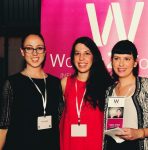
Woman2Woman co-founders, from left, Efrat Dayagi, Keren Herscovici and Noya Lempert. (photo from Woman2Woman via israel21c.org)
Israeli actress Gal Gadot may be Wonder Woman on the big screen but Keren Herscovici, Noya Lempert and Efrat Dayagi – the initiators of a program for advancing women in prominent positions in their careers – are the true wonder women of Israel. They started Woman2Woman to help young women in top decision-making positions advance in their careers (in all fields) with some guidance from mentors who have already been there and succeeded.
“A number of times in my life, I’ve felt that I’m really in need of a mentor, and that’s what our initiative is geared toward, answering this need,” said Dayagi, a lawyer. “You can’t just cold-call someone and say, ‘So-and-so told me to call you for advice.’ I’ve sought something like this program and I would have loved a connection like this with a mentor.”
Herscovici, Lempert and Dayagi say theirs is different from other female empowerment initiatives because they don’t see women as underdogs.
“We’re not coming from the stereotypical place where women need help because they are in a lower place,” said Lempert, a doctoral student in clinical psychology. “We’re coming from a place where women have a ton of potential and we want to help them take that potential as far as possible; not from weakness but from a place of strength.”
“Ideally, there shouldn’t be a glass ceiling but, in reality, there is. The ceiling still exists. So, as long as it is there, we need to talk about it,” the women said, finishing off one another’s sentences.
Herscovici, Lempert and Dayagi are graduates of Unit 8200, the Israel Defence Forces’ signal intelligence division, known for producing an unprecedented number of startup entrepreneurs, as well as alumni with problem-solving, leadership and top managerial skills. They saw that, although women comprise half the soldiers in the unit, as 8200 alumni progress in their civilian careers, fewer women are staying in the lead. Since each member of the trio is moving full steam ahead on her individual career path, they wanted to know why other women – including those who were officers in the army – were stalling before reaching their destination.
They said they found that even the most talented woman can stumble on self-planted obstacles.
“There are many factors that can hold a woman back – family, society, discrimination – but we found one of the main reasons is they don’t believe in themselves,” said Dayagi. “There are many women who have amazing potential but feel their womanhood is stopping them from reaching the top of their game. If we know that we have the potential to succeed – and not belittle ourselves with, ‘But I’m a mom’ or ‘I’m a woman,’ or compare ourselves to men by saying, ‘Well, I’m a woman, I won’t get that position’ – then there’s no reason not to succeed.”
“We want to take the young women who are just setting out and to make sure that they continue on the path of leadership and success. We connect them with women who have already progressed a long way,” added Herscovici, a master’s student in operations research.
The program matches a young woman at the beginning of her career with a mentor in a senior position in her chosen field of expertise and sets up one-on-one sessions and group meetings.
The first four-month mentorship program, which concluded in August, accepted 20 of the 80 23-to-33-year-old applicants coming out of Unit 8200. Among the many volunteer mentors were former Treasury director-general Yael Andorn, manager of Kodak Israel Einav Aharoni-Yones and global head of human resources at Amdocs Karmit Shilo. The second program will be open to all success-minded women, not just those who have served in Unit 8200.
“We’re not aiming to change the world – we want to change how women see themselves and their worth,” said Dayagi. “We want women to embrace the idea that they can succeed in any industry.”
Herscovici said the programs are part of a bigger overall goal. “Our mission is to have an influence on the future,” she said. “We are among the few to offer personal, woman-to-woman mentors. We also have a variety of careers, not just high-tech and not just entrepreneurship, but different fields such as financing, law, science and others. We want to create a professional network of women mentors.”
Israel21Cis a nonprofit educational foundation with a mission to focus media and public attention on the 21st-century Israel that exists beyond the conflict. For more, or to donate, visit israel21c.org.
On Oct. 19, Richmond Mayor Malcolm Brodie, second from the right, joined the Bayit’s celebration of Sukkot. He is pictured here with, from the left, Michael Sachs, Bayit president; Miki Fadida, sponsor of the Fadida Family Sukkah; Rabbi Levi Varnai, spiritual leader of the Bayit; and Moshe Fadida. The mayor discussed the local Jewish community, as well as some of the challenges facing young families. (photo from the Bayit)