
Skip to content
  • Home
  • Subscribe / donate
  • Events calendar
  • News
    • Local
    • National
    • Israel
    • World
    • עניין בחדשות
      A roundup of news in Canada and further afield, in Hebrew.
  • Opinion
    • From the JI
    • Op-Ed
  • Arts & Culture
    • Performing Arts
    • Music
    • Books
    • Visual Arts
    • TV & Film
  • Life
    • Celebrating the Holidays
    • Travel
    • The Daily Snooze
      Cartoons by Jacob Samuel
    • Mystery Photo
      Help the JI and JMABC fill in the gaps in our archives.
  • Community Links
    • Organizations, Etc.
    • Other News Sources & Blogs
    • Business Directory
  • FAQ
  • JI Chai Celebration
  • JI@88! video

Recent Posts

  • Last hostage home
  • New bill targets hate crimes
  • Concerning actions
  • Recipes not always required
  • Survivor urges vigilance
  • Seniors profoundly affected
  • Farm transforms lives
  • Musical legacy re-found
  • A range of Jewish literature
  • A concert of premieres
  • Variety telethon on Feb. 22
  • Victoria club’s many benefits
  • Avodah dedicated to helping
  • Artists explore, soar, create
  • Life’s full range of emotions
  • Community needs survey closes March 29
  • Jerusalem marathon soon
  • Historic contribution
  • Chronicle of a community
  • Late-in-life cartoonist
  • Cashflow vs growth portfolio
  • My new best friend is Red
  • ישראלים רבים ממשיכים לתמוך בטראמפ ועדיין אינם מבינים במי מדובר
  • עשרים ואחת שנים בוונקובר
  • Supporting the Iranian people
  • The power of photography
  • A good place to start
  • When boundaries have shifted
  • Guitar virtuosos play
  • Different concepts of home
  • Broadway’s Jewish storylines
  • Sesame’s breadth and depth
  • Dylan Akira Adler part of JFL festival
  • Mortality learning series
  • A new strategy to brighten up BC
  • Sharing latkes and light

Archives

Follow @JewishIndie
image - The CJN - Visit Us Banner - 300x600 - 101625

Tag: Haram al-Sharif

Whose holy site?

When organizers of the Vancouver Jewish Film Festival select the films they will screen, timeliness is probably among the considerations. They could hardly have known they would hit the nail on the head so perfectly with One Rock Three Religions. The film explores the contending claims for the world’s most in-demand religious real estate: that which Jews call the Temple Mount.

The site of the First and Second Temples, the latter destroyed by the Romans after 70 CE, is also the location of al-Aqsa Mosque and the Dome of the Rock, holy sites for Muslims. The Western Wall, adjacent to the Temple Mount, known to Muslims as Haram al-Sharif, is the holiest site on earth for the Jewish people. The Temple Mount also holds significance for Christians. This is not breaking news.

But the 58-member executive board of UNESCO, the United Nations Educational, Scientific and Cultural Organization, earlier this month passed a resolution – with 24 countries in favor, 32 against or abstaining and two absent – that uses language that exclusively recognizes the Muslim history of the area, implicitly erasing Jewish and Christian claims to the space. (Canada is not part of the board.)

Denying Jewish claims to the Temple Mount is not breaking news, either. This form of historical erasure has been going on for decades.

In the film, Rabbi Marvin Hier, founder of the Simon Wiesenthal Centre in Los Angeles and a rabbi emeritus of Vancouver’s Schara Tzedeck, notes that the supreme Muslim authority in Jerusalem published for decades a visitor’s guide to the site. From 1924 until 1953, the guidebook made clear that the location was indisputably the site of Jewish temples. The 1954 iteration of the guide omitted the Jewish connection to the holy place for the first time. Some Arab and Palestinian figures, including Yasser Arafat and Mahmoud Abbas, have made it their business to deny the historical and archeological truth ever since. The denial of a Jewish connection to Jerusalem has come to coexist with the denial of Jews to a right to self-determination in our unceded ancestral territory, as part of a global phenomenon of denying Jewish history.

It may be naïve to get on our high horses and pretend that UNESCO’s appalling denial of Jewish (and Christian) connections to the Temple Mount is some new low in global attitudes toward Israel. This is nonsense, certainly, but only on a continuum of nonsense that defines the anti-Israel movement globally.

We can take some solace in the fact that the vote was not passed by a majority. As well, on the positive side, this “theatre of the absurd,” as Israeli Prime Minister Binyamin Netanyahu called it, at least forced the hands of a few leaders, including Italian Prime Minister Matteo Renzi, who promised to find out why his country’s representative abstained from the vote. Even UNESCO’s own director-general, Irina Bokova, said: “Jerusalem is the sacred city of the three monotheistic religions – Judaism, Christianity and Islam.… To deny, conceal or erase any of the Jewish, Christian or Muslim traditions undermines the integrity of the site, and runs counter to the reasons that justified its inscription on the UNESCO World Heritage list.”

In the end, it all amounts to bubkes for Israel. Israel will continue to provide, as the VJFF film demonstrated, access to all religious sites for all peoples, to say nothing of continuing to be the educational, scientific and cultural exemplar it is. If only UNESCO contributed as much.
Posted on October 28, 2016October 27, 2016Author The Editorial BoardCategories From the JITags anti-Israel, antisemitism, Haram al-Sharif, Israel, Temple Mount, UN, United Nations
Word choice matters

Word choice matters

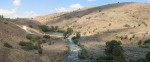
The Jordan River is “the only river on planet earth that on its good days is a few feet wide, and people claim that it has a bank 40 miles wide.” (photo from Beivushtang via Wikimedia Commons)

Settlements or Jewish communities? West Bank or Judea and Samaria? East Jerusalem or eastern Jerusalem? Those are some of the language choices that journalists covering the Israeli-Palestinian conflict are faced with each day – and those choices should not be taken lightly, experts say.

“It’s the terminology that actually defines the conflict and defines what you think about the conflict,” said Ari Briggs, director of Regavim, an Israeli nongovernmental organization that works on legal land-use issues. “Whereas journalists’ job, I believe, is to present the news, as soon as you use certain terminology, you’re presenting an opinion and not the news anymore.”

“Accuracy requires precision; ideology employs euphemism,” said Eric Rozenman, Washington director of the Committee for Accuracy in Middle East Reporting in America (CAMERA).

At the conclusion of his essay, “Politics and the English Language,” George Orwell argues that writers have the power to “send some worn-out and useless phrase … into the dustbin, where it belongs.” Many Jewish leaders, organizations and analysts wish to do just that with the following terms, which are commonly used by the mainstream media in coverage of Israel.

West Bank: Dani Dayan believes the “funniest” term of all that is used in mainstream coverage of Israel is West Bank. Dayan is the chief foreign envoy of the Yesha Council, an umbrella organization representing the municipal councils of Jewish communities in an area that the Israeli government calls Judea and Samaria, in line with the region’s biblical roots. Yet, media most often use West Bank to describe the area in reference to the bank of the river situated on its eastern border.

“[The Jordan River] is the only river on planet earth that on its good days is a few feet wide, and people claim that it has a bank 40 miles wide [spanning across Judea and Samaria],” Dayan told this reporter. “There is no other example of such a thing in the geography of planet earth. That proves that West Bank is the politicized terminology, and not Judea and Samaria, as people claim.”

Member of Knesset Danny Danon (Likud) has said it’s “ridiculous” that West Bank – a geographic term that once described half of the Mandate of Palestine – has “taken on a political meaning that attempts to supersede thousands of years of Jewish tradition.”

“The correct name of the heartland of the Land of Israel is obviously Judea and Samaria,” he said.

Rozenman, the former editor of the Washington Jewish Week and B’nai B’rith Magazine, draws a distinction between the context of Palestinian and Jewish communities in the area. “If I’m referring to Palestinian Arab usage or demands, I use West Bank,” he said. “If I’m referring to Israeli usage or Jewish history and religion, etc., I use Judea and Samaria. Israeli prime ministers from 1967 on, if not before, used and [now] use Yehuda and Shomron, the Hebrew from which the Romans latinized Judea and Samaria.”

West Bank is fair to use, “so long as it’s noted that Jordan adopted that usage in the early 1950s to try to legitimate its illegal occupation, as the result of aggression, of what was commonly known as Judea and Samaria by British Mandatory authorities,” added Rozenman.

Dayan, meanwhile, prefers to call Palestinian communities in Judea and Samaria exactly that. “The area is Judea and Samaria and, in Judea and Samaria, there are indeed Palestinian population centres, and that’s perfectly OK,” he said. “We cannot neglect that fact, that yes, we [Jews] are living together with Palestinians. And, in Judea and Samaria, there is ample room for many Jews, for many Palestinians, and for peaceful coexistence between them if the will exists.”

Settlements: Judea and Samaria’s Jewish communities are often called settlements, a term that can depict modern-day residents of the area as primitive.

Settlements “once referred in a positive manner to all communities in the Land of Israel, but at some point was misappropriated as a negative term specifically against those Jews who settled in Judea and Samaria,” Danon said. “I prefer to use ‘Jewish communities in Judea and Samaria’ when discussing the brave modern-day Zionistic pioneers.”

Dayan said that “settlements” is not pejorative, but still inaccurate. “It’s a politically driven labeling in order to target those [Israeli] communities,” he said. “Most communities in Judea and Samaria are not different from any suburban or even urban community in Europe, in the United States, in Israel itself, or elsewhere.”

Read more at jns.org.

Format ImagePosted on December 5, 2014December 3, 2014Author Jacob Kamaras JNS.ORGCategories IsraelTags Green Line, Haram al-Sharif, Israel, Jerusalem, Palestine, Palestinians, settlements, West Bank
Proudly powered by WordPress