Oberlin’s Jewish problem

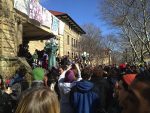
Protesters at Oberlin College. (photo by Pteranadons via Wikimedia Commons)

(This is Part 1 of a two-part series. The second article examines the student-as-customer approach at universities and its relation to identity politics on campus.)

New York Times columnist Frank Bruni wrote in a June article that “Oberlin College would certainly be in the running” if he picked one campus “that has been roiled the most by struggles over political correctness.”

While university president Marvin Krislov has acknowledged upheaval, he wrote – in the same Times section – that Oberlin’s “faculty and staff … maintain high academic standards and rigor.”

Since I attended the 50th reunion of my class, I realize I do care about the calamity that Oberlin College now exemplifies.

Every town in northern Ohio has history built around either its bar or its liberal arts college. Oberlin was a “dry” town, founded in 1833, the same year as Oberlin College. Then, in 1893, Oberlin became the birthplace of the Anti-Saloon League, the political movement behind the U.S. Constitution’s 18th amendment: prohibition, which took effect in 1920. That social experiment was a disaster, and the 21st amendment repealed the 18th in 1933. Oberlin College finally eased its ban on beer decades later, yet zealotry still haunts the campus.

Bruni scorns “the demand for a so-called trigger warning to students who might be upset reading Antigone,” and he seems bemused by “complaints about the ethnic integrity of the sushi in a campus dining hall.” But it was not funny when, in September 2013, a Latina Jewish student helped plan a Shabbat dinner where Latin American food would be served – and another Oberlin Latina student denounced the event’s “cultural appropriation.” As one Jewish student recalled in a Tablet article this past May, posters for a previous Asian Fusion Shabbat were “defaced with graffiti about appropriation and orientalism. Comfort food Shabbat was also ill received, with comments about appropriating black cooking.

“There is a common belief at Oberlin that all Jews are white and rich” – so a Jew cannot be Latin American, cannot be a “person of color,” etc. – and, therefore, all Jews on campus should eat “white” food. Of course, such dogma defies both fact and logic, harms individuals and undermines the college’s stated “diversity” goals.

In the same Tablet article, it was noted that, in 2013, the Oberlin Student Cooperative Association revoked affiliation of one dining hall, “the Kosher-Halal Coop (used predominantly by Jews).”

Timothy Elgren became Oberlin’s dean of arts and sciences in July 2014. In February 2016, Oberlin’s online news site posted the transcript of conversation in which Elgren told Krislov that “changes to the way we run our faculty searches have been very important.”

One such search for an assistant professor led to the appointment of Joy Karega. By March, Karega had received worldwide attention for her social media postings of anti-Jewish hatred and conspiracy theories. Karega has neither denied nor disavowed her connection to these items.

In November 2015, for example, Karega wrote that “ISIS is not a jihadist, Islamic terrorist organization. It’s a CIA and Mossad operation….” In other online postings, Karega asserted that Israel and/or Jews also were responsible for bringing down the Twin Towers of New York’s World Trade Centre on Sept. 11, 2001; for murders at the Charlie Hebdo office in Paris in January 2015; for the massacres of 130 people in Paris in November 2015; for shooting down a Malaysian passenger jet over Ukraine; and for “weaponizing the weather” to inflict the damage of Hurricane Sandy in New York City.

Karega’s illustrated postings also have claimed that the Rothschild family is “worth 500 trillion dollars,” owns “nearly every central bank in the world” and owns “the media, your oil, and your government.” Abraham Socher, an Oberlin associate professor of religion, noted in the student newspaper, the Oberlin Review, that such notions harked back to the infamous antisemitic fabrication The Protocols of the Elders of Zion. He reminded his readers that a U.S. government definition of antisemitism specifically includes: “Making mendacious, dehumanizing, demonizing or stereotypical allegations about Jews as such or the power of Jews as a collective – especially but not exclusively, the myth about a world Jewish conspiracy or of Jews controlling the media, economy, government or other societal institutions.”

While Karega posted anti-Jewish bigotry and conspiracy theories online, she also taught “social justice writing” to Oberlin students. When I spoke with Krislov on April 6, he could not identify any actual research or publication by Karega at Oberlin. Yet, Karega retained her professorial position there.

Starting in March, publicity about Karega and Oberlin spread among online news sites and print newspapers in the United States, then to papers in England and Israel. Articles about controversy at Oberlin had appeared months earlier in The Atlantic and Vanity Fair, as well as a New Yorker feature that followed in May.

As I learned about Karega, I found that broad anti-Jewish manifestations at Oberlin predated her – and that other campuses in the United States and Canada may have similar cultures, in which it is acceptable to denounce, mock, bully or intimidate any student who is perceived to be Jewish. Perhaps only “fringe” individuals on campus indulge in bigoted behavior, but the community as a whole may ignore or appease the fringe – as part of “free speech” and “academic freedom” or to avoid personal reprisals?

Some of the fringers, however, restrict free speech. They disrupt presentations that they disdain and they have invaded Hillel meetings or other Jewish activities, according to one unnamed “longtime Oberlin professor,” quoted in the same Tablet article as the student cited previously.

Hadas Binyamini, a 2014 Oberlin graduate and co-founder of the college’s J Street U chapter, wrote in the Forward in March this year: “I was uncomfortable publicly identifying as a Zionist” but, even more importantly, “What I didn’t find at Oberlin were spaces to engage with prevalent forms of antisemitism that have nothing to do with Israel. No tools were offered for students to critically examine American Jewish identity and to deconstruct antisemitic motifs….” And, Binyamini continued, “the Multicultural Resource Centre … remains silent on antisemitism. Similarly, the department of comparative American studies, which trains students to ‘investigate power, inequality and agency through the analysis of … race … class … and citizenship,’ [seems] unable to engage students with these same issues when it comes to American Jews.”

Marc Blecher, an Oberlin professor of politics and East Asian studies, agreed: “our Multicultural Resource Centre has been silent on antisemitism.” It is worth noting that, this year, Oberlin celebrates the 20th anniversary of its MRC, which “strives to advance … multicultural understanding among all campus communities.”

Isabel Sherrell, another Jewish graduate of Oberlin – who, according to the Forward, attempted some dialogue with Karega – compiled a list of anti-Jewish incidents and attitudes on the campus. She permitted the use of her name when a Washington Post blog publicized her observations this past February. For instance, Item #6 on her list is anti-Zionist advocacy in the classroom of an African studies professor. Item #18 includes, “Being told I was simply European and Judaism is a religion not an ethnicity,” although the latter view logically contradicts the (false) campus dogma that a person cannot be both Jewish and a “person of color.”

Item #10 on Sherrell’s list begins, “The fact that so many Jewish students are bullied into silence….” Unlike Sherrell, I have zero personal knowledge of “cyber-bullying” or “trolling” or “doxing” via “social media” and I have no idea how a target on campus should respond to such abuse. But Jonathan Weisman – who is not a student, but rather is an editor at the Washington bureau of the New York Times – announced in June that he felt obliged to quit Twitter altogether, because, “For weeks, I had been barraged on Twitter by rank antisemitic comments, Nazi iconography of hooknosed Jews stabbing lovely Christians in the back, the gates of Auschwitz, and trails of dollar bills leading to ovens.” (Weisman believes that the tweets he received came mostly from right-wing white supremacists, not from left-wing campus “social justice” warriors.)

By mid-April, Oberlin’s board of trustees and a majority of faculty members had publicly criticized Karega. Also, some sort of investigative process was announced. But at least three members of the Africana studies department individually voiced some support for Karega. One concern was that

Karega might be a scapegoat, burdened with blame for an anti-Jewish climate that pervaded the campus before she arrived.

I have found no record of public comment by Krislov regarding Karega or related issues until after her story went viral. Then, he issued a statement, which the Oberlin news site posted on March 1, about “The Mission of Liberal Arts Education”: “At Oberlin, we are deeply committed to … ensuring our students a diverse, inclusive and equitable educational experience. We demand intellectual rigor….”

In his mission statement – as in his Times essay and elsewhere for months – Krislov minimized campus problems, promulgated platitudes and did not mention Karega by name.

Oberlin has an Office of Equity, Diversity and Inclusion, and it released on May 19 a “Campus Climate Report,” which also did not include Karega’s name in its Jewish section.

During the first week of August 2016 – five months after the earliest Times article about Karega, and fast approaching the start of the 2016-2017 academic year – Oberlin finally announced that “Dr. Karega has been placed on paid [emphasis added] leave and will not teach at Oberlin” until “the faculty governance process … plays out.” Karega’s attorney accused Oberlin of “pandering to the dictates of a handful of vocal and wealthy religious zealots.”

The Atlantic, back in 1941, invited and published an article on “The Jewish Problem in America,” in which the journalist (formerly an Episcopal priest) Alfred Jay Nock wrote: “The problem, stated in the fewest words, is that of maintaining a modus vivendi between the American Jew and his fellow citizens which is strong enough to stand any shocks … such as may occur in the years ahead.”

From New York City, he observed with alarm: “… in the late summer of 1939 … anti-Jewish street demonstrations … were going on in Brooklyn, Jackson Heights, the Bronx and Yorkville at the rate of 50 or 60 a week. “These were assaults, baitings, intimidations, picketings, soapbox speeches, incitements to boycott, and the like.

“I think it is not impossible that I shall live to see the Nürnberg laws reenacted in this country and enforced with vigor.”

The Nürnberg – or Nuremberg – laws, which were announced by Nazi Germany in 1935, stripped Jews of citizenship and institutionalized their persecution. Happily, Nock lived to see Hitler and Nazism defeated in 1945.

In 2014, the Nuremberg city council adopted a one-page resolution stating: “We are decisively opposed to every form of antisemitism…. Jewish life in Nuremberg enjoys our very special protection and our care [and] demonstrations in the context of the Israeli-Palestine conflict must be prevented from being misused as political manifestations of antisemitism.”

Oberlin’s official online optimism outshines Pollyanna, Pangloss and Pinocchio. But the actual campus – the college on the ground in Ohio, about 35 miles southwest of Cleveland – does have a Jewish problem in 2016.

Ned Glick lives in Vancouver. His baccalaureate is from Oberlin College and his PhD is from Stanford. After teaching at the University of Chicago, he had University of British Columbia appointments in mathematics, in statistics and in the faculty of medicine. He retired to emeritus faculty status in 1992.

Much more yet to learn

Outright denial of the Holocaust is a phenomenon almost exclusively in the realm of utterly discredited figures who deserve condemnation. One of those figures is David Irving, who lost his libel suit against Deborah Lipstadt, an American professor and author, who correctly characterized him as a Holocaust denier in her book Denying the Holocaust. A new film, called Denial, about the trial, opens today in Vancouver and the Independent interviewed Lipstadt earlier this week.

It only takes a quick Google search to find that there are certainly people in the world today who, for various reasons, make it their business to allege that the Holocaust did not happen or, in an insidious manner presumably intended to lend a hint of credibility to their position, acknowledge that it happened but quibble about details – as if the number of millions murdered can be considered “details.”

There is, however, a different kind of Holocaust denial that also deserves attention and is potentially more dangerous. This form of denial does not rest on the supposition that the Holocaust did not happen. Rather, it is more often an expressed view that it doesn’t matter. Of course, these ideas are rarely expressed so crudely. Yet, this is the subtext of a commonly expressed position, even in so-called polite company, that the Holocaust has had its run, that we have spoken enough about it, that it happened 70 years ago, that it is time for people other than the Jews to have their historical grievances addressed.

The idea that we talk about the Holocaust too much has both particular and universal consequences. The Holocaust was particular in its intention to eradicate the Jewish people from the earth. However, as most individuals and organizations devoted to Holocaust education, commemoration and awareness understand, work about the particular experience of Jewish genocide is foundational to the prevention of future genocides affecting other groups, as well as violence and discrimination that does not meet the level of genocide.

This should not diminish the Jewish particularity of the Holocaust, and it need not. However, while the Holocaust was a particular product of Nazism and of Germany, we will fail the future if we do not recognize the Holocaust as a keystone to understanding the human capacity for genocide, as well as less cataclysmic group targeting, isolation and discrimination. Ultimately, the Holocaust was perpetrated on human beings by other human beings.

The word genocide was invented to find language for the Shoah. Tragically, we have been able to apply it to many terrible incidents since – and before, such as the Armenian genocide. To create a better future, we need to devote more resources to understanding these events and their antecedents. These are not pleasant topics to discuss, to put it mildly. There can be nothing in human experience more distressing to confront than genocide. Yet we must.

There are many truths around the Holocaust that cannot be denied. One of them is that, because human motivations are not an exact science, particularly when extrapolated into the madness of crowds, we really do not understand why the Holocaust or other genocides have happened. The proof of this statement is that, we hope, if we did understand genocide in a complete way, we would have eradicated it from the world.

In the context of how much it matters and how much we have left to learn, we are certainly not talking too much about the Holocaust, devoting too many resources to it or moving far enough away from it in time to start deemphasizing it. No. We have barely begun to discuss and understand it.

Loans to help students

The Hebrew Free Loan Association of Vancouver (HFLA) continues to evolve to serve the Jewish community better. Last fall, HFLA introduced a new maximum $5,000 loan category that has become its most requested type of loan. The association’s latest innovation is a new student loan program.

Students are saddled with increasingly large debts after graduation because of the high cost of education. HFLA understands this dilemma and is happy to be able to give interest-free loans to Jews in British Columbia. Each and every payment made on an HFLA loan pays down the principal, getting rid of the debt far more quickly than any interest-bearing loan, no matter how low the interest rate. Borrow for education, pay no interest. Simple and helpful.

The program has a new scale for the repayment schedule, a maximum $3,000 yearly loan amount for four years, and requires proof of enrolment and two guarantors. The parameters of this new program have been guided by best practices from other successful student loan programs that have been running for many years in other cities.

The low repayment schedule gives students a chance to chip away slowly at their student debt throughout their post-secondary education without appreciably impacting their limited student budget. In the second year of borrowing, the payments level out at $100 per month and do not increase until six months after graduation, at which time, repayment is required at HFLA’s usual rate of $25 for every $1,000 borrowed.

The HFLA Student Loan program is perfect for an undergrad or graduate student who needs to top up a Canada Student Loan or a scholarship. HFLA seeks to ease the financial burden on students and their families while enabling students to reach their potential. All kinds of post-secondary education fall under the program and will be considered by HFLA’s board of directors as are all of its loans.

For more information on this or other interest-free loan types, visit hfla.ca or call 604-428-4282.


Familiar song from long ago

“And the ransomed of the Lord shall return / And come with song unto Zion.” (Isaiah 35:10)

Seville, Spain, summer 1480

“The fire is painful to the flesh, but kind to the soul,” said the man in red velvet robes who sat at the dark mahogany table. Such statements had earned him the title of “the Scourge of G-d.” He sat stiffly at a table that flanked one end of a courtyard fenced with eight-foot-high stucco walls. A heap of faggots surrounding a pile of tree limbs stood at the other end of the courtyard. In the middle of the enclosure, a cluster of people, surrounded by darkly dressed men with swords, shuffled their feet and stared dolefully at the dust that rose with their movement. Destitute of hope, their hearts were as dry as the earth.

One family stood rigidly facing the table where the red-robed figure scanned names from a lengthy scroll.

“It’s your choice, but be quick about it. We’ve got a town full of Jews to process before sundown.”

It was a familiar scene all over Spain. The Inquisition was in full flower, creating martyrs and new Christians. And now it was the turn of the Capouya family. And, that day, Zalman Capouya, father to three whimpering daughters plagued with heat and terror, chose life for his family. “We already have enough martyrs in heaven. We need more Jews on earth so they can grow and multiply as the Lord commanded.” His wife nodded and sobbed softly in relief.

But the life that followed wasn’t so simple. No visible thread of their Jewish identity could be displayed. Like tens of thousands of crypto-Jews, they attended church and disguised within an alien ceremony whatever level of mitzvot obedience they practised. There was always a lifeline – a tether to the ancestral faith: the lighting of candles behind shuttered windows, a Shema before bedtime with the family huddled in a tight group, a favorite song now relegated to the basement instead of the gilded assembly hall of the synagogue. No bread during Passover. There was always something. Slight and hidden, as light as a tallit thread, but a reminder that children wouldn’t forget. Maybe the seeds would sprout in other times, other lands.

New Jersey, U.S., autumn 2016

It was a haunting melody. A tide of suffering, but sweet with hope. It poured out of the open doors of the synagogue like a stream, swollen with the rains of spring. Catherine was a block away, but the song flooded her senses. She’d walked around the synagogue twice as she listened. Last year she’d heard it, too. And on this same holiday the Jews called Rosh Hashanah. Their New Year, someone told her.

But it was not only the beauty of the song that made her circle the synagogue twice in astonishment. This melody – sung by Jews – was her family song. That’s what her parents and grandmother called it: “our family song.” They sang it at Christmas and New Year’s. They sang it at baptisms and funerals. It was an old, old family custom, her grandmother had explained.

But Grandmother couldn’t explain the song’s origins. “All I remember is that my grandmother sang it to me,” she replied irritably after a hail of questions from Catherine. “It’s a family song. Enjoy it and don’t ask so many questions.” But why would Jews sing it, Catherine wondered.

At school the next day, Catherine couldn’t wait to meet her friend Rachael at their locker.

“Rachael, I walked by your synagogue yesterday morning on your holiday. They were singing this gorgeous song.”

“You must have heard us chanting Avinu Malkeinu.”

“Let me go with you next week. Would you mind?”

“No, of course not. It will be chanted again next week on Yom Kippur.”

Catherine did not tell her family the exact truth about the lure of the synagogue, only that she was meeting a friend. And that was true enough. They met a short block from the synagogue and, as they walked, Rachael explained the meaning of the day, the elements of the service. Catherine listened somberly, almost apprehensively. Something larger than she had ever encountered was looming on her horizon.

Once inside, she followed her friend’s instruction and carefully read the English for each prayer. It was all so familiar – like a dream reencountered – a spiritual déjà vu.

The congregation sang – their voices filled the domed assembly hall like the prayers of the lost fill the heart of G-d. Deep in Catherine’s being was an ache she’d never known before. She sang and let a gentle tide carry her home.

Ted Roberts is a freelance writer and humorist living in Huntsville, Ala. His website is wonderwordworks.com.

Ukrainian Jews to Israel

The Hon. Stockwell Day, right, and International Fellowship of Christians and Jews of Canada senior vice-president Rabbi Yael Eckstein with a Ukrainian Jewish family who were among the 220 that the Fellowship brought to Israel on Sept. 29. (photo from the Fellowship)

The Hon. Stockwell Day, chair of the International Fellowship of Christians and Jews’ board of directors in Canada, and his wife Valorie gathered with the immigrants as they boarded two flights from Kiev bound for Tel Aviv to begin their new lives in Israel, thanks to support from the Fellowship’s donors in Canada. The flights are the latest in the Fellowship’s ongoing campaign to help Jews in need living in Ukraine and other communities around the world facing economic challenges and antisemitism. Not counting these latest flights, the Fellowship’s global partners have brought 3,532 Jews on 29 flights from Ukraine to Israel.

Glimpses of happiness

Many people have read an enormous amount of Holocaust literature during their lifetime. The stories are tragic, horrifying, heartbreaking. No matter how many books you read, or films and documentaries you see, you can never come to terms with the fact that such evil exists in the world.

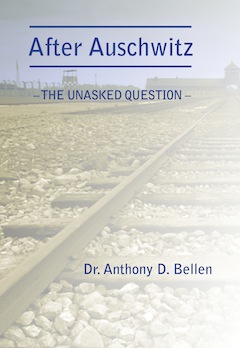
But Dr. Anthony D. Bellen’s book – After Auschwitz: The Unasked Question (Mazo Publishers, 2016) – is different. He is a clinical psychologist specializing in post-traumatic stress disorder, moral resilience and restorative processes. He lives in Israel, is a husband, father and grandfather, and has retired from the Israel Prison Service, where he headed the department of treatment and rehabilitation. He now works with people who have suffered trauma.

book cover - After AuschwitzThe unasked question in the book’s title is: “Do you remember any positive experience from your time in the concentration camp? Was there ever a positive interaction – a brief moment of happiness in the midst of that evil abyss?”

Bellen has chosen six survivor interviews for this book from 56 he conducted with Holocaust survivors in 2004 for his doctoral research study in the department of criminology at Bar Ilan University. The six gave him permission to share their stories, although their names have been changed for privacy.

I don’t think I will ever forget any of these stories. Motti’s moment of happiness occurred on the day of liberation from Theresienstadt, when a Russian soldier stood on a wooden crate and called out in Yiddish: “Has anyone seen my mother?” For Ida, it was finding a friend from her village – Miryam. For Eva, it was finding her hairbrush from home that her brother managed to give her before he was gassed in Majdanek. Reuven’s moment of happiness came in a swimming pool with two friends. Ya’acov’s joy came from meeting the love of his life, Sonya, in a laundry in Brintz. Sarah’s positive memory came from a Christmas in Bromberg, where she and some friends “performed” a song for the SS and later for the inmates of the camp.

These were just miniscule moments of happiness, gone in a flash, but powerfully remembered decades later – and never shared before.

The book concludes with a bibliography and references, as well as the seven questions Bellen asked each interviewee. These remarkable stories may help other people with different traumas find the strength to overcome them. They may even change your perceptions and understanding of your own life.

Dvora Waysman is a Jerusalem-based author. She can be contacted at dwaysman@gmail.com or through her blog dvorawaysman.com.