
Skip to content
  • Home
  • Subscribe / donate
  • Events calendar
  • News
    • Local
    • National
    • Israel
    • World
    • עניין בחדשות
      A roundup of news in Canada and further afield, in Hebrew.
  • Opinion
    • From the JI
    • Op-Ed
  • Arts & Culture
    • Performing Arts
    • Music
    • Books
    • Visual Arts
    • TV & Film
  • Life
    • Celebrating the Holidays
    • Travel
    • The Daily Snooze
      Cartoons by Jacob Samuel
    • Mystery Photo
      Help the JI and JMABC fill in the gaps in our archives.
  • Community Links
    • Organizations, Etc.
    • Other News Sources & Blogs
    • Business Directory
  • FAQ
  • JI Chai Celebration
  • JI@88! video

Recent Posts

  • On war and antisemitism
  • Jews shine in Canucks colours
  • Moment of opportunity
  • Shooting response
  • BC budget fails seniors
  • Ritual is what makes life holy
  • Dogs help war veterans live again
  • Remain vital and outspoken
  • An urgent play to see
  • Pop-up exhibit popular
  • An invite to join JWest
  • Successful campaign
  • Next-gen orthotic wins
  • Tapping into their creativity
  • The holidays à la JACS
  • Garden City of Tel Aviv
  • Sanctuary garden benefits
  • Gardening in Eden …
  • האנטישמיות גואה ביוון
  • Hateful messages intensify
  • Creating entrepreneurs
  • Wrong choice to host Piker
  • Attack on Jewish kids
  • Multiple benefits of a break
  • Dialing up the perfect thriller
  • Empowerment & more
  • Songs in war of peace
  • Successful trip to Cuba 
  • Tackling antizionism head on
  • Thinking of leaving Canada?
  • Kindness as a matter of fact
  • Personal stories, vital lessons
  • Connecting generations
  • Vancouver to Vienna
  • Recipes a form of resistance
  • Community milestones … February 2026

Archives

Follow @JewishIndie
image - The CJN - Visit Us Banner - 300x600 - 101625

Tag: Chad Gadya

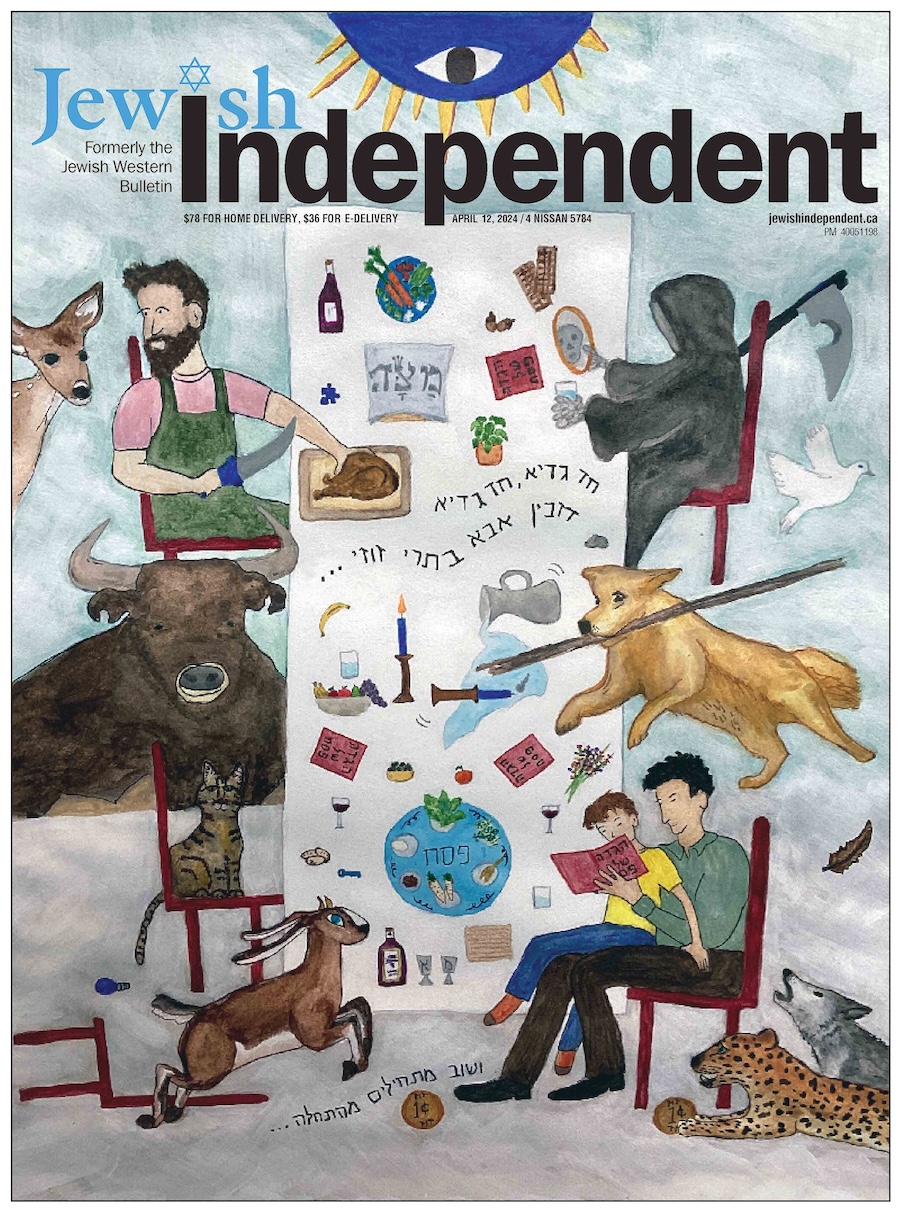
About the 2024 Passover issue cover

image - JI Passover cover April 12 2024There are numerous interpretations of Chad Gadya (One Little Goat), which ends the Passover seder. A cumulative song, like “There Was an Old Lady Who Swallowed a Fly,” it starts with Father buying a goat, which is then eaten by a cat. Because it’s easier to summarize from the end, the last verse is, depending on your translation: then came the Holy One, Blessed be He, and slew the angel of death, who killed the butcher, who slaughtered the ox, that drank the water, that quenched the fire, that burnt the stick, that beat the dog, that bit the cat, that ate the goat. The Hebrew on the table in the cover image is the beginning of the song: Chad gadya, chad gadya, d’zabin Aba bitrei zuzei (that Father bought for two zuzim).

Often sung with different seder participants making the sounds of the succeeding aggressors, Chad Gadya is a cheerful song despite its violent imagery. With the numerous conflicts that mark human history and our present, I imagined the song’s characters, animate and inanimate, sitting down for a seder and what that might look like. This idea forms the centre of the cover scene.

While specifically about the Israeli-Palestinian conflict, Chava Alberstein’s 1989 version of Chad Gadya has always spoken to me more personally than politically. I have “been” the deer and dove of her song in my more empathetic and hopeful moments; her wolf and leopard in my more angry, fearful and hurt moments. As she sings – I, too, sometimes “don’t know who I am” in this world that can be so incredibly harsh. I, too, have thought, as Alberstein sings, and which I’ve written on the bottom of the cover art in Hebrew: “And we start again from the beginning …” each time one of us attacks another, with words or actions.

But giving up is not an option. So, while the characters of Alberstein’s song lie at the periphery of the seder image I created, 16 other symbols that might appear on a modern seder plate are scattered throughout. They represent what each of us can do to make ourselves better humans and the world a better place. They are not my ideas. I completely lifted all of them from “Beyond Bitter Herbs: Contemporary Additions to the Seder Plate” by Beverley Kort (with Leland Bjerg), which we ran in the Jewish Independent’s Passover issue last year.

Kort explains the meanings behind the fruit, acorns, chocolate, coloured light bulb, key, mirror, potatoes, banana, olives, basil, whole wheat matzah, vegetables, dried flowers, feather, rock and puzzle piece. For all the explanations, visit jewishindependent.ca/the-modern-seder-plate. Highlighting some of them: the acorns at the top of the picture represent an acknowledgement of Indigenous land rights; the rock above the dog’s head is symbolic of resilience; the key by the seder plate is about unlocking doors, embracing change; on the left side, the coloured lightbulb symbolizes the creative spirit; and the feather wafting off to the right is a reminder of the importance of kindness and compassion.

Chag Pesach sameach.

Posted on April 12, 2024April 10, 2024Author Cynthia RamsayCategories Celebrating the HolidaysTags Beverley Kort, Chad Gadya, Chava Alberstein, Passover, Pesach, seder plate, symbolism
“Chad Gadya”: an ecologist’s favorite seder song

“Chad Gadya”: an ecologist’s favorite seder song

Passover is soon upon us, and many Jews will celebrate by singing rounds of their favorite classic Passover songs. “Chad Gadya” is a song that ensnares the singer in an increasingly complex chain of causality. Starting with one’s father who buys a goat that gets eaten by a cat that is bitten by a dog that is beaten by a stick, etc., etc. But “Chad Gadya” is not simply an incredibly fun shanty, it is also a great lesson in food chain ecology.

A food chain describes the complex interconnections that occur in nature from different organisms that eat each other. At the start are plants that absorb energy from the sun. The plants are then eaten by herbivores, that are then eaten by predators, that are then eaten by higher-level predators and so on. Each step up the food chain is called a trophic level, from the Greek word trophikos, meaning food.

One phenomenon documented by ecologists is called a trophic cascade. When you remove a key species from the food chain, say from the top, the effects will cascade down the food chain, affecting every organism along the way. One classic example involves the sea otter, a charismatic marine mammal that lived off the coasts of North America as far south as California. Unfortunately, the sea otter was once prized for its lovely fur and, by the early 20th century, they had become extinct south of Alaska.

Sea otters happen to eat a lot of sea urchins. Sea urchins eat a lot of kelp. When the sea otters disappeared, the effect cascaded down the food chain. Sea urchin populations skyrocketed, and began feasting on the kelp. Entire forests of kelp began to disappear, only to be replaced by barren underwater fields full of spiky urchins. This spelled trouble for the many fish and other animals that depended on the kelp forests for shelter and food. Bald eagles, for instance, would normally eat fish hiding in the kelp forests. Without those fish, the eagles had to search elsewhere for food.

Fortunately, sea otter hunting was banned, and populations from Alaska were shipped in. Those new immigrant sea otters have begun to repopulate our coasts, restoring the kelp forests and returning balance to the ecosystem.

Understanding how ecosystems work can be very helpful. For instance, in Israel, on Kibbutz Sde Eliyahu, they grow many useful crops, such as alfalfa and oats. But voles (a type of rodent) can be a huge pest problem. Thousands of burrow openings can accumulate per hectare, causing severe damage to their crops. Poisons are expensive, can be dangerous for consumption and for other animals, and are often ineffective anyway because more voles can just immigrate from nearby fields. Barn owls eat voles, but they only nest in pre-existing cavities, so farmers began putting up nesting boxes to encourage the owls. The strategy worked, the owls keep the voles under control, and they end up being more cost effective than poisons. Manipulating ecological systems for pest management in agriculture – known as biocontrol – is an increasingly common strategy used around the world to improve yields.

So, when sitting down for your Passover seder, eating your favorite foods, reclining and singing your beloved songs, take a moment to reflect on the complex chains of events that brought that food to your table.

Ben Leyland is an ecologist at Simon Fraser University, a musician and an Israeli-Canadian resident of Vancouver.

Format ImagePosted on April 11, 2014April 16, 2014Author Ben LeylandCategories Celebrating the HolidaysTags barn owls, Chad Gadya, Passover, Sde Eliyahu, sea otters, seder, trophikos, voles
Proudly powered by WordPress