Skip to content
  • Home
  • Subscribe / donate
  • Events calendar
  • News
    • Local
    • National
    • Israel
    • World
    • עניין בחדשות
      A roundup of news in Canada and further afield, in Hebrew.
  • Opinion
    • From the JI
    • Op-Ed
  • Arts & Culture
    • Performing Arts
    • Music
    • Books
    • Visual Arts
    • TV & Film
  • Life
    • Celebrating the Holidays
    • Travel
    • The Daily Snooze
      Cartoons by Jacob Samuel
    • Mystery Photo
      Help the JI and JMABC fill in the gaps in our archives.
  • Community Links
    • Organizations, Etc.
    • Other News Sources & Blogs
    • Business Directory
  • FAQ
  • JI Chai Celebration
  • JI@88! video

Recent Posts

  • Story of Israel’s north
  • Sheltering in train stations
  • Teach critical thinking
  • Learning to bridge divides
  • Supporting Iranian community
  • Art dismantles systems
  • Beth Tikvah celebrates 50th
  • What is Jewish music?
  • Celebrate joy of music
  • Women share experiences 
  • Raising funds for Survivors
  • Call for digital literacy
  • The hidden hand of hate
  • Tarot as spiritual ritual
  • Students create fancy meal
  • Encouraging young voices
  • Rose’s Angels delivers
  • Living life to its fullest
  • Drawing on his roots
  • Panama City welcoming
  • Pesach cleaning
  • On the wings of griffon vultures
  • Vast recipe & story collection
  • A word, please …
  • מארק קרני לא ממתין לטראמפ
  • On war and antisemitism
  • Jews shine in Canucks colours
  • Moment of opportunity
  • Shooting response
  • BC budget fails seniors
  • Ritual is what makes life holy
  • Dogs help war veterans live again
  • Remain vital and outspoken
  • An urgent play to see
  • Pop-up exhibit popular
  • An invite to join JWest

Archives

Follow @JewishIndie
image - The CJN - Visit Us Banner - 300x600 - 101625

Month: October 2017

Stories from the Sylvia Hotel

Stories from the Sylvia Hotel

Left to right: Advah Soudack, Tom Pickett and Adam Abrams co-star in Two Views from the Sylvia, playing at the Waterfront Theatre Nov. 8-12. (photo from Kol Halev)

“For me, the ‘coolest’ thing is Sylvia herself,” Advah Soudack told the Independent. “From everything I have read and heard, she was a dynamite of a woman – fiery, passionate and full of life. The woman lived until 102, for goodness sake, and did so with a heart murmur that caused much concern for doctors and her parents when she was young. I like the story of how she met her husband, Harry. The two were on a Jewish singles cruise and, when Harry witnessed Sylvia dive enthusiastically off the side of the boat, he knew in that moment that she was the gal for him. I only wish Sylvia was alive to see the show.”

Soudack takes on the role of Sylvia Ablowitz, née Goldstein, whose father, Abraham, built the Sylvia Hotel and named it after his daughter. The family’s story and stories about the renowned establishment in English Bay are depicted in Two Views from the Sylvia, which is being presented by Kol Halev Performance Society Nov. 8-12 at the Waterfront Theatre.

“This is the most ambitious show Kol Halev has produced, and their first as a registered society. But it fits perfectly into their mandate to tell stories of Jewish history and local Vancouver history, with music, song and performance, in an engaging and entertaining way,” said Adam Abrams, who plays Abraham in the production, and is also vice-president of Kol Halev. “I’m so excited to be a part of it,” he said.

Two Views from the Sylvia is comprised of two original one-act plays. Its genesis can be traced back some four years, to a Jewish psychology network meeting attended by Kol Halev president Sue Cohene and Ablowitz’s great-niece, Marsha Ablowitz, who pitched the story of her famous great-aunt to Cohene. In mid-2013, members of Kol Halev met with Marsha Ablowitz and her mother, Sally Seidler, who is now 99 years old.

By August 2013, Joan Stuchner had drafted the first two pages of a play. A few months later, Deborah Vogt joined the writing team, with she and Abrams assisting Stuchner. Sadly, Stuchner died in June 2014 of pancreatic cancer and Vogt had to complete the script without her.

Vogt’s one-act play, Sylvia’s Hotel, with music by Britt MacLeod and Kerry O’Donovan, lyrics by MacLeod, is set in 1912, and focuses on the origins of the hotel and on the Ablowitz-Goldstein family. “Both young Sylvia Goldstein and Joe Fortes, the beloved lifeguard who taught Vancouver children to swim, experience the challenges of those who didn’t quite ‘belong’ in the Vancouver of the time,” notes the promotional material. It forms Act 1 of Two Views from the Sylvia.

Act 2, called The Hotel Sylvia, is by Cathy Moss and Kelsey Blair. It focuses on the period after the building of the hotel, and “we meet the characters whose lives and loves became interwoven with the story of the Sylvia over her 100-year history.”

In Act 1, most of the characters are based on real people, members of the Goldstein family and Fortes. In Act 2, most of the characters are composites of more than one person or story, notably the character of Franny, who is a nod to a longtime Sylvia employee.

“Several of the stories told in this one act play are the stories as told to Cathy Moss and me by Huguette Gingras, who was the front-desk clerk at the Sylvia Hotel for 35 years,” said Cohene.

Tom Pickett, who plays Fortes in Act 1, plays the character of John in Act 2. “Though John is an independent character, he cares about the Sylvia the way Joe cares about the kids and English Bay so, in my mind, I imbue a hint of John with a bit of Joe and maybe vice versa,” said the actor.

Pickett – who said he has played Fortes a few times before – was immediately on board when he heard that Christopher King was the director and Shelly Stewart Hunt was the choreographer of the production. “Then I had the pleasure of talking with Sue Cohene on the phone and the connection was instantaneous,” he told the Independent. “And then, as we began rehearsals, the artistic opportunities to honour a Vancouver landmark like the Sylvia and represent a historical figure like Joe Fortes deepened. I think many people know of the Sylvia but don’t know a lot about the Sylvia. I’ve done a gospel concert at the Sylvia, my wife’s cousin from Montreal always stays at the Sylvia, my mechanic, the teller at my bank, the list goes on.”

“It seems that everyone has a story or a connection to the Sylvia,” agreed Abrams, “so it’s exciting to be telling a story about something so iconic, that means so much to people in Vancouver. And though I’m thrilled to have a great role, I’ve been mostly just impressed with what everyone else is bringing to it. There are some really beautiful moments both visually and dramatically, and some wonderful music, too. I think people are going to leave the theatre humming the title theme, ‘At the Sylvia’!”

About his character in Act 1, Abrams said, “Abe is someone who wants more than just personal success, he really wants to make his city a better place and feels the hotel will help achieve that. He’s also proud of his Jewish heritage and wants to show what his people can accomplish – despite facing a lot of the prejudice that was so common at that time.”

In Act 2, Abrams plays Mr. Lowry, “the manager of the present-day Sylvia, [who] is trying out Franny for the front-desk job to see how she does. He just shows up a couple of times, but I’m finding a lot of little moments of humour in his appearances.”

In preparing for the show, Soudack met with Marsha Ablowitz. “I not only flipped through piles of photos and heard stories,” said Soudack, “but also held Sylvia’s hairbrush, mirror and curling iron with her initials gracefully engraved on them in my hands. If the audience is paying close attention, they may even catch a glimpse of these artifacts in the show.”

While Sylvia appears in Act 1, she is only talked about in Act 2. In the second half of the production, Soudack plays Nora, who appears, said Soudack, “as a flashback to the Sylvia during the Second World War.”

“She is an interesting character, not only because of her independent nature, but also because of the times in which she would exercise this independence,” said the actor. “Nora, as explained by her daughter Gloria in Act 2, would visit the Sylvia twice a year. Gloria mentions that her mother, Nora, would come to write in her journal. She made a routine of it and even wore the same blue dress…. It turns out that she didn’t always come to write in her journal, she would also come to the Sylvia to dance.

“For me,” said Soudack, “Nora is an intriguing character to play because there has to be a reason why she came to the Sylvia and did so year after year. In the script, she talks about ‘taking a night off from everything.’ She mentions things about the war, headlines, air-raid precautions, however, as the actress, I choose to dig deeper and find what else she is ‘escaping’ from and taking the night off from…. There is a pure innocence to Nora going to the Sylvia twice a year to write in her journal and dance, but is there also an alter ego or an alternate life she desperately wants to explore?”

Other Jewish community members in the cast are Anna-Mae Wiesenthal and Joyce Gordon, while Heather Martin is associate producer and Gwen Epstein is on the production team. The Jewish Museum and Archives of British Columbia has created a photo exhibit, which will be on display at the theatre.

“Lots of things are very exciting,” said Cohene, “like watching amazingly creative choreography being developed on the spot. Hearing beautiful singing by the cast makes me want to sing along. I don’t – I am the producer and need to remember my role.

“I hope that people who come to the show are aware that we are a community theatre group. We are so fortunate to have the wonderful participation of two professional actors,” she said, referring to Pickett and Soudack, “who work alongside our very talented group of emerging actors. Kol Halev strives to be inclusive, accommodating performers of all ages, backgrounds and levels of experience. We aim to offer the opportunity to learn and create, in all aspects of our production. I’m hoping that this value is appreciated when the public sees the show.”

For tickets ($28) – and a chance to win free ones with your story of the Sylvia – visit kolhalev.ca.


Format ImagePosted on October 27, 2017October 25, 2017Author Cynthia RamsayCategories Performing ArtsTags Adam Abrams, Advah Soudack, Joe Fortes, Kol Halev, musical theatre, Sue Cohene, Sylvia Ablowitz, Sylvia Hotel, Tom Pickett, Vancouver
Or Shalom’s new cemetery

Or Shalom’s new cemetery

Or Shalom Rabbi Hannah Dresner, reciting psalms, leads the congregation around the Or Shalom cemetery perimeter. (photo by Robert Albanese)

Or Shalom Synagogue celebrated a major milestone on Oct. 15 with the dedication of its new cemetery.

In March, after four years of discussions with the City of Vancouver, the synagogue signed an agreement for a small area within Mountain View Cemetery (MVC). The area runs along the west side of Fraser Street extending south from 33rd Avenue.

Rabbi Hannah Dresner noted that the dedication helped “connect our bayit (our home in life) to our beit kavurot (our home in death).”

The ceremony, attended by more than 50 people (and a few dogs), began with a service at the synagogue, followed by a walk along Fraser to MVC. After reciting psalms while circling around the Or Shalom cemetery perimeter seven times to consecrate the area, participants proceeded to a reception at the MVC Celebration Hall.

Or Shalom is affiliated with Aleph, the Jewish Renewal movement, whose core values support efforts to explore and redefine Jewish traditions in ways that are egalitarian and inclusive. Accordingly, the cemetery offers a choice of all-Jewish and interfaith sections, a green section and double burials.

The area contains 64 lots (burial sites). However, Jewish custom allows multiple burials in one grave in locations where land is scarce, such as Jerusalem and Vancouver. Many older Jewish cemeteries in eastern Europe followed this practice. The Or Shalom section permits two people, related or not, to share a lot. Due to the small size of the cemetery, purchases are limited to individuals who have been Or Shalom members for at least five years.

Lots are purchased directly from MVC, which is owned and managed by the City of Vancouver. MVC manager Glen Hodges supported the project from the beginning and Or Shalom member Catherine Berris, a landscape architect with Urban Systems, helped with design.

Referring to Abraham’s purchase of a cave at Machpelah to bury his wife Sarah (Bereishit/Genesis 23) as the “first Jewish cemetery,” Dresner said, “It is beautiful to be buried in community, and this is what we will now be able to provide for one another at Mountain View: community in death.”

Dodie Katzenstein is a member of Or Shalom and a founding member of the cemetery planning committee.

Format ImagePosted on October 27, 2017October 25, 2017Author Dodie KatzensteinCategories LocalTags Judaism, Mountain View Cemetery, Or Shalom
Searching for identity

Searching for identity

(facebook.com/keepthechangefilm)

Like one of her favourite romantic comedies, Crossing Delancey, writer-director Rachel Israel’s narrative feature debut, Keep the Change, is a New York love story with a tangible Jewish undercurrent.

The romantic duo in the Vancouver Jewish Film Festival’s opening night selection readily self-identify as Jewish, but they share another quality that for most people primarily defines them: David (Brandon Polansky) and Sarah (Samantha Elisofon) are on the autism spectrum.

Refreshingly honest and sexually straightforward in its portrayal of the way people with autism interact with each other, with their families and with strangers, Keep the Change received two prizes when it premièred at the Tribeca Film Festival in April.

“A few of the characters are naturally unfiltered in the way they talk about sex, and I thought it was a beautiful and fun aspect of the characters,” Israel explained in a phone interview.

“A lot of depictions of people with autism shy away from sex, and I think it’s important to show that people on the spectrum have sex lives,” she said. “To shy away from it is in some way demeaning or infantilizing.”

Keep the Change receives its Canadian première when it opens the VJFF Nov. 2 at Fifth Avenue Cinemas, followed by a Nov. 12 screening at the Rothstein Theatre. It also screens Nov. 19 at the Roxy Theatre, as part of the Victoria International Jewish Film Festival.

Israel spent her childhood in the Princeton, N.J., area and her adolescence and teen years in Boca Raton, Fla., before pursuing her undergraduate degree at the Rhode Island School of Design. She moved to New York for her graduate studies in film at Columbia, where she refocused her first screenplay from a drama about David’s family to an endearing, awkward and rocky love story between he and Sarah.

Israel set about making a short film, and discovered a community of people with autism at the Manhattan Jewish Community Centre. She cast Brandon and Samantha and, some five years later, asked them to reprise their roles for a feature.

“Brandon’s search for love and companionship, and possibly sexual experience, is a defining part of his personality,” Israel said. “When I met him, I didn’t know he was on the spectrum … until he told me. When he told me he had autism, it was an awakening, because I thought of someone like Dustin Hoffman in Rain Man, someone who shies away from contact. And that was very much not the way Brandon was.”

His character’s Jewishness is front and centre, which may feed into some viewers’ judgment of his ostentatiously wealthy parents (played by Jewish actors Jessica Walter and Tibor Feldman). Sarah’s Jewish identity is much less pronounced but it could be a plus – in theory – in winning David’s parents’ acceptance.

“He is quietly desperate to have a girl, so it wouldn’t have stopped him at all [if Sarah wasn’t Jewish],” Israel said. “But it’s a big thing for many Jewish parents for your kids to stay in the tribe. He thinks that it will please his parents. But, more than that, for himself he wants some traditional things for his life. He wants a permanent loving relationship. I think he thinks that should be marriage. He very much wants the things that he’s seen his peers from childhood acquire, and he doesn’t understand why he shouldn’t have them.”

David and Sarah are fictional versions of the real people.

“We wrote it in collaboration with the cast, but they are playing fictional characters,” Israel emphasized. “They are not playing themselves. We’ve created characters that had some of their tendencies, while other things were different. They could definitely draw upon who they were to inform their characters.”

After Tribeca, Israel screened Keep the Change at the Los Angeles Film Festival and at Karlovy Vary in the Czech Republic, where it won two more prizes. Her grandfather, a financial supporter of the film, who escaped Czechoslovakia at 14 on one of the Kindertransports organized by Sir Nicholas Winton, attended the festival with Israel and the film.

For tickets and the full schedule for the VJFF (Nov. 2-12) and VIJFF (Nov. 18-21), visit vjff.org and vijff.ca, respectively.

– Michael Fox

***

photo - Dreaming of a Jewish Christmas
(riddlefilms.com)

About two dozen of the most popular Christmas songs were written by Jewish composers. An engaging documentary by Canadian producers, Dreaming of a Jewish Christmas, uses this fact as a jumping off point to explore the varied issues around Jewish relationships with Christmas, including Chinese food, the Chanukah-Christmas competition and some Jews’ conflicting desire to both fit in and remain distinctive from the majority culture.

The dreamlike documentary takes a retro, festive approach to the topic, beginning with a family of four arriving at a Chinese restaurant, circa the 1960s. Here, the wide-eyed children drink in the scene as waiters and fellow patrons break into song and chefs engage in kitchen percussions and choreography. Talking heads intersperse with these song-and-dance routines to explore, in an amusing way, the sometimes deep and multifaceted connections between Jews and the inescapable December holiday.

Jewish songsters are responsible for familiar tunes like “Walking in a Winter Wonderland” (Felix Bernard, born Felix William Bernhardt), “Chestnuts Roasting on an Open Fire” (Mel Tormé and Robert Wells, born Levinson) and “It’s the Most Wonderful Time of the Year” (George Wyle, born Bernard Weissman). The propensity for changing Jewish-sounding surnames is also addressed.

Mark Breslin, the founder of Yuk Yuk’s comedy club chain, puts a fine point on the Jewish role in Christmas music. “You could write a song three percent of the population would buy the record or you could write a song that 97% of the population will buy the record,” he says. “The businessman in me says go for the bigger market.”

Another comedian, Jackie Mason, dismisses the idea that there is anything odd about people writing songs about a holiday that is not their own. “Who cares if it’s your own holiday?” Mason says. “If I see a lot of cows on the street, am I going to write about a cow? Do I have to be a partner with cows, do I have to live with cows, to write a song about them? If everybody’s a Christian, that’s an easier sale, isn’t it?”

One commentator notes that almost all the Christmas carols written by Jews were what could be called “secular” songs. They are not about the birth of Jesus but about chestnuts, snow and winter coziness, reinforcing a new mythology that was emerging in the middle of the 20th century, which turned Christmas into a non-denominational winter celebration. In this, Jews and other non-Christians could more fully participate.

Ron Sidran, author of There Was a Fire: Jews, Music and the American Dream, cites Irving Berlin’s “White Christmas,” sung by Bing Crosby in the 1942 film Holiday Inn, as a turning point. “That song is the song where Irving Berlin de-Christs Christmas,” he says. “He turns Christmas into a holiday about snow.”

Calgary-born Ophira Eisenberg, who hosts NPR’s Ask Me Another radio quiz show, recalls receiving Chanukah gifts so she wouldn’t feel left out when her friends were getting visits from Santa. When the young Ophira asked her mother who the gifts came from, she was told that Moses came down from the mountain each year bringing presents to good little Jewish boys and girls. “Presents of dreidels and socks,” she adds wryly.

And while one speaker claims that Jewish composers wrote Christmas songs not as Jews, but as Americans, music journalist Robert Harris says “Rudolph the Red-Nosed Reindeer” is explicitly Jewish.

Rudolph’s creator, Robert May, said that he based the story of the reindeer – with his prominent nose, who was excluded from games with his peers and called names – on his own childhood as a Jewish American in the first half of the 20th century.

“And you know what’s incredible about Rudolph?” Harris says. “Rudolph doesn’t get a nose job. The point of Rudolph the red-nosed reindeer is not for Rudolph to blend in and become another reindeer. The point of Rudolph is for Rudolph to be appreciated for what he is.” Dreaming of a Jewish Christmas screens at the Vancouver Jewish Film Festival on Nov. 5.

– Pat Johnson

***

photo - Bar Behar
(tiff.net/films/in-between)

In Maysaloun Hamoud’s Bar Bahar (In Between), three young Palestinian women share an apartment in Tel Aviv as they struggle with the issues of religion, sexuality and overall identity. They live “in between” cultures. They are not Israeli enough – they are Palestinian, and are reminded of that fact occasionally. They are not Palestinian enough either – they want to escape the traditional role of a Palestinian woman. Centuries-old traditions and modernity clash in this film, as each of the main characters undergoes her own challenges and heartaches.

Leila is a lawyer. Educated, sophisticated and beautiful, she drinks and parties, smokes constantly and does drugs, but, in her heart, she wants to find love and purpose. While she doesn’t forgive betrayal, she is generous and kind to her friends – no matter how lousy she feels, how much she mourns her unfulfilled dreams, she is always ready to help her roommates.

Selma is a bartender and a lesbian, but her parents can’t even hear the word, much less accept their daughter’s sexual orientation. Their confrontation on screen is painful to watch. The parents are overwrought, unable to come to terms with their daughter’s choices. Selma herself is full of anguish, torn between her parents and her lover, even though she doesn’t say a word. Only her father talks, or rather screams, furiously. Her conflict and her parents’ desperation are powerful.

Nour is a university student, studying computer science. Religious and quiet, she wears a hijab and tries to reconcile herself with the traditional role of a Palestinian woman. Unlike her two roommates, she is not an overt rebel. She is betrothed, but her fiancé is scary and repulsive in his hypocrisy; he demands unquestioning compliance, and she tries, but she doesn’t love him.

The rape scene in the movie is not graphic, but its impact is immense. The incident and its aftermath puts all the relationships into perspective. It tests all three women’s courage and their humanity. It shows their capacity for compassion and their resilience.

The movie is simple on the surface, just a few days in the women’s lives, but a lot goes on behind the scenes, providing a multifaceted view of life in today’s Israel. All three roommates are living, breathing women, hoping for a better life, helping each other to achieve it. As much as the movie is their story, its themes are universal.

The film won several Israeli and international awards, and all of the awards are well-deserved.

Bar Bahar screens at the Vancouver Jewish Film Festival on Nov. 5.

– Olga Livshin

Format ImagePosted on October 27, 2017October 25, 2017Author Michael Fox / Pat Johnson / Olga LivshinCategories TV & FilmTags Rachel Israel, Vancouver Jewish Film Festival, Victoria, VIJFF, VJFF
Jewish groups’ M-103 advice

Jewish groups’ M-103 advice

Left to right, MP David Sweet, MP Michael Levitt, CIJA chief executive officer Shimon Koffler Fogel, MP Scott Reid and MP David Anderson pose for a photo during the House of Commons Standing Committee on Canadian Heritage hearings on M-103 on Oct. 18. (photo from CIJA)

Jewish groups were in Ottawa on Oct. 18 to testify in front of the House of Commons Standing Committee on Canadian Heritage, which will make policy recommendations on M-103, a motion that condemns “Islamophobia and all forms of systemic racism and religious discrimination.”

Leaders of the Centre for Israel and Jewish Affairs (CIJA) and B’nai Brith Canada drew on the Jewish community’s experience with fighting antisemitism in their recommendations on how to maximize the motion’s efficacy.

In his testimony, CIJA chief executive officer Shimon Koffler Fogel pointed to statistics that showed Jews are the most targeted religious minority in the country.

“Nationally, there were 54 hate crimes targeting Jews per 100,000 individuals in 2015. While this number is relatively consistent with previous years, there was an increase in hate incidents targeting other minority communities, including the Muslim community. In fact, Muslims were the next most targeted group, with 15 incidents per 100,000 individuals,” Fogel said. “I mention these numbers not to showcase Jewish victimhood, but rather to demonstrate the very real experience our community has in grappling with the issues this committee is studying.”

B’nai Brith Canada chief executive officer Michael Mostyn recommended that the motion be constructed so that it will be “embraced broadly by all Canadians” and by “communities that are the targets of racism and discrimination, including Canadian Jews, who continue to be the target of antisemitism.”

Mostyn said the bill must not diminish “the threat to Canadians of all faith communities who face racism and religious discrimination and it must not suggest that one form of racism or religious discrimination is more threatening, or of greater priority, than another.”

Among Fogel’s recommendations was that the committee work to improve on the collection and publication of hate crime data, as it currently varies widely by police department.

He said statistics from the Greater Toronto Area – including Peel Region, Toronto and York Region – are readily available, “but even with these three neighbouring jurisdictions, each report provides different information, making direct comparisons sometimes difficult.”

He added that there are cities, such as Montreal, that don’t release data about which identifiable groups are being targeted, leaving policymakers with incomplete information.

Fogel said it’s important to properly define hate, as we “can’t effectively fight bigotry and hatred without precisely defining it. The term ‘Islamophobia’ has been defined in multiple ways, some effective and some problematic. Unfortunately, it has become a lightning rod for controversy, distracting from other important issues at hand.”

Fogel used the Islamic Heritage Month Guidebook, which was issued by the Toronto District School Board earlier this month and contains a definition of Islamophobia that includes “dislike toward Islamic politics or culture,” as an example.

“Muslims can be protected from hate without restricting critique of Islamist political ideologies,” Fogel said.

Mostyn agreed that the committee should “exercise great care in any definition of Islamophobia” because, if the definition is vague or imprecise, it can be “hijacked and only inflame tensions between and among faith communities in Canada.”

Mostyn said an imbalance can create “the impression that Canadian Muslims are the only victims of hate crimes. We are just as concerned with the source of hate crimes targeting Canadian Jews from within radical elements of the Muslim community.”

Fogel also recommended that greater and more consistent enforcement of existing laws is needed. “Recently, the attorney general of Quebec decided not to lay charges in a case of an imam in Montreal who had called for the murder of Jews. Quebec’s attorney general also declined to pursue a second charge of genocide promotion. This decision sent a message that someone can call for the death of an entire group of people without consequence,” he said, adding that the federal government should train police and prosecutors to better enforce the existing Criminal Code hate speech provisions and provide resources for the development of more local hate crime units.

In his testimony, David Matas, B’nai Brith Canada’s senior legal counsel, argued that some fear of radical Islam is rational.

“Adherents to some components of Islam preach hatred and terrorism, incite to hatred and terrorism and engage in hate-motivated acts and terrorist crimes,” Matas said. “What the committee, we suggest, can usefully do is propose criteria, with illustrative examples, which can guide those directly involved in the combat against the threat and acts of hatred and terror coming from Islamic radicals.”

Matas called on the committee to “focus both on those victimized by Islamophobia and on the incitement and acts of hatred and terrorism, which come from within elements of the Islamic community.”

In his remarks, Fogel also referred to the passing of Bill C-305 – a private member’s bill that would expand penalties for hate crimes against schools and community centres associated with identifiable groups – which had its third reading on Oct. 18.

“CIJA has long advocated for the changes contained in Bill C-305,” Fogel said. “C-305 is a clear example of how elected officials can work together, in a non-partisan spirit, to make a practical difference in protecting vulnerable minorities.”

CIJA chair David Cape said, “CIJA remains grateful for the tireless efforts of MP Chandra Arya, who has committed his time and energy to strengthening hate crime protections. As we celebrate Canada’s 150th anniversary, we’re reminded that the safety of at-risk communities is essential for a healthy, vibrant country. Criminals who target Jews or other minorities don’t distinguish between houses of worship, community centres and schools – neither should the law.”

– For more national Jewish news, visit cjnews.com

Format ImagePosted on October 27, 2017October 25, 2017Author Sheri Shefa CJNCategories NationalTags antisemitism, B'nai B'rith, CIJA, David Matas, Islamophobia, M-103, Michael Mostyn, politics, racism, Shimon Koffler Fogel
Goldman memoir is a must-read

Goldman memoir is a must-read

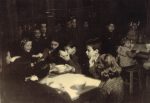
Breakfast at Andrésy circa 1945. René Goldman is holding his bowl out for more food. The children peering through the windows are from another dining room, who had likely finished their meal but had not yet been given permission to leave. (photo from memoirs.azrielifoundation.org)

René Goldman’s account of his childhood – A Childhood Adrift (Azrieli Foundation) – is set in Belgium and France during the Second World War, when Hitler’s plan was to annihilate all European Jews. Each European Jewish child was automatically sentenced to death. Only between six and 11% of European children survived the Holocaust. Ironically, this memoir describes both a heartbreaking and an uplifting story of one Jewish boy’s struggle to stay alive and sane despite all odds against him.

A Childhood Adrift is both personal and, at the same time, an important historical document. The story, written with a spatter of tongue-in-cheek humour, is a fascinating labyrinth of multiple narratives; stories within stories. It is not only about René the child, but also René the man, who revisits the past and examines the wounds left by war.

Goldman weaves his experiences throughout the periods of war and postwar, when he is a young man who travels back to the places that sheltered him and other children lost in the horror of war. The entire narrative is skilfully infused not only with historical and political facts but with the geography of various places so poignantly described one can feel and see them.

Goldman writes about the time when children lost parents, siblings and homes. These children had to depend on the kindness of strangers or were left alone to fend for themselves.

Goldman was 6 years old when the Nazis invaded his native Luxembourg, where he was born, and Belgium, where his family had taken refuge. In 1942, the family fled Belgium for France. From the last station before the French border, they walked on foot to the Demarcation Line between the German Occupied Zone and the Free Zone. No sooner did they cross the line than they were arrested by the French police, who were rounding up Jews escaping from the Occupied Zone, and the family was interned in Lons-le-Saunier. On Aug. 26, Goldman and his mother were taken to the city’s train station for deportation. His aunt appeared from nowhere and tried to take him away, but to no avail. Eventually, she found someone in authority to send two officers to rescue the young boy and save him from boarding the train. His mother was already in one of the cars waving goodbye as the train was pulling out of the station. This was the last time Goldman saw his mother. He was 8 years old.

His father disappeared that morning and it was only in 1944 that Goldman was reunited with him for a brief time, until his father was arrested and taken away. Only after the war did Goldman find out that his father died at the end of the death march from Auschwitz, in January 1945.

In 1942, Goldman was placed in the care of the OSE (Oeuvre de Secours aux Enfants) and brought to Château du Masgelier. After two weeks, he was taken to the village of Vendoeuvres, where a young couple offered to take care of him. Soon afterward, the Free Zone was invaded by the Germans.

What followed for Goldman were moves to several homes due to the changing circumstances, which necessitated a constant search for safe places for children.

Left an orphan in 1945, Goldman was placed in the care of the CCE (Commission Centrale de l’Enfance), an organization inspired by communist ideology, which was instrumental in shaping his political beliefs. His faith in this system remained unshaken until he lived in Poland for three years, when he became disillusioned, even shocked, by it.

He writes, “I can now in all candidness recognize that I caught myself wondering whether communism was not the greatest lie of the century, if not of all time.”

Goldman’s narrative strength, among his many others, leans towards the lyrical.

One of the immediate postwar places to which Goldman was moved in France was the town of Andrésy and its Manoir de Denouval, which inspired poetic instincts in him. Here, he found the beauty of gardens and serenity, a “sanctuary” that shielded him for a time from his loneliness and the postwar chaotic reality. Interestingly, Marc Chagall, who donated funds for the children’s care, would occasionally visit the manor.

“I was enthralled with the Enchanted Manor,” writes Goldman. “It nourished in me a fascination with mystery as I explored it for hidden nooks and ventured up the narrow winding steps that led to the turret, sometimes even in the dark of night.” And, indeed, these were dark times in the young boy’s life for it was then that he realized he was an orphan.

Friendships played a huge part during the war and in the postwar period. In the boys and girls Goldman befriended along the way, and some of the kind teachers, he found a certain relief from the loneliness he felt, and from the lack of affection and support. One person who played an important role in his life was Sophie Micnic, who became his caregiver and friend. This woman, a founding leader of the MOI, the Jewish communist resistance movement in Paris and Lyon during the war, later became the director of CCE. It was she who took Goldman under her wing, and recommended that he live in the “Enchanted Manor.”

A Childhood Adrift – a must-read – is a powerful testimony of a child’s response to the calamities of war and their everlasting imprint on his life. It is also a statement of courage and survival in the face of adversity. Eventually, Goldman developed a tremendous hunger for knowledge, education and a desire for communication in as many as 10 languages.

In the last section of the book, the author reveals himself as a poet and a grown man still deeply immersed in his past.

Lillian Boraks-Nemetz is a Vancouver Holocaust Education Centre outreach speaker, an award-winning author, an instructor at the University of British Columbia’s Writing Centre and the editor of the No Longer Alone section of VHEC’s Zachor, in which a longer version of this book review was originally published. René Goldman will be the keynote speaker at the community’s Kristallnacht commemoration on Nov. 5, 7 p.m., at Congregation Beth Israel. Copies of his memoir will be distributed to those in attendance. Holocaust survivors are invited to light a memorial candle. The ceremony is presented by VHEC, Beth Israel and the Azrieli Foundation. For Pat Johnson’s review of Goldman’s book, which was initially called A Childhood on the Move, visit jewishindependent.ca/fragmented-childhood.

Format ImagePosted on October 27, 2017October 25, 2017Author Lillian Boraks-NemetzCategories BooksTags Azrieli Foundation, Beth Israel, Holocaust, Kristallnacht, René Goldman, survivors, VHEC
From graceful to outrageous

From graceful to outrageous

From the left: Zack Gallery’s Linda Lando and jewelry artists Julie Kemble and Barbara Cohen. (photo from Zack Gallery)

Just as our clothing defines us to some degree, so does the jewelry we wear. Our choices often reflect not only our likes or dislikes, but how brave we are and how adventurous. The current group show at the Zack Gallery, called Light, features a range of unusual jewelry, from stylish and graceful, to whimsical, to outrageous. Practically everything on display, with the exception of a couple of metal sculptures, could be worn, and the gallery supplies a mirror for those intrepid souls who dare to try the pieces on.

Presented by the Vancouver Metal Arts Association, the exhibit introduces jewelry made not only of traditional materials, like silver, but of many unorthodox materials and objects, some of which have never been considered for adornment, until recently.

“These pieces remind me of far-away places, of mystery and romance. Some of them – you need a large personality to wear,” said Julie Kemble, the association’s liaison for the show.

photo - Zula, wearing her own creation, which is on display at the Zack Gallery
Zula, wearing her own creation, which is on display at the Zack Gallery. (photo from Zula)

According to Kemble, the show’s title, Light, invokes different interpretations. “We want to bring light into our works, into the lives of our artists and the people who wear our creations,” she said, adding that the association encourages artists to use alternative materials as well, like plastic or fabrics.

As did several other participants in the exhibit, Kemble started out as an amateur artist. She was a university teacher for many years.

“I always liked art,” she told the Independent. “At first, it was a hobby, but it is much more now. I began with textiles and gravitated towards metal and jewelry about 20 years ago. Metal allows a certain immediacy. You see right away what’s coming out of your hands.”

She explained that this show is the association’s fifth annual one and the second at the Zack. “We want to increase the profile of art jewelry in Vancouver,” she said. “That’s why this is a juried show. We invited the judges and jewelry artists from across Canada.”

Some of those artists are professionals, while others are taking their first steps on the artistic road. One of the beginners is Raymond Schwartz, but nobody would guess that by looking at his sterling silver necklaces. Elegant, sophisticated and relatively smaller than some other pieces on display, they represent a more traditional approach to jewelry.

“I’m brand new to jewelry,” he said. “I started two years ago. I’ve always been artistic, always liked doing things with my hands, but my business was construction. Now, I’m getting older, so I began making jewelry. It’s like construction, but making mini things. I also paint oils, but jewelry allows both creativity and working with my hands; it fills the void.”

This show is Schwartz’s first, although he has already sold some of his pieces.

Barbara Cohen, meanwhile, is a professional jewelry-maker with years of experience. “My background was in textile before I switched to metal. Now, I’m moving away from metal, too, using more of other materials,” she said. “I like the scale of jewelry. It is portable art.

“It’s also the most understated form of communication. When you wear a piece of original jewelry, it often starts conversations. I curated several jewelry exhibitions. Sometimes, I would wear a piece from the show, and people would admire it and ask me where it came from. They didn’t notice it in a display case but they noticed it around my neck. Jewelry should be worn. That’s why we have a mirror in the gallery, so people could see themselves wearing our art.”

Her necklaces, asymmetrical and quirky, draw the eye. Their patterns and textures make people wonder and try to decipher the artist’s ideas. They definitely start conversations.

Zula, also a professional artist, represents an extreme trend in jewelry-making. Her pieces, part of her new Neon Love collection, are a bright acrylic extravaganza, playful and flashy and fairly large. They use geometric shapes and are not for the faint of heart. It is a new development for the young artist, an experimental departure from her more traditional plant-patterned collection in silver and copper.

“I had a health crisis recently,” Zula explained. “I lost my hair to alopecia. Now I’m bald, but I chose not to wear a wig. I asked myself, what is my identity now? If I was a brunette before, am I still a brunette? I had this colourful plastic in my studio and I started playing with it. I needed to be edgy, and my new pieces provide that. They interact with light.”

Many other artists are part of the Light exhibit, which runs until Nov. 12.

Olga Livshin is a Vancouver freelance writer. She can be reached at [email protected].

Format ImagePosted on October 27, 2017October 25, 2017Author Olga LivshinCategories Visual ArtsTags Barbara Cohen, Julie Kemble, Raymond Schwartz, Vancouver Metal Arts Association, Zack Gallery, Zula
Balfour after 100 years

Balfour after 100 years

Balfour Street in Jerusalem. (photo by Pat Johnson)

One hundred years ago, on Nov. 2, 1917, one of history’s most consequential letters was typed. Simple and short, the Balfour Declaration, as it would become known, is a central artifact in the history of Zionism, the state of Israel and the ongoing conflict over claims to the land on which Israelis and Palestinians reside.

The letter from the British foreign secretary, Lord Arthur Balfour, was addressed to Lord Walter Rothschild, a leader in the Zionist Federation of Great Britain and Ireland. It informed Rothschild that the British cabinet had approved this one-paragraph statement:

“His Majesty’s government view with favour the establishment in Palestine of a national home for the Jewish people, and will use their best endeavours to facilitate the achievement of this object, it being clearly understood that nothing shall be done which may prejudice the civil and religious rights of existing non-Jewish communities in Palestine, or the rights and political status enjoyed by Jews in any other country.”

The letter was enormously historic for a number of reasons, not least that the first Zionist Congress had taken place a mere 20 years earlier, the first tangible expression in two millennia that the Jewish people should reasonably anticipate self-determination in the land of Zion. And now one of the world’s great powers was on record as supporting the endeavour.

The letter was also hugely presumptuous because the area in question was still under the control of the Ottoman Empire. The Ottomans would not be thoroughly vanquished by the British-French-Russian allies until 1918. Yet the allies were so confident of eventual victory that the secret Sykes-Picot Agreement of 1916 was already (on paper) carving up the region between the European powers.

Nevertheless, the document stood as a testament to British allegiance to the Zionist ideal in the interwar period. That allegiance, of course, amounted to very little in practical terms. In response to Arab protests (including mass murder in Hebron in 1929), the British froze Jewish migration to Palestine at the very moment in history when it was more urgently necessary than ever. The Holocaust – which can be said to have begun in earnest on Kristallnacht, Nov. 9, 1938, 21 years to the day after the Balfour Declaration was made public – occurred, of course, because of the Nazis’ Final Solution. But it could only have occurred in the enormous extent that it did because no other nation on earth would welcome the imperiled Jews of Europe. Palestine was the most obvious place for them to go, but British resolve folded in the face of Arab protest and Jews were trapped in Europe, where six million would die.

Likewise, the British commitment to Zionism amounted to nothing when it mattered again after the Holocaust. Still preventing widespread Jewish migration to Palestine, the British eventually gave up on the entire enterprise and threw the troubled land into the lap of the newly founded United Nations. The UN, for its part, eventually passed the Partition Resolution that would have seen two states – one Jewish, one Arab – formed in Palestine.

The reality remains that one significant sub-clause of the Balfour Declaration stands out to the contemporary eye. The statement that “nothing shall be done which may prejudice the civil and religious rights of existing non-Jewish communities in Palestine” would certainly be viewed by many as remaining unfulfilled. The civil rights of non-Jewish citizens of Israel are protected in law, but serious inequalities remain. More significantly, the statelessness and associated lack of civil rights experienced by Palestinians in the Israeli-controlled parts of the West Bank would certainly not live up to the well-intentioned words of Balfour.

Some say the British government should apologize for their role in advancing an independent Jewish state. British Prime Minister Theresa May batted that one back in a letter to her party’s Conservative Friends of Israel, saying, “We are proud of our role in creating the state of Israel.… The task now is to encourage moves toward peace.”

If apologies are in order, the British government might consider apologizing for giving little but lip-service to the Zionism enterprise throughout the 20th century.

The Balfour anniversary is an interesting time to reflect on history – and the past has an important role to play in informing us of the present. But, as always, we should keep our focus on the future.

Format ImagePosted on October 27, 2017November 3, 2017Author The Editorial BoardCategories From the JITags Balfour Declaration, Britain, history, Israel, Zionism

Looking for nominees … the nominated and the winners

The Centre for Judaism of the Lower Fraser Valley is looking for nominations for its annual Lamplighter Award, which honours a young person who has performed an outstanding act of community service.

Candidates must be between the ages of 6 and 18 and submission of potential recipients must include two references describing the child’s community service. The chosen lamplighter will receive the award during Chanukah at an evening ceremony at Semiahmoo Shopping Centre.

“Chanukah celebrates the victory of light over darkness and goodness over evil,” said Simie Schtroks. “This is a most appropriate opportunity to motivate and inspire young people to make this world a brighter and better place. By filling the world with goodness and kindness, that light can dispel all sorts of darkness.”

To nominate a candidate for the award, contact Schtroks as soon as possible at [email protected].

* * *

This summer, David Granirer received a Meritorious Service Medal from the Governor General of Canada. The award recognizes a deed or activity that has been performed in a highly professional manner, or according to a very high standard: often innovative, this deed or activity sets an example for others to follow, improves the quality of life of a community and brings benefit or honour to Canada.

Granirer is a counselor, stand-up comic and mental health keynote speaker. Granirer, who himself has depression, has taught stand-up comedy to recovering addicts and cancer patients, and founded Stand Up for Mental Health, a program teaching comedy to people with mental health issues, in 2004. He has trained Stand Up for Mental Health groups in partnership with various mental health organizations in more than 50 cities in Canada, the United States and Australia. His work on mental health is featured by media worldwide and has garnered several awards.

Granirer also teaches Stand-Up Comedy Clinic at Langara College, and many of his students have gone on to become professional comics.

* * *

This year’s Mayor’s Arts Award for Community Engaged Arts went to Earle Peach. A singer, songwriter, composer, conductor, arranger, teacher and performer, Peach leads four choirs in the city and hosts a monthly community coffee house in Mount Pleasant. He teaches privately, and records musicians for demos and albums. He performs with Barbara Jackson as a duo called Songtree and also has a band called Illiteratty.

The emerging artist honour went to Ariel Martz-Oberlander, a theatre artist, writer and teacher. As a Jewish settler on Coast Salish territories with diasporic and refugee ancestry, her practice is rooted in a commitment to place-based accountability through decolonizing and solidarity work. She divides her time between theatre and community organizing, and specializing in creative protest tactics on land and water.

Martz-Oberlander is a facilitator with the True Voice Theatre Project, producing new shows by residents of the Downtown Eastside and vulnerably housed youth, in collaboration with the Gathering Place and Covenant House. Her most recent work, created with support from the LEAP program, won a research and development prize from the Arts Club. Martz-Oberlander is also the associate producer for Vines Festival, presenting accessible, free eco-art in Vancouver parks. Good art is accountable to the community, raises up voices rarely heard and is vital to repairing our world.

* * *

On Oct. 3, the Koffler Centre of the Arts announced the four winners of the 2017 Vine Awards for Canadian Jewish Literature, all of whom were on hand at the award luncheon at the Park Hyatt Hotel in Toronto.

Winners in two of the categories are based in Vancouver. Miriam Libicki won the non-fiction award for Toward a Hot Jew (Fantagraphics Books Inc.), which the jury described as, “An admirably complicated response to being a woman and a Jew in our time, a thrilling combination of memoir, journalism and art.” And Irene N. Watts and Kathryn E. Shoemaker took the prize in the children’s/young adult category for Seeking Refuge (Tradewind Books), which the jury described as, “A superb graphic novel dramatizing the Kindertransport, a powerful story enhanced by firsthand experience and beautiful black-and-white illustrations.”

The other winners were Peter Behrens’ Carry Me (House of Anansi Press) for fiction and Matti Friedman’s Pumpkinflowers (McClelland & Stewart) for history.

The history shortlist included Max Eisen’s By Chance Alone (Harper Collins Publishers) and Ester Reiter’s A Future Without Hate or Need: The Promise of the Jewish Left in Canada (Between the Lines). Runners-up in the fiction category were Eric Beck Rubin’s School of Velocity (Doubleday Canada) and Danila Botha’s For All the Men (and Some of the Women) I’ve Known (Tightrope Books). In non-fiction, Sarah Barmak’s Closer: Notes from the Orgasmic Frontier of Female Sexuality (Coach House Books), Judy Batalion’s White Walls (Berkley/Penguin Random House) and David Leach’s Chasing Utopia (ECW Press) were runners-up, while Deborah Kerbel’s Feathered (Kids Can Press) and Tilar Mazzeo and Mary Farrell’s Irena’s Children (Margaret K. McElderry Books) were on the children’s/young adult short list.

* * *

In September 2017, local community member Dr. Arthur Wolak was elected for a three-year term to the board of governors of Gratz College, a private liberal arts college in suburban Philadelphia. Founded in 1895, Gratz is the oldest independent and pluralistic college for Jewish studies in North America. Accredited by the Middle States Commission on Higher Education, Gratz is also recognized by Israel’s Ministry of Education and Culture. Through its undergraduate and graduate programs, Gratz educates students to become effective educators, administrators and community leaders.

Posted on October 27, 2017October 25, 2017Author Community members/organizationsCategories LocalTags activism, Ariel Martz-Oberlander, Arthur Wolak, books, Centre for Judaism, David Granirer, Earle Peach, Gratz College, Irene Watts, Kathryn Shoemaker, Lamplighter Award, Mayor’s Arts Award, mental health, Meritorious Service, Miriam Libicki, Simie Schtroks, tikkun olam, Vine Awards
Israelis design beauty

Israelis design beauty

Albi Serfaty with the Lucky Lamp. (photo from Aqua Creations)

When Renee Switzer launched the SwitzerCultCreative showroom in 2016, she was adamant that they include pieces by Israeli furniture and lighting designers, giving them a Canadian stage exclusive to Vancouver.

“I visited the New York showroom of Aqua Creations in 2015, and their designs completely blew me away,” said Switzer of the Israeli brand. “The same with Hagit’s [Pincovici] furniture, that reflect beautiful craftsmanship made in Italy and have never been seen here before.”

Together with her son, Adam Bellas, and daughter, Jennifer Wosk, the third generation of a legacy begun by their grandfather in the 1960s, Switzer is delving into modern, high-end furniture collections for Vancouver interiors.

It’s impossible to look at Aqua Creations’ lamps, lighting installations and furniture without feeling a sense of wonderment. The urge to curl up in the enveloping Gladis Lounge Chair in the SwitzerCultCreative showroom is overpowering. When co-founder Albi Serfaty heard my confession, he laughed in agreement. “This is what art is all about,” he said, Skyping from his home in Tel Aviv. “There must be this emotional connection, both for me as a designer, because I’m passionate about my work, and hopefully from our pieces as interior décor in a home, a restaurant or hotel.”

What began in 1994 as a small atelier in Tel Aviv is now a global brand with an Aqua Creations showroom in New York and their lighting installations worldwide, including 1 Hotel, Brooklyn; Savoy Hotel, Seychelles; and Hotel Okura Fukuoka, Japan.

As a photographer and designer, Serfaty re-interprets organic forms and abstract sea life into lighting and furniture. Morning Glory Floor Lamps, in silk over metal, when illuminated, seem to take on an otherworldly beauty all their own. Collections since 1994 show a definite evolutionary progression, with current geometric shapes like the Simon Says Yes Pendant, part of Aqua Creations’ Mino Collection. Whether as a singular hanging pendant or grouped together as colourful wall mounts, as shown in the SwitzerCultCreative showroom, they add a sculptural yet functional addition to interiors.

If you can imagine thousands of magnified neurons under a microscope, you will see the genesis of the Mimosa Collection. Composed of laser-cut galvanized metal, sprayed with clear polymer, the hand-sculpted shades transmit a dreamy, calming light.

The Lucky Lamp wall fixtures are Serfaty’s newest iteration, using groundbreaking technology in which each sustainable and dimmable light is controlled by a micro-computer that alters colour, motion and intensity.

“I’d love to collaborate in the future with a fashion designer like Missoni,” confided Serfaty, “and, at some point, build a place that combines home, work and studio in one location.” He added, “I’m like a sheep dog in that way – I like everything together.”

* * *

When Hagit Pincovici was a little girl in her grandparents’ atelier in Tel Aviv, she remembers the exhilaration of playing with and running between colourful sheets of Plexiglass that would eventually be moulded into trays, frames and furniture by her artisan grandparents.

photo - Flamingo Storage Side Table, by Hagit Pincovici
Flamingo Storage Side Table, by Hagit Pincovici. (photo by Fabrizio Checchi)

“When my grandfather left Romania for Israel, he brought the recipe for making Plexiglass and I remember it was a kind of paradise looking through all the colourful pieces,” said Pincovici, now third-generation maker, in a Skype interview while she was visiting Tel Aviv.

It’s not entirely coincidental, then, that her multi-hued Art Deco-inspired furniture evokes a modern twist on a bygone era. Pincovici’s From Above Coffee Table from the Eclipse Collection is a geometric Carrara marble “moon” integrated into an abstract path of black shadow and coral sun in lacquered wood on a brushed brass base. Flamingo Storage Side Table, also from the Eclipse Collection, is a stunning sculptural platform perched atop stilt-like legs inspired by its namesake; a secret compartment rotates out to store jewelry, if placed in a bedroom, or becomes a handy bar for drinks, sure to spark conversation in the living room. The Metaphysics Sideboard is Pincovici’s take on elegance. The blue and black lacquered geometric wood console designed at multiple heights is mounted on brushed brass and immediately recalls the glamour of the 1920s and ’30s. “I love the thin minimalist lines just bordering on the decorative,” she explained.

After working her way up as head of product development for Aqua Creations in Israel and organizing their exhibition at the annual Salone del Mobile, in Milan, Pincovici decided to relocate to Italy, “where I fell in love with the Italian spirit of creativity,” not to mention her husband, Fabrizio Checchi.

She opened her own design studio in the furniture district of Brianza in 2014, where she sketches her designs by hand. The furniture is made with traditional craftsmanship and sold internationally. When not working on her first collection of lighting, Pincovici is also an instructor at NABA (Nuova Accademia di Belle Arti) in Milan.

“You know, we [Israeli] designers are like chameleons,” said Pincovici. “I don’t think we share a common style but we do share that drive to create and, in Italy, they really appreciate that approach.”

* * *

London-born Eli Chissick of Chissick Design is waxing poetic about wood. Skyping from his home-studio near Tel Aviv, the award-winning designer is concerned about the environment, recycling and products that will increase the mobility of people with disabilities.

photo - Gradient Cocktail Table by Eli Chissick
Gradient Cocktail Table by Eli Chissick. (photo from Chissick Design)

Unlike the vast forests found in Canada, trees are not harvested for the lumber industry in Israel and wood is usually imported. That forces the industrial and product designer to be ingenious about scavenging off-cuts and repurposed wood from carpentry floors. “It’s a magical transformation when I sort what is usually thrown out, then press it into large sheets from which I create my furniture,” said Chissick.

The results are as sculptural as they are utilitarian. Mosaica, from Chissick’s Wood-Con-Fusion series, is a coffee table (or bench) composed of more than 2,000 intricate puzzle pieces of multi-coloured wood. The Marmelade coffee table is a mouth-watering compote of wood with inlaid lime-, raspberry- and white-striped Formica laminate. It’s built on wheels for easy manoeuvring in any space.

“I’m really excited about working with Renee at SwitzerCultCreative because I’m now able to send my furniture designs created on the computer to her and then have many pieces handmade in British Columbia with the same quality as in Israel,” said Chissick.

Those pieces include the Gradient Cocktail Table, handcrafted from eight types of veneer juxtaposed from light to dark in wenge, imbuia, American walnut, teak, African walnut, anigre, white oak and maple. Mirror 2012, from Chissick’s Wood-Con-Fusion series, is set in a painted and lacquered salvaged wood frame and can be customized in various colours. (It was a 2015 platinum winner at the U.S. ADEX Awards for Product and Project Design.)

He’s also a proponent of TOMS (Tikkun Olam Makers), a global movement of makers who donate their specialties to create solutions for people struggling with a debilitating problem. Over three days, 100 designers, engineers and techies meet with potential users personally then brainstorm in small groups and set to work making prototypes. Chissick has participated in these “Makeathons” in both Tel Aviv and San Francisco, resulting in a walker that allows a person to navigate stairs, a door opener for someone who has quadriplegia, and a digital hand and a high-tech go-cart for a child with disabilities, to name only a few.

Switzer, who has visited Israel several times, is planning a scouting trip there in 2018. “It gives me tremendous personal gratification to showcase such talented makers,” she said.

For more information, visit switzercultcreative.com or call 604-736-3020.

Laura Goldstein (lauragoldsteinwriter.com) was an arts publicist and writer in Toronto for 22 years before moving to Vancouver. She’s a frequent contributor to the Globe and Mail’s design section, Westcoast Homes & Design, Canadian House & Home and Destination BC, among many others. A highlight of her career was covering the Royal Tour in Vancouver last year.

Format ImagePosted on October 27, 2017October 27, 2017Author Laura GoldsteinCategories LocalTags Albi Serfaty, Aqua Creations, Chissick Design, Eli Chissick, furniture, Hagit Pincovici, Israel, lighting, Renee Switzer, SwitzerCultCreative
Eat bugs to repair the world?

Eat bugs to repair the world?

Burgers made with insect protein, and no meat. (photo from Eran Gronich)

While the thought of eating insects or worms may sound outlandish or disgusting to many of us, there is growing support for doing just that.

In less than 25 years, the world will have nine billion people living on it. As things stand, there is not enough space or resources to support conventional protein production – beef, chicken, fish, etc. – for that many people. One solution that has been brought to the fore is that we can start eating insect protein. And now, the Israeli company Flying Spark is raising capital to make this a reality.

Leading the charge is Eran Gronich, a serial entrepreneur, and his partner, entomologist Dr. Yoram Yerushalmi.

“When I was looking for my next project, looking into all kinds of ideas, start-ups, etc., I came across a TED Talk in which this university professor was talking about the world having nine billion people by 2040,” said Gronich. “He was talking about all the damages of livestock farming – causing global warming, [using] 70% of growing seed, oceans over-fished…. He was saying the best solution is switching to insect consumption … and, I don’t know why, but I was fascinated. I started to learn about it…. When I realized I don’t know anything about insects, I found my partner, Dr. Yerushalmi, and together we started Flying Spark.”

They chose the larva of fruit flies to work with because it has a number of benefits, such as high values of protein, iron, calcium and magnesium. Its fat is unsaturated and, unlike some other insects, a fruit fly has no cholesterol.

The fruit fly uses less than one percent of water and land resources, has hardly any waste and 100% of the larva can be used. The lifespan of the larva is only six days and it multiplies 15 times in that time.

As it’s a vegetation-eating fly, it is a safe insect to use. No antibiotics, hormones or additives are used in the growing process, and the insect does not share any diseases with human beings.

photo - Flying Spark’s Eran Gronich
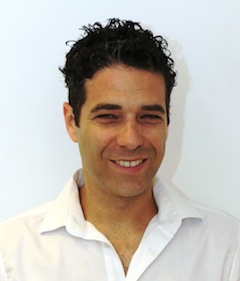
Flying Spark’s Eran Gronich. (photo from Eran Gronich)

Gronich and Yerushalmi’s project was chosen as the winner of a mass accelerator challenge in Boston. “We spent four months in Boston working on accelerating the growth of the company,” said Gronich. “We raised some money there from investors and sent it to Israel. We developed the farming and ecosystem technology around farming the larva, reducing the cost.

“In the food lab, we developed the process that’s basically taking the larva and turning it into high-quality, 70% protein powder and high-quality oil. Also, we worked on all kinds of applications and the functionality of the protein powder. We made all kinds of products just to prove the point that you can make almost anything out of our materials – bread, pasta, cereal, cakes, whatever. And, also, achieve meat replacement, even milk, with more protein than cows.”

As it turns out, the larvae will be fed by fruit surpluses, which, according to Gronich, exist everywhere. “They are in every country and also throughout the supply chain – surplus that the farmer or grocery chain has,” he said. “It’s good food, but doesn’t look so good anymore. So, we developed this formula – based on feeding software – to calculate the right percentage … to get the nutritional diet needed.”

Gronich is working with several major food manufacturers, trying out various applications, with varying degrees of success.

According to Gronich, the product is not kosher and his market is not yet in Israel, though he does have some Israeli and Jewish backers. One of his backers is the Strauss Group, which invested money and provides support with offices, labs and a lot of technical support for marketing and networking with institutions worldwide.

“For Strauss, it’s a financial investment,” said Gronich. “Strauss believes insects will be a part of the human diet in the near future and decided to invest in the best company.”

Another important collaboration in which Flying Spark is involved is with IKEA. “IKEA, eight months ago, [invited] all kinds of start-ups to apply for special programs focused on making the world a better place, especially sustainability aspects. Thirteen hundred companies applied from about 80 countries around the world; they chose 10. We were lucky enough to be one of those 10 companies. So, we started a three-month program. My partner is in Sweden right now, in the IKEA centre, and the goal of the program in the end is to have a product made from our material in the IKEA restaurant.”

Gronich is currently working on designing Flying Spark’s first production facility in Israel, with operations scheduled for the end of 2018. “Now, we are raising three and a half million dollars to build the facility, which will be in Ashdod,” said Gronich.

While selling the product to the Western world is a bit tricky, in the Eastern world or in South America, insects are eaten regularly. So, heading east with their product is an obvious choice.

As for the West, Gronich said, “Now, people from Western countries … when I’m explaining to them about the larva – about how it cleans itself and its nutritional value – people understand it. They get that it is one of the best sources of protein. If you’re comparing it to shrimp or other kinds of seafood, it looks much better. It definitely looks much better than a dead chicken. And millennials are very much aware of what they put into their bodies, and aspects of food and farming, so it’s easier.”

Flying Spark was very happy with their positive reception in Boston. There, more than 85% of millennials told them they had no problem tasting it. And, when they gave people samples, the reaction was positive.

“Now, we’re working with companies that have heard about us through PR,” said Gronich. “Multinational companies approached us and the conversations with them have all been focused on nutritional value – source of the protein, they don’t care about it…. We call it the industrial approach. We’re not serving the insect in its original form. We’re turning it into a white powder and are selling it to regular, traditional food manufacturers – and there is a need for this product.”

Rebeca Kuropatwa is a Winnipeg freelance writer.


Format ImagePosted on October 27, 2017October 25, 2017Author Rebeca KuropatwaCategories WorldTags environment, Eran Gronich, Flying Spark, IKEA, insects, Israel, science

Posts pagination

Page 1 Page 2 … Page 5 Next page
Proudly powered by WordPress