
Month: October 2017


שינוי כללי המשחק
שינוי כללי המשחק בקרב יצרניות המטוסים: בומברדייה תשתף פעולה עם איירבוס נגד בואינג. (צילום: Laurent Errera)
ההסכם לשיתוף הפעולה אסטרטגי בין יצרנית המטוסים האירופאית איירבוס לבין יצרנית המטוסים הקנדית בומברדייה, שנחתם ביום שני שעבר, משנה לחלוטין את כללי המשחק בענף יצרניות המטוסים הגדולות והמובילות בעולם. מעתה תוכל בומברדייה הנחשבת לשחקנית משנה בענף (בדומה ליצרנית המטוסים הברזילאית אמבראר), להתמודד ביחד עם השחקנית הראשית איירבוס – מול השחקנית הראשית השנייה בואינג האמריקנית. אין ספק שהאמריקנים לא אוהבים בלשון המעטה את ההסכם החדש.
ומה כולל ההסכם: איירבוס תחזיק ב-50% מהבעלות של הסדרה סי (מטוסים חסכוניים בסדר גודל בינוני עם 100-150 מקומות ישיבה, שמיועדים בעיקר לטיסות קצרות ובינוניות) של בומברדייה. חלקה של בומברדייה בסדרה ירד מ-62% ל-31% ואילו חלקה של ממשלת קוויבק ירד מ38% ל-19%. איירבוס לא תשלם עבור האחזקות ובתמורה היא תאפשר לבומברדייה נגישות לקווי הייצור שלה באלבמה ארה”ב, למערך המכירות והשיווק, למערך שירות הלקוחות ולכל מה שידרש כדי לעזור בדחיפת המכירות של הסידרה סי. כאשר ממשלת קוויבק העניקה בשנת 2015 הלוואה של מיליארד דולר קנדי לבומברדייה כדי להצילה מפשיטת רגל, היא קיבלה בתמורה מניות. שוויה של הסדרה סי הוערך בכשני מיליארד דולר קנדי. עתה עם הצטרפותה של איירבוס שווי הסדרה מוערך בלמעלה מארבעה מיליארד דולר.
ההסכם בין הצדדים נחתם בשלב זה ל-7.5 שנים ולאחריו, לא מן הנמנע שאחד הצדדים ירכוש את מלוא הבעלות על הסדרה סי, כאשר ממשלת קוויבק תצא מן התמונה. לאור ההסכם הממשלה הפדרלית הקנדית מקווה לקבל בחזרה את ההלוואה שהיא העניקה לסדרה סי של בומברדייה, בהיקף כ-400 מאות מיליון דולר קנדי.
בהנהלת בומברדייה מדגישים כי המערך הראשי ליצור מטוסי הסדרה סי ישאר בעיירה מיראבל בקוויבק, כמו עם המטה הראשי שלה. לא רק שלא יפוטרו עובדים אלה שיש סיכוי גדול שיועסקו עובדים נוספים, כיוון שהיקף המכירות של הסדרה צפוי לגדול בעקבות תמיכה של איירבוס. ועד העובדים של בומברדייה בירך על העיסקה והביע סיפוק מתוצאותיה החיוביות כלפי העובדים.
בבומברדייה מציינים עוד כי המגעים לשיתוף פעולה אסטרטגי עם איירבוס החלו כבר במהלך שנת 2015, ורק עתה הבשילו להסכם, ללא קשר למאבק עם בואינג והגזרות של הממשלה האמריקנית. בתאיד הקנדי מוספים כי הם ימשיכו במאבק המשפטי מול בואינג, כיוון שלטענתם ההלוואות שהתאגיד קיבל ממשלות קנדה וקוויבק לא סותרות את הסכמי הסחר עם האמריקנים. זאת ועוד: בואינג בכלל לא התחרתה עם בומברדייה על מכירת מטוסים לחברת התעופה דלתא האמריקנית. דלתא כבר הספיקה להודיע כי היא מברכת על השת”פ בין בומברדייה ואיירבוס.
ההסכם דרוש אישור של ממשלת קנדה וכמעט בוודאות היא תאשרו ללא מגבלות.
בואינג מצידה טוענת כי בומברדייה קיבלה סיוע כספי (סובסדיות) ממשלת קנדה וממשלת קוויבק, הנוגד את הסכמי הסחר בין ארה”ב לקנדה. לאור זאת החליטה ממשלת ארה”ב להטיל מיסים בהיקף חסר תקדים של 300% על מכירת סדרה סי של בומברדייה בארה”ב. הדבר יביא כמעט בודאות לחיסול העיסקה בין בומברדייה לדלתא, על מכירת 125 מטוסים מהסידרה סי. לפי בואינג הסובסדיות עזרו לבומברדייה להוריד משמעותית את מחיר המטוסים לדלתא. הממשלה הקנדית החליטה בתגובה בשלב זה שלא לרכוש מבואינג 88 מטוסי קרב, בהיקף של בין 15-19 מיליארד דולר. להערכת מומחים בענף עם בואינג בתמיכת ממשלת ארה”ב תמשיך את המאבק עם בומברדייה, לא מן הנמנע שממשלות אירופה יטילו בתגובה מצידן מכסים על מכירות של המטוסים האמריקניים במדינותיהן.

More than just a rom-com
Noa Koler in The Wedding Plan, which screens Nov. 9 at Fifth Avenue Cinemas. (photo from Roadside Attractions)
The grin-inducing trailer for The Wedding Plan nonetheless suggests one question – did Israeli filmmaker Rama Burshtein sell out?
The Orthodox writer-director’s acclaimed debut, Fill the Void, was an uncompromising story of a young Orthodox woman grappling with her parents’ and community’s expectations regarding her prospective husband. In contrast, The Wedding Plan, while also being chuppah-bound, appears from the trailer to be a romantic comedy designed to entertain.
In fact, The Wedding Plan is a high-stakes emotional journey about an observant woman in her 30s who’s so unhappy that she resolves to wed on the last night of Chanukah – with no groom in sight – after her fiancé breaks up with her mere weeks before their appointed date. Michal’s family and friends counsel against such a bold, risky and potentially devastating strategy, but she remains undeterred.
The film contains plenty of witty one-liners but, as the Israeli trailer conveyed, it’s not a disposable sitcom. Burshtein has assuredly not sold out. She simply trusted her U.S. distributor’s marketing strategy, even if some ticket-buyers are misled.
“If you think you’re going to see a romantic comedy and you get something more, that’s good,” said Burshtein. “You get something stronger and that’s OK.”
The Wedding Plan screens on Nov. 9, 4 p.m., at Fifth Avenue Cinemas as part of this year’s Vancouver Jewish Film Festival.
Both of Burshtein’s films raise a curtain on the lives of Orthodox women, in part through honest conversations they have among themselves when men aren’t around. The characters reject the idea that Orthodox women are subservient to men and, unsurprisingly, so does their creator.
“For me,” said Burshtein, “being religious is liberating. It’s not killing or closing or not letting me express my thoughts.”
Burshtein goes even further, asserting that women are the creative force.
“The art world is women,” she said. “[Orthodox] men don’t make films, they don’t cook, they don’t paint.”
Burshtein originally pitched The Wedding Plan as a television series, but, after getting the green light and embarking on the script, she decided it would be a feature film. Although she doesn’t say it, a movie is seen by more people around the world than an Israeli TV show.
“I’m writing from my world to the outside world,” the filmmaker explained in a phone interview during a press day in Washington, D.C. “Not [just] to secular people but to non-Jews. It opens a window to my world to people who know nothing about my world.”
Burshtein was born in New York and became religious while she was in film school in Jerusalem in the 1980s. She admits she didn’t expect the attention her films have received abroad, but at the same time isn’t surprised they touch audiences far beyond Tel Aviv and New York.
“We live in an age when women find their partner pretty late,” she said. “And sometimes they don’t. It’s very hard to find someone that you really want to share your life with. [My films] connect to that. All over the world, it’s the same thing, the same heart.”
The Wedding Plan is unmistakably and unapologetically set in the Orthodox community but the crux of the film is Michal’s urgent personal quest. Although her ostensible goal is to get married, a raw and powerful opening scene makes it clear that what she really craves and seeks is the respect of a committed partner.
Michal’s striving is universal and at times absurd, which spawns the film’s humour. Because she has no time to waste, Michal (played by the fearless Noa Koler) confronts every prospective suitor with direct questions and shockingly honest confessions that derail and discomfit them.
Michal’s pain and desperation are palpable through the laughs, to the point where she makes a pilgrimage to Ukraine to the grave of Rabbi Nachman of Breslov. That’s not an incidental detail, for Burshtein is a proponent of Rabbi Nachman’s philosophy.
“We can handle despair, and we can handle hope,” she said. “The film is that movement between the two. You should be a fighter in the movement, and not get lost in the movement.”
The Vancouver Jewish Film Festival runs Nov. 2-9 at Fifth Avenue Cinemas and Nov. 10-12 at the Rothstein Theatre. For tickets and the full schedule, as well as the trailer for The Wedding Plan, visit vjff.org.
Michael Fox is a writer and film critic living in San Francisco.
Victoria is alive and kicking!
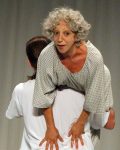
Dulcinea Langfelder, being carried by Eric Gingras, in Victoria, which is at Massey Theatre for two shows only next week. (photo from Dulcinea Langfelder & Co.)
Victoria is coming to New Westminster next week for two shows only. Created and performed by Dulcinea Langfelder, a versatile dancer, multimedia performer and award-winning choreographer from Montreal, Victoria is about old age and young spirit, about laughter in the face of tragedy.
Langfelder started her life in New York. She studied ballet and pantomime, singing and acting. After a few years in Europe, including London and Paris, she moved to Montreal in 1978 to join La Troupe Omnibus. Since then, Montreal has been her home. In 1985, she founded her own company, Virtuous Circle Dance Theatre. In 1997, the company changed its name to Dulcinea Langfelder & Co.
Langfelder loves Montreal and can’t imagine living anywhere else. “The city is effervescent, young culturally compared to New York or Paris,” she said. “Fewer boundaries between categories, and close enough to New York to visit my mom. Why on earth would I want to live elsewhere?”
The same philosophy applies to her choreography and performing. Why on earth would she do anything else? “For the moment, I can still do what I love to do, and I believe that it’s important to see older people on stage. Art has always been the most effective way to influence our attitudes. Victoria gives voice to those who have ‘disappeared’ through aging – but we are still alive and kicking!”
Although it’s hard to pinpoint Victoria’s exact theatrical classification, Langfelder said, “It is a multidisciplinary and multimedia work for the stage. There really is no major discipline. I work with the elements on my palette: movement (I guess I do always put that one first), text, humour, dramatic – through line, projected imagery, music and a bit of puppetry. Everything is choreographed, not just the movement.”
The heroine, Victoria, is “a wheelchair-bound 90-year-old, suffering from the loss of memory, autonomy and just about everything else,” reads the press release. But Langfelder melds poignant and funny in this show of an elderly woman’s courage. Victoria premièred in 1999, and Langfelder told the Independent about its origins.
“In 1994, an actor friend of mine, Charles Fariala, who also worked as an orderly and knew that I have a penchant for tragicomedy, called me to say, ‘You must meet Victor, an old man in a wheelchair who’s lost his memory; sometimes I wonder if he’s just gaga or if he’s discovered Nirvana.’ I immediately responded, ‘We’ll call her Victoria!’ I was intrigued by the question: Where do we find our mental victory when we we’ve lost our physical power?”
Inspired by the concept, Fariala and Langfelder started working on the project. “Charles wrote pages of text, which I re-worked,” said Langfelder. “I also incorporated a lot of text that came from Angel Petrilli, a woman who became the principal model for the character, although there were other people as well, including my own father. But this piece is multidisciplinary and multimedia, so the ‘script’ is composed of text, choreography, song and projected imagery. It was written in concert with all of my collaborators; I created the choreography.”
One of the most unusual aspects of the show is that the protagonist is bound to her wheelchair. “It is hard to tame the wheelchair beast,” Langfelder admitted, “but fascinating for a mover!”
The show’s success and longevity – 18 years now – surprises even its creator. “I didn’t think it would fly at all, with such taboo subject matter,” she said. “But I discovered that audiences had been starving to have this conversation in a non-depressing way. While treating this subject as accurately as I can, Victoria is an uplifting piece, because there really are rich, poetic and hilarious moments when dealing with dementia and the end of life. We just underline those moments, without taking the subject matter lightly.”
Like every performer, Langfelder knows that art must change with time, that an actor should be flexible in her communication with different audiences. Victoria is no exception to this rule. “It changed a lot in the first years,” Langfelder explained, “then subtle changes. It adapted to different languages and cultures, though it clearly reminds us of what we have in common around the world. We’ve done this piece everywhere from Japan to Zimbabwe, in seven languages.”
One of the latest changes was adding another actress to play the title role. “I recently realized that this piece could live longer than I will,” said Langfelder. “I trained Anne Sabourin in the role. She plays Victoria in French.”
Langfelder herself plays Victoria in English in every show, in every country, and the reception has been overwhelmingly favourable, but that is not enough for the actress. “The Victoria project is about touring the piece for the general audience it was designed for,” she said. “Plus, we work hard to get those who can most benefit, and are the least likely to frequent the theatre: seniors and family/professional caregivers. The way we get them to the theatre, and Victoria can’t be done anywhere else, is that we go to them first. We offer workshops that answer their immediate needs, like non-verbal communication, movement for seniors and seminars on creativity, humour and dementia. Then we use the opportunity to make them understand that theatre can actually be useful, even more useful than workshops. We invite them to the theatre.”
Like her heroine, Langfelder meets her challenges with a smile. “I love making people laugh at difficult situations,” she said. “It makes me feel useful. My father’s last words to me, before his stroke, were in response to me complaining about my challenges. He said, ‘You mustn’t get discouraged, because what you do is so important! You put human dilemma on stage and allow us to laugh at it; what could be more important than that?’ I had just begun working on Victoria, and he never saw it. I become him when I play Victoria.”
Victoria is at the Massey Theatre in New Westminster on Oct. 27 and 28. For tickets, visit ticketsnw.ca or call 604-521-5050.
Olga Livshin is a Vancouver freelance writer. She can be reached at olgagodim@gmail.com.

Orthodox and in love?
Kosher Love’s director Evan Beloff, left, with Michael Gamliel, his wife, Miriam. (photo from cbc.ca/firsthand/episodes/kosher-love)
To all those who believe in marrying for love, Montreal-based matchmaker Rabbi Yisroel Bernath asks, “What happens when the romance fails?”
Bernath is spiritual director at Chabad of Notre-Dame-de-Grâce and a chaplain at Concordia University. Known by some as “the Love Rabbi,” he is at the centre of the documentary Kosher Love, which can be see at this year’s Vancouver Jewish Film Festival on Nov. 5, 4 p.m., at Fifth Avenue Cinemas.
The film’s mostly light tone and creative compilation, which includes animation, make for an interesting peek into the ultra-Orthodox world and how its members meet one another, marry and start a family. Bernath seems like an affable man, even though he divides North America’s Jews into only three groups – those who watch Seinfeld and eat bagels, those who are Orthodox and those who are Chassidim – never mind the scores of other affiliations and levels of observance.
What is particularly compelling is that Bernath is open to hearing, if not being swayed by, different points of view. There is one scene between the rabbi and a married couple he matched, in which the woman is comfortable and confident enough to strongly present her opinion that love is a vital part of a relationship. She doesn’t back down when Bernath accuses her of being overly romantic, but rather digs her heels in and tells him, with some vehemence, that she doesn’t agree with him.
Viewers also meet a nightmare mother and son. The mother, whose daughters have both married, is quite obnoxiously desperate to marry off her 33-year-old son. But the man-child YoNatan, a DJ, is clearly more in love with himself and his music than he could ever be with anyone else. YoNatan was never going to add to Bernath’s total of 50-plus successful matches.
As the Montreal Gazette noted in its review, “Regardless of the personalities in Kosher Love, it really transcends religion in touching on universal themes. It is the view of Bernath that love develops over time, but that in today’s fast-paced world, few have the patience to wait.” When and how love develops, and how it can be nurtured, are all worthwhile ideas to consider, and director Evan Beloff offers a charming and engaging introduction to some Jewish thoughts on the subject.
Beloff will be at the film festival’s Nov. 5 screening. For tickets and the festival schedule, visit vjff.org.

Win 2 free film tickets!
A Heartbeat Away follows Save a Child’s Heart pediatric cardiologist Dr. Akiva Tamir to Africa on a medical screening mission to find children in need of lifesaving heart surgery. (photo from Save a Child’s Heart Canada)
Jewish Independent readers can win two tickets to the Nov. 2 Vancouver premiére of the documentary A Heartbeat Away at Scotiabank Theatre. Simply email editor@jewishindependent.ca by Wednesday, Oct. 25, 5 p.m., to be entered in a draw. The winner will be contacted.
A Heartbeat Away, by Tal Barda and Noam Pinchas, follows Save a Child’s Heart pediatric cardiologist Dr. Akiva Tamir to Africa on a medical screening mission to find children in need of lifesaving heart surgery – surgery that is not accessible in Tanzania, where, every day, five children die from heart disorders and rheumatic heart disease. In the documentary, Tamir and his team examine hundreds of children, although only a handful can receive the treatment that will save their lives. When 6-year-old Julius arrives at the clinic in critical condition, Tamir is forced to choose whether to operate on the child, who has very little chance of surviving. Tamir and his team take viewers on an emotional rollercoaster, as they deal with the most serious question of who to treat. The experienced physicians find it hard to detach from the emotional bond they share with their small patients.
The documentary focuses on the challenges of receiving adequate health care in developing countries, and the challenges providers face when so many are in need – how do they pick who to treat?
According to Marni Brinder Byk, executive director, Save a Child’s Heart Canada, “Congenital heart disease is responsible for more deaths in the first year of life than any other birth defect. Due to a high prevalence of acquired and congenital pediatric heart disease in developing countries, and a lack of skilled medical personnel dealing in pediatric cardiac care, there are thousands of children in need of cardiac intervention, and hundreds of medical personnel living in developing countries that require advanced training.”
To date, she said, the Israel-based Save a Child’s Heart has “provided care to over 4,400 children from 55 countries in Africa, Asia, Eastern Europe, the Caribbean, South and Central America, and the Middle East.”
In an interview with Eretz Magazine, Barda, who also directed the documentary, said, “The first thing that the documentary film needs to give the viewer is information. However, for me, the next move is touching the individual’s story…. My dream is to have as many people as possible watch this movie. The story comes from a different world, creates a sense of acquaintance and a better way of coping and looking at things…. There is something very powerful in this story, which is happening in the current dire reality of Israel and the world. It is about people who are taking their professional skills and doing something good with them. They go out of their comfort zone and do something for the benefit of the other. These doctors are taking care of all hearts, simply because they are beating hearts.
“The message here is very powerful, in my opinion,” she continued. “The organization is taking care of all children: Israelis, Africans, Palestinians….” To view the official trailer of A Heartbeat Away, visit vimeo.com/151644429.
The Nov. 2 screening event in Vancouver is chaired by Lana Pulver. It starts at 6:30 p.m. with a wine and cheese reception, followed by the screening of the documentary and a question-and-answer period with a panel of experts on pediatric global health and cardiac treatment. Tickets are $36, with all proceeds benefiting Save a Child’s Heart. To purchase tickets or make a donation, click here or call toll-free 1-844-924-9113.
America’s UNESCO exit
The United States and Israel will withdraw from UNESCO. The United Nations Educational, Scientific and Cultural Organization is one of the most impressive and vital global agencies addressing international cooperation on this range of human endeavours. Unfortunately, like the United Nations itself, which exemplifies unfulfilled promise, it has been coopted into the service of Israel-hating forces.
UNESCO does vitally important work advancing education as a basic human right, fostering cultural diversity and dialogue, and promoting heritage as “a bridge between generations and peoples.” It is also committed to “full freedom of expression; the basis of democracy, development and human dignity.”
The irony here is that, by succumbing to the influence of Israel-bashers, UNESCO is in cahoots with countries that betray the most basic concepts of free expression and democracy.
The U.S. State Department announced last week that it would quit UNESCO and, while insisting that Israel was unaware of the impending announcement and that the decision was uncoordinated between the two countries, Israel’s Prime Minister Binyamin Netanyahu announced that Israel would follow its ally and also leave the agency.
Coincidentally or deliberately, UNESCO elected its first Jewish director general just days after the United States’ announcement. France’s former minister of culture, Audrey Azoulay, was elected to the leadership role, outpolling the Qatari perceived frontrunner, in a vote by UNESCO’s executive last Friday.
The United States was in arrears to UNESCO to the tune of $550 million and even a U.S. State Department spokesperson didn’t deny that money figured into the calculation. The United States stopped paying its dues to UNESCO in 2011, when the agency admitted “Palestine” as a full member state.
In July, UNESCO declared Hebron an endangered World Heritage site, diminishing the Jewish people’s ancient and contemporary connections to the city, home to the tombs of the Patriarchs and Matriarchs.
UNESCO has also adopted resolutions that call Jerusalem “occupied” territory, acknowledge Muslim but not Jewish historical connections to the Temple Mount area and repeatedly reinforced a common Palestinian position that Jews have little or no historical connection to the land of Israel.
The question is, do you stay and fight or give up and decamp in protest? A similar paradox occurred at the United Nations-sponsored World Conference Against Racism, in Durban, South Africa, in 2001. When it became clear that the event had been commandeered not only by anti-Zionist elements, but by some of the most antisemitic forces in the world, the United States and Israel walked out. Canada stayed. The Liberal government of the time justified the decision by saying they could remain as a voice of critical reason. There are legitimate cases to be made for both positions.
In choosing to leave the organization as a member but remain as an observer state, the United States found the right balance. They can continue to make their opposition to UNESCO excesses heard, without countenancing them morally or financially.
At least, that is how it would work in a world in which Donald Trump was not president of the United States. In this, as in so much, Trump changes everything. While the administration’s decision on UNESCO may be a decent one, in context with other decisions of the Trump administration, it becomes part of a retraction of American influence in and engagement with the world. Trump is motivated by spite, not by principle. While another president could have made the same move and explained it as a principled defence of the country’s most important ally in the Middle East, this president’s lack of principle and surfeit of malevolence relocates even defensible positions into a constellation of petty pique. Despite its manipulation by anti-Zionist ideologues, UNESCO remains an invaluable institution, doing much good work in the world. Even while maintaining observer status, the U.S. decision is likely to be read by critics not as a repudiation of what UNESCO does wrong, but as part of an ongoing American trend against all that is good in culture, science and education.
Context matters. Like Richard Nixon in China – OK, perhaps not really like that, but at least in the respect that a president with some credibility in areas relevant to UNESCO could get away with repudiating it – a president Hillary Clinton (or Bill Clinton, or Barack Obama) could have withdrawn from UNESCO and not made their country look like a collection of petty Philistines. When a president who has little demonstrated respect for culture, education or science withdraws from a global organization dedicated to these pursuits, it probably legitimizes UNESCO more than it delegitimizes it.
Worse for Jews, this tight friendship between Trump and Netanyahu reinforces perceptions of the Jewish people – or, at the very least, the Jewish state – as ideologically entwined with a figure who seems destined to go down as the most ineffectual and destructive president in American history. Not an enviable place to find oneself.
Need for interfaith learning
Have you heard about the sacred text in which the Almighty says, “Stand back from this community so that I may annihilate them in an instant?”
What about the king who gives permission to a people “to destroy, kill and annihilate the powers of any people or province that oppressed them, [even] young children and women, and to take their spoils.”
How do you feel about stoning a rebellious child?
That isn’t our religion! That’s not Judaism. It must be from some other religion’s holy book, right? Wrong. Actually, these come directly from the Tanach. Respectively: Numbers 16:21, Esther 8:11 and Deuteronomy 21:18.
Religious literature – heck, all literature – has concepts that might shock or offend. What about ideas that one doesn’t understand? Many educated people don’t read these sections as the literal truth. Thousands of years of commentators, in all religions, help us understand ideas that perhaps don’t make sense to modern sensibilities. These uncomfortable statements are sometimes proving a point by hyperbole, or creating metaphorical relationships to prove a point.
Many of us don’t take literature or anything we read – never mind the Torah – literally. We also know that, when something seems dubious, we should look it up. Use a dictionary, an online encyclopedia or even … a book.
Awhile back, an acquaintance sitting at a Shabbat table said something that seemed outrageous about Islam. His language and vehemence made me wish that there weren’t kids playing nearby. The man insisted he quoted the Koran correctly – nonetheless I felt concerned. Was he taking it out of context or distorting the point? When I got home, I looked it up. How? Easy, I have a copy of the Koran on my bookshelf. I took a whole course on the Koran as an undergraduate at Cornell.
Much of the time, we are too gullible. We believe what we read or hear from others or what we see reported in the news. We take it as true without thinking about it critically. We’re not always thinking about the words used in media reports … was the killer in Las Vegas a “lone wolf” or a “terrorist”? Does religion or race matter when it comes to how the media portrayed him? It does matter. A white man with Christian origins often doesn’t get called a terrorist or an extremist.
In that vein, many – including politicians and media commentators – feel free to make comments about Islam without actually reading the Koran. That sometimes results in a pretty skewed understanding of that faith tradition. Why am I talking about Islam? We live in a multicultural society. It’s important to know about our traditions and those of our neighbours.
Recently, Dr. Ruth Ashrafi gave a series of lectures to Catholics in Winnipeg about Judaism and the New Testament. She did it in connection with the Manitoba Interfaith Council, an important community organization. The president of the Interfaith Council is Belle Jarniewski, another member of the Jewish community.
These types of outreach efforts benefit everyone. Both Christianity and Islam have Jewish roots. Many Christians and Muslims want to learn more about Judaism. Further, Jews could learn a thing or two about others’ beliefs. Mutual understanding and education go a long way towards bridging differences and building on our common values. Ignorance breeds hate. We could all do with less of that, so let’s work on education.
It is easy to get whipped into a fervour when dealing with media reports or reading the newest bestselling polemical book about another people’s faith traditions. Yet, we aren’t experts in those traditions – unless we start from the beginning, read their holy texts, understand their customs, holidays and values before reading the newest polemic. Most of us aren’t even experts in our own traditions. When I was required to read the Hebrew Bible from beginning to end in graduate school, there were definitely upsetting things I read that I hadn’t known before. I had to read commentaries (both Jewish and non-Jewish ones) in order to get a better grip on what it contained.
I’m reminded, when seeing hot media rhetoric, of how my twins tell me about one of their fights. I hear the dramatic narrative from one side, and an entirely different tale from the other. The truth – or my understanding of their fight – lies somewhere in between all the different versions of their stories.
A friend of mine reads the news in multiple languages. If he has particular interest in one issue, he might use one piece of paper to take notes from all the international news sources. When he’s finished, he has created something like a Venn diagram. The news everyone seems to agree on, no matter the language or political agenda of the news source, is somewhere in the middle.
It’s only through study, asking questions and gaining knowledge that we become educated enough to understand difficult conflicts, religious disputes and political issues. We’d benefit from the programming of organizations such as the Manitoba Interfaith Council. As well, we can take time to read our sacred texts and others’ holy books in order to understand ourselves and our neighbours better.
Living an upright life as a Jew includes seriously taking responsibility for engaging with our foundational texts. Then, maybe, we’ll be living out our mandate as the People of the Book.
The next time you read a polemic against someone else’s religion (or your own) or hear a skewed media report and believe it without further research, remember that Venn diagram as a way towards better understanding.
We’re People of the Book. Maybe it’s time to crack some open? We can always learn more.
Joanne Seiff writes regularly for CBC Manitoba and is a regular columnist for Winnipeg’s Jewish Post and News. She is the author of the book From the Outside In: Jewish Post Columns 2015-2016, a collection of essays available for digital download or as a paperback from Amazon. See more about her at joanneseiff.blogspot.com.
Writing Lives begins anew
This academic year marks the second session of Writing Lives, a two-semester project at Langara College, coordinated by instructor Dr. Rachel Mines. Writing Lives is a partnership between Langara, the Vancouver Holocaust Education Centre and the Azrieli Foundation.
This fall, students are learning about the Holocaust by studying literary and historical texts. They are using the resources of the Isaac Waldman Jewish Public Library to help them write detailed research projects on prewar Jewish communities in Europe. In January, students will begin interviewing local Holocaust survivors and then write the survivors’ memoirs on the basis of the interviews. Students are keeping journals of their personal reflections on their experiences as Writing Lives participants. Many students used their first journal entry to reflect on how the course material is changing their perceptions of current events. Here are some excerpts.
I have learned that a racist interaction between a person of colour and a white person is not only between those two specific people. In that interaction is embedded an entire history of racism. A racist society supports white and racist ideology in a way that has historically privileged white people and embeds power in a racist interaction. The social conditions in a racist society psychologically prime the person of colour to strategize in certain ways during interactions they may perceive as dangerous.
Similarly (I realize now), Jews were emotionally and psychologically primed by their history of using appeasement as a successful, non-violent form of survival-as-resistance. This history surely psychologically primed the German oppressors to see the Jews as appropriate targets for their unprecedented scapegoating and the ensuing genocide.
This is one of the few times so far that a concept I have learned as an undergrad is beginning to take hold in my mind, tangibly changing the way I think and interpret information. I am learning to more broadly apply what I have learned about oppression and resistance. My evolving thought process gives me hope that I will in my life have a greater understanding of such dynamics and that I will contribute to the effort to understand, influence and mitigate, or even transform, dynamics between people of power and vulnerable populations.
– April Curry
Learning about the origins of Nazi Germany, the slow and steady rise to power of Hitler and his party, and the various influences that led to the Holocaust has been enlightening, in a troubling way, of course. One of the scariest eye-openers about what I have learned recently is just how human this chain of events was. A hurt and angry nation was ready to find anything and anyone to take their frustrations out on. It’s scary how this chain of events makes sense in retrospect. Yet it’s also disturbing how little thought I gave to this chain of events; they were things that happened, so I left it at that. But there is so much insight to be gained from reading into this history. Learning the history of the Holocaust and the build-up to it has given me a sense of awareness. I feel much more enlightened thanks to learning this history.
– Clayton Dott
There has been much focus on Hitler’s personal pathology (his lack of self-esteem, sense of being an outsider, etc.) to explain his primal role in the Holocaust. Problematically, this view assumes that Hitler’s racist system of values and beliefs arose outside of the environment he lived in. It is clear, however, that antisemitism, a racist ideology, existed long before his time. Furthermore, restricting the discourse to individual pathology denies the connection between Nazi violence and antisemitism, as though “lone wolves,” driven by individual malice, had committed the crimes. For example, the claim that “without Hitler, no Holocaust” denies the incessant influence of historical antisemitism and other dominant ideologies, such as Aryan supremacy and nationalism. Moreover, placing an emphasis on personal characteristics fails to take into account structural oppression. Fascist and authoritarian leaders may be charismatic, but the popular support they garner relies heavily on their ability to create a sociopolitical framework that allows for organized and systematic coercion and manufacture of consent, achieved by subjecting people to and satiating them with dogmatic education and media propaganda.
– Marc Perez
As the class explored the factors that contributed to the prejudice and antisemitism that led to the Holocaust, I was confronted with the reality of the deep and painful cost that the fear of disconnection and abandonment has on our society. Research has shown that the human need for belonging, connection and community is in fact one of the precipitating causes of racism. It is strange and uncomfortable to step away from my generally positive understanding of connection and find that belonging can be built on the loyalty earned by excluding others. In fact, the act of ostracizing and dehumanizing others can help form a shared identity and sense of belonging.
In what ways do I meet my own needs for belonging when I fail to speak up after a racist joke is told or someone is scolded for not speaking English to their own peer group in the line at Starbucks? We have to ask ourselves, what does it mean when people like myself, with so much social privilege, fail to disrupt these sorts of racist attacks? In this way, am I not complicit in the propagation of intolerance and social isolation in my own community?
– L. Ann Thomas

Tashlich with RJDS
(photo from RJDS)
The day before Yom Kippur, Richmond Jewish Day School students in grades 2 and 5 went to Garry Point Park to do Tashlich. The students learned about why Jews have this custom, and listened to a story about teshuvah (repentance) from Moreh Abba (Brodt). They then sang Avinu Malkeinu together and had two students recite the Tashlich prayer for everyone. The students were given breadcrumbs to throw in the water, symbolizing the getting rid of sins.
“Today, we went to Garry Point to say Tashlich,” said one of the students, describing her experience. “We had lots of fun there. We threw breadcrumbs in the water. Each breadcrumb represents my sins I did over the year. I’m so thankful I get to have an opportunity to say sorry to Hashem and ask for forgiveness.”
Chaya Malul is a Grade 5 student at Richmond Jewish Day School.