DOTE dances across the street

LINK Dance Foundation will perform Why did the Chicken Cross the Road? at a few intersections in Vancouver during Dancing on the Edge. (photo from DOTE)

As part of this year’s Dancing on the Edge festival, which takes place July 6-15, LINK Dance Foundation will explore the age-old question, “Why did the chicken cross the road?”

“The idea for Why did the Chicken Cross the Road? came about through various stages, like all things do,” said Gail Lotenberg, founding artistic director of LINK. “The germination to the actual realization was a process and it is still in development for the future.”

DOTE producer Donna Spencer invited Lotenberg to be involved in this year’s festival with a specific piece, but the timing wasn’t right. “So, I told her I had another idea for this year if she was open to it. We had a meeting and together we cooked up this piece,” said Lotenberg.

Leading up to the 2013 provincial election, she said, “I wanted to help attract young people to exercise their right to vote, so I spearheaded a dance performance at the intersection of Davie Street and Granville Street with signage from Rock the Vote BC.

“The dance did not deliver overt messages about voting (though there were subtle motifs in the choreography), rather it aimed to stop people in their daily lives to enjoy viewing a quick dance by an ensemble of dancers as they crossed a busy intersection. We had people stationed at the corners to hand out pamphlets with more specific information about voting day.”

The concept was introduced to Lotenberg in 2005 by a “close friend and colleague, Cara Siu, who came to Whitehorse, Yukon, when I used to live there. At that time, I was producing an annual festival called Dancing in the Streets. She came from Vancouver to make a dance at the intersection of two main streets in Whitehorse as part of the week of outdoor dance performances. I loved the idea and always knew I would use it again.”

For the 2017 incarnation, Lotenberg said she wanted to “include a large pool of less-well-known dancers in the community in a site-based work at intersections” and Spencer was all for it.

“In fact,” said Lotenberg, “it was her idea to involve young dancers from pre-professional training programs in the project. She also saw the benefit of having DOTE volunteers on the corners to provide more information to people about other shows they could see during the annual summer festival. Donna really helped to make the idea crystallize into what it is now, a work for eight dancers – mostly young dancers in the final stages of their training with the exception of two professionals. The two dancers who would normally be considered out of their training stage … will perform my core idea of a duet between pieces of white cloth to complete the show.”

Lotenberg, however, won’t be performing. “I will not be dancing in this work,” she said, “unless I’m wearing a chicken costume.”

She hopes “Intersection Interventions” will become “an annual part of DOTE, in the way Dusk Dances were a signature aspect of the festival for almost a decade.”

She said, “I believe in public art. I see myself as someone who evolved from the same fabric as the public frivolity movement of the 1990s – Unsilent Night, flashmobs, etc. These are acts of art that enhance our civic arena.

“I like art that engages people in community and invites people briefly into the humanizing experience of co-creating art. I don’t like art that does this by ignoring the principles of composition and virtuosity and esthetics, meaning they are inclusive but not very entertaining. So, I strive to find the duality that makes work provocative and pleasing to view, while at the same time offering some type of invitation to be an active rather than a passive participant.”

From 2008 to 2012, Lotenberg was an associated artist with Simon Fraser University’s Centre for Dialogue. The academic director of the centre then, Mark Winston, supported many of her endeavours, she said, “because he saw my work as a model for how to employ art as part of public engagement and how to construe social engagement as fertile soil for making art. I am grateful to Mark for that period of cross-pollination of ideas and expertise. He, too, is a Jewish person and together we mined the depths of what it meant to be Jewish and engaged in our mutual professions, he as a scientist and director of the CFD, me as a dance artist and director of a dance company.”

She said, “When I was a younger artist, there was a hierarchy in my mind that put work onstage above public-engaged art practice. Then I met Liz Lerman, a famous populist choreographer from the U.S., and I shifted my perspective to a less hierarchical model.

“I love seeing how dance can enter the public domain and engage people in something that lives between the opposing ends of a spectrum. On the one hand, you have pure social dancing that is non-performative but fully inclusive and, on the other end, you have very formal dance performance, which occurs on a stage with no apparent involvement from the audience except as witness. I love the in-between.”

Over the course of her dance performance and choreography career, Lotenberg has created many works that combine dance and activism.

“I’m a political person,” she said. “I grew up that way. As a Jewish person, I was taught to think in terms of how I could contribute to making the world a better place. I use my attributes as a choreographer to bring people together in a way that feels beautiful or powerful or profound or just fun.

“Take the Occupy Movement, for instance. I see something like that and I think, ‘Oh, imagine how easy it would be to occupy more space by getting people to not just stand around and chant but rather to do a square dance, which inherently takes up a lot more space.’ In occupying space with a square dance, people are using dance politically and the results are varied. People are having more fun. Authorities may not feel so threatened because the impulse is to relish life, not to be destructive, which is true of most political movements that are not hate-based. So, dance for me is an interface between the institutions we hope to shift and the people who are trying to have sway in shifting those institutions.”

Being Jewish has informed Lotenberg’s way of engaging with the world in various ways.

She said, “Being Jewish made me a political person and that feeds an aspect of my choreographic interests…. Being Jewish also surrounded me with people who embrace ritual and ritual is an important aspect of art. Being Jewish led to many opportunities to be in community through song and dance, and there is nothing more uplifting than that. In fact, I would say that these acts of sharing voice and song are what do connect me to my spirituality.

“And finally, I grew up as a New York Jew and my parents were very involved in the Civil Rights Movement of the 1960s. We moved to a town that was emerging as a leader in desegregation of schools, so I went to a school right from Grade 1 that was racially mixed.”

Lotenberg earned her bachelor’s degree at University of Michigan, was a dance teacher and skier in Crested Butte, Colo., for about five years and then did her master’s degree in history at University of Washington. In Seattle, she said, “I met a Vancouver boy, graduated, sold everything, moved here and then, within a year, we left for the Yukon.”

While Yukon was home from 1993, Lotenberg returned to Vancouver often for dancing. In 2007, she and her family moved to Bowen Island – “bad for my dancing career but otherwise wonderful,” she said.

Lotenberg took an approximately three-year break from dancing to be more present for her daughter, who has a learning disability, she said. “She’s good now. She’s strong and knows how to self-advocate for learning support that allows her to perform well in school. And, she basically is my happy place. But, I missed dance and being with other dancers – people who see and sense the world through a different lens.

“I feel gratitude at the opportunity to re-enter the dance milieu from the place I am today. I am grounded; I have a good job as a pilates instructor; I want to have my work seen and appreciated but that desire does not define me anymore. I am eager to share my work, but I feel strong and I feel confident and I trust that my work is valuable because it is honest and well-crafted and unique.”

Lotenberg is in the midst of developing a new stage work for next year’s DOTE in which she will be dancing.

“It is a piece I am challenging myself to take on because it feels important for me to step back into the dancing body to tell my story in a real and vulnerable way,” she said. “In fact, the application to show this work I’m describing is what actually led to having Why did the Chicken Cross the Road? happen at this year’s festival. Life is a beautiful journey that way. You sow seeds but you don’t always know how they will bear fruit.”

The promotional material for Why did the Chicken Cross the Road? asks the question, “Rather than walk, why not dance to get to the other side?” What can be gained from dancing, even if only across the street?

“Dancing is liberating,” said Lotenberg. “Dancing is frivolity and elemental connection (at the same time). Dancing is one of the first forms of art and, in some cultures, it is the glue that defines who they are, how they touch the earth with their feet and what is the rhythm of their heartbeat.

“I tried to leave dance and choreography to become a better mother. I did become a better mother but I also realized in that period that dance is essential to who I am.

“Dancing across the street,” she said, “is a way of celebrating life, is a way of being part of making the world a more beautiful place, is an invitation to be part of a happening that makes today just a bit more rich than yesterday or tomorrow.”

For the times and locations of Why did the Chicken Cross the Road?, visit dancingontheedge.org/program/chicken-cross-road. For the full DOTE schedule, visit dancingontheedge.org.
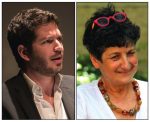
Jerusalem a high-tech hub

Lior Schillat of Jerusalem Institute for Policy Research and Maya Halevy of Bloomfield Science Museum Jerusalem will speak at Jerusalem of Gold: Capital of Innovation & Tech on July 16. (photos from CFHU Vancouver)

“Hebrew University is probably the only university that ‘founded’ a state rather than vice versa, as the cornerstone for the university was laid on July 24, 1918, and, on April 1, 1925, the Mount Scopus campus was opened,” Dina Wachtel, Western region executive director, Canadian Friends of the Hebrew University, told the Independent. “The contemporary history of the city of Jerusalem and the story of the Six Day War is intertwined with the story of the university – what better way to celebrate that than by bringing in four of Jerusalem’s change-makers?”

The July 16 TED Talk-style event at the Jewish Community Centre of Greater Vancouver – hosted by CFHU, the Jerusalem Foundation and JCCGV – “is a celebration of the start-up nation and the role the city is playing in becoming a centre for innovation and technology,” said Wachtel. “Thus, it is also the story of how innovation improves the lives of humanity in this world regardless of boundaries of any kind: geographical, political, ethnic, religious.”

At the event called Jerusalem of Gold: Capital of Innovation & Tech, the speakers will be Lior Schillat, director general of Jerusalem Institute for Policy Research; Maya Halevy, executive director of Bloomfield Science Museum Jerusalem; Yonatan Avraham, student ambassador of HUstart, the university’s entrepreneurship centre; and Tamir Huberman, vice-president of business development and information-technology director of Yissum, the technology transfer company of Hebrew U. The Jewish Independent interviewed each of the presenters in anticipation of their Vancouver visit, and will feature Schillat and Halevy this week, and Avraham and Huberman on July 7.

Schillat will talk about Jerusalem’s Population: What Does the Future Hold? But first, what about the Jerusalem of the past – what would have inspired a Canadian Jew to make aliyah 50 years ago?

Actually, said Schillat, in the 20th century, the biggest wave of immigrants from countries such as Canada came right after the Six Day War.

“If you’re Canadian and you’re making aliyah in ’67 and you’re choosing Jerusalem for your home, I guess the main reason you would do that would be because of the spiritual effect the glorious victory of 1967 would have on you,” said Schillat.

“If you are a bit more practical, you also understand that, with this victory, Jerusalem, for the first time since 1948, became again the centre of the country … centre in the geographical meaning and also the centre of attention as to what was going on in the country.”

Fifty years later, he said, while “we still haven’t reached some kind of stability in the situation in Jerusalem,” the city “is one of the most interesting … cities in Israel, and why is that? First of all, it’s Jerusalem, meaning it’s beautiful, it has stories that are in the heart of billions of people all over the world…. I would say the Jerusalem brand is stronger than any other brand in Israel, including the Israeli brand itself…. So, if you would come to Jerusalem, it would be because you want to spend your life in a way that is a bit more meaningful than … in any other city in Israel, in any other Western country.”

In Jerusalem, he said, “from the moment you wake up until the moment you go to sleep, you live for something, for an idea. It’s true for everyone – of course it’s true for religious people, but it’s also … true for secular people. Life here just has much more meaning. You know, it’s not for nothing that Jerusalem is 10% of the Israeli population but 25% of civic society organizations are based here. And if you look at Israel’s biggest struggles or debates, many of them were generated from the Jerusalem society.”

Jerusalem is a completely different city than it was 50 years ago, said Schillat. “Jerusalem is one of the most advanced high-tech ecosystems in the world today…. When you look at the numbers, you see that, today, Jerusalem is considered among the 30 biggest ecosystems in the world. And some of the researchers even say that they would consider it for next year among the 20.”

It’s not the tech hub that Tel Aviv is, he acknowledged, but, in proportion to its population, Jerusalem rates high on the tech scene. And this shouldn’t be surprising, he said.

“People here are using their minds all the time, and high-tech is exactly that – it’s how you use your mind in order to create gain, in order to create technology that could help better the world…. The number of technological companies in this city has more than doubled in the last four years. The number of employees in high-tech is growing 15% every year for the last three years.”

Schillat gave as the best example of Jerusalem’s growing prominence in this area the recent acquisition by Intel of Jerusalem-based company Mobileye for $15.3 billion. Not only that, he said, but Intel also has decided to base in Jerusalem its international research and development centre for autonomous cars.

“I don’t see the Jerusalem of the future as being another New York or another Frankfurt or another Tel Aviv; it won’t be a financial centre. I see it as a city of knowledge; of creating fruits from thinking, from knowledge, from discussion. And I also think that Jerusalem is facing now the amazing challenge, and very hard challenge, of integrating into this group of thinkers and builders the more weak populations…. The real test for Jerusalem for the next 50 years would be, ‘Did you integrate the Charedi groups, did you integrate the Arab groups into this economic development model of a city of thinkers, or did you just go with this idea by yourself, meaning just a small elite group of thinkers went with it by themselves and left the majority of the city behind?”

One facility that is trying to integrate various population groups is Bloomfield Science Museum. Founded and operated by the Jerusalem Foundation and HU, the museum is supported by the national and municipal governments. Its website describes science “as a common language that disregards physical borders, cultural and religious differences and enables dialogue among participants with a common interest and diverse backgrounds.” Halevy will talk on the topic Raising a Start-up Nation.

“There is much research that shows that young kids love science and science classes,” she said, “but they don’t see themselves in a STEM [science, technology, engineering and mathematics] career, mainly because they believe that having a STEM career is being a scientist, which they think it is to work alone in a lab, and can be relevant only to the best scholars. Our role is to show the variety of opportunities that STEM learning can open for them in a future career.”

Bloomfield serves as a lab and hub for education programs, she said. “As a lab, we develop new approaches, new pedagogy, new tools, and we test those with a variety of people, as we are also a hub for all the communities in Jerusalem.”

The museum collaborates with institutions around the world, as well. A current exhibit that will travel to Ottawa, among other places, is the Bicycle Exhibition 2 x 200. The new Canada Science and Technology Museum is set to open in November after extensive renovations and the exhibit is scheduled to arrive there after a few other stops.

The idea for the exhibit came when Halevy was on a visit to Ottawa in October 2015, at the request of then-Israeli ambassador to Canada Raphael Barak, “who wished to develop cooperation among cultural institutions from Canada and Israel.”

Visiting the museum while it was under renovation, Halevy saw the collection of bicycles it had in storage and learned that 2017 would mark 200 years since this invention.

“So we decided to focus our cooperation on a bicycle exhibition,” she said, “to use their collection and to add interactive exhibits – we are very experienced in this field – and the idea was that we will develop and build the whole exhibition in Jerusalem and later on it will travel to Ottawa.

“We were lucky to find two more partners, from Germany and Italy, that loved the concept of the exhibition and that wished to join us, so the tour will start in Jerusalem, will move to Bremen (July 2018) and then to Naples (July 2019) and will end in Ottawa (2020). We were also approached by other museums that wish to present the exhibition after the partners’ tour ends.”

Bloomfield signed a letter of intent with Ontario Science Centre last year. “The main idea is to develop our cooperation around the culture of innovation and to start developing this culture from an early age, as the future of both our economies is based today on innovation and entrepreneurship,” explained Halevy. “We plan to develop together an interactive exhibition and special programs for young children and youth and to connect them to each other. We wish to open the exhibition and launch the programs in 2018 – 70 years to the establishment of Israel. During my time in Toronto, I will have a meeting with the CEO and president of the Ontario Science Centre, Dr. Maurice Bitran, to discuss it more in-depth.”

As for other collaborations with Canadian institutions, Halevy said, “We might develop new collaborations on my tour, as I plan to visit my colleagues from Calgary and Vancouver.”

Jerusalem of Gold: Capital of Innovation & Tech is open to the public. Tickets are $45, though Wachtel said, “Students who are interested in coming to the event are welcome to register at our office and receive a free ticket.” For tickets, the speakers’ bios and other information, visit cfhu.org, email vanc@cfhu.org or call 604-257-5133.

Join Bob Bossin at folk fest

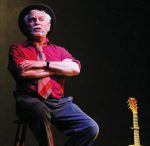
Bob Bossin as Davy in Davy and the Punk. (photo by Derek Kilbourn)

For legendary Canadian folksinger Bob Bossin, who has called Gabriola Island home since 1991, it all started with “The King.”

“It was Elvis,” he told the Independent about his start in music. Bossin is among the performers featured at this July’s Vancouver Folk Music Festival. “I loved the early rock ’n’ rollers, and asked my parents for a guitar when I was 9. They bought the cheapest one – ‘he’ll never stick with it’ – and I only stuck with it because they said I wouldn’t.

“That would have been 1955,” he said. “It only took a few years for the music industry to take over rock ’n’ roll and turn it mushy. Then, one night in 1958, I was listening to the radio and they played a spare, strange song about a man who was about to be hanged for murdering a woman, a particular woman named Laura Foster. His name was Tom Dooley. It was the damndest song I’d ever heard. I was hooked by folk music and have stayed hooked for 60-plus years.”

For Bossin, “Folk music is just the musical expression of what you might otherwise talk about or write about or argue about or read about.

“I suppose I like performing because I like the attention. I also like that you can get ideas across, sometimes profoundly, once you’ve learned the skills to do that. When I was performing Davy the Punk, my show about my dad’s life in the 1930s gambling business, I loved to show an audience that you could spark their interest and pull them into a world they knew little about, and do it with just a bare stage, a beat-up acoustic guitar and 50-odd years of learning how to tell a story.

“At this late date in my performing career,” he said, “I also realize there is a part of the history of folk music that we old fogies can share, those of us who saw or hung out with Rev. Gary Davis, Jean Carignan, Dave Van Ronk, the Seegers and so on.”

It was in 1971 that Bossin and Marie-Lynn Hammond formed Stringband. Their first album was Canadian Sunset and, with various other band members, they toured for some 15 years and recorded seven albums. They went from one end of the country to other, and back again, more than once.

Writes Bossin on his website, “We played, over the years, in the U.S., U.K., U.S.S.R., Europe, Japan, Mexico and Newfoundland. The list of musicians who sat in or recorded with us is too long to recite, though it includes Nancy Ahern, Daniel Lanois, Stan Rogers, Kieran Overs and Jane Fair. The songs we made (sort of) famous include ‘Dief Will be the Chief Again,’ ‘The Maple Leaf Dog,’ ‘I Don’t Sleep with Strangers Anymore,’ ‘La jeune mariee,’ ‘Tugboats,’ ‘Daddy was a Ballplayer,’ ‘All the Horses Running,’ ‘Lunenburg Concerto’ and ‘Show Us the Length.’”

The music industry has changed in so many ways since he began his career, said Bossin. “When we started Stringband in 1971, there was no indie music scene, virtually no indie recording. Some credit us with starting that whole movement in Canada, and there is some truth to that.

“They say it is harder to earn a living as a musician now, but it is also easier to get your music out there. There are so many more ways to reach specialized audiences like folkies. So, while it probably is harder to be a professional musician, that has never been what folk music is about at its core. I think the internet, the social networks and all that high-tech stuff have been a great boon to folk music, to people making and sharing music about what they and their communities care about.”

Bossin has certainly used technology to inform, educate and influence people on environmental issues. As examples, the video Sulphur Passage was an integral part of the campaign that saved Clayoquot Sound from clear-cut logging, and his 10-minute video laying out the potential consequences of Kinder Morgan’s Burnaby plans has more than 12,000 views since it was posted at the end of April.

“I remember thinking, when I decided to join the fight against turning Vancouver into an oil port, that I probably had one more good fight in me. And it has been a great experience, I’ve met lovely people, been learning a lot,” said Bossin. “On the other side of the ledger, my YouTube video Only One Bear in a Hundred Bites but They Don’t Come in Order, has gone positively viral. It may have even changed a few votes in the provincial election. If it helped get rid of those heartless bastards that have been in power here for far too long, hooray!”

Bossin is quite comfortable mixing music and politics. About the role of art in a society, he said it should be “to make people’s lives better, by the beauty of the sound or the freshness of the vision. Or by contributing to the struggle for a better and more just world. Or, these days, just to there being a habitable world at all.”

Born and raised in Toronto, Bossin lived in Vancouver from 1980 until he moved to Gabriola. His mother, Marcia, was an artist and his dad was “Davy the Punk” – Bossin wrote both the book Davy the Punk: A Story of Bookies, Toronto the Good, the Mob and My Dad (The Porcupine’s Quill, 2014) and the musical version. His music credits also include the records The Roses on Annie’s Table (2005) and Gabriola V0R1X0 (1994); in the late 1980s, he created the musical play Bossin’s Home Remedy for Nuclear War, which he performed some 200 times. He has written essays, articles and poetry that have been published by various outlets over the years, and his book Settling Clayoquot (1981) was part of the Province of British Columbia’s Sound Heritage Series. In 2007, he published the short story Latkes, which was illustrated by fabric artist and fellow Jewish community member Sima Elizabeth Shefrin – the two met in 2005 and were married in 2012.

When asked by the JI if he’d like to add anything else, he said, “I’m the oldest softball player on Gabriola Island. Possibly ever.”

For more on Bossin, visit bossin.com. For the full Vancouver Folk Music Festival schedule, visit thefestival.bc.ca – the festival starts with a Thursday night concert this year, running July 13-16 at Jericho Beach.

Prejudiced reasoning

On June 24, as part of gay pride festivities taking place in cities around the world, an incident occurred at a “dyke march” in Chicago that rightfully caught the attention of people everywhere. A group of Jews who were attending the event with rainbow pride flags emblazoned with the Star of David were asked to leave.

There are at least two galling aspects to this incident. The first and most obvious is the unabashed bigotry of throwing people out of what is ostensibly a human rights march because they belong to an identifiable group. The second is the misrepresentation of victim and victimizer – Jews were asked to leave because some other participants might feel “triggered” or “unsafe.”

To understand the reasoning, such as it is, we need to recognize how concepts of minority and human rights have altered in recent years – and how these changes bode ill for Jews.

Among the varied forms of antisemitism is one that sees Jews as the embodiment of privilege. This is because antisemitism differs from many other forms of discrimination in part by how the perpetrators view their target. White supremacy, which also seems to be having a renaissance in the United States, is a strain of discrimination that allows the perpetrator to feel better about themselves by positioning themselves (in their minds) above members of another group. Antisemitism, at present at least, differs in that the perpetrators often attribute to Jews a sense of superiority. Review the comments section of almost any news story involving Jews and see how ubiquitous the term “Chosen people” is in the screeds of antisemites. There is a prevalent idea that Jews think they are better than other people – and deserve to be brought down a notch.

In Chicago, people who see themselves as victims turned what limited power they had onto a group that they miscategorized through a crude and racist ideological lens: the powerful Jews may oppress Palestinians and control Hollywood, Washington, the banks, the media and what not, but, at the very least, we can promote equality and justice by kicking them out of our dyke march. There is actually a logic to it, if you recognize the prejudiced reasoning behind it.

Economic inequality experienced by minorities, police violence, systemic discrimination, growing social intolerance, a rise of open racism and xenophobia and a vast range of other problems are real. The idea that anyone was “unsafe” because Jews were present in a lesbian march is not. This type of thinking diminishes the credibility of these movements. It also undermines the foundation of the entire social justice movement, which talks constantly about “allies.” When it comes to Jews, it seems, talk is all it is.

Digital marketing expertise

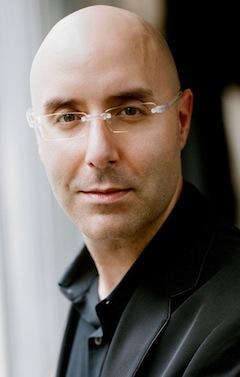
Mitch Joel is an expert in digital marketing, a sought-after speaker and an author.

Twenty years ago, the president of Mirum – a marketing agency operating in more than 45 offices around the globe, with more than 2,500 employees – was the editor of In Montreal, a newspaper geared to the university-aged set of Federation CJA. Among other endeavours along his media path, he was editor of two boutique music magazines and he co-launched Distort Entertainment.

Last week, Joel was one of the keynote speakers at the Call to Action Conference in Vancouver. His professional mission, he told the Independent, is to help companies “figure out how to transform their business in this digital world,” while “taking large, complex, usually highly regulated organizations and brands, and helping them make a big shift.”

In 2002, Joel joined digital marketing company Twist Image, whose clients included Home Depot, Microsoft, Fujifilm and other corporations and financial institutions. Three years ago, Twist was acquired by WPP, the largest marketing communications network in the world – worth $30 billion US – and it became Mirum.

To keep his proverbial finger on the pulse of industry trends, Joel uses a skill set honed early in his career.

photo - Mitch Joel, president of Mirum marketing agency
Mitch Joel, president of Mirum marketing agency. (photo from Mitch Joel)

“My first real job was in journalism,” he said. “A ‘nose for news’ doesn’t just apply to journalists, it applies to life. It’s a curiosity. It’s not really satiable, so I can’t imagine not having an entrepreneurial spirit, even if I was an entry-level employee.”

In addition to having one’s antennae always up, Joel encourages businesspeople to not fly solo, if they can help it. “Choosing that partner – making sure it’s the right fit – is really critical,” he said, noting that Mirum’s corporate leaders complement each other in their abilities. “We each hate what the other one is doing,” he said, with a chuckle.

Knowing one’s strengths and weaknesses is important, and so is knowing to whom your product or service is directed, he said. Joel is less interested in making broad generalizations of any generation – be it boomer, Gen X or millennial – than on the type of consumer.

“Selling to moms is very different than if we are selling to healthcare professionals. Selling to healthcare professionals is very different than selling to a group you are trying to get to open a checking account,” he explained. “I know a lot of people are making a lot of money on, ‘How do you speak to millennials?’ I think it is really hard to look at millennials and say they are a segment. You are talking about people of different gender, people of different interest levels, people of different education, people of different geography.”

In addition to his speaking engagements and corporate marketing advising, Joel has imparted some of his advice via two bestselling books. His first, Six Pixels of Separation, was named after his popular blog and podcast, and his second, CTRL ALT Delete, was named one of the best business books of 2013 by Amazon.

In CTRL ALT Delete, Joel discusses “flow,” a figurative time-management, three-legged stool, consisting of the personal, communal and professional. It’s a balancing act with which the husband and father of three still struggles.

“I just try to make sure that there is a balance of that stool because, if one leg is shorter than the other, it’s going to tip over,” he said.

But that doesn’t mean that work and family can’t overlap.

“I don’t consider it stressful to look at my inbox or think about a project when I’m not in the office. And vice versa, when I’m in the office, I might take off because there’s something with my kids, or there’s another thing I can do, and I can pick up on the work a little bit later,” he explained. “I’m not 100% successful all the time at hitting that balance, and there are moments when that stool looks like it’s tipping over dramatically. But, I’m aware of it and I think about it, and I focus on that – and I don’t beat myself up over it.”

Dave Gordon is a Toronto-based freelance writer whose work has appeared in more than 100 publications around the world.

Pivotal role in Pier 21

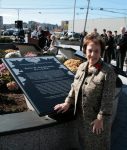
Ruth Goldbloom stands in Nation Builder Plaza in front of the Canadian Museum of Immigration at Pier 21 in Halifax. (photo from CMI at Pier 21)

The museum at Pier 21: National Historic Site opened on Canada Day, 1999. Built to commemorate the almost one million immigrants who passed through Halifax’s Pier 21 between 1928 and 1971, it was renamed the Canadian Museum of Immigration at Pier 21 and designated as a national museum in 2011.

But back to June 30, 1999, the day before it all began. There was a luncheon for the people who had helped turn a shed on the water into a comprehensive museum. Chief among them was Ruth Goldbloom, without whom the museum likely never would have been established. Goldbloom was chair of the Pier 21 Society from 1993 to 1999, and remained active on the board afterward. In 2004, she created and chaired the Pier 21 Foundation, a role that she maintained until just before her death in 2012.

Also present at the luncheon was Rosalie Silberman Abella, who passed through Pier 21 in 1950 as a 4-year-old refugee. In 2004, she became the first Jewish woman appointed to the Supreme Court of Canada.

At the luncheon, Silberman Abella shared two stories. Her parents were married in Poland the day that the Second World War broke out, she said. Her infant brother was killed, and her father’s side of the family was wiped out in the Holocaust. Her parents spent four years in concentration camps, but both survived. In 1946, Silberman Abella was born in a displaced persons camp in Germany.

“It was their way of proving to the world – and themselves – that their spirit was not broken,” she said in her speech, referring to her parents.

After years of trying, the Silbermans were granted entry into Canada. Silberman Abella’s father, a lawyer by trade, was not permitted to practise law in Canada until he became a citizen – but he couldn’t wait the five years it would take to become a citizen to work, as he had a young family to support. So, he became an insurance agent, and inspired his daughter to go into law. He died just before she graduated.

“But he knew somehow it would turn out alright for his family because he was confident in Canada’s generosity,” said Silberman Abella at the lunch. “And how generous it has been! The child my parents had to rebuild their hearts in Germany in 1946 became a judge in Canada in 1976. Remarkable.”

Canada Day, she continued, is her birthday. And what better present could there be than coming back to Pier 21?

“I will never forget how lucky we were to be able to come to Canada, but I will also never forget why we came,” she said. “These are the two stories which complete me – one joyful and one painful – and which merge in the next generation into a mother’s irrevocable gratitude to a country which has made it possible for her children to have only one story – the joyful story, the Canadian story, the story that started at Pier 21.”

Every immigrant has their two stories, at least, from before and after coming to Canada. And countless many of these stories would have been lost to time, a bit more detail lost with each retelling, were it not for the efforts of Goldbloom.

Goldbloom was born Ruth Schwartz in New Waterford, N.S., on Dec. 5, 1923. She was known for her family’s hardware store and for her tap dancing.

“This sense of charity and giving back to the community – at all the community fundraisers and anything, she would always dance at those events, so the spirit was always in her,” said Carrie-Ann Smith, chief of audience engagement at Pier 21.

Smith was one of Pier 21’s first employees. She started working there in 1998, before the museum opened, and continued working with Goldbloom until Goldbloom passed away.

“She just stayed, she just kept volunteering. She was constantly here. She never had an office, we always moved her around,” said Smith of Goldbloom. “I miss her so much.”

The idea to turn Pier 21 into a national site started with J.P. LeBlanc, founding president of the Pier 21 Society. LeBlanc was a retired immigration officer with the modest goal of acquiring an Historic Sites and Monuments Board of Canada plaque to put on the outside of the old Pier 21 building. Before he could complete his goal, however, he developed bone cancer. Around that time, he attended a Dalhousie graduation ceremony where Goldbloom was giving the convocation address.

“This was the ’80s, when people really weren’t looking back and thinking of Canada as a country of immigrants,” said Smith. “And that was the theme of [Goldbloom’s] talk, that we as a country have never really thanked our immigrants. [LeBlanc] knew that he was going to get much sicker, and he was really taken with what she said and how passionate she was about honouring the immigrants that built Canada.”

LeBlanc asked Goldbloom if she would take over the Pier 21 Society, and she did. She began fundraising almost immediately, and decided that a simple plaque wasn’t enough. For years, she worked to create the museum. She traveled the country on her own money, raising awareness and funds about the project, and used her knowledge to lobby the government.

In 1995, Halifax hosted the G7 Summit. Traditionally, the summit’s host city receives a gift and, for Halifax, it was a promise from then-prime minister Jean Chrétien to help build a museum at Pier 21. The deal was, if Goldbloom could raise $4.5 million, then the municipal, provincial and federal levels of government would work together to match that donation.

“It sounds so modest now,” said Smith of the $9 million that brought the museum into being.

photo - The Wheel of Conscience commemorates the voyage of the St. Louis, whose 937 Jewish refugee passengers were refused entry into Canada and other countries in 1939
The Wheel of Conscience commemorates the voyage of the St. Louis, whose 937 Jewish refugee passengers were refused entry into Canada and other countries in 1939. (photo from CMI at Pier 21)

When it opened, the museum contained exhibits about the history of immigration in Canada, as well as a database of more than one million immigration records. Smith remembers the very first person who ever asked for an immigration record.

“When I showed her the record, she started crying,” said Smith. “I just didn’t realize how profound the impact of that [immigration record] collection was going to be. Her husband had just died days before, and she wanted to make sure she had the original European spelling of his last name on his grave.”

Marianne Ferguson is another woman who received a surprise on the first day the museum opened. (See “Making Canada home.”) Ferguson had come through Pier 21 in March 1939, a Polish immigrant who had escaped Europe months before the start of the Second World War. While the pier was put to military use during the war, Ferguson volunteered there once it reopened, helping refugees get settled in Canada.

By 1999, Ferguson was an established member of the Halifax Jewish community. She would always ask Goldbloom to help her out at shul, but Goldbloom was too busy. To make it up to Ferguson, Goldbloom planned a surprise for her on the opening day.

“When I got to the pier, I didn’t know what to look for,” said Ferguson. “[Goldbloom] said, ‘I’m not going to tell you, you have to find it yourself.’ And I didn’t know, what am I looking for?… I had my son Randy with me that day, he says, ‘Oh, come here, here’s something from you.’”

It was a quote from an essay Ferguson had written in 1942 as a 16-year-old schoolgirl in Canada: “Everyone asked them to take us with them, but that, too, was impossible.” The essay can be found on Pier 21’s website. The “everyone” refers to Ferguson’s extended family, all of whom died in the Holocaust.

Ferguson only had kind words to say about Goldbloom, calling her “the heart of Pier 21.”

Goldbloom would prove that multiple times over the years.

“By about 2002, 2003, it was getting pretty rough to pay the bills,” said Smith. “It was just really a shed on the waterfront, one of the windiest spots in the country, and it was expensive to heat and light … when you’re a National Historic Site, we had that status by then, that just means they can’t tear down the building. That’s all it means, it didn’t come with any funding.”

So, Goldbloom decided to set up a foundation to raise money for the museum. Instead of going door-to-door and asking a million people for $7, she decided to ask seven people for $1 million. These people would be called “Nation Builders.”

“When she had the six Nation Builders, all of her friends chipped in and made her the seventh Nation Builder,” said Smith. “That allowed us to have an endowment. That’s what she wanted – that security for us.”

This year, to celebrate Canada’s 150th anniversary, the museum is putting on a special exhibit called Canada: Day 1, which looks at what the first day in Canada is like for arriving immigrants. Since Goldbloom was born in Canada, she never had that experience. But, as she would regularly point out, the only indigenous people in Nova Scotia are the Mi’kmaq – almost everyone living in Canada can connect their history to an immigrant at some point. She dedicated much of her life to commemorating immigrants’ contributions to this country and her story is inextricably entwined with that of Canadian immigration and Pier 21.

Alex Rose is a master’s student in journalism at the University of King’s College in Halifax. He graduated from the same school in 2016 with a double major in creative writing and religious studies, and loves all things basketball. He wrote this article as part of an internship with the Jewish Independent.

Expanding food savvy

Kat Romanow is director of food programming at the Museum of Jewish Montreal. (photo from Kat Romanow)

Kat Romanow has taken upon herself the challenge of teaching people more about Jewish food in one of Canada’s most Jewish cities.

“I started studying Judaism in my undergrad and, at the end of it, food was something that sparked my interest,” said Romanow. “I ended up going to Boston for a summer to do an internship and it was there that all of this coalesced.

“Jewish food is what I want to study academically. I also felt a connection to Judaism – Shabbat dinners, shul … I get the non-academic Jewish things, and it was there I realized I felt a deep connection to it. That’s when I knew I wanted to convert. It’s a connection I didn’t necessarily feel in Catholicism, but I found in Judaism – the community, rituals … things that really speak to me and bring meaning to my life.”

Romanow was born and raised in Montreal and is currently the director of food programming at the Museum of Jewish Montreal, where she runs and manages Fletchers, the museum’s restaurant.

Founded in 2010, the museum offers walking tours of historic Jewish neighbourhoods, numerous online exhibits and a large oral history collection. And, now that they have a physical space – which they acquired about a year ago – they also offer lectures, workshops and pop-up exhibitions.

Romanow majored in Jewish food history at Concordia University and, in conjunction with the museum and a friend, developed a walking tour called The Wandering Chew.

“We aimed to teach people about lesser-known Jewish food traditions through pop-up dinners, cooking workshops and other food events,” said Romanow. “That’s where I got the cooking experience, holding pop-up dinners for 30 to 40 people. We’d find the community we wanted to explore, interview people from the community, including getting their recipes, put together a menu and do a dinner.”

The goal was to expand people’s knowledge about Jewish food. “Here, in Montreal, you automatically think of bagels and smoked meat,” said Romanow. “But, our aim was to go beyond that and show people that Jewish food is very diverse and is made up of a lot of different cuisine and dishes.”

At Fletchers, they serve foods during the day that draw from the flavours of the diverse communities highlighted on the walking tours. And, in the evening, one can find a variety of workshops, meals and cookbook launches.

Romanow has been selected to represent Montreal at the ROI (Return on Investment) Summit in Jerusalem July 2-6. The summit brings together 150 of the brightest Jewish minds from around the world to brainstorm ideas for the future.

“I’m really excited,” said Romanow. “It’s also my first time going to Israel. For the summit, I’m most excited about getting to meet all these other young Jews doing really cool projects … making connections and sharing ideas. We’ll learn from each other and build off of what we’re all doing. So, I think, coming out of this, I’ll be full of new ideas and inspiration. I’ve already received emails and I can see potential future collaboration.”

Romanow is planning to stay in Israel after the summit, to visit the country, experience the Israeli food scene and get some new ideas for Fletchers.

Something she has found lately is that people in their 20s and 30s are becoming more open to exploring different ways of making the food they grew up with different, putting their own mark on it.

“There’s now a community of younger Jews who are reintroducing people to what Jewish food is,” said Romanow. “I want to keep adding to the menu and keep holding more and more events, so that people can really engage with their Jewish identity through food on a regular basis.

“But, I also aim to write a cookbook about exploring Jewish food in the Diaspora. That’s what I’ve been doing with the Wandering Chew. I think the cookbook is the next step. I’m in the process of writing the proposal, so hopefully in the next few years it will come out.”

For now, Romanow plans to delve deeper into local Jewish food history, as she balances running Fletchers, the Wandering Chew dinners and walking tours of the local Jewish food scene, which are called Beyond the Bagel.

Through Beyond the Bagel, Romanow said, “We go to places like Schwartz’s and we eat bagels. But, I did all kinds of archival research and oral history interviews … and so you get to go deeper into the history of these places.

“At our space (at the museum), we also have a boutique where we sell things related to Jewish history and Montreal – books, locally made products. And we use it as an event space … concerts, lectures and many more.

“Right now, we have Yiddish classes there, too, and photo exhibits that change throughout the year related to Jewish culture. We’re not a traditional museum, one that you go into and look at objects. You can come to the space, grab a bite, browse the boutique and also go on one of the walking tours or onto the website.”

For more information, visit imjm.ca.

Rebeca Kuropatwa is a Winnipeg freelance writer.

Jewish Buddhists in Halifax

Isaac Greenberg grew up speaking Hebrew, and he was raised with Shambhala, as well. (photo by Alex Rose)

With his lean frame folded behind a small coffee table at Just Us Café in Halifax, with his large wire-frame glasses and thinning hair, Michael Chender looks somewhat like Larry David. But although Chender shares David’s sense of humour and perhaps some of his neuroticism, the soft-spoken and measured Chender embodies little else of the Curb Your Enthusiasm star’s notorious annoyance and impatience with other people. That is not a coincidence.

Chender is a Jewish Buddhist, or Jew-Bu, one of a number who call Halifax home. Most of the Jew-Bus in Halifax follow a tradition called Shambhala.

In Tibetan folklore, Shambhala is a mythical kingdom that represents a just and good society. It is also the inspiration for a worldwide movement, which has its headquarters in Halifax.

The movement was started by Tibetan Buddhist Chögyam Trungpa Rinpoche (Rinpoche is a Tibetan honorific). He escaped Chinese-occupied Tibet in 1959 at 19 years old, already a renowned sage. According to Chender, in Tibet, older teachers would come and ask the teenage Trungpa questions.

By the 1970s, Trungpa had settled in Boulder, Colo., where his Western following began to develop in earnest. He wanted to teach meditation in the West in a secular language. He taught that everyone was possessed with a fundamental goodness, and that life is worth living. A central philosophy of Shambhala is spiritual warriorship, which is accomplished by living a life of fearlessness, gentleness and intelligence.

Trungpa was known for both his incredible mind and for being an eccentric. He encouraged his followers to take pride in their heritage, so on Robbie Burns Day he would dress up in a kilt and celebrate with his Scottish disciples, and he would work Yiddish phrases like “oy vey” into his lectures. In 1986, Trungpa moved the headquarters of the Shambhala community to Halifax. In 1987, he died there of liver failure at the age of 48.

“He decided that Colorado was too speedy, materialistic, flashy, and that we should move to a simpler, more peaceful, calm place,” said David Greenberg, a former Jew-Bu and current Christian. He was raised outside Boston as an atheist Jew, and is conversant in Hebrew. He is the grandson of Rabbi Simon Greenberg, the founder of the University of Judaism at Los Angeles, a branch of the Jewish Theological Seminary of America.

When Greenberg was 17, he started reading Trungpa’s teachings, and joined the Shambhala community for the first time at 22. He met his wife through Shambhala and, together, they had four children. Eventually, the couple divorced and, in 2009, Greenberg converted to Christianity. Nonetheless, he said he felt more Jewish when he became a Buddhist, and even more Jewish now as a Christian; it’s allowed him to appreciate his Jewishness and not just take it for granted. For example, he said, he explains the Hebrew meanings of Bible verses to his fellow churchgoers.

photo - Michael Chender knows what he likes about Judaism and what he wants to take from it
Michael Chender knows what he likes about Judaism and what he wants to take from it. (photo by Alex Rose)

Chender feels similarly.

“I began to feel much more Jewish after I became a Buddhist,” said Chender. “My being Jewish … it’s deep in the bones, an ethnic thing. I’m very proud of my people.”

Chender calls himself an Upper West Side Manhattan product of the late 1960s – a Woody Allen-type kid who was high-strung and philosophical, the kind who was worried about the world ending millions of years in the future. For him, being Jewish meant viewing the world through Allen’s lens, not beneath a phylactery on his forehead. Religion was never a key component of his Jewish identity – he only knew one observant family growing up – but the culture and heritage always were. He is proud of the Jewish intellectual and moral tradition.

Chender knows what he likes about Judaism and what he wants to take from it. Not every Jew-Bu has such a concrete self-identity.

Isaac Greenberg is David Greenberg’s son, and a university student in Halifax. He grew up speaking Hebrew, and he was raised with Shambhala, as well. After his parents divorced, his mother moved him and his three siblings to Halifax. He was 11 at the time, and he lost his connection with Judaism for almost a decade. When his mother left Shambhala, when he was 17, he lost touch with that community, too.

“After first year of university, I kind of lost my mind … I just became totally untethered. I broke up with the person I was dating for a year-and-a-half, which set off this total spiral of insecurity and not figuring myself out. And then you just grasp the things that you know,” said Greenberg, noting that Judaism and Shambhala are his “foundations.”

Towards the end of his second year, he wanted to reconnect with Judaism. He was dating a Jewish woman, he said, “and she invited me to a seder and she was talking all about Judaism. And I was like, ‘Oh, I remember these things, and they were really great times.’”

Since then, he has been making a conscious effort to become more involved in the local Jewish scene. But he’s not entirely sure how.

“I kind of feel like an outsider,” he said.

As to why some Jews find their way to Buddhism, Chender said there are three common links between Judaism and Buddhism. The first one is appreciation for the critical mind, of inquiry and analysis. The second one is the importance of humour. The third is the truth of suffering.

“As my grandmother said to me when I was telling her about Buddhism, ‘You’ve gotta tell me this?’ We kind of know the truth of suffering in our bones,” said Chender. “So, it was like really coming home to some long-lost cousins who, actually, whatever they’ve been doing the last few thousand years, they had figured some sh*t out…. I wouldn’t go so far as to speculate where the lost tribes went or came from, but, you know.”

Alex Rose is a master’s student in journalism at the University of King’s College in Halifax. He graduated from the same school in 2016 with a double major in creative writing and religious studies, and loves all things basketball. He wrote this article as part of an internship with the Jewish Independent.

Pediatric leaps and bounds

Artist Pnina Granirer signs copies of her book Light Within the Shadows: An Artist’s Memoir at its May 25 launch at Lord Byng High School. (photo by Cynthia Ramsay)

***

In every community, there are folks who frequently capture the spotlight for their work while others quietly get things done behind the scenes. In our Kibitz & Schmooze profile, we try to highlight members of our community who are doing admirable and mention-worthy work out of view of the general public. If you know of profile subjects who fit this description, please email laurenkramer@shaw.ca.

We all love a quick turnaround, but when it involves a transition from illness to health, it’s especially meaningful. That’s one of the things Erik Swartz loves about his career as a pediatrician at Richmond Hospital, where he attends complicated deliveries, looks after preemies in the neonatal intensive care unit and sees outpatients at the Child Health Centre. “Children get sick very quickly, but they also recover very quickly,” he notes quietly. “It’s very gratifying, as a doctor, to see how quickly their health improves.”

photo - Erik Swartz
Erik Swartz (photo by Lauren Kramer)

Swartz, 43, is a homegrown Vancouverite who attended Vancouver Talmud Torah, Eric Hamber Secondary and then studied pharmacology and medicine at the University of British Columbia. After graduating, he specialized in pediatrics in Edmonton and worked in that city until 2008.

It was a great time, he recalls wistfully. “Our friends there were like family, and the training I got there, the professional environment, was wonderful.”

Swartz, always one to say an enthusiastic “yes!” when opportunity comes a-knocking, also had a weekly segment on Edmonton’s Global Morning News, where he’d answer questions from parents worried about their kids’ health. “For awhile, I was a C-list celebrity,” he says with a laugh.

Family ties and a great job opportunity enticed him back to Vancouver, where he remains today with his wife and two daughters. At work, he wears a number of different hats. When he’s not at Richmond Hospital, you’ll find him at B.C. Children’s, where he works in the pediatric emergency department and attends inpatients at the clinical teaching units. He also heads pediatrics for Vancouver Coastal Health and Providence Health Care, a position that involves overseeing physicians in a wide geographic area – from Lions Gate and St. Paul’s hospitals to clinics further afield in Powell River and Bella Coola. “If a child comes into a hospital in Sechelt and there are issues, we troubleshoot what happened from an administrative point of view,” he explains.

There are “big picture” guys and “small picture” guys in every field, but Swartz is both. He helped bring the Pediatric Early Warning System, PEWS, to the Richmond Hospital emergency room a few years ago. Children admitted to the hospital receive a PEWS score, which determines the level of monitoring and care they’ll need. “It’s our attempt at figuring out which children are going to deteriorate before that happens, so we can mitigate the risk,” he explains. Swartz and his team were the first to use PEWS successfully in an ER setting in British Columbia and, possibly, in all of Canada.

“In a hospital that is not used to looking after many children, the PEWS score is a number that clearly identifies how sick that kid is,” he notes. “We assessed the confidence and knowledge levels of staff before we introduced PEWS and reassessed them after its introduction and, by comparing those results, we can see it’s been a wild success. Because of that, the whole province is wanting to introduce it.”

Swartz’s work is his passion, and his dedication to improving care on a systemic level is remarkable. He decompresses from his days training for half-marathons, but says his life is filled with “aha moments” that make everything seem purposeful and worthwhile. “I’m often called out in the middle of the night when a baby is born with a low heart rate and isn’t breathing,” he reflects. “To do the appropriate things in five to 10 minutes and see the improvements, you feel really satisfied that a few minutes of your life changed the trajectory of another family’s life forever.”

Lauren Kramer, an award-winning writer and editor, lives in Richmond. To read her work online, visit laurenkramer.net.

* * *

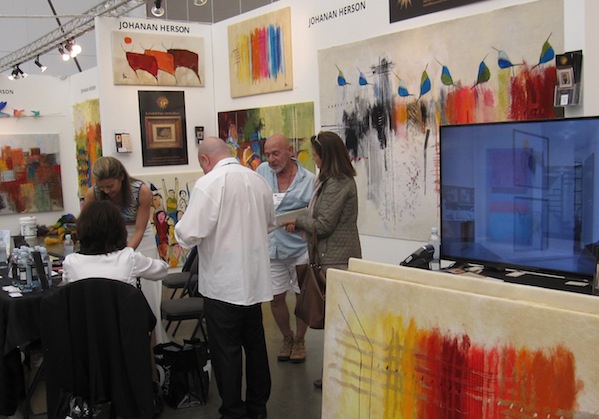
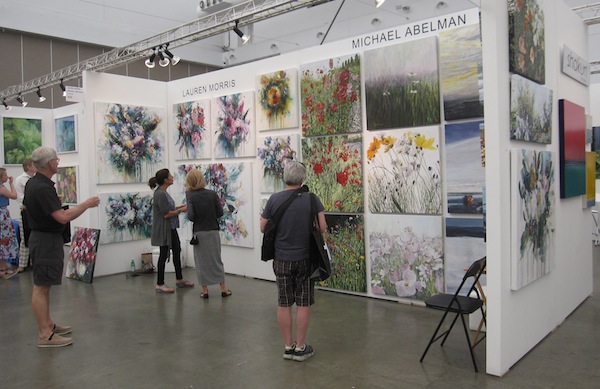
photo - Art! Vancouver included the work of Johanan Herson (second from the right) and Lauren Morris (third from the right) from May 25 to 27 at Vancouver Convention Centre-West.
Art! Vancouver included the work of Johanan Herson (second from the right in the above photo) and Lauren Morris (third from the right in the photo below) from May 25 to 27 at Vancouver Convention Centre-West. (photos by Cynthia Ramsay)

photo - Lauren Morris at Art! Vancouver 2017. 

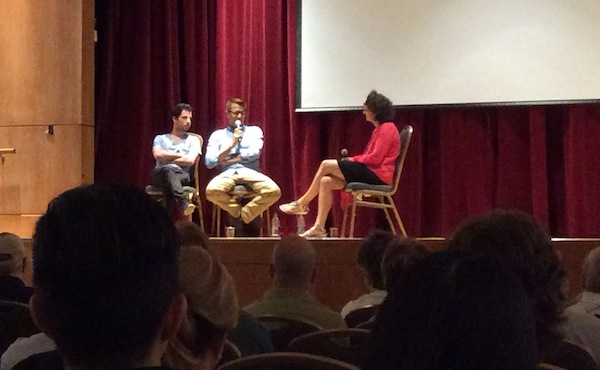
photo - Lior Noyman, left, Dan Gadassi and moderator Shula Klinger field questions from the audience after the June 5 screening of a documentary film capturing some of the memories Vancouverites have of the Six Day War.
Lior Noyman, left, Dan Gadassi and moderator Shula Klinger field questions from the audience after the June 5 screening of a documentary film capturing some of the memories Vancouverites have of the Six Day War. (photo by Cynthia Ramsay)


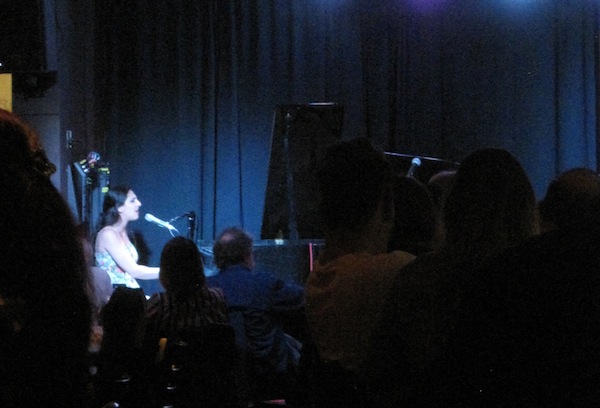
photo - Noam Vazana was joined by Itamar Erez (not seen in photo) at a Caravan World Rhythms performance at Frankie’s Jazz Club June 7
Noam Vazana was joined by Itamar Erez (not seen in photo) at a Caravan World Rhythms performance at Frankie’s Jazz Club June 7. (photo by Cynthia Ramsay)

Negev Dinner gala in photos

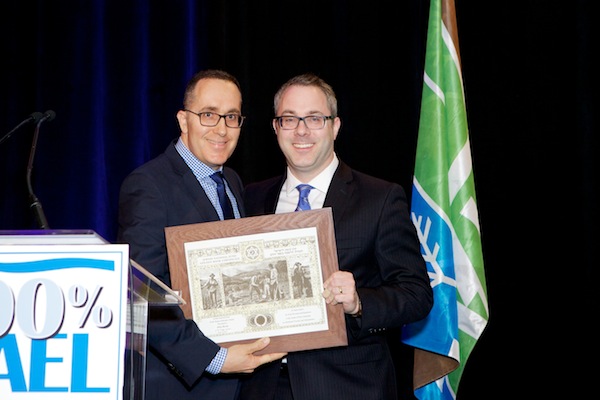
Left to right: Shannon Gorski, Gary Averbach, JNF Pacific Region president David Goldman, Michael Averbach and JNF shaliach Ilan Pilo. (photo by Robert Albanese)

The soldout Jewish National Fund of Canada, Pacific Region, Negev Dinner on June 4 at Four Seasons Hotel Vancouver honoured Gary Averbach and his two children who live locally, Michael Averbach and Shannon Gorski, for their service to the community. Proceeds from the gala will fund infrastructure improvements to the Israeli Scouts (Tzofei Tzamid) facilities in Raanana and Dimona, in order to make them more accessible for children and youth with disabilities. The Israeli Scouts, which runs programming for youth aged 9-21, has more than 80,000 members, including more than 2,500 children and youth with disabilities.

photo - Richmond Jewish Day School principal Abba Brodt, right, was honoured with JNF’s Education Award
Richmond Jewish Day School principal Abba Brodt, right, was honoured with JNF’s Education Award. (photo by Robert Albanese)
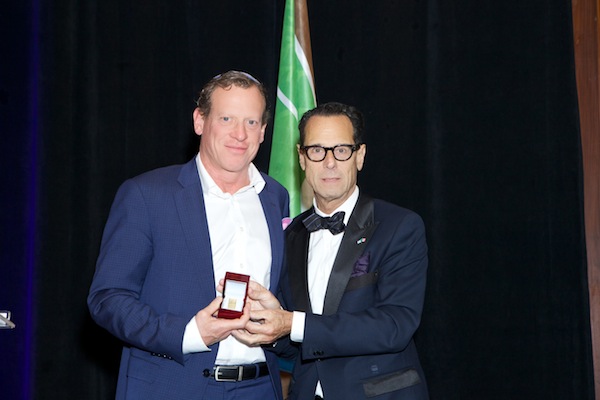
photo - Current JNF Pacific Region president David Goldman, right, presents the president’s pin to immediate past president Frank Sirlin
Current JNF Pacific Region president David Goldman, right, presents the president’s pin to immediate past president Frank Sirlin. (photo by Robert Albanese)
photo - Elaine and Zev Shafran, honourary gala chairs, together with Shay and Mickey Keil, and Ariel and Rachael Lewinski
Elaine and Zev Shafran, honourary gala chairs, together with Shay and Mickey Keil, and Ariel and Rachael Lewinski. (photo by Robert Albanese)
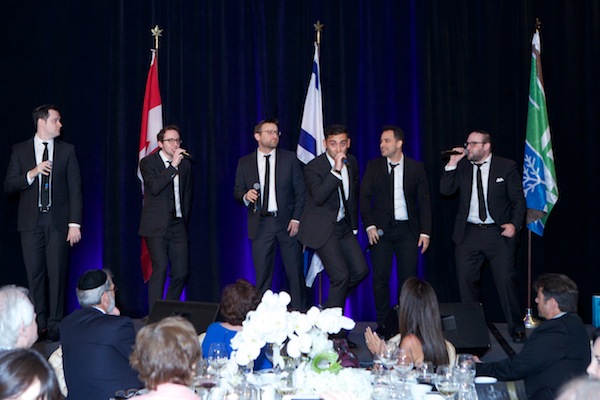
photo - The Maccabeats got the crowd up and moving
The Maccabeats got the crowd up and moving. (photo by Robert Albanese)