Canada’s legacy of trauma

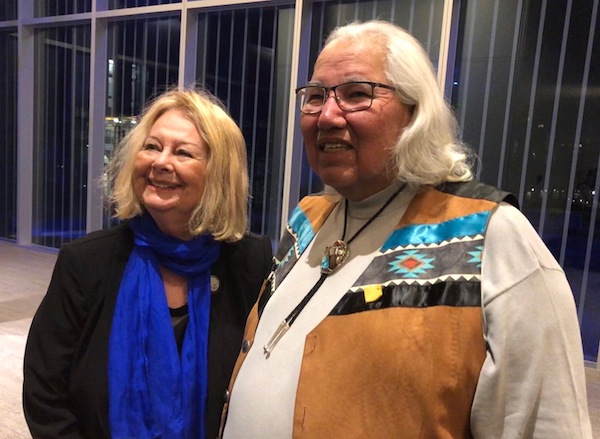
Lillian Boraks-Nemetz and Senator Murray Sinclair. (photo by Jerry Nussbaum)

A succession of unjust Canadian laws piled one upon the other in the last part of the 19th century, enabling the federal government to take indigenous children from their homes and eradicate their cultural identities. The full scope of those laws – and their impacts on generations of First Nations people to today – was outlined by Senator Murray Sinclair, former head of the Truth and Reconciliation Commission, who spoke at the University of British Columbia last week.

The impact of residential schools and the laws that created and sustained them was the theme of Sinclair’s talk, which was presented by the UBC faculty of education and the Janusz Korczak Association of Canada.

Prior to Sinclair’s presentation, Vancouver author Lillian Boraks-Nemetz, a board member of the Korzcak association and a child survivor of the Holocaust, contextualized the lecture in the spirit of Korczak’s legacy.

Korczak was an educator and pedagogue who ran orphanages, including one in the Warsaw Ghetto, where Boraks-Nemetz was also confined. Korczak was a respected figure in Polish society, considered by many the originator of the concept of children’s rights.
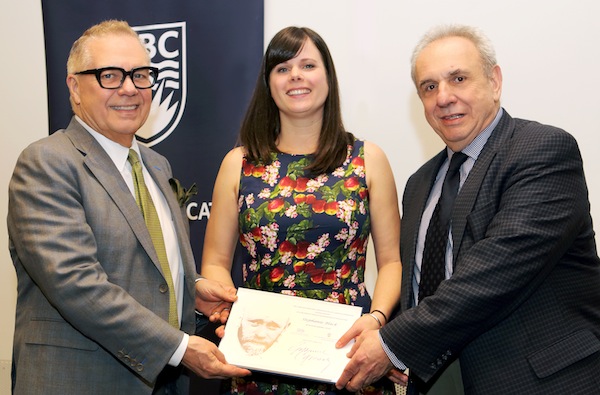
photo - Dr. Charles Ungerleider, professor emeritus of educational studies at the University of British Columbia and a former B.C. deputy minister of education, left, and Jerry Nussbaum, president of the Janusz Korczak Association of Canada, present an award to Stephanie Black, 2019 recipient of the Janusz Korczak Scholarship
Dr. Blye Frank, dean of the faculty of education, University of British Columbia, left, and Jerry Nussbaum, president of the Janusz Korczak Association of Canada, present an award to Stephanie Black, 2019 recipient of the Janusz Korczak Scholarship. (photo from Tiffany Cooper)

“Korczak observed and listened to children, never judging, criticizing or showing intolerance,” said Boraks-Nemetz. He cultivated their self-esteem and believed that children should grow into who they want to be, not who others want them to become.

“During the Nazi persecution, Korczak, when offered a reprieve from the depredations of the Warsaw Ghetto, he would not abandon his children in their last journey to the cattle cars heading for Treblinka, the death camp,” she said. “He refused, saying, ‘My children need me. I deplore desertion.’ He went with them and they all perished.”

Sinclair then painstakingly outlined the conspiracy of legal barriers to justice that the government erected to perpetuate what has been termed cultural genocide.

As the federal government began to expand Canada westward in the 1870s, it entered into treaties with the indigenous peoples. One of the demands indigenous negotiators insisted upon in exchange for being limited to reserves was that the federal government create and fund schools on those reserves.

Sir John A. Macdonald sent a representative to the United States to see how they were running schools for Native Americans. In direct repudiation of the treaties, the federal government opted for a similar system and his government created what they called “industrial schools.”

Sinclair said MacDonald believed that, if children went to school on reserves, “the kids would go to the schools in the daytime and they would then return home to their parents, who are nothing but savages, and we would be teaching those children basic skills that all children learn from schools and what we’re going to end up with at the end of the day is nothing but savages who can read and write.”

Because the government wanted to “do it on the cheap,” said Sinclair, “they decided to involve the churches, who were quite willing to get involved because it was great for the churches as well to gain numbers through their missionary zeal.”

Children were punished for speaking their languages and for talking with their friends and siblings, “because they wanted to break your ties to those relationships…. Everything was done in the schools to break down cultural bonds that existed in those children.”

Those who were not physically or sexually abused lived in fear that they would be, Sinclair said.

“And, of course, the children, when they came home, would tell their parents what happened in those schools,” he said.

The natural inclination to stop it from happening led to a cascade of legislative injunctions that took away the most fundamental rights of First Nations peoples.

“In the 1880s, the government passed the law that amended the Indian Act and said that it was an offence, a legal breach of law, if you did not send your child to a school when the Indian agent told you to send the child,” said Sinclair.

When parents tried to hide their children, the parents would be prosecuted and go to jail. Faced with the prospect of indigenous people taking the government to court over the issue, the government passed another law, making it impossible to go to court against the government for anything done under the Indian Act “unless you get permission from the minister of Indian Affairs first.” The government soon made it illegal for indigenous people to consult with a lawyer on anything relating to the Indian Act – with the punishment for the lawyer being disbarment. Then, another step was added, making it illegal for a white Canadian to speak to a lawyer on behalf of an indigenous person.

When it seemed parents might protest the situation, the government made it illegal, in 1892, for three or more First Nations people to gather together in order to discuss a grievance against the government of Canada. It was made illegal for indigenous people to attend large gatherings like the traditional sundances or the potlatch, “not just because of the religious aspect of it but also because, at these gatherings, that’s when Indians got together in order to discuss their grievances,” said Sinclair.

Fears of a violent uprising were dismissed by Northwest Mounted Police in documentation Sinclair has seen, which, he summarized: “We don’t have to worry about the Indians taking up arms against the government because we have their kids. They are not going to go to war against us.”

Children who returned from the schools were scarred and often unable to communicate with their parents in a shared language.

“Their ability to know how to hunt, fish or trap, which is what the communities depended upon, was lost to them,” said Sinclair.

Estimates are that about 35% of indigenous children attended residential schools, but the damage extended to the other 65%, who were taught in public schools the same white superiority/indigenous inferiority curriculum as those who were taken away.

When those children grew up and had children, they had no learned skills at parenting and were burdened with their own demons, said Sinclair. As a result, when child welfare systems were burgeoning in the 1950s, it was mostly indigenous children who went into care. It was, and is, disproportionately indigenous people who are incarcerated.

Indigenous Canadians have the highest suicide rates of any cultural group in the world, said Sinclair. High school dropout rates, substance abuse and violent crime affect indigenous Canadians in exponentially greater numbers than non-indigenous Canadians.

The problems will not be resolved, Sinclair said, by spending more money on child welfare, policing or incarceration. The education system and society must help indigenous young people realize who they are as Anishinaabe, Cree, Sto:lo or Mohawk.

“The educational system is just not giving them what they need,” he said. “We have a lot of work to do, but, if we address that one aspect of how our society is functioning, we will see the most dramatic change that will resolve or redress the history of residential schools in Canada on indigenous people, on indigenous youth in particular.… It begins with recognizing that … indigenous youth, in particular, must be given their chance to develop their sense of self-respect first, and that’s going to take some time to do.”

’Tis the season for jazz

Jazz artist Maya Rae (photo © Maya Rae Music)

Jazz artist Maya Rae has a busy week ahead. Tomorrow night, Nov. 30, she takes part in Temple Sholom’s Fall Fest Fun-raiser, after a benefit concert earlier in the day at Brentwood Presbyterian Church called Socks for Souls. On Sunday, Dec. 1, she is among 11 bands that will perform in Jazz Walk at the Shadbolt. And, on Dec. 4, she is at the Vancouver Playhouse, participating in the show Strings and Jazz.

“Definitely this time of year is very busy when it comes to gigging and playing shows,” Rae told the Independent. “Because it’s surrounding the holidays, people are needing musicians for lots of things, so there are more opportunities to work right now. I’ve also been lucky enough to have played numerous shows throughout the years, so people are reaching out more now, hiring me for future gigs as well.”

One of the highlights of Rae’s past year was a trip to the southern United States.

“I went to Nashville last March to record my album and that was definitely one of the most amazing experiences I’ve had so far in my career,” said Rae.

The album, which will see its release in April, is the young musician’s second.

“Every song on it was written by my brother and myself, so the whole project is composed of originals,” she said. “My debut album, Sapphire Birds, is made up of some jazz standards, rearranged pop tunes and a few originals as well. The upcoming album, Can You See Me?, focuses on my original music from the past year, a lot of it reflecting on what I’ve learned and experienced. The music is incredibly personal, but I’m super-excited to share it with the rest of the world.”

Most of the songs on the new recording were inspired by things that have happened to Rae or to people close to her.

“I graduated high school back in June, and so a lot of the songs are about what I experienced throughout that journey,” she explained. “For example, ‘Can You See Me?,’ the title track of the record, is about removing the mask that hides one’s true self and not being afraid to be who you are. I found that, throughout high school (and outside of it), people try so hard to fit a certain box and be who they think they should be rather than who they really are. This song is about removing that façade and being OK with showing your true colours.

“‘Sun Will Come Out Again’ is another tune on the record that I wrote with so many people in mind. So much of the time, when we’re stressed, sad, angry, or any other uncomfortable feeling, it feels like the end of the world. This song is about how, no matter one’s current situation, whether it be big or small, there is always light at the end of the tunnel. That dark, upsetting feeling will not last forever.”

For more information on Rae’s music and upcoming performances, visit mayaraemusic.com.

The Fall Fest Fun-raiser (templesholom.ca/fall-fest-fun-raiser) on Saturday starts at 7 p.m. and also features Annette Kozicki and Friends and Tal & Yael’s Israeli dance, while Strings and Jazz on Dec. 4 includes Sinfonietta, VSO School of Music’s honour jazz combo (vsoschoolofmusic.ca).

The Dec. 1 Jazz Walk is a daylong event, 11 a.m. to 10 p.m., at the Shadbolt Cenre for the Arts. The scheduled lineup includes Rae, Dave Robbins Sextet, Lucine Yeghiazaryan, Dawn Pemberton Quartet, Brad Turner Quintet, Grant Stewart Trio, Cory Weeds Quintet featuring Roy Mccurdy, Steve Kaldesta, Grant Stewart, Alyssa Allgood, Stephen Riley, Chris Hazelton, Jill Townsend Jazz Orchestra and Ernest Turner. It also includes roundtable discussions with various people in the field, such as archival record producer Zev Feldman of Resonance Records in Los Angeles. Tickets and more information can be found at shadboltcentre.com.

Nazi auction called off

Under community pressure, a Richmond auction house backed down from selling a collection of Nazi memorabilia last weekend. Maynards Fine Art and Antiques was set to auction items including Nazi flags, military items and other war-era artifacts on Saturday. Two days before that, the Centre for Israel and Jewish Affairs was made aware of the items by a member of the community.

“We spoke to the lead appraiser, the person in charge of auctioning this lot,” said Nico Slobinsky, CIJA’s Pacific region director. “We provided context and tried to explain why auctioning these items was morally reprehensible. I would love to be able to tell you that we got positive engagement and understanding at the time when we had those conversations on Thursday. We did not get that positive engagement. It was clear to us from the response from the auction house that they were going to go ahead with the auction as originally planned.”

Community members and elected officials quickly mobilized and media seized the story. Individuals messaged the auction company and politicians lined up in opposition to the sale. Two members of the legislature from Richmond, Jas Johal and John Yap, spoke out, as did Andrew Wilkinson, leader of the B.C. Liberals.

Mike Sachs, past president of the Richmond congregation the Bayit and a Jewish community activist in Richmond, mobilized his contacts – even while vacationing in Mexico. He said Richmond Mayor Malcolm Brodie not only spoke out against this incident but promised to proclaim Holocaust Awareness Day in January 2020.

“People were just disgusted that Maynards would do such a thing,” said Sachs. “As a whole, we all agree enough of profiting off Jewish blood. Enough. We’re not going to accept it anymore.”

Sachs and Slobinsky praised community allies who spoke up. They both believe that historical artifacts like these should be in museums or educational institutions, where they can serve as educational tools in proper context.

CIJA is asking Maynards for an apology and a donation to the Vancouver Holocaust Education Centre. The organization extended an offer to the undisclosed owner of the items to assist in placing them in an appropriate venue.


Troubles in leadership

A world leader decries investigations into his possible criminal corruption as an “attempted coup” based on “fabrications and a tainted and biased investigative process.”

No, not that world leader. This time it is Binyamin Netanyahu, Israel’s prime-minister-by-a-thread. Finally indicted on graft charges after months of anticipation, he became the first Israeli prime minister ever to face charges while in office. He insists the indictment will not impact his leadership, just as the country seems on an irreversible path to a third election in a year.

In a region with a scarcity of free and fair elections, Israel can’t seem to stop having them. From that perspective, things could be worse. Whether Netanyahu’s Likud party stands with him in his time of trouble remains to be seen. The possibility of his departure from the political scene, which he has dominated for nearly a generation, would provide the most significant shakeup of the field and possibly prevent a third inconclusive outcome.

On this side of the ocean, the U.S. House of Representatives continues investigating President Donald Trump. Few people, including Republicans, are making much of an effort to refute the basic facts. Evidence piles upon itself that the U.S. president indeed asked the president of Ukraine for a dirty political favour – a bribe – in exchange for military financial aid that had already been approved by the U.S. Congress. GOP responses to this evidence range from “So?” to the only slightly more nuanced argument that the president of the United States didn’t get what he wanted and the president of Ukraine did, so no harm done.

With Trump seemingly in thrall or somehow beholden to Vladimir Putin, and his party steadfast behind him, we are treated to the spectacle of a party that 60 years ago was trampling over individual liberties based on a largely false suspicion that “the Russians” were infiltrating the country’s government and threatening its entire way of life now responding to a disturbingly similar situation, this one far more provably real, with a shrug.

While Canada, thankfully, has no such level of political intrigue or corruption at the moment, a shocking diplomatic move last week has set the official voices of the Jewish community on edge.

The day before swearing in a new cabinet, the government of just-reelected Prime Minister Justin Trudeau opted to vote at the United Nations General Assembly to condemn all Israeli settlements in the West Bank, jumping on a dogpile led by North Korea, Egypt, Nicaragua and Zimbabwe, none of whom should be arbiters of justice or human rights. To be clear, the vote means almost nothing in practical terms. But symbolism does count. And the vote was a slap in the face by Canada to Israel and those in this country who recognize it as our closest ally in the region for historical, moral and pragmatic reasons.

Some speculate that the shift in tone reflects the new minority government currying favour with the New Democratic Party, which has included some notorious Israel-bashers. That is probably a less likely reason than the campaign by Trudeau to win Canada one of the rotating seats on the United Nations Security Council. Where former prime minister Stephen Harper’s refusal to “go along to get along” in the anti-Israel hatefest that occurs annually at the UN was seen as a key reason we lost out on a seat, Trudeau seems determined to hedge his bets.

A prestigious seat on the Security Council would presumably elevate Trudeau in the eyes of the world after he frittered away the “Canada is back” optimism of four years ago by failing to meet climate targets while bhangra dancing across the world stage.

Regardless of the motive, it is a reprehensible act that could have serious implications for the political orientation of Jewish Canadians in the next few years. Coming as it does while the ink is barely dry on the results of an election in which Liberals mostly made the right noises to Jewish and pro-Israel Canadians, it seems a particularly brutish little dagger to unsheathe now.

Interfaith peace efforts

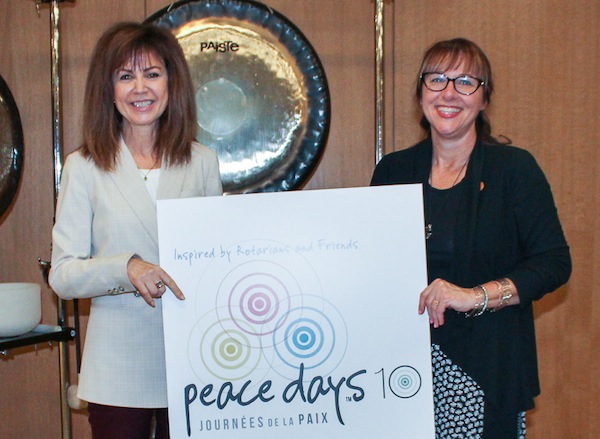
Belle Jarniewski, president of the Manitoba Multifaith Council, left, and Christine Baronins, public affairs director for the Church of Jesus Christ of Latter-day Saints. (photo by Miriam Nucum / CJCLDS)

Earlier this fall, the annual Meditation for Peace took place at St. Boniface Cathedral in Winnipeg. Led by a group that is part of the Archdiocese of St. Boniface, the silent meditation was part of Peace Days this year and open to the general community.

Peace Days, which are organized by the Rotary Club and others, have existed for a number of years and there are all kinds of different events that take place, focusing on different segments of the population.

“Originally, a group of planners associated with the Archdiocese of St. Boniface came up with the plan and wanted to include it as part of the Peace Days lineup,” said Belle Jarniewski, president of the Manitoba Multifaith Council and executive director of the Jewish Heritage Centre of Western Canada, about the Meditation for Peace. The archdiocese group wanted to bring the Manitoba Multifaith Council into the event in order “to have representatives from all the different faith communities bringing prayers for peace as part of the event, and to take part in the water ceremony.”

The aim is to schedule the meditation not too far into the year, so that it could be held outdoors. “But, the last couple years, the weather brought us indoors,” said Jarniewski.

Despite being held on the night of the provincial election, Sept. 10, some 130 people showed up – people of different faiths, backgrounds, ages and genders. The event began with an introduction by the archbishop of the cathedral.

“He did a little introduction and presented tobacco to an indigenous elder, who also provided an introduction,” said Jarniewski. “We went into a 15-minute silent meditation with a gong player. There were a few circular gongs there, so everyone was invited to close their eyes, relax and meditate to the sound of the gongs. Then, we proceeded to the prayers.

“Then, I called up the representatives from I think it was 10 different faith communities, with each one presenting a prayer from their tradition. Sometimes, it was just something that they themselves composed and sometimes it was something like, for example, from the Jewish community, Dr. Ruth Ashrafi, who read out Oseh Shalom [A Prayer for Peace] and translated it.

“Then, after each person presented their prayer, they took a small glass of water and poured it into a larger recipient, symbolizing the unity of all humans and all traditions.”

Jarniewski heard from several attendees that they learned of the event from an article in the Winnipeg Free Press, by the newspaper’s faith reporter, John Longhurst.

For her part, Jarniewski said, “What I do is I reach out to my board members and I ask them if either they or someone they could designate from their community could take part in it. Often, they will designate someone else.”

The Manitoba Multifaith Council, which started up more than 50 years ago, began as an Ecumenical Christian group, which later broadened to include Jewish representation. “Eventually, it really broadened to include people of many different faiths,” said Jarniewski. Currently, there are two Jewish board members.

“It’s also important to know that some of the people on the board actually represent their communities. For instance, we have a Roman Catholic priest who represents the Winnipeg Archdiocese and we have Greg Barrett, who represents the St. Boniface Archdiocese. But, for the rest of us … we are members of those communities, but we’d never claim to represent the community, because that wouldn’t make sense.”

When Jarniewski first joined, Jewish Child and Family Service’s Al Benarroch was on the board. Now, Ashrafi heads up the education committee.

“I’ve been president,” said Jarniewski. “This is my second term. JCFS is a community member of the organization and are particularly involved. They have a representative on the spiritual health committee, which is involved with the spiritual health of chaplains in hospitals, care homes, etc. There are various committees, like spiritual health, justice and corrections, and education and community relations.”

Rebeca Kuropatwa is a Winnipeg freelance writer.

Envying South African Jews

During the Goldene Medina exhibit this past summer, the documentary Leah, Teddy and the Mandolin was screened. It will be shown again on Dec. 8 at Congregation Beth Israel. (photo from Steve Rom)

I have a bad case of South African Jewish envy. This condition developed when I moved to Vancouver from the North End of Winnipeg. I can’t remember meeting even one South African Jew while growing up in the Prairies – the majority of Jews in my hometown were from Eastern Europe. However, I met oodles of South African Jews when I moved here in the early 1990s and I was impressed by their knowledge of Judaism and their commitment to Jewish life. There seemed to be something unique about their community and it seemed exotic compared to Winnipeg’s. Many of them became my good friends, perhaps because, as a Litvak (my last name literally means a Jew from Lithuania), I share a common ancestry with my South African co-religionists, who predominately hail from Lithuania.

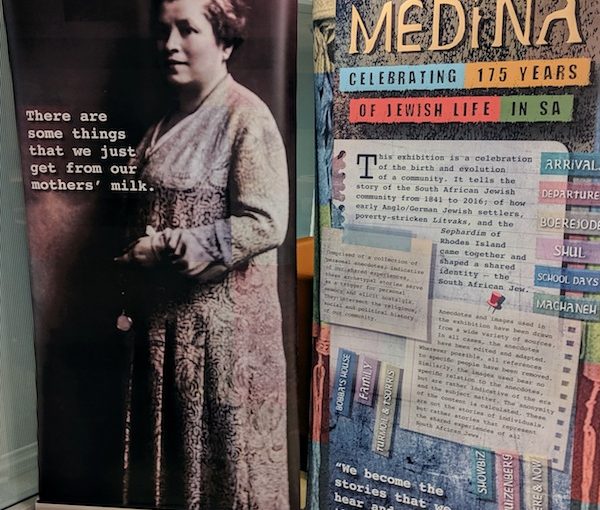
When I first moved here, my South African friend Geoff Sachs, z”l, two Montrealers and I organized Tschayniks, an evening of Jewish performing arts at the Jewish Community Centre of Greater Vancouver. It was at the JCC that I met another South African friend, Steve Rom, who was working there at the time, and helped us set up our events. About a month ago, Steve brought a fascinating exhibit to Congregation Beth Israel. Prior to being mounted in Vancouver, the exhibit, Goldene Medina, a celebration of 175 years of Jewish life in South Africa, was displayed in South Africa, Israel and Australia. Thanks to Steve, Jews in Vancouver got a taste of South African Jewish life, as well.

A unique feature of the exhibit was that nobody was named or personally identified on any of the displays. This approach helped tell the story of all South African Jews, and made the exhibit simultaneously particular and universal.

Stories were depicted on a series of panels, and traced the South African Jewish community from its origins in 1841 – when Jews first settled in South Africa – to the present. On one of the panels, I recognized the son and daughter in-law of Cecil Hershler, who has South African roots and is well known in the Vancouver Jewish community as a storyteller. His son married a woman from Zimbabwe and the wedding in Vancouver, which I attended, was a joyous blend of South African and Zimbabwean cultures. Seeing the panel brought back memories of that happy occasion and gave me an unexpected personal connection to the exhibit (other than identifying with my Lithuanian landsmen).

Other panels depicted various aspects of Jewish life in South Africa. While I was fascinated by the differences between the South African Jewish community and my experience growing up in Winnipeg, the exhibit was really a microcosm of Jewish life in the Diaspora. For example, the panel on Muizenberg depicted the resort town located near Cape Town, where throngs of South African Jews flocked to during the summer. The photos of crowded beaches told a thousand stories. However, that panel also reminded me of the stories that my dad, z”l, told me about taking the train to Winnipeg Beach in the summer with other Jews from the city to escape the summer heat. Like at Muizenberg, there was a synagogue at Winnipeg Beach. I am sure that Jews from New York have similar stories of escaping the city heat by going to the Catskills. In addition, the Jews of America, like the Jews of South Africa, referred to their new home as “the Goldene Medina.” Ultimately, all three places – Canada, the United States and South Africa – represented a new start for Jews fleeing persecution in Eastern Europe.

The Goldene Medina exhibit gave me an opportunity to learn about Jews from the land of my ancestors in Lithuania, who were able to reinvent themselves on the African continent and create a thriving Jewish community, which, at one point, reached 120,000. This resiliency is a characteristic of Jews and Jewish communities all over the world. And this resilience was evident in the film Leah, Teddy and the Mandolin: Cape Town Embraces Yiddish Song, which screened at Beth Israel during the exhibit – and will be shown again at the synagogue on Dec. 8.

Using 10 years of archival footage, Leah, Teddy and the Mandolin showcases the Annual Leah Todres Yiddish Song Festival, which was held in Cape Town. The documentary features stirring renditions of classic Yiddish songs like “Romania Romania” and “Mayn Shtetele Belz,” as well as two original songs written for the festival by Hal Shaper, a renowned songwriter, which are sung with passion by talented South African Jews of all ages. The songs featured in the film evoke a yearning for a Jewish world that no longer exists in Lithuania and Eastern Europe and highlight the power of the Yiddish language and music.

While the South African Jewish community has shrunk since its heyday in the 1970s to approximately 50,000, it is still an important Diaspora community. In addition, South African Jews make important contributions to every Jewish community they move to, and bring their unique culture to their new homes.

Seeing the exhibit and the documentary cemented the kinship I feel with my South African brothers and sisters. A few of my South African friends even dubbed me an honourary South African Jew at the exhibit, an honour I gladly accepted. One day, I hope to make a pilgrimage to the land of the Litvaks to experience South African Jewish life firsthand. Until then, I will have to continue to learn about South Africa vicariously.

The Dec. 8 screening of Leah, Teddy and the Mandolin at Beth Israel takes place at 4 p.m. Admission is a suggested donation of $10. For more information, visit leahteddyandthemandolin.com.

David J. Litvak is a prairie refugee from the North End of Winnipeg who is a freelance writer, former Voice of Peace and Co-op Radio broadcaster and an “accidental publicist.” His articles have been published in the Forward, Globe and Mail and Seattle Post-Intelligencer. His website is cascadiapublicity.com.

Oberlander Prize established

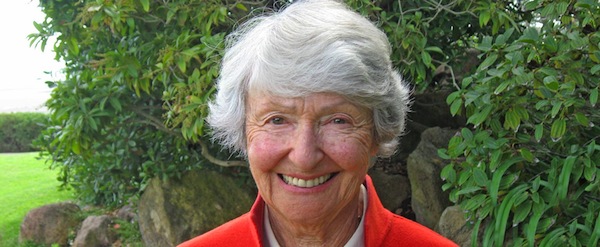
Cornelia Hahn Oberlander (photo © Charles A. Birnbaum, courtesy the Cultural Landscape Foundation)

The Cultural Landscape Foundation (TCLF), a nonprofit, Washington, D.C.-based education and advocacy organization, announced last month that award-winning Vancouver landscape architect Cornelia Hahn Oberlander is the namesake of a recently established prize.

The Cornelia Hahn Oberlander International Landscape Architecture Prize (“Oberlander Prize”), which will be conferred biennially beginning in 2021, is the first and only international landscape architecture prize that includes a $100,000 US award, along with two years of public engagement activities. The naming announcement was made at an event at the Consulate General of Canada in New York City.

The 98-year-old Oberlander has been in practice for more than 70 years. Her notable projects include the New York Times building courtyard (with HMWhite landscape architects and urban designers), the Museum of Anthropology in Vancouver, the Canadian chancery in Washington, D.C., the National Gallery of Canada in Ottawa, the Canadian embassy in Berlin, Robson Square in Vancouver, the Vancouver Public Library, and many others. Oberlander has worked on public housing in the United States and Canada, pioneered playground design with the Children’s Creative Centre at Montreal’s Expo ’67 (and designed 70 other playgrounds), was an early champion of green roofs and, for decades, has advocated for landscape architecture’s leading role in addressing environmental, ecological and social issues and the impact of climate change.

Oberlander is held in high regard both within and beyond her profession, as is reflected in the early results of a campaign to raise $1 million to help endow the Oberlander Prize, with commitments of $10,000 each from and/or on behalf of 100 women, part of a broader campaign to raise $4.5 million. The 100 Women Campaign launched in July 2019 and its website includes information about each of the more than 70 women who have contributed to date.

“It was the consensus of the prize advisory committee, which helped shaped the prize, and TCLF’s board of directors that Oberlander’s inspiring and trailblazing career in the field of landscape architecture exemplifies the critical values and ideals of the prize, and that she is someone who embodies the prize criteria of creativity, courage and vision,” said Charles A. Birnbaum, TCLF’s president and chief executive officer.

In tandem with the naming of the prize, all of Oberlander’s publicly accessible works are being added to TCLF’s What’s Out There landscape database; on June 20, 2021, the centennial of Oberlander’s birth, TCLF will host a What’s Out There Weekend of free, expert-led tours of Oberlander’s landscapes in the United States, Canada and Germany; and an update to TCLF’s 2008 Pioneers Oral History with Oberlander has been produced. More public engagement events will be announced later. See tclf.org/prize.

Lichtmann interns with StandWithUs

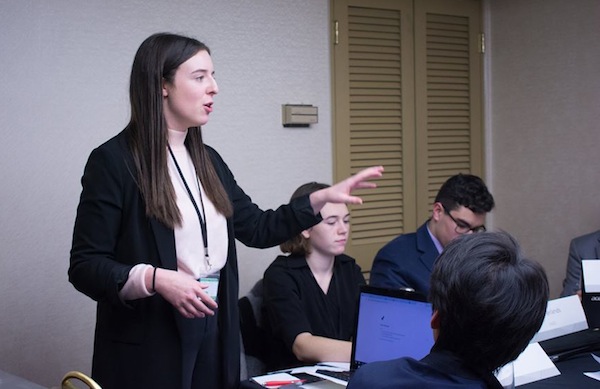
Maya Lichtmann (photo from Connect Model United Nations Vancouver)

Maya Lichtmann was selected in May as a Canadian high school intern for StandWithUs, an international organization that educates about Israel and fights antisemitism. She was chosen for the program after participating in a StandWithUs event at King David High School.

Lichtmann, a Grade 12 student at J.N. Burnett Secondary School in Richmond, attended a conference in August at the American Jewish University in Los Angeles with about 100 other high school interns, including about a dozen Canadians. She will join all high school and college interns in January at the same location.

As part of the internship, she recently delivered an educational program to two History 12 classes at her school. She covered the history of the Jewish people, how they came to Europe, the rise of Nazism, the Holocaust, the creation of the state of Israel and the rise of anti-Zionism. While she uses resources offered by StandWithUs, her presentations are developed independently.

“A lot of the presentations that StandWithUs have are catered toward Jewish audiences, because a lot of the kids who are doing the internship go to private Jewish schools,” she said. Because she goes to a public school, and one where a majority of students are of Asian heritage, she developed the presentations for audiences with limited knowledge of the topic. She received entirely positive feedback from a “100% non-Jewish audience,” she said.

Lichtmann plans to make a presentation about LGBTQ+ rights in Israel to her school’s gay-straight alliance, and one about Israel’s role in the international community at her Model United Nations Club, which she led as president last year. She will also be delivering a presentation at a student-run TEDx event.

“I’m very passionate about Israel,” she said. “It’s one of the key factors in fighting international antisemitism because I believe that unity and acceptance of Jewish people has been a struggle for the past 1,900 years, as the Jewish people were throughout the Diaspora, and I hope to continue to help Jewish people feel more accepted within society.”

She added: “My grandfather was in a concentration camp, Bergen-Belsen. We were forced to relocate after the Holocaust, so my family moved to Israel and my father was born in Israel and then immigrated to Canada. But my ties and connection to Israel are obviously still very strong.”

Lichtmann also is on her school’s student council, president of the school’s Women in Leadership Club, youth representative on the board of directors at the Thompson Community Centre in Richmond, and premier-elect of the Richmond-Delta Youth Parliament. She coaches cheerleading and tutors international students in English.

Lichtmann is a daughter of Mandy and Eyal Lichtmann and big sister to Noa and Liel.

Mystery photo … Nov. 29/19

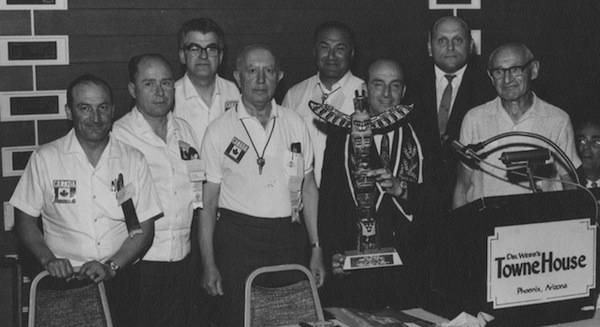
Group of B’nai Brith delegates at a Phoenix convention, 1975. Dave Jackson is on the left and Harry Buller is fifth from the left. (photo from JWB fonds, JMABC L.10220)

If you know someone in this photo, please help the JI fill the gaps of its predecessor’s (the Jewish Western Bulletin’s) collection at the Jewish Museum and Archives of B.C. by contacting archives@jewishmuseum.ca or 604-257-5199. To find out who has been identified in the photos, visit jewishmuseum.ca/blog.

Generations struggle together

I’ve heard some unsettling real-life stories lately. These weren’t news, but family stories, in my social media inbox. One friend is wrestling with how to best cope with family members struggling with addiction. (This is, unfortunately, a common problem.) In another note, I heard of how an estate is being divided after a parent died; in this case, a sibling told his sister and her family (who stayed local to care for the parents) that she will be homeless within two months unless she can manage to get a mortgage to buy the family’s home. Another message concerns the arrival of a baby, and how scared the new mother is about being sent home early from the hospital. Finally, another friend and I shared our cultures’ rituals as we worked through a discussion about miscarriage, premature babies, infertility and pregnancy loss.

There is both love and struggling out there. These challenges are just part of dealing with our families and lives. No matter what your religion, you may encounter things like this in your life. But, while none of the stories I’ve mentioned is a “Jewish” one, neither are they not Jewish.

With these burdens in mind, I thought about the stories we hear in synagogue this time of year. This week’s parashah, Toldot (Genesis 25:19-28:9), offers vignettes about life. There’s Rebecca’s story about what it’s like to struggle with infertility and pregnancy difficulties. There’s sibling favouritism, as Isaac and Rebecca raise their twins, Jacob and Esau. There’s inheritance trickery when the twins struggle over their father’s blessing. Their dying father, Isaac, shows what some might call poor judgment, as he mixes up his children’s identity and offers them unequal blessings.

This section of Genesis contains a lot: wealth, poverty, lying, distrust, water rights, and discord between neighbours, intermarriage, family relationship troubles and even possibly some mental health issues. What happens to Rebecca, for instance, when Isaac dies? She needs to know that Jacob will marry someone with whom she can cope, as she mentions with the phrase, “I am disgusted with my life….” (Genesis 27:46)

When we wrestle with similar family and community relations issues in a 21st-century context, many feel isolated. Despite plentiful online information, we can feel overwhelmed and lost when life throws us big challenges.

Our tradition gives us support. When I hear the Torah read or read it on my own, I’m reminded that these stories come with centuries of commentary. When using a modern tool like sefaria.org, I can pull up the portion, but also see commentaries (in both English and Hebrew) that allow me to learn from that scholarship.

It’s true that, for some, nothing beats seeking out an elder or a rabbi who might offer in-person wisdom. For others, the struggles are deeply private. It can be good to have access to knowledge online when dealing with hard issues like addiction, infertility or other family issues. Sometimes, the backlash from older family members can be such that a young person might never again want to talk with them about it. For instance, the pressure to “start a Jewish family” or even “accept being childless” from an older family member can be anguishing.

This Torah portion is called Toldot, which translates to Generations. We’re often in a North American generational struggle, as the phrase “OK, Boomer” currently echoes around the internet. Millennials seek help, guidance and a place in society, while their elders respond with comments like the AARP’s senior vice-president Myrna Blyth, who said, “OK, Millennials, but we’re the people that actually have the money.” (Even as a Gen Xer, I’ve long known how the Millennials might feel. Yes, Boomers have the money. The rest of us, largely, don’t.)

Elders do often have the money, power and influence in society. They sometimes, like Isaac and Rebecca, make selfish or complicated decisions. So, the question is, how does Judaism and its leaders respond to younger generations who seek out help? Are we doing this on a local level to help those in need? These sound like institutional questions, and perhaps our institutions can help. Yet, the last step is a personal one. What can we do as individuals when we see someone in need of support? We can reflect on how our words, actions and contributions help others along life’s path.

I go back to what I heard about how that estate was managed after a parent died. What parent would want to turn out their child and her family from their home? What sibling declares that “it’s only fair” to insist his sister pay off the other siblings or be homeless within two months? (Especially considering this was after she did most of the daily caretaking of their parents for years.)

Of course, families are complicated and have their difficulties, but being an upstanding elder might mean thinking ahead. How does your child/executor behave? Is he or she without compassion? Good, fair estate planning should protect all your children. It should recognize and support those who took time off to care for you. That’s a sign that you’re helping all your generations along their way.

None of these are new problems, but they’re hard. Luckily, we have voices of experience, love and compassion in our tradition to help us do the right thing. It might be time to listen.

Joanne Seiff has written regularly for CBC Manitoba and various Jewish publications. She is the author of three books, including From the Outside In: Jewish Post Columns 2015-2016, a collection of essays available for digital download or as a paperback from Amazon. Check her out on Instagram @yrnspinner or at joanneseiff.blogspot.com.