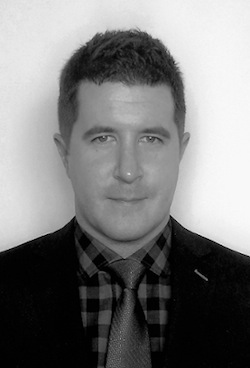
אלכסנדרה ביסונאט (27) שיועמד לדין על 11 סעיפי אישום בהם שישה מקרי רצח בדרגה ראשונה, וחמישה נסיונות לרצח, הזדהה עם העמדות של מנהיגי הימין ומתנגדי ההגירה המוסלמית. בהם: הפוליטיקאי הלאומני הצרפתי, ז’אן-מארי לה פן (מנהיג מפלגת הימין הרדקלי החזית הלאומית), ונשיא ארה”ב, דונלד טראמפ.
ביסונאט פעל כזאב בדד עת תקף מוסלמים שהתפללו במסגד בקוויבק סיטי ביום ראשון בערב, והרג שישה גברים ופצע שמונה עשר בהם חמישה במצב קשה (שניים מהם זקוקים לעבור ניתוחים נוספים). הוא פעל במקרה או שלא במקרה יומים אחרי הוצאת הצו של טראמפ שאוסר על כניסת מוסלמים משבע מדינות, בשלושת החודשים הקרובים. שכנים שהכירו את הרוצח ציינו שגר בשכירות עם אחיו התאום לא הרחק מהמסגד, והוא נחשב לצעיר לא חברותי ומאוד מסוגר בתוך עצמו.
ביסונאט יליד קוויבק סיטי ברח ממקום האירוע והוא נמצא ברכב ביציאה מהעיר (במרחק כ-40 ק”מ מהמסגד), כאשר התקשר למשטרה והסגיר עצמו. הוא טען שהרגיש רע והוא מתחרט על מה שעשה. החשוד הועבר ביום שני בבוקר לבית המשפט ושם הוקרא כתב האישום נגדו, שלא כלל סעיפים שקשורים לטרור. הדיון הראשון בעניינו יתקיים בבית המשפט ב-21 בפברואר. עד אז ישאר כמובן במעצר והמשטרה תמשיך לחקור את מעשיו החמורים והרקע להם.
ביסונאט היה סטודנט שלמד אנתרופולוגיה ומדע המדינה בפקולטה למדעי החברה באוניברסיטת לאוול המקומית. לא היה לו עבר פלילי והוא לא היה מוכר למשטרה. ככל הידוע הוא כנראה לא היה מקובל חברתית בבית הספר וסבל מהטרדות מצד תלמידים אחרים. בדף הפייסבוק שלו (שהורד בינתיים) הוא ציין את תמיכתו בטראמפ, לה פן ובהוגה דעות מקוויבק שדבק בלאומנות והתנגד לרב-תרבויות. פעילים בקהילה של קוויבק סיטי למען פליטים וכן סטודנטים באוניברסיטה, הכירו את ביסונאט ותמונותיו בשל דעותיו הרדקליות. הוא פירסם בפייסבוק ובאמצעי מדיה אחרים תגובות כנגד הגירת מוסלמים לקנדה. עמית לספסל הלימודים באוניברסיטה אמר כי אצל ביסונאט התפתחו עם השנים דעות רדקליות והוא אף התנגד לפמניזם. אגב הנהלת אוניברסיטת לאוול הזרזה והודיעה ביום שני כי הרוצח הורחק מלימודים והעונש יהיה בתוקף, כל עוד עומדות נגדו הרשעות פליליות.
בשנים האחרונות נרשם גידול משמעותי בפעולות השינאה נגד זרים בקנדה, בעיקרם מוסלמים ויהודים. מרבית האירועים התרחשו במחוזות של קוויבק, אונטריו ואלברטה. קהילות המוסלמים והיהודים נמצאות ביחסי שכנות טובה בכל רחבי קנדה, והן משתפות פעולה באירועים שונים ומגנות כל פעילות נגד אחת הקהילות. בחודש יוני אשתקד (בתקופת חודש הרמדאן) הונח ראש חזיר מול דלת הכניסה למסגד בו התבצע הטבח ביום ראשון. בקהילה המקומית מציינים שהם פנו מספר פעמים לשלטונות בקוויבק לפעול לאור האיומים וההתקפות נגד מסגדים בעיר אך דבר לא נעשה.
ראש ממשלת קנדה, ג’סטין טרודו, כינה את הטבח במסגד פעולת טרור והוסיף: “אנו מגנים את מתקפת הטרור שכוונה נגד מוסלמים במרכז פולחן ומקלט. קשה מאוד לחזות באלימות חסרת פשר שכזו. הרב תרבותיות היא העוצמה שלנו, וסובלנות דתית היא ערך שאנו כקנדים מוקירים מאוד. המוסלמים הקנדים הם חלק חשוב במרקם הלאומי, ולפעולות חסרות פשר כאלה אין מקום בקהילות, בערים ובארץ שלנו”.
הרב ראובן פופקו, שמשמש היו”ר המשותף של ועד הרבנים בקנדה ויו”ר הסניף בקוויבק של המרכז לענייני ישראל והיהודים בקנדה, אמר: “הקהילה היהודית מזועזת מהירי הרצחני במסגד. שום דבר לא מצדיק רצח של אזרחים חפים מפשע שהתאספו במקום פולחן”.
משרדי שוז.קום הסגורים בוונקובר ביום שישי האחרון (צילם: Roni Rachmani)
הקמעונאית למכירת נעליים במסחר האלקטרוני מוונקובר קבוצת שוז.קום טכנולוג’יס אינק, הכריזה ביום שישי האחרון על פשיטת רגל. המשרדים הראשיים של החברה ברחוב אלברני בדאון טאון ונקובר נסגרו ושומר הוצב במקום. כל האתרים של החברה באינטרנט הורדו. שוז.קום לא הצליחה להתמודד עם גופים מתחרים בעידן של תחרות שיווקית קשה, ההכנסות ירדו, החברה פיטרה עשרות עובדים בשנה האחרונה אך זה לא עזר.
פעילותה של הקבוצה כללה שלושה ערוצים במסחר האלקטרוני: שוז.קום, שומי.סיאיי ואון-ליין שוז.קום. בנוסף החברה הפעילה שתי חנויות חדשות ברחוב קווינס בדאון טאון טורונטו (שנפתחה בחודש יולי), וברחוב בורארד בדאון טאון ונקובר (נפתחה רק בספטמבר האחרון). משרדי החברה והמחסנים מוקמו בוונקובר, ברנבי ומעבר לגבול בסיאטל. עוד לפני מספר חודשים חשבה הנהלת שוז.קום שיש מקום להפוך את הקבוצה מגוף פרטי לחברה שנסחרת בבורסה וזאת לצרכי גיוס כספים. אך בפועל מתברר שבחודשים האחרונים נקלעה שוז.קום למצב כלכלי קשה שהחמיר מיום ליום. אפילו מינויו למנכ”ל של ברדלי וילסון בחודש ספטמבר האחרון, לא עזר לעצור את המפולת. וילסון לשעבר מנכ”לה של חברת אקספדיה וטריווגו נחשב למומחה בפעילות של המסחר האלקטרוני.
שוז.קום שהחלה לפעול ב-2012 הגיעה בשיאה למצבת כוח אדם של 650 עובדים אך בקיץ האחרון המספר ירד מספרם דרמתית ל-230. בעותה עת הקבוצה נחשפה ככל הידוע לפחות לארבע תביעות משפטיות בהיקף כולל של כ-434 אלף דולר, הרבה תלונות מצד הלקוחות על שירות גרוע, ואף תלונות מצד ספקים על חשבונות שלא שולמו.
מומחים בענף מציינים כי את שוז.קום ניהלו מומחים לתחום המסחר האלקטרוני, אך הקבוצה הייתה חסרה עובדים בכירים שמתמחים באופנה, עיצוב ומסחר של נעליים, והיא לא קראה את השוק נכון. עוד מתברר שהפעילויות של הגופים הענקיים כמו וולמארט שרכשה בראשית חודש ינואר תמורת 70 מיליון דולר את שוביי.קום, במקביל לאמזון שרכשה עוד קודם לכן את זאפוס.קום – שתיהן המתחרות הקשות של שוז.קום, פגעה קשות באחרונה. וולמארט שנחשבת לקמעונאית הגדולה בעולם עם הכנסות של 482.1 מיליארד דולר בשנה יכולה לרסק כמעט כל מתחרה עם היא רוצה. המומחים חשבו שאולי וולמארט או אמזון ירכשו את שוז.קום אך זה לא קרה. למרבית הפלא וילסון (שמחק בינתיים מהרזומה שלו בלינקדאין כי ניהל את שוז.קום) לא חשב שהמהלך של וולמארט יפגע בקבוצה מוונקובר. אך הוא טעה בגדול ורכישת שוביי.קום ע”י וולמארט היה כנראה הנוקאאוט האחרון שחיסל סופית את שוז.קום.
קבוצת שוז.קום הגיעה להכנסות של 89.2 מיליון דולר אמריקני בשנת 2014, ואילו ב-2015 ההכנסות גדלו משמעותית ל-223 מיליון דולר אמריקני. באותה תקופה החברה הצליחה למכור כשבעת אלפים זוגות נעליים ביום (של יותר מחמש מאות ברנדים שונים). בהנהלת הקבוצה תכננו להגיע אף להכנסות של כמיליארד דולר בשנת 2020 אך זה כבר לא רלוונטי. עדיין לא פורסמו הנתונים של אשתקד אך אין ספק שחלה נסיגה משמעותית בהכנסות החברה שחדלה מלפעול.
בעלי השליטה בקבוצה והיו”רים שלה, רוג’ר הרדי, ושון קלארק לא מגיבים בשלב זה על ההחלטה להכריז על פשיטת רגל והגנה בפני הנושים. השניים פעלו כל הזמן לרכוש ולאחד עוד פעילויות של קמעונאיות נעליים הפעילות בתחום המסחר האלקטרוני, תחת המטריה של קבוצת שוז.קום. עתה מתברר שהם הלכו רחוק מדי. ב-2016 שניהם זכו בתואר “היזמים של השנה בבריטש קולומביה” בתחום המסחר האלקטרוני. אך מתברר שתארים לחוד והמצב כלכלי של הקבוצה שהתטמוטטה לחוד.
The cast of Crossing Delancey, left to right: Jonathan MacDonald (Sam), Nina Tischhauser (Izzy), Joan Koebel (Bubbie), Helen Volkow (Hannah) and Jon MacIntyre (Tyler). (photo by Tracy-Lynn Chernaske)
Many of us are still looking for our bashert, our soul mate, that one person with whom we want to spend the rest of our lives. Sometimes, our family and friends try and guide us in our quest, sometimes we go it alone, double-clicking away in cyberspace, hoping to make the perfect connection and, sometimes, we hire a professional, a matchmaker. While that last approach may seem old-fashioned and outdated, it can work – as the latest offering at Metro Theatre, Crossing Delancey, charmingly illustrates.
Set in New York in the 1980s, playwright Susan Sandler’s romantic comedy has five characters. We meet 30ish yuppie bookseller Isabelle (Izzy) Grossman, who lives and works Uptown and is enamoured of Tyler, a non-Jewish local author who often drops by the shop to check on his book sales. Meanwhile, back on the Lower East Side, on the main thoroughfare, Delancey Street, Izzy’s grandmother, Ida Kantor, has retained matchmaker Hannah Mandelbaum to find the perfect match for Izzy. What follows is a smorgasbord of Jewish humour peppered with witty Yiddish sayings – the evening’s program contains a glossary of the Yiddish words and phrases used in the play and it is a good idea to read it over before the show begins – as we follow the action to what we expect to be a predictable ending. Or is it?
Bubbie (Joan Koebel) will do almost anything to see her granddaughter, Izzy (Nina Tischhauser), married. (photo by Tracy-Lynn Chernaske)
On stage, the action alternates from Bubbie’s kitchen to the New Day Bookstore to a park bench. The curtain rises on the warm glow of the kitchen with Izzy (Nina Tischhauser) visiting Bubbie Ida (Joan Koebel) for their regular Sunday night tête-à-tête. Ida is the quintessential Jewish grandmother, doting on her granddaughter, making sure there is lots of food on the table (her claim to fame is her kugel), regaling anyone who will listen with tales of her youth, and being an all-around busybody. The night’s conversation leads to a discussion about loneliness and finding a mate. Izzy is adamant that she is a modern woman and does not need a man to feel whole. Bubbie, who continually reminds the audience in a number of melodramatic asides of what a beauty she was in her prime and how she had three marriage proposals, begs to differ. Bubbie makes it clear that her goal, in whatever life she has left, is to find her granddaughter a husband, so that Izzy will have true happiness. Enter Mrs. Mandelbaum (Helen Volkow) with her collection of photographs of eligible men. What a catch she has lined up for Izzy – Sam Posner (Jonathan MacDonald), the pickle man who runs the local deli – “a real mensch, a college graduate, a nice boy, goes to shul every day and, you could do worse.”
Unfortunately, Izzy is a bit of an intellectual snob and finds Sam bland and unromantic, so she shuns his attentions while focusing on Tyler Moss (Jon MacIntyre). Despite Izzy’s frosty attitude, Sam is smitten after their initial meeting and persists, using gastronomical courtship – an assortment of the “best pickles in New York” and chocolate cake – to woo her. He tells Izzy the story of a man whose life took a dramatic turn when he changed the type of hat he wore and that, although her Uptown life was “sociologically a million miles away” from Delancey Street, she, too, could change her style. The next day, a hat box arrives at Bubbie’s and Izzy has a new accessory – but will she wear it?
Each of the five cast members is strong but Volkow really shines. She is the stereotypical yenta with her cat eyeglasses, capri pants and oversized bosom (safely ensconced in a floral polyester top). She nails the New York accent and mannerisms.
Tischhauser adroitly handles Izzy’s metamorphosis from fantasist to realist in her choice of suitors, while MacDonald is an understated but effective beau, playing his role with calm and self-assurance. Koebel puts her heart and soul into Bubbie’s character and does a nice job with the Yiddish-heavy dialogue and the song and dance numbers. MacIntyre comes across as the stiff, self-absorbed man his character is.
One thing that Metro does particularly well is sets and this one does not disappoint. Divided into two, one side of the stage houses the bookshop; the other, Bubbie’s intimate apartment kitchen. The mood lighting and music, a mix of 1980s hits and klezmer tunes, bring it all together.
Kudos to director Alison Schamberger, with technical advice from decades-long JI contributor Alex Kliner, for bringing this light-hearted fare to Vancouver audiences.
A quintessential Jewish play with Yiddish humour, free parking, an upstairs bar and lounge, what’s not to like? Just go and enjoy – a nice pick-me-up for the January blues.
Crossing Delancey runs Thursdays through Saturdays, at 8 p.m., with two Sunday matinées, at 2 p.m., on Jan. 29 and Feb. 5. For tickets and more information, go to metrotheatre.com or call 604-266-7191.
Tova Kornfeldis a Vancouver freelance writer and lawyer.
“April 5, 2006, Reflected Embers: Cerulean, Cadmium Red, Yellow and Orange.” One of the sunsets Jack Rootman captured in oil over the space of a year.
For three decades, Jack Rootman combined two of his passions: medicine and art. Last year, after 43 years of practice as an eye surgeon, he retired and finally could dedicate himself completely to his art.
“This is the first opportunity I had in my life to paint whenever I wanted,” he said in an interview with the Jewish Independent. “I like painting in series. It allows me to explore my chosen theme from different viewpoints, but it was not easy when I could only paint a few hours a week. Now I can.”
Artist Jack Rootman (photo by Olga Livshin)
His latest series – of sunsets – comprises his new show at the Zack Gallery. Called Contemplating Sunset: English Bay, the show opened on Jan 19.
“I began the series just before I retired,” said Rootman. “My studio is in English Bay, and I watched sunsets there almost every day for years. Every night of the year, people come to the beach to watch the sunset. It’s become almost a ritual. Of course, more people come during the summer months than in winter but, in any weather, a sunset inspires people to enter a spiritual mood. Couples embrace. Everybody often stays silent, no small talk. Sometimes, people sing or salute the setting sun with their raised hands.”
Several years ago, Rootman started taking photographs of the sunsets he witnessed. “I also took colour notes for every photo. A camera doesn’t always reproduce the exact colours of sea and sky, so I noted the oil paint names.” Examples of his notes, which mix in with the images’ titles, are: “January 31, 2010, Serene Mist: Cobalt Violet, Ivory Black, Ultramarine Blue” or “June 12, 2015, Final Moment: Lavender and Lilac.”
“As the months go by, the position of the setting sun moves across the azimuth, from the far left in January to the far right in July,” observed Rootman, whose series covers a full year. “After the summer solstice, the sunset position starts to move back, gradually month by month. Sunsets also take longer as the days grow longer.”
Rootman started the series at the beginning of last year, after he had accumulated a great number of photographs. He wanted to depict the best sunset for each month.
“No sunset is the same,” he said. “Even on the same day, when I took photos every few minutes, the view is different. The sky, the sea, the clouds, the colours change almost every moment.”
That’s why he never tried to paint on site, because the sunset is constantly in flux. The best artistic approach, he explained, was to paint inside his studio, to capture the moments using his hundreds of photos as inspiration.
“June 12, 2015, Final Moment: Lavender and Lilac,” by Jack Rootman, is one of the sunsets on display at Zack Gallery until Feb. 19.
“I wanted to characterize the nature of light of both sky and sea, to paint a series of portraits of individual sunsets, as if they were persons,” he said. “Sunset always has an emotional impact on its human watchers, and I painted them, too.”
Indeed, some of the paintings at the Zack Gallery are populated by people who are sharing the sunset with the artist; most of them have their backs to him.
One of the most interesting features of a sunset over water is that, exactly as Rootman depicts in this series, at a certain point, the sea becomes a mirror, reflecting the sky above.
“You might notice that the sea is always a different colour than the sky,” he said. “It is because the sea reflects what is up, directly over it, but the artist looks at the sky and paints the sideway view. We don’t see what is above that distant sea on the horizon. We only see what is in front of our eyes. The entire sunset is like a sequence of visual effects in a movie.”
Rootman considers sunsets an intimidating subject, “a colossal challenge,” perhaps because of their fluid, “visual-effect” nature. Many artists over the ages have tried painting sunsets, but not many have succeeded. One of his friends, an Israeli artist Yasha Cyrinski, wrote in an email exchange with Rootman: “The subject matter you chose is quite challenging to say the least. A subject devoid of irony.”
But Rootman is never afraid to tackle a challenge.
“I have done landscapes and portraits on commission, and portraits are much harder,” he said. “When I paint a portrait, I want to capture the essence of a person, his emotional subtext. When I painted sunsets, I wanted to catch the ephemeral moment of what a sunset is.”
The exhibit Contemplating Sunset: English Bay continues until Feb. 19.
Olga Livshinis a Vancouver freelance writer. She can be reached at olgagodim@gmail.com.
On President Donald Trump’s inauguration day last Friday, Richard Spencer, an up-and-coming voice of the extreme right-wing in America, was punched in the face by a protester.
Spencer is president of the National Policy Institute, a white supremacist organization, and calls for a whites-only homeland. He is sometimes credited with inventing the term “alt-right,” which is a catch-all for the extremism emerging in the United States at present. He was giving an interview to a reporter when someone stepped into the frame and punched him in the face.
Social media erupted, with plenty of people contending that punching Nazis is fair game. (For the record, Spencer had denied he is a Nazi just before the punch landed. He describes himself as an “identitarian,” which is a term associated with far-right, white supremacist ideology.)
Spencer is one among many on the far right who are emboldened
by Trump’s victory. His attacker, apparently, was emboldened by the belief that violence against people like Spencer is justifiable. This is the reality of the day in parts of the American body politic.
No one knows what the Trump administration portends. The new president contradicts himself and has no guiding ideological compass. He speaks (and tweets) without any evidence of self-control and reacts wildly to the mildest provocation. It is probably safe to venture, however, that the Trump administration will not advance the rights of women, religious or ethnic minorities, refugees and immigrants or LGBTQ people. While the Trump team includes numerous Jews, Zionists and philosemites, the campaign also attracted support from the most racist and antisemitic individuals and entities in the country. Journalists with Jewish names who reported unflatteringly on Trump have been subject to particularly brutal online harassment.
As Trump moves from rhetoric to action, we will have plenty of opportunity to analyze his record. What is likewise worthy of consideration is the manner in which the opposition to Trump manifests. The mass rallies in Washington and around the world last Saturday were inspiring. While billed as “women’s marches,” participants reflected a panoply of interests and identities. The events went off, largely, without a hitch – there were no arrests in the approximately 600 marches that took place around the world, including here in Vancouver. It remains to be seen, however, whether the outpouring of political engagement demonstrated by marchers will morph into a structured political movement. As an historian of social movements told the New York Times, after big rallies like Saturday’s “there is a lot of unfun, unglamorous work to do.”
The marchers were overwhelmingly civil, their handmade signs frequently illustrating superb wit and insight. But not all of the resistance to Trump has been as peaceful. The individual who punched Spencer represents a different sort of character.
There is a stream on the left – perhaps we should call it the “alt-left” – which exhibits its own totalitarian tendencies. So righteous are some “progressives” – we’ve seen this very clearly among some anti-Israel activists – that opposition to their target is justified by any means necessary. For some, this means punching an opponent in the face. For others, it can mean justifying such violence, or completely rejecting in other ways the right of dissenting voices to be heard.
As odious as Spencer’s ideas are, and however much we might contend that people who share such views only understand force, the introduction of violence – as well as ideological extremism in defence of liberty – is, to contradict Barry Goldwater, indeed a vice.
Most of us can probably agree that if anyone’s ideas are worthy of approbation, it is Spencer and his like. Yet if we extend this to argue that, as a result, a punch in the face is justifiable, then – does this really need to be explicitly expressed? – we accept that violence based on political disagreement is a legitimate part of our society’s foundations. If mere disagreement is enough to merit physical attack, then what will our political institutions eventually become and how will we ever be able to keep our leaders, or those with the financial and other means, from systematically abusing human rights or other oppression? With even more violence?
It is, of course, challenging to engage with supporters of a man who is belligerent and nasty, and who licenses this behaviour in his followers. The booing of Hillary Clinton during the inauguration was a symptom of the mentality of some Trump supporters.
But we side with Michelle Obama on this, suggesting that when those on the extreme right go low, those of the centre and of the reasonable left and right should go high. To employ the tactics we have seen from Trump and his supporters – lying, scapegoating, vicious personal attacks – would not only debase causes deserving of defending, it would represent a spiral from which the political system might never return.
In addition to the many differences of policy that will emerge between the Trump administration and its critics in the years to come, we hope there will also be a discernible difference of style; that, in the face of boorishness, “alternative facts” and insensitivity, the opposition will demonstrate dignity, truth and respect for humanity.
Dr. Tami Jacoby, associate professor at the University of Manitoba, has been studying Middle East politics and international relations for nearly 20 years. (photo from Tami Jacoby)
Dr. Tami Jacoby, associate professor at the University of Manitoba, has been studying Middle East politics and international relations for nearly 20 years. She not only shares her expertise with students at the university, but the broader community as well, via books and lectures. She is currently teaching an eight-week class at Winnipeg’s Rady JCC called Terrorism and Political Violence.
After working toward her undergrad degree at the Hebrew University, Jacoby finished her studies at U of M. She then went back to Hebrew U for her master’s degree in political science and international relations. At that time, Jacoby made aliyah and started a family and life in Israel. Later, she moved to Toronto to do a doctorate in political science at York University. She eventually returned to Winnipeg, where she currently resides.
While doing her PhD, Jacoby traveled back and forth regularly between Canada and Israel, and did field work in Israel, conducting interviews and research on women’s protest movements.
Over the years, Jacoby has written several books, including Women in Zones of Conflict: Power and Resistance in Israel (McGill-Queen’s University Press, 2005). Using the framework of “a case study of three women’s political movements in Israel: Women in Green, the Jerusalem Link and the lobby for women’s right to fight in the Israel Defence Forces,” the book, according to the publisher’s description online, “challenges the traditional view, which suggests a natural connection between women and pacifism, based on the feminine qualities of caring, cooperation and empathy.”
“What I did was a number of years of interviews and research on women’s protest movements … and the book that came out was a book on the diversity of feminism in Israel, but as a level of extremism,” Jacoby told the Independent. “I was interested in how women in one national context could have such radically different views on the same things, like feminism, the Arab-Israeli conflict and just run-of-the-mill party politics.”
One of the interesting things Jacoby found was that many women on the left were interested in things like dialogue with the Palestinians about a two-state solution, and feminism. In contrast, right-wingers’ idea of dialogue with the Palestinians was through protest, the media and policy.
“They were very driven by their fear of not only losing the state of Israel, but of losing their identity as Jews, as Israelis,” said Jacoby. “And the left-wing portion of the Israeli women’s movement was very interested in dialogue with Palestinian women. They wanted to get together with them and have cultural programs and social events. They wanted to listen to and get to know the stories of Palestinian women, to be able to walk in their shoes and completely understand them.”
The class that Jacoby is teaching at the Rady JCC – which started last week and runs to March 21 – looks at terrorism in Canada and the legal and political/social aspects of it.
“This class I’m teaching at the JCC is, in a sense, piggybacking on other research and teaching that I’m doing right at the moment,” she told the Independent before the course began. “So, I’d assume the people in the class will be interested in the kind of terrorism that Canada and Israel deal with…. But the class takes a step back and looks at the phenomenon of terrorism as a philosophical and structural issue….”
While Jacoby is teaching the class, she is also a student of sorts, as she is interested in hearing what people have to say.
“People have a lot to say and it’s not just off the cuff; it’s substantiated by empirical evidence and anecdotes that are based on experience,” she said. “What I try to do is open a little window on something that I’ve been very heavily researching … and open a discussion about things that people may not have thought of before … so people can bring things to the table and we can work to enlighten ourselves about the topic.”
Touching a little on what will be examined in the course, Jacoby said, “One of the things I’ve come to realize about terrorism is that it has a particular dynamic to it, no matter where it is and what period of history it is in. And that is, you have a small group of people trying to terrorize, make afraid, a large group of people … so they start to feel their life is untenable and then pressure the government to act. That’s the case with literally every terrorist group, regardless of their philosophy, background or tactics. That’s the logic of terrorism. I’m interested in seeing how case studies fit into that logic.”
Another topic will be how to pair counterterrorism with policies like multiculturalism, democracy and liberalism.
“The human tendency is to look for people who might look like them, causing a whole range of Islamophobia, antisemitism, racism and xenophobia,” explained Jacoby. “These are the kinds of problems not specific to any one particular form of terrorism, but that fuel a broader understanding of terrorism in general.”
Jacoby sees political violence like terrorism as a way in which people express themselves at the extreme end of the spectrum. “Political violence is quite broad,” she said. “It could be something quite innocuous, like threatening someone or inciting someone to violence … or, it could be throwing a fist or a bomb, or using nuclear weapons as a scare tactic.”
The Middle East will likely be discussed in terms of the ongoing cold war between Iran and Saudi Arabia and their backers, as well as both American and Russian policies.
“One thing that people seem to not understand nowadays is that people may oppose a terrorist group’s tactics, but they may also support the underlying goals … which can be quite honourable,” said Jacoby. “For example, terrorists might use violence to press their point about Muslim victims in the Middle East, [while] a moderate person might say they are against and shocked by the high casualty rate of Muslim victims. There are a lot of divisions out there, of which terrorists only represent a very small group … [an] active, vocal, radical, but miniscule, minority. While we may not like the tactic, many people may support the ultimate goals, which include justice and peace. The reason we can’t see the ultimate goals is because terrorism destroyed them … [and] in the end, makes it worse.”
As for possible solutions to terrorism, Jacoby said it “is one of the most difficult tasks to respond to.”
She explained, “I would say this: the effect of terrorism is more psychological than anything else. Fewer people die from terrorist attacks every year than from faulty wiring or furniture falling on them when they sleep. But, because of the media and the dramatic nature of its coverage of terrorism (pervasiveness, images, taboos, fear), people spend more time worrying about terrorism than any other more concrete and actual danger to their lives. My suggestion is we, as a society, need to be more ‘comfortable’ with the psychological discomfort that comes with terrorism. We must continue to be vigilant, but also live our lives to the fullest so that the terrorists won’t ultimately win.”
The Canadian military helped liberate Bergen-Belsen and other Nazi concentration camps near the end of the Second World War, a fact that was omitted for decades from recorded history.
The experiences of Canadian liberators – and the meaning of the term “liberation” itself – were the subject of the keynote address at the International Holocaust Remembrance Day observance in Vancouver last week.
Prof. Mark Celinscak, a Canadian who teaches at the University of Nebraska Omaha, delivered the address Jan. 18, at a commemoration presented by the Vancouver Holocaust Education Centre (VHEC) in partnership with the Norman and Annette Rothstein Theatre.
Celinscak’s book, Distance from the Belsen Heap: Allied Forces and the Liberation of a Nazi Concentration Camp, was recognized as the best nonfiction book of 2016 by the Vine Awards for Canadian Jewish Literature. In his lecture, he explained how he stumbled upon the facts of Canadian involvement in the liberation of Nazi camps.
Researching the liberation of Bergen-Belsen, he encountered multiple conflicting narratives, but none involved Canadians, he said. In archival research, he found references to Canadians encountering Nazi camps and so he consulted leading Canadian military historians, but all assured him there was no Canadian role in the liberation of concentration camps.
Through further research, Celinscak identified a few soldiers who confirmed the Canadian military’s involvement. These connections led to more and, eventually, he had identified 1,000 individual cases of Canadian military personnel who participated in the liberation of Nazi camps. Seven decades after the end of the war, this aspect of history is only now coming to light. The oversight, said Celinscak, was likely due to the general sense of chaos in Europe at the end of the war.
In introducing Celinscak, VHEC executive director Nina Krieger said: “Were it not for the tenacious scholarship of this evening’s presenter, future generations might never have known of the Canadian role in this aspect of the Second World War.”
Celinscak believes his research helps right an omission in the record. He reflected on an incident from 1997, when plans for a new Canadian War Museum included a Holocaust memorial gallery. Controversy ensued, and Senate hearings were held on the appropriateness of including the Holocaust in a museum devoted to Canadian military history.
“Upon conclusion of the hearings, the plan for a Holocaust memorial gallery was promptly abandoned,” Celinscak said. “In the view of many who testified, the Holocaust either had no place in the country’s war museum or it held no direct connection to Canada and its military.”
His research, however, indicates that the Canadian military did indeed have a connection to the Holocaust, as liberating forces.
Celinscak’s local address was related to the exhibition currently being presented at the VHEC, called Canada Responds to the Holocaust, 1944–45. The exhibition, Celinscak said, reflects “a recent growing body of research that explores how the Canadian government, Canadian organizations and average Canadians responded to the Holocaust.” Celinscak wrote the exhibition’s panels related to Bergen-Belsen, while the overall exhibition was developed by Prof. Richard Menkis and Ronnie Tessler.
Canadians helped liberate camps in the Netherlands and in northern Germany, Celinscak said, though Bergen-Belsen was not taken by military force.
“Simply put, the Allies became involved in Bergen-Belsen because the Germans turned it over to them,” he said. Recognizing that the war was all but lost and that the disease-ridden camp presented a public health hazard to the surrounding German population, a representative from the German army crossed British lines and said that inmates in a nearby concentration camp were ill. The Allies entered Bergen-Belsen on April 15, 1945.
“In the ensuing days, weeks and months, British and Canadian forces from the surrounding area arrived at Bergen-Belsen to assist, to witness and to document,” said Celinscak. “Clearly, military personnel were unprepared for what they were to find in the camp.”
The “liberation” removed the Nazis from the scene, but life improved slowly for the survivors of the camp.
“The war, of course, still continued,” he said. “As a consequence of that, supplies were limited, personnel were largely unavailable and many resources were occupied elsewhere. Those who remained to work in the camp were left with monumental tasks.”
The victims of Bergen-Belsen continued to die. In the two weeks after the Allies took over, 9,000 people died of disease. The next month, 4,500 inmates succumbed, and another 400 perished the following month.
“In total, approximately 14,000 people died in the camp after its transfer to Allied control,” said Celinscak. “In other words, nearly a quarter of the total number of prisoners still alive when the British and Canadian forces first arrived in the camp ultimately met their demise.… While the situation slowly improved, the conditions in the camp remained grim even weeks after its surrender.”
This reality is partly why Celinscak’s research also focuses on the meaning of the term liberation.
“Liberation was an experience that transformed the lives of both liberators and survivors,” he said, noting that this is another newly emerging field of academic inquiry.
“What does that word mean in relation to the Holocaust?” he asked. “If we consider some popular representations of the liberation of Nazi concentration camps, we often see it framed as a jubilant event, one that brought to an end the suffering of the victims of the Holocaust. In films such as Roberto Benigni’s Life is Beautiful, in history books and in some museum exhibits, liberation is frequently depicted as a homogenous, joyful moment in time. But how accurate is this portrayal?”
Liberator narratives, he said, “are overflowing with shock, grief, confusion, disgust and rage.” For survivors, life did not turn for the better instantly. Public health considerations meant the camp inmates were effectively quarantined.
“The prisoners remained behind barbed wire,” he said. “Initially, the survivors were not given autonomy to leave the camp whenever they saw fit. Instead, in the weeks – and, for some, in the months and even years that followed – they continued to live behind the barbed wire of these camps. Places like Bergen-Belsen became displaced persons camps. The survivors were still guarded, only by men in different uniforms.”
In extensive interviews with many survivors, Celinscak came to realize the nuance in the concept of liberation.
“Liberation was a highly ambivalent experience,” he said. “They understood that they were no longer prisoners of Nazi Germany, but many would remain in displaced persons camps long after the war, learning that many of their friends and family had not survived what we now refer to as the Holocaust. For both survivor and liberator, they would contend with these experiences for the rest of their lives.”
Phil Levinson, president of the board of the VHEC, welcomed visitors and introduced a procession of Holocaust survivors carrying Yahrzeit candles. David Schaffer led the Mourners’ Kaddish. Councilor Raymond Louie read the proclamation from the City of Vancouver.
International Holocaust Remembrance Day, which was designated by the United Nations in 2005, is officially on Jan. 27, the anniversary of the liberation of Auschwitz-Birkenau.
Pat Johnsonis a communications and development consultant to the Vancouver Holocaust Education Centre.
The human consequences of implementing the recent United Nations resolution about Israel would be devastating, say American representatives of Israeli schools, synagogues and other institutions in parts of Jerusalem that Israel captured in 1967.
UN Security Council Resolution 2334, adopted Dec. 23 with the United States abstaining, asserted that all “Israeli settlement activities” in “the occupied Palestinian territory, including East Jerusalem” are “a flagrant violation of international law.” It stated that Israel must “immediately and completely cease” such activities and also take action to “reverse negative trends on the ground.”
A number of major Jerusalem neighbourhoods are situated in what the UN calls “East Jerusalem,” which is the area that Jordan occupied following the 1948 Arab-Israeli war. Nineteen years later, those sections of the city were reunited with the rest of Jerusalem as a result of the 1967 Six Day War.
One of those neighbourhoods is French Hill, a major urban area located in the northeastern part of the city. “I live in French Hill,” award-winning Israeli author Yossi Klein Halevi told JNS.org. “So the recent UN resolution has criminalized me and my family as occupiers.”
“I’m not illegal, and I’m not a ‘settler,’” said historian Maurice Roumani, a professor emeritus at Ben-Gurion University of the Negev, who resides in Armon HaNetziv (East Talpiot), a neighbourhood in eastern Jerusalem with a population of 14,000. “These artificial definitions by the UN do not reflect reality.”
The institutions that could be adversely affected if the UN resolution leads to international boycotts or other actions include the Ilan Residential Home for Handicapped Young Adults and the Beit Or Home for Young Autistic Adults, both of which are located in the Gilo neighbourhood; forests and housing projects sponsored in and around Jerusalem by the Jewish National Fund (JNF); and portions of the Hebrew University campus. Even the ancient Jewish cemetery on the Mount of Olives might be affected.
“My grandparents, great-grandparents and great-great-grandparents, going back seven generations, are buried on the Mount of Olives,” Washington, D.C.-based attorney Alyza Lewin told JNS.org. “Does the UN propose to ban Jews from using the oldest and largest Jewish cemetery in the world? The notion that Israel is violating international law by burying its dead on this sacred spot is unthinkable.”
Could members of the British family find themselves accused of fostering the “illegal occupation” of eastern Jerusalem? Princess Alice of Battenberg, a great-granddaughter of Queen Victoria, is buried in a small Christian cemetery at the foot of the Mount of Olives. A number of British royals have visited her gravesite over the years, including Prince Charles during his trip to Israel last October.
There also are Arab residents in a number of across-the-line Jerusalem neighbourhoods, including Givat HaMatos, Gilo and Neve Yaakov. “Some of my neighbours [in French Hill] are Arab Israelis,” Halevi noted. “Are they occupiers, too, or is it only the Jewish Israelis? Now that I am officially outside of the law according to the UN, I imagine that anything can happen.”
Possible international action against those sections of Jerusalem would cut across Jewish denominational lines, affecting Orthodox and non-Orthodox institutions alike.
The Masorti movement – the Israeli branch of Conservative Judaism – sponsors a school and synagogue in French Hill, a school in Gilo and synagogues in the Ramot neighbourhood and the Jerusalem satellite community of Ma’ale Adumim. “The UN resolution is indiscriminate and historically obtuse,” said Rabbi David Wolpe of Sinai Temple in Los Angeles, who is one of the most prominent Conservative rabbis in the United States.
The recent Toronto Jewish Women’s Renaissance Project group in front of the Western Wall in Jerusalem. (photo from Nicole Pollak)
In its flagship program, Momentum, the Jewish Women’s Renaissance Project (JWRP) provides Jewish women and men, typically mothers and fathers, with a free journey throughout Israel (airfare is not included).
The trips – the women’s and men’s trips are separate – are designed for people who are not shomer Shabbat (Shabbat observant). As well, 90% of participants must have children at home under the age of 18, and participants must be physically and emotionally healthy.
Rebbetzin Lori Palatnik founded JWRP in 2008. Since then, it has become an international initiative bringing thousands of women and hundreds of men to Israel each year from 19 different countries.
“The goal is that the women have 10 incredible, uplifting, inspirational days together … and then go home and bring that back to their families and communities,” said Toby Bernstein of the Chabad Romano Centre in Richmond Hill, Ont.
Bernstein led a group of women on the program in December 2016, noting, “We decided to do this trip to encourage some of the women in our community to be more connected to Judaism.”
Bernstein took with her 10 women, “women who come to synagogue services, a couple Hebrew school moms [and] a couple preschool moms.”
These women joined 250 others from the United States, Canada, Russia, Greece and England.
“It was an inspirational trip, because there were classes every day [about] what it means to be a Jewish mom, a Jewish wife, to be a Jew altogether … what’s the purpose of life,” said Bernstein. “It got a lot of people thinking, so it was inspirational. Even me, who grew up with all of this, grew from [the trip] and gained new insight, new inspiration…. It was beautiful to see the women growing and taking it all in.”
One of the participants was Nicole Pollak, a business owner in Toronto along with her husband, Aaron; the couple has a 3-year-old, Sydney.
Pollak went on the trip with both of her sisters after her younger sister, Melissa Jacks, who sends her children to the Chabad Romano Centre, was invited to join by Bernstein.
“My sister came to me and said that Chabad Romano is going to be running a JWRP trip and asked if me and our older sister, Allyson Theodorou, were interested in going,” said Pollak. “We applied, and all three of us went on this trip together.
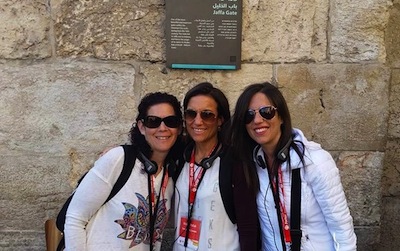
Left to right, sisters Allyson Theodorou, Nicole Pollak and Melissa Jacks during a tour of the Old City, outside Jaffa Gate. (photo by Megan Epstein)
“We thought it would be an amazing experience to do this together, and to learn more about Judaism and Israel,” she said. “And I, personally, have been studying with a rabbi for about eight years. So, I really liked the idea that it was an educational trip to teach us more and give us more insight into Judaism and the religion, and thought it was a good opportunity to get some Jewish inspiration.”
Before leaving, Pollak had to do what she could to ready her daughter for her absence. “From an emotional standpoint, preparing my daughter that I was going to be away for that amount of time was very difficult for a 3-year-old,” said Pollak. “I don’t think she has a concept of time – 10 days, for her, could be 10 hours, 10 minutes or 10 weeks … [so it was hard to tell] her that I’m going away and what that means and that I’ll be calling her every day. Preparing for the trip on my end, it was not really that difficult. It was just a matter of packing and organizing.”
Pollak’s husband was very supportive of her going on the trip. When Pollak became anxious about leaving, it was her husband who helped push her through it.
“There were a couple of times where I contemplated whether I was even going to go. I thought it was going to be too stressful for the family for me to be gone,” said Pollak. “My husband was the one who said, ‘I support you whether you want to go or if you don’t want to go, but I’d be very disappointed if you didn’t go. I think that would teach our daughter we don’t do things because we’re afraid, instead of showing her to do what we want – to learn, to have an adventure or explore life. He was pushing me to go because he thought it would be an incredible opportunity to go to Israel, learn and spend that time with my sisters.”
From the moment Pollak arrived at the airport, she could feel the camaraderie of the women traveling, all with similar feelings about leaving home, and she began focusing on the trip and getting as much out of it as she could.
Each day of the program in Israel involved one or two discussions, lectures, lessons and classes, sightseeing and tours, and the opportunity to see something cultural or religious in the region. For Pollak, the learning was the best part of the experience.
“One of the things we learned was that there are three major mitzvot for a Jewish woman: lighting Shabbat candles, making challah and going to the mikvah,” she explained. “We had the opportunity to light Shabbat candles and to participate in a challah-making class. And, on our visit to Tzfat, we visited a mikvah and had a tour.
“One of the things they talked about is, if you’re a secular Jewish woman and you don’t have a lot of religion in your life, you should start with lighting Shabbat candles. My older sister, Allyson, had never lit Shabbat candles in her house in her whole life and she’s been married 18 years. In Israel, she bought Shabbat candles and, last Friday night was the first time ever she lit them in her house. That’s pretty amazing.”
As for challah-making, the sisters have committed to getting together sometimes on Friday nights and making challah for Shabbat. As for the mikvah mitzvah, Pollak plans to investigate it more before deciding whether she wants to make it a part of her life.
With respect to the sightseeing, visiting the Kotel was a major highlight for Pollak, especially after having had a class about prayer before going in a spot overlooking the wall.
“I heard a lot of people saying … they don’t know how to pray, they don’t know what that means,” said Pollak. “People will often go to the wall and pray for world peace or for their entire family to be happy or healthy. They pray for these big things because they think that, when you talk to G-d, that’s what you ask for – big things.
“Something they emphasized in that class was that praying is not about just big things, it’s about little things, too; it’s that we should pray about everything. You can pray that you want your little son Johnny to do well on his math test. You can pray that you hope that your daughter wins that award, or that next week your haircut is going to be great. The message was, pray for what’s important to you.”
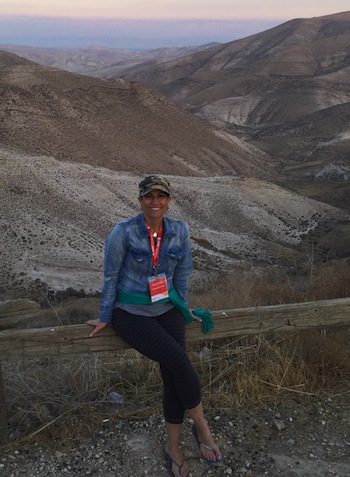
Nicole Pollak at Eretz Bereshit, overlooking the Judean Desert. (photo by Allyson Theodorou)
Another class that hit home for Pollak was one about judgment and perspective. In it, a story was shared that she has been telling people ever since. It was about a little girl who is standing in the kitchen with her mom, holding two bright red apples, one in each hand.
“She says to her mother, ‘Mommy, do you want one of my apples?’” said Pollak. “The mother says, ‘Yes, I do.’ So, the little girl proceeds to take a bite of one apple and then takes another bite from the other apple. The mother stops and thinks to herself, ‘Oh, you little brat.’ Then, the little girl puts her hand out to her mother and says, ‘Here, Mom. This one is sweeter.’
“That story really hit home and depicted that we judge based on what we see and not on what really is. I realized that it’s easy for us to judge based on what we think is happening. That story took me through the trip and really made me stop in my tracks every time I looked at someone or if I heard a story and judged what was going on with that person.”
Once back in Toronto, Pollak thanked G-d for the life that she has. She also discovered that her husband, mother-in-law and friends really stepped up and looked after her life while she was away. Her husband, she said, “appreciated me more, just like I appreciated him more when I came back.”
As a result of the trip, Pollak has decided to find ways to live her life with more intention and more appreciation for her marriage, focusing on the positive things in her life, as well as understanding the responsibilities of being a Jewish woman in one’s home.
“I think coming back made me realize that I have a responsibility bigger than I thought from a spiritual standpoint and that I’m going to live and work to do more of that,” she said.
A Vancouver JWRP group is being formed under the auspices of Vancouver Torah Learning Centre for a July 17-24 trip to Israel. For more information, contact Devorah Brody via e-mail at devorahbrody@gmail.com or visit jwrp.org.
From left to right, at Hebrew University’s Truman Institute Jan. 17: Issam Zeitoun, Sirwan Kajjo and Ksenia Svetlova. (photo by Reuven Remez/Truman Institute)
“You are living in a paradise in comparison to the Syrian people. Shame on you. We are being killed,” said Issam Zeitoun, who lives in the Syrian portion of the Golan Heights, in response to Arab-Israeli students who accused him of being a traitor because he was speaking in Israel.
Zeitoun was one of two Syrian opposition figures who addressed Israelis Jan. 17 at Hebrew University’s Harry S. Truman Research Institute for the Advancement of Peace in Jerusalem. The Syrians shared their plight and vision, and overcame an attempt to disrupt their message. A third Syrian opposition member gave remarks in a video message.
Moderated by Member of Knesset Ksenia Svetlova (Zionist Union), the event featured Sirwan Kajjo, a Syrian-Kurdish author and journalist from the city of Qamishili in northeastern Syria, where his family still resides, and Zeitoun, who is from the village of Bet Jan, which is situated minutes from the border with Israel.
Since the outbreak of the Syrian civil war about six years ago, Zeitoun has served as a liaison between rebel groups (such as the Free Syrian Army) and international players, including Israel. He maintains daily contact with rebel commanders in southern Syria.
Zeitoun’s address was interrupted by four Arab-Israeli students who were sitting in the audience and began protesting the willingness of the Syrians to visit Israel and address the public here. They heckled Zeitoun and shouted slogans against “the Israeli occupation” of the Golan Heights.
Svetlova attempted to restore order, telling the hecklers, “You are welcome to protest outside the event. If you wish to remain, you are welcome to do so if you are silent and let our guests finish the session.”
Kajjo, a refugee living in the United States who regularly visits Syria illegally, is wanted by Syrian President Bashar al-Assad’s regime. He was in Syria as recently as last July, and maintains contact with Kurdish armed groups such as the YPG, which is on the frontline in the war against Islamic State.
Speaking to JNS.org after the event, Kajjo said he is in touch with a network of activists in the northeast Kurdish area of Syria, and that he is keen to tell the Israeli people about what is happening in his homeland.
The Kurds have succeeded in securing most of their areas and ridding them of Islamic State, he said, and are currently trying to push into the de facto Islamic State capital of Al-Raqqah. “This is important strategically, to capture Raqqah with Arab partners and to ensure that there is no threat to the Kurdish areas,” he said. Kurdish fighters, backed by the United States and the international coalition against Islamic State, have been extremely effective in beating back the jihadist terror group, Kajjo said.
“This fight will only continue, because the Kurds are determined to eliminate ISIS…. It’s true that the Kurds are Muslims, but moderate Muslims. This is a different form of Islam – completely different from what exists in other parts of Syria. It is very important to keep ISIS and its ideology out of Kurdish areas,” he stated.