Congratulating Trump

President Donald Trump gives his inaugural speech Friday. (photo from YouTube)

Israeli and American-Jewish leaders congratulated President Donald Trump on his swearing-in Friday, Jan. 20, as the new Republican commander-in-chief promised an “America First” agenda in his inaugural speech.

“Congrats to my friend President Trump,” Israeli Prime Minister Binyamin Netanyahu wrote on Twitter. “Look forward to working closely with you to make the alliance between Israel and the United States of America stronger than ever.”

Israeli Ambassador to the United Nations Danny Danon also warmly welcomed Trump, saying, “A true friend of Israel will enter the White House today. Thank you, President Trump for your unequivocal support. We look forward to welcoming you to our capital of Jerusalem.”

Referring to December’s Resolution 2334, which condemned Israel’s settlement policy and passed after the Obama administration’s refusal to veto the measure, Danon said, “After the shameful resolution that was adopted by the Security Council, Israel looks forward to strengthening our most important alliance and leading together towards a new era at the UN.”

In his inaugural speech, Trump echoed many of the populist themes from his campaign, in which he promised to restore American jobs, manufacturing and prestige.

“From this moment on, it’s going to be America first, America first,” Trump said. “Every decision on trade, on taxes, on immigration, on foreign affairs, will be made to benefit American workers and American families.”

Following Trump’s address, Rabbi Marvin Hier of the Simon Wiesenthal Centre delivered a benediction for the administration.

“Eternal God, bless President Donald J. Trump and America, our great nation,” Hier said. “Dispense justice for the needy and the orphan, for they have no one but their fellow citizens. A nation’s wealth is measured by its values and not its vaults.”

Leaders of the Conference of Presidents of Major American Jewish Organizations, a coordinating body on international and national concerns for 52 national Jewish groups, said they “look forward to working with President Trump and his administration to deepen the historic special relationship between the U.S. and Israel, enhance the safety and security of the Jewish state and its people, and on other issues of vital importance to the American Jewish community.”

“Among these [issues] are the multiple threats posed by Iran, promoting peaceful resolutions wherever possible, standing forcefully against terrorism and its backers, and fighting antisemitism and racism,” said Stephen M. Greenberg, chair, and Malcolm Hoenlein, executive vice-chair and chief executive officer, of the Conference of Presidents.

Zionist Organization of America leaders said they “appreciate our new president’s determination to eliminate the scourge of radical Islam, and his quote of one of our favourite lines from Psalm 133, often sung by the Jewish people, about dwelling together in unity.”

Trump said in his speech, “We will shine for everyone to follow. We will eradicate radical Islamic terrorism from the face of the earth. When you open your heart to patriotism, there is no room for prejudice. The Bible tells us, ‘How good and pleasant it is when God’s people live together in unity.’”

For more international jewish news and commentary, visit jns.org.
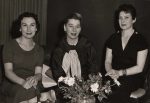
Mystery photo … Jan. 27/17

National Council of Jewish Women, 1955. (photo from JWB fonds, JMABC L.13956)

If you know someone in this photo, please help the JI fill the gaps of its predecessor’s (the Jewish Western Bulletin’s) collection at the Jewish Museum and Archives of B.C. by contacting archives@jewishmuseum.ca or 604-257-5199. To find out who has been identified in the photos, visit jewishmuseum.ca/blog.

Opinions from the streets

Corey Gil-Shuster has split his time between Canada and Israel for 28 years now. (photo from Corey Gil-Shuster)

Corey Gil-Shuster is an Ottawa-born and -raised Jew who spends a great deal of his time and energy asking people their opinions regarding the Middle East conflict – and doing so on camera. He has his own channel on YouTube, called the Ask Project.

Gil-Shuster has spent the last 28 years splitting his time between Ottawa and different places in Israel. He first went to the Jewish state in the 1990s for a study-abroad program at Tel-Aviv University.

At the time, Gil-Shuster said he was just happy to find “a good, safe place to travel and then, from there, to travel to other places. Then, when I was here in Israel, actually I didn’t like it very much. It was very different than I expected. I found it too chaotic…. It took me about six months to get used to it. Once I did, I started to fall in love with the place.”

In 1995, Gil-Shuster met his now-husband, Yaron. The couple later adopted a child.

Gil-Shuster said he has found Israelis to be fairly open to discussing homosexuality, and noted a level of acceptance or openness that he has not found in Canada. Even strangers in Israel have felt very comfortable asking him questions about being gay, and he has used the opportunity to educate them about the topic. On more than one occasion, once that initial question has been broached, people have invited him over for dinner to ascertain how they can move to Canada, make a good living and buy a big house.

“I found Israel refreshing,” said Gil-Shuster. “I kind of enjoyed that, because it put me in control as opposed to the opposite – at least the early 1990s in Canada – being gay with straight people in control of whether you’re accepted.”

As he acclimated to Israeli society, Gil-Shuster found himself getting into debates about how Israelis really feel about the situation in the Middle East.

“I thought, well, I have a video camera, so why don’t I just go out my front door and ask random people on the streets to answer some questions?” he told the Independent.

What Gil-Shuster initially found was that, while people had their opinions, they were not interested in asking questions themselves or in listening.

“All these people are either pro-Israel or pro-Palestinian, and they are sure they know everything about Israel,” he said. “But, nobody could come up with a question to either confirm their ideas or give the opposite of what they think. Finally, somebody said something about how Israelis won’t accept a one-state solution. Great, I’ll take that and ask that as a question. I asked neighbours, the guy who sells me fruit and veggies, and another grocery store guy.”

Gil-Shuster had to do on-the-spot translation of the comments from the street interviews. “I would translate as they were speaking Hebrew,” he said. “I put it together. I had seven or eight people and I put it in a film. I learned to edit, but I didn’t cut anything out, and I put it on YouTube.”

In no time at all, Gil-Shuster understood the power in simply letting people share their views – “how much power that can have to go against what mainstream media puts out, whether that’s Canadian, American, Israeli or Palestinian. Every country’s media has a certain narrative they want to say. They have a story they’re trying to sell to their people, and they have to frame the conflict within that.”

To make his videos more objective, Gil-Shuster started to venture further than his backyard in Tel Aviv. He began traveling the country asking people for their opinions. Regardless of what they said, he made a point of not cutting or editing the videos – even if racist or horrible comments were made that didn’t conform to his views.

That doesn’t mean he keeps silent, however. He allows himself the right to make sarcastic comments as he feels the need, noting, “It keeps me more interested. I try to make it very objective … I try to figure out, as much as possible, where they’re coming from. If their question is, ‘Why don’t you all just get along,’ I’ll reply quite naively insofar as what my follow-up questions are … thinking that’s kind of where they’re coming from.”

Gil-Shuster has been doing this for the past four years, with a growing following that comprises a mix of pro-Israel and pro-Palestinian fans and many others in between. He provides a variety of views and topics to keep people watching.

When he has to travel for work, doctor appointments or other reasons, he brings his camera along, stopping to speak with people along the way. Jerusalem and Haifa are a couple of his favourite places to do this, as he is more likely to encounter both Israelis and Palestinians.

In general, he has found Palestinians to be more open to talking, though some are fearful and only want to be interviewed if he will agree to conceal their face. Typically, in these situations, he works with a translator.

“When I first started out, my hope was to use these videos as a forum for creating peace in some way, to create a dialogue between Israelis and Palestinians,” he said. “For me, it’s about understanding. But, quickly, I realized that very few Israelis and Palestinians are interested in having a dialogue – at least, not in a public way.”

Some people get mad at Gil-Shuster, feeling he is doing something purposefully against one group or another. In contrast, he gets a lot of messages from people in the Middle East saying, “Thank you for showing me a different side of the conflict. I always had a feeling I was being lied to.”

“These are the emails I like the most,” he said. “You don’t have to like what somebody says, but I’m hoping they’re humanized as a group.”

When asked about how the project has changed his views, Gil-Shuster said he no longer thinks peace is possible.

“Israelis are tough-talking, but are willing to compromise to a certain degree. Palestinians are very open to other people in some ways, but, it’s very black and white for them. It’s all … the land was stolen by foreigners who shouldn’t be there, and that there’s no solution until they leave. Maybe someday they’ll get a leader who’ll be brave enough to tell them what reality is, but they don’t have those kinds of leaders. They always deal with Israel … [with the view that] for now, we can benefit from it, but it’s all ours, so we will get it back someday.”

To date, Gil-Shuster has created more than 500 videos. They can be found at youtube.com/user/coreygilshuster, and he encourages viewers to suggest questions.

Rebeca Kuropatwa is a Winnipeg freelance writer.

Beautifully produced book

It must have been a prodigious effort by editor Ezra Glinter to look through countless Yiddish Forward microfilms going back more than 100 years and come up with the superb collection of short fiction Have I Got a Story for You: More than a Century of Fiction from the Forward (W.W. Norton, 2016).

Unlike contemporary American newspapers, Yiddish papers, both here and in Europe, published fiction. Readers looked forward to the weekend editions, where they could find stories by their old favourite authors and newly emerging writers.

This new variegated collection, which begins with 1907 and ends in 2015, with contributions by 20 talented translators, including Glinter, has many of the famous names in 20th-century Yiddish belles lettres – Sholem Asch, David Bergelson, Avraham Reyzen, Israel Joshua Singer, Isaac Bashevis Singer and Chaim Grade. And, though even the lesser-known names were familiar for decades to the loyal Forward audience, they may not be so anymore, and the volume contains cogent and insightful introductions to each writer.

book cover - Have I Got a Story for You: More than a Century of Fiction from the ForwardHave I Got a Story for You is a beautifully produced book, from the stunning, colourful cover, the fine introductions by Glinter and novelist Dara Horn and, of course, the lively fiction. Even the clever title, Have I Got a Story for You, resonates with Yiddish braggadocio.

The anthology begins with a story by Rokhl Brokhes, Golde’s Lament, published in 1907, about a woman who is tormented with jealousy because her husband has sailed to America with another woman posing as his wife, and concludes with a 2015 story, Studies in Solfege, by the current Yiddish Forward editor, Boris Sandler, about which I’ll tell you later.

First, we read stories about the immigrant experience, including one by Abe Cahan himself, the guiding spirit of the Forward (known in Yiddish as the Forverts) from 1903 to 1946, and humorous sketches by B. Kovner, who wrote for the paper for nearly 70 years of his 100-year life (1874-1974).

Some of the book’s most powerful pages, whose sheer force of imaginative and vivid prose overwhelms the reader, were written in Russia under wartime circumstances. Here we see gripping stories by Asch, Bergelson and I.J. Singer. Obviously, tales with such stress and suspense make New York-based fiction about collecting rent or about a lovelorn seamstress pale by comparison.

It is also noteworthy that, whereas stories by Yiddish masters like Peretz, Sholem Aleichem and Reyzen invariably pertained to Jewish life, in this collection, Yiddishkeit is at a minimum. One story by the very secular daughter of Aleichem, Lyala Kaufman, speaks of a woman who prays daily but doesn’t particularly like her assimilated son and daughter-in-law. She closes her morning prayer with a wish that “they die a horrible death.” Another story, by Zalman Schneour, tells of a little youngster who is tempted and finally succumbs to tasting pig meat.

In their Eastern European shtetls or cities, the rhythms of Jewish life were central to Jews’ existence. In the United States, with many of the early immigrants not committed to Jewish observance, the secularly minded Yiddish writers writing for a socialist-leaning paper like the Forward did not have Yiddishkeit at the forefront of their creative imagination.

Noteworthy, too, is that not one of the writers included in Have I Got a Story for You was born in the United States. One can understand that, early in the 20th century, the Yiddish writers would be European-born, but, as the decades progressed toward the mid-20th century, one would have expected at least one American-born Yiddish writer to emerge. But none did.

Also, if you look at the years of birth of the contributing writers, only one was born in the 1920s and none was born in the 1930s or 1940s. The two writers who were born in the early 1950s were Russians. This means that most of the writers who contributed to the Forward, at least those selected for this anthology, were born prior to 1910.

In A Treasury of Yiddish Stories (1953), edited by Irving Howe and Eliezer Greenberg, Grade, born in 1910, was the youngest author. And so it is curious to see in this anthology, published in 2016 – 53 years later – that Grade is still among the youngest. There are only three younger than he, Yente Mash (1922), Mikhoel Felsenbaum (1951) and Sandler (1950). Certainly the decimation of Jewry during the Holocaust and the repressive Stalinist regime in Russia had something to do with this gap.

(I should add, if only parenthetically, that in the magazine Afn Shvel, published by the League for Yiddish, one can read American-born Yiddish writers, in their 20s and 30s, publishing fiction and non-fiction.)

Full of Yiddishkeit, however, is the masterful novella by Grade, Grandfathers and Grandchildren. Set in an old Vilna shul between the two world wars, it tells of a group of old men whose children have assimilated. Their lives perk up when little boys come into the shul in the winter to warm up, and the old men start giving them private lessons. During summer, the boys disappear but their lives take on new meaning again when two yeshivah bokhers come into the shul to look for old texts and take on the oldsters as their students.

The last two stories in the anthology are by Russian Yiddish writers. Felsenbaum, now living in Israel, depicts a married Israeli Yiddish writer who goes to a Basel book fair, where he meets and falls in love with a beautiful woman. In the book’s last tale, Sandler focuses on a teenage boy who describes taking singing lessons from a slightly older girl; she also introduces him to the Indian love guidebook, Kama Sutra.

I have resisted quoting delectable lines from this anthology till now, but can resist no longer. When the girl asks the boy if he knows what Kama Sutra is, he says the first thing that comes into his head: “Of course. It’s a type of Japanese wrestling.”

Curt Leviant is the author of two recent novels, King of Yiddish and Kafka’s Son.

New discoveries at Sobibor

The remains of the Sobibór extermination camp. (photo from Israel Antiquities Authority via Ashernet)

In a recent discovery made at the site of former Nazi extermination camp Sobibór – where more than 250,000 Jews were killed – remains were uncovered in what is believed to be the location where victims undressed and their heads were shaved before being sent into the gas chambers. The findings were discovered by Polish archeologist Wojciech Mazurek and Israel Antiquities Authority archeologist Yoram Haimi with their Dutch associate, archeologist Ivar Schute.

The archeological excavations, underway since 2007, are underwritten by the steering committee for the international project to establish a new museum and memorial site in the former German Nazi extermination camp, in coordination with Yad Vashem’s International Institute for Holocaust Research. The extermination camp was located near the village and railway station of Sobibór, in the eastern part of the Lublin district in Poland.

photo - A pendant with the Hebrew words “mazal tov” and the date July 3, 1929, and its opposite side (below)
A pendant with the Hebrew words “mazal tov” and the date July 3, 1929. (photo from IAA via Ashernet)

The remains of the building unearthed by the archeologists are located on the “Pathway to Heaven,” the path along which Jewish victims were forced to tread to the gas chambers. The personal items found in the foundations of the building probably fell through the floorboards and remained buried in the ground until they were discovered this past fall.

Among the personal items found in the area were a Star of David necklace, a woman’s watch and a metal charm covered in glass with an etching of the image of Moses holding the Ten Commandments; on the reverse side of the charm is the inscription of the essential Jewish prayer, Shema. Also found was a unique pendant, probably belonging to a child from Frankfurt who was born on July 3, 1929, which bears the words “mazal tov” written in Hebrew on one side and, on the other side, the Hebrew letter hey (God’s name), as well three Stars of David.

photo - The opposite side of the pendant, with the Hebrew letter hey (God's name), as well three Stars of David
The opposite side of the pendant, with the Hebrew letter hey (God’s name), as well three Stars of David. (photo from IAA via Ashernet)

Leading experts at Yad Vashem, the World Holocaust Remembrance Centre, together with Haimi, revealed in an announcement on Jan. 15 that the pendant discovered in Sobibór bears close resemblance to one owned by Anne Frank, who was murdered in the Holocaust and is well known for the diary she wrote while in hiding in Amsterdam. Through the use of Yad Vashem’s online pan-European deportation database, Transports to Extinction, they were able to ascertain that the pendant might have belonged to a girl by the name of Karoline Cohn. Dr. Joel Zissenwein, director of the Deportations Database Project, found that Cohn, born on July 3, 1929, was deported from Frankfurt to Minsk on Nov. 11, 1941. While it is not known if Cohn survived the harsh conditions in the Minsk ghetto, her pendant reached Sobibór sometime between November 1941 and September 1943, when the ghetto was liquidated and the 2,000 Jewish prisoners interned there were deported to the death camp. There, along the path to the gas chambers of Sobibór, the pendant belonging to 14-year-old Cohn was taken, dropped and remained buried in the ground for more than 70 years.

photo - A metal locket covered by glass with the image of Moses holding the Ten Commandments painted on it. (photos from IAA via Ashernet)
A metal locket covered by glass with the image of Moses holding the Ten Commandments painted on it. (photo from IAA via Ashernet)

Additional research reveals that, aside from similarities between the pendants, both Frank and Cohn were born in Frankfurt, suggesting a possible familial connection between them. Researchers are currently trying to locate relatives of the two families to further explore this avenue.

Over the past decade, the archeological excavations at Sobibór under the guidance of Yad Vashem have made several important discoveries, including the foundations of the gas chambers, the original train platform and a large number of personal artifacts belonging to victims. Among the unique items are metal discs attached to charm bracelets typically worn by children. Engraved on the discs was contact information in case the child went missing.

The most recent excavations have uncovered the remains of the building where victims undressed and their heads were shaved, as well as other areas bearing signs of the use of mechanical equipment to dismantle the camp. In one specific location are imprints left in the ground where trees were planted in order to conceal evidence of the camp.

photo - The locket’s opposite side has the Shema printed on it
The locket’s opposite side has the Shema printed on it. (photo from IAA via Ashernet)

Prof. Havi Dreifuss, head of the Centre for Research on the Holocaust in Poland at Yad Vashem’s International Institute for Holocaust Research, said, “These recent findings from the excavations at Sobibór constitute an important contribution to the documentation and commemoration of the Holocaust, and help us to better understand what happened at Sobibór, both in terms of the camp’s function and also from the point of view of the victims.”

photo - The face of a woman's watch
The face of a woman’s watch. (photo from IAA via Ashernet)

According to Haimi, “The significance of the research and findings at Sobibór grows with every passing season of excavation. Every time we dig,” he said, “we reveal another part of the camp, find more personal items and expand our knowledge about the camp. In spite of attempts by the Nazis and their collaborators to erase traces of their crimes, as well as the effects of forestation and time, we enhance our understanding of the history previously known to us only through survivor testimonies. In this way, we ensure that the memory of the people killed there will never be forgotten.

“This pendant,” he continued, “demonstrates once again the importance of archeological research of former Nazi death camp sites. The moving story of Karoline Cohn is symbolic of the shared fate of the Jews murdered in the camp. It is important to tell the story, so that we never forget. I wish to thank my Polish partner Wojciech Mazurek and the researchers at Yad Vashem for their dedication to the project, as well as Tel Aviv University for supporting the project, and the Polish-German Foundation who made the excavations possible.”

Relatives of Karoline Cohn, or any member of the public who can assist with details regarding her family or Sophie Kollmann, who filled out Pages of Testimony in April 1978 for Richard Else Cohn and Karoline Cohn, are requested to contact Haimi via email yoramhi@israntique.org.il.


Trying to prevent child abuse

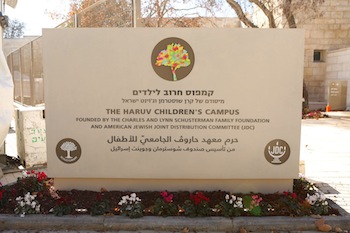
The Haruv Children’s Campus at Hebrew University of Jerusalem at Mount Scopus is the first-ever global centre combining research and treatment of child abuse. (photo by Dror Sithakol from facebook.com/schustermanfamilyfoundation)

The first-ever global centre combining research and treatment of child abuse opened Jan. 9 at Hebrew University of Jerusalem at Mount Scopus. The Haruv Children’s Campus brings together for the first time, in one location, a comprehensive array of services for abused and neglected children, including emergency treatment, therapeutic facilities and child advocacy assistance.

Haruv campus houses seven organizations working on all aspects of identifying, diagnosing and treating children, allowing for increased cooperation and coordination. It is also home to a world-class research centre and training services for a wide range of professionals.

This multi-disciplinary campus provides a holistic, child-centred approach to treating, studying and addressing the global issue of child abuse and creates new opportunities for collaboration between institutes and organizations in Israel and around the world. Partnering with the new campus are Hebrew University and the Hadassah Medical Centre.

“Child abuse and neglect occurs in all sectors of society and has a destructive impact on growth and development,” said Prof. Asher Ben-Arieh, director of the Haruv Institute. “We are striving to create the first-ever comprehensive research and treatment centre for maltreated children, based on the widely admired university hospital model. The campus will attract top researchers, professionals and students from Israel and abroad, creating opportunities to affect real change for at-risk children.”

According to the World Health Organization, every fourth child worldwide is a victim of child abuse. Within Israel, about 400,000 youth are considered at-risk for child abuse. In 2015, there were an estimated 44,000 new cases of child abuse reported, with every third Israeli child suffering some form of neglect, 11% involving sexual abuse and 20% involving children with special needs. The problem is so acute that child services workers routinely deal with unmanageable levels of caseloads.

photo - Haruv campus at Hebrew U is based on university research model
Haruv campus at Hebrew U is based on university research model. (photo by Dror Sithakol from facebook.com/schustermanfamilyfoundation)

The Mount Scopus campus was chosen for its strategic location and general accessibility. The site also offers proximity to the ultra-Orthodox and Arab communities, which predominate in nearby residential areas, and the centre will bring a culturally sensitive approach to its work with these populations.

Leading the initiative is the Haruv Institute, with the support of the Charles and Lynn Schusterman Family Foundation, Joint Distribution Committee-Israel, the Ministry of Welfare and Social Affairs, the National Insurance Institute and the Jerusalem Municipality Welfare Services.

The campus will house several organizations devoted to dealing with child abuse, including the Schusterman Emergency Centre, the Beit Lynn Child Protection Centre, the Israel National Council for the Child, the Centre for Treatment of Sexually Abused Children, the Israel Medical Stimulation Centre, the Municipal Child Welfare Centre and the Goshen Program for Comprehensive Child Health.

“Ever since its founding in 2007, Haruv has served as a beacon of hope and a source of strength for victims of child abuse and their families. It has been a forceful advocate for those least able to defend themselves, and it has trained thousands of professionals responsible for preventing and treating abuse and neglect,” said Lynn Schusterman, founder and co-chair of the Schusterman Family Foundation. “The opening of the Haruv Children’s Campus ushers in the next phase of this critically important mission and is a striking example of how Haruv has grown to become an international centre of excellence in its field. We are proud to have partnered with others to make the new centre a reality and look forward to continuing to help Haruv establish itself as the preeminent organization in the prevention and treatment of child abuse and neglect.”

The planning and design of the campus reflects its emphasis on addressing the needs of children and families. Throughout the campus, calming elements have been introduced, such as water, pastoral greenery and play areas created from natural materials. The interior spaces have colourful playrooms, work areas that provide privacy, and a school and kindergarten for children at the emergency centre.

“The opening of the Haruv Campus for Children in Jerusalem is not just a major step in the treatment and prevention of child abuse and neglect in Israel and beyond. It champions a holistic approach ensuring critical players in this field can learn from and inform each other’s success, something we understand full well from our own work in Israel,” said David Schizer, chief executive officer the American Jewish Joint Distribution Committee. “We’re proud of our partnership with the Haruv Institute and the Schusterman Family Foundation to once again foster innovation of new program models to support Israel’s most vulnerable and of the larger effort to provide a safer and brighter future for children and families who will benefit from the one-of-a kind Haruv campus.”

How trees adapt to conditions

The Weizmann Tree Lab, left to right: Dr. Tamir Klein, Ido Rog, Yael Wagner, Omri Lapidot and Shacham Magidish. (screenshot from wis-wander.weizmann.ac.il)

While studying trees during his postdoctoral fellowship, Dr. Tamir Klein made such a startling discovery that his research supervisor at the University of Basel at first declared that it must have been a mistake. In the forest, trees are known to compete for resources such as light and nutrients, but Klein found that the same trees also engage in sharing: he showed that carbon molecules taken up by the canopies of mature spruce trees were passed through the soil in large quantities to neighbouring beech, larch and pine. As he reported in Science in 2016, the carbon was being transferred via “underground highways” formed by overlapping networks of root fungi.

“Neighbouring trees interact with one another in complex ways,” said Klein. “Of course, there is a great deal of competition among them, but they also form communities, sorts of ‘guilds,’ within which individual trees share valuable resources. In fact, trees belonging to a ‘guild’ usually do much better than those that don’t.”

In his new lab in the Weizmann Institute’s plant and environmental sciences department, Klein follows up on these findings to investigate tree ecophysiology: how the tree functions in its ecosystem.

“Studies on ‘underground’ tree collaboration may reveal which tree species get along well, and this may help determine which trees should be planted next to one another,” he said. “Our studies have additional relevance to forestry and agriculture because we elaborate on the mechanisms of growth and drought resistance of different tree species.”

Only five percent of Israel’s land is covered by forest, but the country nonetheless offers unique advantages for forest research: its hot, dry climate provides an opportunity for investigating how trees adapt to drought and stress. Many trees common to Israel are already resistant to drought; understanding the mechanisms that allow them to live with little rain may help develop varieties of lemons, almonds, olives and other tree crops that can grow in even drier areas.

image - A micro-computer tomography scan of a Jerusalem pine branch, performed after a dry spell, reveals large amounts of air (blue) filling the water channels
A micro-computer tomography scan of a Jerusalem pine branch, performed after a dry spell, reveals large amounts of air (blue) filling the water channels. (image from wis-wander.weizmann.ac.il)

Projects in Klein’s lab aim to clarify how trees manage their water and carbon budgets – both separately and as a forest community. In one study, the team focuses on emboli: tiny air bubbles that form inside the tree’s water channels during drought. When drought persists, the emboli can kill a tree, much like blood vessel clots that can cause a fatal heart attack in a human being. After injecting fluids into tree branches at different pressures, Klein and his students analyze the emboli in the minutest detail, using micro-computed tomography.

In Weizmann’s greenhouses, Klein’s team members experiment with seedlings of pine, cypress, carob and other trees commonly found in Israel. The researchers make use of advanced technologies, including nuclear magnetic resonance imaging, to study hydraulic conductivity in trees and a special lamp-equipped belowground camera to study the growth of tree roots in the soil.

When conducting field studies on their research plot near Beit Shemesh, Klein and his students hug trees – not to have a spiritual experience, but to follow a tree’s growth by encircling the trunk with a measuring tape. In parallel, they apply laser isotope analysis and analytical chemistry techniques to trace carbon metabolism in individual trees, and they investigate carbon transfer among trees via different types of fungal “highways.” The scientists also employ thermal imaging, which enables remote temperature measurements, to study the rate of evaporation in the foliage.

These studies will help predict how future climate changes, including global warming and the rise in greenhouse gases, may affect forests. In one set of experiments, for example, Klein will double the concentration of CO2 to mimic the atmospheric conditions that may emerge on earth as a result of pollution. Klein hasn’t owned a car in 10 years, so as not to contribute to CO2 emissions, but he warns against jumping to conclusions when it comes to the impact of increased CO2 on tree biology. “Higher CO2 concentrations don’t help trees grow faster – contrary to the hopes of industrialists – but, surprisingly, recent research suggests they might render the trees more resistant to drought-induced stress. This doesn’t mean it’s OK to carry on with CO2 pollution, but it does mean that we need to deepen our understanding of its effects on trees in general and on agricultural tree crops in particular.”

Klein is the incumbent of the Edith and Nathan Goldenberg Career Development Chair. His research is supported by Nella and Leon Y. Benoziyo; and Norman Reiser. More on Weizmann Institute research can be found at wis-wander.weizmann.ac.il.

Is America part of a divine plan?

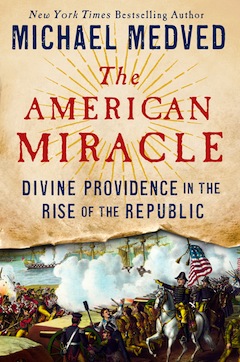
In The American Miracle, Michael Medved argues that the success of the United States is not based on random “happy accidents.”

Early America’s historical events could be seen as a set of dominoes falling conveniently into place, creating a thriving free and democratic nation, but Michael Medved believes there’s a divine hand that helped.

The Jewish nationally syndicated radio show host has just published his 13th book, The American Miracle: Divine Providence in the Rise of the Republic (Crown Forum, 2016), describing a dozen incidents from the 1580s to the American Civil War, in which a moment of crisis was successfully resolved, against great odds, and seemingly by chance.

photo - Michael Medved
Michael Medved (photo from twitter.com/medvedshow)

“I think this is the first time someone has approached it from this angle,” he told the Independent. “The best explanation for the emergence of the United States as the dominant economic, military, even cultural power in the world … is not a pattern of happy accidents, because a pattern of happy accidents is still a pattern. The evidence, it seems to me, suggests very strongly that America is a product of intelligent design.”

One of Medved’s examples is that of Abraham Lincoln surviving six assassination attempts, with the seventh and final one coming only after he freed the slaves. Another such occurrence, according to Medved, involves Confederate General Robert E. Lee’s battle plans, which were etched on a cigar wrapper cover, discarded unknowingly by one of his infantry and later found by a Unionist soldier, radically turning the tide of the war and saving the union.

Additionally, writes Medved, Napoleon Bonaparte was to take command and possession of Louisiana to protect it against the British, but the harbour uncharacteristically froze over on that April day. It was part of a series of events that led the French conqueror to cede land four times the size of France to the Americans – later called the Louisiana Purchase – for the paltry sum of a penny an acre.

“With the United States – and with the modern state of Israel – there are clear moments of creation reflecting acts of will and providential acts of will,” he said. “It’s not based on tribe or blood or place of birth. It’s based on conscious decisions by generations of people to be part of this endeavour, and that makes the United States and Israel completely distinct from every other country on earth. It’s a much stronger argument for design rather than evolution.”

Medved’s other books have covered American themes as well, including The Ten Big Lies About America; The Shadow Presidents, a history of White House chiefs of staff; and Right Turns, an autobiography covering his path to becoming a conservative.

book cover - The American Miracle: Divine Providence in the Rise of the RepublicPart of the reason why he penned this recent book was not only to show that America’s founding had, as he sees it, a little help from above and has changed the world for the better, but “because we have lost that sense America is miraculous and astonishing,” he said.
“If you don’t look at America as providing grounds for gratitude, then you will look at America as providing grounds for guilt, and that is what our education system emphasizes now: we slaughtered native Americans, we exploited African slaves, we oppressed workers and we enslaved women.

“We’ve taken the heroism out of it, taken the nobility out of it,” he said. “We’ve taken the purpose out of it – and America is about nothing if it’s not about a sense of purpose.”

As to why America has been so particularly blessed, Medved posits a theory: the Founding Fathers were philosemites.

“John Adams, Alexander Hamilton, George Washington, believed that one of the reasons for America’s distinctive blessings can be found in Genesis, Chapter 12, verse 3,” he said, explaining the section where God says He will bless those who bless Jews, and curse those who curse Jews.

In fact, he added, Thomas Jefferson and Benjamin Franklin worked together to create what they hoped would be the great seal of the United States, featuring an image of Moses leading the people across the Red Sea.

“The founders themselves,” he said, “insisted that they were the instruments, rather than the authors, of the design.”

Dave Gordon is a Toronto-based freelance writer whose work has appeared in more than 100 publications around the world.

הרפר יוצא נגד טראמפ

מצעד הנשים בוונקובר ,21 בינואר השנה. (צילום: Roni Rachmani)

ראש ממשלת קנדה לשעבר, סטיבן הרפר, יוצא במתקפה נגד הנשיא החדש של ארה”ב, דונלד טראמפ. עם זאת הרפר לא מגיב כלל ליחסים ההדוקים בין טראמפ ושר החוץ שלו, לבין רוסיה ומנהיגה ולדימיר פוטין. הרפר וממשלתו החרימו את רוסיה בעיקר בגלל פעילותיה באוקריאנה, והובילו את המאבק הנחרץ ביותר בקרב מחנה מדינות המערב נגד פוטין.

מעניין כיצד ראש ממשלת ישראל, בנימין נתניהו, היה מתייחס לדברי הרפר כנגד טראמפ. כזכור הרפר ונתניהו ניהלו מערכת יחסים הדוקה ביותר וראש ממשלת קנדה לשעבר נחשב לידיד הקרוב ביותר של ישראל. עתה נתניהו מרגיש שיש לו הרבה במשותף עם טראמפ שלא מפסיק להבטיח שיתמוך באופן משמעותי בישראל, ואף יעביר את שגרירות ארה”ב מתל אביב לירושלים.

הרפר דיבר ביום חמישי שעבר בניו דלהי וזו בעצם הפעם הראשונה שהוא מדבר ישירות על נושאים פוליטיים בינלאומיים, מאז הובס בבחירות הפדרליות בנובמבר 2015 על ידי הליברלים בראשות ג’סטין טרודו. נאומו החשוב (בן החצי שעה) של הרפר התקיים בפני הפורום של קרן המחקר אובזרוור, שדן בעתיד העולם בעידן טראמפ. הרפר התייחס בנאומו לסידרה של זעזועים פוליטיים המתרחשים בעולם כיום, בהם החלטת בריטניה לעזוב את אירופה ובחירתו של טראמפ לנשיאות בארה”ב.

הרפר קורא למדיניות החוץ של טראמפ חוסר ודאות גלובלית. לדבריו שלטונו הבדלני של טראמפ הוא המקור עיקרי לאי הוודאות הבינלאומית. מדיניותו החדשה של טראמפ היא ציון דרך של שינוי מדיניות החוץ של ארה”ב, לעומת שבעים השנים האחרונות. לדברי הרפר אין לנו מושג ברור מה מתכוון הנשיא החדש של ארה”ב לעשות, אך יש לנו מספר קווי מתאר רחבים, והמשמעותי שבהם כאמור הוא לחזור אחורה ולהפוך את אבני היסוד של מדיניות החוץ האמריקנית, שמתקיימת מאז מלחמת העולם השנייה.

הרפר אומר כי טראמפ מתכוון להפחית משמעותית את מעורבות ארה”ב בעניינים בינלאומיים עולמיים, והוא יהיה מונחה על ידי אינטרסים כלכליים צרים. והראשונה שעל הפרק היא סין, שנחשבת על ידיו בוחריו ליריב גיאופוליטי ולכן יש לנקוט במדיניות קשה נגדה. ראש ממשלת קנדה לשעבר חושב שהנשיא החדש של ארה”ב יעבוד עם דידים ובני ברית של ארה”ב, אך עתה הם יאלצו להביא נכסים אמיתיים לשולחן הדיונים עם השלטון האמריקני. הוא לא הזכיר את קנדה במפורש אך התכוון גם אליה. הרפר ציין עוד כי השינוי במדיניות עם מדיניות ידידותיות יבוא לביטוי בראש ובראשונה עם מדינות אירופה.

הרפר טען עוד כי טראמפ הוא נשיא חסר תקדים בהיסטוריה של ארה”ב, והוא דוחה את הרעיון שאמריקה לבד צריכה לקבל את האחריות על נושאים עולמיים. רבים ממנהיגים העולם לא יאהבו את השינוי במדיניות החוץ של ארה”ב, שתתבסס מעתה על אינטרסים לאומיים חיוניים של ארה”ב, המוגדרים באופן צר ובעיקר מתייחסים לאינטרסים הכלכליים. המדיניות הבינלאומית החדשה הזו של ארה”ב תיצור סיכונים משמעותיים לעולם.

הרפר מאמין שהשינוי המשמעותי הנוסף במדיניות הבינלאומית של ארה”ב תחת שלטונו של טראמפ, מתייחס כאמור לגבי סין. בעידנו ארה”ב תפסיק להתייחס לגידול של סין כדבר שפיר וחיובי, אלא שיש להפסיק ולממן את היריב הגיאופוליטי. זה הולך להדאיג מאוד בעיקר נוכח המאזן השלילי המאסיבי ביחסי הסחר בין שתי מדינות אלה. היחס של טראמפ לסין מתאים להשקפה בדעת הקהל האמריקנית שתמיד הייתה סקפטית בנוגע לגבי מדיניות החוץ של ארה”ב כלפי סין, והאם היא באמת יותר הזדמנות מאשר איום.