Jewish Family Service Agency chief executive officer Richard Fruchter with Ellen Bick, recognizing the work of JFSA staff at the agency’s Nov. 30 annual general meeting. (photo from JFSA)
Richard Fruchter is the new chief executive officer of the Jewish Family Service Agency (JFSA). He barely had time to settle into the agency’s former location before its move to East Broadway, adjacent to Vancouver Aboriginal Child and Family Services Society. As Fruchter cheerfully leads an office tour, he has clearly settled into his role, proud of the new space, the agency’s staff and their work.
Fruchter is excited to expand the agency’s activities and profile in the Jewish community and beyond, as well as to take it in some new directions required by changing times.
“It’s inevitable now because of the generational shift that there is going to be more need for home support,” said Fruchter, citing one example. “That particular area of service is growing by more than 10% a year. We now have more than 80 home support workers. They go out into all neighbourhoods in the community. We also work with the Better at Home program with United Way, working in the broader community. That’s another potential growth area for us that we have to prepare for.”
Fruchter said JFSA’s activities in the Jewish community are more urgently needed with each passing month.
“What we’re seeing is that there is a tremendous need for food and housing,” he explained. “These are two areas where there is an affordability crisis for our community just like the rest of the community; we’re seeing astounding growth in those two areas on a month-to-month basis. When it comes to food security, we’re seeing growth all across the board – certainly with seniors, but we’re also seeing more families, it used to be mostly individuals. We see people coming to the [Jewish] Food Bank twice a month instead of once. The demand for food vouchers has grown by over 20% this year.”
He added, “If housing is getting more and more expensive for people, they begin making choices between rent and food or medicine, and we don’t want people making those kinds of choices. Those needs tend to tumble into each other, and people end up needing more and more services.
“The advantage that we have as an agency is that we have this remarkable basket of services, so that if someone is food insecure, sometimes they’re also housing insecure. If they are a new immigrant, they may need employment opportunities, they may need a hand-up for a couple of months in transitional housing.”
Another mounting issue, said Fruchter, is the growing needs of aging Holocaust survivors. “We are seeing that many survivors are beginning to need support, or more support,” he said.
“People are not cognizant enough of the presence of poverty in the Jewish community,” he continued. “We plan to partner with CIJA [Centre for Israel and Jewish Affairs] to do unprecedented advocacy both within the Jewish community and with the government – federal, municipal and provincial – to show what an important cog we are in helping people to be more resilient and able to deal with the crises in their lives. I am looking forward to working more closely with our partner agencies and our synagogues to make sure no one slips through the cracks.”
As for the role JFSA plays in the broader Vancouver community, Fruchter explained, “Most of the services we do are in the Jewish community, but if you go back to our values, when our sages said, ‘welcome the stranger,’ they didn’t mean the Jewish stranger. They meant, ‘welcome the stranger’! If we find that people are in need, we’re going to go out there and help them. The main areas are employment, settlement and the Better at Home program, which is for lower-income seniors who need a little help to stay in their homes. The United Way came to us and said we love what you’re doing, we wonder if you could replicate that in the broader community.”
Fruchter came to service work in the Jewish community after a background in journalism, communications and social services. His work with the Jewish Federation of Greater Seattle was pivotal. “I just grew into that job and loved what I did, and my Jewish identity blossomed from the work I was doing,” he said.
Fruchter worked for federations in Arizona and Minneapolis before heading to Seattle. He first came to Vancouver as a senior management consultant two years ago for the Jewish Federation of Greater Vancouver, after being president and CEO of the Seattle Federation for six-and-a-half years. “I got a call from Mark Gurvis, an old pal in the Jewish communal services field, saying he was moving to New York and had a proposition for me. I got the interim job, then went home. Later, I got a call from JFSA wanting consulting, and that progressed to a job offer. I was inspired by what I was seeing and the potential of the organization, so I accepted.”
Fruchter’s wife and three sons still live in Seattle, while he commutes to Vancouver every Monday.
“I love the community here,” he said. “It is very strong, very intergenerational, very committed. The agencies work well together, the rabbis work well together, which is not the case everywhere.”
Matthew Gindinis a freelance journalist, writer and lecturer. He writes regularly for the Forward and All That Is Interesting, and has been published in Religion Dispatches, Situate Magazine, Tikkun and elsewhere. He can be found on Medium and Twitter.
Prof. Cary Nelson, an opponent of the academic boycott of Israel, teaches at the University of Illinois at Urbana-Champaign. (photo from cjnews.com)
Opponents of an academic boycott of Israel scored back-to-back victories at a conference of the Modern Language Association (MLA) earlier this month, defeating a pro-boycott resolution while gaining sufficient votes to pass a resolution that calls on the organization to specifically refrain from endorsing a boycott.
The second of the resolutions at the Jan. 5-8 event, which passed by a 101-93 margin, stated that the Palestinian campaign for an academic and cultural boycott of Israel “contradicts the MLA’s purpose to promote teaching and research” and would curtail debates with Israeli academics, “thereby blocking possible dialogue and scholarly exchange.”
The first, pro-boycott resolution, which accused Israeli universities of perpetuating violations of international law while denying academic freedom and educational rights to Palestinians, was defeated by a vote of 113 to 79.
A third resolution, which refers to attacks on Palestinian scholars and students by Palestinian political organizations, was shelved after the first two successful votes, according to Prof. Cary Nelson, an opponent of the academic boycott of Israel.
“We got everything we asked for,” said Nelson, who teaches modern poetry and literary theory at the University of Illinois at Urbana-Champaign. “We weren’t so confident going in.”
According to the U.S. Campaign for the Academic and Cultural Boycott of Israel, about a dozen academic organizations have endorsed the boycott, divestment and sanctions (BDS) movement, including the African Literature Association, the American Studies Association, the Association for Humanist Sociology, the National Association of Chicana and Chicano Studies Annual Conference, and the Native American and Indigenous Studies Association.
The MLA was founded in 1883 to strengthen the study and teaching of languages and literatures.
Nelson, author of The Case Against Academic Boycotts of Israel, said he has been fighting boycott-related resolutions at the MLA for 10 years, and he expects similar motions attacking Israel will continue at the next delegate assembly in 2018.
Boycott advocacy at the MLA has been trending up among younger faculty members in the last three years, Nelson said, but opponents also have been recruiting support from younger academics. Most MLA members are agnostic about the issue and would rather the organization stick to matters that concern them, he added.
Nelson said opponents of the boycott resolution worked hard on the floor at the convention in Philadelphia to convince delegates to oppose a boycott. “We tried to convince members it’s none of the MLA’s business. It doesn’t need a foreign policy,” he said.
Opponents circulated a 10,000-word report on the issue, outlining the case against boycott and noting factual misrepresentations in the case being presented by its proponents.
Rebecca Comay, a professor of philosophy and comparative literature at the University of Toronto, was one of two co-sponsors of the pro-boycott resolution at the MLA conference.
“After five decades of a brutal military occupation, with the situation only deteriorating, it is time for the international community to act,” she said, explaining why she pushed the boycott resolution. “Given that there is no prospect of significant change happening from within (and as the Israeli leadership moves ever rightward), BDS is the most effective means – at this point the only means – of intervening on behalf of Palestinian human rights.
“Boycott is a non-violent, legal tactic that has historically proved effective in seemingly intractable situations. South Africa is a pertinent example,” she told the CJN via email. Comay said Palestinians have been “dispossessed, disenfranchised and stripped of the fundamental human rights that we take for granted. These rights include a basic right to education and academic freedom.”
Asked why Israel should be singled out, Comay responded, “Israel is susceptible to boycott in a way that other countries (Saudi Arabia, Syria, Russia, etc.) simply are not. As the so-called ‘only democracy in the Middle East,’ Israel is actually susceptible to global public opinion, as the panicked reaction to the BDS movement clearly demonstrates. Israel has in any case already been ‘singled out’: it receives an unprecedented amount of U.S. military and economic aid (to the tune of $38 billion over the next 10 years) – [former president Barack] Obama’s parting gift to Israel – that’s more than to all the countries of sub-Saharan Africa, Latin America and the Caribbean combined.”
Nelson said the BDS movement is growing within the humanities and social sciences, but less so in the hard sciences. However, much of the propaganda it advances is inaccurate, he said, noting that Israel has doubled the number of Palestinian and Arab students in Israeli universities in just the last 10 years. The student body at some schools, like the Technion and the University of Haifa, where he’s an affiliated professor, is more than 25% Arab, he said.
Yael Halevi-Wise, an associate professor in the English department at McGill University, said a small but influential group of leftist academics – “the radical caucus” – has been pushing the boycott proposal for several years.
“If you look at the BDS strategy, it’s a form of bullying. Omar Barghouti takes credit for the BDS and he says he would like to help Israel euthanize itself,” she said.
Halevi-Wise said the boycott effort “is an attempt to isolate and demonize our fellow colleagues in Israel.” Most of those colleagues, she said, are pro-peace and support a two-state solution, and some of the professors who would be affected are Arabs, she said.
“We had to work very hard to get through, because Israel is being maligned so frequently,” she added.
The resolution urging the MLA to refrain from boycotts now goes to the group’s executive council, which will determine if there are legal or constitutional issues posed by its language. From there, it will be forwarded to the organization’s membership for ratification.
Over the weekend, representatives of 70 countries and international organizations gathered in Paris to discuss peace between Israel and the Palestinians. Absent were Israelis and Palestinians.
A final statement adopted by participants innocuously promised “to support both sides in advancing the two-state solution through negotiations.” It also called on Israelis and Palestinians “to refrain from unilateral steps that prejudge the outcome of negotiations on final-status issues, including, inter alia, on Jerusalem, borders, security, refugees, and which they will not recognize.”
The gabfest wound up with no firm plans for future action and with no tangible results save a statement of well wishes for peace and coexistence.
The official absence of the very people whose future the conference was convened to discuss carries echoes of the past. In an earlier age, European powers gathered to redraw the maps of the Middle East, among other places. More recently, in 1938, world powers gathered in Evian to decide what to do about the Jews of Europe (conclusion: nothing).
The French government, which hosted last weekend’s conference, aimed to nudge along the process toward a two-state solution.
“The two-state solution, which the international community has agreed on for many years, appears threatened,” French President François Hollande said. “It is physically threatened on the ground by the acceleration of settlements, it is politically threatened by the progressive weakening of the peace camp, it is morally threatened by the distrust that has accumulated between the parties, and that has certainly been exploited by extremists.”
The futility of the conference – and the incomplete understanding of the issues by the parties involved in it – may have been summed up in Hollande’s litany of what he sees as the barrier to two states.
Certainly settlements are not helpful to advancing an ultimate resolution and are a kind of provocation. But settlements are not irreversible. There can be negotiated land swaps or Israel can hand over settlements to Palestinians, as they did in Gaza. They are an obstacle to peace, but they are not the most grievous.
Likewise, to cite the “progressive weakening of the peace camp” without acknowledging why Israelis who have believed in peace are abandoning hope dismisses Israelis’ legitimate reasons for losing faith in a negotiated peace. Certainly there has been a recent emboldening of extremists on both sides, as compromise has seemed to float further from reach. Yet the “peace camp” Hollande referenced is an Israeli entity. Weakened though it may be, it is eminently stronger than any equivalent on the Palestinian side, where signs of compromise with the Zionist entity invite accusations of collaboration. Ordinary Palestinians who want to live in peace, too, are left feeling little hope, with their governments and extremist clergy inciting the elimination of Israel on one side and a right-wing Israeli government that has done little towards reconciliation on the other.
A solution, or set of solutions, to the Israeli-Palestinian conflict is complex and, at this point, hard to imagine. But, inasmuch as there is hope for one, it must come from Israelis and Palestinians. International diplomats and do-gooders can hold all the confabs they want, but all such gatherings are a pointless waste of time.
The subject of surrogacy has been examined by Jewish scholars, mainly rabbis, for thousands of years. The Jewish belief system of ethical values incorporates two independent and seemingly disparate thoughts. The first is the obligation to be fruitful and multiply and to fill the earth, and the second is the obligation to free the captives, to actively engage in the redemption of those who are enslaved. In modern context, to free the captives is the fight to end human trafficking, and surrogacy has been identified as a form of human trafficking. An examination of how these two elements of Jewish core beliefs, once given ethical attributes, interface can hopefully open discussion in the Jewish community.
Genesis 1:28 commands us be fertile and increase. Jewish tradition considers it to be the first of the 613 commandments of the Torah. Again, after the flood, Noah is enjoined, in Genesis 9:1, to be fruitful and multiply. In this context, it stands for regeneration of life after death-dealing disasters.
In biblical times, infertility or barrenness in women spoke to, among other things, the values and concerns of an agrarian society requiring manpower to work the land and tend to the flocks. The need to people the land and have heirs to inherit property was of great importance. Adoption and polygamy were acceptable practices. The Jewish matriarchs, Sarah, Rebekah and Rachel, all were infertile prior to God’s intercession. The significance of having a child was so valued that the Divine presence saw to the continuation of the lineage. Handmaids bore children, fathered by the patriarchs, when their wives suffered from infertility. The surrogates for the biblical matriarchs bore the children; however, as the Bible stories tell us, relational conflicts ensued.
Jewish tradition finds connection from one mitzvah to another, from one transgression to the next. How does this fit with the subject of surrogacy and how it is perceived today? Surrogacy can certainly be a dimension of human trafficking, a form of modern-day slavery where people profit from the control and exploitation of others. As defined by Canadian federal laws, victims of human trafficking include children involved in the sex trade, adults aged 18 or over who are coerced or deceived into commercial sex acts, and anyone forced into different forms of “labour or services,” such as domestic workers held in a home or farm workers forced to labour against their will. In many countries, the practice of commercial surrogacy can be indistinguishable from the buying and selling of children, and meets the criteria of human trafficking.
Altruistic or compassionate surrogacy is legal in Canada, but it is definitely illegal to pay a surrogate mother for her services. The Assisted Human Reproduction Act prohibits the provision or acceptance of financial consideration to a woman for acting as a surrogate. However, it is legal to reimburse a surrogate mother for her reasonable expenses incurred as a result of surrogacy. In the province of Quebec, the Quebec Civil Code has not allowed for surrogacy agreements. Recent case law has changed the rights for couples to engage in surrogacy agreements, paving the way for legislative change in the future.
Jewish law has been forced to evolve as reproductive technologies have impacted family, parent(s) and child(ren). Rabbinical authorities have had to apply halachic analysis and interpretation to modern technologies including reproductive technology. Since the 1970s, there has been discussion, starting with the subject of artificial insemination. Sperm donation, ovum donation and surrogacy are the three ways for an infertile couple to become parents. Legal contractual obligations are undertaken.
Opposition to surrogacy was raised by Rabbi Immanuel Jacovits, chief rabbi of the United Hebrew Congregations of the Commonwealth from 1976 to 1991. In his 1975 publication Jewish Medical Ethics, he argued that to use another person as an incubator and then take from her the child that she carried and delivered for a fee is a revolting degradation of maternity and an affront to human dignity. It is not the technology that concerned him; rather, the social and ethical implications of the act of medical reproductive intervention.
In 1977, Rabbi Elie Kaplan Spitz acknowledged that ethical problems can arise with surrogacy when the offspring has no relationship with its birth mother. The status and rights of a surrogate vary among geographical localities based on the laws of the land which, increasingly, form the basis of rabbinical discourse.
The Committee on Jewish Laws and Standards of the Rabbinical Assembly provides guidance to the Conservative Jewish movement in matters of halachah. In 1984, Rabbi David Lincoln’s guidance was accepted, citing surrogacy as a “mitzvah-blessing so great that we should not deny couples of this opportunity.” By 1988, the committee concluded that the mitzvah of parenthood is so great that ovum surrogacy was permissible.
Rabbi Prof. Aaron Mackler offered his opinion that surrogacy could not be recommended, as he believed that maternal status is determined by gestation and birth, and that the danger of commodification of the child is real and present. His thoughts are echoed by Rabbi Prof. David Golinkin who, in a response published by the Schechter Institutes in 2012, redirected childless couples to adoption. He stated, “anyone who raises an orphan in his home, Scripture considers it as if he has given birth to that child.”
Many Jewish women in the latter part of the last century, in response to the Holocaust, felt an added incentive to be fruitful, like Noah’s kin in biblical times, in order to create a continuance of their ethnic identity. Therefore, Jewish women could be cast in the role of breeders whose purpose was the security of the Jewish ethnic identity. It is possible that the fear of annihilation created a psychological response that welcomed any safe method of family creation. It is also possible that this fear is now embedded in the Jewish community’s psyche as a modern response to fulfilling the biblical injunction. As such, there might be a greater willingness for women to look for alternative methods of family creation. Being fruitful so that your family will continue now speaks to procreation through natural family births, adoption and surrogacy.
It can seem problematic to apply the label of exploitation to any part of the surrogacy agreement. In commercial surrogacy, the birth mother receives a commission for her service, beyond her health-care, lodgings and clothing expenses and potential lost income. Is there any coercion for these mainly middle-class women to engage in surrogacy for financial rewards (not financial needs)? However, what needs recognition by Canadians is the state of surrogacy around the world. There is much cruelty and abuse resulting in significant pain and suffering of birth mothers. Baby-breeding farms do exist. International surrogacy agreements dissolve, leaving newborns stateless.
There is a body of literature that recognizes attachment issues for the gestational surrogate mother to her birth child. Developing an emotional bond with a baby during pregnancy, knowing that, after birth, all contact and rights will be relinquished can cause psychological distress. During the nine months of gestation, the birth mother bonds with and becomes emotionally attached to the baby growing inside her. This is a normative emotional response and it is in conflict with the rational understanding of the surrogacy process.
Jewish law recognizes the birth mother as the legal mother. Although this status can be waived and national laws allow for the transfer of newborn children through legal contractual vehicles, ethical and moral consideration should be given to the surrogate. It is fundamental, as a Jewish value, to care for those in need. If the surrogate has unresolved needs after giving birth, they should be acknowledged and resolved, as she is not only a production vessel. Is there a mechanism to ensure that the surrogate is not trapped or enslaved in a state of ongoing post-partum depression? Education for the new parents, as a component of the contract, on the surrogate’s needs beyond the physical could have value. Judaism recognizes women as equal to men in the eyes of God, according to the Torah. Valuing the birth mother will assure a fair process.
Addressing the subjects of infertility and parenthood in today’s context brings forward the changing demographics of families, their structure and roles. Indeed, the definitions of family, marriage, spouse, men’s and women’s rights and obligations within the family have made a paradigm shift. Now, same-sex Jewish couples and single people can choose surrogacy as a method of family development. Rabbis’ seeming silence on this issue is, to some, a problem, as they see the rabbis as having acquiesced to the law of the land in regards to the legitimacy of surrogacy.
Surrogacy in our North American context appears to be a mainly benign and favourable solution for those who want to create or enlarge their families. Still, caution must be taken when embarking on this process of family creation to ensure that there is no pressure from external interest bodies on any parties in the surrogacy relationship. Consideration of the potentially negative aspects of surrogacy needs to come into play in decision-making. Both those wanting a child and the surrogate need to be protected from undue influence and to be provided with appropriate supports.
Surrogacy has become an accepted form of reproductive technology in our modern Jewish life. Denial of its worth is not an option. The ethical values discussed by Maimonides, a great halachic scholar, philosopher and physician who lived in the 12th century, hold true today. He talks about behaviours that need modification, balance and examination for the individual to reach a virtuous state: “In truth, it is the middle way that should be praised.” His guidance is worthy of due consideration. Surrogacy, as a process for the creation of a Jewish family, must be undertaken with a full understanding that the path to be taken has ethical complexities that need to be considered before the journey starts.
Marni Besseris a consultant to National Council of Jewish Women of Canada, human trafficking file.
Israeli app developer Uri Levine. (photo from Uri Levine)
This could be the year you start saving all kinds of money and time from using apps, and you may have Israeli Uri Levine to thank for it.
Levine, a computer programmer, investor and start-up guru, was a Waze co-founder (with two others), as well as president of the Israel-based company from 2007 to 2013.
Waze’s platform provides drivers an opportunity to post real-time alerts about any traffic situation for other drivers, anywhere in the world. Four years ago, Google bought Waze for a reported $1.3 billion US, said to be the largest buyout in the history of Israeli high tech.
“Waze had to be sold,” Levine told the Independent. “Only Google knew how to monetize it in a gigantic way that we could never be able to do.” Today, 50 million people use the app.
Since his Waze days, Levine has been hard at work producing other apps meant to help consumers. To name a few, Engie connects to your car’s diagnostic computer, informing you of precisely what needs repairs before going to the mechanic. For people looking for discounted hotel rooms, Roomer helps people who want to offload non-refundable hotel reservations. Then there’s Fairfly: once people have bought their airplane tickets, the service searches for a cheaper flight. Similarly, with FairSale, another after-purchase app, once you’ve already bought an item, you scan your receipt with your phone, and the service will keep tabs on when the store has a price guarantee. According to Levine, about $130 billion is lost by American consumers alone because they don’t know about, or they ignore, low-price guarantees.
In 2009, while still working at Waze, Levine launched the app FeeX with a $100,000 investment. The aim is to help people save money on financial services and investment funds. The idea came to him during the economic downturn, at a time when funds in his own investment portfolio lost a fifth of their value, and he had been charged what he thought was an unjust bank user fee.
“After I argued with them, they reimbursed me. That’s when I wanted to find ways to expose hidden financial fees,” he said. “FeeX examines people’s portfolios and suggests similar investments that have less expensive fees.”
In the United States, he said, people pay about $600 billion annually to investment managers for retirement and other funds. Today, there are about 30,000 users of FeeX in America and about 100,000 in Israel.
Levine holds a bachelor’s of economics from Tel Aviv University, but his love for programming came earlier. In 1981, at age 16, he acquired his first computer, a Sinclair ZX – in its day, it was one of the most popular computers globally, with just two kilobytes of memory. By way of example, most microwave ovens manufactured in 1982 had more functionality.
One of Levine’s first jobs was as a software developer in the Israeli army. Later, he became a developer at Comverse, a telecommunications company in Israel. About 20 years ago, Comverse was one of the largest employers of software engineers, and a high-tech industry success story.
“I would nearly say that the economics degree provided me with a point of view, but the real study was in the army and, later, on the job as a developer,” he said.
Often asked for his advice on how to launch a start-up, Levine offered a five-step approach: “First, fall in love with the problem – not the solution. Second, make mistakes fast; the biggest enemy of good enough is perfect. Third, focus – it’s very easy to defocus. You have to say no to everything else which is not solving the problem. Fourth, half of the startups fail because they realize that the team is not right and they don’t fix it. And, finally, understand who your users are, and what their perception of the problem is.”
As for apps, those wishing to create and launch one should have this goal in mind, he said: “Create value for the users, and make it simple to get to the value.”
Dave Gordonis a Toronto-based freelance writer whose work has appeared in more than 100 publications around the world.
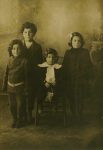
Left to right, Harry, Joseph, Benjamin and Rachel Seidelman, in approximately 1906. (photo from JMABC L.25670)
The following is an edited version of remarks presented at the Jewish Museum and Archives of British Columbia (JMABC) Intersections speakers series on Dec. 15 about the museum’s online exhibit Letters Home.
Recently, my wife Shelley and I were on a tour of Italy that stopped at the Cassino War Cemetery for soldiers killed during the Battle of Monte Cassino, a battle which resulted in 55,000 Allied casualties. In the 15 minutes we were there, we found two headstones with a Magen David, for soldiers from British Columbia who were killed in this Second World War battle. These headstones commemorate just two of many soldiers who have died in the fight for democracy but whose bodies are interred far away from family. My Uncle Joe was even less fortunate. Since his body was never found, there is no grave and, therefore, no headstone.
The First World War claimed the lives of 38 million civilians and soldiers alike. Approximately 2,700 Canadian Jews served in the Canadian Expeditionary Force, with about 1,200 seeing combat. Of those, an estimated 123 died in battle.
In late 1917, Gen. Douglas Haig, commander of the British Expeditionary Force, insisted that the key to victory on the Western Front was capturing the area around the village of Passchendaele, near Ypres in Belgium. Even though bad weather had turned the battlefield into a quagmire, Haig was determined to proceed.
At Passchendaele, on Oct. 26, 1917, 15,654 Canadian soldiers were killed. Among those who paid the terrible price for this hopeless decision was Pte. (Edward) Joseph Seidelman, 20, of Vancouver. His father, William, was a Hungarian Jewish immigrant who, after living in Kansas and Seattle, had settled in Vancouver in the 1890s. There, he met Esther Pearlman from Winnipeg. The two were married in 1896. Joseph was born a year later, followed by four more children during the next decade. Their father unfortunately died in 1907, leaving Joseph, Rachel, Harry and Ben; William was born after his father died and was named after him.
In 1916, Joseph was a student at the University of British Columbia. He would have graduated in 1918, the final year of the university’s transition from being an annex of McGill University to being a fully independent UBC.
Yearbooks are meant to celebrate successes at the institution but the 1918 edition also records the experiences of students who went to fight in the war and returned home, and it laments those students who went to war and did not return. One section is entitled “Military” and includes a copy of the Roll of Honour in Memoriam plaque that hangs in the foyer of the UBC War Memorial Gymnasium. It also contains brief biographies of those who were killed in action, including Joseph. Seventy-eight UBC students lost their lives during the war, and are commemorated on plaques in the War Memorial Gymnasium.
Compelled to do his patriotic duty, Joseph enlisted in the Western Universities 196th Battalion, which was made up of more than 150 students from universities in Manitoba, Saskatchewan, Alberta and British Columbia. Joseph was in England by November 1916. Early in 1917, he was sent to northern France and found himself in the muddy trenches of the Western Front.
So, how much do we know about someone who lived and died so long ago? Well, because of the letters featured in the JMABC online exhibit Letters Home, we have come to know Edward Joseph Seidelman better. In addition, in the 1918 yearbook, there is also a short mention of Joseph in a message from Prof. Lemuel Robertson, the first chair of the classics department at UBC. “Do you remember those little talks on socialism with Coughlan, or when Norman Hughes came into class the day after a dance, in the hope that he wouldn’t be asked anything? And Seidelman, too?” There are only three words but they give us a clue into his personality, that perhaps he liked to party.
In the letters Joseph wrote to his sister Rachel over nine months, he discussed family business and Vancouver affairs – in one letter, he expressed surprise at being a candidate for a Rhodes scholarship – and stated his hope that the war might end soon, though his optimism about the war varied. Even though he was in the centre of the action, he seems, in retrospect, to have been somewhat ignorant of how the war was actually proceeding.
The following letters are only examples drawn from the 87 he wrote. The letters from May 7, 1917, and are part of the JMABC online exhibit.
Camp Hughes, Man., Oct. 2, 1916: “I am going to Brandon again on Thursday afternoon and will stay over Friday, the 6th of October and also Saturday. I stayed with a Jewish family named Kisner and they were glad indeed to have me. Five or six decent-looking Jewish families wanted me to stay with them but Kisners had me first. Mrs. Kisner is only about 30 years old and she comes from the same city in Russia where mamma comes from, Novgorod. Mrs. Kisner introduced me to her 18-year-old sister….”
Dec. 24, 1916: “I knew Mr. Gibson’s son who was reported killed. Mamma has no reason to worry about me. It looks as though Germany will surrender to the Entente Allies…. I read in a London newspaper to-day called Lloyd’s Weekly News that a very high official of the German government … has confessed that Germany is starving and will give to England all that England demands even surrendering the Kaiser himself if necessary. It is quite possible, therefore, that the war may stop within a month or two by Germany’s sudden and complete surrender.”
Joseph stated that he applied for a transfer to the Royal Flying Corps but they were not taking any more applicants at that time. Instead, he was taking a lieutenant’s course and would perhaps go to a military training school later.
Feb. 17, 1917: “Two large Trans Atlantic liners carrying about 12,000 sacks of mail were reported torpedoed and sunk by German submarines and so let me tell you once again not to send anything valuable, for a German submarine might put an end to it.”
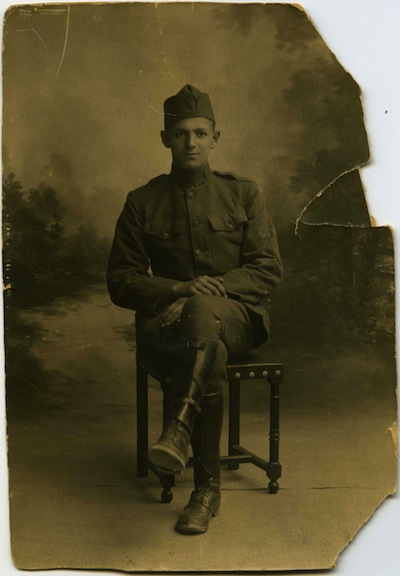
Joseph Seidelman in uniform. (photo from JMABC L.25664)
Feb. 27, 1917: “No doubt there are still many fellows hanging around in Vancouver who should be in the Army. I cannot understand their state of mind unless they have no self-respect or sense of honour. Let them go their ways while there is no conscription but I certainly am glad I am not in those times in civilian clothes. The B.C. University will have to wait until the end of the war for me at least.”
March 4, 1917: “France is certainly a muddy place. You ought to hear our artillery guns hurl death and destruction into the rank of the Huns [Germans]. The artillery makes most of the noise at night and then, when you wake up, you hear the terrific reports of each shot as quickly as the pat-pat-pat of a typewriter.”
March 11, 1917: “Things are somewhat interesting around this part of the world. British aeroplanes fly over us about as thickly as birds. To-day the Huns were firing at our aeroplanes and the puffs of smoke from the enemy’s shells bursting around the aeroplanes could easily be seen. It is very regrettable though that one of the enemy’s shells must have pierced the petrol tank of one of our aeroplanes, for it came down a mass of flames with a thick black column of smoke shooting out behind it. I never saw a single German aeroplane since I came to France. No doubt they have their wits scared out of them.”
April 7, 1917: “The chances of peace do not … look as rosy as I thought but the Huns will be defeated ultimately.”
April 17, 1917: “To-day after returning with a party from a certain part of France where the Germans were once expelled from and the ground all cut and plowed up with trenches, I found waiting for me a parcel containing a broken biscuit tin with some of mamma’s home-made confectionary (including many crumbs) and a tin of strawberries and coffee.”
May 7, 1917, datelined “some other place in France this time”: “I suppose it must have been reported to you that I was very slightly wounded by two very small pieces of shrapnel and, as I feel that you folks at home are very anxious to hear particulars, I want to assure you that there is absolutely nothing whatever for you to worry about. The two wounds I got are on the outer side of my right leg, one above the knee about the centre and the other below the knee about the centre. Although each wound has the appearance of nothing more than a [scratch?] on the skin, nevertheless I had to come to the hospital, where it is a pleasure to be for a change. One of the attendants told me that the leg will be alright again in about 5 days. So tell mamma to be happy and cheerful at home.
“I received three letters from you while I was in the firing line. I was much surprised to hear of the murder of Chief of Police McLennan. I guess Vancouver was shocked at the time almost as badly as a war event.”
On May 22, 1917, from “somewhere in France,” Joseph writes that he still has not rejoined his battalion after his leg injury, as another shrapnel piece was found in his leg, and required more medical attention at the hospital. Joseph tells Rachel that the shrapnel was found with the aid of an X-ray, and the doctor let him keep the shrapnel as a souvenir.
On July 3, 1917, again from “somewhere in France,” Joseph has returned to his battalion. In this letter, he tells Rachel that, on the night of May 5, 1917, when he received his leg wound, he still made the effort to help out a wounded officer. A telegram indicating Joseph’s return to the battalion from the hospital was sent to Joseph’s mother, Esther, on July 5, 1917.
On Oct. 14, 1917, still “somewhere in France,” Joseph reports “nothing to write about.” It is the last letter he writes home.
Joseph fought and survived the Battle for Vimy Ridge, was wounded in the leg in another battle and spent several weeks in an army hospital before being sent back to the front. On Oct. 26, the first day Canadian soldiers fought at Passchendaele, he was killed. Joseph was the first Canadian Jewish soldier from Vancouver to die fighting in the war.
UBC Remembrance Day Ceremonies have been held since 1951, when the War Memorial Gymnasium was opened. Since that time, I have attended nearly every ceremony. At first, I went with my brother and our father, Harry, who was too young to be part of the First World War and too old to be part of the Second World War. In the early years, my father would speak with veterans who knew Joseph. Over time, they all have passed away, but I have continued to attend the memorial ceremony with various members of my family as a way to remember my Uncle Joe, who is lying somewhere in France with no grave or headstone; our own kever avot (tradition of visiting the graves of our fathers).
Perry Seidelmanis, among other things, president of the board of the Jewish Museum and Archives of British Columbia.
I am at Vancouver International Airport and U.S. Customs hands me a card asking the purpose of my visit to the United States. Is it business, pleasure, study? “None of the above,” I respond.
If I were to write a response, it would be: “To say goodbye to a lifelong friend who is leaving our world shortly.” Even at 65, it’s the first time for me to be traveling somewhere with a purpose such as this. And I never expected it to be Zvika (Irv Spivak), a childhood friend whom I have known longer than my husband.
At 15, we met at a rural boarding school in Israel. Two “misfits” or, should I say, creative souls, who had not quite grasped how to integrate into Israel’s society. Zvika was from New Jersey and myself, England. Our friendship flourished. Our mothers, both widows, also became friends.
Zvika was a natural comedian. He could imitate anyone. Presidents, cartoon characters, teachers and family members were only a few of the objects of his jokes. He mimicked accents and, when reciting a joke, it was told with such colour and credit, it became real.
Zvika loved to perform to an audience and I became his “informal” manager in Haifa. I introduced him to my good friends Ronit and Pini and several others and we became a close group. No party was complete without an hour or two of sketches. Nobody was ever excluded and tourists often made up half the parties we held. By midnight, we were laughing and crying uncontrollably, clutching our stomachs in pain. There were frequent complaints from neighbours and we were sure they thought we were drinking and smoking funny stuff but we were all high on pure laughter.
Zvika loved flying and had developed a series of international airline stewardess skits performed in numerous languages. Eventually, when the repertoire was over, I’d lead a round of Hebrew and English folk songs into the wee hours of the morning, with harmonies added by Zvika.
We didn’t know at the time that these carefree days would end very abruptly. On Yom Kippur, a coalition of Arab states launched a surprise attack, knowing that the majority of Israelis would be in synagogue. Zvika had stayed over and we were preparing to go out when the shrill siren began blaring. We looked at each other in disbelief. Today? Yom Kippur? The holiest day? Turning on the radio, we learned that Israel had been attacked by Egypt, Syria and Jordan. We headed to the shelter and remained there for several hours until the shorter siren indicated it was safe to leave.
Our lives took a different turn. I had been hired to perform on a cruise line heading to France and Zvika was planning to actualize his dream of becoming an airline steward.
Haifa’s port, however, was now closed indefinitely, so I offered to perform for the Israel Defence Forces military troops. Together with a magician and another musician, the newly formed Tsevet Havai Pikkud Tsafon (Northern Command Entertainment Troupe) was created.
Zvika was drafted as a medic and stationed somewhere near Nazareth.
En route to the Golan Heights after several successful performances, I realized we were passing army bases in Nazareth. “Stop, stop!” I yelled to the driver. “I want to visit my friend.”
Surprisingly, the driver complied and, moments later, I was hugging Zvika.
“Join us,” I said.
“Are you kidding? I won’t be allowed, even though I do very little here.”
“Let’s speak to your base commander,” I urged. Shortly after, we were performing our tunes for the commander and soldiers. With hearty applause, the commander understood how immensely valuable our music would be for the troops and permission was granted for Zvika to leave.
Our group performed in newly acquired territories: deserted villages surrounded by cattle and sheep, bunkers, and sometimes only a few miles from the bombings. We traveled to the Lebanese, Syrian and Sinai borders. The silent and somewhat eerie landscape filled with roars of laughter as Zvika carried out his sketches for the soldiers. We would learn later that, for some, this would be the last show they would see.
Eventually, Zvika was summoned to his base and I returned to Haifa to complete my previous plan.
Zvika moved to New York to become, you guessed it, an airline steward, and I moved to England. We’d reunite on special occasions. When I moved to Vancouver, my English friends threw a farewell party and Zvika flew over to attend and share all the skits with my friends. When he finally settled in San Francisco, we always stayed in touch.
Zvika’s larger-than-life personality drew people to him from all walks of life. Everyone felt that he was their best friend. He loved people, Cuban cigars and food and, before long, began selling diamonds at a Union Square store.
However, in 1989, he developed HIV and, with every visit, I began to wonder if it would be the last one. But, he overcame it and, in contrast, developed yet a larger tenacity with life.
He became a marriage commissioner, California-style. I was fortunate enough to attend Ronit’s daughter’s wedding and witness how eloquently Zvika created meaningful wedding vows. In 1997, he officiated more than 75 weddings and then branched out to do funerals, naming ceremonies, pet funerals and being the master of ceremonies at various events.
In March 2016, Ronit informed me that Zvika had been diagnosed with an aggressive form of bile duct cancer. He sent regular updates including this one: “The standard prognosis is four to six months or an additional year or two if chemo is successful. That being said, I was told 25 years ago that I’d be dead from AIDS after six months and we all saw how that prediction turned out. :-)”
I arrive at the hospice and my other lifelong friend, Ronit, is there to greet me. Zvika clutches my hand and I suppress my tears. In the days to come, he weakens. There are swarms of people coming in to say their final goodbyes. His friends move him to his house to die peacefully. I sing our old melodies to him. There are no harmonies. But, he is surrounded by love and care until his passing.
One of Zvika’s quotes was “My friends are my greatest blessing. I value honesty, loyalty and friendship. I love making new friends.”
Sixteen years ago, in a post-birthday note to all his friends, Zvika wrote: “If I were to die today … I’d die the happiest man ever to have lived and loved for knowing you. It has never been about the material things for me (hell, I’ve lost everything twice), it has always been about the memories of good times with each and every one of you. Your footsteps are indelibly etched in my brain. You are all my personal angels and friends.”
Jenny Wrightis a writer, music therapist, children’s musician and recording artist. She also teaches creative writing and can be reached at jennywright3@gmail.com.
The formation of the moon has remained something of a puzzle. A leading theory proposes a cataclysmic impact involving a Mars-sized object and a young earth. But there are some inconsistencies with this scenario. A new study at the Weizmann Institute of Science, based on hundreds of simulations run on a computer cluster, suggests that a more plausible chain of events might involve a number of run-ins with smaller objects. This would have produced smaller moonlets that would have eventually coalesced into the single moon we have today. The research appeared this month in Nature Geoscience.
Research student Raluca Rufu and Prof. Oded Aharonson of the Weizmann Institute’s earth and planetary sciences department point out that the accepted explanations for the formation of our moon rely on highly specific initial conditions – for example, a collision with an object of a particular size traveling at a defined velocity and hitting the earth at a specific angle. Furthermore, in a typical impact, different proportions of that object would have ended up in the earth and the moon, leaving a detectable difference between the bodies, but various chemical analyses of the moon’s makeup, taken from samples returned by astronauts, reveal that it is nearly identical to that of the earth. In other words, there is no trace of the large body that supposedly hit the earth, and the theories, say the researchers, turn out to be improbable.
Rufu and Aharonson, together with Dr. Hagai Perets of the Technion–Israel Institute of Technology, asked whether a number of smaller collisions might better explain what happened several billion years ago, when the solar system was taking shape. Such smaller bodies would have been more prevalent in the system, and thus collisions with smaller objects would have been more likely. Small, high-velocity collisions could also mine more material from the earth than a single, large one. In addition, explained Aharonson, if a number of different bodies collided with the earth over a period of millions of years, their different chemical signatures – for example, ratios of oxygen-16 to its heavier cousins, oxygen-17 and -18 – might even out, masking the traces of the various collisions.
The collisions – with small planets one-tenth the mass of the earth to space rocks the size of the moon, a hundredth the mass of the earth – would have sent clouds of rubble, melt and vapour into orbit around the early earth. These, according to the simulations the scientists created, would have cooled and agglomerated into small moonlets that, in time, could have merged into one.
To test this scenario, the group ran around 800 impact simulations on the Weizmann Institute of Science’s Chemfarm cluster, which has more than 5,000 processor cores.
“The new scenario does not require finely tuned initial conditions,” said Rufu, “and, if the smaller moonlets, as we think, were drawn into the same orbit, they could have merged over millions of years.”
“We are now running further simulations to try to understand how the smaller moonlets produced in these simulations might have coalesced to form our moon,” added Aharonson.
Aharonson’s research is supported by the Benoziyo Endowment Fund for the Advancement of Science; the Helen Kimmel Centre for Planetary Science, which he heads; the Minerva Centre for Life under Extreme Planetary Conditions, which he heads; the J & R Centre for Scientific Research; and the Adolf and Mary Mil Foundation.
For more on the research being conducted at the Weizmann Institute, visit wis-wander.weizmann.ac.il.
The most frequently used words by alumni answering the question “What does Camp Miriam mean to you?” The larger the word, the more frequently it was used. As with other Jewish camps, “Jewish” and “identity” are the most common responses. (from campmiriam.org/home/about/our-impact)
As a director at JCC Chicago’s Camp Chi, I often found it difficult to know with much certainty if our goals and mission were being met. Sure, I knew that campers were having a lot of fun, trying new things and forming friendships, but what about the deeper connections or personal growth?
Satisfaction surveys and return rates demonstrate one type of success, but these measurements don’t get to the heart of what we want kids to take away from their camp experiences.
I saw firsthand last summer that this challenge is even more true at day camp, where campers often don’t have the maturity or verbal expression skills to accurately share their feelings. By spending a minute at any of the nine JCC Chicago day camps, you know that campers are having the time of their lives, but how do we know if we are meeting or exceeding what we want to be the positive impact of camp or, more precisely, the positive impact of Jewish camp.
We found the answer to this question in a surprising way. Towards the end of the summer, as part of a larger project, we asked JCC Chicago day campers to complete this sentence: “It’s not just camp. It’s _______.”
Using markers and crayons, words and pictures, campers shared – often with creative spelling – what camp “is” to them. Among responses that ranged from reflective to silly, we discovered a number of answers that highlighted the distinctive elements of Jewish camp. Campers wrote: Jewish memories … Shabbat … family … Jewish tradition … Maccabi games … inspiration … Jewish … community … Israel experience … a chance to show yourself … kindness … Shabbat singing … JCC.
With an opportunity to write anything they wanted about camp, many of our campers chose to express what was meaningful to their Jewish identity and Jewish experience. These ideas were surrounded by other words and phrases, such as swimming, home sweet home, soccer, awesomeness, my happy place, fantastic, best part of the year, friends, painting and love.
Screenshot from a 2014 Camp Solomon Schechter promotional video. While swimming and other secular activities engage campers, so do Shabbat and Israel. (from youtube.com)
Seeing this better defined for me, more than any research study, why Jewish camp matters. The melding of Jewish rituals, ideas and activities with the excitement that naturally happens at camp is the real magic of Jewish camp. Swimming was a dominant theme with our day campers, but so was Shabbat and Israel. Campers related “Jewish” alongside fun, joy, comfort and belonging.
This reminded me of something I experienced in the months leading up to my first summer working at Camp Chi. I met with small groups of campers and staff to get the real scoop on the camp. I asked all of them to tell me their favourite part of camp. Almost always the answer was “Shabbat.”
Not having attended Jewish camp as a child, I thought this was an odd response at a camp with outstanding facilities and activities. I would have expected “horseback riding” or “water skiing” or even “my friends,” but, instead, I heard about how connected they felt to the Jewish community or their “Jewishness” when at camp.
What our day and overnight campers told us is so much more than just words on paper or stories to be shared. There is incredible power in this positive relationship to Judaism that campers make while at Jewish camp. At JCC Chicago day and overnight camps, being Jewish is fun, accessible, relaxed, just like almost everything else that takes place there. In their own ways, our campers, from the youngest to the oldest, expressed that “Jewish at camp” has meaning and importance to them; it’s part of what makes camp and their camp experiences so special.
As adults, we can see that their words and stories are evidence that the seeds of Jewish connection are planted throughout the summer. The potential impact of Jewish camp is tremendous. It sets the stage for a lifetime of sense of belonging to a Jewish community, a relationship with Jewish traditions, a feeling of pride in Jewish identity and an understanding of values.
It’s not just camp. It’s the start of a lifelong Jewish journey and so much more.
Jamie Lakeis marketing manager of JCC Camping. This article is reprinted with permission from JUF News. It can be found at juf.org/news/local.aspx?id=440848.
Climbing at Camp Kalsman. Kids will come home from camp laden with good memories. (photo from campkalsman.org)
My son left for camp a few weeks ago and, try as I might, I cannot quell the heartache at his absence.
At 11, he is independent and outgoing, with a gentle disposition and a winning smile. Every day, he pauses to wrap me in a long embrace, regardless of the battles we have fought over homework, “screen time” in front of the computer and TV, and our ongoing feud over why he has no iPod. “Everyone I know has one,” he insists.
He fights a good battle, my son, and I miss our exchanges – both the affectionate ones and the “you’re so unfair” ones – while the reins of control are in the hands of his camp counselors for 18 days.
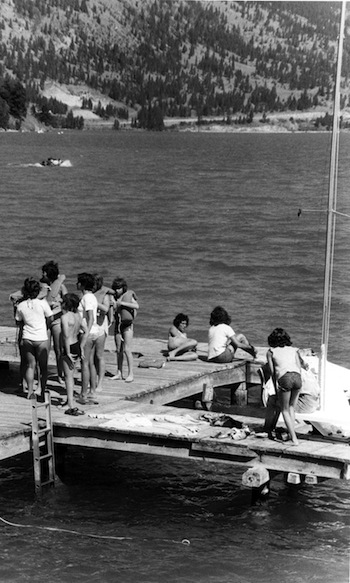
Children on the dock at Camp Hatikvah, 1976. Though the writer’s camp experience occurred on a different continent and in a different generation, Jewish overnight camp changed her life. (photo from JMABC L.09597)
I know his time away will be exceptional and that he will return home laden with good memories. His days and nights will be full of campfires, Jewish songs, new friends and exhilarating zip lines through the treetops. He will forget to change his underwear for far too long, spend every day in a swimsuit and leave the sunscreen untouched despite my pleas to the contrary. But, he will come home with even more confidence, buoyed by his newfound ability to stay away for longer stretches of time, surrounded by people his own age.
Back home he has left a large void in the family, a space of silence that he usually fills with chatter, observations and mischief. My daughters reflect on how quiet and dull life is without their older brother, who organizes impromptu theatrical performances long after bedtime and is always game for a round of Monopoly. Sure, there’s less sibling rivalry. But I’d trade it in a heartbeat for his broad smile and spontaneous hugs.
My own days at camp come to mind vividly, though they happened a quarter-century ago. You can’t forget your camp crush, the couple that got expelled for climbing into a sleeping bag together or guard duty, when we climbed atop a water tower to “protect” the other campers from imagined threats to their safety.
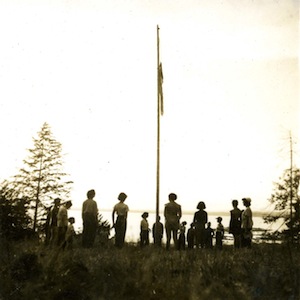
Shabbat eve at Camp Miriam, 1949. For generations, Jewish camp has been instilling Jewish values and a love of Judaism in campers. (photo by Sarah Ehrmann (née Shirley Gurevich) Habonim collection, JMABC L.24608)
I remember the warmth of singing songs around a long table, our bellies filled with food. My camp occurred on a different continent and in a different generation, but, like the one my son is attending, it was a Jewish overnight camp and it changed my life. It opened my eyes to different ways of being Jewish and impregnated my mind with the beauty of Shabbat.
As I prepare to welcome him home in a few days, I’m fervently hoping his camp will leave him with a similar feeling of Jewish warmth and nourishment. Those in the business of funding Jewish overnight campers firmly believe that the future of Judaism and its leaders lies in the bunk beds of today’s Jewish camps. That’s because they offer a 24/7 Jewish environment that’s engaging, supportive and fun, one that promotes religion and religious values.
With two years to go until a bar mitzvah, I’m counting on it. I’m already fielding questions like “Why do I have to eat kosher?” If I’ve had to endure 18 days without my son, he’d better come back with – at the very least – an answer to that question.
Lauren Kramer, an award-winning writer and editor, lives in Richmond. To read her work online, visit laurenkramer.net. This story was first published in 2012.