Hoping to revive Dead Sea

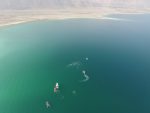
Twenty-five swimmers from around the world crossed the Dead Sea on Nov. 15. (photo from EcoPeace)

On Nov. 15, some two dozen swimmers made the seven-hour trek across the Dead Sea, starting from the Jordanian side and swimming to the Israeli.

The demise of the Dead Sea is not news. According to the group EcoPeace Middle East – a Jordanian, Palestinian, Israeli environmental peace-building organization – the sea has receded by 25 metres in the last three decades and has lost a third of its surface area. Yet, hope remains.

The recent event’s initiator and a participant swimmer, Oded Rahav, stated in an EcoPeace press release, “If it’s possible to do the impossible, like swimming across the Dead Sea, then it’s possible to save the Dead Sea. We are not just interested in raising awareness, but creating real action to benefit the Dead Sea.”

Co-sponsoring the event with EcoPeace was Tamar Regional Council in Israel.

“A group of Israeli swimmers approached EcoPeace last spring with an idea to do a first-ever event – to swim across it [the Dead Sea]!” said Mira Edelstein, project coordinator of EcoPeace’s Jordan River Rehabilitation and Save the Dead Sea projects. “Not only were they looking for an idea to follow their previous success in topping a Guinness record – swimming from Cyprus to Israel – they also sought a way to raise awareness about the need to save the Dead Sea.

“They, naturally, turned to EcoPeace, as we’re the only regional environmental organization in the Middle East working on the issue of the rehabilitation of the River Jordan, which is in direct correlation with saving the Dead Sea. We gladly took on co-organizing the event and worked hard to make it happen, especially in getting permission from the Jordanian army to ‘sail’ across the border in the middle of the sea, starting from the Jordanian side.”
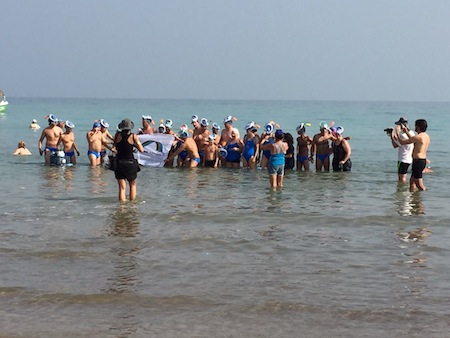
photo - The Dead Sea swim team
The Dead Sea swim team. (photo from EcoPeace)

There were 25 swimmers from all over the world who participated, including from Israel, Palestine, South Africa, New Zealand, Greece, Spain and Denmark. They had to swim with a full-face snorkeling mask because of the water’s extreme salinity and they also had to adapt their swimming style because of the water’s high density. It was a life-risking venture and the swimmers were accompanied by a medical team, as EcoPeace notes in the press release: “A drop in the eye causes severe irritation, and chance swallowing of its water can be fatal if not treated immediately.”

The event generated an unprecedented amount of media attention and EcoPeace hopes this will help its ongoing efforts to get local decision-makers to take action on the issue.

“We’re also being approached by several other organizations to do other cross-border events – bicycle event, music event, art event, etc. – and we’ll review all of them to see which is more feasible and which will give us the best results,” said Edelstein, who was born and raised in New York and made aliyah in 1993. She now lives in Gan Yavne, which is near Ashdod. She joined EcoPeace in 2004.

“Personally, as an environmentalist but also a general nature lover, the Dead Sea is such a pearl of nature with so many unique qualities found nowhere else on this earth, that it would be a tragedy to lose it,” she told the Independent. “This is a man-made catastrophe and we must work as hard as possible to reverse it.”

Edelstein explained that the threats to the Dead Sea are coming from two directions.

“First is from the north,” she said. “Historically, the main inflow to the Dead Sea has been the Lower Jordan River. And, with the diversion of more than 95% of the Jordan River’s water by Israel, Jordan and Syria, leaving a meagre five percent to reach the Dead Sea … no wonder the Dead Sea is shrinking – by more than a metre a year.

“EcoPeace is working extremely hard to rehabilitate the Lower Jordan River back to at least a third of its historic flow, not only for the river’s own integrity – this is the holy Jordan River! – but we’re doing this for the Dead Sea as well.

“Second is from the south – from both Israeli and Jordanian mineral industries. These industries are using the most simple, antiquated, water-intensive technology to harvest minerals from the Dead Sea: evaporation. Unfortunately, both industries have no incentive to change their extraction technology, because they do not pay a penny for the amount of water they use.”

EcoPeace is working to change this; however, discussions about extracting minerals using systems based on desalination technologies (reverse osmosis) have come to a standstill, as they cost money, while evaporation is free.

“They claim they are studying them (these technologies), but have concluded that they’re very expensive,” said Edelstein. “Our point is exactly that – that until they will be forced to pay for the amount of water they use, any kind of change will be expensive.”

With the Israeli mineral industry’s contract with the state on its last leg, Edelstein is hopeful that a new contract will include putting a price on the Dead Sea’s water.

“EcoPeace is working very hard to get a bill passed through the Israeli parliament wherein the Dead Sea Works [part of the company ICL Fertilizers] will need to pay for the amount of water they use,” she added.

“Both of these actions together, that EcoPeace is working on, will help stabilize the Dead Sea. The Dead Sea will not yet be completely saved or restored, but we understand we first need to halt its destruction and [then] to work on stabilizing it.”

While there was a plan to draw water from the Red Sea to the Dead Sea, the original mega-project, which the World Bank was studying for more than a decade, has been deemed unfeasible. The present-day Red Sea-Dead Sea canal project “is different than the original one,” said Edelstein. “This project is based on a water swap between Israel and Jordan, which also includes a component for Palestinians to get more water from Israel.”

With both the Jordanian and Israeli governments working closely, mainly on furthering the canal project, EcoPeace applauds the joint efforts, but does not see the project as the solution.

“I do believe that the Dead Sea is high on the public agenda,” said Edelstein. “It’s not difficult to find information on the issue. Our website is being upgraded and we’ll soon have updated information to share, but recent news articles are a good place to begin.”

For more information about EcoPeace, which was formerly called Friends of the Earth Middle East, its Dead Sea and other projects, visit foeme.org.

Rebeca Kuropatwa is a Winnipeg freelance writer.
Importance of listening

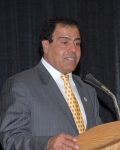
Dr. Izzeldin Abuelaish (photo by Bob Talbot)

I was born in Soroka Hospital in Be’er Sheva, southern Israel. My father, an Israeli-born Jew of Tunisian descent, began his residency in obstetrics and gynecology the following year. Joining him in the program was a Muslim-Palestinian doctor from Gaza, the first to do so in an Israeli hospital. Through their respective residencies, they grew to become close friends and remain so to this day. This is the story of how that doctor from Gaza taught me the advantages of remaining level-headed during disputes, by his mere demeanour and the way in which he converts misfortunes into valuable life lessons. This is the story of how Dr. Izzeldin Abuelaish changed the way I appreciate my parents, invest in my future and, most importantly, how I listen.

Dr. Izzeldin Abuelaish was born in 1955 in Jabalia refugee camp in Gaza, in conditions most of us can’t even comprehend. His school bag was an old, fibre bag, he owned a single pair of pants sewed from scrap materials and his school eraser was so valuable he had to wear it on a string around his neck. His mother, the “Lioness,” as he often refers to her, knew education to be the most powerful weapon of choice in their limited arsenal. Consequently, she pushed him to his limits, having him work in the mornings before school and in the afternoons. His teachers saw in him a passion and competence that could elevate him and his family out of their current conditions and, like his mother, pushed him to pursue his studies. He went on to receive a scholarship to study medicine in Cairo, he then went on to receive a diploma in OB/GYN from the University of London, accompanied by a subspecialty in fetal medicine in Belgium and Italy; and onwards to completing a master’s of science in health policy and management at Harvard University.

His road out of poverty was not smooth, but 2009 brought the worst wave of hurt to his life. Only a few months after losing his wife to cancer, Abuelaish’s apartment was shelled by an Israel Defence Forces tank during the Gaza War. His three daughters – 20-year-old Bessan, 15-year-old Mayar and 13-year-old Aya – and 17-year-old niece Noor were all killed. The entire tragedy was caught on live television, as Abuelaish had been communicating with Israeli media on the effects of war on Palestinian civilians. Destroyed and devastated, his wails were heard all over the world and, for the first time during the war, the Palestinian people had a human face, and a haunting shriek.

Despite this unimaginable heartbreak, Abuelaish refused to let hatred coerce him into visceral action. “Hatred,” the doctor said, “is destructive to the hater, not the hated.” In the face of such trauma and injustice, he remained calm and rational and channeled his anger into a fight for justice, not revenge. He knew that hatred would only hurt his interests and sway him off course.

Abuelaish had friends in the hospitals he worked at, colleagues, patients and others who cared for him deeply, my father being one of the many among them. Abuelaish knew not to let the loudest of political actions silence the intentions of citizens on either side of the border. He knew to listen, to speak out with kindness and courage and through action.

I was formally introduced to Abuelaish for the first time when he came to speak at my university. “You’re the son of Bentov?” he said to me. I replied with a smile and a nod. He was ecstatic to meet me, and I could barely believe I was in his presence. We were both baffled by the coincidence, and rejoiced in the opportunity. After the lecture, the professor and several students went to a nearby café to further discuss the tenets of his talk. He inquired on the well-being of my parents and I shared my vague childhood memories of him. Upon his departure, he left his card with me and asked me to contact him again. I have remained in close touch with him since.

In the summer of 2015, Abuelaish offered to let me work in his office, hoping I could write a research paper under his guidance. Sitting in his office at Dalla Lana School of Public Health at the University of Toronto, I gazed around the room, awestruck by the number of awards, photographs with world leaders, diplomas and gifts from supporters and friends that were on display. I remember most my reaction when I saw his bookshelf: the goliath volumes of medicine and politics were overshadowed by the collection of self-help books on overcoming trauma.

One morning, Abuelaish asked me to come with him to see the office of his philanthropic organization, Daughters for Life Foundation. After asking me whether Upper Canada College or University of Toronto Schools, both of which command some $20,000 in annual tuition, are better high school choices for his son’s education, he threw on the same black leather jacket he’s owned for at least a decade and a half, and we made our way to his 1998 Saturn SUV. The priorities he made clear that day and his mere demeanour ingrained in me a sense of proportion that drastically altered the things I hold dear in life. I am unable to articulate exactly how I felt driving in his car that day. I wanted to go home and burst into tears. His humility, his unending devotion to his children, his disregard for material goods. For the life of me, it took everything in my power not to shed a single tear during that car ride.

Before I met Abuelaish, I was an angry young man, easily swayed by inflammatory rhetoric and propaganda. I was arrogant, rigidly opinionated and impatient. When I met the doctor, my father’s friend, I saw a sobering display of the prowess of human endurance – an absolute refusal to remain defeated, even after many severe blows. I coined his philosophy “proactive pacifism,” as I could see no other way to describe it.

I began to realize the many unacknowledged fortunes in my life and the immense efforts my parents made. I also learned the value of listening and the importance of letting others voice their opinions unscathed by my bias. Most of us are quick to see differences, carelessly and lazily dividing people by economic, political and religious beliefs and doctrines. Instead of investing our energies into improving our lives, we spend it on putting or shutting down others, lest they make us work harder to maintain our place in the world or our opinions. Following the change of atmosphere in Europe and the United States, I think Canadians can learn from the valuable lessons of Abuelaish’s actions.

Instead of seeking revenge against those who have harmed him, he has chosen to empower those who have been harmed. In all of the self-help books and all of the various philosophies I have come across, I have never met anyone who embodies the “golden rule” as much as Abuelaish. I’m 20 years old and have had a life virtually devoid of struggle, in large part because my parents worked incredibly hard to provide me with all that I have. I did not fully appreciate this until I got to know Abuelaish.

After meeting him, I also saw the real benefits of allowing speech to flow freely and, when someone speaks, I now listen. As aggravating as that feels sometimes, I know that preserving this right, this freedom, is more important than my reaction to the words being spoken. I am now confident that proving a point means more than shouting out an opinion; it means putting my beliefs into action. After every conceivable reason to give in to hate, Abuelaish not only rose above his many adversities, he used them to fuel his goal of greater peace and cohesiveness between Israelis and Palestinians.

Abuelaish does not stand on the shoulders of giants; he guides them onwards. In 2011, he created Daughters for Life Foundation, which raises funds for academic scholarships for aspiring female students of Jewish, Christian, Muslim and other backgrounds from the Middle East. Abuelaish believes that, through the success of other young female students, he can bring to life the ambitions of the daughters he lost.

Abuelaish has accomplished more through dialogue than through dispute. As well, there are hundreds of Israeli and Palestinian children enjoying their lives due to his work as an obstetrician. Because of him, and the few others like him, I firmly believe in the prospect of peace in the region.

Abuelaish is far more than a mentor to me – he is my friend, he is family. The way he endures the many misfortunes in his life, the way he looks after his children, the way he helped me and the way he spoke of my parents are only examples. His many lessons transcend and translate into all aspects of life.

Following the recent election in the United States and a return of nationalist support across Europe, politics divide us now more than they have in a very long time. In an era of sound bites, protests and identity politics, it seems that most individuals have very little interest in listening to opposing viewpoints, lest these views betray their crafted narratives. We are eager to impose our opinions on others, convinced that mere criticism means that someone is an enemy of our noble cause or wants to harm us. This phenomenon is causing divides in parts of the world where diversity has been flourishing for decades. In these times, it would be wise for us to take a breath, to put things into perspective and remain coolheaded, regardless of our differences – or even our similarities, for that matter. If we invest our energies on improving ourselves, and encourage others to do the same, we should be able to get along, even if we disagree. These are just a few of the things I learned from my good friend, Dr. Izzeldin Abuelaish. As he has said, “The energy you want to waste on anger. Convert it to strength and determination.”

To learn more about Abuelaish, his book I Shall Not Hate: A Gaza Doctor’s Journey is available at various booksellers, including online, and the link to his foundation is daughtersforlife.com.

Gilad Kenigsberg-Bentov is a student at University of Western Ontario, where he is majoring in economics.

Thoughts on Oakridge exhibit

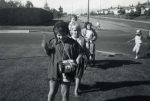
Staging a parade on Laurel Street, circa 1960. An image from the Jewish Museum and Archives of British Columbia’s online exhibit, Oakridge. (photo from Gail Dodek Wenner via jewishmuseum.ca)

The oral history exhibit recently launched by the Jewish Museum and Archives of British Columbia on the postwar Jewish community of Vancouver’s Oakridge neighbourhood struck a chord and gave me pause. This is the area where my mom grew up – she was 13 when the shopping centre opened, the mall where my high school friends and I would later hold part-time jobs – and where my grandparents’ family home remained until a few years ago. And, it gave me pause because it reminded me that a little history can shake one’s sense of complacency.

Spending my teen years in Vancouver in the late 1980s, I sometimes wondered why the Jewish community didn’t live more north or more west – in short, closer to the beach, and in reach of sea and mountain views. Surely, part of the Jewish community’s move southward had to do with the wider lots and newer homes available as the city sprawled outward. But another important – and, to me, overlooked – part of the story is the legacy of racism and antisemitism that had infected the buying and selling of property in Vancouver.

One of the interviewees in the exhibit recalls a real estate agent telling her father, in reference to a house on King Edward Avenue between Oak and Granville streets, “This is a good neighbourhood because no Jews or Chinese are allowed.” By the fifties and sixties, however, Jews felt welcome and comfortable in the south Vancouver area, bounded by Oak and Cambie.

Times were different for my generation, growing up as multiculturalism was taking hold in a serious way and antisemitism and racism were increasingly seen as unmannered, even if they never fully went away.

In the mid-1980s, I recall accompanying my grandmother to an annual general meeting at the Richmond Country Club, where she regularly played tennis. I recall a discussion that evening about whether Jewish membership should be privileged. (An interview with the club’s current general manager, Mark Strong, confirms that, while the club’s written charter states that no member will be denied admission based on race, colour or creed, in practice, during that era, the club promoted Jewish membership.) After the meeting, I was outspoken in my criticism. To my 12-year-old sensibilities, trying to stack the membership of a recreational club with any particular religion or ethnicity seemed parochial and antiquated at best, and prejudiced and discriminatory at worst.

What I didn’t sufficiently appreciate then was the legacy of Jews being barred from many country clubs and, indeed, the Richmond Country Club had been founded by a group of Jewish businessmen and professionals in 1951 for that reason. If the club’s policies seemed antiquated to my 12-year-old ears, there was more resonance to it than I then realized. While I was trying to afflict the comfortable, these club members likely still felt the sting of affliction requiring comfort.

Today, the Richmond Country Club has a Magen David in its logo, and states on its website that “the spirit of inclusion remains one of our core values.” (I will leave aside the separate though partially related question of whether any country club can be economically inclusive.)

What does it mean to have grown up in what felt like a post-antisemitism era? I admit that, until recently, I have been suspicious of those who seek to find antisemitism at every turn. Not long ago, an older relative clipped a real estate ad for a cottage near Lake Winnipeg that stated it was in a “restricted” area. My relative took this to mean no Jews allowed. I did a little research and soon learned that, in this particular cottage zone, “restricted” meant something very different – no cars allowed. When I showed my relative what I’d found, he turned angry. It’s easy to get locked into patterns of victimhood.

But now my comfortable post-antisemitism bubble seems to be bursting. The Trump era has unleashed a torrent of hateful, xenophobic and bigoted discourse. Swastikas and racist graffiti have popped up on various houses of worship – including four Jewish institutions where I live, in Ottawa. Trump has appointed as chief counsel Steve Bannon, a man accused of trafficking in antisemitism via his website, Breitbart News.

Modern liberal polities require a constant sense of balance between comfort and vigilance. Too much comfort, and one risks complacency – for oneself and others. Too much vigilance, and one veers into paranoia. At the very least, we mustn’t forget history. Narratives of the past help explain collective fears, while suggesting what is necessary to make possible the kinds of societies that are worth fighting for.

Mira Sucharov is an associate professor of political science at Carleton University. She is a columnist for Canadian Jewish News and contributes to Haaretz and the Jewish Daily Forward, among other publications.

Enhancing nature activities

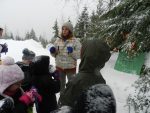
Inbal Len Nenner holds the attention of campers on Cypress Mountain during JCC Camp Shalom’s winter session last month. (photo from JCC Camp Shalom)

When Inbal Len Nenner arrived in Vancouver last year from Israel, she fell in love with the natural environment, as well as its people. “I met the nicest people in the world,” she said.

When JCC Camp Shalom met Nenner by chance at the Jewish Community Centre of Greater Vancouver, she spoke about her work with Israeli children, where she created a special program called Children’s Tribe. Inspired by ancient tribal traditions, it focuses on group-building activities for children and youth and connects them to nature.

photo - Arts and crafts are a big part of JCC Camp Shalom, no matter what the season
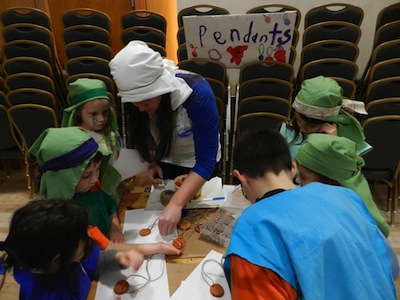
Arts and crafts are a big part of JCC Camp Shalom, no matter what the season. (photo from JCC Camp Shalom)

This type of programming was of interest to Camp Shalom, as it has always focused on nature education and teaching values that foster appreciation and respect for the environment. So, during the two weeks of JCC Camp Shalom’s 2016 winter session, Nenner volunteered to work with all age groups.

During the winter camp, Nenner created many activities, including a quest for Big Foot at Cypress Mountain, where campers learned to follow tracks in the snow, and a “tribe day,” where the youth campers (grades 4-7) became the Spirit Eagle Tribe – each child had a role to fulfil, learned a job and shared with others. Meanwhile, with the younger campers (preschoolers), Nenner ran a Chanukah storytelling session, during which the children had the chance to dress up and play some of the roles in the story. The highlight of the week was a camp-wide celebration of Chanukah as in biblical times, which included booths and activities such as ceramics, dance and Olympic games.

Nenner’s goal in her work is to develop creative thinking in children and to show them the positive effect of making social connections in a group. This aligns exactly with JCC Camp Shalom’s values, so the camp could not have been more excited to give Nenner a chance to demonstrate her craft. During her time as a volunteer, the campers laughed and played, and created an environment that fostered positive self-image and growth.

“Inbal quickly became part of our Camp Shalom team and was loved by the campers and staff alike,” said Ben Horev, JCC Camp Shalom director.

Nenner has since returned to Israel, but JCC Camp Shalom is taking the necessary steps to ensure that she will return to the JCC in the spring. Not only did she enjoy her experience with the camp, but she was an amazing asset to the camp program, translating the camp’s values into meaningful activities from which the children grew and learned in an experiential way.

For more information about JCC Camp Shalom and its programming, contact Horev at ben@jccgv.bc.ca.

Bringing light to darkness

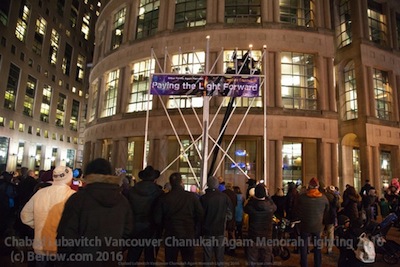
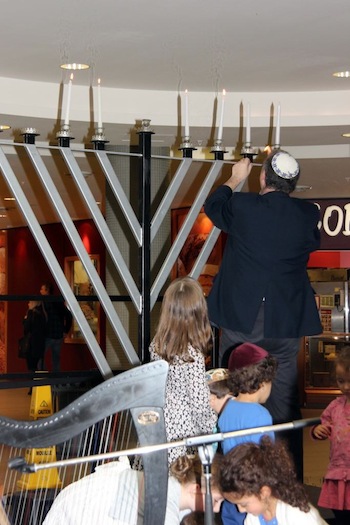
MLA George Heyman addresses the crowd at the lighting of the Silber Family Agam Menorah (below) on Dec. 25. (photo by Glenn Berlow)

photo - Lighting the Silber Family Agam Menorah
Lighting the Silber Family Agam Menorah. (photo by Glenn Berlow)

There were many Chanukah celebrations that took place around the Lower Mainland last month. Here are but a sampling of the events that were held to mark the holiday.

Despite the frigid weather, more than 200 people gathered on Dec. 25 for the annual lighting of Canada’s tallest menorah, the Silber Family Agam Menorah.

The menorah is usually placed outside of Vancouver Art Gallery but, due to construction, it was placed outside of the Vancouver Central Library on West Georgia Street this Chanukah. The program included greetings from MLA George Heyman, Rabbi Avraham Feigelstock, Herb Silber and Rabbi Yitzchak Wineberg. B.C. Premier Christy Clark sent her greetings to be read at the event as well.

– Lubavitch BC

* * *

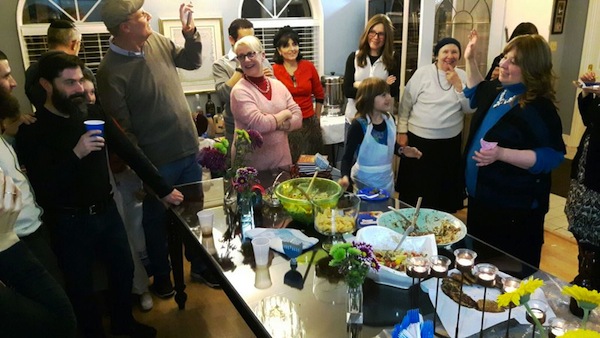
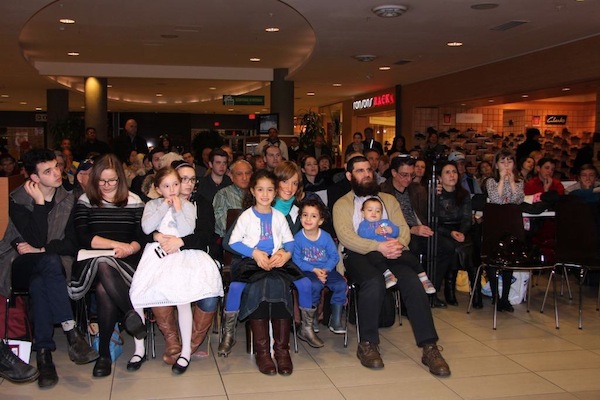
photo - “Young and old joined together for an evening of lights, song, great food and amazing fun” at the Centre for Judaism’s Iron Chef Chanukah
“Young and old joined together for an evening of lights, song, great food and amazing fun” at the Centre for Judaism’s Iron Chef Chanukah. (photo from Centre for Judaism)

On Dec. 25, the third Iron Chef Chanukah took place, hosted once again by the Centre for Judaism of the Lower Fraser Valley.

photo - Iron Chef Chanukah 2016
(photo from Centre for Judaism)

“Rabbi and Simie Schtroks really know how to throw a party!” said chef Marat Dreyshner. “This was my third Iron Chef Chanukah competition and it gets better each year. Young and old joined together for an evening of lights, song, great food and amazing fun.”

“It was an evening that warmed my Yiddishe kishke,” one of the guests commented, echoing the sentiments of many.

After the competition, guests sat and shmoozed with Rabbi Falik and Rebbetzin Simie Schtroks into the night. A first-time attendee was overheard saying, “I am so glad that I came. This place really feels like one warm family. It really lifted my spirits.”

– Centre for Judaism

* * *

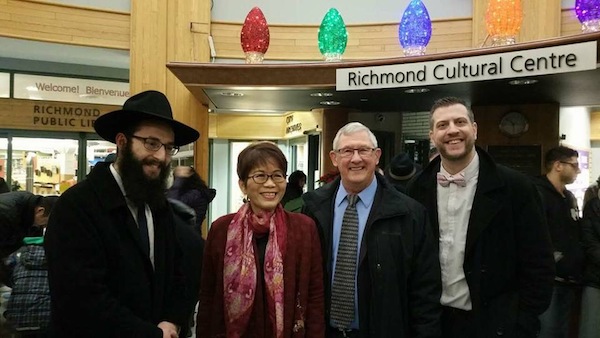
photo - Community leaders at the Dec. 26 menorah lighting in Richmond included, left to right, Bayit Rabbi Levi Varnai, MLA Teresa Wat, councilor Bill McNulty and Bayit president Michael Sachs
Community leaders at the Dec. 26 menorah lighting in Richmond included, left to right, Bayit Rabbi Levi Varnai, MLA Teresa Wat, councilor Bill McNulty and Bayit president Michael Sachs. (photo by Michael Sachs)
photo - Michael Sachs, president of the Bayit, lights the menorah outside of Richmond Public Library and Cultural Centre on Dec. 26
Michael Sachs, president of the Bayit, lights the menorah outside of Richmond Public Library and Cultural Centre on Dec. 26. (photo by Shay Rokach-Penn)

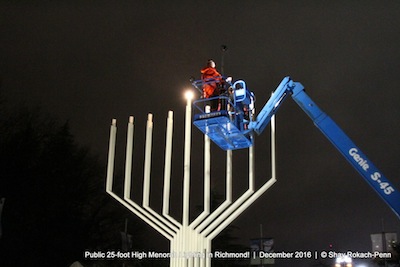
On Dec. 26, the third night of Chanukah was marked in the plaza of Richmond Public Library and Cultural Centre with a celebration that included the lighting of a 25-foot steel menorah designed by the late Arthur Erickson and fabricated by Ebco Industries Ltd.

MLA Teresa Wat was in attendance and addressed the more than 300 people who braved the difficult weather conditions to come out for the community event, which also featured kids entertainment and Chanukah treats.

Some of the companies and organizations involved were the Bayit synagogue (Rabbi Levi Varnai and president Michael Sachs), Chabad of Richmond, the City of Richmond, Richmond Public Library and Cultural Centre, and Helmet and Hugo Eppich from Ebco Group of Companies. Joe Dasilva was a main organizer.

– The Bayit

* * *

photo - Semiahmoo Shopping Centre was filled on Dec. 29 for the menorah lighting, which was done by Cantor Yaakov Orzech, and the awarding of the 2016 Lamplighter Award to Jason Aginsky (below), among other festive activities
Semiahmoo Shopping Centre was filled on Dec. 29 for the menorah lighting, which was done by Cantor Yaakov Orzech, and the awarding of the 2016 Lamplighter Award to Jason Aginsky, among other festive activities. (photo by Naomi Nelson)
photo - Cantor Yaakov Orzech lights the menorah
Cantor Yaakov Orzech lights the menorah. (photo by Naomi Nelson)

Approximately 120 people attended the annual Centre for Judaism’s public menorah lighting at the Semiahmoo Shopping Centre on Dec. 29.

MLA Marvin Hunt, White Rock Mayor Wayne Baldwin and councilors Dave Woods, Helen Fathers, Mike Starchuk and Rudy Storteboom joined the celebration and brought greetings from their cities and from the government of British Columbia. Rabbi Yitzchak Wineberg, director of Lubavitch BC, and his wife, Rebbetzin Henia Wineberg, also joined the Centre for Judaism’s Rabbi Falik and Rebbetzin Simie Schtroks for the evening.

photo - Jason Aginsky, the 2016 Lamplighter Award winner
Jason Aginsky, the 2016 Lamplighter Award winner. (photo by Naomi Nelson)

Although MP Dianne Watts was sick with the flu, she made sure to call Simie Schtroks prior to the event. She also sent a letter of greetings on behalf of the Government of Canada. In the letter, she stated her support for the Jewish people and the state of Israel, especially at this time.

Jason Aginsky was awarded the Centre for Judaism’s Lamplighter Award. Aginsky was the second-youngest participant in the B.C. Ride to Conquer Cancer in August 2016, when he rode the 250 kilometres from Surrey to Seattle over two days. He raised more than $4,000 for the cause.

Cantor Yaakov Orzech lit the menorah and sang Chanukah songs. Musical entertainment, including “The Baal Shem’s Niggun,” was provided by violinist Robert Rozek, one of his students, Rebecca Bukhman, and her mother, musician Rada Bukhman. The talented young harpist Adina Ragetli also entertained the audience with Jewish songs.

Not to be forgotten was a quick game of Let’s Make a Chanukah Deal, as well as doughnuts, chocolate gelt and dreidel glasses.

– Centre for Judaism

Going to camp for the food

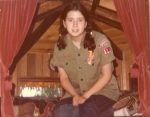
Dawn Lerman, age 15 in this photo, at summer camp. (photo from Dawn Lerman via JNS.org)

In My Fat Dad: A Memoir of Food, Love and Family, with Recipes (Berkley Books, 2015), New York Times wellness blogger and nutritionist Dawn Lerman shares her food journey and that of her father, a copywriter from the Mad Men era of advertising.

Lerman spent her childhood constantly hungry. She craved good food as her father, 450 pounds at his heaviest, pursued endless fad diets, from Atkins to Pritikin to all sorts of freeze-dried, saccharin-laced concoctions, and insisted the family do the same – even though no one else was overweight. Her mother, on the other hand, could barely be bothered to eat a can of tuna over the sink; she was too busy ferrying her other daughter to acting auditions and scolding Lerman about cleaning the house.

My Fat Dad is as much a coming-of-age memoir as it is a recipe collection from Lerman’s upbringing and culinary adventures. Released as part of the 2016 JNS.org summer camps special section, below is an adapted excerpt from Chapter 17 of My Fat Dad, in addition to a recipe for fruit-infused bug juice. 

My little sister April’s contract was renewed. She and my mom were going to spend the summer in Washington, D.C., where she was a principal orphan in the first national tour of the Broadway show Annie. I was going to Hillcrest Camp for a month before joining them.

Hillcrest was a performing arts camp in Connecticut where teenagers were allowed the freedom to arrange their own schedules. The activities ranged from glassblowing, to silk-screening, to acting, to stained glass-making, to, most important, free choice, which translated into hanging out with cute, artsy boys.

Marley was my best friend from middle school. We spoke daily, even though we’d both transferred schools after the sixth grade. She taught me how to line my eyes on the inside ring and the art of applying black nail polish to look edgy. Marley had already been to the sleep-away camp the past three summers and was instrumental in convincing my mom to allow me to go. She said the experience was life-changing, and she really found her voice as an artist in the printmaking shop. My mom thought I was getting too serious with my boyfriend, Hank, after I told him during the ninth grade prom that I loved him, so she signed me up immediately – even though she found the cost to be outrageous.

My mom equated every experience, every meal and every activity with cost. She talked about money incessantly, not in the normal way like other parents did. “We need to save up, we can’t afford it, let’s wait till it goes on sale, maybe next year,” she would say. It seemed to have nothing to do with if we could afford it, but everything to do with the fact she thought she was always being ripped off, unless it was a super-sale. Any normal purchase – food, clothes, toiletries – seemed to bring her physical pain and enraged her, causing her to lash out. I was usually on the receiving end of these outbursts, swallowing her rage and internalizing the message that I was not worthy of normal comforts.

I never really did anything wrong, but somehow I could never do anything right, and my mother constantly used words and tones that were so harsh that I was in a constant state of turmoil. The fact that I preferred fresh seafood and vegetables to soggy SpaghettiO’s for dinner somehow irked her, making her feel unappreciated and angered. I was not your typical kid, and my parents – my 450-pound dad and my flamboyant stage mom – were not your typical parents. The combination of our unique quirks and habits was often toxic and unsettling. So the thought of going to overnight camp – where I wouldn’t need to worry what diet my dad was on or if I would have enough money for food, as most nights I was left on my own – was a welcome relief.

Read more – and find the recipe for “bug juice” – at jns.org.

סדר עדיפויות שונה

ג’סטין טרודו יחמיץ את טקס השבעתו של דונלד טראמפ. (צילום: Alex Guibord)

לראש ממשלת קנדה, ג’סטין טרודו, יש סדר עדיפויות משלו והוא בחר שלא יגיע לטקס השבעתו של הנשיא החדש של ארה”ב, דונלד טראמפ, שיערך ב-20 בחודש בוושינגטון הבירה. זאת כיוון שהוא יהיה עסוק בסיור ברחבי קנדה בעותה עת. טרודו ישלח משלחת קנדית רמת דרג לטקס במקומו אך עדיין לא פורסם מי הם חבריה.

טרודו יבקר בחמש פרובינציות בין ה-17 ל-20 בחודש ויפגש עם תושבים מקומיים כדי לשמוע את דעתם בנושאים שונים, לקראת השנה שנייה של הליברלים בשלטון. לאחר מכן הוא יתארגן לנהל את ישיבות הקבינט שיערכו באלבטרה (23-24) ויעסקו בתקציב הפדרלי. וכן בסוגיה: כיצד להיערך למדיניות של השלטון החדש בארה”ב בראשות טראמפ, שמבקש בין היתר לבטל את הסכם הסחר החופשי בין ארה”ב, קנדה ומקסיקו.

מחקר קנדי ממליץ שלא לגור ליד כבישים סואנים שמזיקים לבריאות

מחקר קנדי חדש ממליץ לתושבים שלא לגור באזורים רועשים ובעלי רמת זיהום גבוהה כמו כבישים סואנים, כיוון שזה עלול לגרום לנזקים בריאותיים קשים. המחקר המקיף נערך במחוז אונטריו במשך אחד עשר שנים. הוא עקב אחר 4.4 מיליון צעירים בגילאים שבין 20-55, וכן אחר 2.2 מיליון מבוגרים בגילאים שבין 55-85. המחקר פורסם ב-4 בחודש בכתב העת הרפואי היוקרתי הבריטי “לנסט”.

לפי תוצאות המחקר מגורים בסביבה רועשת מעלים את הסיכון לחלות במחלת הדמנציה. אלו שגרים במרחק של כחמישים מטר מכביש סואן מעלים את רמת הסיכון שלהם לחלות במחלה בשיעור של שבעה אחוזים. אלו שגרים במרחק של מעל חמישים מטר ועד מאה מטר מכביש סואן מעלים את רמת הסיכון שלהם לחלות בארבעה אחוזים, ואילו שחיים במרחק של מעל מאה מטר ועד מאתיים מטר מגדילים את רמת הסיכון שלהם בשני אחוזים בלבד.

עורכי המחקר מציינים כי החשיפה ההולכת וגדלה לתנועת רכבים שמגבירה את זיהום האוויר והרעש, תוך גידול באחוז האוכלוסייה שגרה ליד כבישים, יכולים להפוך לנטל בריאותי ציבורי גדול. מדי שנה מתים בעולם כשלושה מיליון איש רק מתוצאה של זיהום אוויר (שמגביר את הסיכון לחלות במחלות שונות בהן: מחלת לב, מחלת ריאות, מחלות נשימה וסרטן). להערכת מומחים בריטים מדובר במחקר מעניין וחשוב מאוד, וזה בהחלט הגיוני שהמגורים ליד כבישים סואנים מגבירים את הסיכוי לחלות בדמנציה. וזאת כיוון שזיהומים ורעשים מרכבים עשוים להשפיע על פעילות המוח לאורך זמן. ולכן ברור שלא מומלץ לאוכלוסייה לגור ליד כבישים סואנים.

דמנציה (בעברית שיטיון או קהיון) היא מחלה שגורמת לפגיעה רחבת היקף בתפקודו הקוגנטיבי של האדם. התפקוד הקוגנטיבי כולל את כל היכולות המוחיות הגבוהות של בני האדם, בהם: שפה, זיכרון, תפיסה, יכולת למידה, יכולת לבצע אנליזה וסינתזה (ובכך להבין את המציאות היום יומית). הגורם השכיח ביותר לדמנציה הוא מחלת אלצהיימר, שבה מתנוונים ומתים תאים מייצרי אצטילכולין באזורים שונים של המוח, ויוצרים פגיעה משמעותית ומתקדמת בתפקוד הקוגנטיבי. גורמים נוספים למחלה הם: פרקינסון, הנטינגטון, איידס, שימוש בסמים, השמנה, טרשת עורקים, רמות גבוהות של חומצת אמינו, לחץ דם גבוה או נמוך, חולשה, עישון, סכרת, פגיעות ראש, דום נשימה בשינה, עששת, מחסור בוויטמין די ומחסור בוויטמין בי-12. בדרך כלל מחלת הדמנציה פורצת בגילאים מבוגרים. כאחוז וחצי מכלל האוכלוסייה יחלו בדמנציה עד גיל 65, ועשרים אחוז מהאוכלוסייה יחלו במחלה מעל גיל 85. לפי נתוני הסטטיסיקה בעולם יש כיום כחמישים מיליון חולי דמנציה ומדי שנה מתווספים כשמונה מיליון חולים נוספים.

לאור נאום ג’ון קרי

ג’ון קרי בישראל בשנת 2013. (צילום: U.S. Embassy Tel Aviv via Wikimedia)

דוברת משרד החוץ של קנדה חוזרת על עמדתה הרשמית של ממשלת ג’סטין טרודו, שתומכת בהקמת מדינה פלסטינית לצד ישראל שתביא לסיומו של הסכסוך במזרח התיכון. דבריה נאמרו לאור נאומו של שר החוץ של ארה”ב, ג’ון קרי, שתקף בשבוע שעבר בנאום פרידה את ישראל, שלדבריו ממשיכה לבנות בשטחים ובכך מסכנת את אופציית הקמת המדינה הפלסטינית. לדברי מפלגת הירוקים הקנדית מדיניות נתניהו מהווה איום על השלום.

הדוברת של שר החוץ סטפן דיון, שנטל גניון, ציינה “שכתוצאה מהנחישות לבניית שלום קבוע בין ישראל והמדינה הפלסטינית, קנדה תתמוך במאמצים לקיים את פתרון שתי המדינות, וליצור את התנאים ששני הצדדים יחזרו לנהל משא ומתן ישיר למציאת שלום כולל, צודק ובר קיימא”.

חבר הפרלמנט מטעם המפלגה הקונסרבטיבית, פיטר קנט, תקף את ממשלת טרודו הליברלית לאור השתיקה שלה (אותה הגדיר “כמבישה אך לא מפתיעה”), על ההחלטה האנטי ישראלית שהתקבלה במועצת הביטחון של האו”ם. הוא הביע גם אכזבה מהממשל היוצא של אובמה בנושא. קנט ציין עוד כי עתה יותר מתמיד ישראל זקוקה לידידיה ולבני בריתה. לדבריו הדבר היחיד שמעניין את ממשלת טרודו הוא להיות שוב חברה במועצת הביטחון של האו”ם.

לעומתו חברת המפלגה הדמוקרטית החדשה, הלן לורדייר, וראש המפגלת הירוקים, אליזבט מאי, ציינו כי הן תומכות בדברי קרי לגבי ישראל והמזרח התיכון. לורדייר: “להתנחלויות הישראליות יש השפעה שלילית על הסיכויים לשלום. ומה שאנו רוצים באזור זה שלום לכולם”. ואילו מאי אמרה: “הייתי רוצה לראות שקנדה תנקוט עמדה תקיפה יותר. כמו שג’ון קרי אמר חברים הם שם גם כדי להגיד לך שמשהו אינו מתאים או אינו מקובל. המדיניות של נתניהו היא איום על תהליך השלום. אנשים צריכים להיות מסוגלים לומר את זה בכל רם מבלי שטון של לבנים ירדו עליהם”. מאי הוסיפה עוד כי חבל שארה”ב התמתינה כל כך הרבה זמן להפסיק עם החלטות הווטו שלה באו”ם.

יצויין כי מפלגת הירוקים הורידה מסדר היום את התמיכה בתנועת הבי.די.אס להחרמת ישראל, לאור איומיה של מאי לפרוש מההנהגה. המפלגה החליטה בראשית דצמבר לתמוך בהחרמת מוצרים ישראלים המיוצרים בשטחים.

כפי שפורסם בשבוע שעבר ראש ממשלת קנדה לשעבר, סטיבן הרפר, יצא נגד החלטת מועצת הביטחון של האומות המאוחדות שהכריזה לפני כשבועיים, כי ההתנחלויות של ישראל בשטחים אינן חוקיות ויש לפנותן. הרפר הגיב לתגובה של הנשיא הנבחר של ארה”ב, דונאלד טראמפ, שאמר: “בנוגע לאו”ם הדברים יראו אחרת אחרי העשרים בינואר”. הרפר בוודאי היה מסתדר עם טראמפ בכל הנוגע לסוגיית המזרח התיכון בכלל ולישראל בפרט. אך מעניין כיצד שני האישים היו מתנהלים אחד כלפי השני, בזמן שהרפר יצא נחרצות נגד פעילותה של רוסיה והעומד בראשה, הנשיא ולדימיר פוטין, והפעיל חרמות וסנקציות שונות, בעוד שטראמפ מסתדר עם רוסיה, מנהל מערכת יחסים די חברית עם פוטין והוא אף מינה לתפקיד שר החוץ אישיות מקורבת למנהיג הרוסי? הכל פוליטיקה.

ועוד בנושא ישראל: חברת הפרלמנט מטעם המפלגה הקונסרבטיבית שמנסה להתמודד על ראשות המפלגה, קלי ליץ’, והמכונה טראמפ של קנדה לאור ההתבטאיות החמורות שלה, ציינה כי אם תעמוד בראש המפלגה שגם תנצח בבחירות הכלליות ולכן תכהן כראש ממשלה, היא תעביר את שגרירות קנדה לירושלים. נוכח החלטת מועצת הביטחון ודברי קרי “על קנדה להפגין את תמיכתה בישראל” אמרה ליץ’.