המאמן של קבוצת הכדורסל מכבי אשדוד באר טוביה, בראד גרינברג (יהודי אמריקני), מונה לעוזר מאמן נבחרת קנדה, לאליפות העולם בכדורסל, שתיערך בסין החל מסוף החודש הבא. גרינברג ישמש אחד מארבעת עוזרים של המאמן הראשי, ניק נרס. גרינברג הוא בן שישים וחמש ונולד בלונג איינלד בארה”ב.
הוא שימש במשך שתיים עשרה שנים בתפקיד עוזר מאמן של קבוצת הלוס אנג’לס קליפרס. קודם לכן הוא שימש בתפקיד הסקאוט בקבוצת הניו יורק ניקס. ולפני כן הוא החזיק במספר תפקידים מקצועיים בקבוצת הפורטלנד בלייזרס. וכן שימש בתפקיד מנהל כללי של קבוצת הפילדלפיה סיקרס. לאחר סיום אליפות העולם בסין יחזור גרינברג לאמן את מכבי אשדוד המשחקת בליגת העל בכדורסל בישראל, זו העונה השלישית ברציפות. הוא יחזור לישראל רק במהלך חודש ספטמבר (בגלל אליפות העולם) ויחמיץ לכן את תחילת האימוני הקבוצה, לעונה החדשה שפתח וכן משחקי גביע ווינר. את האימונים יעביר במקומו עוזרו בשנתיים האחרונות דני גוט. תחת שרביטו מכבי אשדוד בעונתו הראשונה הגיעה למקום למקום הרביעי בליגת העל הישראלית, וכן הגיעה לחצי הגמר בגביע המדינה. בעונה שעברה הקבוצה הגיעה למקום למקום התשיעי בלבד. בשנים האחרונות משמש גרינברג בתפקיד המאמן הראשי של נבחרת קוסבו בכדורסל. לפני שהגיע למכבי אשדוד אימן גרינברג בישראל את קבוצת הפועל ירושלים במשך שלוש שנים. ההישג הגדול ביותר שלו עם הפועל ירושלים היה הגעה לרבע גמר היורוקאפ. לפני ירושלים הוא אימן את קבוצת מכבי חיפה במשך עונה אחת.
הנבחרת הלאומית של קנדה לגברים נמצאת במקום העשרים ושלושה בעולם בדירוג של התאחדות הכדורסל הבינלאומית (פיב”א). הנבחרת הקנדית נחשבת לנבחרת ברמה בינונית בעולם. ההישג המשמעותי שלה הייה זכייה במקום השני במשחקים האולימפיים בשנת אלף תשע מאות שלושים ושש. באליפות יבשת אמריקה לכדורסל הנבחרת הקנדית הגיעה פעמיים למקום השני (באלף תשע מאות ושמונים ובאלף תשע מאות תשעים ותשע). ההישג הטוב ביותר של הקנדים היה מקום שישי באליפות העולם בכדורסל בשנת אלף תשע מאות שמונים ושתיים.
אליפות העולם בכדורסל הקרובה או כמו שהיא נקראת רשמית גביע העולם בכדורסל אלפיים ותשע עשרה, תיערך ברפובליקה העממית של סין, בין השלושים ואחד באוגוסט לחמישה עשר בספטמבר. האירוע מאורגן על ידי התאחדות הכדורסל הבינלאומית ואיגוד הכדורסל הסיני. המשחקים יערכו בשמונה ההערים הבאות: בייג’ינג, נאנג’ינג, שאנגחאי, ווהאן, פושאן, דונגגוואן, שנג’ן וגואנגג’ואו. אולמות הכדורסל בערים אלה יכולים להכיל בין שלושה עשר לשמונה עשר אלף צופים.
המכרז לבחירת המארחת של אליפות העולם בכדורסל נפתח בחודש אפריל לפני חמש שנים. שנה לאחר מכן הוחלט שהמשחקים יערכו ביבשת אסיה. על כן שתי הצעות סופיות הגיעו לגמר של המכרז: של סין ושל הפיליפינים. לאחר מספר חודשים נפל הפור והוחלט שסין תארח את משחקי האליפות לשנת אלפיים ותשע עשרה.
בחודש פברואר השנה הסתיימו הטורנירים של המוקדמות לאליפות העולם ונקבעו שלושים ושתיים הנבחרות שישתתפו בתחרות. מיבשת אירופה ישתתפו שתיים עשרה נבחרות והן: איטליה, גרמניה, טורקיה, יוון, ליטא, מונטגרו, ספרד, סרביה, פולין, צ’כיה, צרפת ורוסיה. מיבשות אסיה ואוקיאניה ישתתפו שמונה נבחרות והן: סין שמארחת את המשחקים, אוסטרליה, איראן, הפיליפינים, יפן, ירדן, ניו זינלד, ודרום קוריאה. מיבשת אמריקה ישתתפו שבע נבחרות והן: ארגנטינה, ארצות הברית, ברזיל, הרפובליקה הדומיניקנית, ונצואלה, פוארטו ריקו וקנדה. מיבשת אפריקה ישתתפו חמש נבחרות והן: אנגולה, חוף השנהב, ניגריה, סנגל ותוניסיה.
טקס ההזדווגות השנתי של נחשי בירית מצויים מצליח למשוך אליו אלפי בני אדם, בהם חובבי נחשים ושונאי נחשים כאחד. במשך ימים אחדים באביב, המבקרים מגיעים למאורות נחשים במקום שנקרא נארסיס במחוז מניטובה.
האזור מושך אליו את הנחשים בדיוק מאותן סיבות שגרמו לחקלאים רבים לנטוש אותו לפני עשרות שנים. האדמה מורכבת משכבת עפר דקה על גבי סלע גיר שהמים שחקו. כך נוצרה רשת מערות קטנות שאליהן אפשר להגיע דרך בולענים בקרקע. במקום קר כמו קנדה הנחשים מצאו להם בית מושלם לחורף.
פרץ הנחשים הנראה בכל אביב ובעשרת הימים שבהם הם עסוקים בחגיגות ההזדווגות, תלויים בעיקר מזג האוויר שקשה לחזות אותו. עננים, טמפרטורות נמוכות וגשם עשויים להשאיר את כל הנחשים מתחת לפני הקרקע. זה שנים רבות שהנחשים זוחלים החוצה בדיוק בזמן, מה שהפך את הצפייה בהם לטיול פופולרי ביום האם. האביב האחרון היה קר והנחשים הגיחו החוצה רק לקראת סוף מאי.
מן הסתם מדובר בריכוז הנחשים הגדול בעולם, אומר מרצה לביולוגיה באוניברסיטה של מדינת אורגון, פרופסור רוברט מייסון. כמעט מזה שלושים שנה הוא מגיע לנארסיס בכל אביב. מדהים אותו כמה אנשים רוצים לראות את הנחשים האלה הוא מוסיף. לדבריו הנחשים הם השגרירים המושלמים של עולם הזוחלים. אלמלא הנחשים נארסיס היתה נותרת עיירת רפאים. ומה יש בה: תחנת הדלק נטושה בסמוך להריסות של בית.
המדענים עורכים לרוב את מחקריהם באזורים קטנים של מאורות נחשים בשטחים פרטיים. אבל שירות חיות הבר של מניטובה הקים פארק סביב מאורות הנחשים, שבחורף משמשות בית לכשבעים אלף מהם. הם אמנם מסוגלים להכיש אך אין בכך סכנה לבני האדם.
בפארק השוכן מצפון לנארסיס מוצבים ספסלים ושולחנות פיקניק, שלטי הסבר ושבילי כורכר המובילים אל תוך חורשת צפצפות קטנה וגבעה. הנקודות הפופולריות ביותר הן ארבעה בולענים באזור הזה. גודלו של כל בולען הוא כשל חדר גדול, ועומקם מגיע לכשלושה עד ארבעה מטרים. תחילה, נדמה כי הבולען מכוסה בצמחייה ירוקה. מאחר שזו זזה, ניתן להבין מיד כי המקום רוחש נחשים. עוביים של מרבית הנחשים כשל מרקר והגדול ביותר עשוי להגיע לאורך של חצי מטר. במקומות שונים במאורה הנקבות שגדולות יותר מהזכרים, מתפתלות בתוך פקעות תזזיתיות של זכרים קטנים
אמנית מהעיר ווינפג, נט סוסטריק, שביקרה בפעם הראשונה במקום עם משפחתה, אמרה כי היא נגעלה קצת בהתחלה מהנחשים שהיו קלועים אחד בתוך השני. זה נראה לה תחילה כמו שטיח חלקלק ושמנוני. לאחר שאזרה אומץ והרימה את אחד הנחשים בידיה היא הבינה כי הם לא כל כך נוראיים, אלא דווקא יצורים נוחים ויפהפיים. סוסטריק פחדה מנחשים עד שהעזה להרים אחד ולהחזיק בו. בעלה של סוסטריק שהוא רופא בחדר מיון, השווה את המקום לסרט של אינדיאנה ג’ונס. אי אפשר היה לראות את הקרקע משום שהיא מכוסה בשכבה שנעה ומתפתלת ללא הרף, הוא אמר.
הפארק הוא שמורת חיות בר יוצאת דופ, שבה ההנהלה מעודדת את המבקרים לגעת בבעלי החיים, אך לא בנקבות. המבקרים הופתעו לגלות שהנחשים אינם ריריים או קשקשיים למגע, אלא רכים ומשיים כמו ארנבי אנגורה מתפתלים. לדבריהם הנחשים ממש מתמוססים לתוך היד. גם הצלילים שמשמיעים הנחשים התפתיעו את המבקרים. הם אינם מלחששים או שורקים. גוש הנחשים המתחככים זה בזה ובקרקעית המאורה מייצרים צליל שלדבריהם דומה לאוושת רוח המנשבת בין ענפי עצים בעוצמה גבוהה ביותר.
Brazil’s Mauro Perelmann takes part in the upcoming Festival Judío. (photo from mauroperelmann.com.br)
For eight days, Aug. 2-9, the Peretz Centre for Secular Jewish Culture will be transformed into a hub of Latin American culture as it hosts Festival Judío, a multifaceted celebration showcasing Jewish artistic work from Argentina to Mexico. The festival, revived after its original 2004-2006 run, is expected to be the largest of its kind in terms of scope anywhere in the world.
“There is so much material to choose from that there could easily be separate festivals for Latin American Jewish visual art, books, films and music,” said organizer David Skulski, who also spearheaded the previous festivals.
Jewish Connections
Among the highlights of this year’s event is a show featuring Mauro Perelmann, who fuses various Brazilian styles with Israeli and klezmer music.
“My aim is to stir emotions through my music. I want to be evocative and create an atmosphere. It is more important for me to get a reaction from people than to play what is written,” he told the Jewish Independent from his home in Rio de Janeiro.
The samba was invented in the same Rio neighbourhood that later became a Jewish enclave, and there have always been links between Jews and Brazilian music in the city, he said. “With some modification of the scales,” he added, “I am able to turn familiar Brazilian tunes into sounds that resemble klezmer.”
A known composer and choir conductor in Brazil, Perelmann is no stranger to Vancouver audiences, having performed here in 2015 and 2016. His Festival Judío appearance on Aug. 8, as part of a nine-piece musical ensemble, will be preceded by a samba dance lesson.
Buenos Aires-based bandoneonist Amijai Shalev will present the lecture Tango: The Jewish Connection. “Jewish musicians and songwriters were very involved in the creative process of tango,” he explained. “The style of the violín tanguero is that of a Jewish violin arriving in Rio de la Plata (Argentina and Uruguay).” His Aug. 5 discussion of the parallels between tango and klezmer will examine the habanera rhythm (heard in George Bizet’s opera Carmen) that is present in both tango and klezmer. He will also trace the Eastern European origins of the bandoneon, a concertina that is a fixture in tango music.
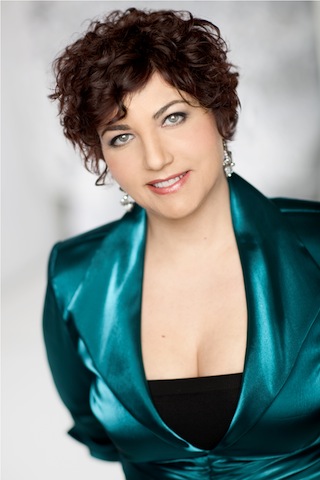
Vancouver’s Andrea Fabiana Katz will perform several works by Jewish composers. (photo from andreafabiana.ca)
On Aug. 3, Argentine-Canadian mezzo-soprano Andrea Fabiana Katz’s performance will cover several works by Jewish composers. “People associate tango with earthiness, passion and emotion…. The texts are very, very rich and full of metaphor and deep emotions, mostly about love, especially old familiar love. The poetry is always wonderful,” said Katz, who lives in Metro Vancouver.
The evening will be a milonga, which can be taken to mean both a musical genre and a tango party. Prior to the concert will be a tango dance lesson, and Jewish foods from Latin America will be available.
Film screenings
Among the festival’s offerings are five films. An Unknown Country employs firsthand accounts in following the lives of Jews who escaped from Nazi Germany to Ecuador, and shows their contributions to the economic, artistic, scientific and social life of their adopted country. Director Eva Zelig will be on hand after the film, on Aug. 7, for a question-and-answer period.
Other films at the festival include Los Gauchos Judíos, based on an Alberto Gerchunoff novel portraying the thousands of Russian Jews who came as farmers to Argentina in the late 1880s and 1890s; and The Fire Within, a documentary chronicling the integration of Moroccan Jewish settlers with the indigenous women of rural Peru in the late 19th century.
Two dramas, the bittersweet comedy Nora’s Will (Mexico) and the slow-burning thriller The German Doctor (Argentina), complete the cinematic line-up.
Lectures and artists
The Song of Lilith, an Aug. 6 talk by visual artist, filmmaker and Jungian therapist Liliana Kleiner, explores the ancient myth of Lilith found in the Talmud and in kabbalah, its incarnations through the ages, and how this legend relates to the present day.
Additional events include a writers workshop led by young-adult author Silvana Goldemberg and a presentation about the reality of the situation in Venezuela, led by Jack Goihman, who was an agriculture engineer when he left his home country of Venezuela because of its political instability. Arriving in Vancouver in 2014, Goihman completed a master’s in business administration and now works as a project manager.
A visual art show and sale will exhibit works by local and internationally shown and collected artists, including Miriam Aroeste and Kleiner, as well as a mural by the late Arnold Belkin.
A book sale, primarily of selections from the University of New Mexico Press, includes Oy, Caramba! An Anthology of Jewish Stories from Latin America, edited by Ilan Stavans, and Yiddish South of the Border: An Anthology of Latin American Yiddish Writing, compiled by Alan Astro, with a introduction by Stavens.
“Festival Judío is a double celebration of Jewish culture and Latin American culture,” observed Shalev. “Both are expressions of the richness and diversity of humanity.”
Jennifer Lines and Andrew McNee in The Taming of the Shrew. (photo by Tim Matheson)
Bard on the Beach celebrates its 30th season with an eclectic, nontraditional mix of three Shakespeare plays – a western Taming of the Shrew, a Bollywood All’s Well that Ends Well and Coriolanus, a political drama with gender reversal – and a stage version of the Oscar-winning movie Shakespeare in Love.
A Western-style Shrew
How do you present Shakespeare’s tale of a strong-willed woman brought to her knees by a tormenting husband in today’s #metoo world? Can you justify staging a misogynistic play in the 21st century? That was the dilemma facing director Lois Anderson, who played the female lead in 2012. Her solution? Take some liberties with the script – nip it here, tuck it there, add in some role and speech reversals, set it in the American Wild West of the 1870s. While purists may bemoan the surgery, there is a lot to like about this production.
In Shrew, Lucentio (Kamyar Pazandeh), the son of a wealthy merchant from Pisa, comes to Padua to study and is smitten by Bianca (Kate Besworth), the lovely younger daughter of Madam Baptista (Susinn McFarlen). He is resolved to marry her but the good Madam insists that her older daughter, Katherine (Jennifer Lines), must be married off first. Unfortunately, Kate has the reputation of being an über shrew and none of the local men sees her as wife material. Enter Petruchio (Andrew McNee), a down-on-his-luck Veronan who has come to Padua to “wife it wealthily” and sees Kate (and her dowry) as both a challenge and an answer to his prayers.
Their first meeting is a fiery battle of evenly matched wits and an insight into things to come as the “taming” journey begins from a spontaneous marriage proposal, through the outlandish wedding to the honeymoon in a canvas tent on the range. The scene with Petruchio’s men lounging around the campfire singing in harmony about tumbleweed is a harbinger of Kate’s metamorphosis from the shrew to the good wife.
Meanwhile, back in Padua, now that Kate has been married off, Bianca’s admirers are set to woo her. Lucentio and Hortensio (Jewish community member Anton Lipovetsky) disguise themselves as tutors to vie for her affections. Lucentio wins the battle of the swains, the couple elopes and Hortensio consoles himself by marrying a wealthy widow. Kate and Petruchio return to Padua to celebrate the nuptials and a wager is made among the three grooms as to which wife will be the most obedient and come when called. Although Kate is the one who appears to obsequiously respond, she makes her final exit with a bang.
Lines is stellar as Kate. We see her feisty side when she lassoes her sister Bianca and drags her around the room, when she throws a flowerpot out of a window onto a mocking crowd below and when she breaks a lute over Hortensio’s head – Lipovetsky plays the part with great comedic timing. We also see Kate’s more vulnerable side, as she sits alone contemplating her spinsterhood and what is, in essence, the bullying she endures from the townsfolk.
Petruchio’s character has been made into a kinder, gentler soul, more palatable to today’s sensibilities, but the nice guy doesn’t always mesh with the mean one Shakespeare wrote. That said, McNee is strong in his portrayal and you cannot help but like him. It helps that the chemistry between the two leads is palpable – their characters are outsiders who have finally found their soul mates and revel in the discovery.
The production values are high for Shrew. Mara Gottler has done a stellar job with the costumes, the colourful frocks worn by the women, the cowboy dusters and the urban togs of the localites. Cory Sincennes’ set is simple, with the opening scene of Padua City’s main street readying for a summer fête easily morphing into the Baptista sitting room or a saloon. Gerald King’s lighting design and Malcolm Dow’s western sound design, replete with sounds of galloping horses in a very funny pony express scene, complete the theme.
This Shrew is certainly worth seeing but it would have been better with the original script, acknowledging the culture of the Elizabethan period regarding the treatment of the “fairer” sex and opening the dialogue about how far women have come in the past 400 years and how much further there is to go. After all, you don’t take the antisemitism out of Merchant of Venice or the elder abuse out of King Lear – and you should not take the misogyny out of The Taming of the Shrew. Shakespeare’s works, warts and all, should be looked at through a 16th-century lens, not a modern one.
The Bard in India
Edmund Stapleton and Sarena Parmar in All’s Well that Ends Well. (photo by Tim Matheson)
All’s Well that Ends Well defies classification into one of Shakespeare’s genres – comedy or tragedy. Bard on the Beach plays it as the former and it pays off, with an audience-pleasing feast of colour, music, bhangra dancing and swordplay.
The setting is 1946 India in a country on the cusp of independence from British rule prior to the partition with Pakistan, which divided the country into Hindu and Muslim nations. The story revolves around Helena (Sarena Parmar), an upper-class Hindu physician’s daughter and ward of the aristocratic British Countess (Lucia Frangione), who falls in love with the Countess’s soldier son, Bertram (Edmund Stapelton). Bertram is dismissive of Helena, considering her beneath his station.
However, Helena is determined to have him. The Viceroy (Bernard Cuffling) is ailing and near death. Helena, remembering her now-deceased father’s various remedies, offers to treat the Viceroy in exchange for the right to marry any man of her choosing. But, while she gets her wish and Bertram is forced to marry her, he abandons her to go to battle. He leaves behind a letter stating that he will not live with Helena as her spouse until she retrieves a ring he is wearing and bears him a child.
In Delhi, Bertram meets virginal but coquettish Diana (Pam Patel) and seduces her (so he thinks) but Helena has previously met with her and made plans to trade places with Diana in the bed chamber. This deception allows her to meet Bertram’s conditions and finally convince him that she is worthy of him – although why she would want such a cad is beyond comprehension.
Helena’s journey of self-discovery is symbolized by her sartorial choices, as she changes from Western garb to a traditional sari by the end of the play, paralleling the Indian journey from colonization and British rule to independence.
It is nice to see the diversity of cast in this production and the use of Hindi dialogue, particularly by Diana’s mother, the widow (Veenesh Dubois). Parmar is lovely as Helena, Cuffling a grouchy but avuncular Viceroy. David Marr as Lafeu, the minister, is hilarious and Jeff Gladstone as Parolles, one of Bertram’s military mates, steals the show with his slapstick antics. Newcomer Patel as Diana is a breath of fresh air. The ensemble dancers under the direction of choreographer Poonam Sandhu and the two Gurkha guards, Munish Sharma and Nadeem Phillip, bring authenticity to the onstage movement.
This show is all about the visuals – the set, the costumes, the dancing and the lighting. Kudos to costume designer Carmen Alatorre for her stylish choices and to set designer Pam Johnson for the stunning terracotta arched set, which transitions from a palatial Delhi home to a Punjabi marketplace brimming with colour and activity. Co- directors Rohit Chokhani and Johnna Wright, with their talented cast and crew, have created a gem. This fusion of East meets West is a winner.
Fall for Shakespeare
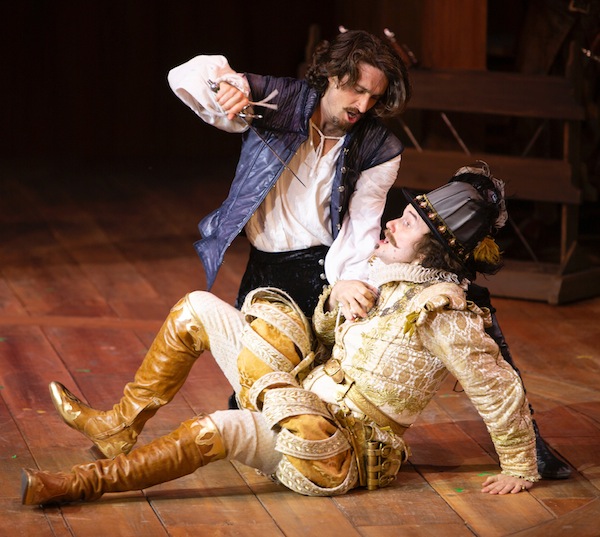
Charlie Gallant, left, and Anton Lipovetsky in Shakespeare in Love. (photo by Tim Matheson)
As director Daryl Clonan – who helmed last year’s hit, As You Like It, Beatlemania-style – said to the opening night crowd of Shakespeare in Love, this play is a love letter to the theatre. Not only that but it is great fun. The costumes, the acting, the set, the ambience, all do honour to its namesake 1998 film starring Joseph Fiennes and Gwyneth Paltrow. The movie took the cinematic world by storm, winning seven Oscars, including best picture, and this summer’s stage version is set to wow Vancouver audiences.
The story is set in period, the early 1600s. The Bard (dashing Charlie Gallant) is suffering from writer’s block as he works on a new play, Romeo and Ethel and the Pirate’s Daughter. His inspiration ultimately arrives in the form of muse Viola De Lesseps (Ghazal Azarbad), the daughter of a wealthy merchant, who dreams of acting on stage. However, as women were not allowed thespian careers at that time, she has to disguise herself as Thomas Kent in order to audition for Shakespeare’s new play. As Kent, she gets the part of Romeo.
Meanwhile, Shakespeare meets Viola and falls for her – and she for him, although she has been promised to Lord Wessex, a nasty fortune-hunting aristocrat who plans to whisk her away to his family’s Virginia tobacco plantations.
This show has something in it for animal lovers (the dog Spot is a scene stealer), movie buffs and, of course, Shakespeare mavens, who will delight in identifying the various lines from the Bard’s repertoire, the play-within-a-play, mistaken identities, swordplay, a balcony scene, an in flagrante delicto moment and more.
The ensemble cast is terrific and Gallant and Azarbad are sublime in their portrayals of the two lovers, who enjoy some steamy moments behind the bed curtains. Jennifer Lines has a small but memorable role as a regal and stately Queen Elizabeth I. Mention must also be made of newcomer Jason Sakaki, who plays Sam, the young boy who plays Juliet until opening night, when his voice changes, giving Viola a chance to tread the boards without hiding her gender. Kit Marlowe (Austin Eckert), one of Shakespeare’s competitors, has been given an enhanced role in this rendering and he helps Shakespeare muddle his way through Sonnet #18: “Shall I compare thee to a summer’s day….”
Four Jewish community members are involved in this production. Warren Kimmel – last seen at Bard as Shylock in The Merchant of Venice – plays Fennyman, a local impressario who takes a share in one of Shakespeare’s plays and, while it is a small role, Kimmel plays it to the comedic max. Anton Lipovetsky makes the unctuous groom Lord Wessex utterly repellent, Mishelle Cuttler provides a potpourri of baroque melodies as sound designer and musical director, and Tara Cheyenne Friedenberg’s work as movement coach adds energy and playfulness, as it does in The Taming of the Shrew.
Set and costume designer Cory Sincennes once again keeps the set simple, a stark sepia-coloured Globe Theatre, but goes all out on a colourful feast of costumes.
This will likely be the hit of the season.
Three of the four Bard productions are up and running; Corialanus opens Aug. 21. For the schedule and tickets visit bardonthebeach.org or call 604-739-0559.
Tova Kornfeldis a Vancouver freelance writer and lawyer.
In a world where Israel is accused of being an “apartheid state” and Zionism is equated with racism, it is understandable that we would recoil from accusations of actual racism in Israel, but we can’t afford to do so.
On June 30, 18-year-old Solomon Tekah was shot and killed by a police officer in Haifa. He is one of at least four Ethiopian-Israelis killed by police in recent years, while another seven deaths were cited as suicide or as being the result of uncertain causes after police encounters, according to community leaders. Reports of police brutality against the black community are alarming and suggest a systemic problem.
Supporters of Israel on social media like to celebrate Muslims, Druze and other minorities who reach the pinnacles of Israeli society, and so we should. But we should not restrain our criticism of serious racial injustice in that country just because of what outsiders might think. There have been struggles in Israel not only between Jews and Arabs, but around the treatment of and inequalities experienced by Sephardim and Mizrahim, Bedouins, Ethiopians and others. There are also legitimate concerns around the treatment of African asylum-seekers, concentrated in south Tel Aviv, who have been neglected and used as political footballs by politicians.
The New York Times Sunday compared the growing awareness of police brutality, as well as more casual racism, to the Black Lives Matter movement in the United States. In addition to the most visible cases – police killings – the article also includes examples of pervasive prejudices, such as the Ethiopian-born head of a social services agency who was offered housecleaning work by strangers on the street, as but one example. Interestingly, even though one arm of the Israeli government coordinated the airlift of 14,000 Ethiopian Jews in 1991, another arm insisted on second, symbolic circumcisions for the men, whose Judaism was apparently legitimate enough for the Law of Return but somehow not legitimate enough for the state-sanctioned arbiters of religious identity.
It is particularly disheartening when one compares the racism experienced by Ethiopian-Israelis with the hopefulness this community carried with them to Israel. One individual said that arriving in Israel after journeying for two months was “like touching the moon.”
“Is this the Israel we dreamed of?” Zion Getahun remarked. “It’s a question I ask.”
In light of recent events, the minister for internal security, Gilad Erdan, is setting up a new unit “to fight expressions of racism wherever they exist,” to ensure that force is used by police responsibly and that “over-policing” – in which Ethiopian-Israelis say they feel like they are treated like automatic suspects – is brought to heel.
The parallels are notable with the situation in the United States, where African-Americans experience disproportionate brutality and deaths at the hands of police officers. Also similar are the fears of parents, like the mother who worries about the coming time when her now-11-year-old son will want to go out by himself.
What is notable in the Times article, which seems well presented and fair, is that, unlike African-Americans in the United States, Ethiopian-Israelis do not have nearly the same level of community leadership or representation in government and other places of power. They are a small minority of 150,000, lacking the established community organizations that African-Americans have built over generations.
This means that, more even than in the United States, and more than in Canada, where non-indigenous Canadians have begun to speak up on behalf of the rights of indigenous peoples here and to address the wrongs that have been perpetrated, the moral obligation falls even more heavily on people who do not belong to the affected communities to right these wrongs.
In Israel, there is a need to encourage and support communal leadership among Ethiopian-Israelis while simultaneously speaking out on their behalf when they experience discrimination. As supporters of Israel and as people who are proud of the many achievements of the Jewish state in creating an enviable society nearly from scratch in an historical blink of an eye, we, too, have a voice.
Express concerns to Israeli family and friends, send support to the myriad organizations that build connections across Israel’s many divides and, while we’re at it, consider whether we can improve our own attitudes about and treatment of people who are different from us.
Erica Dee curated the show Weaving Voices, which takes place Aug. 9 at CRAB Park at Portside. (photo from Vines Art Festival)
Weaving Voices features Jewish community member Erica Dee, Tonye, Miss Christie Lee, Janelle Reid and Sara Cadeau, with instrumentalists Sean Mitchell and Jonny Tobin. The performance at this year’s Vines Art Festival on Aug. 9 is based on Dee’s singing workshop, Sing for the Soul.
Dee has been offering the group singing classes over the past two years. “This has been one of my favourite projects I have ever created and it has inspired me to write a whole new album and live performance,” Dee told the Independent. “Sometime in 2020, I will release this new project with a new name and it is very different from anything I have performed. It will be a live, multi-sensory experience that is meant for listening rooms and theatres, or parks. And I will activate the spaces with my singing workshop prior to the show and then include the participants in my live performance. I won’t share the name yet, but it does include my family’s name in it.”
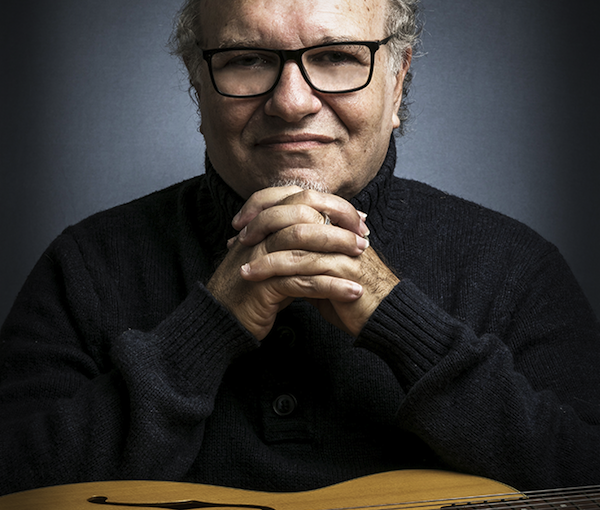
Dee’s cultural heritage includes Jewish and Italian roots, and jazz on both sides of the family. Her paternal grandparents are Evelyn Stieglitz (z’l) and Murray Landsberg, who she described as “the sweetest Jewish couple, who met in the Bronx in the 1930s. They were 13 and 15 and they were together until my grandmother past away a couple years ago. My father, Paul Landsberg, is a prolific jazz guitarist, who started his career teaching at Berklee College of Music in Boston, Mass. My mother, Rita Marie, was born to Rita Shirley Dallesandro and Jim Smith. Rita Shirley’s brothers, Frankie and Arthur, started a jazz big band in the ’50s called the Dellasandro’s, where they played saxophone and clarinet.”
Born Erica Dee Landsberg in Boston, Mass., Dee goes by only her first and middles names. She grew up “in the mountains of the Sinixt Territory (Nelson, B.C.). My mother, father, sister and I moved to the Kootenays in 1989 because my father helped start Selkirk College’s music program.”
Expressing her gratitude at being a Canadian citizen, Dee said she first moved to Vancouver in 2005, a couple months after graduating high school. “I followed my passion,” she said, “as I had already been performing and writing and I was ready to move to the big city to expand my artistry. I also followed my heart here, after falling deeply in love with a female DJ and producer who was running Vancouver’s only lesbian bar at the time.”
Dee is a vocalist, DJ, writer and producer. She released her first recording, Golden Mixtape, a combination of remixes and original work, in 2011. Her debut album, New Skies, came out in 2016.
“I am firstly a singer,” she said, “which means I get to connect to my instrument (aka my body) in such a deep and intimate way. I usually have some burst of inspiration come to me, whether it’s a hook, or a bass line, or a drum beat. Then I spend time developing the tone, feeling and resonance. Words usually come after, as I find when I add words to my art, it brings it into the mind and I like to stay in the body for as long as possible.
“As far as production goes, I have been producing music for over 10 years and have yet to release something that is completely self-produced. I use production as another way to get my ideas out, using drum pads, keys and programs like Logic and Ableton, and then eventually collaborate with other musicians and producers to complete the creation.
“Recently,” she added, “I have been creating on a loop pedal, which has taken my artistry to a completely new level. I started DJing when I was 20, when I realized that I could be my own band mate, and started touring a performance where I would sing and MC over top of my DJ sets, fusing together the music that I love and moves me with my originals and remixes.”
Dee collaborates a lot, both in performances and in the creation of new work. Her bio notes that she has “supported and toured with artists such as Lil’ Kim, Mos Def, Quest Love, A Tribe Called Red and Bad Bad Not Good.” Past guest artists have included Snotty Nose Rez Kids and Desiree Dawson.
“I love the magic that happens when artists share space together,” she explained. “Each person is unique, with their own experience, tone, voice, stories and inspirations. It activates every part of my soul to witness artists coming together in this way, harmonizing, improvising, and the dynamics of different voices coming in and out of the music. I always say, sometimes just having another person in the room is enough, without a word shared. I can feel every piece of music they have absorbed since their creation lighting up the space. It is truly is my favourite part about being an artist.”
For the Vines Art Festival show, Dee said, “I have brought together a group of such powerful artists…. Each of these artists shares their stories and truth in such a real and accessible way.”
Dee said she is honoured to be part of the festival, as she really connects to its core values. Part of the festival’s mission is to offer “platforms for local artists and performers to create with and on the land, steering their creative impulses toward work that focuses on the environment – whether a deep love of nature, sustainability, or climate justice.”
“Growing up, I spent a lot of time outside and I find a lot of my inspiration in nature,” said Dee. “I attended Waldorf School as a kid, where I learned how to use my hands to connect and create with the natural world in a sustainable way.
“Since then, I have always had a very strong connection and appreciation for the land I occupy. Wherever I travel, I always take the time to educate myself on whose land I am on and acknowledge that within my show. I use my platform to share information about the social and environmental issues that I feel are important – I actually got fired from a festival in Calgary for speaking about the pipeline and how much harm it will cause to indigenous communities.”
For the performance at Vines, Dee shared that there is going to be “an extra special element.”
Of that element, she said, “I have never done this before and I am so excited. During the first time I sat down with Heather [Lamoureux, the festival’s artistic director], I had a vision and I am really looking forward to bringing it to life!”
Weaving Voices on Aug. 9 takes place at CRAB Park at Portside, at 7 p.m. Other Jewish performers in the festival include mia susan amir, Ariel Martz-Oberlander and Rabbit Richards, and it features more than 80 artists overall, performing at parks throughout the city. Every event is free admission and more information can be found at vinesartfestival.com.
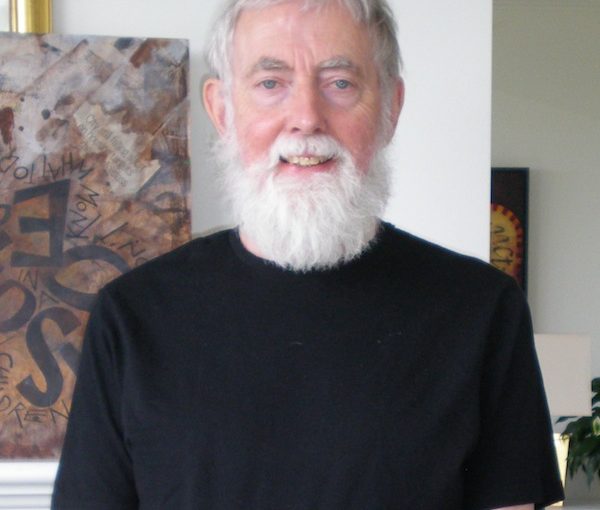
Ken Hughes infuses his paintings with messages. (photo by Olga Livshin)
Ken Hughes has always been fascinated with typography. “Since childhood, letters of the alphabet have intrigued me,” he said in an interview with the Independent.
“Public lettering is a centuries-old method of civic communication, both official and informal,” he said. “It goes back to Mesopotamia. By Greek and Roman times, public writing – inscriptions on buildings, commercial graphics, signs, epitaphs on tombs, graffiti – was common. The messages could be political or commercial, funerial or commemorative, religious or frivolous. In more contemporary times, particularly in Europe, public inscriptions have undergone a revival.”
The artist draws from this rich tradition for his paintings and his new show at the Zack Gallery, Ancient Writings in Contemporary Contexts, opens next week. A collection of inscriptional paintings, beautiful and evocative, colours and shapes of the images enhance and deepen the meanings of the lettering, and every piece tells a story.
Before retiring, Hughes was a professional graphic designer. He taught graphic design for years at Emily Carr and Kwantlen universities. He turned to art five years ago.
“Inscriptions – texts expressed formally or otherwise in different alphabets or languages – are a major source of inspiration for my paintings,” he said. “This particular exhibition’s goal is to visually express texts related to Jewish beliefs and culture. Some of the paintings have writings in the Hebrew alphabet. Others have transliterated Hebrew using the Roman alphabet.”
He explained that the messages in his paintings come from various sources: the Hebrew Bible, fiction and nonfiction by Jewish writers, as well as quotes by famous people, all related in one way or another to Jewish culture.
“I don’t speak Hebrew,” he said, “but I have friends who do. I always ask them to check the writing before I incorporate it into my paintings.”
In his work, the esthetics of the letters are intertwined with the message of the citation used. He has been collecting quotes, personal mottos, sayings and other forms of public texts for a long time. “I sing in a choir, and much of choral music is liturgical,” he said. “It has incredible messages, many of them in Latin. I also read a lot and get my messages from books, from newspapers, from common idioms.”
In 2002, Hughes took a yearlong sabbatical from teaching to prepare for what he does now.
“I traveled through Europe – Poland, France, Turkey, Belgium, Greece and Israel,” he said. “I took photos of the public inscriptions on civic buildings, in churches, at cemeteries. I wrote down quotes from illuminated manuscripts in national libraries. There are incredible inscriptions on the tombstones in Budapest, where many famous Hungarians are buried. Jewish cemeteries have beautiful inscriptions in Hebrew.”
Sometimes, a line of text or a quote stays in his memory or in his notebooks for decades before appearing in one of his paintings. Many of his pieces are sad, executed in a darkish palette, underscoring words of deep emotion: grief, fear, despair, memories of hard times and bleak thoughts. But there is hope and joy, too, and Hughes uses bright and colourful compositions to accentuate those messages.
One of his uplifting works, a multi-paneled cycle based on the story of Genesis, with Hebrew lettering dancing across the panels, is decorative as well as informative. The series will be in the exhibit at the Zack.
“Alphabets are amazing inventions, incredible almost,” Hughes said. “They allow people to communicate ideas with just a few symbols. And they are all different – the Roman alphabet, the Cyrillic letters, the Hebrew. In all cases, letters by themselves mean nothing; they’re just symbols. But a combination of letters, a phrase, could have profound meaning.”
When Hughes starts working on a piece, he approaches it as a designer, with a typographer’s attention to detail. He makes many sketches while investigating each idea. What colours should be employed and in what combinations? What is the best number of panels for this message and the most expressive configuration to highlight the meaning of the words? Even the font used can make a difference.
“Some letters look better in a rounded font; others need a blockier typeface,” he said. “The positioning of the letters and the words could be of paramount importance in my paintings. They constitute the composition. And, of course, the message itself often dictates the font type.”
There are not many artists in Canada who dedicate their art to this kind of painting.
“I wanted my paintings at the Zack,” Hughes said. “I don’t want to display at commercial galleries. I think my works are much more suited to schools, churches or community centres.”
Ancient Writings in Contemporary Contexts runs from July 25 to Aug. 25. To learn more, visit kenhughes-art.com.
Olga Livshin is a Vancouver freelance writer. She can be reached at olgagodim@gmail.com.
Michael Germant, left, Sarah Boes and Drew Henderson co-star in Island Production’s The Understudy, Aug. 1-10 at PAL Studio Theatre. (photo by Jayme Cowley)
Oftentimes, in cultural endeavours, there is a tension between artistic vision and profit margins; that is, if there is any money to be made. This is one of the themes of The Understudy by Theresa Rebeck, which is being presented by Island Productions next month at PAL Studio Theatre.
The show co-stars Sarah Boes as Roxanne, the stage manager, who also is a frustrated actor; Drew Henderson as Jake, the good-looking action-hero star trying to be taken seriously as an actor; and Jewish community member Michael Germant as Harry, the understudy, who happens to be Roxanne’s ex-fiancé. Despite the personal drama, “a stoned lightboard operator, an omnipresent intercom system [and] the producers threatening to shutter the show,” Roxanne must try to run the understudy rehearsal for the Broadway première of a recently discovered Franz Kafka masterpiece.
Existentialism, explains director Mel Tuck in his online notes for the production, “denotes the inexplicable nature of human existence and emphasizes man’s freedom of choice and responsibility for the consequences of his acts.”
“What I like about The Understudy and what I think is funny,” Germant told the Independent, “is that, just when you think the characters have got things under control, everything falls apart. I also love how Rebeck makes the events of the play intertwine with the events of Kafka’s ‘undiscovered’ play-within-the-play thematically.”
Echoing Tuck’s comments, Germant added, “The existential aspects in Kafka’s play lead to the final choice that our three protagonists make at the end, both within and ‘without’ Kafka’s play.”
About those protagonists and what they symbolize, Tuck writes, “There are actors that have substantial careers because they are attractive, and then there are actors who have chameleon-like skill at hiding themselves within the role they are playing. Both have their place and purpose. The battle between art and business is forever being played out before our very eyes. There are many arguments for art as opposed to business. We artists believe in the value of entertainment and intelligent growth for ourselves and our public. We are exploring polarities and the implications of internal versus external thoughts; how we are affected by our conditioning and how that manifests in our social lives and activities. In the theatre, as in movies and TV, one prime issue has taken precedence: money. Money is a defining and deciding factor in avenues of artistic endeavour. What is the best possible way to make a play, movie or TV show successful? The sad reality is usually money takes precedence. And often funny means money. This is a very funny play.”
The Independent has interviewed Germant a few times, all for serious dramas, but he has done comedy before.
“Good dramas have humour written into them,” he said. “It’s the spoonful of comedy that makes the drama go down. And vice versa – good comedies like The Understudy have drama at their core.
“We’ve actually done another comedy, called Seminar, by Theresa Rebeck…. A drama we did – John Patrick Shanley’s The Dreamer Examines his Pillow – has a lot of humour, and a comedic ending. Both of those plays were also at the PAL Studio Theatre and both in 2014,” said the actor, for whom this play marks his seventh for Island Productions.
“On screen,” he added, “I was in a pilot called High Moon, where my character was the comic relief, and I did a short dark comedy, which was really well-received at film festivals this year called Caught in the Spokes.”
About the ways in which comedic and dramatic roles differ, Germant said, “Comedy is heightened pace and energy. In drama, you can set your own pace – you can pause or take a break or a breath wherever you want. But comedy is structured very specifically and timing is the golden rule. In that way, it’s more disciplined and difficult than drama.”
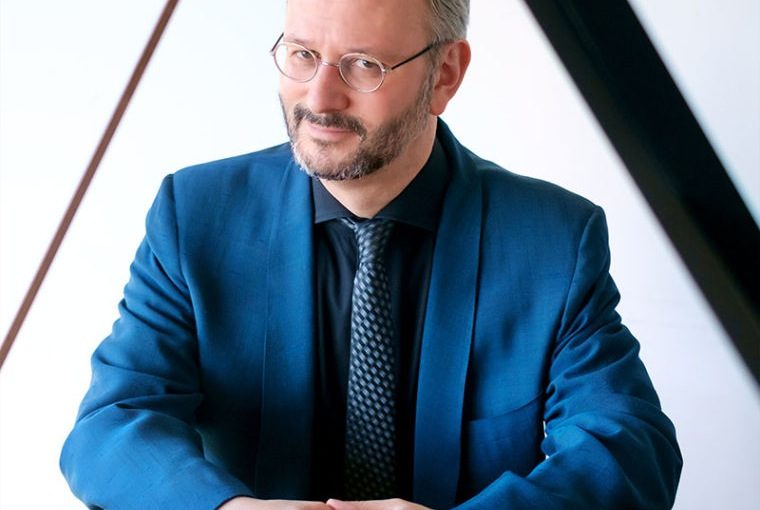
Byron Schenkman performs in the concert called Chopin Preludes on Aug. 1 at Christ Church Cathedral. (photo from Byron Schenkman)
“I think Chopin was an exceptionally sensitive pianist and composer – more of a poet than most. Sometimes his music is almost painfully beautiful. And, these days, I think we need all the poetry and beauty and sensitivity we can find!” Byron Schenkman told the Independent.
Schenkman returns to the Vancouver Bach Festival this year. Presented by Early Music Vancouver, they will perform preludes by Frédéric Chopin on Early Music’s 19th-century Broadwood fortepiano on Aug. 1, 1 p.m., with a pre-concert talk at 12:15 p.m., at Christ Church Cathedral.
The concert is a collaboration with the Vancouver Chopin Society. Describing Chopin as “a central figure of 19th-century Romanticism,” the program summary notes that “his connections to Bach are clear in his own preludes, which were directly inspired by Bach’s The Well-Tempered Clavier.” To place “Chopin’s music in the context of Romantic composers who influenced his work,” Schenkman’s performance will include pieces by Maria Szymanowska, Robert Schumann, Clara Schumann and Johannes Brahms.
Of playing Chopin, Schenkman said, “I think the biggest challenge – and the greatest joy – is honouring the delicacy of Chopin’s music even when it is intellectually complex and emotionally very deep. Compared with performing most other composers’ work, it’s like creating art out of glass instead of marble or bronze.”
Schenkman performs on piano, harpsichord and fortepiano, which is, simply, a piano made in the 18th and early 19th century. They also have contributed to more than 40 CDs, including some on which they have played on historical instruments from the National Music Museum, in Vermillion, S.D., and from the Museum of Fine Arts, in Boston. The award-winning musician is a founding member of several ensembles, and teaches music history at Seattle University, as well as being a guest lecturer on the harpsichord and fortepiano at other institutions. In 2013, they launched Byron Schenkman & Friends, a Baroque and classical chamber music series in Seattle.
A graduate of the New England Conservatory and Indiana University, Schenkman said, “I grew up in a home with lots of music. I often heard one of my older sisters practising the piano and it is still a very comforting sound for me, especially the repertoire that she practised most: Mozart, Beethoven, Schubert and Chopin.”
In past Bach Festivals, Schenkman has performed Bach, Ludwig van Beethoven, Johannes Brahms, Felix Mendelssohn and Ignaz Moscheles.
“I am really happy to be returning to Vancouver, one of my favourite cities,” they said. “And I am honoured to be part of the wonderful Vancouver Bach Festival along with so many inspiring colleagues.”
This year’s 14-concert festival, which runs July 30 to Aug. 9, begins with EMV’s ensemble-in-residence, Les Boréades, in a performance over two nights – July 30 and 31 at the Chan Centre for the Performing Arts – of Bach’s Complete Brandenburg Concertos. It also closes at the Chan Centre – with Henry Purcell’s Hail Bright Cecilia – but the other concerts take place at Christ Church. For tickets and more information, visit earlymusic.bc.ca or call 604-822-2697.
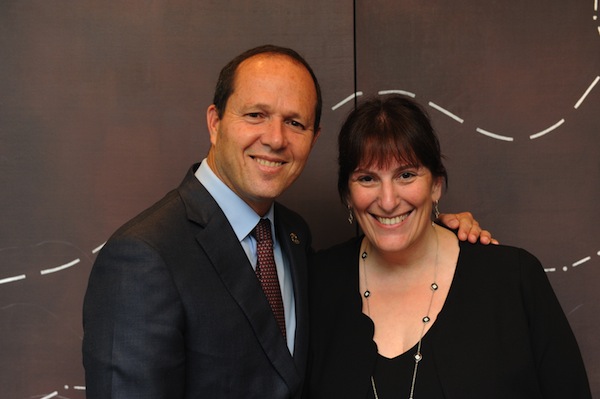
Then-mayor of Jerusalem Nir Barkat and Nomi Levin Yeshua at the Jerusalem Foundation of Canada gala in Toronto in 2014. (photo from Nomi Levin Yeshua)
This article is the first in an occasional series about people with British Columbian roots having positive impacts in Israel and elsewhere.
When Nomi Levin Yeshua went to Israel in 1990, she wasn’t committed to staying there. Almost three decades later, the Vancouver-born and -raised woman can look back on a career that has impacted the face of Jerusalem and Israel.
Thanks to a chance meeting over Shabbat lunch with her grandmother’s former neighbour’s sister – “You know Israel,” she said, laughing – Yeshua had barely arrived in Israel when she got a job as assistant to the assistant to Teddy Kollek, Jerusalem’s mayor – but the job was more than that.
Shula Eisner, Yeshua’s new boss, had been working for Kollek since 1965, just before he began his 28-year run as mayor. Kollek was chairman of the Israel Museum and, before that, had served 11 years as director general of the prime minister’s office under David Ben-Gurion. In that role, Kollek effectively created almost all of the government agencies in the new state.
“One of the things he believed was that there had to be a national museum,” Yeshua told the Independent recently while in Vancouver for a milestone birthday of her mother, Shanie Levin. “He went around raising money to start the Israel Museum. He had an office there and [Eisner] was originally hired there to work with him with all the foreign donors. Then he was elected mayor and he kept to the Israel Museum office.”
In 1966, Kollek founded the Jerusalem Foundation, where Yeshua now works.
“That was his way of creating a forum for supporters of Jerusalem around the world, to be part of creating a new vision for Jerusalem. Then, a year after that, with the Six Day War and the reunification of the city, suddenly everything was just multiplied,” she said.
Yeshua acknowledged that Kollek’s multiple roles as mayor, head of the national museum and leader of a major foundation would probably not be sustainable today, but that was a different time.
“For him, it was all fluid,” she said.
To accommodate his different hats in the era before email or even fax machines, there was a driver who shuffled between offices, taking papers back and forth.
When Eisner moved over to another foundation, she handed her baton to Yeshua, who worked with Kollek through his last years as mayor and continued until a few months before he passed away, in 2007. She continues to run all donor relations for the Jerusalem Foundation and she personally handles Canadian fundraising for the organization.
The Jerusalem Foundation was started by Kollek because he saw that Jerusalem was a very poor city.
“A lot of religious institutions that don’t pay taxes at all are in Jerusalem, so he knew that it was always going to be a challenge for the city to have a balanced budget, to expand the city, to develop the city, to provide for the citizens of the city, so he knew that he was going to need to raise money,” she said.
Kollek pioneered a fundraising model that is now almost universal across Israeli and Jewish philanthropy.
“He connected every donor to a specific project and they knew that their money went to that project and they could come – and now their grandchildren come – and see those projects. To this day, they can still track the money. The Jerusalem Foundation was really at the forefront of that movement of changing the way people were giving to Israel. Now, it’s taken for granted, but it wasn’t back in the late ’60s and early ’70s at all. That was Teddy,” she said. “He wanted people to feel personally connected to the city, to the project, to the place.”
The foundation emphasizes “shared living” and is now focused on a vision for 2030.
“This is a city that is completely about how to exist together in this space that we share. It’s not just Arabs and Jews. It’s also secular and religious, it’s poor and rich, it’s all kinds of divisions that exist in the city,” she said. “But how do we share and how do we understand each other better?”
One major project is Hand-in-Hand School for Bilingual Education.
“Bilingual education is something that Canadians completely understand but Israelis less so. This is a school that teaches in Arabic and in Hebrew, in mixed classrooms. The rest of the Israeli education system is – we don’t like to use this word but it’s the truth – segregated,” she said. “There are Jewish schools, there are Arab schools and then, even within the Jewish schools, there are religious and nonreligious. This school brings together all of the different population groups and at all times there is an Arabic-speaking and a Hebrew-speaking teacher in the classroom.” There are now six such schools around the country.
Another area of the foundation’s work is helping the most vulnerable populations in the city, through projects such as Springboard, which develops programs primarily through the education system to push gifted kids into opportunities their financial situation might not otherwise permit.
The Jerusalem Foundation is also the city’s second-largest funder to the arts, after the municipality.
“We really believe that a modern and thriving city should have a good cultural scene. Culture is not just for one population group. All members of the community should be cultural consumers. But you have to create culture that is appropriate for those people,” she said. “For example, there is a dance troupe for ultra-Orthodox women. They only perform for women, of course, because otherwise that wouldn’t work for them. But they’re really doing amazing stuff and giving these ultra-Orthodox women who want to dance an opportunity to have a really high-level, professional dance troupe within the system that works for them.”
The foundation is also building a new Hassadna Conservatory of Music.
“They help kids ages six all the way through high school with classical music education and they also provide a special program for children of Ethiopian descent who don’t necessarily have the financial means to get musical training and they have a special program for special needs kids that’s integrated,” she said.
Yeshua credits her Vancouver upbringing as foundational to her worldview and accomplishments. She grew up in the Habonim Dror Zionist youth movement and was a camper, counselor and camp director at Camp Miriam. At home, her Jewishness was nurtured in a pluralistic way.
“In terms of how my mother brought us up, Jewish identity wasn’t limited to our religious identity,” she recalled. “National identity was something that was acceptable, cultural identity was very much encouraged. I think growing up in the very open community of Vancouver – to me it always seems that way, at least – it allowed me to be Jewish in a way that I felt good with and it wasn’t only one way to be Jewish.”
Yeshua acknowledged that “many people feel somewhat alienated from Israel today.”
“I want people to understand that there is a way to engage with Israel, to support Israel, and not contradict your own value system or what you think is acceptable,” she said. “What we do with the Jerusalem Foundation is something that people can respond to, relate to, understand – to protect Jerusalem as a city that is for everyone.”