Skip to content
  • Home
  • Subscribe / donate
  • Events calendar
  • News
    • Local
    • National
    • Israel
    • World
    • עניין בחדשות
      A roundup of news in Canada and further afield, in Hebrew.
  • Opinion
    • From the JI
    • Op-Ed
  • Arts & Culture
    • Performing Arts
    • Music
    • Books
    • Visual Arts
    • TV & Film
  • Life
    • Celebrating the Holidays
    • Travel
    • The Daily Snooze
      Cartoons by Jacob Samuel
    • Mystery Photo
      Help the JI and JMABC fill in the gaps in our archives.
  • Community Links
    • Organizations, Etc.
    • Other News Sources & Blogs
    • Business Directory
  • FAQ
  • JI Chai Celebration
  • JI@88! video

Recent Posts

  • Story of Israel’s north
  • Sheltering in train stations
  • Teach critical thinking
  • Learning to bridge divides
  • Supporting Iranian community
  • Art dismantles systems
  • Beth Tikvah celebrates 50th
  • What is Jewish music?
  • Celebrate joy of music
  • Women share experiences 
  • Raising funds for Survivors
  • Call for digital literacy
  • The hidden hand of hate
  • Tarot as spiritual ritual
  • Students create fancy meal
  • Encouraging young voices
  • Rose’s Angels delivers
  • Living life to its fullest
  • Drawing on his roots
  • Panama City welcoming
  • Pesach cleaning
  • On the wings of griffon vultures
  • Vast recipe & story collection
  • A word, please …
  • מארק קרני לא ממתין לטראמפ
  • On war and antisemitism
  • Jews shine in Canucks colours
  • Moment of opportunity
  • Shooting response
  • BC budget fails seniors
  • Ritual is what makes life holy
  • Dogs help war veterans live again
  • Remain vital and outspoken
  • An urgent play to see
  • Pop-up exhibit popular
  • An invite to join JWest

Archives

Follow @JewishIndie
image - The CJN - Visit Us Banner - 300x600 - 101625

Month: January 2022

Rabbi talks of healing

Rabbi talks of healing

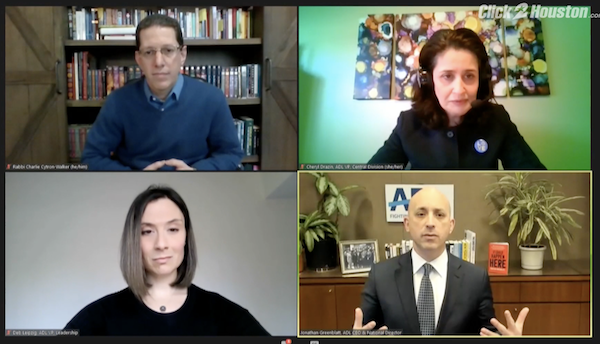
Clockwise from top left: Rabbi Charlie Cytron-Walker of Congregation Beth Israel in Texas speaks with the Anti-Defamation League’s Cheryl Drazin, Jonathan Greenblatt and Deb Leipzig. (screenshot)

Rabbi Charlie Cytron-Walker was bustling around Congregation Beth Israel, in the Dallas suburb of Colleyville, Tex., getting ready for Shabbat morning services. There was a knock on the synagogue’s door and the rabbi welcomed a stranger who was looking for shelter from the unusually cold morning. Cytron-Walker prepared the man a cup of tea and made conversation.

“There were no initial red flags,” the rabbi recalled Jan. 20, in an Anti-Defamation League web event that included the director of the Federal Bureau of Investigation. The man exhibited no signs that he would be a danger, said Cytron-Walker.

“The sense of nervousness, the darting around, those kinds of things that you might expect,” were absent, said the rabbi. “He was calm, he was appreciative, he was able to talk with me all the way throughout, look me in the eye.… I didn’t have a lot of suspicions.”

The unexpected guest was, of course, Malik Faisal Akram, an armed British man who would take the rabbi and three congregants hostage in an 11-hour standoff on Jan. 15. In the end, for all the responders mobilized and crisis negotiators assembled, the incident ended when the rabbi threw a chair at the attacker and the four hostages escaped.

Cytron-Walker explained how he put together the man’s motivations by listening to his rantings and the conversations he was having by phone. Akram was seeking the release of Aafia Siddiqui, a convicted terrorist known as Lady Al Qaeda, who is incarcerated in an American prison not far from Beth Israel synagogue. The hostage-taker apparently subscribed to antisemitic ideas, including the belief that the United States would do whatever was necessary to save the lives of Jewish hostages and that pressure by Jews could lead to his demands being met. At some point, Akram became aware of Rabbi Angela Buchdahl, senior rabbi at Central Synagogue in New York City, and demanded to speak with her during the incident.

“I don’t know how or why he chose her exactly, other than the fact that he thought that she was the most influential rabbi,” said Cytron-Walker. “And I was thinking, this guy really believes that Jews control the world.… I tried to explain to him to the best of my ability that it doesn’t work that way.”

The rabbi credited law enforcement for their response, and spoke at length about the security preparations that synagogues and other Jewish institutions take, with the support of groups like UJA Federations, the Anti-Defamation League, the Secure Community Network and the FBI.

“We had a security plan in place,” said Cytron-Walker. “All of it was helpful, and yet, one of the things that we are aware of is that no matter how good the plan is, no matter how good the security is, these kinds of things can still happen.”

Christopher Wray, director of the FBI, expressed solidarity with not just those immediately affected by the incident but the entire Jewish community.

“We understand all too well that these kinds of attacks are terrifying and that they are not only terrifying to the individuals directly and physically involved, they are also terrifying for all the members of Congregation Beth Israel and, really, for the entire Jewish community, many of whom understandably worry about other threats still out there,” Wray said. “Our joint terrorism task forces across the country will continue to investigate why this individual specifically targeted Congregation Beth Israel on their day of worship.”

Neither Wray, nor any other individual on the livestream, addressed remarks by the FBI’s special agent in charge of the case. As the hostage-taking in the synagogue was unfolding, Matthew DeSarno told media that the assailant was “singularly focused on one issue, and it was not specifically related to the Jewish community, but we are continuing to work to find motive.” His remarks have been condemned as erasing the antisemitic motivations of the terrorist.

While none of the hostages was physically harmed, Cytron-Walker spoke of the emotional recovery that he, the other hostages and the broader community are undergoing.

“It’s going to be one step at a time for us,” he said. “We are doing the best we can to heal. We’re going to have services on Shabbat evening, we’re going to have services on Shabbat morning, we’re going to have religious school on Sunday and we already had a beautiful healing service on Monday night that was so meaningful – to actually see people, to be able to hug people.… But it’s one step at a time.… I’m getting the care that I need. I’m trying to make sure that I take care of my family and, at the same time, one of those pieces that we’re going to have to get past is that sense of fear.

“There was something traumatic that happened within the congregation,” he continued, “and we know that it’s not just our congregation that feels a sense of fear. It’s something that a lot of people and a lot of Jewish people in particular, our people, are living with.… We want to be able to go to services and pray and be together because one of the most important things is to be with one another within that sense of community. That’s needed right now more than anything else.”

Jonathan Greenblatt, chief executive officer of the Anti-Defamation League, moderated the online event.
Format ImagePosted on January 28, 2022January 27, 2022Author Pat JohnsonCategories WorldTags ADL, Anti-Defamation League, antisemitism, Charlie Cytron-Walker, hostage-taking, security, terrorism, Texas
A chance to journal, create

A chance to journal, create

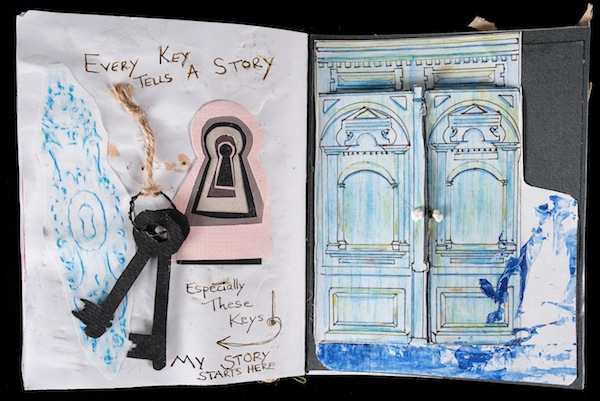
Kathy Bilinsky’s two-page collage makes us wonder what story – or two or three or more – we could find behind the mysterious ornate blue door. (photo by Byron Dauncey)

The Sketchbook Show officially opened at the Zack Gallery on Jan. 12. The brainchild of Hope Forstenzer, gallery director, and Lisa Cohen Quay, coordinator of the Jewish Community Centre of Greater Vancouver’s Adults 55+ program, the exhibit is the culmination of a journaling workshop.

“We wanted to give JCC members the opportunity to say what they felt about COVID and everything else in their lives,” Forstenzer told the Independent. She offered the gallery as a place for the in-person workshop and invited instructor Lex Ireton to lead it.

photo - Lex Ireton led the workshop that resulted to the Zack Gallery’s current exhibit, the Sketchbook Show
Lex Ireton led the workshop that resulted to the Zack Gallery’s current exhibit, the Sketchbook Show. (photo from Lex Ireton)

Ireton, a graduate of Alberta College of Art and Design, and Forstenzer know each other through their work as glass artists.

“I recently went back to school to get an art therapy diploma,” said Ireton. “When Hope contacted me about the workshop she had in mind, I was excited. I’ve taught art classes before, but this one was my first class for adults.”

Putting It All Down: A Creative Journaling Workshop started in the fall of 2021, well into the second year of the pandemic.

“The beauty of journaling is that you don’t have to be an artist,” said Ireton. “We provided all the participants with blank journals plus writing, drawing and crafting supplies. And they had the gallery space itself to work together and create.”

Although more people initially came to the workshop, only six participants stayed to the end. “We met once a week for eight weeks,” Ireton said. “Everyone wore masks, of course. I came up with an exercise, and we did it during the session, sometimes timed, sometimes not. Often, people were so involved, they continued the work at home.”

One of the exercises was called 30 Circles. Ireton explained: “I gave each participant a sheet with 30 empty circles and asked them to fill each circle in any way they chose: a line, a colour, words, images. The circles could be filled thematically or not. Nobody was forced to fill all the circles. Just a few could spark a direction the person wanted to go. It was a warm-up activity, a way to explore the materials and ideas without the pressures of a final completed project. Later, we used the circles as inspirations for journal pages or utilized them for collages.”

Another exercise was a thematic prompt to fire participants’ imaginations, so they could write or draw on a subject. Some wrote poetry or essays. Others did collages using materials they wanted: old magazines, coloured paper, their own paintings or drawings, dry leaves and flowers, fabric fragments.

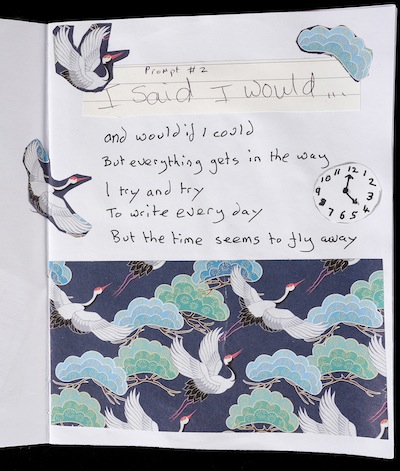
photo - A page of Judy Stern’s sketchbook expresses a lamentation familiar to any writer
A page of Judy Stern’s sketchbook expresses a lamentation familiar to any writer. (photo by Byron Dauncey)

“As the workshop progressed, participants wanted to know more about each other. We talked a lot. People shared ideas and finished pages. Everyone became more confident with the techniques and media,” Ireton said. “Each session was a joyful social event as much as a journaling workshop. We were all tired of the isolation restrictions caused by COVID.”

While the JCC supplied materials for the workshop, local artist Susan Lee created the empty journals everyone used. “Susan donated the journals for the workshop,” said Forstenzer.

This month, Forstenzer mounted the show, which comprises selected pages of participants’ journals.

“This show is a tangible result of the workshop,” she said. “It is imbued with the energy of the participants putting their imagination to work, creating something meaningful regardless of their personal history as art-makers. The show reflects the child-like pleasure everyone experiences while playing with glue and paper and colours. The weeks of working on their creative sketchbooks has yielded a look into the beauty of putting thoughts on paper in words and images.”

The show is anonymous – there are no names attached to any of the pages, but each image serves as a window into the author’s personality. Some are humorous, like a tongue-in-cheek collage of two pages from a magazine. The collage contains two contradictory lists: What Men Love in Women juxtaposed with What Women Love in Men.

Other images are colourful and lyrical drawings, like a leafy branch with no words. And others combine drawings with poetry and cuttings.

Several workshop participants agreed to talk to the Independent about themselves and their journals.

Judy Stern, a retiree, didn’t have any artistic experience prior to the workshop. “In high school,” she said, “art was the only subject I ever failed. This took away any confidence I might have had, so I have never taken an art class, although I often thought about doing so. Last fall, I received information from the JCC about the upcoming journaling class. I enjoy writing and do have an interest in art, so I asked whether I needed any art experience. I was told, absolutely not…. I was so excited about this, as it was my first group social activity since the beginning of COVID. I was eager to be out and about again, doing something different.”

At first, she was nervous, but the welcoming atmosphere of the workshop soon put her at ease. One image from her journal, cranes flying away among the clouds, integrate her poem – a lamentation familiar to any writer – into a beautiful metaphoric collage.

“I would’ve been happy for the class to go on indefinitely,” she said. “I hope that something similar will be offered again. I am already thinking about my next journal.”

Kathy Bilinsky, another retiree, admitted to having some previous artistic exposure. “I’ve always enjoyed the creative process,” she said. “I have taken various art classes over the years, including two certificate programs at Emily Carr.”

Bilinsky, joined the workshop at the recommendation of Stern, who is a friend. “Judy said I might like it, and she was right. Before, when we could still travel, I always worked in sketchbooks. I have many travel journals documenting our trips with sketches, watercolours, and a bit of cut and paste. As we’re not traveling these days, I looked at this workshop as the opportunity to create.”

Her adjoined journal pages, “Keys and Door,” feature a key ring and a keyhole, above which is written, “Every key tells a story.” We wonder what story – or two or three or more – we could find behind the mysterious ornate blue door depicted on the opposite page.

“I didn’t fill all the pages in my journal,” said Bilinsky, “but so many ideas have been circulating in my mind that I would like to fill in the remaining pages.”

The show can be viewed in person at the Zack Gallery or online at online.flippingbook.com/view/892314086. It runs until Feb. 11.

Olga Livshin is a Vancouver freelance writer. She can be reached at [email protected].

Format ImagePosted on January 28, 2022January 27, 2022Author Olga LivshinCategories Visual ArtsTags journaling, Judy Stern, Kathy Bilinsky, Lex Ireton, Sketchbook Show, Zack Gallery
A blind view of terror

A blind view of terror

Another violent attack on a North American synagogue, this one in Texas, has undermined the feelings of security among Jewish people everywhere.

It is important to see the incident in perspective. Thankfully, the rabbi and three other hostages survived the 11-hour ordeal and the only physical casualty was the perpetrator himself. Second, although such incidents happen too frequently, it must be remembered that, in the context of the many Jewish institutions in North America, this remains a highly unusual phenomenon. Third, the community – Jewish and non-Jewish – locally and internationally condemned the attack and celebrated the escape of the hostages. This differs from situations we have seen in other times and places in which those in power – police, political leaders, the general public – were either complicit or indifferent. A service of healing two days after the incident brought a thousand people of many religious and demographic backgrounds together in response. Police, interfaith leaders and elected officials were united in their expressions of condolence and solidarity.

As Rabbi Charlie Cytron-Walker noted in a presentation with the Anti-Defamation League (click here for story), Jewish community organizations benefit from the (sadly necessary but well-developed) security protocols created and implemented in partnership with Jewish organizations and law enforcement officials. These precautions are familiar to anyone who has set foot in a Jewish institution in recent decades. The visible presence of security can be a reassurance but also is a reminder of the potential for such an attack for people entering a synagogue for services or a Jewish community centre for a workout or sending their children to a Jewish day school. However, another byproduct of this increase in security and comfort for some Jews is the discomfort and lack of safety these protocols elicit in racialized Jews and others who experience more harm from policing. The answer to the problem of a lack of security cannot only be addressed by ever-increasing security, be it walls, cameras, guards, or bollards.

It is perhaps one of the most enduring cognitive disconnects that, while almost any Jew has, at least in the back of their mind, the potential for attack, whenever such an incident does take place, a seemingly opposite reaction occurs among some non-Jewish observers.

In the Texas case, it was exemplified by Matthew DeSarno, the FBI agent in charge of the case, who, in the midst of the crisis, told media that the perpetrator “was singularly focused on one issue, and it was not specifically related to the Jewish community, but we are continuing to work to find motive.”

Even without knowing the details of the individual perpetrator or his motivations, the idea that an official would insist that an attack on a synagogue is unrelated to the Jewish community is jaw-dropping. Unfortunately, it is a common response.

The most celebrated example was after terrorists in Paris targeted a kosher supermarket in 2015, when then-U.S. president Barack Obama condemned those who “randomly shoot a bunch of folks in a deli in Paris.” If the Islamist terrorists who perpetrated the attacks on multiple Jewish targets that day didn’t know that Hypercacher was a kosher supermarket with a primarily Jewish clientele, it was an incredibly lucky coincidence for them.

This refusal to see explicit attacks on Jews as explicit attacks on Jews may be a psychological phenomenon beyond our realm to unravel. Yet there seems to be some socio-psychological need to search for any alternative explanation than plain old antisemitism when a synagogue or other Jewish institution is attacked.

To be kind, perhaps it is wishful thinking. Decent people might search for a rationale that alleviates the fear that the oldest prejudice is as alive today as ever. More realistically, there is a web of conscious and, probably more commonly, unconscious biases that blind people to the blatantly obvious.

As we learned more about the perpetrator, we discovered that he subscribed to a form of conspiracy thinking that sees Jews as having unparalleled power – in this case, the ability to induce the American government to release an imprisoned terrorist. Nevertheless, because the perpetrator was using Jews as an avenue meet his objectives, rather than being motivated solely by a desire to attack Jewish people, the FBI agent eliminated antisemitism as a motive – a truly confounding perspective from a law enforcement official standing outside a synagogue where Jews were being held hostage.

This reaction happens too frequently to be dismissed as a coincidence. There is something baked into the Western imagination that makes denial and deflection the default response to an attack on Jewish people.

One explanation may be that the very ideas that the Texas assailant held – that Jews are inordinately powerful – although rarely expressed so crudely, is actually held by a large swath of the general public, perhaps leading people to conclude that, no matter what befalls an individual Jew or two, “the Jews,” as a people, still hold all the cards or will be just fine.

Other obfuscations dismiss clear and unequivocal attacks on Jews as mere “political statements” on Middle East affairs. Interestingly, those who sometimes explicitly blame Israel or Israeli policies for overseas antisemitic incidents are playing into another familiar and ancient trope about Jews: whatever befalls them, they have brought upon themselves.

It is never bad advice for Jews to be vigilant about our individual and collective security and each violent attack is a timely reminder. But what we need to see are more non-Jews, especially those in positions of authority, addressing the blindness they have as individuals and institutions to what is, to Jewish eyes, absolutely obvious.

Format ImagePosted on January 28, 2022January 27, 2022Author The Editorial BoardCategories From the JITags antisemitism, Charlie Cytron-Walker, FBI, security, terrorism, Texas

Sadly, not a new experience

Some of us are likely struggling to recover from the hostage-taking event at Congregation Beth Israel in Texas, along with pandemic stress. Perhaps most stressful is that we know a synagogue invasion could happen anywhere, during any service. Most of us figure out where the exits are when we go to synagogue, a Jewish community centre or other Jewish institution. We know the history. We need to be on guard when we gather.

On Jan. 15, we streamed our local congregation’s services to our Winnipeg living room and watched a kid my children knew from elementary school lead services. He was becoming a bar mitzvah. Jewish life continues despite the pandemic.

Antisemitism and traumatic events continue, too. When I realized what was happening in Texas, thanks to Jewish social media, it was hard to look away, even though it was Shabbat. Initially, non-Jewish news reports said there was an “apparent hostage-taking event.” This language was used despite the event being livestreamed. Why wasn’t it “real” from the beginning? Even after the hostages were freed, alive, thank G-d, the FBI didn’t immediately use the word antisemitism or hate.

There was no immediate answer from the FBI on why this person chose a synagogue during Shabbat services. There was a rush in some quarters to discuss why Islamophobia is wrong. Even as the hostage-taker identified his cause as aligned with that of Dr. Aafia Siddiqui, a convicted felon who was outspoken in her antisemitism at her trial, others (including the synagogue president and the FBI) suggested this was a random event. Some articles said the hostages were “detained” – somehow implying they were at fault by being at synagogue on a Saturday morning.

When Jewish leaders, as well as President Joe Biden, Vice-President Kamala Harris and Prime Minister Justin Trudeau spoke about this as an antisemitic act of terrorism, it wasn’t a narrative immediately embraced elsewhere. I found this unsettling. The feeling – of pointing out an issue but not being believed or heard – felt all too familiar. Language and how we tell our stories can twist our understanding of events, and this experience already seemed to be depicted in a way that didn’t ring true.

Certainly, the hostages will be debriefed, the hostage-taker’s family and history will be examined. We’ll learn more about what his motivations might have been. However, my instincts follow that of many Jewish people, as Rabbi Rick Jacobs, Union for Reform Judaism president, told MSNBC, “There’s no doubt that the underlying whole premise … was antisemitism,” he said, “The hostage-taker didn’t go to McDonald’s, didn’t go to some random place, and that is part of the story of antisemitism, to single Jews out.”

Remembering similar recent experiences hasn’t helped. Since the May 2021 war in Israel and Gaza, I’ve spent time reminding myself that I’m not crazy, and that I studied a lot of Middle East history as part of my long-ago undergraduate degree and graduate work. I knew that some of the narratives being touted online about the Israel/Palestine conflict were incorrect and badly mangled interpretations of the relevant history. I was particularly upset by the idea circulating on social media that Israelis were simply “white colonizers” subduing a brown people. This narrative didn’t reflect our thousands of years of history in Israel, nor did it account for the detail that, in fact, more than 50% of Israeli citizens are people of colour.

I recently studied a text in the Babylonian Talmud, Megillah 29A, which brought these issues to mind. It explored where Jews could find the Divine Presence in Babylonia. Rabbis were discussing how to find a holy place in the Diaspora after the destruction of the Temple. Rabbi Abaye says the Divine Presence visits the ancient synagogue in Huzal and the synagogue that was destroyed and rebuilt in Neharde’a. From there, two different stories are told about when the Shechinah, the Divine Presence, made itself known in Neharde’a.

Abaye died in 337 CE. So, we know that nearly 1,700 years ago, synagogues existed where Jewish people went to pray and study, and some of them were ruins that were rebuilt. Our need for holy places of gathering in the Diaspora is not new. Further, according to the stories on this page of Talmud, these places didn’t always feel safe. Sometimes, even the Divine Presence herself, the Shechinah, dropped by and that was frightening – never mind modern-day hostage-takers with guns.

A bit farther down on the page, Rabbi Eleazar haKappar, a late tannaitic rabbi (who lived roughly around 220 CE) suggests that, one day, in the future, all the synagogues and study halls in Babylonia will be transported and reestablished in Israel. Even then, there was a longing for return to Israel. Archeology shows us that Rabbi Eleazar haKappar was a real person, a colleague of Judah HaNasi, who likely spent most of his life in Katzrin. There is a door lintel originally from his beit midrash, his house of study, in the Golan Museum. Found in a mosque in the Golan Heights, its inscription says, “This is the Beit Midrash of Rabbi Eleazar haKappar.”

I felt reassured by reading about the Babylonian synagogues and the longing for Israel that was felt so long ago. Our religious connection to Israel is old. It’s in every synagogue service, every Passover seder, and deep within the Talmud. Our stories are tied to Israel. Despite others’ “versions” of history, the Jewish connection to Israel cannot be made into just a 19th-century European political movement.

Also, like the rabbis, I believe that those who are inclined to do so can feel the Shechinah within ourselves and in our synagogues. Jews and allies prayed world over for the safety of the hostages at Congregation Beth Israel. It would also take the hostages’ training and bravery and the intervention of police and FBI. Many people, including Rabbi Angela Buchdahl in New York, called 911 in the effort to try to help things turn out OK.

The trauma of this experience will linger with the Jewish community of Colleyville, Tex., for a long time. A man with mental health issues was offered shelter in a synagogue and given a cup of tea by Rabbi Charlie Cytron-Walker. That man became an armed hostage-taker. He took Jews as hostages. That rabbi and his congregants bravely handled the situation. The rabbi threw a chair at the right moment – and then, this man died there.

We’ll surely learn more detail over time. Meanwhile, we continue to be on our guard. Our congregations are holy because we come to be inside them. Sometimes, the Shechinah is there, too. This is the powerful story of the synagogues in Huzal and Neharde’a.

The text reminds us that we must keep track of our Jewish identity and narrative. Journalists who call Jews “apparent” hostages or say that Jews were “detained” in their own place of worship and an FBI spokesperson who doesn’t mention antisemitism? This isn’t our narrative. We can’t let it become the history that matters.

We’re People of the Book. We’re a people with a long, well-documented history. This ages-old written and oral history, and even archeological evidence, gives us confidence to believe in who we are and our story. Our words and the way we use them matters, so we must choose carefully. No story is perfect, we are only human. Even so, we should be the ones to tell it and guard it for future generations.

Joanne Seiff has written regularly for CBC Manitoba and various Jewish publications. She is the author of three books, including From the Outside In: Jewish Post Columns 2015-2016, a collection of essays available for digital download or as a paperback from Amazon. Check her out on Instagram @yrnspinner or at joanneseiff.blogspot.com.

Posted on January 28, 2022January 27, 2022Author Joanne SeiffCategories Op-EdTags antisemitism, Charlie Cytron-Walker, FBI, history, hostage-taking, Judaism, Shechinah, Talmud, terrorism, Texas
Iconic musical at Studio 58

Iconic musical at Studio 58

Left to right: Sofie Kane, Zachary Bellward and Angus Yam in Studio 58’s The Rocky Horror Show, with costume design by Donnie Tejani and makeup by Weebee Drippin. (photo by Emily Cooper)

“It’s the fun and freaky escape we’ve all been craving!” announces the press release for Studio 58 at Langara College’s The Rocky Horror Show. And it’s a statement that’s proven true, with an almost sold-out run as the JI went to press this week.

At least two Jewish community members are involved in the production, which takes place live in the theatre Feb. 3-20. Josh Epstein directs and Itai Erdal created the lighting design.

Amid the happy news regarding ticket sales, COVID continues to cause challenges. “We have multiple Plan Bs and we update them often,” Epstein told the Independent. “Enough of the show has been learned that I know, wherever we end up, this incredible group of performers can entertain.”

While Epstein has done other creative works over the past two years, and so has experience dealing with all the pandemic regulations, this show has been “way harder,” he said.

“I was involved in Craigslist Cantata, which was a filmed production; and a workshop of a new musical at Studio 58 I co-wrote, it was basically an outdoor concert. With Rocky Horror, the cast is large, the lighting, sets and costumes are all world-class. We are being extremely careful to follow all regulations, Studio 58 guidelines and avoid infection. We took a week on Zoom when needed and made other adjustments as needed. I also have two kids under 2 – that’s really the harder part!”

Erdal also has been busier than many in the performing arts sector, but he, too, is finding the situation difficult.

“I have been luckier than most designers I suppose, but still, the last couple of years have been a real struggle, both financially and mentally,” said Erdal. “Just last week, I had to postpone my one-man show How to Disappear Completely, which was scheduled to run at Presentation House in North Van – one of the toughest decisions I had to make.

“Making a living as a theatre artist is tough in the best of times,” he added. “Right now, it’s damn near impossible. It’s been tough mentally too – I basically sat at home for a year between November 2020 and 2021. Fortunately, I’ve been writing a play about my military service [in Israel], so that kept me busy and sane for that year.”

That Erdal is also a writer, producer, performer and artistic director (of the Elbow Theatre) must help in his design of lighting for a production, which begins with his reading of the play in question, “taking notes of things like locations, time of day, mood, atmosphere, effects (lighting, gun shots, smoke, haze, etc.).”

He then meets with the director to “hear their vision of the piece and if they have any specific ideas about lighting. Ideally, this is before the set is designed so I have some input into the set design – Is it an abstract set or a naturalistic one? If the set has walls on the sides, then I can’t use side lighting; if it’s staged in the round, it will obviously change my design.”

He takes more notes while watching rehearsals and, for a musical, like Rocky Horror, he needs to know exactly where the performers are for every song.

“Then I will go home and draw the lighting plot – this show has about 150 lights and the crew needs to know where every light is hung, which way it’s facing and what colour or pattern it takes. Then we hang all the lights, circuit them and patch them to the lighting board.

“After the hang is finished,” he said, “we focus all the lights and then we record the cues. A musical will typically have anywhere between 200 and 300 lighting cues, so that will take awhile to record, at least 12 hours. I use light walkers and ask them to stand where the performers will be standing and we record all the cues and put them all in the prompt script so the stage manager can call the show.”

The performers are then shown their every cue, being told “where to stand, making sure the director likes how it looks and the stage manager knows exactly when the cue is called. In a musical like Rocky Horror,” said Erdal, “the vast majority of the cues will be called with the music, so I would give the stage manager a detailed cue list that includes bar numbers so the show can be called musically. After practising all that for a few days, we add the costumes and all other design elements and do a tech dress and then a dress rehearsal. After that, the audience comes in for previews and we do a few last tweaks before we open the show.”

Collaboration is crucial and it’s one of Epstein’s favourite parts of directing this show – working with the students and the creative team. “After a few years away from this process,” he said, “there is nothing that gets me jazzed more than bouncing artistic ideas off each other and then guiding them to life.”

Given the popularity and longevity of The Rocky Horror Show – first staged in 1973 and then made iconic by the 1975 film adaptation – one might be intimidated when faced with staging it, but not Epstein.

“I love and trust my artistic team and give them a lot of ownership over where we’re headed. If we each dream big and make it happen, it will be unlike any other production – and I think we’ve done that,” said the director.

“Usually,” he added, “I avoid any other productions or history of a show but Rocky Horror has had such a unique life. I researched its beginnings, looked for lyric changes, did consultations with different communities, made conscious decisions about context and intention. I really took to heart ‘Don’t dream it, be it’ and have made that a touchstone of our show – that you can be whoever you want to be and, more importantly, be fabulous.

“One thing that’s going to happen,” Epstein concluded, “is we’re going to honour the audience that this show created, in a big way.”

For showtimes and tickets, visit studio58.ca.

Format ImagePosted on January 28, 2022January 27, 2022Author Cynthia RamsayCategories Performing ArtsTags COVID, Itai Erdal, Josh Epstein, Langara College, musical, Rocky Horror, Studio 58, theatre
Secret Jewish fighters

Secret Jewish fighters

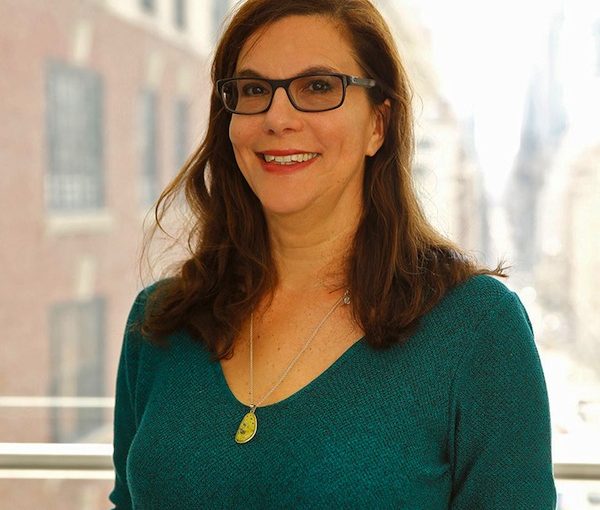
Leah Garrett has pieced together the most comprehensive story yet of a little-known but fascinating footnote to the Second World War, and she shares her findings in her new book, X Troop. (photo by Deb Caponera / Hunter College)

Using recently declassified military records and interviewing family members, author Leah Garrett has pieced together the most comprehensive story yet of a little-known but fascinating footnote to Second World War history – and the role that a few score of Jewish men played at pivotal moments in the conflict.

Garrett is a professor at Hunter College, in New York City. As part of the Cherie Smith JCC Jewish Book Festival, she will speak about her new book, X Troop: The Secret Jewish Commandos of World War Two, in a virtual event on Feb. 6.

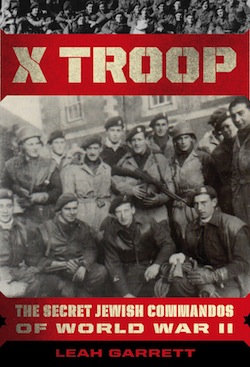
X Troop tells of the 87 men – 83 of them Jewish – who made up the No. 10 (Inter-Allied) Commando, 3 Troop. The secret weapon X Troop members shared was that most of them were from German-speaking parts of Europe, had escaped occupied countries and, as Jews, had a deeply personal drive to defeat the Nazis.

Formed officially on July 2, 1942, the unique commando unit would, among other things, allow British forces to expedite interrogation of captured Axis soldiers.

“X Troop would be Britain’s secret shock troop in the war against Germany,” Garrett writes. “They would kill and capture Nazis on the battlefield. But that would not be all. They would also immediately interrogate captured Germans, be it in the heat of battle or right afterward. The men’s fluency in German would enable them to get essential intelligence that would guide the next moment’s choices rather than having to wait to interview prisoners until they were back at headquarters.”

No less than Winston Churchill himself gave the group their nickname.

“Because they will be unknown warriors … they must perforce be considered an unknown quantity. Since the algebraic symbol for the unknown is X, let us call them X Troop,” declared the then-prime minister of the United Kingdom.

One of the many consequential incidents, which could have turned disastrous, was when two troop members, whose anglicized noms de guerre were Roy Wooldridge and George Lane, were captured by the Germans and taken to a command post. The next day, they were driven to the French countryside and, instead of being summarily executed as they had feared, found themselves in the château that was serving as headquarters for field marshal Erwin Rommel.

“During his training … Lane had been taught to give only his (fake) name, rank and serial number if he was captured,” writes Garrett. “But instead he found himself having an extended conversation with the field marshal over tea. Lane fortunately recovered his composure and didn’t say anything that would give him and his comrade away.”

Later, when they were transferred to a POW camp in central Germany, which was filled with 300 British officers, the pair was able to share their knowledge of Rommel’s location – information that was surreptitiously conveyed back to London through a hidden homemade wireless radio.

“A few months later … during the Normandy campaign, Rommel’s staff car was strafed by RAF Spitfires as he drove from Château de La Roche-Guyon to the front near Saint-Lô. The attack left Rommel, one of Germany’s best and most creative generals, with serious injuries, and from that moment on his participation in the war was effectively over,” notes Garrett.

The irony was that some of the members of X Troop suddenly transformed from prisoners of war – Jews of German or Austrian origin, who were viewed as “enemy aliens” – to members of an elite British military troop.

image - X Troop book cover“I found it rather odd that one day I could not be trusted with anything more lethal than a broomstick and the next I was told that I was going to be a spy for the British,” said one member, Tony Firth. “But who said that the English are logical?”

The men faced a fourfold risk if captured. Hitler had ordered Allied commandos to be shot on sight. As refugees from Europe who may have still had family in Nazi-occupied areas, they risked not only their own lives, but those of their families. As Jews, they were the explicit target of state-sanctioned murder and, as German or Austrian nationals, they would be considered traitors to their homelands if captured.

The commandos were trained in a Welsh village and, though each had each created a false persona, it took wilful blindness for the village folk to not realize there was something odd about these particular British soldiers. Recalled one townswoman, “… when we would ask them what nationality they were, they would say: ‘Vee are English.’” (A memorial to X Troop in that Welsh village today ostentatiously omits the fact that almost all of them were Jewish.)

Though trained together and with a tight-knit sense of camaraderie, the troop was deployed not as a group but across the British military. The book follows members of the troop through heroics and horrors at Normandy and in Egypt, Italy, Greece and Yugoslavia. In the end, half of the men would be killed, wounded or forever missing in action.

Some reviewers have drawn parallels between the real-life exploits of X Troop and a 2009 Hollywood blockbuster, but Garrett contrasts the facts and fictions. “Whenever possible, the X Troopers used their intelligence to outmanoeuvre the Nazis and to capture them before a shot was fired,” she writes. “In this regard, the X Troopers were the opposite of Quentin Tarantino’s vengeful Jews in his film Inglourious Basterds. Rather than wreaking personal revenge on the Germans, they followed the rules of war. They coolly collected battlefield intelligence from the enemy and outwitted them using their intellect rather than brute force. And even in extreme instances, such as when Colin Anson confronted the man who had been responsible for his own father’s death, they refused to compromise their own moral standards.”

Among the lessons the author aims to convey is the heroism of Jews in the fight against Nazism, adding a new layer to a growing literature on resistance of various forms.

“Through their exemplary and courageous service,” Garrett writes, “their story challenges the idea that only in Israel did the Jews become armed warriors who fought to try to establish a safe life for themselves and their families.”

Garrett’s Feb. 6 book festival event starts at 3:30 p.m. For tickets, visit jccgv.com/jewish-book-festival.

Format ImagePosted on January 28, 2022January 27, 2022Author Pat JohnsonCategories BooksTags history, Holocaust, JCC Jewish Book Festival, Leah Garrett, war, X Troop
Poetry and painting flourish

Poetry and painting flourish

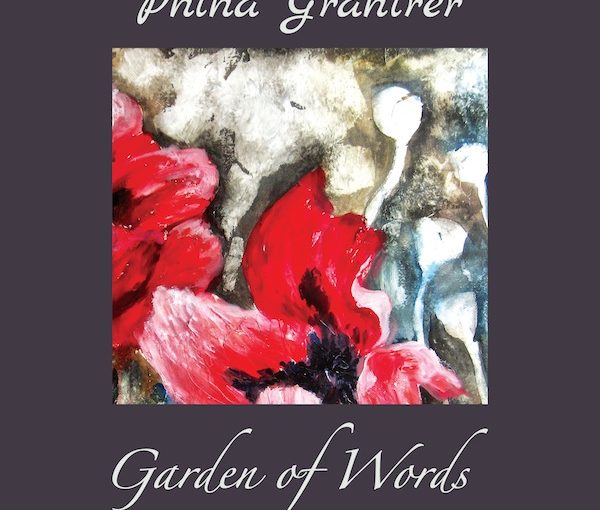
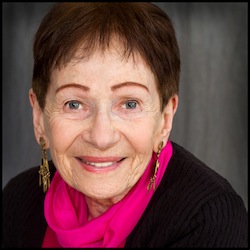
Pnina Granirer launches her new book, Garden of Words, at the Cherie Smith JCC Jewish Book Festival Feb. 9. (photo from JBF)

“Unexpected and unplanned, like small gifts offered by a kind friend, poems have been forming in my head ever since I was a child,” writes Pnina Granirer in her most recent book, Garden of Words. “Unexpected” is the perfect word for Granirer, who continually reinvents her artistic self.

Garden of Words is a beautiful mix of Granirer’s painted “words” and her written ones, her more distant past and recent experiences, including the loss of her life-partner of more than 65 years, in August 2020. The book is dedicated to Eddy and the final poem (“Goodbye”) and image (“Eddy Studying During Power Outage,” 1957, charcoal on paper) are of him.

This collection is a very personal work that shows Granirer’s powers of observation, both in her paintings and drawings, as well as in her poetry. It also shows her strength via her willingness to be vulnerable.

photo - Pnina Granirer
Pnina Granirer (photo courtesy JBF)

Two poems are part of the book’s foreword. The first, explains Granirer, who was born in Romania, “expresses the joy and happiness of a 10-year-old when on August 23, 1944, the Soviet Red Army entered our town, on the day that the cattle cars were waiting at the train station to take us away to the concentration camps. It had been a narrow escape, indeed!” The second is the title poem, in which Granirer notes that she is a painter, “I speak with paint and brush / my words are written / with colour and with line.” But, she recognizes the power of words, their ability to “conjure a Universe”: “I should so like to plant / a garden of words / in my field of colours // and watch them grow.”

Garden of Words has six sections: Sea and Stones; Pandemic; Dancers; Memories of Spain; This and That; and Closure. Her poems are short, concisely capturing the ephemerality of life – not even stones are permanent, the ebb and flow of water covers and exposes them, reshapes them, while they absorb past lives (fossils) and form sculptures. Stones offer inspiration and company to Granirer, who listens to their “quiet whispering.”

While all of the paintings Granirer has selected for this book interact wonderfully with her poems, reinforcing their themes, particularly powerful is the interplay between the poems about COVID-19 and artworks that had, of course, other meanings when they were created years ago. The new poem “All Together Now,” which starts, “This novel enemy is democratic. // In its indifference / all prey is equal,” is followed by the 2008 painting “Utopia – All Together Now,” which features four people dancing within a diamond-shaped boundary. One dancer’s head and their left foot cross the barrier. With dancing as one of the activities that has been restricted during the pandemic and the fact that we’ve all had to create bubbles (diamonds?) within which we can socialize safely, this probably once-joyous painting takes on a more sombre joy.

There are also sparks of sombre humour in various poems, including “Visit with El Greco” and “City Woman.” And the fear is palpable and relatable in the prose poem “Grenada,” which includes the stark reflection: “Five hundred years after the Inquisition, the burnings and autos-da-fé are pushed out of memory, conveniently forgotten, but the ceremonies persist; the dark past is not taught in Spanish schools. It has been turned into an Easter celebration, a parade, a fun event.” But, for Granirer, the crowds are ominous, evoking images of the Inquisition: “I am a Jew and it is coming for me. I am a Muslim and I am afraid. I am a Black woman and here is the KKK coming. I am terrified. The sight of those pointed hoods unleashes a flood of emotion I did not know I was capable of. My anxiety is close to panic.”

There are happier reflections. “Pas-de-deux,” for example, describes two men, each flying their own kite, but close together: “They leap / they dance / they bend and kneel / they sway from side to side / and turn as one.” When the men and their kites finish their dance, they receive “scattered applause from the small gathered crowd.”

At age 86, Granirer continues to create in new and meaningful ways. She launches her new book at the Cherie Smith JCC Jewish Book Festival on Feb. 9, 1 p.m. Visit jccgv.com/jewish-book-festival.

Format ImagePosted on January 28, 2022January 27, 2022Author Cynthia RamsayCategories BooksTags art, Garden of Words, JCC Jewish Book Festival, painting, Pnina Granirer, poetry
Poetic auto/biography superb

Poetic auto/biography superb

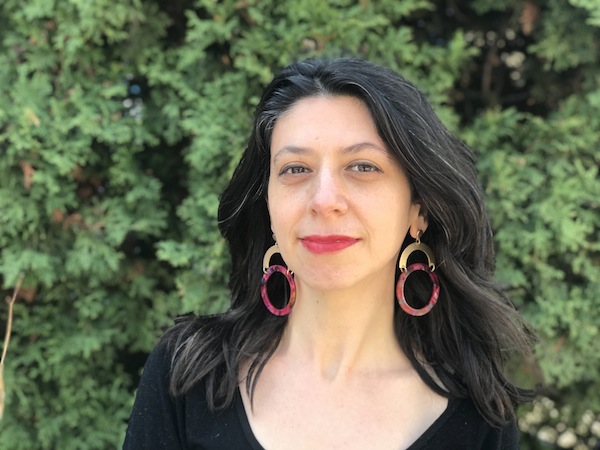
Lisa Richter, author of Nautilus and Bone, joins the Jewish Book Festival Feb. 7 (photo from Lisa Richter)

Nautilus and Bone: An Auto/biography in Poems by Toronto poet Lisa Richter – who takes part in the Cherie Smith JCC Jewish Book Festival on Feb. 7 – will send readers down many proverbial rabbit holes. They will want to know more about the writings and life of Yiddish poet and journalist Anna Margolin – not only to better understand Margolin, but to appreciate more fully Richter’s poetic biography of Margolin and her conversations with Margolin’s works.

Margolin is the pen name of Rosa Lebensboym, who was born in Brisk (now Brest, Belarus) in 1887. She immigrated to New York City in 1906, “spent time in London, Paris, Warsaw, Odessa and Palestine before eventually settling permanently in New York in 1913, where she died, in 1952.”

Says Richter: “I was enticed by this Russian-Jewish-American woman writing a hundred years ago about myth-making, roots, identity, alienation, gender fluidity, Eros and desire (at times unmistakably queer, arguably pansexual). Her poetry felt bold and subversive, even by modern standards: H.D. meets Patti Smith.”

Richter does not speak Yiddish, so has relied on Shirley Kumove’s Drunk from the Bitter Truth: The Poems of Anna Margolin, a translation of Margolin’s volume of poems, Lider (Poems), with a “thorough and comprehensive introduction to Margolin’s life and work.” Richter also accessed Margolin’s files at YIVO and read Reuben Iceland’s (Ayzland’s) memoir, From Our Springtime: Literary Memoirs and Portraits of Yiddish New York, as well as other source material.

Richter discusses her many reasons for feeling connected to Margolin, including that, as Lebensboym adopted the name Margolin upon arrival in New York, Richter’s maternal great-grandfather, born Samuel Margolin, “changed his surname to the more Russian-sounding Lapitsky to avoid antisemitism when he immigrated to Montreal as a young man in 1903.”

Richter writes, “I like to imagine him meeting Miss Rosa Lebensboym. In my imagination, he passes his old birth name to her, much in the way one would pass along a string of heirloom pearls to one’s daughter (though they would have been roughly the same age, both born in the 1880s).” Richter notes that the name Margolin and its variations come from the Hebrew margoliyot, meaning pearls.

The emotional and spiritual connections come through in Nautilus and Bone. Richter does not claim to explore every facet of Margolin’s life and work. She explains, “The persona I have enacted in these poems hovers on the periphery of my imagination, filtered through my own dreams, preoccupations, (dis)pleasures, experience. I try my best to give a lyric voice to the most essential, enduring aspects of the poet’s life and work as I see her, and to engage in conversation with those parts of myself that are most closely, most symbiotically intertwined with her story.”

And she does so in a wide variety of poetic forms, all of which she wields with great skill. Among the recognition the book has garnered are the Canadian Jewish Literary Award for Poetry and the National Jewish Book Award for Poetry (United States) – “the first time a Canadian poet has ever received this honour,” Richter shared with the Independent.

In Nautilus and Bone, most readers will encounter forms of poetry they’ve never encountered before. “A City at the Sea’s Mouth” is a homolinguistic translation (in this case, English to English). “Primeval Murderess Night Talks Back to Anna Margolin” is a Golden Shovel poem – the “end-words of each line make up the first two lines of Anna Margolin’s poem ‘Primeval Murderess Night,’” notes Richter, crediting the creation of the form to Terrance Hayes. And, as the name suggests, “Anna Margolin Cento” is a cento, in which a poem is composed of lines from other poets’ poems.

“A poem’s form and content are inextricably linked, in the same way that a particular dish can only be made or served in certain kinds of containers,” Richter told the Independent in an email interview. “The same raw dough can be shaped into dinner rolls, pretzels or challah bread – the way you present and shape the material will affect the way it’s consumed and experienced.

“In some cases,” she said, “the form came to me later (the prose poem form of ‘So Uncommonly Smart for a Girl,’ for example) after a traditional, lineated form didn’t seem to be working. In other cases, the form came first, and the poems later. For instance, the long sequence of sonnets at the end of the book became the vehicle for telling the love story of Anna Margolin and her final life-partner, the poet Reuben Ayzland, as the sonnet has a long and distinguished history of wrestling with matters of the heart.

“The process of homolinguistic translation, or ‘re-translating’ a poem from the same language, is a means of engaging/wrestling/ conversing with a source text, and keeping it alive by breathing new life into it, using fresh grammar, syntax and language. I see it as an act of homage and tribute.”

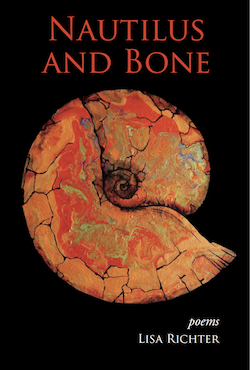
image - Nautilus and Bone book coverSome of the poems were written as early as 2017, said Richter, shortly after her first book – Closer to Where We Began – was published, but “the bulk of the poems were written over the course of a year-and-a-half, from 2019 to spring 2020,” she said. “The original manuscript was much more autobiographical, but once I started researching and writing the Margolin poems, it became clear that the book was to become ‘an auto/biography in poems,’ as the book is subtitled, and was much more about Anna Margolin than it was about me. I have to credit my editor at Frontenac House, Micheline Maylor, for her vision and encouragement for this project. Both she and George Elliott Clarke, my mentor at the Sage Hill Spring Poetry Colloquium, were extremely supportive.”

While Richter’s conversations with Lebensboym/Margolin left her with more questions than answers, Richter said, “I think that’s a good state of mind for a poet to live in. As Rilke famously put it in Letters to a Young Poet, ‘Do not now seek the answers, which cannot be given you because you would not be able to live them. And the point is, to live everything. Live the questions now.’ I don’t think I’ll ever be entirely ‘done’ with Anna/Rosa, but it’s not entirely up to me. For all I know, she’ll be with me for some time…. I would love to learn to read Yiddish someday so I could read and appreciate her work in its original form.”

As for what she hopes readers take away from the conversations, Richter said, “Mystery, uncertainty, history, complexity, ambiguity, ancestral lineage, eros/sensuality, mythmaking. But if a reader just finds one poem in the book that speaks to them, I’m happy.”

Richter will be joined Feb. 7, 6 p.m., by local translator Rachel Mines (Jonah Rosenfeld: The Rivals and Other Stories; see jewishindependent.ca/stories-that-explore-the-mind) in a discussion with moderator Faith Jones. Visit jccgv.com/jewish-book-festival.

Format ImagePosted on January 28, 2022January 27, 2022Author Cynthia RamsayCategories BooksTags Anna Margolin, JCC Jewish Book Festival, Lisa Richter, Nautilus and Bone, poetry, Rosa Lebensboym, Yiddish

Novels about love, art

Inspired by real people, Jai Chakrabarti and Michaela Carter have written novels that explore the Holocaust and its impacts. Their books also happen to share common themes. Notably, the power of art to change the world, and the power of love to change a person.

Chakrabarti (A Play for the End of the World) joins Gary Barwin (Nothing the Same, Everything Haunted: The Ballad of Motl the Cowboy) on Feb. 6 in a Cherie Smith JCC Jewish Book Festival event, moderated by Helen Pinsky, called Mythical Quests. Carter (Leonora in the Morning Light) and Meg Waite Clayton (The Postmistress of Paris) take part in the event Art and War on Feb. 9, moderated by Hope Forstenzer.

In Chakrabarti’s A Play for the End of the World, the quest is that of child survivor Jaryk Smith, who travels from New York to India in 1972 to collect the ashes of his best friend and fellow Holocaust survivor, Misha, who died of a heart attack. Misha had ventured to India to help a village mount a production of Rabindranath Tagore’s Dak Ghar (translated as “The Post Office”), which Jaryk and Misha had performed when they were under the care of Janusz Korczak (aka Pan Doktor by the children) in Warsaw in 1942.

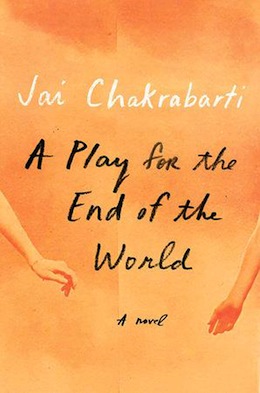
image - A Play for the End of the World book coverWhile Jaryk, Misha and all the other characters are fictional, Korczak and Dak Ghar were very real. “The play is about a dying child living through his imagination while quarantined,” writes Chakrabarti in the author’s note. “Pan Doktor chose to stage the play to help his orphans reimagine ghetto life and to prepare them for what was to come.”

The Indian villagers are also being prepared for what is to come – they are under threat of expulsion, or worse, from the government; already, protesters have been imprisoned, even killed. The Indian professor promoting the play wants to bring international attention to their plight.

Tangled up in all this is Lucy, who Jaryk loves but abandons in New York when he hears about Misha’s death. One of the many choices Jaryk faces is whether he can accept the happiness that Lucy and life in general can offer him.

Happiness is a rare and difficult-to-achieve state in Carter’s novel, as well. The Leonora of the book’s title is artist Leonora Carrington, who was born in England in 1917 and died in Mexico in 2011. An unofficial part of the Surrealist movement (because women weren’t allowed), Carrington was an acclaimed painter and writer. Of her relationships, the most famed would be with fellow Surrealist Max Ernst, who was twice her age at their time of meeting.

“I was drawn to Leonora Carrington before I even knew who she was,” writes Carter in the author’s note. “Long intrigued by the Surrealist artists, by their playful take on creativity and their celebration of surprise and strangeness, I had set out, in 2013, to write a fictional story placed among them, set between the wars and with a young woman at its centre.”

image - Leonora in the Morning Light book coverIt was only later that Carter, at the Tate Gallery, came across a piece by Carrington, as well as the book Leonora Carrington: Surrealism, Alchemy and Art by Susan L. Aberth. For months, Carter says, she resisted the idea of writing a novel, but “read everything about Leonora I could get my hands on, as well as everything available about Max and Peggy Guggenheim, who was, I realized, an integral part of their story.”

Ernst had many lovers, including Guggenheim, who helped him get to the United States, but Carter’s novel posits that Carrington was his true soulmate, and that he was Carrington’s. Their affair is interrupted by the Second World War, however, and, after we get to meet the couple in 1937, the novel mainly alternates between Carrington’s story from that point and Ernst’s from 1940, as he is trying to escape from France. While the two met in London, they moved to Paris – Ernst first (Carrington’s father apparently had a hand in Ernst’s work being declared “the product of an immoral mind,” which was an arrestable offence at the time in London), then Carrington.

Leonora in the Morning Light – which is named after a painting Ernst made of Carrington – takes readers to 1943, by which time Ernst is in Arizona and Carrington is in Mexico; both married to other people.

“During her 94 years on this earth, she created thousands of magical, mystical works of art – drawings, paintings, statues, masks, plays, short stories and her masterful novel, The Hearing Trumpet,” writes Carter of Carrington. “She was also an eco-feminist who fervently believed in the innate rights of all individuals – of humans, animals, plants and the earth itself.”

Visit jccgv.com/jewish-book-festival for the full festival lineup and tickets.

Posted on January 28, 2022January 27, 2022Author Cynthia RamsayCategories BooksTags fiction, historical fiction, Jai Chakrabarti, Janusz Korczak, JCC Jewish Book Festival, Leonora Carrington, Max Ernst, Michaela Carter, painting, Rabindranath Tagore, Surrealism, theatre
A minority within a minority

A minority within a minority

Rivka Campbell, co-founder of Jews of Colour Canada. (PR photo)

On Jan. 9, Rivka Campbell, co-founder of Jews of Colour Canada, spoke on the topic Harmony in a Divided Identity: A Minority Within a Minority, the third Zoom talk in Kolot Mayim Reform Temple’s 2021-22 Building Bridges lecture series.

A Jew of Jamaican descent, Campbell seeks to create a sense of community among Jews of Colour in Canada. At the same time, she works to establish dialogue with mainstream Jewish organizations and to provide a better understanding of Jewish diversity and the experiences of Jews of Colour.

Her opening remarks focused on what she labeled “the question” – that is, the unwelcoming, uninviting and off-putting line of inquiry Jews of Colour often confront when entering Jewish spaces. Though born and raised in Toronto, Campbell, like other Jews of Colour, is often asked, “Where are you from?” – the implication being that she is not Jewish.

This question, she points out, is alienating from the start and is not the kind of introduction that Jews of Ashkenazi backgrounds ordinarily face when, say, entering a synagogue.

A decisive period for Campbell occurred after getting married and starting a family. At the time, she wanted to introduce her children to their Jewish roots so that they could understand and appreciate every aspect of who they are.

“We leaped into the community with the assumption that I am a Jew and that this should be a non-issue. I am going to go to synagogue, put my kids in Hebrew school and just do stuff. I was wrong. What I didn’t reflect on was that I did not meet the stereotype, if you will, of what a Jew looks like, and it never occurred to me because I am Jewish, what’s the big deal? And I realized that for some people it was.”

The questions and comments would come even before a hello – Are you Jewish? How are you Jewish? But your last name isn’t Jewish.

“If I am a new face, then fine, we should welcome new faces. But the way to welcome new faces is with ‘Shabbat Shalom. My name is So-and-So, what’s your name? Here’s where we keep our siddurim.’ Welcome me first and the rest will flow naturally,” Campbell said.

She referred to these episodes, when she is singled out and her Jewishness is openly questioned, as “microaggressions.”

“Microaggressions are like mosquito bites at a summer camp. You might spray yourself and take other measures to prevent bites. Nothing works, so you spray yourself more and wear long sleeves and still nothing. After many efforts and layers, you finally say, ‘I can’t do this any longer,’ and you remove yourself from the place where the mosquitoes are,” she said.

For Campbell, there also have been more repugnant full-on aggressions, including having the derogatory term “Schvartze” directed at her.

“Would you continue to want to put yourself in that position? I have met and spoken to quite a few Jews of Colour who have said, ‘I am done. I can’t take it anymore.’ They do not want to subject themselves or their children to that kind of treatment. If we say there is no racism in our community, then we are fooling ourselves. All of us should feel they belong,” she said.

Campbell had a very good experience during an extended stay in Israel, where she met Jews from myriad backgrounds. In Israel, she did not feel she had to explain who she was and did not encounter the same questions she is asked in Jewish spaces in Canada. That trip caused her to realize that the Canadian Jewish community could do better and led her to start Jews of Colour Canada.

Things changed dramatically in May 2020 after the murder of George Floyd in Minneapolis, which, to Campbell, symbolized the banality of evil.

“That event made me not give a hoot whether people were comfortable or not with what I say because, until we are all uncomfortable, there won’t be change,” she said. “It really flipped the way I felt about diversity and the work that needs to be done. And that is where we sit today. And I see us as a community doing the work – we are listening and not just hearing what people are saying. You fix your own house first before you fix anyone else’s. And you cannot rest on the laurels of others, such as Martin Luther King Jr. and Rabbi Abraham Joshua Heschel.”

Campbell is the executive director at Beit Rayim Synagogue in Vaughan, Ont., and a board member of ADRABA, Toronto’s first 21st-century Jewish high school. She also hosts the CJN podcast Rivkush, which focuses on diversity, Israel and other Jewish topics. She is the sole Canadian recipient of the inaugural JewV’Nation Fellowship from the Union for Reform Judaism. For more information, visit jewsofcolour.ca.

The next speaker in Kolot Mayim’s Building Bridges series is, on Feb. 6, poet, author, literary scholar and internationally recognized speaker on transgender issues Joy Ladin on the topic of Jonah, God and Other Strangers: Reading the Torah from a Transgender Perspective. On Feb. 13, Reverend Hazan Daniel Benlolo, cantor, rabbi and founder of the Montreal Shira Choir for special needs adults, presents The Power of Music. To register for either or both talks, visit kolotmayimreformtemple.com.

Sam Margolis has written for the Globe and Mail, the National Post, UPI and MSNBC.

Format ImagePosted on January 28, 2022January 27, 2022Author Sam MargolisCategories NationalTags Jews of Colour Canada, Judaism, Kolot Mayim, racism, Rivka Campbell

Posts pagination

Page 1 Page 2 … Page 4 Next page
Proudly powered by WordPress