Skip to content
  • Home
  • Subscribe / donate
  • Events calendar
  • News
    • Local
    • National
    • Israel
    • World
    • עניין בחדשות
      A roundup of news in Canada and further afield, in Hebrew.
  • Opinion
    • From the JI
    • Op-Ed
  • Arts & Culture
    • Performing Arts
    • Music
    • Books
    • Visual Arts
    • TV & Film
  • Life
    • Celebrating the Holidays
    • Travel
    • The Daily Snooze
      Cartoons by Jacob Samuel
    • Mystery Photo
      Help the JI and JMABC fill in the gaps in our archives.
  • Community Links
    • Organizations, Etc.
    • Other News Sources & Blogs
    • Business Directory
  • FAQ
  • JI Chai Celebration
  • JI@88! video

Recent Posts

  • Legal help for students
  • Revisiting myth of Lilith
  • Wrong person rebuked
  • Canada’s mixed messages
  • Questions for museum
  • Symposium on antizionism
  • Making soccer political
  • CJPAC lauds Pulver’s impact
  • City recognizes Vrba’s legacy  
  • Organ donation saves lives
  • Theodore’s March premiere
  • A healing Shabbaton
  • Supplying healthy food
  • A chime of metal tags
  • Yellowknife seder a first
  • Ishai energizes, unifies
  • A Lag b’Omer to remember
  • Expanding the healing
  • Hannah Senesh – a unique hero
  • Community milestones … May 2026
  • Sharing her testimony
  • Fall fight takes leap forward
  • The balancing of rights
  • Multiple Tony n’ Tina roles
  • Stories of trauma, resilience
  • Celebrate our culture
  • A responsibility to help
  • What wellness means at JCC
  • Together in mourning
  • Downhill after Trump?
  • Birth control even easier now
  • Eco-Sisters mentorship
  • Unexpected discoveries
  • Study’s results hopeful
  • Bad behaviour affects us all
  • Thankful for the police

Archives

Follow @JewishIndie
image - The CJN - Visit Us Banner - 300x600 - 101625

Month: April 2019

קנדה תמשיך לתמוך בפתרון שתי המדינות

קנדה תמשיך לתמוך בפתרון שתי המדינות

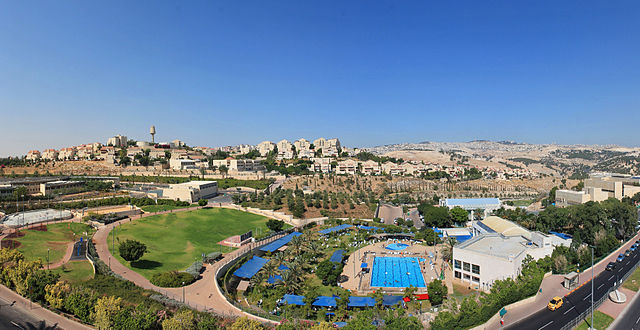
מעלה אדומים, ישראל (David Mosberg)

“עמדתה של קנדה נותרה ללא שינוי ואנו נמשיך לתמוך בפתרון של שתי המדינות במזרח התיכון”. כך אמר בפרלמנט, ראש ממשלת קנדה, ג’סטין טרודו. דבריו נאמרו על רקע תוצאות הבחירות בישראל, שעל פי הן שוב נבחר לרשות הממשלה, בנימין נתניהו. ראש ממשלת ישראל החדש-ישן הודיע ערב הבחירות, כדי לרכוש לעצמו עוד קולות מהימין, כי ממשלתו החדשה תכריז של סיפוח שטחים באזורי יהודה ושומרון. נתניהו אמר: “אנו דנים בהחלת הריבונות על מעלה אדומים וגם בדברים אחרים. לאחר ההכרה האמריקנית בריבונות ישראל ברמת הגולן, קיימים גם דיונים על סיפוח אזורים ביהודה ושומרון. אני הולך להכיל ריבונות אבל אני לא מבדיל בין גושי ההתיישבות לנקודות היישוב הבודדות. כל נקודת ישוב כזאת היא ישראלית ויש לנו אחריות כממשלת ישראל. כל אחד מבין שהקדנציה הבאה שלנו תהיה גורלית לשני הכיוונים – האם נוכל להבטיח את הביטחון שלנו ועל השטח החיוני של יהודה ושומרון שהוא פי עשרים גדול מעזה”.

לאור תוצאות הבחירות בישראל שאל חבר הפרלמנט הקנדי מטעם המפלגה הדמוקרטית החדשה, גיא קארון, את ראש הממשלה טרודו: “בינימין נתניהו ימשיך בתפקידו כראש הממשלה. בהבטחה של הרגע האחרון הוא הודיע כי יספח התנחלויות בגדה המערבית. אם ממשלת ישראל תעמוד בהבטחתה זו, עשויות להיות לכך משמעויות חמורות על היציבות באזור. עמדתה של קנדה עד היום היתה ברורה שאין ההתנחלויות חוקיות. ומועצת הביטחון של האומות המאוחדות מסכימה עם כך. האם ראש הממשלה יאשר כי קנדה תתייחס לסיפוחם של שטחים אלה כבלתי חוקיים ותפעל בהתאם בנושא?”

טרודו אמר בתגובה לשאלתו של קראון: “עמדתנו נותרה ללא שינוי. אנו תומכים בפתרון שתי המדינות ישראל לצד פלסטין במזרח התיכון. הפתרון הזה אמור להיות מושג באמצעות משא ומתן בין שני הצדדים. פעולות חד צדדיות כגון התנחלויות, אינן לגטימיות ואינן מסייעות בפתרון המצב במזרח התיכון”.

פרופסור קורן שהסתבך בקנדה קיבל תפקיד בכיר בקופת מכבי

פרופסורר גידי קורן, שניהל מעבדה לגילוי שימוש בסמים ובאלכוהול בבית החולים “סיק קידס” בטורונטו והסתבך, מונה לתפקיד מדען בכיר במכון המחקר של קופת החולים “מכבי”. יש שלא מבינים מדוע.

פרופסור קורן נחשב למומחה בעל שם עולמי בפרמקולוגיה, אך הוא הסתבך בפרשייה שהסעירה את קנדה, והובילה לבחינה מחודשת של כמה ממחקריו. וכן לוויתור על רישיון הרפואה שלו במחוז אונטריו. קורן החליט להסביר ראשונה את גרסתו למקרים החמורים ששמו נקשר בהם.

הפרופסור הפך לאחד החוקרים הבולטים בתחום בדיקת שיער לגילוי שימוש בסמים או באלכוהול. הוא הקים את מעבדת “מאת’ריסק” בבית החולים, שהייתה היחידה שהשתמשה בטכניקה הזו. שׁירותי הרווחה הקנדיים נעזרו בבדיקות שלה במשך כמעט שלושה עשורים. שנים עברו עד שוועדות חקירה קבעו כי ערכות הבדיקה שבהן השתמשו במעבדה היו לא תקינות. באותה עת בתי המשפט הסתמכו על הבדיקות שאמורות היו לספק מידע ראשוני – כקביעה חד-משמעית, על מנת להפריד ילדים ממשפחותיהם.

קורן טוען להגנתו: “הבדיקות שעשינו במעבדה לא גרמו לאף ילד לעזוב את ביתו. התפקיד שלי היה לבדוק שהילדים האלה נמצאים באזור בטוח. זאת הייתה מטרת העבודה. יש טעויות בכל מערכת והטיעון שילדים הורחקו מבתיהם זו עלילת דם. בישראל התחילו אותה קבוצה מאוד שמאלנית של רופאים לזכויות אזרח. ובעקבות כך הגשתי קובלנה פלילית. בית המשפט שעסק בסוגיה מצא בין השאר שבשום מקרה לא קרה שילד ניזוק מבדיקה זו או אחרת”.

Format ImagePosted on April 24, 2019April 14, 2019Author Roni RachmaniCategories עניין בחדשותTags "מאת'ריסק", Canada, elections, Gideon Koren, Hospital for Sick Children, Israel, Maccabi Healthcare Services, Middle East, Motherisk, Netanyahu, Trudeau, two-state solution, בחירות, בית החולים "סיק קידס", בנימין נתניהו, ג'סטין טרודו, גידי קורן, מזרח התיכון, פתרון שתי המדינות, קופת החולים "מכבי", קנדה
Israeli music icon sings here

Israeli music icon sings here

Yoni Rechter will be in Vancouver to perform for Yom Hazikaron and Yom Ha’atzmaut. (photo from Jewish Federation of Greater Vancouver)

“I love to know the world through music, and music has brought me to many places …. When I come and play and then I also make connection with the place, I prefer it to being the usual tourist. So, I’m glad I have the opportunity to come back to Canada after so many years … especially to Vancouver, that I heard so much about it,” Yoni Rechter told the Jewish Independent in a phone interview.

Rechter headlines the community Yom Ha’atzmaut celebration May 8 at the Chan Centre for the Performing Arts. While he has toured around the world, he hasn’t ever performed outside of Israel on Israel’s Independence Day. So, why now?

“There are two artists,” he said, “who were previously in this concert – Nurit Galron [2013] and Shlomi Shaban [2018] – they are both friends of mine, I work with them. Each one of them told me how nice it was to be there at the Yom Ha’atzmaut event, so I got good recommendations.”

Since he wrote his first song more than 50 years ago, Rechter has become a virtual icon of Israeli music. The composer, pianist, singer and arranger has created music for solo performances, bands, theatre, film, symphony, dance and opera. He has more than a dozen albums and has collaborated with a large portion of the who’s who of the Israeli cultural arts scene. Yet, he remains humble.

“I worked with the right people. I mean, people that I had the opportunity to learn from them, from the beginning of my musical career,” he said of his success. “I was first in the group Kaveret – you know, Poogy? By the way, we performed in Canada in ’76. We were in Montreal and Toronto and Winnipeg, and I still remember the temperature in Winnipeg. I think it was in winter; it really was the lowest temperature I ever felt. Anyway, then I worked with Arik Einstein, then I worked with Yossi Banai … and then I had the opportunity to work with very important theatre directors, like Hanoch Levin, Nissim Aloni and Miki Gurevich, and, also in movies. Because this is a small country, if you are willing to work, you can do various musical activities…. I had a lot of people to learn from, and really great, great artists.”

He said Israel is different than the United States or Canada with regard to the concept of celebrity. In Israel, he said, “We grew up very simply, and I go every day to swim. It’s not that I live in a protected house and I have bodyguards. It’s not this type of culture in Israel, first of all, but still there are people in Israel who might use their publicity for power or this kind of thing, but my character, I feel that I’m a musician, it’s the music and not me…. I feel that I have what to say in my music, but I never speak about myself; nobody knows about my wife, about my children, my private life. I’m really not into doing something with it, and it’s many years like this, but, I must confess, that I’m also not required by people or by journalists to speak about my personal life. Really, people accept me as I am.”

Rechter almost didn’t become a musician. When he was about to go into the army, at age 18, his father had what was probably the biggest architecture firm in Israel at the time. Even though his parents separated when Rechter was very young and he didn’t live with his father, he said it was a big decision as to whether to follow in his father’s footsteps. But, also, he said, music came easily to him.

“You know, I was just sitting at the piano and I composed, everything flowed, so I thought maybe life should be more difficult, and I should go to places that are more requiring of effort,” he said. “And this feeling I had, I was sure I was going to be an architect, but, in the army, I played in a military group of the artillery … and, when I finished the army, I thought to go to study architecture but then I got a telephone call from the members of what was going to be Kaveret group (Poogy group), and they called me for an audition. I heard the music and I fell in love. In the end, it came out to be [that I became] pianist of this group and a member of this group that changed … my career…. I have a brother who continues my father’s legacy.”

As to music and the projects he takes on, Rechter said there are a couple of factors he considers, notably the seriousness of the request and whether he has something to contribute musically. He gave the example of the Israeli Opera, who asked him to create a work for them, which will play again next year. He based the opera, Schitz, on the play by Levin.

“To write an opera,” he said, “it’s a year of 12-hours-a-day work; it’s really very [intensive]. It was an 80-minute opera, symphonic – I made all the arrangements and orchestration and I worked with the singers; it’s a huge work. It takes one year to do it, so, the first condition is that I know the project is serious.

“I have to find the right text,” he added, “because I really connect it to lyrics, to text, and I feel I have something to say in this. It’s a process. So, I start to improvise on this and I see if I have something to say musically. And, when I feel it’s all connected, I start to work on it. For example, the other [opera] … it was by David Grossman. Itamar Pogesh Arnav, it’s called, Itamar Meets a Rabbit. It’s a for-children opera, we made it with the Israeli Philharmonic. Of course, David Grossman, I knew he’s a very interesting man and I can find a way to connect with him, to communicate.”

Rechter said it is hard to define “Israeli music.” From the state’s inception through the 1970s, he said, “before the great internet and … we became one global ‘forum’ … [Israel] developed its own voice, which was, I would say, influenced by Russian music, from the immigrants that came, and also by music from the east, from Sinai, from Jordan, from all our neighbours. I think I grew up with influences of this spirit – sometimes I liked it, sometimes I didn’t like it. It depends on the people; for example, there was Sasha Argov, who was a very famous composer, and I really liked his music, which was very rich harmonically. Today, I think, after this explosion of communication, I don’t think it’s different from other places.”

That said, Rechter singled out some Israeli jazz performers, like Avishai Cohen, who is now based in New York, and others. “So, there is something here,” he said. “I think that living under pressure all the time [has something to do with it] … your life, all the time, is in danger because you don’t know when the next missile will fall in Tel Aviv. In my life, it has happened already two or three times…. Last week, there was one missile or two that fell near Tel Aviv. So, our life is, all the time, not protected, in a way. I believe it influences in a positive way our art, because we make art – all the Israeli artists – like you must survive. It gives us some very different energy than Europe, that used to be very calm.” He said, “The good artists that are serious become very known in the world [outside of] Israel.”

Music is important, said Rechter, “because it, especially in this time, I think that music should be a messenger. It has a task, and the task is to bring people back to real feeling, to themselves, to touch their souls, their energy, their spirit. Music is a force of nature, something that comes out of real creativity, at its best. Sometimes, I go to a concert and I cry from the music, it touches me so deeply. And that’s what I want to make. I don’t want to be somebody who’s going there to make lots of money; it doesn’t interest me. I want to touch people and, when it happens, for me, it’s the best prize.”

Rechter is coming to Vancouver with a band, “all of them Israeli, who live in New York” – singer Tammy Scheffer, saxophonist and player of multiple woodwinds Eitan Goffman, guitarist Shahar Mintz, bassist Uri Kleinman and drummer Shay Wetzler. “I sent them all the notes and the recordings of what I plan to play in Vancouver,” he said. “They’ll practise and we’ll meet at the beginning of May for two rehearsals n Manhattan.”

The audience at the Chan Centre can expect some of their favourites, said Rechter.

“I started to write songs when I was like 14, because of the Beatles,” he said. “I fell in love with the Beatles…. The first songs [of mine] were written in this age. I think the most famous song was – there is a song called ‘Dma’ot Shel Mal’achim,’ ‘Angels’ Tears.’ It became a song of memorial, and I wrote it in high school … with my friend who was sitting near me, his name is Danny Minster, he wrote the lyrics and I wrote the music. I tell this to you because I will sing it in Vancouver at the Yom Hazikaron memorial.”

Rechter will perform just the one song at the memorial May 7, 7:30 p.m., at the Jewish Community Centre of Greater Vancouver. On Yom Ha’atzmaut, May 8, 7:30 p.m., at the Chan Centre, he will perform more than 20.

Presented by Jewish Federation of Greater Vancouver, Yom Ha’atzmaut is supported by 46 community partners, with the Jewish Independent as the media sponsor and Georgian Court Hotel as the hotel sponsor. For the first time, there will be a party after the concert, though there is limited space available and only guests who attend the Yom Ha’atzmaut celebration may purchase tickets to the party. Visit jewishvancouver.com/yh2019.

Format ImagePosted on April 19, 2019April 17, 2019Author Cynthia RamsayCategories MusicTags Israel, Jewish Federation, music, Yom Ha'atzmaut, Yoni Rechter
Friendly below the radar

Friendly below the radar

At the JNF Negev Gala April 14, left to right: comedian Elon Gold, JNF Pacific Region president Bernice Carmeli, Ambassador Ron Prosor, JNF Pacific Region executive director Ilan Pilo and JNF Canada chief executive officer Lance Davis. (photo from JNF Pacifoc Region)

The diplomatic cold shoulder Israel has received from African, Asian and Arab countries has been thawing in recent years, and a former Israeli ambassador to the United Nations says the situation is even more encouraging under the radar screen.

Ambassador Ron Prosor, who was the Jewish state’s representative at the world body from 2011 to 2015, spoke at the Jewish National Fund of Canada’s Negev Gala Sunday night.

The UN General Assembly is a den of hypocrisy, Prosor said, citing the presence of the most oppressive countries on committees dealing with human rights. The UN Human Rights Council has been dominated by states with the world’s worst human rights records. Moreover, the council, which is supposed to be concerned with human rights abuses all over the world, has a specific article that singles out only one country for routine, ritual denunciation.

“Surprise, surprise – Israel,” Prosor said. “The structural and institutional bias against Israel is unbelievable. There is stuff that I can’t even invent. The Saudis chairing the conference on the status of women. The Iranians … they’re deputy chairs on nonproliferation and arms control.

“What is amazing is not the bad guys,” he continued. “The bad guys are easy to explain. What is really difficult to explain is the so-called like-minded countries.”

European nations and some of the other democracies that make up a minority of the countries at the General Assembly routinely side with despotic regimes against Israel. In such a situation, small victories count heavily. Prosor took heart when countries opted to abstain from votes rather than side against Israel.

He shared an anecdote about Pablo, the ambassador of Panama, an apparent reference to Pablo Antonio Thalassinós.

“‘Pablo, are you with us on this vote? Are you going to vote for us?’” Prosor recounts asking. “‘No. How can I vote? The Arabs are threatening me. What do we do?’ I look at Pablo. He looks at me. I say, ‘Pablo, I feel you’re beginning to catch the flu.’” In the story, the Panamanian begins to cough.

Prosor shared stories of similar conversations with other ambassadors, convincing them to abstain or not show up for votes, and even making him their proxy vote in these latter instances.

While a great many votes relating to Israel are still deeply lopsided, he said, ambassadors like him have helped some others understand that abstaining is better than a no vote.

“The United States of America moves the embassy to Jerusalem. The Europeans take the Americans to the General Assembly,” Prosor said. “One hundred and thirty-nine countries vote against, 32 countries vote for and 21 countries have huge navigation problems finding the General Assembly. Huge navigation problems. Not coincidental.”

Behind the scenes, Israel is not the isolated pariah it appears, he contended.

“In essence, Israel talks with everyone,” Prosor told the audience at Schara Tzedeck Synagogue. “The only ones we do not talk to, or I didn’t talk to, are the Syrian ambassador and the Iranian ambassador. We talk to countries that you guys would be amazed. First of all, most of the Arab countries, countries that we don’t have diplomatic ties with. As the Germans would say, we don’t have to kiss each other on the main road.”

For example, Prosor said, India’s relationship with Israel has grown very warm in recent years.

“The ambassador of India loves Israel,” he noted. “India votes against Israel in every committee and every subcommittee. When we hit the atomic reactor in Syria, the ambassador came to me, ‘Ron, amazing work. It’s good that you showed them.’ Then he goes over to the Security Council [and says], ‘We absolutely condemn Israel.…’ So, there is a difference between relations and voting patterns.”

Relations between Israel and the Sunni Arab world are changing dramatically, he said, due to shared concerns over the Shiite theocracy in Iran.

“I can tell you that what you see happening now in the Arab world, the Sunni world, is something that has been prepared for many years,” he said. “What you see now is not because the Sunni world – the Saudis and the others – really give a toss about the Palestinians. They fear that the rope is tightening around their necks because of Iran and they have decided they have coinciding interests with Israel. I don’t care why – this is an amazing opportunity for us to coordinate and cooperate.”

Prosor remains defiant despite the pillorying his country continues to receive at the world body.

“We have nothing to be ashamed of. They have [things] to be ashamed of,” he said of Israel’s critics. “Political structures, attitude toward women, gays … we have nothing to be ashamed of.”

Of the 193 countries at the UN, he noted, only 87 are democracies. Twenty-two are members of the Arab League, 56 are part of the Organization of Islamic Cooperation and 126 countries are part of the so-called nonaligned group. By contrast, Israel is the only country at the UN that is not a part of any regional grouping. This means Israel cannot sit on any committees or subcommittee of the body.

In such a context, he said, humour and sarcasm go a long way. Elon Gold, a comedian who followed Prosor on the bimah Sunday, remarked that the ambassador was funnier than he was. Prosor shared stories of what seem like diplomatic pranks.

“There are six [official] languages at the United Nations,” he said. “One of them is Arabic. I had, on my team, Arab speakers. I decided to tell them that they have to speak and respond in the different committees in Arabic. Suddenly, someone presses the microphone and, in Arabic, bashes the Arabs. Arabs don’t know what’s happening. Europeans are surprised. They don’t know where it’s coming from.”

Overall, the ambassador said, things that are not clearly visible bode well for the future.

“Under the radar screen, there is huge support for Israel,” he said. But, he warned of evolving tactics by Israel’s enemies to weaken it.

“The battle that we are in may be the toughest battle that we’ve been in since the beginning of the state of Israel,” he said. “They tried to take us out with military means and that didn’t work out. They tried economic boycotts. Today, they are trying to put a wedge between Israel and the Jewish communities abroad, going after the mutual values that we all respect, that we all live with. It’s lies, half-truths, Chinese torture – drop, drop, drop – and we have to be out there and call it and fight it and not look away. We have to confront it and work together.

“Inside the United Nations, I saw flags of 193 countries,” he concluded. “I saw 15 flags with a crescent on them, 25 flags with a cross on them but only one flag with the Magen David, and we should all work, every day, to make sure that this flag flies strong, high and proud in the family of nations where it belongs.”

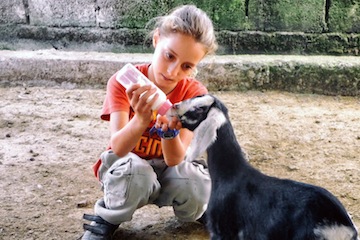
photo - Funds from the Jewish National Fund of Canada’s Negev Gala will support an animal-assisted therapy centre in the city of Sderot
Funds from the Jewish National Fund of Canada’s Negev Gala will support an animal-assisted therapy centre in the city of Sderot. (photo from hanof.kkl.org.il)

In addition to comedian Gold (see story, jewishindependent.ca/jnf-gala-features-comic-gold), the evening featured a few speakers, including Sanford Cohen paying tribute to the philanthropic work of honourary event chairs Bob Markin and Ralph Markin at a gala dinner before the main program, and JNF Pacific Region president Bernice Carmeli offering remarks at the dinner and during the program. Schara Tzedeck’s Rabbi Andrew Rosenblatt spoke about humour in Jewish theology. Actor and writer Josh Epstein emceed. Shannon Gorski chaired the event and Shirley Hirsch was convenor. Ilan Pilo, Jerusalem emissary and executive director of JNF Pacific Region, recognized past president David Goldman.

Funds from the event will support an animal-assisted therapy centre in the city of Sderot, where children and adults live with post-traumatic stress disorder due to years of rocket and mortar attacks from nearby Gaza. The project was described to the audience by Lance Davis, chief executive director of Jewish National Fund of Canada.

Format ImagePosted on April 19, 2019April 17, 2019Author Pat JohnsonCategories LocalTags Elon Gold, Jewish National Fund, JNF, Negev Gala, Ron Prosor, United Nations
The power of resilience

The power of resilience

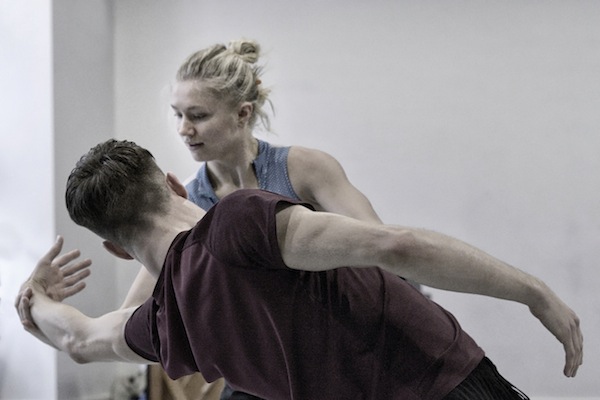
Ballet BC dancers Scott Fowler and Parker Finley in rehearsal for the company’s final program of the season, which features all Jewish community choreographers. (photo by Michael Slobodian)

Ballet BC concludes its season May 9-11 with Program 3, featuring all Jewish community choreographers: Israel’s Sharon Eyal and Gai Behar, Vancouver’s Serge Bennathan and Israel’s Ohad Naharin.

Program 3 begins with the North American première of Eyal and Behar’s Bedroom Folk and concludes with the return of Naharin’s Minus 16, a crowd-pleaser that Ballet BC presented in 2017. The middle piece, by Bennathan, is a world première, commissioned by Ballet BC.

“Emily Molnar invited me to create a work for the company,” Bennathan told the Independent in a phone interview. “That’s it. All the rest is for me to create what I want for them.”

Given that leeway by Molnar, Ballet BC’s artistic director, Bennathan said he wanted to create a work for all the dancers.

“I’m so in love with the company that I felt it will be wonderful to have them all, mostly for the kind of work I do,” he said.

“When I create work, whatever it is, for my company or another company, I always say I like to have the group of people that are strong individuals that make sense together,” he explained. “That is exactly what the company is right now. If you take Ballet BC now – individually, they are quite fantastic, each of their personalities, they’re fine, but they make so much sense together. That’s the beauty of it.”

Bennathan was born in France and came to Canada more than 30 years ago. Artistic director of Toronto’s Dancemakers from 1990 to 2006, he then came to Vancouver, where he founded Les Productions Figlio.

“My work, I would say, is quite physical, but my point of departure is to work from the energy. Not the energy being exuberant or something like that, but the energy that makes you move. So, you have to be present in the moment with your body and move from inside…. You have to find it in yourself to move.”

Bennathan has created many full-length works, both for his own companies and others, and he has a long history with Ballet BC.

“My first-ever commission was the first time I came to Vancouver. Reid Anderson was the artistic director,” he said. “I had just arrived in Canada. I was a young immigrant and I was doing work here in Vancouver and they saw my work and they invited me to create. The first-ever piece was a duet. And then, throughout the years, the invitations kept coming, so I created.”

Set to an original score by Montreal-based composer Bertrand Chénier, Bennathan shared a little about next month’s première, as well as his creative process.

“It’s [about] how do you find the form of resilience. How do you sustain that [thing] that keeps your head above water? That’s what it is,” he said of the work.

“Before I create the piece with dancers, I spend time [on my own] – I paint, I sew and I write and I explore these ideas that come to me through painting; not to paint movement … but to try to extract what it means in a poetic way. So, when I ‘write,’ in the studio with the dancers, what happens is, when I choreograph, I don’t think about the piece. I let my body talk because I believe that the mounds and mounds and mounds that I read – like, for this one, I read a lot of poetry, I painted, I wrote poetry – when I’m in the studio with them, I just let my body talk when I choreograph. And then they grab it. But this is only the beginning. After that, there is another period. I don’t want them to do exactly what I did. The movement can transform itself – what needs to stay true is the essence of why we did this movement at the beginning.”

For Bennathan, dance is more than an art form.

“I left my family quite early, I was 14 years old. Let’s say, my life was taking a direction that, deep inside me, I knew it was not the direction I wanted to take. I want to say [that] to people because, sometimes we see a lot of youth and we say, ‘Oh, you should get out of this, or you should do this …’ but the fact is, sometimes, mostly when you are young, you are taken into a spiral and you cannot get out. And, if you do not have the opportunity, or create yourself the opportunity, to lead you to someone that can tell you a word or a phrase that will change you or offer something you can open the door to, you are in a terrible situation, you cannot get out. I was able to have this in my life and … at 14, I said, ‘OK, I’m going to leave this, I’m going to Paris, I’m going to study dance, and that’s what I want to become, a dancer. This saved me, literally. I needed to do this to get out of a situation I didn’t want for me.”

Bennathan described dancers as “courageous, at all levels; not courageous just to apply themselves physically – because it’s there, they have the courage to abandon themselves into this art form – but, at the same time, to live as a dance artist. And, even more in our days, you have to be courageous, you have to have resilience.”

He said he can’t just invite talented dancers from other parts of the country to come work with him here because Vancouver has become so expensive. “Young artists or young families cannot come live here anymore. That’s the thing. And you have to be courageous to say, ‘OK, I’m going to come.’… These days, you don’t just say, ‘Oh, I’m going to live in Vancouver.’”

Bennathan believes in the power of dance, and art in general, to improve the world.

“A lot of people say ‘art can save the world,’ but why can you say that? It’s because we need the inspiration, we need poetry in our lives. Sometimes, poetry, these days, is dismissed. We so forget the importance of the inspiration of poetry in our day-to-day lives. There is a reason, not only in North America, but everywhere in the world right now … why cynicism is the most important thing…. It’s because we left all this – whether it’s writing poetry, written poetry or dance or music – we stop these art forms at the door instead of inviting them into our lives.” If we did invite them in, he said, “we would talk differently and we would start to see things differently.”

Program 3 is at Queen Elizabeth Theatre May 9-11, 8 p.m., and Ballet BC will celebrate 10 years with Emily Molnar as artistic director with a reception after the closing performance on May 11. For tickets to the performances, visit balletbc.com. Tickets for the reception are available via eventbrite.ca.

Format ImagePosted on April 19, 2019April 17, 2019Author Cynthia RamsayCategories Performing ArtsTags Ballet BC, dance, Emily Molnar, Gai Behar, lifestyle, Ohad Naharin, Serge Bennathan, Sharon Eyal
Defending a neo-Nazi

Defending a neo-Nazi

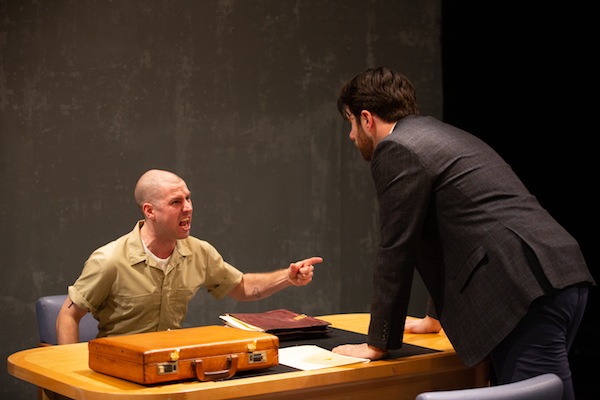
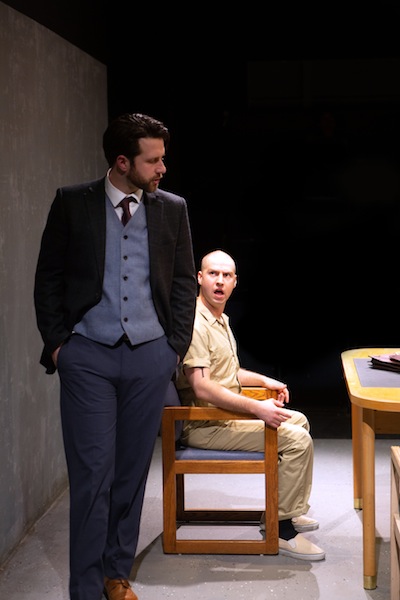
Kenton Klassen, left, and John Voth co-star in Pacific Theatre’s production of Cherry Docs. (photo by Dylan Hamm)

I often wonder, as a lawyer and the child of a Holocaust survivor, if I would be able to defend a skinhead charged with a racist crime. Can a person shut off their emotions and take on a case that is at odds with their moral compass?

This is the premise of Cherry Docs, a two-hander playing at the Pacific Theatre until April 28. Playwright David Gow penned the piece in 1998 as a response, in part, to the homophobic attack by a group of skinheads on his university friend and, in part, to his Jewish Belgian family’s Holocaust experiences.

“I wanted to explore and come to terms with my own anger at seeing young people dressed as Nazis and adopting Nazi thinking 50 years after the end of a war that killed so many millions,” Gow told the Jewish Independent. “Now, 70-odd years later, we seem to have more neo-Nazis than ever before. It looks far, far worse today than in 1998, when someone could (and did) say with a straight face, are you sure this is a problem? It was not good in 1998. Now, of course, it is a problem of epic, international proportions.”

Cherry Docs has been produced globally, including a long run in Germany, where, said Gow, “the critical reception … was extremely detailed, extremely well-written, unlike anything we see in North America, even from, say, the New York Times, in terms of depth and breadth of commentary and analysis. The play ran for something like seven years in rep in Berlin. Two distinct productions have been done in Tel Aviv over the years, and maybe two in Jerusalem.”

As well, he added, “productions in Poland ran for 13 years. One Polish production went to Beijing for an international theatre festival and, there, it played with Chinese subtitles, so, an English Canadian play in Polish and Chinese, in China.”

The success of the play and its international acclaim led Gow to adapt the story for the big screen. Its cinematic debut came in 2006, as Steel Toes. It won several awards on the film festival circuit.

In the two-actor play, which features John Voth as Danny Dunkelman and Kenton Klassen as Mike Downey in the Pacific Theatre production, Danny is a Jewish legal aid lawyer who has been assigned the task of defending Mike Downey, a 20ish, tattooed skinhead, who is charged with murder in the stomping death of a Pakistani fast food worker in a back alley in downtown Toronto. The play’s title represents Mike’s pride and joy, his steel-toed, cherry red Doc Marten combat boots, which he is wearing when he commits his hate-motivated crime. The rationale for Mike’s unprovoked, drunken attack is his perception of the decline and fall of white male supremacy as brought on by what he sees as unchecked immigration, reverse discrimination for employment opportunities and a ZOG (Zionist occupation government) conspiracy of the Jewish elite.

Mike has been indoctrinated into the white racist youth movement and recites antisemitic clichés with ease and conviction. He is a proud foot soldier for the Aryan resistance movement. He goads Danny on by saying, “In an ideal world, I would see you eliminated, but I need you. I know you will do a good job for me, as you are a Jewish liberal thinker, a humanist, who believes in checks and balances in the system.”

Mike insists that he be tried for his crime, which he admits – although he says he did not intend to kill the victim – as an individual. “Try me,” he says, “not the skinhead ideology.”

Danny aggressively challenges high school-dropout Mike to formulate a convincing defence strategy, taking him through “the eye of a needle” in an effort to make him stand up and be accountable for his actions.

photo - John Voth, left, and Kenton Klassen co-star in Pacific Theatre’s production of Cherry Docs
John Voth, left, and Kenton Klassen co-star in Pacific Theatre’s production of Cherry Docs. (photo by Dylan Hamm)

The two travel their own paths of discovery through the seven months of legal proceedings. Mike’s journey leads him to a path of redemption, while Danny struggles. Danny must confront not only his violent dislike for his client, but his own racism; in doing so, he explores his Judaism and its tenets of atonement and forgiveness.

The biblical names of the characters Daniel (in the lions’ den) and Michael (the archangel) suggest an allegory, “A battle from above played out here,” said Gow. As the story unfolds, we see the impact that two ideologically opposite humans can have on each other, and that Danny is no saint and Mike no devil.

All of the action takes place in the prison, where Mike is being held in administrative segregation. The style – alternating monologues from the protagonists followed by intense bouts of verbal sparring – and the sparse set (two chairs and a table) are appropriately stark for the subject matter and the intimate theatre space. The costumes also are uncomplicated – Mike’s prison jumpsuit and Danny’s business attire. Subtle lighting and sound cues complete the atmosphere.

Klassen is superb in his portrayal of Mike. At the opening night reception, he shared with the Independent that he had prepared for the role by talking to a reformed neo-Nazi skinhead, which gave him insight into his character. While Voth is solid as the defence attorney, he is not as engaging as Klassen.

Two particular scenes bear mention. In one, the two actors stand at opposite ends of the stage, just breathing and looking at each other with no words spoken – the silence is more powerful than any dialogue. In the second, Mike sits alone on the stage, repeatedly opening and closing a lighter, his face mirrored in the glow of the flame – again, the silence says it all. Kudos to director Richard Wolfe for bringing all the parts of this production together into a riveting whole.

As for another reason why audiences should come to see the play, Gow said, “It is highly entertaining, and that is why it has attracted tens of thousands of audience members. The best-known actor associated with the play has said, ‘It will recalibrate your soul.’ I am not sure about that, but certainly thought-provoking, I believe … not an average play, in any case.”

Cherry Docs is, indeed, a thought-provoking play, whose themes remain timely and relevant. It is difficult to perform and a brave choice for Cave Canem Productions and Pacific Theatre – it is both a visceral and intellectual experience, suitable for older teens and up, as it contains mature subject matter, violence and profanity. For tickets, call 604-731-5518 or visit pacifictheatre.org.

Tova Kornfeld is a Vancouver freelance writer and lawyer.

Format ImagePosted on April 19, 2019April 17, 2019Author Tova KornfeldCategories Performing ArtsTags antisemitism, Cherry Docs, David Gow, law, Pacific Theatre, racism, theatre
Responding to the landscape

Responding to the landscape

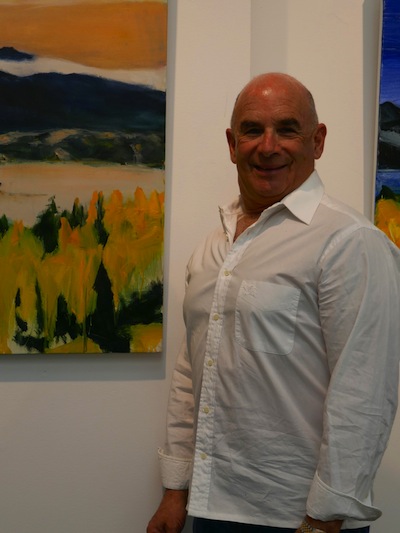
“ReView 2” by Ian Penn.

Ian Penn is not a new name for regular visitors to the Zack Gallery, which has exhibited his work before. “I like this gallery,” Penn told the Independent. “It’s like a public marketplace. It’s transparent and open. Children come in. Older people. People on the way from their lunch or the gym. The gallery is accessible, the way art should be. I could show at a traditional gallery, but I don’t want to.”

Penn makes one exception to this statement – for his homeland, Australia. “I have a gallery in Australia that represents me, and I exhibit there frequently, once or twice a year,” he said. “Last year, I was an artist-in-residence at that gallery. I gave artistic workshops to high school children. It was fun.”

His current exhibition at the Zack, From the Deck: View and ReView, is dedicated to landscapes, specifically the scenery he sees from the deck of his house: trees and mountains, water and clouds. Penn has painted these landmarks in different lights and different seasons. “I tried to capture different moods,” he said. “Some are grand, panoramic. Others are smaller, more intimate.”

He explained his idea behind the show. “View and re-view are two parts of the process. I look at the view from my house deck, have been looking at it for years. I enjoy the landscape from a single view. I take photographs. I sketch it multiple times. It’s my immediate response to the landscape. I’m part of it. I’m mapping it. This is ‘View,’ but it is not the territory, just a map. It is my understanding of the place.”

Penn’s View paintings are more abstract, sometimes just splashes of colour. What is important to the artist is that every element appears in the right size and shape in relation to the other elements. “I measure all the distances at this stage and mark the proportions. How far is this treetop from that ship passing through? How large are these bushes compared to that shoreline? I make lots of drawings.”

The second part of the process, the review, is done in the studio, later. “This is the second part of my response,” he explained. “I’d think: what is important in that idea? A ‘ReView’ is my emotional and physical answer to the ‘View’ and the landscape. It’s all about the place itself, the place and the painting. At this stage, I’m recreating the territory.”

photo - Ian Penn at the opening of his latest solo exhibition at the Zack Gallery, which runs until April 28
Ian Penn at the opening of his latest solo exhibition at the Zack Gallery, which runs until April 28. (photo by Olga Livshin)

Unlike the bold brush strokes of his Views, most of his ReViews are more detailed, while still exploring the same landscape. And the ratio of abstract versus figurative slants towards the figurative. “I’m interested where representation and abstraction interact,” he admitted.

In his ReViews, a tree becomes a more detailed tree, not just a blob of yellow, even while maintaining its impressionistic abstract profile. A ship becomes more identifiable as a ship, not simply a dark squiggle. And a cloud can’t be mistaken for anything else.

In fact, clouds play a huge role in most of the paintings on display: light and fluffy in one image, heavy and menacing in another. “Clouds change constantly; that’s why they interest me. I’m fascinated by change, by periods of transition,” said Penn. “That’s why most of these paintings are done in spring or autumn. Those are the seasons of change. In summer, the landscape is full and the sky is clear, but, with autumn, comes change. The colours of the leaves change. When the leaves fall, the shapes of the trees change. The bones of the landscapes are transformed. The weather changes. Same in spring. By exploring those changes, I’m addressing the changes in our lives.”

By the juxtaposition of constant change within the same view – from one location – Penn follows in the footsteps of one of his favourite artists, Paul Cezanne. “I studied Cezanne. He painted Mont Sainte-Victoire countless times, all different,” Penn said. “He changed the landscape genre forever, took it apart and re-created it.”

Penn’s investigation of the landscape as an art form goes further. “A traditional landscape is horizontal, with certain set dimensions,” he explained. “I’m challenging those dimensions, trying landscapes of different formats. A portrait shape. A diptych, which is much wider than a traditional landscape. I’m playing with different geometry. What if the two parts of a diptych are of different widths: one square, another a wider rectangle? What if both parts are off-squares?”

Penn’s experiments with the shapes of his paintings, with the changing of weather and seasons, makes the show diverse. The exhibition demonstrates the richness of landscape as an art form.

“Landscape as we know it is relatively new in the modern Western art,” he said. “Before the Renaissance, landscape was mostly a background for figures in the composition. It only became a separate art form in the 16th and 17th centuries, after the paint tubes became small enough that artists could take them out of the studios, to paint on locations. That was what the Group of Seven did. That is what I do.”

Penn’s show runs until April 28 at the Zack. For more information about his work, visit ianpenn.com.

 Olga Livshin is a Vancouver freelance writer. She can be reached at [email protected].

Format ImagePosted on April 19, 2019April 17, 2019Author Olga LivshinCategories Visual ArtsTags art, Ian Penn, landscape, painting, Vancouver
Tapestry up for raffle

Tapestry up for raffle

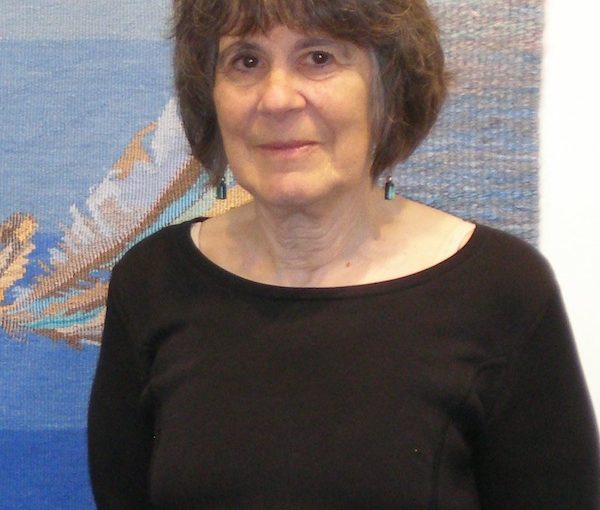
Barbara Heller (photo by Olga Livshin)

Temple Sholom’s Dreamers and Builders gala is not only a time to celebrate, but to raise funds for the synagogue. In addition to honouring Jack Lutsky and Susan Mendelson, this year’s sold-out event on May 5 will include a silent art auction at the dinner and a raffle, the bidding for which has already started.

“We have art donations for the silent auction from members of the synagogue, Ian Penn and Ivan Gasoi, as well as from Dina Goldstein and Gordon Smith, and a tapestry by Barbara Heller for the raffle,” said Karen Gelmon, gala co-chair, in an interview with the Independent. “Barbara is a member of Temple Sholom and an internationally known tapestry artist. Her works are very valuable, unique and truly remarkable.”

Gelmon noted that the synagogue has several tapestries by Heller on its walls. “There are two magnificent pieces that are on either side of the ark at the front of the sanctuary,” she said. “They are wonderful and loved by the congregation. She has donated two other works that are in another room and are also very appreciated. All these pieces have been there for more than 20 years and are fixtures at the synagogue.”

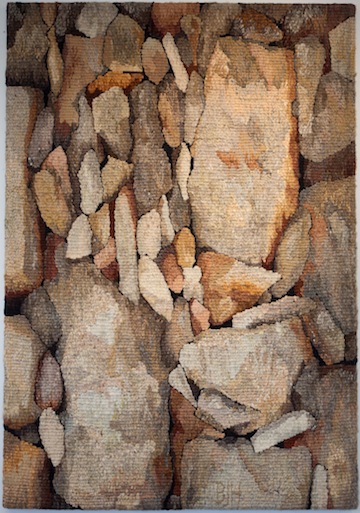
The raffle features the tapestry “Stones 22 – Stonefall,” the 22nd in Heller’s Stonefall series.

“I have been weaving these tapestries of stone walls and stones on the ground every few years for decades, between more difficult pieces,” Heller told the Independent. “I love these stone walls, built by man without mortar or cutting the stones to fit. If these walls fell down, the stones would return to the earth and no one would be the wiser. Yet, I see the spirits of the people who built the walls. Their energy remains in the stones.”

Heller also likes that the tapestries are abstract. “I get to immerse myself in the act of weaving as I transform them from stone into wool,” she explained. “I play with the handspun and hand-dyed yarns, the textures and the colours, without worrying about the underlying message.”

photo - Fabric artist Barbara Heller has donated her work “Stones 22 – Stonefall” to Temple Sholom’s Dreamers and Builders fundraiser
Fabric artist Barbara Heller has donated her work “Stones 22 – Stonefall” to Temple Sholom’s Dreamers and Builders fundraiser.

“Stones 22” was woven in 2013. “It was based on the photos I took in Caesarea on the Mediterranean in Israel,” said Heller. “The site has been home to invader after invader for millennia. It has been an archeological dig since a farmer plowing the meagre soil first uncovered a large stone block and called the scientists. Here, there are definitely ghosts of the people who came before.”

About why she chose to offer one of her artworks for the raffle, she said, “When I was asked to donate a tapestry by Susan [Mendelson] and the organizing committee for Dreamers and Builders, I was happy to say yes. Susan and Jack have supported my art and own a few tapestries. Temple Sholom is my synagogue and has also supported me. It has several of my tapestries, some as donations and two on loan. The bimah is flanked by two of my tapestries that were commissioned at the time of my son’s bar mitzvah, and the library has a tapestry that my mother willed to the Temple on her death. Now, it was my turn to support them.”

The decision of which tapestry to donate was a practical one. “I felt it had to be mid-size, large enough to have a presence but not so large that it would not find a new home in a modern condo,” she said. “And the reference to Israel was also important to me.”

As an artist who makes a living by her art, Heller has given much thought over the years to the concept of donating work.

“It has been awhile since I donated artwork,” she shared. “There was a time a few years ago when art auctions were all the rage for fundraising, to the detriment of the artists. The fundraisers always stressed that the auctions would be good publicity for the artists, but I don’t think so. People always wanted a bargain when they bid at auctions, and I don’t think that the fundraisers were aware of the lost income for the artists.”

An artist must look at a donation as just that, said Heller, as a donation to raise funds for a charity they believe in. “I now do it only on occasion. I am reminded of what my friend, a pianist, does. When approached to play for free, she says, ‘You pay me what my normal fee would be, and then I will decide how much to give back to you as my donation.’ This makes the fundraisers aware of what they are actually asking.”

Gelmon and the organizing committee were well aware of what they were asking. “I think different artists may have different motivations to donate their art,” said Gelmon. “For Barbara, I think she saw this as a worthy cause. It is raising money for her synagogue, where she and her family have been members for years, and it probably gives her great pleasure to contribute.”

To take part in the raffle, visit templesholom.ca/dreamers-builders-2019-raffle.

Olga Livshin is a Vancouver freelance writer. She can be reached at [email protected].

Format ImagePosted on April 19, 2019April 17, 2019Author Olga LivshinCategories Visual ArtsTags art, Barbara Heller, fundraiser, Israel, philanthropy, tapestry, Temple Sholom

Strongmen bromance

Binyamin Netanyahu appears comfortably ensconced in the Israeli prime minister’s office after last week’s elections. While his Likud bloc effectively tied for seats with the upstart Blue and White party, the smattering of smaller parties are mostly of the nationalist, religious and right-wing bent, meaning Netanyahu will have a fifth term as leader. If he hangs on until July, he will surpass David Ben-Gurion as Israel’s longest-serving prime minister.

The likelihood that he will reach that mark seems good. He faces probable criminal charges but that does not necessarily mean the end of his career. Rumours are rife that he is considering a legal escape hatch that would permit him to remain in office even if indicted or, more likely, make it illegal to indict a sitting prime minister. In most democracies, at most times in recent history, such a move would be seen as intolerably corrupt. Times change.

The leaders of democracies today are blazing new trails. The words and actions of the U.S. president confound our capacity for incredulity. Jaw-dropping statements of contempt, bigotry, juvenile pique and lies emanate from his mouth (and Twitter fingers) faster than the outrage can follow. Across Europe, far-right extremist parties are rising, as they did in elections in Finland on the weekend. In Britain, which is convulsing from self-induced Brexit trauma, the leftist Labour party is engulfed in an antisemitism crisis. Positions and statements that would have been unthinkable in the civil discourse of recent decades are suddenly at the centre of public discourse in democracies everywhere.

Israel is no exception. During the recent election campaign, candidates expressed erstwhile unspeakable ideas, including a scheme to ethnically cleanse the West Bank of Arabs and annex the land to Israel. The advocate of that idea was soundly defeated – the Knesset democratically cleansed of his ideology when the party failed to reach the 3.25% minimum vote to enter parliament.

But Netanyahu himself floated some astonishing trial balloons during the campaign. He mooted annexing West Bank settlement blocs into Israel – a concept that is not ludicrously beyond the pale since, if a negotiated settlement ever emerges, it will likely include such a move in exchange for traded land. But he also suggested annexing settlements that are not adjacent to or contiguous with Israel’s recognized boundaries. Such an idea would create a patchwork in the West Bank along the lines that would make an independent Palestine unworkable. The fact that the incumbent prime minister opened this political Pandora’s box is evidence of a new willingness to play with potential fire.

That foot play with extremists is not limited to domestic affairs. If an Israeli Rip Van Winkle fell asleep a couple of decades ago and woke up to Israel’s current diplomatic situation, he would be confused and possibly delighted. If that Van Winkle shared our worldview – an apparently old-fashioned belief in pluralistic, inclusive, universal humanitarian values – he would quickly conclude that the prima facie bonanza of goodwill has a rotting core.

As former Israeli ambassador to the United Nations Ron Prosor said Sunday night (see cover story), Israel has open lines of communication with countries that for decades steadfastly rejected its very existence. Likewise, Israel has excellent relations with some of the most populous and powerful countries in the world – India, China, Russia, Brazil and, in different but important ways, a refreshed, familial relationship with the current U.S. administration.

Israel has superb relations with these countries, and with the Philippines, as well as with Hungary and other eastern European states that have traditionally been problematic for the Jewish state. That seemingly good news is tempered by the fact that these good relations are not based on conventional diplomatic alliances. To a large extent – especially in the cases of Hungary, the Philippines, Brazil, Russia and the reinvigorated bonhomie between the leaders of Israel and the United States – these close relations are based on a shared strain of politics that fill us with more nervousness than naches.

These relationships are less between Israel and Brazil or the Philippines or Hungary or Russia than a bromance between Netanyahu and Jair Bolsonaro, Rodrigo Duterte, Viktor Orban and Vladimir Putin, to say nothing of the continuing lovefest between Bibi and Donald Trump. Each of these figures is a strongman who is, to varying degrees, pushing the limits of their democracies to see how far they can stretch rule of law and diminish respect for human rights. With this in mind, the diplomatic warmth seems less about traditional bilateral relations than about a fraternity of nationalist, populist and authoritarian men leading the world down a path unimagined a decade ago.

With that background, Israel’s unprecedentedly improved relations with so many countries seems less positive a development. Our proverbial sleeper might pull the covers back over his head and hope for better in the decades to come.

Posted on April 19, 2019April 17, 2019Author The Editorial BoardCategories From the JITags Binyamin Netanyahu, democracy, elections, human rights, Israel, politics
Interacting with genocide

Interacting with genocide

A project of the Canada-Ukraine Foundation, the national educational tour about the Holodomor began in 2015 and has reached about 30,000 Canadian high school students so far. (photo by Pat Johnson)

What constitutes a genocide? How many Ukrainians were murdered by Josef Stalin’s human-created famine in the 1930s? Would you stand up in a situation where lives were at risk – even if it meant you might become targeted?

These were some of the questions confronted by Grade 12 students of King David High School last week. A national educational tour about the Holodomor – the mass murder of Ukrainians by the Soviet regime – pulled into Vancouver, opening the eyes of young people to this chapter of history.

Beginning in 1932, the Soviet government under Stalin began a calculated, systematic famine in Ukraine, seizing all food sources, cutting off escapes for people fleeing starvation and implementing summary execution for the crime of stealing the smallest piece of sustenance. Farming was collectivized, creating catastrophic conditions. Political and intellectual elites were murdered.

Some details, including the number of Ukrainians killed, remain cloaked in uncertainty because, from the start, the Holodomor was deliberately hidden from the outside world through a comprehensive system of censorship and misinformation, as well as the complicity of media and other countries. Estimates of the number of dead range from seven million to 14 million.

Holodomor is a portmanteau made up of holod, starvation, and mor, death, meaning “death by starvation.”

photo - Last week, King David High School Grade 12 students and others participated in the educational tour
Last week, King David High School Grade 12 students and others participated in the educational tour. (photo by Pat Johnson)

The Holodomor National Awareness Tour consists of a bus-sized repurposed former recreational vehicle. Rather than a static exhibition through which participants walk, the vehicle has been retrofitted with a 30-foot screen down one interior wall and 30 theatre-style seats down the other, with interactive tablets that invite students to study and discuss in small groups before reconvening to share what they’ve learned with the larger group. A project of the Canada-Ukraine Foundation, the tour began in 2015 and has reached about 30,000 Canadian high school students so far.

The Holodomor was not an endeavour to kill an enemy, but an effort to restructure society, a form of social engineering at its most extreme. In September 1932, Stalin wrote to one of his lieutenants that Ukraine was restive. The Soviets perceived Ukrainians as being profoundly religious, individualistic, believers in private property and attached to their plots of land, making them unsuitable for building communism. Addressing these perceived flaws would require, according to Soviet leaders, an action so extreme that a word had not yet been invented to describe the intent.

The entire agricultural sector was upended by collectivization and resisters were murdered or sent to gulags, Soviet concentration camps. At first, remaining supplies of food sustained the Ukrainian people, but those reserves were soon depleted, while the Soviets extracted ever-increasing quotas of grain and Soviet wheat exports to the West grew. As the Holodomor proceeded, NKVD secret police were sent to search for and confiscate any remaining food sources. While those caught stealing or concealing food were executed, for millions more, fate was less sudden.

“Most of the victims died slowly, at home,” according to the narrator of one of the interactive films viewed by students. “Special NKVD units raided people’s homes to collect the dead bodies. They received 200 grams of bread for every dead body they delivered.”

Students examined the forces that allowed the Soviet Union to hide the reality from the world. For the Soviets’ part, there was censorship and the threat of retaliation for those who shared the truth. But their crimes were abetted by Western figures, including New York Times correspondent Walter Durante, who won a Pulitzer Prize for his reporting from the USSR, even as he misrepresented the Holodomor. In one article, titled “Hungry, not starving,” Durante wrote that there is no actual starvation or death from starvation, though he acknowledged there was widespread mortality from diseases due to malnutrition.

Leading journalism figures from the time are brought to life through reenactments. British journalist Malcolm Muggeridge, reporting for the Manchester Guardian, reflected on being raised in a socialist household and how he was enthusiastic about traveling to the Soviet Union to report on the utopia being created there. When he saw the reality, he evaded Soviet censors by sending his dispatches home via the British embassy’s consular pouch.

One of the heroic figures of the story is Gareth Jones, a Welsh journalist who risked his life to bring the truth from Ukraine. He convened a press conference in Berlin, on March 29, 1933. But the timing was terrible. The Soviets were about to launch a show trial against six U.K. citizens, accusing them of espionage in what would become known as the Metro-Vickers Affair.

In order to remain in the USSR and report on what promised to be a trial of global importance, journalists had to stay on good terms with the authorities.

“It would have been professional suicide to make an issue of the famine then,” one reenactor remarked. “So, none of us supported Jones.”

Lauren Shore is a student in King David’s Holocaust and Genocide Studies 12 course. The class, created by teacher Anna-Mae Wiesenthal, is delivered during lunch hour and, while students receive credit, they take the course in addition to their full complement of other classes. A province-wide genocide studies elective course is part of the new B.C. curriculum and will be offered next year at schools that opt-in.

Shore, with a partner, did a project on the Holodomor.

“Since there is a lot of debate on whether it’s a genocide or not, and how it was planned, we decided to focus on that,” she said. “We were focusing on the different steps of genocide [and] people were debating whether it was a genocide or not, since it wasn’t necessarily planned as exactly as other genocides were. As we looked into it, we found that it was planned just as much as the other genocides, just in other, more subtle ways.”

Solly Khalifa, also in Grade 12, was impressed with the interactivity of the Holodomor tour.

“I was astonished at how innovative it is,” he said. “They really get everybody participating and it’s very interesting and an easy way to participate also.”

Classmate Noah McNamara saw parallels between the Holodomor and the Holocaust.

“All genocides are kind of similar, in that it’s a governing body that takes advantage of their power to push a goal,” he said. “In the Holocaust, [it was] the Aryan race that they wanted to push. In this case, it was communism that they wanted to push. I think it’s important for us now to be aware of aggressive governments and governments that are trying to radically push things, because that’s definitely a precursor to genocide.”

Ava Katz, who worked with Shore on their Holodomor project this year, noted that studies of the Holocaust enforce the dictum “never again.”

“But I feel like sometimes that’s overlooked with other genocides,” she said. “Not a lot of people will say that. But when you really study other genocides in-depth and see how severe they are, it’s important that we never let any of them happen again.”

The cross-country tour operates with a shoestring staff. Alexi Marchel leads students though the experience. Kevin Viaene drives the bus and supports the program.

Format ImagePosted on April 19, 2019April 17, 2019Author Pat JohnsonCategories LocalTags education, genocide, Holocaust, Holodomor, human rights, journalism, KDHS, King David High School, media, Ukraine
Stressed out by technology

Stressed out by technology

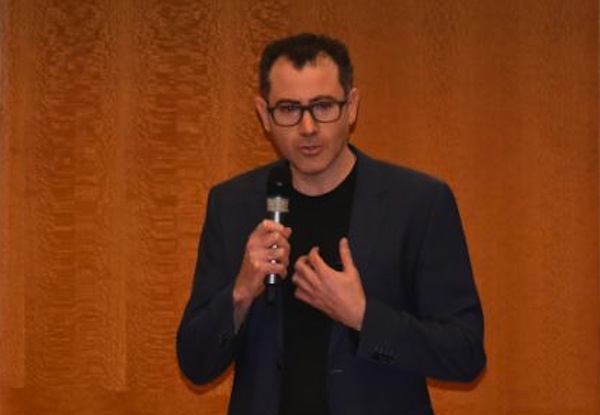
Elan Divon speaks at King David High School earlier this month. (photo from KDHS)

Elan Divon has found his passion and purpose in life – helping people to find their passion and to confidently fulfil a purpose that not only builds their own positive energy but also lets that energy spill out to improve the world in both small and potentially large ways.

On April 8, King David High School’s PAC hosted an evening that featured Divon, founder and chief executive officer of the Divon Academy, which, according to its website, “help[s] students and professionals stand out, and develop skills that are proven to boost their long-term success and well-being.”

He began by sharing the story of avoiding a deadly suicide bombing by sheer coincidence. Twenty years old, a soldier in the Israeli army, he had just returned home and was on a date at a café. The woman wanted ice cream instead, so they left; moments later, they heard three bombs go off, many people were killed, hundreds were injured, in the area they had just been. The experience jolted Divon onto a path of self-reflection and a search for spiritual meaning.

He went to study abroad, later quitting a Wall Street job and then studying archeology and anthropology at Brandeis University, followed by comparative religion at Harvard University.

“Since then,” reads his bio, he “has directed a peace camp for embattled Israeli and Palestinian teens; delivered countless personal development workshops to young professionals around the world, frequently presents before CEOs and business leaders; and, most recently, co-founded the Einstein Legacy Project to inspire the next generation of brilliant minds on the planet.”

Divon explained to the audience at KDHS that he feels he has found his purpose and can, therefore, live his purpose and make every moment count. He wants others to be able to do the same. He spoke about what he called a “stress epidemic” and identified five key aspects that inhibit personal growth and cause poor performance for students and adults alike.

The first factor is how much technology has invaded our ways of behaving and thinking. “Because of technology, people feel that everything needs to happen instantly,” he explained. With smartphones and constant access to the internet and apps, people find the answers they are looking for without really having to search, and they communicate with others without really having to interact.

“Our outer reality works very quickly but our inner reality takes time to develop,” he said about why this causes stress. Using the example of gestation, Divon explained how certain biological functions cannot be rushed – by technology or just because we shower them with attention. It takes time and experiences – both positive and negative – to build the necessary skills for human interaction and resilience, to be a well-rounded and confident person, he said.

The culture of comparison that dominates the internet is the second challenge. Before the advent of the internet, said Divon, a person might compare themselves to their sibling, a neighbour or the most impressive student at school. Today, we see carefully crafted virtual personae online from all over the world, and use those as a totally unrealistic benchmark for self-comparison, he said.

Next, Divon focused on the benefits that can be gained from discomfort. “Parents need to give their children space to solve their problems themselves,” he said, noting that, currently, teens can avoid uncomfortable situations by hiding behind their over-involved parents or their phones.

Social isolation – Divon’s fourth area of concern – can result from living a virtual life. Without direct personal contact, he said, people suffer all kinds of stress. Age-old ways of coping with painful situations or celebrating happy moments are eliminated by text communication. “Studies show that when good news is shared via text, it’s like it didn’t happen, even when the recipient of the text responds. Only through personal contact do people feel supported and connected,” explained Divon.

Finally, he said that overstimulation is damaging everyone. “We are drowning in information but starving for wisdom,” he said.

Divon outlined three ways to enhance happiness and purpose in life.

First, we need to have a proactive rather than a reactive mindset, he said. Using the establishment of the state of Israel as an example, Divon explained how the nascent state was able to turn a rocky beginning into a success. Rather than focus on the paucity of resources and abundance of hostile neighbours, those who established the modern state of Israel were optimistic and counted their blessings. “Being a victor over circumstances rather than a victim of circumstances is what sets people with a positive mindset apart from those with a negative one,” said Divon.

A positive mindset helps build the second key factor: relationships. A strong – real, not virtual – support group is a protection from stress, it helps most people find their jobs and determines and gives meaning to life, said Divon.

The third component to finding contentment and productivity is stress management. “Stress is resisting what is in a present moment,” Divon said. If stress is resistance and 95% of stress occurs in the mind, it is possible to eliminate or manage most of the stress we perceive in our lives, he explained. While the steps needed to manage stress are not easy, Divon said that, with practise, step-by-step, people of all ages can change their habits and develop more effective ways of coping.

Neuroplasticity is the ability of the brain to adapt and change. Divon explained that, although there are many stressors and that technology is often our foe instead of our friend, we can all develop new pathways in our brain. We can enhance the quality of energy we possess and make ourselves and those around us happier.

Michelle Dodek is a freelance writer living in Vancouver, and the mother of a 12- and a 13-year-old.

Format ImagePosted on April 19, 2019April 17, 2019Author Michelle DodekCategories LocalTags Elan Divon, KDHS, King David High School, lifestyle, parenting, technology

Posts pagination

Page 1 Page 2 … Page 6 Next page
Proudly powered by WordPress