Skip to content
  • Home
  • Subscribe / donate
  • Events calendar
  • News
    • Local
    • National
    • Israel
    • World
    • עניין בחדשות
      A roundup of news in Canada and further afield, in Hebrew.
  • Opinion
    • From the JI
    • Op-Ed
  • Arts & Culture
    • Performing Arts
    • Music
    • Books
    • Visual Arts
    • TV & Film
  • Life
    • Celebrating the Holidays
    • Travel
    • The Daily Snooze
      Cartoons by Jacob Samuel
    • Mystery Photo
      Help the JI and JMABC fill in the gaps in our archives.
  • Community Links
    • Organizations, Etc.
    • Other News Sources & Blogs
    • Business Directory
  • FAQ
  • JI Chai Celebration
  • JI@88! video

Recent Posts

  • טראמפ עוזר דווקא לנושא הפלסטיני
  • New rabbi settles into post
  • A light for the nations
  • Killed for being Jewish 
  • The complexities of identity
  • Jews in time of trauma
  • What should governments do?
  • Annie will warm your heart
  • Best of the film fest online
  • Guitar Night at Massey
  • Partners in the telling of stories
  • Four Peretz pillars honoured
  • History as a foundation
  • Music can comfort us
  • New chapter for JFS
  • The value(s) of Jewish camp
  • Chance led to great decision
  • From the JI archives … camp
  • עשרים ואחת שנים להגעתי לונקובר
  • Eby touts government record
  • Keep lighting candles
  • Facing a complex situation
  • Unique interview show a hit
  • See Annie at Gateway
  • Explorations of light
  • Help with the legal aspects
  • Stories create impact
  • Different faiths gather
  • Advocating for girls’ rights
  • An oral song tradition
  • Genealogy tools and tips
  • Jew-hatred is centuries old
  • Aiding medical research
  • Connecting Jews to Judaism
  • Beacon of light in heart of city
  • Drag & Dreidel: A Queer Jewish Hanukkah Celebration

Archives

Follow @JewishIndie
image - The CJN - Visit Us Banner - 300x600 - 101625

Tag: artwork

Both personal & cosmic

Both personal & cosmic

Eric Goldstein and Jenny Judge are different in their backgrounds and creative philosophies, in their media and techniques, but they have two characteristics in common: their images are abstract, and strings drive their artistic perceptions. (photo by Jenny Judge)

A string is a simple, utilitarian object. Usually, it connects things, but rarely is it associated with beauty. However, String Theory, the current two-artist exhibition at the Zack Gallery, definitely brings beauty to gallery patrons.

The artists participating in the show – Jenny Judge and Eric Goldstein – are different in their backgrounds and creative philosophies, in their media and techniques, but they have two characteristics in common: their images are abstract, and strings drive their artistic perceptions.

Judge has been an installation artist for decades.

“I received a BFA in sculpture and printmaking in 1983 and completed an MFA in sculpture in 1991,” she told the Independent. “I often integrate a variety of craft-based material and processes in my installations, and I have exhibited them in Canada and abroad, but I have never exhibited my drawings before this show. I’ve been drawing for a long time, but my drawings were never the focus of my art. They were for clearing my head, as was my writing, which is also essential to my practice. Both helped me understand my own concepts better. I guess it is time for my drawings to be in the foreground of a show.”

photo - Jenny Judge
Jenny Judge (photo by Mads Colvin)

Like her installations, Judge’s drawings have depth, displaying multiple layers of texture and meaning.

“The heart of these drawings is transition, the two different sides coming together, connected by lines or strings,” she explained. “Light versus dark. Old age versus youth. Northern hemisphere versus southern. Sky versus water. My family lives in Canada and New Zealand, and I’m often traveling from there to here and back. My drawings help me to make sense of these transitions.”

All her pieces in the show are a wash of muted paint in the background overlaid by a network of strings and nodes in faintly contrasting colours. The web of strings and their junctions is complex and delicate, the lines gossamer-thin, reflecting the artist’s contemplation of belonging to the emotional and physical landscape of both Canada and New Zealand. 

“My drawing are like landscapes,” she said. “There is even a horizon line in most of them, the line where two different worlds meet, the areas of constant shifting and negotiations. But there is much more to the story I want to tell. That’s why I paint in the abstract style. A simple landscape is just that – a landscape, a forest or a mountain. But an abstract picture always leaves room for interpretation. Everyone can come up with their own story.”  

Like her images, Judge’s titles are also open to interpretation: “Crossing,” “Striations,” “Pass Through,” for example.

“They underscore my feelings of not always knowing where I am in time and space, of always seeking connections,” she said.     

Inspired by the concepts of meeting points, of confluence and repetition, Judge also sees parallels between her compositions and knitting.

“I learned to knit from my mother when I was 10. I remember sitting with her as we talked, knitted and counted stitches. I still enjoy knitting. When you knit, you have one string of yarn and you repeat the same pattern over and over again. And, suddenly, you have something else: a scarf or a sweater. That’s what I do when I draw. I repeat endless variations of the same pattern until something meaningful emerges,” she said.  

Another link between her drawings and her knitting is the tool she employs. She draws with a bamboo skewer (very like a knitting needle), dipped in acrylic ink. “It is a very domestic item,” she said. “But it has a sharp point, sharper than any brush. It allows me to draw very thin lines. I build those webs of lines over one another, rows and layers, until I’m satisfied with the result. Sometimes, it takes several layers until the whole starts making sense. Of course, it takes a long time to draw all the lines I visualize for even one painting.”

Perhaps the length of time it takes her to create her pieces contributes to the fact that she doesn’t take commissions. “I tried,” she said. “But I didn’t like the clients’ constant demands. I don’t create art for the money.”     

Goldstein, however, does take commissions and he relishes seeing his pieces in people’s homes.

“I create mixed media collages,” he said. “I use coloured fibres, gold foil, glass, paint, plaster.”

While Judge’s web-like pictures imply multiple dimensions, Goldstein’s fibre string collages tend to one-directional geometries, either horizontal or vertical, their colour patterns cheerful and dazzlingly bright. The gold foil and the glass fragments provide even more pizzazz to his deceptively simple compositions. “I build my canvasses like an architect builds a building,” he said. 

Goldstein came to the visual art from the movie industry. Over the past three decades, he has been the director of photography for more than 75 film projects, from Hollywood features to documentaries. Creating gorgeous, highly decorative fibre collages for the last 15 years has provided him with a different outlet for his artistic vision. 

“I’m inspired by nature, by the West Coast landscape,” he said. “Not as it appears on the surface. Instead, I want to capture how it feels to experience it – often chaotic, often incomprehensible. I try to convey feelings. As a mixed-media artist, I delve into the intricate, visual storytelling of people and the world around us.”  

The pieces Goldstein presents in this show have rather mundane titles, in contrast to the elaborate poetry of the images themselves. “I call my paintings ‘Poetic narratives with kinetic energy,’” he said. 

One of the paintings, “View of the Bay,” is a symphony of blue, where glass tiles twinkle among the strings like windows on the far shore. “No Curtains Needed,” on the other hand, is a subtler image, hinting at an open window and a playful light. The artist offers a short description for every canvas, and this one reads: “The absence of curtains allows for unfiltered light to dance freely upon the walls. It creates a sense of freedom and awe. Reminding us to let go of our barriers, both physical and cerebral, so we can.” 

One of his most notable pieces in the exhibit – the white and blue “What Remains” – feels like a scream of the artist’s soul.

“The colours are the deconstructed Israeli flag,” he said. And his description of the image reads like a part of a poem: “This is my way of bearing witness to the horror unfolding in Israel and Gaza. It expresses my profound sense of conflict and loss of a meaningful identity. This piece isn’t about right or wrong or even resolution; it’s about holding space for complexity, for grief and empathy, and hope that something sacred remains.”  

Goldstein exhibits a lot, and his works are in demand. “Next month, I’ll have a show at the Queen Elizabeth Theatre,” he said. “I’ll have 12 paintings there.”

Judge and Goldstein didn’t know each other before Sarah Dobbs, the gallery curator, decided that their works were complementary. “Together,” she said, “Judge and Goldstein show that both our lives and the universe are shaped by invisible threads – of memory, matter and meaning. String Theory is … about the poetic links between the personal and the cosmic, reminding us that everything is connected.” Both artists agree.  

String Theory is at the Zack Gallery until Sept. 22. To learn more, check the artists’ websites: ericgoldsteinart.com and jennyjudge.com. 

Olga Livshin is a Vancouver freelance writer. She can be reached at [email protected].

Format ImagePosted on September 12, 2025September 11, 2025Author Olga LivshinCategories Visual ArtsTags artwork, drawing, Eric Goldstein, exhibits, Jenny Judge, mixed media, painting, Sarah Dobbs, sketching, string theory, Zack Gallery
Problematic work in exhibit

Problematic work in exhibit

“Delible (poppy, watermelon, wheat, walnut, blackberry)” is on display at the Art Gallery of Greater Victoria until Oct. 26, as part of the Architectures of Protection exhibition. (photo by Toni Hafkenscheid, courtesy Susan Hobbs Gallery)

Beth Stuart’s “Delible (poppy, watermelon, wheat, walnut, blackberry)” is part of the Architectures of Protection exhibition, which opened at the Art Gallery of Greater Victoria (AGGV) on May 24 and ends Oct. 26.

In each of the five “Delible” pieces, a black ledge has replicas of food items on top of it and a length of black mesh suspended below. Stuart used plaster, iron oxide pigment, dyed silk, steel and Sumi ink to create the works. The replicas are casts of halved walnuts, pizza crusts, poppy hulls, blackberries and watermelon seeds. According to the artist, each original mold was made from the source itself, except for the watermelon seeds, which were cast from clay originals.

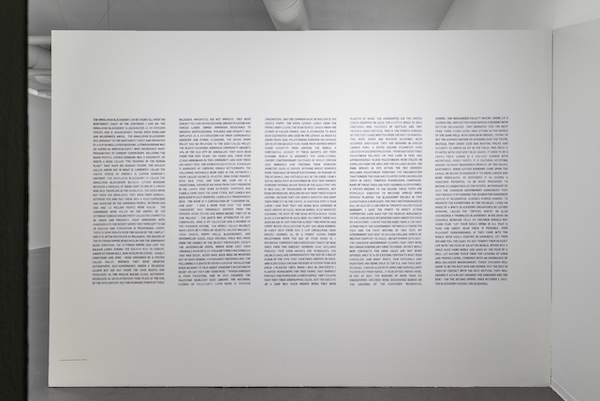
On a wall leading to the five pieces, there is a several-square-foot textual display featuring more than 1,600 words, written entirely in capital letters, with the thoughts seeming to randomly jump from one topic to another; there are no paragraphs, but the words cover five columns. The text, an integral element of the overall artwork, was hand-stenciled by Stuart and relates to the physical pieces. 

photo - Beth Stuart’s “Delible (poppy, watermelon, wheat, walnut, blackberry)” installation comprises a wall of text and five structures
Beth Stuart’s “Delible (poppy, watermelon, wheat, walnut, blackberry)” installation comprises a wall of text and five structures. (photo by Mike Andrew McLean, courtesy Art Gallery of Greater Victoria)

The text begins with mention of the Himalayan blackberry, an invasive species in British Columbia, and then moves to Luther Burbank, an American botanist, horticulturist and eugenicist, before discussing the Armenian Genocide (1915-16) and Canada’s residential schools.

In the middle portion of the textual display, Stuart describes what she sees as the plight of Gazans and the attitudes of certain Israelis.

“AS I WRITE, THERE HAS BEEN NO AID OF ANY KIND FOR ALMOST TWO MONTHS AND EVERY WATER DESALINATION PLANT HAS BEEN BOMBED,” Stuart writes. “IN EARLY 2024 THERE WAS A CLIP CIRCULATING FROM ISRAELI CHANNEL 14, OF A PUNDIT SAYING EVERY PALESTINIAN OVER THE AGE OF FOUR YEARS IS A POTENTIAL TERRORIST AND A NECESSARY TARGET OF WAR. SINCE THEN TWO KNESSET MEMBERS HAVE DECLARED PUBLICLY THAT EVEN INFANTS ARE TERRORISTS. THE DELIBLES BAGS ARE APPROXIMATELY THE SIZE OF A BAG OF FLOUR OF THE TYPE THAT SOMETIMES ARRIVES IN GAZA, AND ALSO COULD CONTAIN THE BODY OF A FOUR-YEAR-OLD CHILD.”

Stuart then talks about tree-planting, which she apparently did in university, then writes: “THIS IS THE FOURTH VERSION OF THIS TEXT I HAVE WRITTEN OVER THE PAST 20 MONTHS. THIS WEEK THERE ARE MASSIVE WILDFIRES NEAR OCCUPIED JERUSALEM. THEY ARE BURNING IN AYALON CANADA PARK, A SEVEN SQUARE KILOMETER PARK LOCATED IN OCCUPIED PALESTINE. THERE HAD BEEN THREE PALESTINIAN VILLAGES ON THIS LAND IN 1948. AND APPROXIMATELY 10,000 PALESTINIANS WERE KILLED OR EXPELLED FROM THE AREA AND THE VILLAGES RAZED.”

She talks more about “THE ORGANIZATION THAT FUNDED THE PARK” without naming it and then raises the issue of the Canadian government’s involvement with Israel and, specifically, its military.

“BETWEEN OCTOBER 7TH 2023 AND THE FIRST WRITING OF THIS TEXT, MY GOVERNMENT HAD SENT 30 MILLION DOLLARS WORTH OF MILITARY SUPPORT TO ISRAEL,” she writes. “ON SEPTEMBER 10TH 2024 THE CANADIAN GOVERNMENT CLAIMED THAT THEY WERE NO LONGER SENDING ANY ARMS TO ISRAEL. IN FACT, WHILE CONTRACTS FOR ARMS SALES ARE NOT BEING OFFERED, ONLY 12% OF EXISTING CONTRACTS HAVE BEEN CANCELLED, AND MANY PARTS, RAW MATERIALS AND MUNITIONS ARE BEING SOLD TO THE U.S. AND THEN SENT TO ISRAEL. CANADA ALSO BUYS ARMS AND SURVEILLANCE TECHNOLOGY FROM ISRAEL.”

The text moves into Stuart’s comments on residential schools before she concludes with the sentence: “FOR THE SECOND SPRING SINCE OCTOBER 7, 2023 THE BLACKBERRY HEDGES ARE BLOOMING.”

To at least one member of the Victoria Jewish community, Stuart’s work is an example of “artfully coded antisemitism – all the more reprehensible for its coyness.”

“In itself, ‘Delibles’ are very beautiful, evocative works,” Maurice Yacowar, a professor emeritus (English and film studies) of the University of Calgary, wrote in a letter to the art gallery that was also sent to the Independent.

“What renders the work problematic is the full-wall text – in spectral grey – that accompanies the sculptures,” Yacowar said. 

He said,“As a whole, the work contrasts the self-renewal of nature’s produce with humans’ murderousness. Unfortunately, the art is undermined by the artist’s ignorance and prejudice in its Palestinian references.”

He said Stuart misrepresents Israel and its media by choosing to reference a news outlet “that even in Israel is considered extremist.” And, he argues,“She omits the Oct. 7 context. A Hamas spokesman flatly stated, ‘There are no civilians in Israel’ – ie., only targets in war.”

Stuart’s exhibit does not include the word “Hamas.”

In a statement to the Independent, the AGGV said:

“The gallery is aware that some members of the community disagree with the subject matter of a current work of art on display. We are always interested to hear how the public, and our members, respond to our exhibitions. We also embrace learning, new ideas and critical perspectives.

“At the AGGV, we respect the artists and curators who work with us to create exceptional exhibitions. As an arts institution, our role is to amplify artists’ voices and create space for conversation and learning. We encourage an exchange of ideas that results in meaningful dialogue and understanding through art.”

The Architectures of Protection exhibition, in the synopsis posted by the AGGV, is supposed to reflect “on ideas and modes of protection and refuge – with regards to oneself, to community, knowledge, culture, identity and land. What are these spaces and practices? What is protection for some and not for others? 

Together, in the wake of the COVID-19 pandemic and in the current global social and political climate, the artworks in Architectures of Protection direct critical attention towards systems and structures that shape and impact everyday and sacred environments and encounters, alongside individual and collective relationships with the land.”

The exhibit also features the artwork of Dana Claxton, Jessica Karuhanga, Emilio Rojas and France Trépanier. 

Sam Margolis has written for the Globe and Mail, the National Post, UPI and MSNBC.

Format ImagePosted on September 12, 2025September 11, 2025Author Sam MargolisCategories Visual ArtsTags AGGV, antisemitism, Art Gallery of Greater Victoria, artwork, Beth Stuart, Canada, First Nations, Gaza, genocide, global politics, Israel, sculpture
Two different kinds of magic

Two different kinds of magic

It’s almost a new year. We’ve been taking stock more than usual throughout the month of Elul. It’s a valuable skill – being able to do regular cheshbon hanefesh, accounting of the soul, reflecting on our views and actions, with an eye to self-improvement, maybe even creating a positive ripple effect that extends beyond ourselves.

Two new children’s picture books introduce – or reinforce – the Jewish values of Shabbat (taking a break from work and technology, thereby recharging our physical and mental selves) and tikkun olam (taking care of ourselves, our homes, our neighbourhoods, and so on). They remind us that making the world better starts with us, what we do, how we treat ourselves and others.

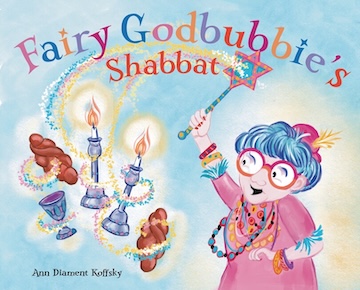
Seattle publisher Intergalactic Afikoman released Fairy GodBubbie’s Shabbat by Ann Diament Koffsky this month. Koffsky has written and illustrated more than 50 kids books, with many about Judaism, its holidays, foods and symbols. Her website is worth checking out: there are reading guides, you can see her many artistic styles, download colouring pages featuring scenes from her books, as well as other images, and, of course, there are links to purchase her books.

In Fairy GodBubbie’s Shabbat, the Mazel family is busy and seems happy enough, Dad on his laptop, Mom on her phone, Sara playing games on a tablet. But, “Why is no one schmoozing?” wonders Fairy GodBubbie. “Noshing?? Kibbitzing!”

“Unlike regular fairy godmothers who come only when called, Fairy GodBubbies just show up to fix things.

“Even when they’re not invited,” writes Koffsky.

So, poof! With a couple of Shabbat candles and a frequency jammer, Fairy GodBubbie helps the Mazels experience a different kind of Shabbat, a much more fulfilling one, a magical one. And readers can create the experience at their own homes, trying out what Koffsky calls a “a Tech Shabbat – a day away from screens.” She asks, “If your family does choose to try out a Tech Shabbat, what would you most like to do during that time?” And offers some choices – “Will you eat a family meal? … Curl up with a good book?” – and encourages readers to come up with their own ideas to make their “next Shabbat feel magical.”

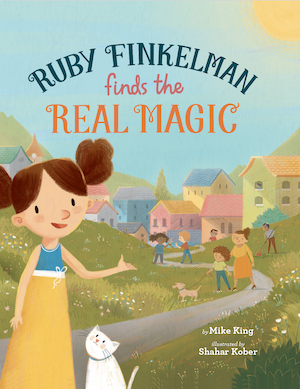
image - Ruby Finkelman Finds the Real Magic book coverThe Collective Book Studio’s Ruby Finkelman Finds the Real Magic, written by Mike King with illustrations by Shahar Kober, which came out earlier this year, also features a young heroine and, as the title indicates, “magic.” But there are no magical GodBubbies; rather, a self-realization that a beautiful village, a beautiful life, don’t just happen by magic – happiness, cleanliness, kindness, etc., require not only effort, but sometimes doing things you don’t enjoy doing. In Ruby’s case, she “especially didn’t like brushing her teeth,” so, one night, she decides, “I’m never going to brush my teeth again.”

Even such seemingly inconsequential actions have repercussions. Other kids stop brushing their teeth. Then they decide not to wash their faces, tidy up after themselves or treat one another kindly. Parents nag, children kvetch. The grownups become so exhausted, they have “no strength left to lift a toothbrush, do the laundry, take out the garbage, and on and on.” Kvellville soon turns into what neighbouring villages start calling “Schmutzville.” A town meeting devolves into several arguments, everyone turning on one another.

Seeing the madness, and realizing how it all started, Ruby sets about to right the situation.

“Mensch is a Yiddish word that means ‘human,’ but when used in the sense of ‘being a mensch,’ it means being a human in the best possible way, or being the best human that you can be,” writes King in an author’s note at the end of the story. “But it’s not only a Jewish thing – it’s a universal value, an idea of how to act in a way that makes the world a better place, simply because you behave in a good and kind way.”

While the toothbrushing premise is a little bit of a stretch, King is a pediatric dentist, so it’s no wonder, and he does manage to make the story work. It’s a wonderful message, of course, and Kober’s artwork is delightful. 

Format ImagePosted on September 12, 2025September 11, 2025Author Cynthia RamsayCategories BooksTags Ann Diament Koffsky, artwork, children's books, Collective Book Studio, Intergalactic Afikoman, kids books, Mike King, Shahar Kober

About the Rosh Hashana 5786 cover art

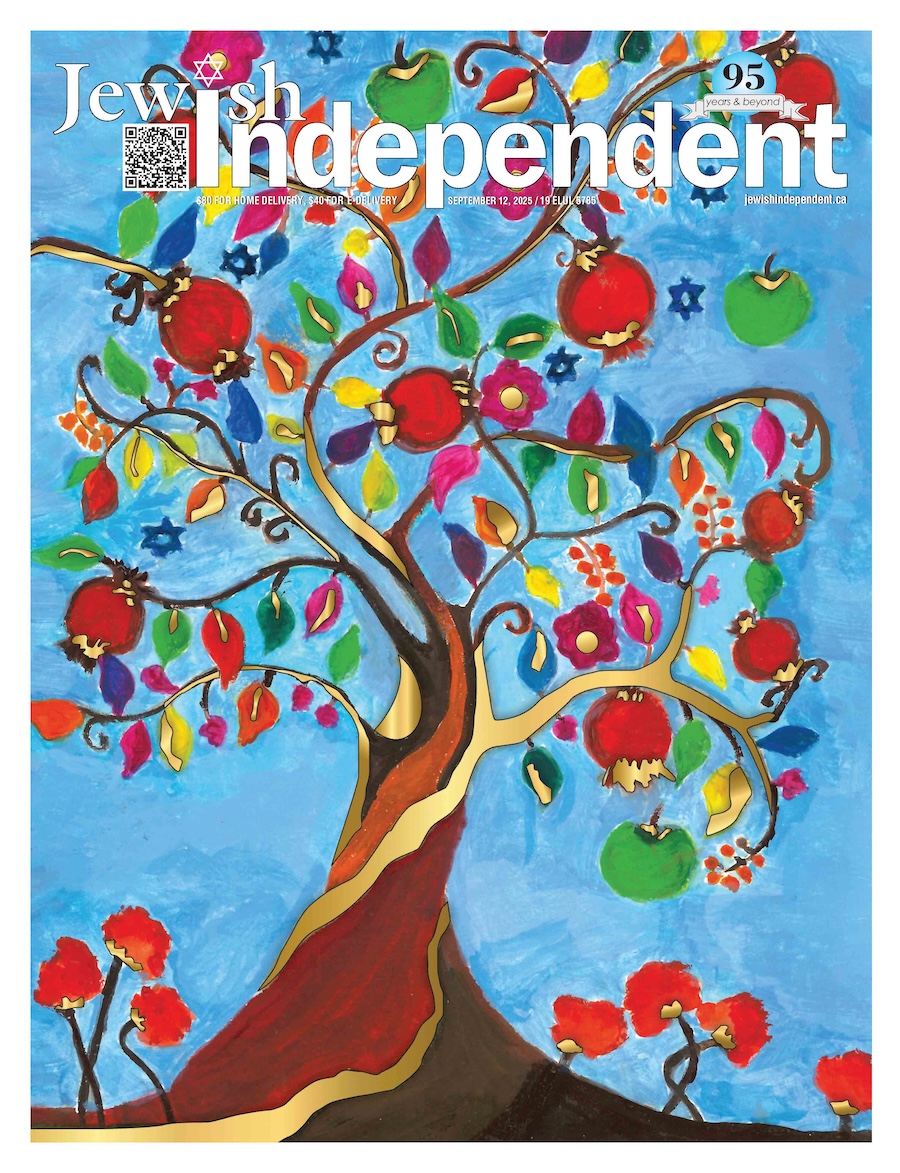
image - 2025 Jewish Independent Rosh Hashanah issue cover by Elaine ArensonThis year’s Rosh Hashanah cover art was created by Elaine Arenson in 2024 for Chai Cancer Care, the British Jewish community’s national cancer support organization. “This is my tree of Chai, my tree of light,” she wrote about the image. “Through the art group, we find creativity, renewal, community and exceptional care. We discover we are so much more than a cancer diagnosis.”

There is a story behind the centre’s annual card, which is selected from works created by Chai clients who attend art workshops. In 2013, a Chai client received a Rosh Hashanah card and told the centre: “It was so bright and cheerful. It lifted my spirits and gave me courage and strength when I needed it most.”

So, the brief to workshop participants is simple: create an image that reflects the warmth, light, joy and hope at this special time of year, and the tangible impact Chai support has on its clients. A quote from the artist always accompanies the image, explaining the sentiment and inspiration behind the design. 

The centre’s Rosh Hashanah cards not only deliver good wishes but are also a source of income for Chai. They are available to buy blank or with a printed message and as ecards. To purchase some, email [email protected]. For more information about Chai Cancer Care, visit chaicancercare.org.

Posted on September 12, 2025September 11, 2025Author Cynthia RamsayCategories Celebrating the HolidaysTags artwork, Chai Cancer Care, Elaine Arenson, greeting cards, Rosh Hashanah
Proudly powered by WordPress