Skip to content
  • Home
  • Subscribe / donate
  • Events calendar
  • News
    • Local
    • National
    • Israel
    • World
    • עניין בחדשות
      A roundup of news in Canada and further afield, in Hebrew.
  • Opinion
    • From the JI
    • Op-Ed
  • Arts & Culture
    • Performing Arts
    • Music
    • Books
    • Visual Arts
    • TV & Film
  • Life
    • Celebrating the Holidays
    • Travel
    • The Daily Snooze
      Cartoons by Jacob Samuel
    • Mystery Photo
      Help the JI and JMABC fill in the gaps in our archives.
  • Community Links
    • Organizations, Etc.
    • Other News Sources & Blogs
    • Business Directory
  • FAQ
  • JI Chai Celebration
  • JI@88! video

Recent Posts

  • האלימות בישראל מורגשת בהרבה מגזרים
  • טראמפ עוזר דווקא לנושא הפלסטיני
  • New rabbi settles into post
  • A light for the nations
  • Killed for being Jewish 
  • The complexities of identity
  • Jews in time of trauma
  • What should governments do?
  • Annie will warm your heart
  • Best of the film fest online
  • Guitar Night at Massey
  • Partners in the telling of stories
  • Four Peretz pillars honoured
  • History as a foundation
  • Music can comfort us
  • New chapter for JFS
  • The value(s) of Jewish camp
  • Chance led to great decision
  • From the JI archives … camp
  • עשרים ואחת שנים להגעתי לונקובר
  • Eby touts government record
  • Keep lighting candles
  • Facing a complex situation
  • Unique interview show a hit
  • See Annie at Gateway
  • Explorations of light
  • Help with the legal aspects
  • Stories create impact
  • Different faiths gather
  • Advocating for girls’ rights
  • An oral song tradition
  • Genealogy tools and tips
  • Jew-hatred is centuries old
  • Aiding medical research
  • Connecting Jews to Judaism
  • Beacon of light in heart of city

Archives

Follow @JewishIndie
image - The CJN - Visit Us Banner - 300x600 - 101625

Tag: Collective Book Studio

Life, beginning to end

Love is at the heart of three new children’s books that would make great Hanukkah gifts.
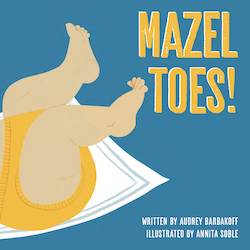
image - Mazel Toes! book coverMany different types of families welcome their newborns in Mazel Toes!, written by Dr. Audrey Barbakoff and illustrated by Annita Soble. Each set of pages is a work of art with a rhyming poem that highlights playful gestures of love, like a kiss on the pupik (belly button), and more serious ones, like making sure baby is safe and warm in their schmatte (rag or, in this case, “a well-loved baby blanket”). Multiple generations of Jews are depicted, multiple family configurations and multiple cultures. It is a fun board book for both reader and listener – and can be as interactive as you want it to be. You can read it quietly, all snuggled up, or more raucously, with tickles of “mazel toes” and other giggles.

image - Waiting for Max book coverA more serious but equally  adorable and educational book is Waiting for Max: A NICU Story, written by Emily Rosen and illustrated by Esther Diana. Based on Rosen’s own experiences of having had a baby who had to spend 16 days in the hospital’s neonatal intensive care unit (NICU), Waiting for Max centres around Louise, Max’s big sister, who is very keen to meet her new baby brother and doesn’t really understand why Max, who was born premature, can’t come home yet. So, she puts her mind to figuring out ways to help him escape from the “little plastic box” (incubator) he’s in. She puts a lot of imagination and work into drawing out her ideas. Each one she comes up with, she gives to her parents to take to Max, so that he can follow her instructions. She shows great perseverance, always thinking up a new idea when one doesn’t work. She keeps at it until Max eventually makes it home – no doubt, because of her idea.

Apparently, one in 10 babies in the United States must spend time in an NICU, and Rosen will donate a portion of her book’s proceeds, as well as copies of Waiting for Max, to NICU hospitals and nonprofits across the States.
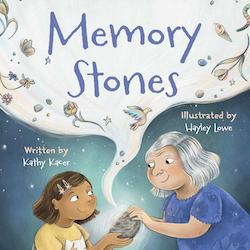
image - Memory Stones book coverAt the other end of the life spectrum, author Kathy Kacer, who specializes in writing books to educate younger readers about the Holocaust, has come out with a different kind of lesson. In Memory Stones, which is beautifully illustrated by Hayley Lowe, we meet Sophie, who has just lost her beloved grandmother. We see some of the many fun things Sophie and Granny would do together, and how heartbroken Sophie is when Granny dies. Sophie brings flowers to Granny’s grave, but they never last long. When Sophie’s mom shares that people in some cultures, including Jews, place stones on loved one’s graves, Sophie figures out a special way to remember her grandmother.

Memory Stones, published by Second Story Press, is intended for readers 6 to 8 years old. Published by the Collective Book Studio, Waiting for Max is for readers 4 to 8 years old, and Mazel Toes!, for babies to toddlers.
Posted on November 21, 2025November 20, 2025Author Cynthia RamsayCategories BooksTags Annita Soble, Audrey Barbakoff, children's books, Collective Book Studio, death, Emily Rosen, Esther Diana, Hayley Lowe, Kathy Kacer, kids books, life, Mazel Toes!, memory, Memory Stones, Second Story Press, Waiting for Max
Two different kinds of magic

Two different kinds of magic

It’s almost a new year. We’ve been taking stock more than usual throughout the month of Elul. It’s a valuable skill – being able to do regular cheshbon hanefesh, accounting of the soul, reflecting on our views and actions, with an eye to self-improvement, maybe even creating a positive ripple effect that extends beyond ourselves.

Two new children’s picture books introduce – or reinforce – the Jewish values of Shabbat (taking a break from work and technology, thereby recharging our physical and mental selves) and tikkun olam (taking care of ourselves, our homes, our neighbourhoods, and so on). They remind us that making the world better starts with us, what we do, how we treat ourselves and others.

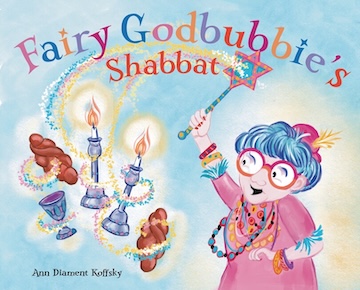
Seattle publisher Intergalactic Afikoman released Fairy GodBubbie’s Shabbat by Ann Diament Koffsky this month. Koffsky has written and illustrated more than 50 kids books, with many about Judaism, its holidays, foods and symbols. Her website is worth checking out: there are reading guides, you can see her many artistic styles, download colouring pages featuring scenes from her books, as well as other images, and, of course, there are links to purchase her books.

In Fairy GodBubbie’s Shabbat, the Mazel family is busy and seems happy enough, Dad on his laptop, Mom on her phone, Sara playing games on a tablet. But, “Why is no one schmoozing?” wonders Fairy GodBubbie. “Noshing?? Kibbitzing!”

“Unlike regular fairy godmothers who come only when called, Fairy GodBubbies just show up to fix things.

“Even when they’re not invited,” writes Koffsky.

So, poof! With a couple of Shabbat candles and a frequency jammer, Fairy GodBubbie helps the Mazels experience a different kind of Shabbat, a much more fulfilling one, a magical one. And readers can create the experience at their own homes, trying out what Koffsky calls a “a Tech Shabbat – a day away from screens.” She asks, “If your family does choose to try out a Tech Shabbat, what would you most like to do during that time?” And offers some choices – “Will you eat a family meal? … Curl up with a good book?” – and encourages readers to come up with their own ideas to make their “next Shabbat feel magical.”

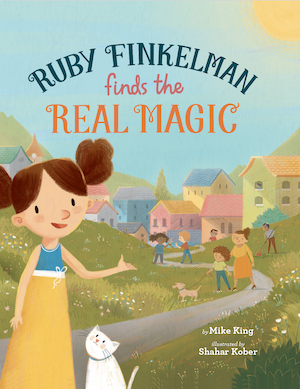
image - Ruby Finkelman Finds the Real Magic book coverThe Collective Book Studio’s Ruby Finkelman Finds the Real Magic, written by Mike King with illustrations by Shahar Kober, which came out earlier this year, also features a young heroine and, as the title indicates, “magic.” But there are no magical GodBubbies; rather, a self-realization that a beautiful village, a beautiful life, don’t just happen by magic – happiness, cleanliness, kindness, etc., require not only effort, but sometimes doing things you don’t enjoy doing. In Ruby’s case, she “especially didn’t like brushing her teeth,” so, one night, she decides, “I’m never going to brush my teeth again.”

Even such seemingly inconsequential actions have repercussions. Other kids stop brushing their teeth. Then they decide not to wash their faces, tidy up after themselves or treat one another kindly. Parents nag, children kvetch. The grownups become so exhausted, they have “no strength left to lift a toothbrush, do the laundry, take out the garbage, and on and on.” Kvellville soon turns into what neighbouring villages start calling “Schmutzville.” A town meeting devolves into several arguments, everyone turning on one another.

Seeing the madness, and realizing how it all started, Ruby sets about to right the situation.

“Mensch is a Yiddish word that means ‘human,’ but when used in the sense of ‘being a mensch,’ it means being a human in the best possible way, or being the best human that you can be,” writes King in an author’s note at the end of the story. “But it’s not only a Jewish thing – it’s a universal value, an idea of how to act in a way that makes the world a better place, simply because you behave in a good and kind way.”

While the toothbrushing premise is a little bit of a stretch, King is a pediatric dentist, so it’s no wonder, and he does manage to make the story work. It’s a wonderful message, of course, and Kober’s artwork is delightful. 

Format ImagePosted on September 12, 2025September 11, 2025Author Cynthia RamsayCategories BooksTags Ann Diament Koffsky, artwork, children's books, Collective Book Studio, Intergalactic Afikoman, kids books, Mike King, Shahar Kober

Love and learning 

People from many cultures show love via food and, of course, Jews are no exception. And what a palate our culture has, since we have lived in so many places. Two children’s books from Collective Book Studio, one new and one from recent years, highlight the flavourful diversity of Jewish culture, while teaching other valuable lessons.

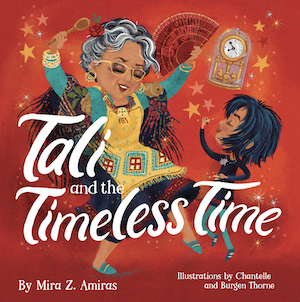
image - Tali and the Timeless Time book coverComing out this August, Tali and the Timeless Time by Mira Z. Amiras, with illustrations by Chantelle and Burgen Thorne, shares the love of a granddaughter for her grandmother, and vice versa. Every Friday, Tali helps her nona get ready for Shabbat. Nona gives hugs, tells stories, still tries to get Tali to nap, even though she’s older now. When Nona dozes off, Tali explores in the backyard, cleans up the small fountain there, feeds the goldfish. When Nona awakes, it’s time to cook.

“We bake!” says Tali. “Today, it’s bourekas, yummy for eating. Nona makes them with filo (which it turns out is cheating). She says her nona let her ’cause it doesn’t need kneading.”

The week before, the pair made stuffed grape leaves – yaprakas, dolma or dolmades. Nona’s favourite dish is huevos (eggs) cooked in tomatoes with feta and arroz (rice). 

While Tali’s grandmother might get Tali’s name wrong, or forget a word or two, she has these recipes ingrained in her. 

“I’m having big thoughts,” says Tali, “but Nona’s not listening – she’s singing ‘chakchouka,’ it’s sometimes called, not just huevos, in the Holy Land, Tunisia and the land of the pharaohs. In Mexico, it’s a lot like huevos rancheros….” But Nona loses focus, she starts dancing with “her zills and her fans.” Tali finishes making dinner, the pair eat together, then dance some more.

In another role reversal, Tali tucks Nona into bed for the night, not sure she should leave her alone. Luckily, Tali and her family live nearby.

It’s a lovely book, “timeless time” being a beautiful description of a day spent with a loved one, doing this and that, in no particular order, sharing stories, mixing up past with present, making memories that will adapt over time.

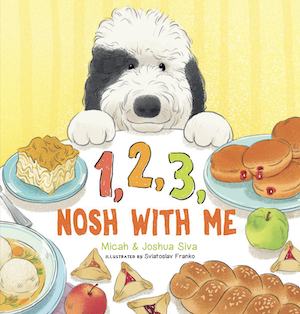
image - 1, 2, 3 Nosh with Me book coverFamily and food are also at the heart of 1, 2, 3 Nosh with Me, written by Micah and Joshua Siva, and illustrated by Sviatoslav Franko, which was published a couple of years ago. In it, the dog Buckwheat shows us the yummy food the family eats, starting with the “One golden challah, to celebrate Shabbat…” We work our way up to “Ten crispy latkes, served by candlelight.” In between, we have matzah balls, matzot, kugel, knishes, apples for a sweet new year, sufganiyot, bagels and hamantashen. (It’s not clear why the Hanukkah treats are separated, but that’s a quibble.)

Tali covers a few Sephardi staples and Buckwheat has the Ashkenazi favourites down. Between the two books, the breadth of world Jewry, as seen through just some of its traditional foods, is impressive. 

Posted on July 11, 2025July 17, 2025Author Cynthia RamsayCategories BooksTags aging, Ashkenazi, children's books, Collective Book Studio, counting, culture, education, food, generations, identity, learning, Sephardi, traditions

What your tchotchkes think

Ever wondered what your leather-bound journal thinks about you? Your menorah? The bowl you made in a pottery class? What astrological sign your keepsakes might be? How they’d like to be handled, cared for? Where they’d like to be in your home?

For most of us, the answer is probably no … to all of the above. But Elisabeth Saake has thought of all these things. And, after reading her latest book, Tchotchkes and their F*cked-Up Thoughts: The Messed-Up Minds of Your Trinkets and Treasures (Collective Book Studio), you will too. It’s a follow-up to her 2023 Houseplants and Their F*cked-Up Thoughts: PS, They Hate You, which she wrote with Carlyle Christoff.

image - Tchotchkes and their F*cked-Up Thoughts book coverDivided into five sections, no knickknack is spared. Saake covers the whimsical (lava lamp, rubber chicken, etc.), vintage and collectibles (antique compass, souvenir spoon, etc.), cultural and artisanal (woven tapestry, ceramic urn, etc.), spiritual and mystical (worry stone, crystal ball, etc.) and functional and decorative (novelty salt and pepper shakers, participation trophy, etc.).

About your journal, don’t worry, it thinks “your poetry is profound” and is “totally listening and deeply moved”; it only appears to be setting itself on fire.

But your menorah would like to be treated as more than a “fancy candleholder”: “Fill my branches with holy oil from trees grown on the Mount of Olives, just a day’s worth, and watch me burn for eight! Or cram in cheap candles from your big box store’s Hanukkah display. That works, too. Way to honour your ancestors, nudnik.”

And your handmade pottery is a “real bowl,” even if it “was made in a beginner’s night class at the community college”: “I’m round enough, I’m stable enough and, doggone it, people like me!” Though, it’s “a bit wobbly,” so perhaps no soup … maybe just display it on a kitchen shelf, as the “mantel is for the perfect porcelain.”

Tchotchkes and their F*cked-Up Thoughts would make a great gift to any friend (with a sense of humour) who’s a collector of things, or to any friend who has judged others’ collections of things. It’s snarky, a little dark at times, but will bring many chuckles and laughs, even if every joke doesn’t land. It’s colourful and beautifully put together. Hopefully, it will think as highly of you, its place in your home and how you care for it – and have an astrological sign that’s compatible with yours. 

Posted on March 14, 2025March 13, 2025Author Cynthia RamsayCategories BooksTags Collective Book Studio, Elisabeth Saake, home, lifestyle, Tchotchkes and their F*cked-Up Thoughts
Costumed counting fun

Costumed counting fun

Ten Purim Bears: A Counting Book for Purim introduces kids to Purim, numbers 1-10.

Fans of Once a Bear: A Counting Book by Ron Atlas (words) and Zach Horvath (illustrations) will be happy to find that their bear friends have returned – this time, in Ten Purim Bears: A Counting Book for Purim. Both 24-page board books are published by the Collective Book Studio, which has produced several well-written and -designed books reviewed by the Independent.

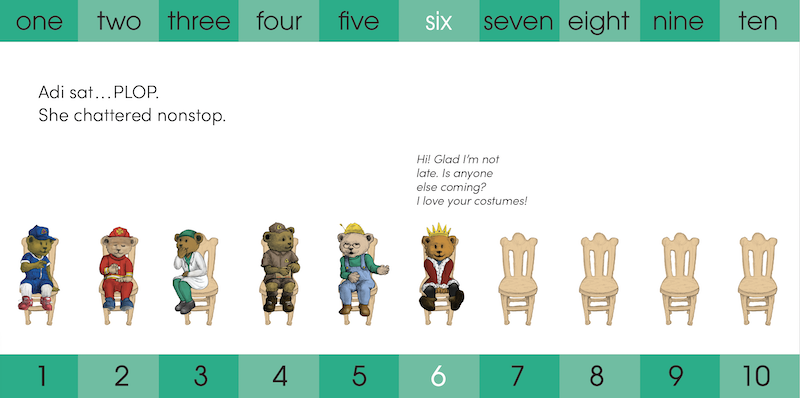
Ten Purim Bears features all the same adorable bear characters as the first book, and follows the same format. Each scene spreads over two pages, with the numbers one through 10 written out on top and appearing numerically on the bottom, as borders. In the middle are 10 chairs, the first scene with mostly empty chairs, except for the one on the far left, where sits a baseball-costumed bear wondering, “Where is everyone?” As we progress through the story, we get more bear bums on seats, each dressed in a different costume. As each new bear enters, the new number of bears is highlighted in white on both the top and bottom borders.

image - Adi, bear #6, takes her seat in Ten Purim Bears: A Counting Book for Purim by Ron Atlas (words) and Zach Horvath (illustrations), published by the Collective Book Studio
Adi, bear #6, takes her seat in Ten Purim Bears: A Counting Book for Purim by Ron Atlas (words) and Zach Horvath (illustrations), published by the Collective Book Studio.

Directed to readers up to 6 years old, their reader-helpers will enjoy a laugh or two, as well. For example, Flor, “who lives next door,” sits down and says, “I’m saving a seat for my friend.” Turning the page, Pete, “from down the street,” has sat next to Flor, saying: “I’m the friend.” I hear him doing it in a deadpan voice and it makes me chuckle every time.

There are two short narratives for each scene – one introducing the next bear and the bears talking among themselves. It’s a nice touch, kind of like having a parent narrator and then the kids’ views on things. As we are told by the narrator that Adi’s sister, Mandy, “brought some sweets – lots and lots of Purim treats,” we see Mandy handing them out: “There’s some for everyone,” she says. “Thank you,” says her sister. The hamantaschen that Amari Bear baked to share with his friends are his favourite, he says, while Adi agrees, “Yum!”

Kids learns not only how to count, but a bit about Purim and its traditions. Sharing, politeness and a sense of community are encouraged. As is a sense of fun, with the various costumes. And the arts! The bears have all gathered to watch a Purim spiel, of course. And we get to see a scene of the play, with quadruple-threat performers – acting, dancing, singing and playing instruments – looking like they are having a good time. The 10-bear audience certainly is.

Ten Purim Bears and Once a Bear can be purchased at thecollectivebook.studio. Check out the publisher’s website further when you’re there, as there will no doubt be another book or two you’ll want to add to your collection. 

Format ImagePosted on February 28, 2025March 6, 2025Author Cynthia RamsayCategories Books, Celebrating the HolidaysTags children, Collective Book Studio, education, Jewish holidays, parenting, Purim, Ron Atlas, Ten Purim Bears, Zach Horvath

Learn ABCs, Hanukkah-style

The Canadian Medical Association would probably not approve, but Rachel Teichman’s D is for Donut is a sweet way to teach kids their ABCs. (Pun intended … groan.)

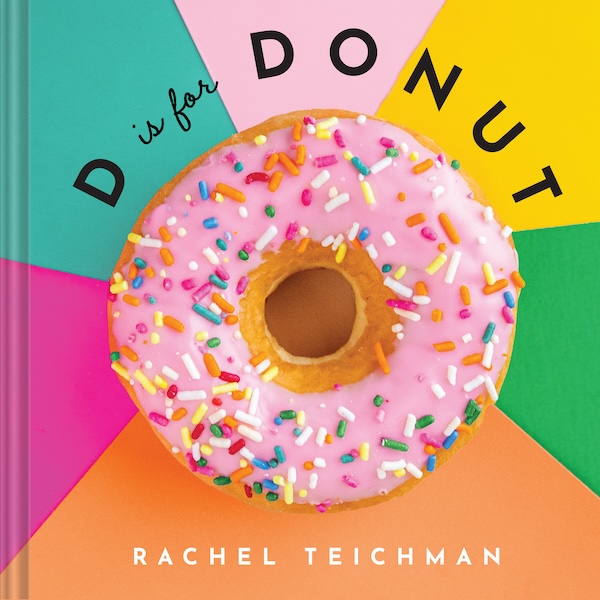
image - D is for Donut by Rachel Teichman, with photos by Rebecca Wright, book cover

For this hardcover (or ebook), Teichman again pairs up with Rebecca Wright, Teichman composing the rhyming text and Wright taking the colourful large-as-life photographs. D is for Donut (2023) and their previous collaboration, B is for Bagel (2022), are both published by the Collective Book Studio, grouped as the ABCD-Eats series, implying, perhaps, that there are more books on the way.

The Collective Book Studio describes itself as “an independent publisher dedicated to creating high-quality, beautifully crafted books that celebrate diverse voices and empower storytelling.” On their website, under Collections, one can find Jewish Voices, which, in this time of increased antisemitism, is even more nice to see. The ABCD-Eats books are included here, as are two cookbooks that the Independent has reviewed and enjoyed: 52 Shabbats: Friday Night Dinners Inspired by a Global Jewish Kitchen by Faith Kramer, and NOSH: Plant-Forward Recipes Celebrating Modern Jewish Cuisine by Micah Siva. Collective also published Tali and the Toucan, which the JI reviewed (positively!) in its Nov. 29 issue.

D is for Donut is more proof that the Collective Book Studio really does produce beautiful, high-quality books. Whether or not one agrees with teaching kids their letters by also introducing them to the wide variety of sugary toppings that can be put onto fried dough, D is for Donut makes for a fun and eye-popping read. It begins with a brief summary, poetically written, of how donuts are made, from “First, flour, yeast and milk are mixed together and left to rise” through the frying then the frosting and sprinkles. “Did you know donut holes come from where the donut’s shape is cut?” asks Teichman. (I did not.)

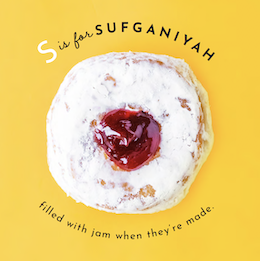
image - D is for Donut by Rachel Teichman, with photos by Rebecca Wright, includes the letter S, for sufganiyah
D is for Donut by Rachel Teichman, with photos by Rebecca Wright, includes the letter S, for sufganiyah.

The bulk of the book is the letters, and a global range of donut types. For example, “A is for apple fritter with fruit and cinnamon inside”; “L is for loukoumades dipped in honey and piled high”; “S is for sufganiyah filled with jam when they’re made” (happy Hanukkah!); and “Z is for zeppole, they’re a real work of art!” 

“Donuts are delish, frosted and fried! So tell me … which ones have you tried?” asks Teichman.

D is for Donut includes two recipes: one for Raised Donuts, which takes more time and requires some tools people may not own (to be exact, a two-quart pot, cooking thermometer and heat-resistant slotted spoon), and one for Quick Baked Donuts. 

Posted on December 13, 2024December 11, 2024Author Cynthia RamsayCategories BooksTags Collective Book Studio, D is for Donut, donuts, Hanukkah, Rachel Teichman, sufganiyot

Two great books for giving – Tali and the Toucan & Oy, Santa!

Honestly, I think adults would benefit from reading children’s books, even if they don’t have kids. Generally, the books impart good messages, like how to overcome challenges or be proud of who you are, and their illustrations are works of art. The two I reviewed for this issue of the Jewish Independent are prime examples.

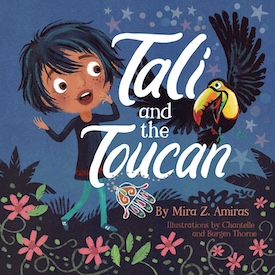
image - Tali and the Toucan book coverTali and the Toucan by writer Mira Z. Amiras and illustrators Chantelle and Burgen Thorne (Collective Book Studio) is set in San Francisco. The young protagonist, Tali, longs to tumble, swing and cartwheel like other kids, and she would love to take martial arts. But she is debilitated by fear – that the world will shatter, that she will break into a million pieces, that she will get hurt. Then, one night, she has a dream. At first, it’s kind of a scary dream, with a storm raging, chickens flapping about. One chicken makes it to the roof, pecks a hole in the window glass, and transforms into a toucan. The colourful-beaked bird teaches Tali how to tumble and soar in the sky. She awakes with new spirit and courage, no longer feeling like a chicken but like a toucan, ready to fly – and fall – with the other kids.

While not spelled out in the story, at the end of the book, there’s a note that explains that Tali’s fear of the world shattering “is taken from Jewish teachings that the world is indeed broken and that our job, called in Hebrew tikkun olam, is to put it back together again – starting with ourselves.” In addition to the “hamsa she wears – an amulet common to peoples of the  Middle East worn to protect children – her dreams lead her to conquer her fears, begin her tikkun and follow the path of Aikido, the Japanese martial art of nonviolence that teaches harmony, mutual assistance and peaceful resolutions to conflict.”

Other than the fact that Tali wants to do martial arts, the text of Tali and the Toucan doesn’t touch upon ideas like multiculturalism, cooperation or what a well-functioning society looks like, but rather expresses these concepts through the artwork. There’s a lot to look at in the illustrations and they beautifully capture Tali’s emotional journey.

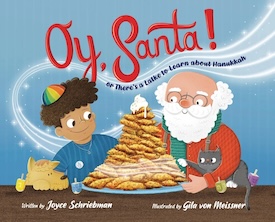
image - Oy, Santa! book coverOy, Santa!, or There’s a Latke to Learn about Hanukkah by writer Joyce Schriebman and illustrator Gil von Meissner (Intergalactic Afikoman) also expresses so much with its artwork. Whereas Tali’s hamsa makes an appearance on almost every page of her book, different kinds of light run through Oy, Santa! – white swirls full of stars, hanukkiyot with candles lit, strings of Christmas lights and exploding fireworks. While Tali and the Toucan only hints at multiculturalism and doesn’t explicitly talk about Judaism, Oy, Santa! puts both topics front and centre.

On Christmas Eve, young Oliver Overstreet writes an email to Santa: “I know you’re busy making toys, so I won’t write much. But I’m Jewish. And that means you don’t have to come down my chimney on Christmas Eve. I just wanna make sure you know.”

And so begins a delightful – and educational – email exchange between Oliver and Santa, who assures Oliver that he knows that both Oliver, and Oliver’s friend Ibrahim, do not celebrate Christmas. Oliver rails at Santa’s signoff, wishing Oliver a “Happy Chrismukkah!”

“Dear Santa,” he writes. “I know you’re still very busy. But please don’t write Chrismukkah. That’s not my holiday. I celebrate HANUKKAH. And Hanukkah and Christmas are different….” Oliver goes on to explain the story of Hanukkah and some of the fun ways the holiday is celebrated.

Santa and Oliver talk about many things in subsequent emails, from elves getting time off to celebrate whatever holidays are in their culture, to miracles and how reindeers fly, to whether it’s acceptable to put ketchup on latkes, and more. The conversation even gets a little heated, but – spoiler alert – Oliver and Santa work things out.

Oy, Santa! is a wonderful read, with lots of humour, fun illustrations, and great takeaways about identity, diversity, culture, civil discourse and friendship. 

Posted on November 29, 2024November 28, 2024Author Cynthia RamsayCategories BooksTags children's books, Collective Book Studio, Hanukkah, Intergalactic Afikoman, tikkun olam
Proudly powered by WordPress