
Skip to content
  • Home
  • Subscribe / donate
  • Events calendar
  • News
    • Local
    • National
    • Israel
    • World
    • עניין בחדשות
      A roundup of news in Canada and further afield, in Hebrew.
  • Opinion
    • From the JI
    • Op-Ed
  • Arts & Culture
    • Performing Arts
    • Music
    • Books
    • Visual Arts
    • TV & Film
  • Life
    • Celebrating the Holidays
    • Travel
    • The Daily Snooze
      Cartoons by Jacob Samuel
    • Mystery Photo
      Help the JI and JMABC fill in the gaps in our archives.
  • Community Links
    • Organizations, Etc.
    • Other News Sources & Blogs
    • Business Directory
  • FAQ
  • JI Chai Celebration
  • JI@88! video

Recent Posts

  • Supporting the Iranian people
  • The power of photography
  • A good place to start
  • When boundaries have shifted
  • Guitar virtuosos play
  • Different concepts of home
  • Broadway’s Jewish storylines
  • Sesame’s breadth and depth
  • Dylan Akira Adler part of JFL festival
  • Mortality learning series
  • A new strategy to brighten up BC
  • Sharing latkes and light
  • Johnson awarded for human rights work
  • Cherished tradition ensured … Silber Family Agam Menorah
  • Nothing as lovely as a tree
  • Camp welcomes new director
  • Popular family camp expands
  • A life-changing experience
  • Benefits of being a counselor
  • Camper to counselor
  • האלימות בישראל מורגשת בהרבה מגזרים
  • טראמפ עוזר דווקא לנושא הפלסטיני
  • New rabbi settles into post
  • A light for the nations
  • Killed for being Jewish 
  • The complexities of identity
  • Jews in time of trauma
  • What should governments do?
  • Annie will warm your heart
  • Best of the film fest online
  • Guitar Night at Massey
  • Partners in the telling of stories
  • Four Peretz pillars honoured
  • History as a foundation
  • Music can comfort us
  • New chapter for JFS

Archives

Follow @JewishIndie
image - The CJN - Visit Us Banner - 300x600 - 101625

Tag: traditions

Love and learning 

People from many cultures show love via food and, of course, Jews are no exception. And what a palate our culture has, since we have lived in so many places. Two children’s books from Collective Book Studio, one new and one from recent years, highlight the flavourful diversity of Jewish culture, while teaching other valuable lessons.
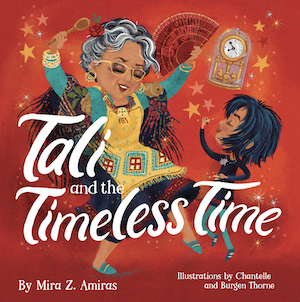
image - Tali and the Timeless Time book coverComing out this August, Tali and the Timeless Time by Mira Z. Amiras, with illustrations by Chantelle and Burgen Thorne, shares the love of a granddaughter for her grandmother, and vice versa. Every Friday, Tali helps her nona get ready for Shabbat. Nona gives hugs, tells stories, still tries to get Tali to nap, even though she’s older now. When Nona dozes off, Tali explores in the backyard, cleans up the small fountain there, feeds the goldfish. When Nona awakes, it’s time to cook.

“We bake!” says Tali. “Today, it’s bourekas, yummy for eating. Nona makes them with filo (which it turns out is cheating). She says her nona let her ’cause it doesn’t need kneading.”

The week before, the pair made stuffed grape leaves – yaprakas, dolma or dolmades. Nona’s favourite dish is huevos (eggs) cooked in tomatoes with feta and arroz (rice). 

While Tali’s grandmother might get Tali’s name wrong, or forget a word or two, she has these recipes ingrained in her. 

“I’m having big thoughts,” says Tali, “but Nona’s not listening – she’s singing ‘chakchouka,’ it’s sometimes called, not just huevos, in the Holy Land, Tunisia and the land of the pharaohs. In Mexico, it’s a lot like huevos rancheros….” But Nona loses focus, she starts dancing with “her zills and her fans.” Tali finishes making dinner, the pair eat together, then dance some more.

In another role reversal, Tali tucks Nona into bed for the night, not sure she should leave her alone. Luckily, Tali and her family live nearby.

It’s a lovely book, “timeless time” being a beautiful description of a day spent with a loved one, doing this and that, in no particular order, sharing stories, mixing up past with present, making memories that will adapt over time.
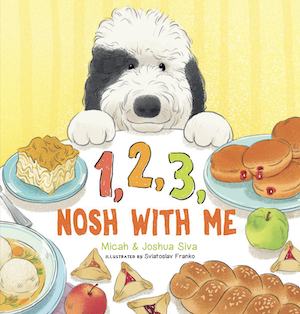
image - 1, 2, 3 Nosh with Me book coverFamily and food are also at the heart of 1, 2, 3 Nosh with Me, written by Micah and Joshua Siva, and illustrated by Sviatoslav Franko, which was published a couple of years ago. In it, the dog Buckwheat shows us the yummy food the family eats, starting with the “One golden challah, to celebrate Shabbat…” We work our way up to “Ten crispy latkes, served by candlelight.” In between, we have matzah balls, matzot, kugel, knishes, apples for a sweet new year, sufganiyot, bagels and hamantashen. (It’s not clear why the Hanukkah treats are separated, but that’s a quibble.)

Tali covers a few Sephardi staples and Buckwheat has the Ashkenazi favourites down. Between the two books, the breadth of world Jewry, as seen through just some of its traditional foods, is impressive. 
Posted on July 11, 2025July 17, 2025Author Cynthia RamsayCategories BooksTags aging, Ashkenazi, children's books, Collective Book Studio, counting, culture, education, food, generations, identity, learning, Sephardi, traditions
Unique Cochin rituals

Unique Cochin rituals

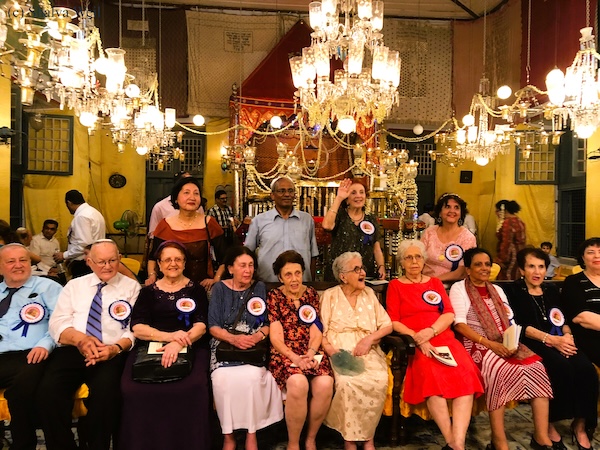
Cochin Jews at the 450th year celebration of the Paradesi synagogue, December 2017. (photo by Shalva Weil)

A study on the Purim traditions of the Cochin Jewish community by Prof. Shalva Weil of Hebrew University was published in the Journal of Modern Jewish Studies. It examines the historical and cultural significance of effigies in Purim celebrations among Cochin Jews, tracing their evolution from the 16th century to the modern day.

The Cochin Jewish community, numbering no more than 2,400 at its peak in 1948, lived in harmony with their Hindu, Christian and Muslim neighbours. Unlike other Jewish communities, they never experienced antisemitism in India, except during the Portuguese conquest of the 16th century. Their unique Purim celebrations featured role reversals that symbolically challenged societal hierarchies based on caste, religion and gender. This inversion of power structures was most vividly expressed through the construction and destruction of effigies representing adversaries, a practice embedded in the communal and ritualistic fabric of Cochin Jewry.

By the 20th century, Cochin Jews increasingly aligned themselves with the global Jewish community. Following the establishment of the state of Israel in 1948, the majority of Cochin Jews made aliyah by 1954, leaving behind only a small number of Paradesi and Malabar Jews scattered across the state of Kerala. The once-thriving Cochin Jewish community on the Malabar Coast is nearly extinct, and traditional Purim celebrations have all but disappeared. With only one Paradesi Jew remaining there and a handful in other former Cochin Jewish locations, synagogue services now rely on visiting Jewish tourists.

In stark contrast, in Israel, where an estimated 15,000 descendants of Cochin Jews now reside, Purim is celebrated in ways that reflect broader Jewish and Western cultural traditions. Children dress up as superheroes, soldiers and biblical figures; they participate in school parties and exchange hamantashen. Observant Jews continue to read the Book of Esther in synagogue and hold festive meals, incorporating their heritage into mainstream Jewish customs.

Weil, who has been awarded this year’s Yakir Yerushalayim honour as a distinguished citizen of Jerusalem due to her lifelong research into ethnicity and gender, highlights in her research the transition of Cochin Jewry from a localized, community-bound identity to an integrated and globalized Jewish experience. While their presence in India has nearly vanished, the legacy of Cochin Jews continues to thrive in Israel and beyond. 

– Courtesy Hebrew University

Format ImagePosted on March 14, 2025March 13, 2025Author Hebrew UniversityCategories Celebrating the Holidays, WorldTags anthropology, Cochin, customs, history, India, Israel, Purim, rituals, traditions
Proudly powered by WordPress