Understanding the past, including the darkest eras, can help people recognize the symptoms of a society going off the rails.
A forthcoming book for young readers, titled Can Posters Kill? Antisemitic Propaganda and World War II, by Torontonians Jerry Faivish and Kathryn Cole, explores how propaganda and racist imagery desensitized a society to atrocities.
Faivish, a retired lawyer, has collected Jewish posters since young adulthood, building one of the world’s largest private collections. The son of Holocaust survivors, he created this book with Cole, an illustrator, art director, editor, designer and publisher, to educate young people about the dangers of hatred and the powers of persuasion used for evil ends.
 The richly illustrated publication spotlights how vivid imagery and repetition intended to evoke fear, distrust, loyalty or revulsion served to influence populations to accept (even collaborate in) barbarism.
“By understanding the visual language of propaganda from the past, we can learn to recognize and resist messages of hate – an essential skill in a digital world where information is spread in seconds,” according to the publisher, Second Story Press.
Aimed at readers 13 and up, this book about the past has its purpose firmly planted in the present and future.
“Like social media today,” write the authors, “visual communication in the ’30s and ’40s – from movies to newspapers to paper posters – was clever and interesting, engaging and effective. But, under Nazi manipulation, it became deadly.”
The focus of the book is visual, befitting a volume of this topic, with just enough copy to contextualize the imagery and point out salient aspects that the reader might not have noticed. It is also perhaps a perfect mix of text and graphics for the generation it aims to reach.
The authors provide a brief overview of the post-First World War economic conditions in Germany, the impacts of the Treaty of Versailles, and Hitler’s rise to power. This history tilled the soil for the hate-messaging showcased.
“A false message, when repeated often enough, can become the truth in the minds of people who are frightened, oppressed and searching for someone to blame for their misfortune during hard times,” the book warns.
Can Posters Kill? also delves into how graphic design played into the success of the brainwashing – “clever use of different typefaces grabs the attention of passersby,” among other innovations.
Joseph Goebbels, the Nazis’ minister of propaganda, who more than any other individual is associated with this sort of material, did not overestimate his audience.
“The rank and file are usually much more primitive than we imagine,” he is quoted in the book. “Propaganda must, therefore, always be essentially simple and repetitious. In the long run, only he will achieve basic results in influencing public opinion who is able to reduce problems to the simplest terms and who has the courage to keep forever repeating them in the simplified form, despite the objections of intellectuals.”
The messages his department imparted were subtle as sledgehammers.
In one poster, a doctor or scientist is looking through a microscope at a vicious “Jewish” disease devouring healthy tissue. Jews are characterized as sexual deviants and blamed for spreading tuberculosis, syphilis and cancer.
“It’s a chilling message because it can quickly turn into ‘kill or be killed,’” the book says.
In another poster, a Jew hovers menacingly over the globe, spinning a web from his index finger.
“This reinforces the Nazi-supported notion that Jews are power-hungry and backed by secret cabals or conspirators,” the authors write.
Jews are depicted as the mortal enemy of Christianity and the Star of David is equated alongside the communist red star, implying a dual-pronged threat to German society.
Faivish shares his family’s story: his mother’s experiences in various ghettos, work and concentration camps, and at extermination sites such as Auschwitz, and his father’s defiant escape from a cattle car headed for the gas chambers. Faivish’s father lost his parents and his eight siblings in the Holocaust. His mother had just one surviving brother and one remaining sister out of a family of 10.
Faivish goes into some detail about the experiences of his mother in the constellation of Nazi ghettos and camps, and his father’s unlikely survival in hiding, thanks to a gentile Polish family. He places significant emphasis on the heroism of non-Jews.
“After the war, my parents met in Bergen-Belsen, the DP camp where they married and started a family,” he writes. “My older sister was born there in 1949.… In 1952, my parents immigrated to Canada. In 1953, I was born in Montreal. For my parents, the question of how to deal with recurring hate, and what could be done about it, was more than philosophical. It became a guideline for how to live their lives and what to pass on to their children. The lessons they taught us are still applicable and valuable today.”
He includes nine values his parents instilled in him and that he hopes the book will pass on to others, including: be proud of who you are and embrace your faith and culture [because the] aim of the “Final Solution” was to annihilate Jews and to destroy Judaism; respect your fellow human beings and treat them well; and recognize and eliminate hate and evil as much as possible.
A timeline of historical events and an excellent glossary of relevant terms are included at the end of the book.
As British Columbia and other provinces institute mandatory Holocaust education in school curricula, books like Can Posters Kill? Antisemitic Propaganda and World War II provide powerful resources for educators to convey the lessons of history in ways that are impactful but age-appropriate, with undeniable and clear lessons around critical media consumption for contemporary generations.
While not formally related, the book is also a valuable complement to the Vancouver Holocaust Education Centre’s current exhibition, Age of Influence: Youth & Nazi Propaganda, which is being reconfigured into a traveling exhibit.

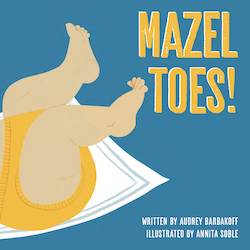 Many different types of families welcome their newborns in Mazel Toes!, written by Dr. Audrey Barbakoff and illustrated by Annita Soble. Each set of pages is a work of art with a rhyming poem that highlights playful gestures of love, like a kiss on the pupik (belly button), and more serious ones, like making sure baby is safe and warm in their schmatte (rag or, in this case, “a well-loved baby blanket”). Multiple generations of Jews are depicted, multiple family configurations and multiple cultures. It is a fun board book for both reader and listener – and can be as interactive as you want it to be. You can read it quietly, all snuggled up, or more raucously, with tickles of “mazel toes” and other giggles.
 A more serious but equally adorable and educational book is Waiting for Max: A NICU Story, written by Emily Rosen and illustrated by Esther Diana. Based on Rosen’s own experiences of having had a baby who had to spend 16 days in the hospital’s neonatal intensive care unit (NICU), Waiting for Max centres around Louise, Max’s big sister, who is very keen to meet her new baby brother and doesn’t really understand why Max, who was born premature, can’t come home yet. So, she puts her mind to figuring out ways to help him escape from the “little plastic box” (incubator) he’s in. She puts a lot of imagination and work into drawing out her ideas. Each one she comes up with, she gives to her parents to take to Max, so that he can follow her instructions. She shows great perseverance, always thinking up a new idea when one doesn’t work. She keeps at it until Max eventually makes it home – no doubt, because of her idea.
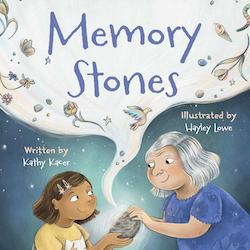 At the other end of the life spectrum, author Kathy Kacer, who specializes in writing books to educate younger readers about the Holocaust, has come out with a different kind of lesson. In Memory Stones, which is beautifully illustrated by Hayley Lowe, we meet Sophie, who has just lost her beloved grandmother. We see some of the many fun things Sophie and Granny would do together, and how heartbroken Sophie is when Granny dies. Sophie brings flowers to Granny’s grave, but they never last long. When Sophie’s mom shares that people in some cultures, including Jews, place stones on loved one’s graves, Sophie figures out a special way to remember her grandmother.