
Skip to content
  • Home
  • Subscribe / donate
  • Events calendar
  • Business Directory
  • FAQ
  • News
    • Local
    • National
    • Israel
    • World
    • עניין בחדשות
      A roundup of news in Canada and further afield, in Hebrew.
  • Opinion
    • From the JI
    • Op-Ed
  • Arts & Culture
    • Performing Arts
    • Music
    • Books
    • Visual Arts
    • TV & Film
  • Life
    • Celebrating the Holidays
    • Travel
    • The Daily Snooze
      Cartoons by Jacob Samuel
    • Mystery Photo
      Help the JI and JMABC fill in the gaps in our archives.
  • Community Links
    • Organizations, Etc.
    • Other News Sources & Blogs
  • JI Chai Celebration
  • JI@88! video

Recent Posts

  • Or Shalom reopens its doors
  • JFS from past to future
  • Need holistic approach
  • Sharing stories, advice
  • Journalist shares fears
  • Skills to live together
  • Road to independence
  • Cutting grass with scissors
  • Zionism as a solution
  • Deceit, desire & the divine
  • Reclaiming sacredness
  • Creative project ideas
  • Summer squares and cobbler
  • Thou shalt … summer commandments
  • Legal help for students
  • Revisiting myth of Lilith
  • Wrong person rebuked
  • Canada’s mixed messages
  • Questions for museum
  • Symposium on antizionism
  • Making soccer political
  • CJPAC lauds Pulver’s impact
  • City recognizes Vrba’s legacy  
  • Organ donation saves lives
  • Theodore’s March premiere
  • A healing Shabbaton
  • Supplying healthy food
  • A chime of metal tags
  • Yellowknife seder a first
  • Ishai energizes, unifies
  • A Lag b’Omer to remember
  • Expanding the healing
  • Hannah Senesh – a unique hero
  • Community milestones … May 2026
  • Sharing her testimony
  • Fall fight takes leap forward

Archives

Follow @JewishIndie
image - The CJN - Visit Us Banner - 300x600 - 101625

Tag: 2G

Stories of trauma, resilience

Love runs through every word in Voices of Resilience: An Anthology of Stories Written by Children of Holocaust Survivors, edited by Deborah (Devora) Ross-Grayman with Wendy Bancroft and the writers.

This compelling, hopeful and inspiring collection of stories will be launched on May 25, 7 p.m., in the Floral Hall at VanDusen Botanical Garden in an event supported by the Vancouver Holocaust Education Centre (VHEC). Some of the authors will share parts of their stories, and signed books will be available for purchase.
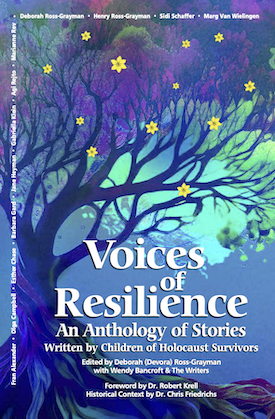
image - Voices of Resilience book coverThe 12 contributors of stories and poems are children of Holocaust survivors and members of the Vancouver Second-Generation (2G) Group, which Ross-Grayman joined in 1993 and of which she is now a facilitator. Bancroft, a former journalist and researcher, is a trained instructor of guided autobiography. 

“After an extensive investigation to better understand the impact of the Shoah’s legacy, Wendy adapted and crafted themes for our group,” writes Ross-Grayman in the book’s preface.

“What began as a six-week course for six of us grew to a two-year writing project for 12 participants,” she explains. “Through laughter and tears, we marveled at the similarity in our felt experiences despite the varied external circumstances. At times it was challenging to face and hold our parents’ pain and loss; at times we were sleepless and anxious, but we supported each other, developed deep bonds, and persevered. Through listening and reflecting on each of the stories, our understanding of ourselves and each other grew as we shared what some of us had never shared and, with understanding, came to a deeper compassion for ourselves and our parents.

“Our narratives so impressed Wendy that she recommended organizing an anthology. We included accounts of our parents’ survival to honour their lives and illustrate examples of post-traumatic growth – the positive psychological changes that can unintentionally arise from a life crisis or traumatic event, even while acknowledging the profound distress such experiences entail.”

The simultaneous holding of grief and contentment, even joy, is remarkable, as is the strength to continue, to grow, to heal – as much as healing is possible. The authors (in order of entries) – Gabriella Klein, Ross-Grayman, Henry Ross-Grayman, Jane Heyman, Marg Van Wielingen, Fran Alexander, Agi Rejto, Marianne Rev, Esther Chase, Barbara Gard, Olga Campbell and Sidi Schaffer – are open, sharing personal, vulnerable experiences on the page. The intergenerational impacts of trauma are clear from their diverse experiences, but so is the capacity for finding peace, for building community, for embracing one’s cultural roots while forging your own individual identity. While specific to the Holocaust, these stories, these remembrances, speak to a universal experience of living through and with historical trauma.

The anthology, put out by Amsterdam Publishers as part of the series Holocaust Survivor True Stories, is dedicated to the writers’ families; “to those who risked everything to save lives; to those who survived; to the millions who perished in the Holocaust; and to all people affected by war, displacement and genocide.” It is published in memory of Rev, who passed away in January.

Dr. Robert Krell, a psychiatrist, author, child survivor and founding president of the VHEC, wrote the book’s foreword, in which he shares some of his own story – he is both a Holocaust survivor and a 2G child – and offers emotional context. Dr. Chris Friedrichs, professor emeritus at the University of British Columbia, provides historical context.

Krell explains that, in general, “the second-generation consists of those born after the war, thousands in the displaced persons (DP) camps, which, for several years, recorded the highest birth rate in the world!” He talks about some of the experiences that 2G have in common, such as the need to sometimes parent their parents, how it feels to live “with the ghosts of the missing.”

“There are moments one cannot forget, must not forget, and these memories linger and reverberate throughout life, reviving the inner rage about the outrage committed against our parents and us,” writes Krell.

“It should therefore be no surprise that this collection of recollections reveals evidence of a surviving rage, problems with trust, confrontations with the meaning of death, and remarkable attempts to reinvigorate a life with meaning, including a meaningful spiritual engagement, whether within the Jewish traditions or not.”

“Mass murders were nothing new in history, but the Holocaust revealed that a once civilized society could orchestrate a program of extermination of human lives on a scale and in a manner that had never been imagined before,” writes Friedrichs. “It was so extensive and so unspeakably brutal that it gave rise to the very concept of genocide.”

Friedrichs writes concisely of the origins of the Holocaust, what happened and about how there are any survivors, as well as about some of the challenges survivors faced after the war.

“This volume reveals not only the enormous variety of what survivors went through but also the tremendous range of emotions and experiences that shaped the lives of their children,” he writes. “Though the Shoah ended 80 years ago, it is a living presence for all members of the Jewish people, and for none more so than those Jews whose own parents had survived this event without comparison in the modern history of humanity.”

In Voices of Resilience, each 2G writer’s chapter includes a brief biography, their parents’ survival stories and a few of their own stories or poems. Maps near the anthology’s beginning shows where all the authors were born and all the survivor parents’ birthplaces. The geography spans continents: Asia, Europe, the Middle East and North America.

Despite vastly different experiences, there are recurring topics: dealing with antisemitism; taking care of their survivor parent; feelings of insufficiency, fear and sadness; being conflicted about religion and feeling like an outsider even inside the Jewish community.

The writers have worked to make their lives and the larger world better, as did their parents. The word “love” is prominent in these stories, as is its expression in the enduring strength of the family relationships, the caring for others, as well as oneself, the compassion shown, the emotional connections forged.

“We offer our stories as a source of hope and the possibility of resilience in the aftermath of trauma,” writes Deborah Ross-Grayman in the afterword.

No one contribution is more quotable than another. The collection does indeed offer hope, as well as thought-provoking explorations of memory, displacement and the generational impacts of genocide.

To attend the launch, RSVP at vhec.org. The anthology is available on Amazon for those who can’t make it on the 25th.

Posted on May 8, 2026May 7, 2026Author Cynthia RamsayCategories BooksTags 2G, Deborah Ross-Grayman, Holocaust, intergenerational trauma, memoirs, resilience, second generation, Vancouver Holocaust Education Centre, VHEC

Engaging in guided autobiography

For more than 20 years, the Second Generation (2G) Group in Vancouver has organized and participated in workshops, local and international conferences, meetings and special projects, with a goal of developing a deeper understanding of ourselves and our history, as well as leaving a legacy for future generations. This article is about how 12 members of Vancouver’s 2G community used guided autobiography (GAB) to write their stories of growing up as children of Holocaust survivors.

Deborah Ross-Grayman: For some years, I have co-facilitated the 2G Group in Vancouver. Over time, I became aware that a growing number of us wanted to write both our own stories of growing up as children of Holocaust survivors and document the survival experiences of our parents. We wanted to explore how growing up in our families, and living with a Holocaust legacy, may have shaped our responses to life’s circumstances and influenced decisions we’ve made and actions we’ve taken. I began to look for a class we could take as a group.

Wendy Bancroft: In the fall of 2020, I was leading a GAB workshop series for the Simon Fraser University Liberal Arts and 55+ Program when I received an email from the program office saying they had been approached by a member of Vancouver’s Second Generation community, looking for a writing instructor to help them document their experience of living with this legacy. There are other writing courses offered through the 55+ program but students tended to give GAB high marks for being “safe” and having a “therapeutic effect,” hence my name was suggested.

GAB is a gently structured method designed to help individuals recall, reflect on, write about and share aloud meaningful memories. Feedback focuses on the experience being shared, and theme-based writing provides a ready focus. Stories must be kept under 1,000 words and all stories are shared aloud in a small group.

It’s a method designed by renowned gerontologist and founding dean of the University of Southern California Leonard Davis School of Gerontology, Dr. James Birren, and it was originally intended as a tool to enhance life review for older adults. In addition to choosing foundational and universal themes, Birren developed a set of associated memory-stimulating questions. It was a powerful tool that has, for several years now, been shared in general populations by instructors certified through the Birren Institute of Autobiographical Studies. I am one of some 600-plus individuals, globally located, trained to lead workshops using guided autobiography.

Truth is, I was thrilled to be asked to lead workshops for the Second Generation Holocaust survivors community. Although not raised as a Jew, I learned as a young adult that my birth father was Jewish and, ever since, I’ve wanted to know more about my genetic inheritance.

Ross-Grayman: For our part, none of us was familiar with GAB, nor knew about Birren. We were attracted by the fact that it gave us a structured way into telling our stories, and six of us enthusiastically signed up.

Bancroft: Shortly thereafter, I had my first meeting with Deborah and Henry Ross-Grayman, co-facilitators of the 2G Group.

Planning the workshops

Bancroft: Deborah and Henry told me about the group and what they hoped to get out of the writing; I helped them understand what GAB was about. Then came the important task of choosing from the many writing themes offered in GAB. Deborah and Henry chose themes addressing experiences they felt would be especially relevant for their 2G community: family, spirituality and identity, facing fear and finding courage, love and intimacy, and finding resilience.

It was then my job to adapt the introductions and associated questions to be relevant and sensitive to the 2G life experience. Up to that point, my knowledge of Judaism had been limited to novels and what I had learned in the past from attending a three-night series of information sessions offered as a Taste of Judaism through Temple Sholom. I worried I might use insensitive language and references so I read books and articles dealing with Holocaust effects and watched interviews available on the internet.

Our first official GAB for 2G workshop series took place on March 14, 2020.

That this was a special group was immediately evident. Many already knew each other so they had a head start on bonding, but they were also unusually open and deeply sharing, warm and … vociferous. The term “herding cats” often came to mind. Some were already outstanding writers. One was an actress and did marvelous imitations of her parents and grandmother.

Most stories were linked to Holocaust effects and led to insights about family or other events in the past. I think here of one that had to do with driving anxieties triggered by bridges. The author remembered being 3 years old and hiding with her family under a bridge to escape bombing. While the stories could be painful, pain was often offset by laughter.

Ross-Grayman: Wendy guided us on our journey with sensitivity and care. In the first session, each of us committed to confidentiality, which created a safe container for our exploration. And, as a result, a deep intimacy developed as we shared things that some had never shared. Through the process of writing, reading and listening to our authentic and honest pieces, we increased our compassion and understanding of ourselves and each other.

In reflecting on the impact of these powerful sessions I wrote: “Like Partisans in the woods, with words our weapons, we fought for truth and liberation. Arm in arm we supported each other, witnessed ourselves mirrored in the other and found the strength to continue excavating. Our expert guide pointed the way with care. We arrived at the end of our journey full of purpose and understanding, more connected and less entangled with the past.”

What began as a six-week course for six of us, grew to a two-year writing project for 12 members: Fran Alexander, Olga Campbell, Esther Chase, Barbara Gard, Jane Heyman, Gabriella Klein, Agi Rejto, Marianne Rev, Deborah and Henry Ross-Grayman, Sidi Schaeffer and Marg Van Wielingen. A majority are in the helping professions and the arts. We were born in Australia, Hungary, Iraq, Germany, North America, Poland and Romania.

We continue to meet bi-monthly as an informal 2G writing group.

Bancroft: It has been a deep and meaningful experience for me. Over the time I’ve spent with these dynamic, compassionate and highly intelligent individuals, I’ve come to feel an even stronger attraction to Judaism. The 50% of me that is Ashkenazi Jew keeps pushing for more and more recognition.

Ross-Grayman: It is important for these stories to be recorded for posterity so future generations can have a greater understanding of the impact of the Holocaust and intergenerational transmission of trauma and resilience. This is not just for the future Jewish community, but for all communities and peoples affected by war, genocide and trauma.

We are now organizing a Second Generation anthology, which we hope to publish soon.

Wendy Bancroft has been helping people tell their stories for 40 years, eight of those as a guided autobiography instructor. In 2022, she was awarded the Betty and James Birren Award for Excellence in Practice from the International Centre for Life Story Innovation and Practice (ICLIP). More information about Bancroft and GAB can be found at storycatchers.ca. Deborah Ross-Grayman brings her background co-founding and running a woman-owned business and her work as a child and family therapist to her role, over 20 years, as co-facilitator of the Vancouver Second Generation Group. She is also a visual artist and writer, currently working on her memoir. She can be reached at [email protected].

Posted on January 13, 2023January 11, 2023Author Wendy Bancroft and Deborah Ross-GraymanCategories LocalTags 2G, guided autobiography, second generation, Vancouver, writing
Proudly powered by WordPress