
Bard’s varied play mix

Bard on the Beach’s production of Shakespeare’s Merry Wives of Windsor is an adaptation set at a recreation centre in a Vancouver suburb, where the women’s soccer team has just won the local championship. (photo by Emily Cooper)

World Cup Fever hit Vancouver this summer and Bard on the Beach was not immune as it launched its 37th season with a soccer-inspired version of the Shakespearean comedy Merry Wives of Windsor, which runs in repertory on the Mainstage until mid-September with a dark and dystopian Macbeth.

Merry Wives has been dubbed Shakespeare-Lite and for good reason. It is more of a chaotic farce than a dramatic piece. And Bruce Horak and director Rebecca Northan have taken the chaos one step further in what can only be described as major surgery on the original, setting the play at a recreation centre in a modern-day Vancouver suburb, where the women’s soccer team has just won the local championship. Younger audience members will appreciate the references to influencers, followers, TikTok and Twitter that pervade the script along with some X-rated cheeky moments, while purists may be appalled. 

Receptionist Miss Quickly (Stephanie Davis) keeps tight control over the comings and goings of the patrons from behind her centre-stage reception desk and sings up a storm. There’s a yoga class, an art class with a thong-wearing male model, steamy sauna scenes and locker room hijinks. 

Washed-up soccer veteran Falstaff (Ashley Wright) has come to town to woo two wealthy suburban housewives – Mrs. Page (Jennifer Lines) and Mrs. Ford (Melissa Oei) – to improve his dismal financial fortunes. However, he sends them both the exact same love letter and the ladies, upon comparing notes and discovering his agenda, set out to extract their revenge on the portly rogue and to teach their husbands a lesson for not trusting their fidelity. 

To that end, Craig Erickson is sublime as the cuckolded (or so he thinks) Mr. Ford – although methinks that he doth protest too much. Wright, in his velour tracksuit, plays his part with aplomb (this is his third time in the role at Bard) and you almost feel sorry for him as he suffers the indignity of being hidden in a laundry basket, followed by an unceremonious dumping into muddy False Creek. Lines and Oei are fantastic as the scheming housewives. The entire cast exudes tremendous energy.

Interwoven with the main event is the subplot of Mr. and Mrs. Pages’ efforts to find a husband for their daughter and captain of the women’s soccer team Ann (Rachel Angco). Ann likes Fenton (Cameron Grant), the men’s team captain, but her mother wants a doctor. In this case, chiropractor Dr. Caius (Raf Rogers) – cue the chiropractor jokes … are they really doctors? Meanwhile, Mr. Page (Munish Sharma) wants local influencer Slender (Sara Vickruck) to be his son-in-law. Thus begins the war of the suitors.

Set designer Amir Ofek, who is a member of the Jewish community, has gone to great lengths to provide a soccer environment on a simple set with pentagonal-shaped-tile floors and some furniture, along with the obligatory soccer net and scoreboard. Costumer Barbara Clayden gets the suburbia chic right and sound designer Steven Charles has put together a great play list.

On the opposite end of the spectrum is Macbeth, one of Shakespeare’s masterpieces. Director Steven Drover’s vision of a post-cataclysmic not-too-distant future, with a clash of power, corruption and politics, resonates in today’s world. 

In this version, the pot-stirring witches are replaced by three eerie zombie-like, masked creatures with distorted electronic voices providing a futuristic veneer. 

photo - Munish Sharma as the title character offers a toast in Macbeth
Munish Sharma as the title character offers a toast in Macbeth. (photo by Emily Cooper)

Munish Sharma is superb in the eponymous role as the conflicted warrior-to-be-king. The production opens with his successful return, armed with the spoils of his triumphs. 

Tess Degenstein is an ambitious Lady Macbeth who manipulates her husband into killing King Duncan (Anthony Santiago) so that he can reign over Scotland. Macbeth agonizes over whether to carry out the plot, while his wife laments the fact that, as a woman, she cannot do the killing herself. Once the bloody deed is done, her “out damn spot” soliloquy portends her descent into madness and ultimate death. 

Macbeth continues on his murderous path, arranging for the death of his friend Banquo (Sebastian Kroon) and the family of his rival, Macduff (Jacob Leonard). Haunted by Banquo’s ghost, Macbeth becomes paranoid and he, too, descends into madness culminating in a duel with Macduff.

Stephanie Davis provides the only levity in the production as the Porter with her “knock-knock” jokes, as she breaks the fourth wall to tease the audience. Her versatility comes through in her alternate role as a poignant Lady Macduff.

Ofek also designed this set – a bunker that was inspired, as he states in the program notes, by “images of tiled, medicinal-like slaughterhouses, abandoned indoor swimming pools and public shower rooms to create a spotless, underground tiled maze as cleanliness-obsessed Lady Macbeth’s domain.” Juxtapose this with the elevated mezzanine of the set, which exudes a dark, toxic outside-world vibe.

Alaia Hamer’s costumes reflect this juxtaposition, with the below-ground Macbeth household clad in simple white garb (the antithesis of the Macbeths’ aspirations) and the struggling others dressed in camouflage. Mary Jane Coomber’s spooky music provides a powerful soundscape. The fight scenes are fast-paced and energetic – kudos to fight director Jonathan Hawley Purvis for his choreography.

In the smaller Douglas Campbell Theatre, Bard is presenting Antigone and Goblin: Oedipus, adaptations of two plays written by Sophocles more than 2,000 years ago.

In Antigone, a masked Greek chorus sets the scene for the poignant story of a dysfunctional royal family and a sister’s fight to ensure that her dead brother has a proper burial – a struggle between moral courage and allegiance to the state. Yoshie Bancroft plays the eponymous lead and is simply stunning. Jennifer Lines as matriarch Jocasta, Kate Besworth (who adapted the play) as younger sister Ismene, Paul Moniz de Sá as King Creon (the uncle) and Cameron Grant as Haimon (the cousin and dead brother Polynices) find the right balance for each of their characters. The visuals are a feast for the eyes, from the stark white pillars and sand-coloured floor mosaic of the set to the draping earth-toned costumes, all suffused with John Webber’s evocative lighting. Greek tragedies are rarely performed in Vancouver so seize this opportunity to see this excellent production.

In contrast, Goblin: Oedipus is for audiences of 18 and older, as it is a treatise on patricide, incest, self-harm and suicide presented by three goblin-like characters (Moog, Wug and Kragva, playing multiple roles) who, at the beginning of the play, enlist 12 audience members to play the half-masked Greek chorus to tell the story of Oedipus and his descent into hell. There is slapstick, mayhem and bedlam in this interactive version of absurdist theatre and it all ends with the audience being invited to the stage for a dance party. Warning: coarse and suggestive language, not suitable for all.

For tickets to any of these productions, go to bardonthebeach.org or call 604-739-0559. 

Tova Kornfeld is a Vancouver freelance writer and lawyer.
Dialing up the perfect thriller

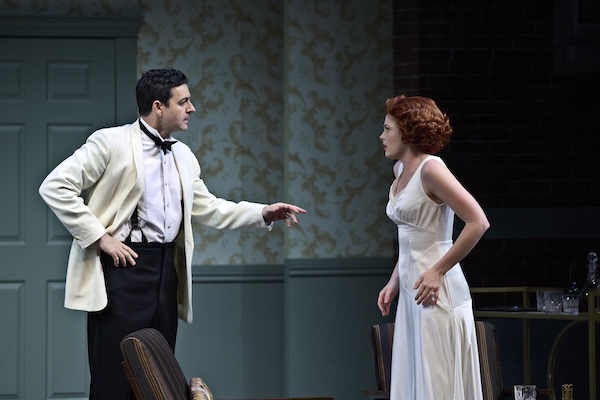
Tyrell Crews and Emily Dallas in Dial M For Murder, mounted by Theatre Calgary in 2025. Crews and Dallas reprise their roles in the Arts Club Theatre Company and Theatre Calgary co-production now playing at the Stanley until March 8. (photo by Trudie Lee for Theatre Calgary)

What do a latch key, a handbag, a compromising letter, two blackmail notes and an unexpected telephone call have in common? They are the primary clues in what is supposed to be the perfect murder – you know, the one you get away with. This is the premise for the Arts Club Theatre Company and Theatre Calgary co-production of Dial M for Murder, now playing at the Stanley. 

Frederick Knott’s 1952 play was adapted for cinema early on, with the 1954 thriller starring Grace Kelly and Ray Milland directed by the master of suspense himself, Alfred Hitchcock. About six ago, playwright Jeffrey Hatcher updated the story to add a contemporary and surprising twist. While the 1950s London setting has been preserved, giving it that quintessential British vibe, the cheating wife’s lover is now a woman – definitely a taboo to audiences of that era. Hatcher has also injected comedic moments and witty bon mots into the script, in contrast to the more noirish original.

This is not a murder mystery where the sleuthing detective ultimately exposes the culprit. In this iteration, we know from the beginning what the plan is, how it is to be executed and by whom – the only question is whether the perpetrator will get away with it.

It all starts when Tony Wendice (Tyrell Crews) discovers that his heiress wife, Margot (Emily Dallas), is having an affair with murder mystery writer Maxine Hadley (Olivia Hutt). Since he married Margot for her money, not love, he has no qualms about doing away with her to inherit her fortune. However, he does not want to do the dirty deed himself, so he blackmails a distant acquaintance from his past, Lesgate (Stafford Perry), to carry out the hit. Unfortunately, the plan backfires. Enter Chief Inspector Hubbard (Shekhar Paleja) of Scotland Yard, who, with Maxine’s assistance, attempts to recreate the murder scene to ferret out the mastermind behind the plot. But will they succeed?

Tony is front and centre of the narrative. At the beginning, he is in full control of the situation, callously planning the murder with painstaking attention to the details. He takes the art of manipulation to new heights. As his plan starts to unravel, we see the layers of his confidence peel away. 

Crews commands the role of Tony and Perry ably portrays Lesgate’s nervousness and angst in confronting Margot with the news that he is about to kill her. Dallas, who portrays Margot in a rather subdued fashion initially, is sublime in her portrayal of the hunted housewife, taking the audience on a melodramatic roller-coaster ride of emotions. Flamboyant Hutt infuses the character of Maxine with intelligence, charm and sleek sophistication, and comes across as the smartest person in the room. 

It is a testament to the abilities of these actors that such a small cast can pull off the highs and lows of this psychological thriller. They are assisted in this feat by a talented design team, including Jewish community members Itai Erdal, whose pinpoint lighting directs the audience’s attention to significant clues during scene breaks, and Anton Lipovetsky, whose sound design increases the suspense. 

Then there is set designer Anton deGroot’s revolving turntable stage. All the action takes place in the Wendices’ sparsely furnished drawing room, which slowly and imperceptibly moves back and forth, providing the audience with different perspectives of the action and emphasizing the fluidity of the story. Even the walls and windows move, providing additional layers to the puzzle. 

Jolane Houle’s costumes capture the essence of the stylish 1950s, elegant frocks for the ladies and tailored suits for the gents, all with colour palettes ranging from brown to blue to green that change with Erdal’s lighting. The ladies are perfectly coiffed and made-up à la that glamorous era. Jillian Keily directs her crew well.

This dialogue-dense production requires the audience to pay attention and focus on the various subtle clues that are dropped to determine if indeed Tony gets away with his deception and betrayal. It’s a cat and mouse game at its finest. 

Dial M for Murder runs to March 8. For tickets, go to artsclub.com or call 604 687-1644. 

Tova Kornfeld is a Vancouver freelance writer and lawyer.

Bard mounts two comedies

Jennifer Lines as Beatrice and Sheldon Elter as Benedick in Bard on the Beach’s production of Much Ado About Nothing. (photo by Tim Matheson)

For a Vancouver summer experience, almost nothing beats an evening at Bard on the Beach. The appearance of the red and white tents in Vanier Park signals the start of the Shakespearean season. This year, two comedies – Much Ado About Nothing, done in its proper period, and Two Gentlemen of Verona, set in the 1980s – are featured alternating days on the BMO Mainstage.

There was much excitement in the air on Much Ado’s opening night. From the moment I walked into the tent and saw the stunning set (kudos to Pam Johnson), I knew I was in for a treat. The scene is 17th-century Mediterranean Messina with an elevated balcony, vined pillars, terraced gardens and a flagstone wishing well, all drenched in a cornucopia of brilliant colours. 

One of the Bard’s most entertaining comedies, the story revolves around two couples, one young and naïve, for whom love is just one romantic whisper away, and one mature and skeptical of what love can bring into their lives. Jennifer Tong and Angus Yam play the young Hero and Claudio while Jennifer Lines and Sheldon Elter, the more experienced Beatrice and Benedick. 

The action starts off with a trio of soldiers, Don Pedro (Matthew Ip Shaw), Benedick and Claudio, who, upon returning from battle, stop to rest at the home of Lord Leonato (David Marr), Hero’s father and the governor of Messina. There is instant chemistry between Claudio and Hero, but, while it initially appears that the younger couple will be the main protagonists, it becomes apparent that the play is really about the older two. Lines, with her mass of red hair, comes across as a fiery feminist and is sublime in her role as she exchanges witty bons mots with Elter’s Benedick, a confirmed bachelor. They both mock love and he makes it very clear that marriage is not on his agenda. However, they both “doth protest too much” and it really comes down to “will they or won’t they?”

The journey to their final epiphany is a furious romp through a masked ball (with an erotic pas de deux), mistaken identities, athletic eavesdropping, false allegations of infidelity and a faked death. The language is peppered with double entendres. 

Don Pedro attempts to play cupid (“some cupids kill with arrows some with traps”) for both couples but is hindered by his dastardly half-brother Don John (deliciously played by Karthik Kadam), who tries to sabotage the Hero/Claudio nuptials. Cue a motley crew of the local watch, helmed by Bard veteran Scott Bellis as the inept Constable Dogberry, who are tasked with bringing Don John and his co-conspirators, Borachio (Tanner Zerr) and Conrad (Kristi Hansen), to justice. Steffanie Davis, as one of the watch team, entertains with priceless facial expressions and physical antics and, along with her cohorts, injects slapstick comedy into this rom-com.

A prologue precedes the first act, with the inclusion of text written by Erin Shields that is meant to provide a counterpoint to 400-year-old misogyny, including with respect to a woman’s supposed holy grail – the snaring of a husband. Lines challenges the audience with her passionate monologue while Tong mimes the actions from the balcony. As Shields notes in the program, “this additional text both gives an opportunity for a limited character to reach her heroic potential and provides a framework for this incredibly successful comedy to reach contemporary audiences in an even deeper way today.” 

In addition to the gorgeous set, the show boasts fabulous costumes by designer Mara Gottler – leather doublets and earth-toned breeches for the men, corset frocks for the women, including frothy gowns and veils for the wedding scene. Jewish community member Mishelle Cuttler provides the sound design.

The production is fun – and it makes a powerful statement. But I have a problem with the script and the suggestion that virginal Hero might risk her marriage to Claudio by having a pre-wedding night tryst with someone else, and with Claudio’s readiness to believe the gossip, leading him to abandon her at the altar. Her subsequent fainting “death” and ultimate resurrection, leading to their reunion, does not account for the wrong that was so easily done to her. Even her final monologue, describing her pain and path to reconciliation, does not ease the blow.

The Much Ado cast shifts gears on alternating nights and pivots to 1980s Verona, with all the colour and decadence that entails.

photo - Matthew Ip Shaw as Valentine, Agnes Tong as Silvia, and Tanner Zerr as Turio in Bard’s production of Two Gentlemen of Verona
Matthew Ip Shaw as Valentine, Agnes Tong as Silvia, and Tanner Zerr as Turio in Bard’s production of Two Gentlemen of Verona. (photo by Tim Matheson)

In Two Gentlemen of Verona, best friends Proteus (Jacob Leonard) and Valentine (Ip Shaw) separate, as Valentine goes to Milan to find excitement while Proteus stays behind to be with his girlfriend Julia (Tess Degenstein). However, Proteus’s parents, Antonio (Craig Erickson) and Ursula (Jennifer Clement), think it best that he follow his friend to Milan, to stay out of trouble. So, off he goes with his manservant Launce (a terrific Bellis) in tow and Crab, Launce’s dog (Mason in real life and artistic director Christopher Gaze’s own yellow Lab). As expected, Crab steals every scene he is in, without making a sound. On opening night, he even stopped to nuzzle some front row patrons as he exited the stage. 

Valentine, on arrival in Milan, is immediately smitten with Silvia (Tong), the daughter of the Duke (a mafiosi-like Elter). When Proteus arrives, he conveniently forgets about his girlfriend Julia and is equally taken with the glamorous femme. So, when Valentine tells his best bud that he intends to elope with the duchess, Proteus, to have Silvia for himself, tells the Duke. After all, as Proteus states, “in love, who respects friends?” Meanwhile, the Duke wants Silvia to marry Trurio (Zerr), although who knows why, because he comes across as a big, dumb athlete. 

Valentine is banished from Milan and Proteus attempts to woo Silvia, who makes it quite clear that she is not interested. Julia arrives, disguised as a man, to check up on her boyfriend and the fun/intrigue begins with swapped rings, torn love letters and a gang of Gothic outlaw rockers armed with various weapons, including a chainsaw, who intervene and provide for a surprising ending.

The production values are high and the designers have done a great job in creating a 1980s vibe, from Johnson’s multi-arched set to Gerald King’s lighting design. Costume designer Carmen Altorre highlights exercise leotards and leggings à la Jane Fonda, padded shoulders, caftans and tennis whites, as well as Miami Vice pastel-coloured suits to clothe the posh crowd. Of course, there is the hair – voluminous back-combed dos for the women and mullets for the men. A lot of the action takes place around the pool house, with props including a floating pink swan, multi-coloured beach balls, boom boxes and skateboards.

Malcolm Dow’s sound design brings back all the 1980s oldies and goldies, including theme songs from Dallas and St. Elmo’s Fire, with some funky choreography courtesy of Nicole Spinola.

Director Dean Paul Gibson has taken liberties with the script and not just a nip and tuck here and there, but major surgery, particularly with the ending. Purists may be appalled but the #MeToo generation will applaud the final scene.

Running on the smaller Douglas Campbell stage are The Complete Works of William Shakespeare (abridged) [revised] [again], a 90-minute romp through all 38 Shakespeare plays and 150-plus sonnets, including a version of Hamlet done backwards, and The Dark Lady, about Shakespeare’s supposed muse, collaborator and lover, Emilia Bassano, a Crypto-Jew.

For tickets, visit the website bardonthebeach.org or call 604-739-0559. The festival runs to Sept. 20. 

Tova Kornfeld is a Vancouver freelance writer and lawyer.