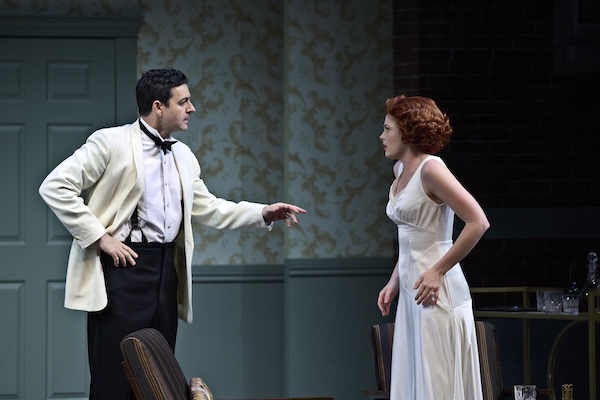
Tyrell Crews and Emily Dallas in Dial M For Murder, mounted by Theatre Calgary in 2025. Crews and Dallas reprise their roles in the Arts Club Theatre Company and Theatre Calgary co-production now playing at the Stanley until March 8. (photo by Trudie Lee for Theatre Calgary)
What do a latch key, a handbag, a compromising letter, two blackmail notes and an unexpected telephone call have in common? They are the primary clues in what is supposed to be the perfect murder – you know, the one you get away with. This is the premise for the Arts Club Theatre Company and Theatre Calgary co-production of Dial M for Murder, now playing at the Stanley.
Frederick Knott’s 1952 play was adapted for cinema early on, with the 1954 thriller starring Grace Kelly and Ray Milland directed by the master of suspense himself, Alfred Hitchcock. About six ago, playwright Jeffrey Hatcher updated the story to add a contemporary and surprising twist. While the 1950s London setting has been preserved, giving it that quintessential British vibe, the cheating wife’s lover is now a woman – definitely a taboo to audiences of that era. Hatcher has also injected comedic moments and witty bon mots into the script, in contrast to the more noirish original.
This is not a murder mystery where the sleuthing detective ultimately exposes the culprit. In this iteration, we know from the beginning what the plan is, how it is to be executed and by whom – the only question is whether the perpetrator will get away with it.
It all starts when Tony Wendice (Tyrell Crews) discovers that his heiress wife, Margot (Emily Dallas), is having an affair with murder mystery writer Maxine Hadley (Olivia Hutt). Since he married Margot for her money, not love, he has no qualms about doing away with her to inherit her fortune. However, he does not want to do the dirty deed himself, so he blackmails a distant acquaintance from his past, Lesgate (Stafford Perry), to carry out the hit. Unfortunately, the plan backfires. Enter Chief Inspector Hubbard (Shekhar Paleja) of Scotland Yard, who, with Maxine’s assistance, attempts to recreate the murder scene to ferret out the mastermind behind the plot. But will they succeed?
Tony is front and centre of the narrative. At the beginning, he is in full control of the situation, callously planning the murder with painstaking attention to the details. He takes the art of manipulation to new heights. As his plan starts to unravel, we see the layers of his confidence peel away.
Crews commands the role of Tony and Perry ably portrays Lesgate’s nervousness and angst in confronting Margot with the news that he is about to kill her. Dallas, who portrays Margot in a rather subdued fashion initially, is sublime in her portrayal of the hunted housewife, taking the audience on a melodramatic roller-coaster ride of emotions. Flamboyant Hutt infuses the character of Maxine with intelligence, charm and sleek sophistication, and comes across as the smartest person in the room.
It is a testament to the abilities of these actors that such a small cast can pull off the highs and lows of this psychological thriller. They are assisted in this feat by a talented design team, including Jewish community members Itai Erdal, whose pinpoint lighting directs the audience’s attention to significant clues during scene breaks, and Anton Lipovetsky, whose sound design increases the suspense.
Then there is set designer Anton deGroot’s revolving turntable stage. All the action takes place in the Wendices’ sparsely furnished drawing room, which slowly and imperceptibly moves back and forth, providing the audience with different perspectives of the action and emphasizing the fluidity of the story. Even the walls and windows move, providing additional layers to the puzzle.
Jolane Houle’s costumes capture the essence of the stylish 1950s, elegant frocks for the ladies and tailored suits for the gents, all with colour palettes ranging from brown to blue to green that change with Erdal’s lighting. The ladies are perfectly coiffed and made-up à la that glamorous era. Jillian Keily directs her crew well.
This dialogue-dense production requires the audience to pay attention and focus on the various subtle clues that are dropped to determine if indeed Tony gets away with his deception and betrayal. It’s a cat and mouse game at its finest.
Dial M for Murder runs to March 8. For tickets, go to artsclub.com or call 604 687-1644.
Tova Kornfeldis a Vancouver freelance writer and lawyer.
Daniel Kalla commands readers’ interest from the first sentence of his latest thriller, The Deepest Fake. And he keeps us turning pages straight to the end, not only as we contemplate who might be the culprit(s) of our hero’s apparent demise, but also as we consider the ideas Kalla puts forward about artificial intelligence, intellectual property, relationships, trust, measures of a successful life, and more.
Jewish Independent readers will be familiar with Kalla, who, in addition to being a writer of many international bestselling novels, is an emergency room physician here in Vancouver. The JI interviewed Kalla in 2023 and has reviewed of a few of his previous novels.
The plot-driving topic of The Deepest Fake – artificial intelligence – is new territory for the doctor-writer, who has penned many medical and science thrillers, using his physician’s knowledge to powerful effect. But he also has written an historical fiction trilogy set in Shanghai during the Second World War, where thousands of Jews fleeing Europe found safe haven, even as China and Japan were at war, so we know Kalla’s not afraid to do the research necessary to create a realistic-seeming fictional world centred around places and concepts less familiar to him, and to most readers.
As much as The Deepest Fake highlights some of the moral issues surrounding AI, it also explores other big issues, like medical assistance in dying (MAiD), fidelity in marriage and business partnerships, the foundations of trust, and where the creative process begins and who owns it. Kalla manages to cover all this ground and raise so many relevant questions while telling a great story. The Deepest Fake begins with a bang – “Liam Hirsch never seriously contemplated dying before his forty-ninth birthday – until today” – and keeps up the pace throughout.
Liam, founder and chief executive officer of a thriving AI company, TransScend, is suffering from a mysterious medical condition that’s first diagnosed as an aggressive form of ASL (amyotrophic lateral sclerosis). His symptoms – twitches and challenges with movement – have been getting worse, and he’s likely to lose basic motor function within months, maybe a year.
Despite the seriousness of his illness, Liam hesitates to tell his wife and kids, the former not only because of the pain it will cause, but because, weeks before, he discovered, with the help of a private investigator, that his wife was cheating on him. Adding to Liam’s stresses and the book’s adventure are some accounting irregularities at his company, the competitive nature of the tech world and the potentially manipulative AI app that he helped create. So, when it becomes obvious that someone wants Liam gone, the suspects are numerous, including his wife, all his staff, an aggrieved former business partner, and the technology itself.
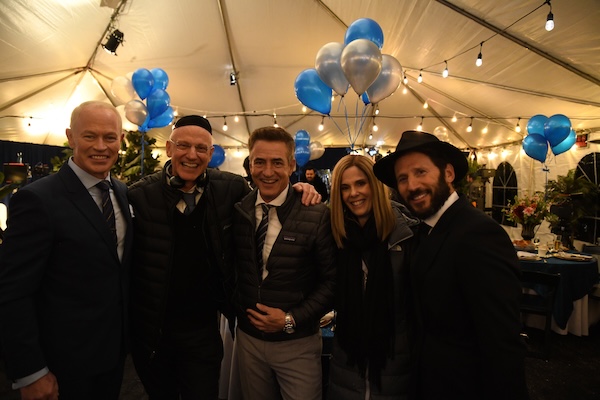
Filmmakers Salvador and Nina Litvak with Guns & Moses cast members Neal McDonough, left, Dermot Mulroney, centre, and Mark Feuerstein, right. (photo from Pictures from the Fringe)
Los Angeles filmmaker and author Salvador Litvak (no relation) will be in the city for this year’s Vancouver Jewish Film Festival to promote and talk about his and wife Nina Davidovich Litvak’s latest movie, Guns & Moses, which screens April 27, 4 p.m., at Fifth Avenue Cinemas.
The action thriller features a Chabad rabbi who becomes a detective and gunfighter to investigate a murder at his synagogue. This will be the third movie by the Litvaks and their production company, Pictures from the Fringe. Their previous films are When Do We Eat?, about “the world’s fastest seder gone horribly awry,” and Saving Lincoln, which is based on the true story of Abraham Lincoln and his friend and bodyguard Ward Hill Lamon.
Between movies, Salvador Litvak became the Accidental Talmudist – in fact, his last event in Vancouver was an Accidental Talmudist Shabbaton at the Kollel. He and his wife co-manage accidentaltalmudist.org, which has more than one million followers. Last year, he published a bestselling book, Let My People Laugh: Greatest Jewish Jokes of all Time.
Salvador Litvak grew up in New York but was born in Santiago, Chile.
“My mother’s family, both my mother and grandmother, were Holocaust survivors who came to Chile from Hungary and my father’s family ended up in Chile fleeing the pogroms in the Ukraine about 1905,” he told the Independent. As immigrants, he said, “we got to this country and my parents wanted me to go to Harvard to be a doctor and, since I was 5, I said OK, but, eventually, I figured out that I didn’t want to be a doctor and I didn’t want to be a lawyer because I enjoyed writing and creating very much.”
He said, “Eventually, I talked my way into UCLA film school, where I arrived in the 1990s, attended the MFA director’s program, and said thank G-d I didn’t miss this because this is what I was meant to do.”
Pictures from the Fringe’s first feature film, When Do We Eat?, about a dysfunctional family’s Passover seder, was inspired by the fact that there were no Jewish holiday movies and the Litvaks wanted to “create a Jewish version of It’s a Wonderful Life.” Both filmmakers are baalei teshuva, or returnees to Judaism, and were “in the early stages of their journey,” said Salvador Litvak. They infused the movie with a “tremendous amount of spirituality, Torah and Chassidut,” but, he noted, “now that we’re Orthodox, we admit that it’s a little edgier than we would like.” However, he said, “All of the deep stuff in it, the Torah, the love, in addition to the raucous humour, stands the test of time.”
Litvak said his journey as the Accidental Talmudist and the establishment of accidentaltalmudist.org have helped When Do We Eat? gain new popularity and provide a built-in audience for Guns & Moses, which was partially inspired by a tragic shooting in California on April 27, 2019.
The couple had “built a large audience interested in authentic Jewish content, and we are filmmakers, so we knew that our next movie would be somehow Jewish. I wanted it to be an action thriller because I love action thrillers,” he said.
The Litvaks watched a thriller a day for three years to “learn the genre inside out,” he said. “While we were immersed in that, there was a tragic murder, a shooting at a Chabad synagogue in Poway, Calif., where a young white nationalist came in and murdered a woman named Lori Gilbert-Kaye, injured the rabbi, and would have killed a lot more people if his gun had not miraculously jammed and members of the congregation rushed at him and then he fled.
“I went down the next day and attended Lori’s funeral and interviewed the rabbi and congregants and got to know what happened there personally, and I said there is something in this that can become an action thriller with a murder/mystery structure,” he said.
And so, Guns & Moses – about a Chabad rabbi who becomes an investigator and gunfighter after witnessing a tragic shooting at his synagogue – came into being. It was filmed in 2022.
Litvak said he knew that a movie about Jews under attack who fight back “would always be relevant, but we had no idea how relevant it would be” after Oct. 7, 2023.
One of the important themes of the movie, said Litvak, is that Jews are in danger and need to protect themselves and be responsible for their own safety. For him personally, that has meant joining a Jewish self-defence organization called Magen Am (which means Shield of the Nation) and going through extensive training (including learning how to use a gun) so that he can protect his own synagogue in case of an attack like the one in Poway. In the movie Guns & Moses, the character of Rabbi Mo Saltzman goes through the same training that Litvak went through.
In Guns & Moses, Saltzman is played by actor Mark Feuerstein, who starred in the hit series Royal Pains and appeared in the movie Defiance, among other things. The cast includes American-Israeli actor Alona Tal as the rebbetzin, Christopher Lloyd as a Holocaust survivor, as well as veteran actors Neal McDonough and Dermot Mulroney, Jake Busey, Craig Sheaffer, Mercedes Mason, Mark Ivanir (who also appeared in When Do We Eat?) and young actor Jackson Dunn, who Litvak believes will become a star. Litvak praised his cast, who only had 20 days to film Guns & Moses.
Litvak is looking forward to coming back to Vancouver, where he has visited many times because he has family here. The city is “very dear to my heart,” he said, and he loves the people and feels at home as soon as he lands here.
For tickets to Guns & Moses and other Vancouver Jewish Film Festival screenings, visit vjff.org.
David J. Litvakis a prairie refugee from the North End of Winnipeg who is a freelance writer and publicist, and a mashgiach at Louis Brier Home and Hospital. His articles have been published in the Forward, Globe and Mail and Seattle Post-Intelligencer. His website is cascadiapublicity.com.
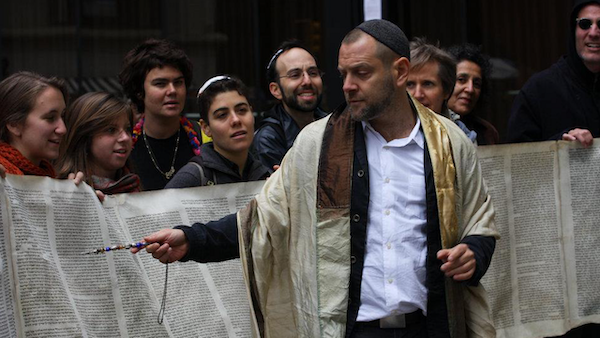
Sabbath Queen is a film about the life of Amichai Lau-Lavie, part of a rabbinic dynasty going back 38 generations. (still from film)
The 36th annual Vancouver Jewish Film Festival runs April 24 to May 4, beginning with opening night film Midas Man, which “offers Beatles fans a fresh look at the pivotal role Brian Epstein played in the band’s meteoric rise.” An enormous range of dramatic and documentary films, features and shorts, fill out the festival’s run, and the Independent reviews some of them here.
Tradition!
Hester Street, based on Abraham Cahan’s 1896 Lower Eastside immigrant novel Yekl, was released in 1975, about the same time as Fiddler on the Roof. The movie approaches some of the same topics of assimilation and tradition, without the song and dance.
Yankl (now Americanized Jake, played by Steven Keats) transforms from a yeshivah bocher to a shmatte sweatshop worker. Along comes Gitl, the wife who had waited behind in Russia, and young son Yossele who, payos cut off, becomes Joey.
The 50th anniversary of the film’s release reminds us that the 1970s were a time of nostalgia and of Jewish narratives that both idealized and lamented the American dream. In Hester Street, which is in black-and-white for mood, the boarder Bernstein (Mel Howard) represents tradition and continuity, contrasting with Jake in the fight of money versus learning, of getting ahead versus getting an education. Bernstein’s presence in the home of the primary couple puts Gitl in a predictable three-cornered bind both romantic and cultural.
Hester Street, which is filmed in black-and-white for mood, confronts the themes of tradition and assimilation. (still from film)
Younger viewers might take some time to recognize Gitl (Carol Kane) as the kooky landlady from Unbreakable Kimmy Schmidt. Meanwhile, the tough-talking landlady in Hester Street is recognizable as Doris Roberts, who contemporary viewers will recognize as the buttinsky mother-in-law from Everybody Loves Raymond.
There are subversive components of the film, including the role of divorce in perpetuating traditional values. Subversion twists again and indeed Gitl assimilates in her particular ways. As the last line in the film declares ambivalently, “We mustn’t be too quick to say this or that.”
Director Joan Micklin Silver was a pioneering woman in male-dominated 1970s Hollywood.
Kosher queen
Tradition, continuity and modern times are absolutely the themes of Sabbath Queen, a film by Sandi DuBowski about the life of Amichai Lau-Lavie.
The scion of a rabbinic dynasty going back 38 generations, Amichai is the son of politician, ambassador (“and we suspect a spy”) Naphtali Lau-Lavie and nephew of Israel Meir Lau, former chief rabbi of Israel. Filmed over 21 years, the documentary follows Amichai as he is ordained as a rabbi, via the Conservative movement’s Jewish Theological Seminary. But choosing the Conservative movement over orthodoxy is the least of Amichai’s rifts with his traditional family.
In 1993, Amichai was outed as a gay man in a news report and, it seems, he never looked back. After fleeing to New York a couple of years later and getting involved with the Radical Faeries, a queer, shamanistic spirituality group, “one vodka too many” leads to his alter ego emerging “out of my head like Athena.”
The drag queen Hadassah Gross – a Hungarian sex advisor, kabbalist, matchmaker and widow of six rabbis – was born. Amichai describes his drag persona as “something between channeling and performing” and it is all about exploring the intersections of feminine and masculine. (“What the goyim call the yingele and the yangele,” says Hadassah.)
“Artists are the new rabbis,” he declares, but eventually seems to decide that being an artist is not enough and he seeks his rabbinical smicha, in large part, it seems, to combat his brother and the larger establishment on Orthodox dogma.
He becomes the spiritual leader of a decidedly unorthodox congregation called Lab/Shul. And, when his officiating of interfaith partnerships clashes with the Conservative movement, the rabbi faces the consequences.
Amichai’s brother, father and mother have their reservations, to put it mildly, about Amichai’s activities.
“We’re pushing a lot of boundaries here,” he acknowledges. Or, as his Orthodox rabbi brother puts it, not entirely sympathetically, “He’s playing with Judaism.”
One feels invasive as the camera goes close up on Amichai at his father’s funeral and that sense of voyeurism repeats throughout the film, as does the feeling that the documentary’ssubject is something of an emotional exhibitionist.
The relationship between Amichai and his immediate family represents the larger cultural dissonance between queer and other nonconforming Jews and the orthodoxy of the tradition, though there is an astonishing, uplifting conclusion to some of these challenges by the film’s ending.
A family affair
I first saw A Real Pain on a flight home from Israel last month. Selecting a Hollywood treatment of two cousins doing a Holocaust road trip to their grandmother’s hometown in Poland, I girded myself for cringe-inducing, inappropriate or otherwise disappointing fare. My expectations were pleasantly upended. This is a profound, beautifully presented film that hits the right notes in so many ways.
I am not the only one impressed. Unbeknownst to me when I chose it, the script and the acting were already grabbing accolades worldwide. Costars Jesse Eisenberg (who won the BAFTA Award for best original screenplay) and Kieran Culkin (who won both an Oscar and a Golden Globe for best supporting actor) deliver moving and multidimensional characters.
David (Eisenberg) and Benji (Culkin) are the proverbial odd couple but what I had somehow anticipated to be slapstick comedy turned out to be deeply touching. As we find out more about Benji’s story, his erratic behaviour makes more sense.
Moments that could come off as didactic – almost documentary-like scenes at the Polin Museum and the Monument to the Ghetto Heroes, among others – somehow work even when you think they shouldn’t. The British tour guide James (Will Sharpe) is repeatedly challenged by Benji and acknowledges his own shortcomings as a non-Jewish facilitator, inviting viewers to ponder insider/outsider roles in the immediate and larger story.
If you ever wondered what corner Baby from Dirty Dancing ended up in, here she is – Jennifer Grey – playing a supporting role as one of the members of the cousins’ small tour group.
Spousal secrets
It is hard to write about Pink Lady without giving too much away. A seemingly ordinary religious Jerusalem couple with three happy kids and an involved extended family are upended when the husband is subjected to violence and blackmail.
Director Nir Bergman’s Hebrew-language feature film sees Lazer (Uri Blufarb) and Bati (Nur Fibak) pondering the most existential questions of how God challenges even his most dedicated adherents. A deeply serious film with both laugh-out-loud incongruities and eye-covering discomfiture, Pink Lady is a slice-of-life with deep theological questions.
Oct. 7 revisited
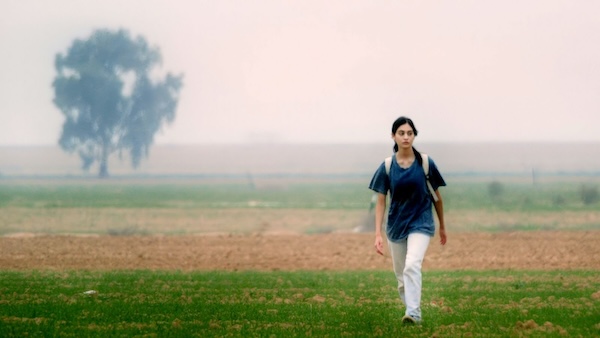
Of Dogs and Men, which deals directly with the attacks of Oct. 7, 2023, is a blend of fiction and documentary. (still from film)
At least two films in the festival deal directly with the attacks of Oct. 7, 2023.
Of Dogs and Men is a blend of fiction and documentary. Director Dani Rosenberg’s film follows 16-year-old Dar (Ori Avinoam, also cowriter) as she sneaks back into Nir Oz, her vacated kibbutz, in search of her missing dog Shula.
While the quest for the dog may be a stand-in for the larger search
Israelis have undertaken as individuals and collectively to discover the fate of missing people – Dar’s mother’s fate remains unknown – it is hard not to wonder if the choice to centre a (missing) dog in the story is not meant to invite dissonance among overseas viewers. Given the indifference and even celebration with which some people worldwide have responded to the Oct. 7 attacks, is the tragedy of a lost dog a statement on the qualitative value the world places on Jewish life?
Dar tags along with a woman who rescues animals in the abandoned and war-torn areas.
“Aren’t you afraid of dealing with those dogs?” she asks the woman.
“Look what human beings did. So, I should be afraid of dogs?” the woman responds. “There’s no creature more awful, crueler than human beings and I still live among you.”
Through the imagery of destruction and the litany of names of victims, the film breaks down distinctions between Israeli and Palestinian victims.
The documentary 6:30 provides a harrowing, minute-by-minute narrative of Oct. 7 events from different locations and perspectives. The interviews with survivors just a week after the attacks show raw emotion.
Some of the Nova festival-goers thought they were hallucinating as the hellish day unfolded. Several people, including first responders, speak of detachment, of a disconnect between what they were seeing and what they could believe. In retrospect, one survivor wonders if his liberation is real or if he died and that is what he is now experiencing. Others talk of the emotional burdens they will carry forever.
Linor Attias, a United Hatzalah volunteer who arrived at Kibbutz Be’eri in a mass casualty event vehicle, notes with pride that Arabs and Jews were united among the rescue workers trying to save the lives of victims. She loaded people into ambulances, where they released piercing shrieks of agony, having held them in for hours of silence in order to save their lives.
“That howl of pain cuts through the soul,” she says.
The most chilling thing about the film is realizing, amid all these horror stories, that these are the testimonies of the lucky ones.
Full details and tickets are available at vjff.org.
Last year, I requested two books from Simon & Schuster Canada. Both contained strong female protagonists and stories that sounded compelling. While it took the pandemic slowdown before I had time to read them, I enjoyed both and would recommend them, albeit one with a caveat.
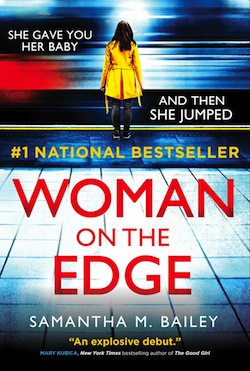
Let’s start with the debut novel, the one I breezed through even though I found the premise tenuous. I wanted to know how Samantha M. Bailey’s thriller Woman on the Edge ended, even as I cursed aloud at the two main characters – Nicole Markham, founder and head of a widely successful athletic wear company, and Morgan Kincaid, a woman who has rebuilt her life after her husband was caught swindling people and then killed himself.
For reasons not revealed initially, Nicole hands her baby to Morgan at a subway stop, then jumps to her death, though video of the incident makes it seem like Morgan may have taken the baby then pushed Nicole onto the tracks. Alternating between Morgan’s attempt to clear her name and how Nicole came to give her baby to Morgan, the read is thrilling, even as it is too obviously contrived. At any point in time, a question or revelation from Nicole or Morgan could have shed light on their respective situations and cleared up critical matters. Yet, both women – unrealistically – keep their suspicions to themselves. The silences are necessary for the plot to work, so I chose to go where I was being led and relish the craziness of it all.
While there is no overt Jewish content in Woman on the Edge, Toronto-based writer and editor Bailey is Jewish. In her first novel, she shows a talent for creating dramatic tension, if not overall story structure. Despite its weaknesses, I found this novel a good escape read.
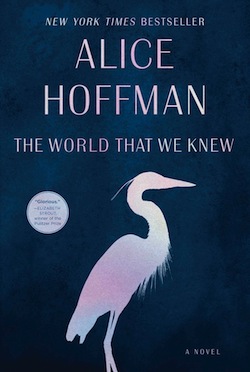
An absolute pleasure to read, and just as page-turning, is veteran author Alice Hoffman’s latest novel, The World That We Knew, set during the Holocaust. In it, there is magic. It is tangible – the golem Ava, created by Ettie, the precocious daughter of a respected rabbi, to protect Lea – and more abstract, in the loyalty of Ava to Lea and the beautiful friendship that develops between Ava and a blue heron along their journey.
After her husband is murdered and her daughter Lea is almost raped, Hanni knows she must get Lea to Paris, but she herself cannot leave Berlin. So, she turns to the rabbi for help, but making a golem is risky business and he won’t do it. Ettie, though, plans to escape with her younger sister, and Hanni’s payment will help her do that. Ettie has observed her father at work, and is able to bring Ava into being. As Ava becomes more seemingly human, however, and forms a bond with the blue heron, the main tension of the novel arises – will her appreciation for her own life and its possibilities outweigh her responsibility to Lea?
Many other tensions and relationships mingle with history, which is sometimes pedantically told but always interesting. The World That We Knew is a well-woven and moving story that offers an understanding not only of the past but of the emotions that motivate us and the connections we make with one another.
Richard Harmon stars in Crypto, written and directed by Jon Silverberg. (photo from Red Castle Films)
Enjoy watching a psychological thriller? Well, now you can help make one. At least, finance one. Starring Vancouver actor Richard Harmon – most recently John Murphy in the Warner Brothers series The 100 – and written and directed by local Jewish community member Jon Silverberg, the feature film Crypto has been shot but needs funding for the finishing touches.
“Crypto is my first feature film, and has been a struggle to complete on personal and private resources so far – this is why we’re now turning to crowdfunding to help finish it!” wrote Silverberg in an email to the Jewish Independent.
“We’ve shot and edited the film, but need the completion funds for VFX [visual effects], sound design and our festival and marketing rollout,” he said in an interview. “We have some really awesome perks to give back to fans in exchange for their donations – from a production diary, to merchandise, to an advance screening gala planned for early 2018.”
The film is described as “a psychological thriller, which follows drug-addicted photojournalist Jake (played by Harmon) who, after taking a job at a wilderness lodge, sets up a darkroom where the photos he develops begin to reveal unsettling apparitions of the future.”
“I enjoy watching lighter films, but the stories that I revisit in my mind long after I watch them are the ones that explore the darker more mysterious aspects of life – especially inside the human mind,” said Silverberg. “In Crypto, we explore the effects of isolation on an already troubled soul, and even the fantastical elements of the story are as much an allegory for the main character’s internal struggle,” as they are entertaining.
The crowdfunding press release talks about the film being Harmon’s “passion project,” but it is also Silverberg’s. “It’s been a longtime goal of mine to direct a feature film and I felt strongly about developing my own material,” he said. “I had been writing the script for Crypto for nearly three years by the time the cameras started rolling.”
Filming took place in Port McNeil, on Vancouver Island, over 11 days in February 2017, with a crew totaling 16, said Silverberg. “My producer, Andy Hodgson, was the other main driving force behind the film, and also served as cinematographer and camera operator on set.”
In the press release, Hodgson notes, “We need about $20,000 to finish the film and get it out to international festivals, which, comparatively speaking, is a very small amount in a world of multimillion dollar movies.”
Born in Montreal and raised on Vancouver Island, Silverberg moved to Vancouver in the early 2000s for film school, “and also for the overall film industry infrastructure. There wasn’t much happening for film on Vancouver Island at the time,” he said.
Silverberg is co-owner of Red Castle Films with producer/cinematographer Hodgson and business manager Nolan Smith. His bio on the site notes that he “grew up fascinated by cinema, and began to shoot photos and develop them in the darkroom by age 6. He attended Capilano University’s film program in 2003, and went on to shoot hundreds of episodes of internationally broadcast documentary television – from the waters of Alaska to the jungles of Mexico – before he settled in Metro Vancouver. More recently, Jon premièred his short film Disappeared at the 2015 San Francisco Indie Fest and is currently preparing to shoot his first feature film Crypto, a sci-fi/thriller set in the Haida Gwaii.”
Silverberg shared with the Independent that, not only was he raised in a semi-observant Jewish home, but that his company’s name, Red Castle Films, and its logo “was chosen in honour of the regional flag of my family’s former home in Poland.”
Crypto is scheduled for release in 2018 through festivals and other distribution. To see a trailer of the film, visit redcastlefilms.com/project/features-crypto. For more information and to donate – perhaps becoming a producer yourself – visit crypto-movie.com.