Skip to content
  • Home
  • Subscribe / donate
  • Events calendar
  • News
    • Local
    • National
    • Israel
    • World
    • עניין בחדשות
      A roundup of news in Canada and further afield, in Hebrew.
  • Opinion
    • From the JI
    • Op-Ed
  • Arts & Culture
    • Performing Arts
    • Music
    • Books
    • Visual Arts
    • TV & Film
  • Life
    • Celebrating the Holidays
    • Travel
    • The Daily Snooze
      Cartoons by Jacob Samuel
    • Mystery Photo
      Help the JI and JMABC fill in the gaps in our archives.
  • Community Links
    • Organizations, Etc.
    • Other News Sources & Blogs
    • Business Directory
  • FAQ
  • JI Chai Celebration
  • JI@88! video

Recent Posts

  • האלימות בישראל מורגשת בהרבה מגזרים
  • טראמפ עוזר דווקא לנושא הפלסטיני
  • New rabbi settles into post
  • A light for the nations
  • Killed for being Jewish 
  • The complexities of identity
  • Jews in time of trauma
  • What should governments do?
  • Annie will warm your heart
  • Best of the film fest online
  • Guitar Night at Massey
  • Partners in the telling of stories
  • Four Peretz pillars honoured
  • History as a foundation
  • Music can comfort us
  • New chapter for JFS
  • The value(s) of Jewish camp
  • Chance led to great decision
  • From the JI archives … camp
  • עשרים ואחת שנים להגעתי לונקובר
  • Eby touts government record
  • Keep lighting candles
  • Facing a complex situation
  • Unique interview show a hit
  • See Annie at Gateway
  • Explorations of light
  • Help with the legal aspects
  • Stories create impact
  • Different faiths gather
  • Advocating for girls’ rights
  • An oral song tradition
  • Genealogy tools and tips
  • Jew-hatred is centuries old
  • Aiding medical research
  • Connecting Jews to Judaism
  • Beacon of light in heart of city

Archives

Follow @JewishIndie
image - The CJN - Visit Us Banner - 300x600 - 101625

Tag: tariffs

Our Jewish-Canadian identity

Before Passover, a relative of ours in New Jersey asked if we would have problems getting Manischewitz wine. I told her all would be fine. Even though US alcohol had been taken off Manitoba’s shelves, we would just buy other brands of kosher wine instead, I said.

I felt confident about this possibility until I marched to the kosher section of the wine shop and saw the notification. The store encouraged us to buy whatever was available “right now” because all kosher wine, no matter where it is made, is imported through the United States. We were fine for Passover and, to be honest, my family is more flexible about wine the rest of the year, so the situation didn’t worry me too much. 

A Manischewitz joke from my mom, visiting from the States, made me wonder about how much kosher wine is available now in Manitoba, and I did some googling. Between the provincially run Liquor Marts and the private wine shop that caters to those who keep kosher, I saw about six wine varieties available.

Then, my husband told a story he’d heard from someone attending minyan. Their family kept kosher. To get the kosher wine they wanted during Manitoba’s ban on US alcohol, they placed a special order with Happy Harry’s liquor store in Grand Forks, ND. The dad drove from Winnipeg, crossed the border, picked up two cases of wine, paid the duty at the border and drove home again. It was a 470-kilometre round trip, more or less, to resolve the issue.

You don’t think a lot about this when supply chains function between countries, but, in the absence of kosher wine imports, you have whatever odds and ends are left – and Kedem grape juice, which is still available.

Plenty of Jewish Canadians may be asking what they will drink on the holidays. This made me think about the Babylonian talmudic tractate I’ve just started studying, Avodah Zara. This tractate, compiled by about 500 CE, concerns how one lives alongside idol worship. It considers issues like whether Jews should do business with non-Jews before their festivals, because the money they earn might go towards ritual sacrifice to idols.

It gets more specific though. Jews lived in diverse places, with many different cultures around them. The rabbis wondered, what if there were a water fountain and the water spurted out of a Greek god or an idol? Jews may not drink “from Zeus’s lips.”

The rabbis then suggest a more concerning health issue about these fountains with pipes. There was danger, they posit, because these pipes brought water from ponds or rivers. You might swallow a leech. Medical suggestions about what to do if you swallow a leech (or, heaven forbid, a hornet) follow. Apparently, one is allowed to boil water on Shabbat to deal with this problem, or swallowing vinegar might help. 

This discussion on Avodah Zarah, page 12, examines how to deal with many issues in communities where we Jews interact with others, working and living together, specifically mentioning Gaza and Bet She’an. Yes, those two locations have been in the news … funny how little changes.

This tractate page describes how to cope with another even more difficult dilemma. During this period – the Mishnah was compiled by about 200 CE, and the Gemara was added by 500 CE – some people believed that Shavrirei, a water demon, came out at night. If you got thirsty at night, you must wake up someone else to accompany you, as the demon would only be a problem if you were alone. However, if you were alone and thirsty, there was another solution. One knocked on the jug lid and recited an incantation: “shavrirei verirei rirei yirei rei.” Maybe reducing the name of the demon at each repeat results in causing the demon to disappear, too? 

To most modern thinkers, this whole approach will seem bizarre. An entire tractate is devoted to avoiding idol worship, since Jews believe in only one G-d. Yet, at that time, Jews also seemed to believe that dangerous demons existed, swallowing leeches could be resolved by consuming hot water, and a person would die from swallowing a hornet but might delay their demise by drinking vinegar. Worldviews are complicated, and full of contradictions.

These days, Jews, both in Israel and the diaspora, live in community with non-Jews. We must cooperate and get along even when our traditions don’t jibe. Further, we must consider when our actions are meaningful and when they’re tokenism. Some examples of avoiding idol worship suggest that Jews should avoid even the appearance of worshipping idols. For instance, if you get a thorn in your foot near an idol statue, don’t bow down there to pull out the splinter! It looks bad.

From the outside, sure, Jews in Canada can stand behind our country’s counter-tariffs and the choices made by our country and provinces to deal with trade issues. It’s within the rights of provinces to pull US alcohol from our shelves. That said, how then do Jewish families who require kosher wine to say Kiddush, celebrate Shabbat or weddings or holidays? According to at least one household, it requires crossing the border, paying the duty and getting on with things.

It’s not clear whether the counter-tariffs, lack of US alcohol sales or decreased Canadian tourism to the United States will make any difference in the Canada-US trade relationship. Like the incantation to get rid of the demon Shavrirei, perhaps reducing the names of those who bother us makes them disappear. Maybe it’s just a ritual that makes us feel better. We can’t tell from here. 

Over time, our priorities differ. Sometimes, we’re scared of a water demon. Other times, we’re feeling thrashed about by trade talks with an “orange” ruler of a different sort. In both cases, we might respond with token acts or incantations, which mostly don’t change things. Yet, the rabbis point out, water is essential to life. We must drink, so we come up with hopefully safe solutions to quench our thirst. Wine is a little less necessary, but we bless it multiple times a year, so does the kosher wine shortage matter more now? The issue creates discord between our Canadian and Jewish identities, as we live in the diaspora.

Perhaps all will be resolved when Canada’s internal trade between provinces improves. Maybe we’ll think less about this when the weather cools and we’re not quite so “thirsty.” Here we are, almost 2,000 years after these issues were first discussed, still wondering the best ways to live in diverse societies, meet our needs and get along with our neighbours. 

Joanne Seiff has written regularly for the Winnipeg Free Press and various Jewish publications. She is the author of three books, including From the Outside In: Jewish Post Columns 2015-2016, a collection of essays available for digital download or as a paperback from Amazon. Check her out on Instagram @yrnspinner or at joanneseiff.blogspot.com.

Posted on July 11, 2025July 10, 2025Author Joanne SeiffCategories Op-EdTags Canada, identity, kosher wine, Passover, politics, tariffs, trade, United States
Key Passover imports exempt

Key Passover imports exempt

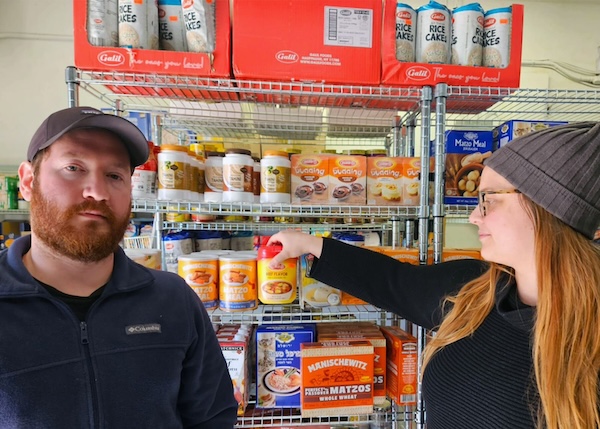
Tal Kinstlich and Stephanie Schneider, the owners of Vancouver’s Kosher Food Warehouse. (photo from Kosher Food Warehouse)

Canada is exempting key imported Passover foods from the current diplomatic trade war with the United States. The ministry of finance sent The CJN a list of kosher-for-Passover products imported from the United States, which are going to be allowed into Canada without being hit by the extra 25% retaliatory import tariffs that Ottawa began imposing on March 4.

The list includes matzah and related matzah products, cake mixes, chocolate, margarine, most juices (but not apple), gefilte fish, and canned fruit and vegetables. However, US exports of nuts, spices, dairy, wine, coffee, chicken and meat products are not exempt.

The development comes after Canada’s biggest kosher food importer recently predicted that the on-again-off-again tariff dispute would rocket prices for imported kosher-for-Passover food by up to 60%. Canadian Jewish leaders have been lobbying Ottawa to give relief to the country’s Jewish community as it heads into the holiday season.

While the news will likely bring a sigh of relief to consumers, it is only a temporary reprieve: it covers only Passover foods and runs only until the end of Passover.

For more on how these food tariffs are impacting Canadian kosher food stores and suppliers across Canada, and what advice they have for you, listen to the episode of The CJN Daily that features the owners of Vancouver’s Kosher Food Warehouse, Tal Kinstlich and Stephanie Schneider. Jack Hartstein also joins: he’s the vice-president of Montreal-based Altra Foods, the largest importer of kosher foods in Canada. The link is thecjn.ca/podcasts/key-passover-imports-will-be-exempt-from-tariff-war-with-u-s-ottawa-confirms. 

– For more national Jewish news, visit thecjn.ca

Format ImagePosted on March 28, 2025March 27, 2025Author Ellin Bessner THE CJN DAILYCategories NationalTags imports, kashrut, Kosher Food Warehouse, Passover, politics, tariffs
O Canada! tote bag line

O Canada! tote bag line

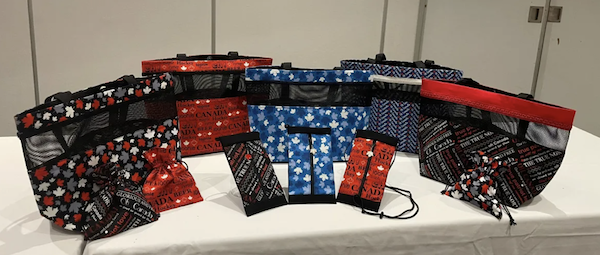
Tikun Olam Gogos’ O Canada! bags proclaim dedication to the ethic of improving the world in friendship with other nations, raising much-needed funds for grandmothers in sub-Saharan Africa who are raising their grandchildren due to the HIV & AIDS pandemic. (photo from Tikun Olam Gogos)

As proud Canadians and fundraisers for the Stephen Lewis Foundation Grandmothers to Grandmothers Campaign, Tikun Olam Gogos have launched a special edition line of O Canada! tote bags – determined to respond to the threats American tariffs pose to Canada, and to the suspension of USAID, which is devastating to the Gogos’ partner organizations in Africa. 

According to Stephen Lewis, “Lives will be lost. Our best contribution at this perilous moment is to attempt to replace the resources that America has expunged.”

Tikun Olam Gogos’ response to the White House is to raise more funds by intensifying its efforts to handcraft and market its O Canada! line of large tote bags, zippered and drawstring pouches.

Tikun Olam Gogos (TOG) is part of the Greater Vancouver Gogos, which includes about 20 Gogo groups across the Lower Mainland. Gogo is the Zulu word for “grandmother” and tikkun olam is Hebrew for “repair of the world.” TOG is a volunteer group of grandmothers and grand-others (non-members who help out the group periodically) in Vancouver that was founded in May 2011 and is sponsored by the Sisterhood of Temple Sholom. Its mission is to raise awareness, build solidarity and mobilize support in Canada for grandmothers in sub-Saharan Africa who are raising their grandchildren due to the HIV & AIDS pandemic. 

In 14 years of operation, Tikun Olam Gogos has raised more than half a million dollars for the SLF Grandmothers to Grandmothers Campaign. With its partners in Africa reeling from the withdrawal of other international programs, TOG is more determined than ever to fulfil its motto: “we will not rest until they can rest.”

Priced at $50, just $5 more than TOG’s original signature totes, the O Canada! bags proclaim dedication to the ethic of improving the world in friendship with other nations. So, wear your maple leaf and your heart proudly on your O Canada! tote. You are telling the world “Canada cares.”

To order your O Canada! tote bags, zippered pouches and drawstring pouches, visit tikunolamgogos.org or call Joyce Cherry at 604-261-5454. 

– Courtesy Tikun Olam Gogos

Format ImagePosted on March 14, 2025March 13, 2025Author Tikun Olam GogosCategories LocalTags Canada, fundraising, Grandmothers to Grandmothers campaign, Stephen Lewis, tariffs, tikkun olam, Tikun Olam Gogos, United States

Taxes, tariffs for Jewish life

In December, our federal government offered a hastily assembled tax break that lasted until mid-February. The most memorable part of it was that the Canada Revenue Agency (CRA) chose to exempt “Hanukkah trees or bushes” from taxes. Your reaction might be like my twins’ outcry when I picked them up from junior high. We discussed it on the way home.

“Did they talk to an actual Jewish person?” they wondered. “Couldn’t they have exempted Hanukkah menorahs and candles? Judaica?

“Don’t they realize,” my kids added, “that anybody who is buying a tree is not doing a Jewish thing?”

I had similar thoughts. There are Jews who, for various reasons, decorate with Christmas items, but it’s not a Jewish thing.

I often write about how Jewish traditions, laws and texts apply to us, as Canadian Jews. This time, I reflected on how Canadian law applies to us, instead. The Hanukkah bush incident on its own wouldn’t have resulted in more than momentary annoyance or a wry chuckle if it had been a one-off mistake.

I thought of this while considering the recent US hoopla around eradicating DEI (diversity, equity and inclusion) policies. Canadians consider diversity part of our strength. Of course, there are efforts to uphold our strength in diversity amid the new US presidential activity. Historically, I’ve been a fan of DEI. It uplifts minorities who deserve a fair chance in a world that touts itself as a meritocracy but, in truth, privileges some far above others. 

After Oct. 7, 2023, it became clear that Canadian DEI does nothing to support Jewish people, although we’re a minority in Canada. More than once, my husband, a professor, was forced to point out surveys, embraced by his university, that left no way to identify as Jewish. In one human resources gaffe, the survey told Jews to identify as “white European.” My husband, whose father was born in a displaced persons camp in Germany in 1946, had no intention of pretending his murdered and displaced ancestors were considered equal or “white” citizens in Europe.

There are more anecdotes that one could share. Jews are a minority in Canada. The current DEI narrative doesn’t match who we are.

All this came up when reading the newly released tariff proposal compiled by the Canadian government. You could get bogged down in the definitions of “offal,” “margarine” and other details. I skimmed quickly, wondering how this would affect our Passover grocery shopping. Then I got stuck on the following entries in the backgrounder that was proposed to go into effect Feb. 4 and then was quickly postponed for 30 days.

Specifically, I got lost in item numbers 6117.10.10, 6117.90.10, 6214.10.10, 6214.20.10 and 6214.30.10. All these objects, associated with shawls, stoles, scarves and mantillas, and parts thereof, specifically list “prayer shawls.” These numbers relate to whether the garment is made, in whole or in part, of wool, silk or synthetics, and knitted or crocheted.

In recent years, it’s true that some older Christian women, usually in church groups, have knit shawls while praying. They gift these “prayer shawls” to those they pray for in their community. There isn’t much cross-border trade in these items. These works of prayer are gifts and are rarely for sale.

It’s easier to jump to the other definition. Tallits, tallesim, tallis, tallitot – however you call it, Jewish garments with tzitzit, made of wool, silk or synthetics, are called prayer shawls in English. Having recently searched for these for my twins’ b’nai mitzvah, many of the biggest Judaica shops that sell these are in the United States. Of course, one can also buy beautiful tallits from Israel. Due to the exchange rate, slow postage times and difficulty of shopping online, we bought our kids’ tallits locally at the synagogue gift shop, but some of those items came from US suppliers.

I wove my tallit for my bat mitzvah. I’m capable of weaving others, but because my kids haven’t grown to their adult sizes, our family decided not to invest too much time and money into their current tallits. What fits now at age 13 won’t work for them as adults. However, the new tariffs indicate that, although Jews are only 1% of the Canadian population, our ritual prayer items apparently deserve “special mention” and tariff fees. Note that, if you can locate a cotton tallit, it might not fit in the tariff schedule yet, but this list and its timeline are open to revision.

Where does this leave us? I’m wondering who compiled the two-month tax break and the tariff list. Someone on these task forces feels the need to single out and “include” Jews without consulting any Jews. The effort towards “inclusion” feels downright uncomfortable. It leaves Jewish Canadians feeling othered. We’re the small minority specifically allowed to purchase “Hanukkah bushes” without tax. Our tallits are mentioned five times in the cross-border tariff battles.

While we dangle in this awkward space, it brings up other issues. How many “Hanukkah bushes” or tallits do the CRA and tariff writers think we buy each year? As a small minority, even if we all bought these items every year (which we don’t), it would amount to nothing much. Something smacks of bias. The notion that we have outsized purchasing power or large numbers is part of a greater set of antisemitic tropes.

Earlier this week, I attended an online panel on antisemitism that included MP Ben Carr, Manitoba MLA Mike Moroz, Belle Jarniewski, executive director of the Jewish Heritage Centre of Western Canada, and Avrom Charach, a longtime Winnipeg Jewish leader and activist who has been cleaning up antisemitic graffiti. Everyone on the panel concluded that education and outreach to non-Jewish Canadians helps, because eradicating ignorant hate takes education and allies. The panel also suggested that appropriate federal and provincial legislation could help bring change.

Mentioning these strange tax cuts and tariff proposals could help educate Canadian government officials. Their efforts to single out the Jewish community have backfired. Let’s hope that future legislation doesn’t create other fake Jewish rituals or charge special tariffs on Jewish ritual items. Such actions aren’t supportive of Canadian diversity. Canada can do better. 

Joanne Seiff has written regularly for the Winnipeg Free Press and various Jewish publications. She is the author of three books, including From the Outside In: Jewish Post Columns 2015-2016, a collection of essays available for digital download or as a paperback from Amazon. Check her out on Instagram @yrnspinner or at joanneseiff.blogspot.com.
Posted on February 14, 2025February 13, 2025Author Joanne SeiffCategories Op-EdTags antisemitism, Hanukkah bushes, history, Liberal party, prayer shawls, tallit, tariffs, taxes, trade policy
Proudly powered by WordPress