Skip to content

  • Home
  • Subscribe / donate
  • Events calendar
  • News
    • Local
    • National
    • Israel
    • World
    • עניין בחדשות
      A roundup of news in Canada and further afield, in Hebrew.
  • Opinion
    • From the JI
    • Op-Ed
  • Arts & Culture
    • Performing Arts
    • Music
    • Books
    • Visual Arts
    • TV & Film
  • Life
    • Celebrating the Holidays
    • Travel
    • The Daily Snooze
      Cartoons by Jacob Samuel
    • Mystery Photo
      Help the JI and JMABC fill in the gaps in our archives.
  • Community Links
    • Organizations, Etc.
    • Other News Sources & Blogs
    • Business Directory
  • FAQ
  • JI Chai Celebration
  • JI@88! video
image - Weizmann Canada Physics Tournament 2025
image - The CJN - Visit Us Banner - 300x600 - 101625

Recent Posts

  • Vrba monument is unveiled
  • Music to build bridges
  • A better future possible
  • Anne Frank exhibit on now
  • Human rights in sport
  • Telling the story of an icon
  • Crawl bigger than ever
  • JCC Maccabi in Toronto
  • A way to meet fellow Jews
  • Time to include
  • Add Jewish joy to the mix
  • Reminder of humanity’s light
  • From the archives … editorials
  • Year-round holiday recipes
  • מדוע עזבתי את ישראל ואינני חושב לחזור ארצה
  • OJC hosts Oct. 7 memorial
  • A journey beyond self
  • Antisemitism a problem
  • Young man is missed
  • Orr action sparks complaint
  • Prison sentence for hate
  • Etgar Keret comes to Vancouver
  • New fall lecture series
  • Series explores music
  • Doc on Zapiro screens Nov. 6
  • Joy of shared existence
  • Community milestones … October 2025
  • MAID vs Jewish values
  • Cheshvan a great month, too
  • Bull, bear or bubble?
  • From the archives … a coin, etc.
  • מדוע האנטישמיות הולכת וגואה בעולם
  • New bio gives Vrba his due
  • Joy brighter than ever
  • When approaches differ
  • New leadership at the JCCV

Archives

Follow @JewishIndie

Tag: kosher wine

Our Jewish-Canadian identity

Before Passover, a relative of ours in New Jersey asked if we would have problems getting Manischewitz wine. I told her all would be fine. Even though US alcohol had been taken off Manitoba’s shelves, we would just buy other brands of kosher wine instead, I said.

I felt confident about this possibility until I marched to the kosher section of the wine shop and saw the notification. The store encouraged us to buy whatever was available “right now” because all kosher wine, no matter where it is made, is imported through the United States. We were fine for Passover and, to be honest, my family is more flexible about wine the rest of the year, so the situation didn’t worry me too much. 

A Manischewitz joke from my mom, visiting from the States, made me wonder about how much kosher wine is available now in Manitoba, and I did some googling. Between the provincially run Liquor Marts and the private wine shop that caters to those who keep kosher, I saw about six wine varieties available.

Then, my husband told a story he’d heard from someone attending minyan. Their family kept kosher. To get the kosher wine they wanted during Manitoba’s ban on US alcohol, they placed a special order with Happy Harry’s liquor store in Grand Forks, ND. The dad drove from Winnipeg, crossed the border, picked up two cases of wine, paid the duty at the border and drove home again. It was a 470-kilometre round trip, more or less, to resolve the issue.

You don’t think a lot about this when supply chains function between countries, but, in the absence of kosher wine imports, you have whatever odds and ends are left – and Kedem grape juice, which is still available.

Plenty of Jewish Canadians may be asking what they will drink on the holidays. This made me think about the Babylonian talmudic tractate I’ve just started studying, Avodah Zara. This tractate, compiled by about 500 CE, concerns how one lives alongside idol worship. It considers issues like whether Jews should do business with non-Jews before their festivals, because the money they earn might go towards ritual sacrifice to idols.

It gets more specific though. Jews lived in diverse places, with many different cultures around them. The rabbis wondered, what if there were a water fountain and the water spurted out of a Greek god or an idol? Jews may not drink “from Zeus’s lips.”

The rabbis then suggest a more concerning health issue about these fountains with pipes. There was danger, they posit, because these pipes brought water from ponds or rivers. You might swallow a leech. Medical suggestions about what to do if you swallow a leech (or, heaven forbid, a hornet) follow. Apparently, one is allowed to boil water on Shabbat to deal with this problem, or swallowing vinegar might help. 

This discussion on Avodah Zarah, page 12, examines how to deal with many issues in communities where we Jews interact with others, working and living together, specifically mentioning Gaza and Bet She’an. Yes, those two locations have been in the news … funny how little changes.

This tractate page describes how to cope with another even more difficult dilemma. During this period – the Mishnah was compiled by about 200 CE, and the Gemara was added by 500 CE – some people believed that Shavrirei, a water demon, came out at night. If you got thirsty at night, you must wake up someone else to accompany you, as the demon would only be a problem if you were alone. However, if you were alone and thirsty, there was another solution. One knocked on the jug lid and recited an incantation: “shavrirei verirei rirei yirei rei.” Maybe reducing the name of the demon at each repeat results in causing the demon to disappear, too? 

To most modern thinkers, this whole approach will seem bizarre. An entire tractate is devoted to avoiding idol worship, since Jews believe in only one G-d. Yet, at that time, Jews also seemed to believe that dangerous demons existed, swallowing leeches could be resolved by consuming hot water, and a person would die from swallowing a hornet but might delay their demise by drinking vinegar. Worldviews are complicated, and full of contradictions.

These days, Jews, both in Israel and the diaspora, live in community with non-Jews. We must cooperate and get along even when our traditions don’t jibe. Further, we must consider when our actions are meaningful and when they’re tokenism. Some examples of avoiding idol worship suggest that Jews should avoid even the appearance of worshipping idols. For instance, if you get a thorn in your foot near an idol statue, don’t bow down there to pull out the splinter! It looks bad.

From the outside, sure, Jews in Canada can stand behind our country’s counter-tariffs and the choices made by our country and provinces to deal with trade issues. It’s within the rights of provinces to pull US alcohol from our shelves. That said, how then do Jewish families who require kosher wine to say Kiddush, celebrate Shabbat or weddings or holidays? According to at least one household, it requires crossing the border, paying the duty and getting on with things.

It’s not clear whether the counter-tariffs, lack of US alcohol sales or decreased Canadian tourism to the United States will make any difference in the Canada-US trade relationship. Like the incantation to get rid of the demon Shavrirei, perhaps reducing the names of those who bother us makes them disappear. Maybe it’s just a ritual that makes us feel better. We can’t tell from here. 

Over time, our priorities differ. Sometimes, we’re scared of a water demon. Other times, we’re feeling thrashed about by trade talks with an “orange” ruler of a different sort. In both cases, we might respond with token acts or incantations, which mostly don’t change things. Yet, the rabbis point out, water is essential to life. We must drink, so we come up with hopefully safe solutions to quench our thirst. Wine is a little less necessary, but we bless it multiple times a year, so does the kosher wine shortage matter more now? The issue creates discord between our Canadian and Jewish identities, as we live in the diaspora.

Perhaps all will be resolved when Canada’s internal trade between provinces improves. Maybe we’ll think less about this when the weather cools and we’re not quite so “thirsty.” Here we are, almost 2,000 years after these issues were first discussed, still wondering the best ways to live in diverse societies, meet our needs and get along with our neighbours. 

Joanne Seiff has written regularly for the Winnipeg Free Press and various Jewish publications. She is the author of three books, including From the Outside In: Jewish Post Columns 2015-2016, a collection of essays available for digital download or as a paperback from Amazon. Check her out on Instagram @yrnspinner or at joanneseiff.blogspot.com.
Posted on July 11, 2025July 10, 2025Author Joanne SeiffCategories Op-EdTags Canada, identity, kosher wine, Passover, politics, tariffs, trade, United States
There are many reasons to visit Summerhill Pyramid Winery

There are many reasons to visit Summerhill Pyramid Winery

Left to right, Ari Cipes, Rabbi Shmuly Hecht and Ezra Cipes have joined forces to help make Summerhill Pyramid Winery’s Tiferet, the only kosher uncooked wine in Canada. (photo from summerhill.bc.ca)

The rolling hills and verdant valleys of British Columbia’s Okanagan region are home to more than 200 wineries, many of which are internationally renowned and award-winning. In fact, a number of Canada’s most prestigious wineries call this region home – Mission Hill, Cedar Creek, Sumac Ridge, to name a few – with one singled out as “B.C.’s most visited winery” by Tourism Kelowna.

There are several possible reasons for Summerhill Pyramid Winery’s popularity. It could be the incongruous sight of the enormous, dazzling white pyramid towering over the central terrace (more on that later). Perhaps it’s because of the estate’s Peace Park or the quality of its 100 percent organic vineyard. Then there’s the winery’s most recent offering, Tiferet (Hebrew for beauty/glory), a new, top-of-the-line kosher wine whose very name reflects the exceptional landscape from which it was created.

Summerhill Pyramid Winery was founded by native New Yorker Stephen Cipes, who moved to the Okanagan with his young family in 1986 and felt an immediate spiritual connection with the land. The developer-turned-vintner purchased Summerhill Vineyards, replanted the existing table grapes with winemaking European grapes and set to work. Located on Kelowna’s Lakeshore Wine Route, the mid-size winery has been producing organic, award-winning wines ever since, making a name for itself in European capitals.

Now, three of Cipes’ four sons are involved in managing the family business. Chief executive officer Ezra Cipes spoke with the Jewish Independent from his office, which overlooks the magnificent, blue waters of Lake Okanagan.

The immediate question at hand was why the winery had decided to produce a kosher wine, especially an extremely limited edition one (1,200 bottles) with a hefty price tag ($100 per bottle). Cipes explained that he was inspired by his friendship with Okanagan Chabad Rabbi Shmuly Hecht and a desire “to share the beauty of natural, uncooked wine with Hecht and all Sabbath observant Jews.”

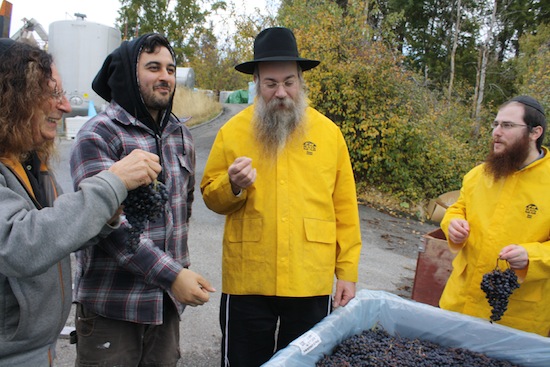
photo - Left to right, Stephen Cipes, Ari Cipes, Rabbi Levy Teitlebaum and Rabbi Shumly Hecht taste the 2012 crop of grapes
Left to right, Stephen Cipes, Ari Cipes, Rabbi Levy Teitlebaum and Rabbi Shumly Hecht taste the 2012 crop of grapes. (photo from summerhill.bc.ca)

Cipes and Hecht formed a deep bond while “studying texts together and drinking mevushal [cooked] wine together,” Cipes explained. “None of [the cooked kosher wines] can compare with living, uncooked wine, and I realized that Rabbi Hecht did not know the pleasure of living wine. There was none available to share with him, so we decided to make it ourselves, and we set out to make it as beautiful as possible. We used the best grapes of the vintage, bought the best barrels from France and now, a year and a half later, I am pleased to say that the wine we made exceeded my expectations.”

Kosher winemaking is somewhat complicated. Governed by the same kashrut laws pertaining to food (prepared under supervision of a rabbi, containing only kosher ingredients, using rabbinically certified equipment), kosher wine is further divided into two categories: uncooked and cooked. Although both are considered equal with respect to kashrut, their production and final result couldn’t be more different.

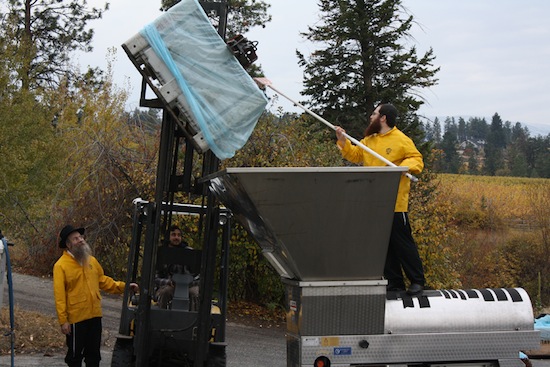
To qualify as kosher uncooked wine, the wine’s entire production – from “vine to wine” in vintner vernacular – must be handled exclusively by Sabbath-observing Jewish males. And that includes pouring. Understandably, it is well-nigh impossible for commercial producers to comply with these conditions and most opt to make the cooked category of kosher wine, if they produce such wine at all. Kosher cooked winemaking allows non-Jews of both genders to handle production and serving, however, the other regulations are no less strict. For a wine to qualify as kosher cooked, it must be heated to 1850F, which, well, cooks it. And therein lies the rub.

Exposure to such high temperatures significantly compromises the wine’s flavor and texture and, while most producers now use flash-pasteurization techniques to minimize the damage, there is simply no way around it. “Wine is a living thing…. By cooking the wine, we are destroying the wine,” Cipes’ explained matter-of-factly. The dilemma facing kosher wine vintners is best summed up as having to choose between quality and quantity, taking into account the obvious economics that accompany those choices.

photo - Rabbi Levy Teitlebaum and Rabbi Shmuly Hecht manage the grape-crushing process
Rabbi Levy Teitlebaum and Rabbi Shmuly Hecht manage the grape-crushing process. The wine’s entire production – from “vine to wine” in vintner vernacular – must be handled exclusively by Sabbath-observing Jewish males. (photo from summerhill.bc.ca)

Which brings us back to Tiferet, whose kosher uncooked status partly explains its steep price. Cipes acknowledged the challenge of producing uncooked wine and described Tiferet’s creation as “a labor of love.”

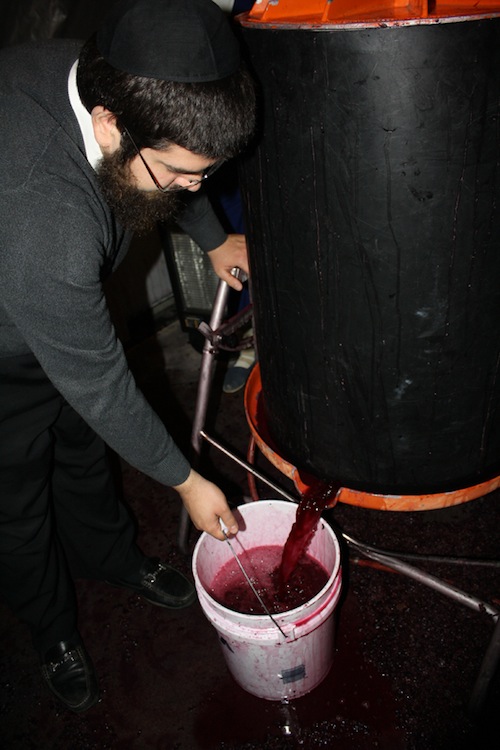
photo - Pressing of the wine post fermentation.
Pressing of the wine post fermentation. (photo from summerhill.bc.ca)

“The complication is that only the hands of Sabbath-observant Jews could touch the wine, equipment or any unsealed vessel containing the wine,” he said. “We had to make the wine away from our regular wine cellar, and without the trained hands of our regular team. But otherwise, it was the most simple and natural process: crush the grapes, allow the fermentation to happen … press the juice from the skins … age in barrels, blend the barrels … allow the solids to settle … rack the wine … and seal it in a bottle. Rabbi Shmuly or myself was there every single day except for Shabbos, checking the temperature of the room or performing some task. For such a simple process, the quality of the wine comes from the quality of the fruit, the careful handling, and creating the correct conditions for the fermentation and maturation.”

Tiferet was made with a relatively new “meritage” blend (merit/heritage), a delicate balance of Bordeaux-inspired grape varieties – merlot (60 percent), cabernet sauvignon (20 percent) and cabernet franc (20 percent) – cultivated in the semi-arid conditions of an Osoyoos organic vineyard and then brought to Summerhill to be turned into something that sounds much more than a run-of-the-mill premium wine.

“Making [Tiferet] with the rabbis changed its way,” Cipes said, trying his best to explain his sense that something else was at work during the creation of Tiferet. “In a way, the wine made itself, there was some magic that happened there. It’s hard to put my finger on it … a certain element of magic happened naturally that wouldn’t have happened otherwise … it was the work of the elements, and of natural forces beyond our control. We can only take credit for partnering with these forces to create this incredible wine.”

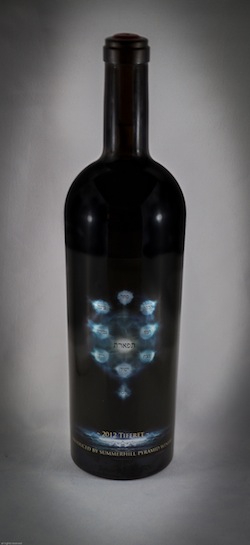
photo - Tiferet bottle
Only 1,200 bottles of Tiferet were made.

The description of Tiferet on Summerhill’s website diverts sharply from adjectives usually associated with wine flavor and aromas. Forgoing the more mundane “‘fruity” or “crisp,” Summerhill goes out on a metaphorical limb declaring, “Tiferet has the aroma of baby’s breath and the flavor of mother’s milk.” (If you’re wondering, as did I, the reference is not to genus Gypsophila, most commonly found in English country gardens!)

On the telephone, Cipes struggled to articulate the sensory sensations evoked by this wine. “It has a sweet milkiness … an unusual flavor, a sweet dairy note that doesn’t linger for long … it’s almost an effervescence. The texture is … full- bodied, soft and kind of silky in your mouth, elegant, fresh, fruity. There’s an added complexity to the wine,” before returning to the rather odd-sounding, “It’s like baby’s breath.” Tiferet wine, Cipes concluded, is for a drinker who “want[s] to have an experience of beauty.” With my request for a sample politely but firmly declined, and a price tag sadly out of reach, I’ll just have to take his word for it.

But, wait. What about the promise for more about that huge, looming pyramid, rivaling only the great pyramids of Egypt for alignment and precision? And the new-age-sounding Peace Garden? You’ll have to visit the winery in person to learn more – and, while you’re there, could you bring me back a bottle of that magic?

Nicole Nozick is a Vancouver-based freelance writer and communications specialist.

(Tiferet, $100 per 750-millilitre bottle, is available only through the winery: summerhill.bc.ca/product/2012-tiferet.)

Format ImagePosted on April 25, 2014April 27, 2014Author Nicole NozickCategories LocalTags kosher wine, Lakeshore Wine Route, mevushal, Okanagan, Shmuly Hecht, Stephen Cipes, Summerhill Pyramid Winery, Tiferet, Tourism Kelowna
Proudly powered by WordPress