
Skip to content
  • Home
  • Subscribe / donate
  • Events calendar
  • News
    • Local
    • National
    • Israel
    • World
    • עניין בחדשות
      A roundup of news in Canada and further afield, in Hebrew.
  • Opinion
    • From the JI
    • Op-Ed
  • Arts & Culture
    • Performing Arts
    • Music
    • Books
    • Visual Arts
    • TV & Film
  • Life
    • Celebrating the Holidays
    • Travel
    • The Daily Snooze
      Cartoons by Jacob Samuel
    • Mystery Photo
      Help the JI and JMABC fill in the gaps in our archives.
  • Community Links
    • Organizations, Etc.
    • Other News Sources & Blogs
    • Business Directory
  • FAQ
  • JI Chai Celebration
  • JI@88! video

Recent Posts

  • Last hostage home
  • New bill targets hate crimes
  • Concerning actions
  • Recipes not always required
  • Survivor urges vigilance
  • Seniors profoundly affected
  • Farm transforms lives
  • Musical legacy re-found
  • A range of Jewish literature
  • A concert of premieres
  • Variety telethon on Feb. 22
  • Victoria club’s many benefits
  • Avodah dedicated to helping
  • Artists explore, soar, create
  • Life’s full range of emotions
  • Community needs survey closes March 29
  • Jerusalem marathon soon
  • Historic contribution
  • Chronicle of a community
  • Late-in-life cartoonist
  • Cashflow vs growth portfolio
  • My new best friend is Red
  • ישראלים רבים ממשיכים לתמוך בטראמפ ועדיין אינם מבינים במי מדובר
  • עשרים ואחת שנים בוונקובר
  • Supporting the Iranian people
  • The power of photography
  • A good place to start
  • When boundaries have shifted
  • Guitar virtuosos play
  • Different concepts of home
  • Broadway’s Jewish storylines
  • Sesame’s breadth and depth
  • Dylan Akira Adler part of JFL festival
  • Mortality learning series
  • A new strategy to brighten up BC
  • Sharing latkes and light

Archives

Follow @JewishIndie
image - The CJN - Visit Us Banner - 300x600 - 101625

Tag: Canadian Jews

A good place to start

A massive 94% of Canadian Jews support the right of Israel to exist as a Jewish  state. However, according to University of Toronto sociologist Robert Brym, who conducted the survey of 600 respondents, only 51% of those call themselves “Zionists.”

In the National Post this month, Brym took aim at those he says have weaponized his work, including the group Independent Jewish Voices and Avi Lewis, who is running for the leadership of the federal New Democratic Party. Lewis and IJV have claimed, based on an apparent deliberate misreading of Brym’s study, that 49% of Canadian Jews are not Zionists.

Brym calls that “gaslighting.”

When asked “Do you support the right of Israel to exist as a Jewish state?” 94% of respondents answered “yes” – in a word, they are Zionist. However, in another question, about how they personally identified, 51% of Jewish Canadians affirm they are Zionist, 15% “express ambivalence” about referring to themselves as Zionist, 7% say they “don’t know” and 27% say they are not Zionist. Just 1% describe themselves as “anti-Zionist.”

Intellectually honest politicians and organizations should not engage in misrepresenting Jewish Canadians’ actual views and the diminishment of their overwhelming emotional, spiritual, familial and other connections to Israel and its right to exist.

Here is something we should be pondering: How has a word and an idea that reflects the manifestation of Jewish self-determination, freedom, actualization and civilizational achievement become so sullied that almost half of Jews hesitate or refuse to identify with it? 

In some ways, it is understandable. Before Israel became a state in 1948, Zionism as a contemporary political movement was the outgrowth of Theodor Herzl’s late-19th-century idea of a separate Jewish homeland. Since 1948, and the existence of Israel as a nation-state, the term Zionism has been associated with a tangible country, with a military, a government, and the flaws and foibles that accompany all nation-states. Zionism has come to mean, in some eyes, a vast range of concepts, including actions, good or bad (but, for the purposes of Lewis and groups like IJV, almost always bad), of the government of Israel.

This contradiction between the strict meaning of the term as it is defined in the political sphere and the broad application of it by bad actors is part of the reason many Jews are hesitant to adopt the descriptor “Zionist.” Jews themselves may have limited knowledge around other forms and visions of Zionism that have existed, making it difficult for the average Jew to engage in a discussion that contextualizes modern-day Zionism and the fuller arc of Jewish history.

Given  the challenges and anxieties around being Jewish in Canada (and everywhere else in the world) right now, perhaps it is unwise to criticize the hesitancy of half of Canadian Jews to self-identify with an unpopular term. This is especially the case when faced with nefarious discourses that align Zionism with racism, white supremacy and Naziism, and a lack of knowledge of how to respond to those charges. 

This survey’s misuse seems like a line in the sand, though.

The defilement of the term “Zionist” to mean things it doesn’t mean is part of a larger trend to score political victories by moving goalposts and using language to obscure truth.

Generally, the anti-Israel narrative is founded on a sort of postmodern rejection of objective definitions and terminology. Terms like “apartheid,” “settler-colonialism,” “ethnic cleansing” and “genocide” are redefined to encompass whatever those who weaponize the terms want them to mean.

When Jews, in the form of the Jewish state, are accused of genocide, a term that had to be invented to describe the Jewish experience of mass death, it makes arguing over the adoption of the label “Zionist” seem petty. But, if there is no consensus on something so foundational to the way many Jews define ourselves and our values, we put ourselves at a disadvantage in combating an abuse of language that reduces the human dignity of the Jewish people and, worse, can have literal life-and-death consequences.

If we are going to reverse this trajectory, which threatens not just Jews but truth itself, we need to contest the manipulation of language. By proudly reclaiming the term “Zionist,” which, apparently, 94% of Canadian Jews are but either don’t know it or won’t admit it, perhaps we can build some of the resilience and strength needed to combat the fight against more destructive and deceitful redefinitions of terms.

If we are going to defend the definition of the words we use to discuss the most vital issues of our time, “Zionism” seems like a good place to start. 
Format ImagePosted on January 23, 2026January 21, 2026Author The Editorial BoardCategories From the JITags Canadian Jews, language, Robert Brym, sociology, Zionism

Surveying Canadian Jews

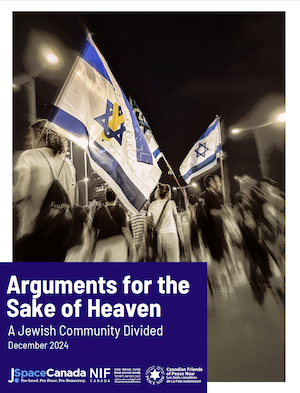
“Canada’s Jewish community is divided over Israeli and domestic Canadian politics, even though rising antisemitism and war seem to have increased the emotional attachment of Canada’s Jews to Israel,” writes sociologist Robert Brym in the executive summary of Arguments for the Sake of Heaven: A Jewish Community Divided. The report imparts the results of a poll sponsored by the New Israel Fund of Canada, JSpaceCanada, and Canadian Friends of Peace Now.

From Aug. 28 to Sept. 16, 2024, the polling firm Leger surveyed 588 Canadian Jews. The sample “was drawn from a large online panel of Canadian adults. It was weighted by characteristics of the Canadian Jewish population based on the 2021 Census of Canada and the 2018 Survey of Jews in Canada,” which was prepared by Brym, Keith Neuman and Rhonda Lenton for the Environics Institute, University of Toronto, and York University. The composition of the sample “is believed to be broadly representative of Canadian Jewry.”

“We undertook this survey in response to conservative establishment Jewish institutions and anti-Zionist Jewish groups co-creating a polarized, black-and-white public debate that didn’t reflect the diverse, nuanced Jewish community we know and love,” write Maytal Kowalski, JSpaceCanada executive director, Gabriella Goliger, national chair of Canadian Friends of Peace Now, and Ben Murane, executive director of NIF Canada, in the introduction to the report, which was released last month.

“Our research confirms that there is no such thing as ‘the Jewish community’s opinion’ as a monolith, nor can any segment of the community (or any institution) claim to speak for all others. In many cases, we see no majority opinion as well as high levels of uncertainty. Therefore, not only are claims of monolithic support misrepresentations of Canadian Jewish diversity, they also erase the spirited nature of Jewish life in Canada.”

image - Arguments for the Sake of Heaven coverExplaining the report’s title, they note: “One of the noblest ideals in Judaism is ‘arguments for the sake of heaven’ – that disagreement and debate are in fact coveted and celebrated as long as the disagreement is ‘for the sake of heaven,’ meaning an argument that seeks to uncover truth.”

They call upon “Jewish communal leaders to uphold and support the variety of opinions and ideas held by Canadian Jews – and to foster arguments for the sake of heaven,” and warn that “Canadian political leaders must engage all of Canada’s Jewish communities and not stereotype us based on a false monolith.”

Brym lists the poll’s highlights, which include that “Canadian Jews express stronger emotional attachment to Israel than in four previous surveys dating back to 2018. Specifically, 84% of Canada’s Jews say they are ‘very’ or ‘somewhat’ emotionally attached to Israel [compared to 79% in 2018]. Ninety-four percent support the existence of Israel as a Jewish state.”

Brym notes, “Just 3% say Israel lacks that right, while another 3% say they don’t know or don’t answer the question. Belief in Israel’s right to exist does not vary significantly by gender, educational attainment, income or denomination. It does vary significantly by age and political party support. Ninety-eight percent of those over the age of 34 say Israel has the right to exist as a Jewish state, compared to 81% of those under the age of 35. Ninety-seven percent of Conservative and Liberal party supporters say that Israel has the right to exist as a Jewish state. Some 79% of NDP supporters concur, although the number of NDP supporters in the sample is too small to provide a highly reliable estimate.”

When asked “Do you consider yourself a Zionist?” however, 51% of respondents said yes, 15% claimed ambivalence, 27% said no and 7% said they didn’t know, or didn’t answer the question.

“Given their strong emotional attachment to Israel and their nearly universal belief that Israel has the right to exist as a Jewish state, one might be tempted to speculate that more Canadian Jews do not consider themselves Zionists because they confuse Zionism with certain policies of the Netanyahu government that they find objectionable,” writes Brym. “Future research needs to probe this issue.”

When asked whether continued building of Jewish settlements in the West Bank helped, harmed or didn’t make a difference to the security of Israel, 34% of respondents said it hurts Israel’s security while 27% said it helps, 22% thought it made no difference and 18% didn’t know or didn’t answer.

Half of respondents favoured a two-state solution, while 25% wanted an Israeli state (the annexation of West Bank and Gaza), while 8% believe that “the best resolution to the conflict is a single, secular, binational state that favours equal rights for Jews and Palestinians.”

“When asked whether Canadian politicians should increase pressure on Israel and the Palestinians to engage in a meaningful peace process, 55% of Canadian Jews agree and 23% disagree,” summarizes Brym. “When asked whether politicians should sanction Jewish West Bank settlers who engage in acts of vigilante violence against Palestinian civilians, 35% of Canadian Jews agree and 41% disagree. When asked whether politicians should recognize a Palestinian state in the near future, 21% of Canadian Jews agree and 53% disagree. When asked whether Canadian politicians should impose an embargo on the arms trade with Israel, 69% of Canadian Jews say no and 10% say yes.”

The survey also asked respondents to rank, in view of an upcoming federal election, their priorities among 11 different issues. From most to least important were cost of living, antisemitism, health care, housing, Israel-Palestine conflict, climate change and environment, crime and public safety, immigration, threats posed by China and Russia, discrimination against Indigenous people, and Islamophobia.

The question was asked, “Which political party did you vote for in the last (2021) federal election?” and also “If a Canadian federal election were held tomorrow, which party, if any, would you vote for?”

“Among decided voters, support for the New Democratic Party remained steady at about 9% between 2021 and 2024,” writes Brym. “Support for the Liberal party fell from 39% to 26%. And support for the Conservative party increased from 36% to 55%. These trends are similar to those in the general population, but the decline in Liberal support and increase in Conservative support is more pronounced among Jews.”

The whole report can be found at jspacecanada.ca/arguments_sake_of_heaven. It includes much more data – including more analysis of responses according to age, gender, level of education, household income, denominational identification and political party support – as well as commentary and recommendations from the survey’s three sponsoring organizations. 

Posted on January 17, 2025January 14, 2025Author Cynthia RamsayCategories NationalTags Canada, Canadian Friends of Peace Now, Canadian Jews, government policy, Israel, JSpaceCanada, Judaism, New Israel Fund of Canada, opinion polls, politics
Proudly powered by WordPress