Skip to content
  • Home
  • Subscribe / donate
  • Events calendar
  • News
    • Local
    • National
    • Israel
    • World
    • עניין בחדשות
      A roundup of news in Canada and further afield, in Hebrew.
  • Opinion
    • From the JI
    • Op-Ed
  • Arts & Culture
    • Performing Arts
    • Music
    • Books
    • Visual Arts
    • TV & Film
  • Life
    • Celebrating the Holidays
    • Travel
    • The Daily Snooze
      Cartoons by Jacob Samuel
    • Mystery Photo
      Help the JI and JMABC fill in the gaps in our archives.
  • Community Links
    • Organizations, Etc.
    • Other News Sources & Blogs
    • Business Directory
  • FAQ
  • JI Chai Celebration
  • JI@88! video

Recent Posts

  • Sharing her testimony
  • Fall fight takes leap forward
  • The balancing of rights
  • Multiple Tony n’ Tina roles
  • Stories of trauma, resilience
  • Celebrate our culture
  • A responsibility to help
  • What wellness means at JCC
  • Together in mourning
  • Downhill after Trump?
  • Birth control even easier now
  • Eco-Sisters mentorship
  • Unexpected discoveries
  • Study’s results hopeful
  • Bad behaviour affects us all
  • Thankful for the police
  • UBC needs a wake-up call
  • Recalling a shining star
  • Sleep well …
  • BGU fosters startup culture
  • Photography and glass
  • Is it the end of an era?
  • Taking life a step at a time
  • Nakba exhibit biased
  • Film festival starts next week
  • Musical with heart and soul
  • Rabbi marks 13 years
  • Keeper of VTT’s history
  • Gala fêtes Infeld’s 20th
  • Building JWest together
  • Challah Mom comes to Vancouver
  • What to do about media bias
  • Education offers hope
  • Remembrance – a moral act
  • What makes us human
  • המלחמות של נתניהו וטראמפ

Archives

Follow @JewishIndie
image - The CJN - Visit Us Banner - 300x600 - 101625

Tag: health

Mastering menopause

Michelle Biton has released a new book. Written in the same style as The Instant Anxiety Solution: 5 Simple Steps to Quiet the Mind & Achieve Calm, her recently released The Menopause Weight Loss Solution: A Woman’s Guide to Menopause Without Pounds offers six steps to help women live their best lives during menopause. Both books are published by Hatherleigh Press Ltd.

The mnemonic device that anchors this book is SHRINK. After an introductory chapter about what menopause is, some of its symptoms, the role of cortisol (“the body’s primary stress hormone”) and a couple of other topics, each section explores one of the letters. So, chapters 2 through 7 are (italics added): Stimulate Your Metabolism; Harness the Power of Your Vagus Nerve; Reinforce the Eight Nutritional Strategies; Incorporate Daily Pelvic Floor and Core Exercises; Nurture Mindfulness and Mindful Eating; and Know Your Female Powers with Confidence.

“Menopause is a natural process,” writes Biton. “You officially hit menopause when you do not get your period for 12 consecutive months. The ovaries stop making estrogen and progesterone and the period disappears. It signifies the end of the reproductive years and the beginning of the wise ‘goddess’ years.

“But that is the easy version. Menopause, or pre-menopause, can feel like a rollercoaster ride of hormones or a symphony of fireworks.”

Pre-menopause, or perimenopause, can start in one’s 30s or 40s and last up to 10 years, writes Biton. “At least 80% of women will experience menopausal symptoms of varying degrees and severity.” And there are many symptoms or changes, including but not at all limited to: slower metabolism, poor memory or brain fog, weight gain around the middle, thinning hair, increased irritability and moodiness, night sweats, increased sadness, diminished sex drive and itchy skin.

image - The Menopause Weight Loss Solution book coverWeight gain during menopause apparently affects 65-70% of women, who gain an average of five to 10 pounds. One reason for this is that “women’s ability to burn calories gets cut by 30% or more,” says Biton. “By the time she reaches middle age, she will have to work almost twice as hard to burn the same amount of calories as she did in her 20s.”

Biton recommends many different types of exercise to build muscle and kickstart one’s metabolism. “Simple things like lifting your body weight against gravity does the job perfectly,” she writes. “You can do them anywhere; they are easy to do and very effective. This includes exercises like push-ups, triceps dips, lunges and squats.” She gives a description of how to do lunges and planks, and talks about things like ideal intensity levels: “Regular physical activity [like walking], versus doing one intense workout on the weekend, will be more beneficial at increasing your metabolism long-term.” She notes that adding protein to every meal can help boost metabolism, as can eating the “right kind of fat,” such as omega-3 and omega-6.

A moderate approach to exercise and eating is, not surprisingly, the recommended approach and she dedicates Chapter 4 to nutritional strategies. Chapter 5 is about ways to increase core strength (“namely, your corset and girdle muscles”), to combat weight gain around the midsection, and exercises to strengthen the pelvic floor muscles to keep incontinence at bay.

The chapter on the vagus nerve – the “key” to activating the parasympathetic nervous system (PSNS), which helps us “calm down, handle stress better, regulate your mood and feel more relaxed, connected and compassionate” – takes a lot from Biton’s previous book on dealing with anxiety. (See jewishindependent.ca/ways-to-tackle-anxiety.)

“During menopause, it is common to feel stressed and overwhelmed, not to mention disconnected, irritable, worried, anxious, depressed and questioning a lot of things in life,” she writes.

She advises: “If you’re having a hard time regulating your emotions, feeling overwhelmed or overly emotional, it’s a good idea to activate your PSNS right away.” And she offers many ways to do that, from splashing cold water on your face, to running on the spot as long as you can, to deep breathing, to immersing yourself in nature, and more.

The chapter on mindfulness focuses on differentiating between physical and emotional hunger. The former “begins in the stomach” and is “a physiological need,” while the latter is “when you eat in response to feelings…. Emotional foods tend to be high in carbohydrates, as they allow more L-tryptophan, a mood-regulating amino acid, to enter the brain. Carbohydrates (and sugar) help the body to make serotonin, the ‘feel-good’ neurotransmitter, so it makes sense why emotional eaters tend to consume foods that give them a ‘sugar high.’” Biton suggests practices like mindful eating (slowing down, chewing your food well); trying “to eat out of physical hunger 95% of the time,” while allowing yourself occasional treats; and, again, adding protein to meals “to feel full for longer.”

The last chapter of The Menopause Weight Loss Solution is about retraining our minds to think more positively and reduce negative thoughts about ourselves. It also tackles perhaps sensitive topics like changes to the vagina, body odor, breast tenderness, skin and more that happen during menopause.

There’s nothing revolutionary or in-depth in this book, but rather it provides an overview and the basics of what a woman can do to understand and get through menopause more easily.

Biton has a master’s in holistic nutrition, a bachelor’s in psychology, and a certificate in kinesiology and fitness studies. She is a former Vancouverite who now lives in Los Angeles. For more information, visit michellebiton.com. 
Posted on May 9, 2025May 8, 2025Author Cynthia RamsayCategories BooksTags health, menopause, Michelle Biton, women
Healing from trauma of Oct. 7

Healing from trauma of Oct. 7

Healing Space has treated more than 20,000 people since it began in response to the trauma caused by the Oct. 7 terror attacks and the ensuing war. (photo from Healing Space)

“It’s important to talk about it because there are still hostages who have been living Oct. 7 every day for over a year-and-a-half. It’s important to talk about it because antisemitism around the world is growing stronger, and there are people who deny or justify the horrors we went through that day. This is not a political matter – it’s a matter of humanity. It’s about human lives,” Raz Shifer, a survivor of Hamas’s horrific terror attack on the Nova music festival, told the Independent.

Shifer, who lives in Giv’atayim, Israel, will be joining Vancouver’s community Yom Hazikaron ceremony on April 29 and Yom Ha’atzmaut celebration on April 30. Another Nova survivor, Inbal Binder, from Petah Tikva, will be coming here as well, and she and Shifer will, among other activities, participate in the events, visit several local Jewish schools and address Federation’s Regional Communities Conference.

Also coming to Vancouver is Dr. Ilana Kwartin, chief executive officer of Healing Space Rishpon, where both Shifer and Binder have participated in workshops and treatments. She has some meetings lined up, but the Israel-related events are the main purpose of the visit.

“In addition, I’m happy to meet people one-on-one or book speaking engagements for groups, communities and teams, where we can share the story of our work and, through that, the story of Israel at this time,” she said.

Healing Space Rishpon was created by Dr. Lia Naor in response to the trauma caused by the Oct. 7 attacks and the ensuing war. With Ra’anan Shaked, therapists and volunteers, Naor set up a centre at Ronit Farm in Sharon that operated for just over a month. With Patrizio Paoletti and Rani Oren, a permanent base was then established in Rishpon. Since Healing Space began, more than 140 therapists have given almost 60,000 hours to treating more than 20,000 people in 16 trauma-healing modalities. 

Kwartin became CEO right after Oct. 7. She and her family live in Eliav, a yishuv she helped found, which is in the northern Negev, abutting the separation barrier.

“The Black Shabbat of Oct. 7 upended my life, like it did for so many others, and as we – individuals, families, communities and a nation – mourn, work to pick up the pieces, mend what can be repaired and rebuild where it cannot, I put my personal and professional background to use as the CEO of this one-of-a-kind haven,” she told the Independent.

photo - Dr. Ilana Kwartin, chief executive officer of Healing Space Rishpon, is coming to Vancouver with Nova music festival survivors Raz Shifer and Inbal Binder for Yom Hazikaron and Yom Ha’atzmaut
Dr. Ilana Kwartin, chief executive officer of Healing Space Rishpon, is coming to Vancouver with Nova music festival survivors Raz Shifer and Inbal Binder for Yom Hazikaron and Yom Ha’atzmaut. (photo from Healing Space Rishpon)

Kwartin was born in the former Soviet Union and made aliyah in 1987, growing up in Jerusalem. “As an officer in the IDF, I served as a tatzpitanit [spotter] in Nachal Oz and later as a founding commander of the Netzarim observation post, and the tragedy of the tatzpitaniyot struck me deeply,” she said, referring to the female military unit that warned of a potential terrorist attack and whose soldiers were among the first killed and kidnapped on Oct. 7.

With BAs in law and psychology from Hebrew University of Jerusalem, Kwartin earned an MA in conflict resolution from Ben-Gurion University of the Negev. Her book, Imprisoned, came from her PhD dissertation on honour-based confinement, which she did at Bar-Ilan University. The stories have inspired activist initiatives across Israel and informed legislation, she said.

Kwartin lectured in law at Sapir College, where she built their legal internship placement program and founded a centre of legal activism, A House of their Own. “More recently,” she said, “I spent three years on shlichut in Los Angeles as the director of Jewish Agency operations on the West Coast. With the outbreak of war in Ukraine, I traveled to the Ukrainian border to help rescue Jewish refugees and bring them to Israel.”

Kwartin’s work at Healing Space Rishpon changes every day. “The programs are so varied and cover many groups of the Israeli population,” she said. “But the most meaningful part is the people who work here – very similar to me, they left everything they were doing and started working at Healing Space to repair the emotional damage we all see around us. They work tirelessly, in uncertain conditions, long hours, doing the hardest work imaginable. It is thanks to the team that Healing Space makes such a big difference in people’s lives.”

Binder found out about Healing Space inadvertently.

“I had heard there was a treatment centre you could go to, but I wasn’t in a mental state that allowed me to reach out for it,” she explained. 

“Later on, I was looking for something that could get me out of the house in the mornings and help create a daily routine. By chance, I came across an ad for a new rehabilitative employment program at Healing Space and it sounded amazing – working with my hands, being in a warm and supportive environment, where I could focus on myself and begin a new movement in my life.”

Binder worked as a beautician before Oct. 7 and, while not currently working, she is taking courses, most recently completing one in conscious psychotherapy. She started going to Healing Space early in the war. It “was the first time I realized that another way was possible – that someone was truly listening to me,” she said.

“More than that, I got to experience treatments I never imagined I’d try, like sound healing and yoga therapy. These are treatments I still do to this day, to help maintain my emotional balance and regulate my body.”

At Healing Space, she added, “Even my mom, who was never really drawn to holistic healing, found a deep connection with one of the therapists and opened her heart to her – that really moved me.”

photo - Group gathered outside at Healing Space Rishpon
A group gathered outside at Healing Space Rishpon. (photo from Healing Space)

From a place of not wanting to do anything or face anything, Binder said, “I now want to grow. I want to move forward and live a good life. And none of this would have happened without the process I went through over the past six months.”

Binder’s Vancouver visit will be the first time she is telling her story publicly. 

“Honestly,” she said, “it’s a little overwhelming to come and talk about my healing journey. It also means recognizing my story – and that alone is a challenge for me. I feel both excited and nervous – telling my story for the first time and receiving acknowledgment for it.

“It’s important for people to hear about the massacre because it was a Holocaust repeating itself,” she said. “The Jewish people are once again in danger, and it’s crucial to echo these stories, to make sure people know and remember.

“Beyond that, the connection between Jews in Vancouver and Jews in Israel – to build strong, deep connections across Jewish communities around the world – that connection is what has always kept us strong as a people.”

Binder attended the Nova festival with her sisters.

“It was actually the first evening that my sister’s boyfriend was introduced to our parents,” she said. “From there, the four of us drove to the party in the south.

“In the morning, when the rockets started, I called my mom to let her know and said we were heading home. We got delayed near the party because one of our friends had a panic attack, and we waited with her.

“We made it to the car, but it took time to decide what to do. At 8:30 a.m., the boyfriend took the lead, called his father, picked us up in the car, and we escaped through the fields. His father navigated him over the phone throughout the whole drive, and that’s how we managed to get out safely. Which is crazy in itself – the reality was so different for so many others. It felt like we were in a divine bubble that protected us.”

“It was the scariest day of my life,” said Shifer of Oct. 7. “I didn’t know if I would make it back home or not, and I didn’t know which of my friends would survive. It was a feeling of helplessness, complete loss of control and sheer terror.”

Unlike Binder, who is only now beginning to share her story, Shifer – who is an actor, singer and artist – has been interviewed by media around the world and has spoken at schools, universities and synagogues.

“I also found myself advocating and telling our story through music during performances,” she said. “In addition, I led tours for people who came to the Nova site and shared my personal story with them.”

Initially, Shifer refused to leave her house after Oct. 7.

“Friends told me there was a place where survivors go to heal, but I was too afraid to go outside and couldn’t bring myself to get there,” she said. “Then, one day, a volunteer came to my home and helped me take that first step – to leave the house and arrive at Healing Space. From that day on, something opened up in me, and I began coming every week.”

Healing Space has helped Shifer cope with her trauma in many ways.

“First of all, the location,” she said. “You arrive at a place full of trees and greenery – everything is peaceful and calming.

“There’s something comforting about sitting among people who have been through something similar to me,” she continued. “The therapists at the centre are kind and embracing. The shared music circles helped me find my way back to music. But, more than anything, it’s the feeling that I’m not alone. That I am seen. That there’s a place that can hold me.”

photo - People at Healing Space Rishpon have had similar experiences
People at Healing Space Rishpon have had similar experiences. (photo from Healing Space)

The body treatments have allowed Shifer to release some stress and start letting down her defences.

“The long-term project I joined under Healing Space gave me the tools to return to a routine and become an active human being again,” she said. “Healing Space is a deeply meaningful part of my recovery process – and I honestly don’t know what I would have done without them.”

To register to attend Yom Hazikaron or buy tickets ($18) for Yom Ha’atzmaut, visit jewishvancouver.com. 

Format ImagePosted on April 11, 2025April 10, 2025Author Cynthia RamsayCategories LocalTags healing, Healing Space Rishpon, health, Inbal Binder, Israel, Jewish Federation of Greater Vancouver, Nova music festival, Oct. 7, Raz Shifer, trauma, Yom Ha'atzmaut, Yom Hazikaron
Determined to help others 

Determined to help others 

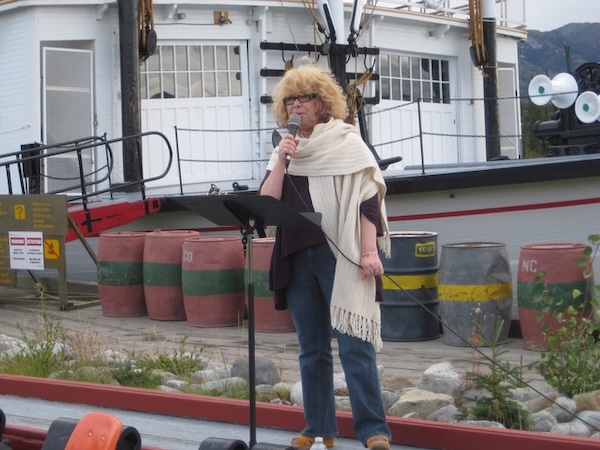
Photos from the book include Joy Karp speaking to a group of people at a Terry Fox Run in Whitehorse. (photo from Rick Karp)

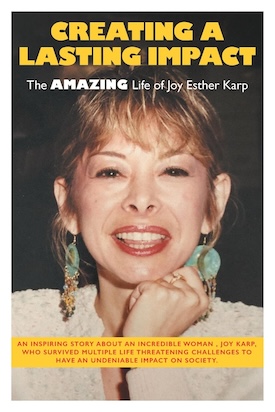
Creating a Lasting Impact: The Amazing Life of Joy Esther Karp was recently published.

Written by Rick Karp, who was married to Joy for 49 years – many of them spent in the Yukon – the account tells of her determination to make a difference and how she made numerous contributions to society, while having to overcome life-threatening issues every few years.

Joy Karp died in 2017.

image - Creating a Lasting Impact book cover“I promised Joy a few weeks before she passed that I would ‘tell her story,’ and that is what I have done. People need to know who she was, what she accomplished throughout her life, how caring and supportive she was for others,” Rick Karp told the Independent. 

Two of the setbacks Joy Karp faced were a heart attack, after giving birth to twins in her early 20s, and a car accident, in which she was thrown from the vehicle onto a frozen Lake Ontario, smashing the bones in her left foot; she had to wear specially made shoes thereafter.

In 1986, the Karps moved from Ottawa to Whitehorse, where they brought the first McDonald’s to the North and were deeply involved in the economic, social and cultural fabric of the Yukon. But this didn’t protect the couple from life’s vicissitudes. 

Joy was kidnapped in 1992 and buried in her car for close to 17 hours.  The kidnappers shackled her wrists and ankles, blindfolded her, put a bag over her head and left her there without needed medication, despite knowing she had heart issues.

“After the kidnapping, Joy suffered horribly for years from PTSD and, a couple of years later, her heart gave out and she had to have a quadruple bypass operation,” Rick Karp said.

In addition, Joy’s foot was severely damaged after the kidnapping, and doctors considered amputation. The Karps, though, demanded that the doctors pursue another course, which allowed her to keep her foot.

A few years later, Joy had her first case of cancer and required operations, chemotherapy and radiation. The cancer returned after several years and proved incurable.

“The doctors thought it was a heart issue and all that Joy needed was a pacemaker,” Karp said. “The X-rays that they did to determine the positioning of the pacemaker showed that the issue was a cancerous growth that had developed in her right lung and had reached out and attached to her heart. 

photo - Rick Karp’s book about his wife, Joy, was recently released
Rick Karp’s book about his wife, Joy, was recently released. (photo from Rick Karp)

“They said that it was inoperable and that Joy only had about three months left, but she survived for close to 11 months.”

Despite all these adversities, Joy had an innate ability to understand and see the potential in others, to learn what they needed, and then make things happen for them, said Karp. People were always drawn to her, he said.

“This was one of the amazing things about Joy. She thought of others. She was a great listener. As a student, she helped her fellow students with assignments, and she had the ability to resolve issues.”

One of Joy Karp’s legacies is the McDonald’s Hands-On Business Training Program. The story begins in Ontario in the 1970s, with a job she had helping an owner-operator grow to five stores, and managing the head office. Confronted with a high turnover rate in some towns, the owner approached Joy for a solution. 

She created a training program in 1978 and implemented it at local McDonald’s restaurants. By the early 1980s, according to Karp, the program was used throughout the fast-food chain.

“This is a three-year program that takes employees, or others that apply, through training and development that solidifies their knowledge of all of the stations in McDonald’s, training in customer service, and all aspects of how the restaurant operates,” he said.

“Then, to the right people, the program offers the chance to rise from crew person to crew trainer, to swing manager, to assistant manager and to manager – it offers career opportunities. Also, embedded in the program is the concept of ‘promote from within,’ which has been adopted by businesses, well, everywhere.”

Among other accomplishments, Joy organized service and customer satisfaction workshops for the Whitehorse Chamber of Commerce when the city played host to the Canada Winter Games in 2007. Her efforts, Karp said, were recognized by the event’s organizers.

Additionally, she played a key role in bringing the Special Olympics to Whitehorse, helped arrange for an outdoor play area and training computers at the Yukon Child Development Centre, and was pivotal in obtaining funding to make the Yukon Arts Centre wheelchair accessible. In 2013, she wrote The Power of Service: Service Through the Eyes of Customers, a book that emphasizes the importance for businesses to develop relationships and trust with those they serve.

Creating a Lasting Impact can be purchased on the Bookstore page at rwkarp.ca. A signed copy can be ordered by emailing Karp at [email protected]. 

Sam Margolis has written for the Globe and Mail, the National Post, UPI and MSNBC.

Format ImagePosted on March 14, 2025March 13, 2025Author Sam MargolisCategories BooksTags business, health, history, Joy Karp, McDonald's, memoir, Rick Karp, tikkun olam
Leaving a legacy of wellness

Leaving a legacy of wellness

Vancouver Talmud Torah students in the new Hildy Barnett Wellness Centre. (photo from VTT)

“It was a dream that came true,” said Jeffrey Barnett of the new Hildy Barnett Wellness Centre at Vancouver Talmud Torah.

The centre, named in honour of his late wife, was dedicated last November.

“As a graduate of Vancouver Talmud Torah and as a teacher of over 30 years, and also being a child psychologist, she knew the value of supporting kids in a Jewish environment,” said Barnett of Hildy, who died April 25, 2024. She and Jeffrey were married 47 years; they have two children and four grandchildren.

Hildy Barnett specialized in education for children with special needs. She worked with the Vancouver School Board for three decades and, after retiring, continued to work with children and teens in various capacities. She volunteered at Canuck Place and with the Jewish Community Centre of Greater Vancouver, among other things. She helped start Jewish Family Services Vancouver’s Innovators Lunch, with friends Naomi Gropper Steiner, z”l, and Kristina Berman.

Shortly before Hildy Barnett passed away, she and Jeffrey made the decision to fund the wellness centre at VTT. Hildy had asked Shirley Barnett, who had a relationship, via her sons, with Shane Foxman, associate director of development at VTT, to inquire about legacy opportunities at the school. Foxman connected Shirley with Emily Greenberg, VTT head of school.

“When Shirley first told me about Hildy, I asked her to tell me a bit more about what she did, her passions, her career,” Greenberg told the Independent. “It became almost immediately clear that she should be part of realizing the vision for the wellness centre. As her health diminished rapidly, Shirley came to the school and I told her to film me speaking about my vision for the space, the children it would serve and the reason we needed to create such a space for our students. I knew what I wanted it to look like, but I wanted to paint that picture for her. I remember, when we stopped recording, I had goosebumps because I could feel how special this room was going to become.

“We hurriedly sent the recording over to Hildy’s daughter, Mira, to show her in her hospital bed,” continued Greenberg. “I remember Shirley got a text back from her within a few minutes. She said that it was exactly what she had hoped for. Hildy, unfortunately, passed away just a couple hours later, but I have always been so grateful that she knew about the wellness centre before she left this world. I think this has made this work even more sentimental. We really wanted to get every detail right.”

photo - Before she died last April, Hildy Barnett, with her husband Jeffrey, decided to fund the building of a wellness centre at Vancouver Talmud Torah, which has been named in her honour
Before she died last April, Hildy Barnett, with her husband Jeffrey, decided to fund the building of a wellness centre at Vancouver Talmud Torah, which has been named in her honour. (photo by Alexandre D. Legere)

A VTT newsletter leading up to the centre’s November dedication noted, “Approximately 20% of our students require some form of extra assistance to fully engage in the curriculum and to meet their full potential…. Over the last several years, we have completed a landscape study to understand best practices for supporting students with learning needs and have implemented several new layers of services to help create unique learning pathways.”

The study comprised a review of what many other schools are doing for student support services, said Greenberg. “There were many takeaways,” she said, “but one of them was that the spaces we create can really enable the programming and support we want to offer. The wellness centre has catapulted our counselors from being in a windowless, uninspiring, tiny office to in a centre that exudes safety, support, belonging and comfort.”

Over the past five years, VTT has gone from having a half-time counselor to two full-time counselors: Donna Cantor and Shakaed Greif. The two are both experienced counselors who are helping “to better support our students, parents and, sometimes, staff, as they navigate the many pressures and challenges of life, especially in a post-Oct. 7 world,” said Greenberg.

The counseling team “has been imperative in helping our many new Israeli students settle into life at VTT. They also run many support groups, including our Free to Be Me club, Chesed club and more,” she said.

The Hildy Barnett Wellness Centre allows Cantor and Greif to have their own offices, as well as a shared space for working with small groups and families.

“When I look back, in a very quiet way, Hildy did what she loved and, having the facility at TT is the ultimate,” Jeffrey Barnett told the Independent. “It brought smiles to her face. She knew that she wasn’t going to be around. She knew that the legacy she was doing would benefit so many youngsters, including the fact that our own grandchildren would be at the school, and that not only this generation but future generations [would be helped]. And it made me feel good that she felt good. It’s still very sad, very touching, and we miss her a great amount.”

Barnett spoke of Hildy’s approach to education, which was based on the methods of the late Dr. Reuven Feuerstein, with whom Hildy Barnett had studied.

Feuerstein was a psychologist from Romania, who trained with the Russian psychologist Lev Vygotsky, explained Charlene Goldstein, who, with Hildy Barnett, years ago established with the Vancouver School Board a learning centre for speech language pathologists, teachers, counselors and others, which has since faded away. Goldstein is a registered psychologist in the neonatal follow-up program at BC Women’s Hospital and Health Centre; she also has a private practice.

“Reuven came to Israel right after the Holocaust and he began to work with children from the Holocaust, as he did with children from Ethiopia,” Goldstein told the Independent. “And what he saw was that these children only lived in the present, that they had limited memories of the past and very few [visions] of the future, and that was because, to protect them, their parents didn’t want them to know too much, plus they had a lot of losses. So, he had a group of volunteers together who would sit by the beds of these children, so if they had nightmares, they would calm them.

“Then, he began to notice that some people were saying that these children were incapable of learning, that type of thing,” she continued. “But what Reuven and Vygotsky believed in [is that] you can have direct learning, where, let’s say I’m a child and I’m looking at putting some blocks together and I figure it out and nobody has to tell me what to do. Or, you could have mediated learning, which is, someone is between the child and the activity helping them to learn what to do. 

“So Reuven, and I still do this now – when a child says to me, I can’t do this, I say, well, what do you already know here? What do you already recognize? What about this is new? And I start asking questions about things. So, what do you call this? Oh, my goodness, look at all of these things that you already know. Reuven would also say to teachers, think of the child, and his logo was ‘just a minute … let me think.’ Because he believed, as I do, that everybody has the potential to think, everyone has the potential to learn. We may not all learn everything the same, but we have potential to learn. And that everyone has potential to give back to society.”

Part of the funds raised by the Hadassah Bazaars – which Hildy’s mother, Marjorie Groberman, helped start here and in other places across Canada – were sent to Israel to support Feuerstein with his work, said Jeffrey Barnett.

Groberman, who was “Mrs. Hadassah-WIZO for many years,” had heard Feuerstein speak at a Hadassah convention, said Goldstein. He was brought to Vancouver by Hadassah-WIZO and Variety Clubs International, with which Jeffrey Barnett was involved, she said.

Feuerstein came back to Vancouver many times, said Goldstein. When here, he trained many educators, including those who worked with Indigenous children.

“Some of the children would think he was Santa Claus and would call him that because he had a long, white beard and his beret,” said Goldstein.

Among the people in Feuerstein’s sphere was Dr. Lorna Wanosts’a7 Williams, an expert in Indigenous language revitalization and education. Williams met Goldstein and Barnett in the mid-1980s, when she was hired by the Vancouver School Board as a specialist in First Nations education.

“I was looking at Reuven’s work because of his ideas around what happens with children when they get separated from the knowledge, from their parents,” Williams told the Independent. (People wanting to know more about this aspect of Williams’s work should watch the 1994 National Film Board of Canada documentary The Mind of a Child.)

Williams said Hildy Barnett was focused on “supporting all children to learn and enable them to overcome all their trauma. She just was so dedicated to that kind of work.” 

Barnett knew how to move things along, said Williams. “She was able to bring people together in such a beautiful way.”

She added, “I really honour her for all the help she gave me and that she gave many other people. She was very quiet but she was very strong.”

Goldstein, who knew Barnett from having grown up in the local Jewish community, before they connected more in Hadassah-WIZO and with Feuerstein’s work, echoed Williams’s observation.

“Hildy had the most gentle voice, she had a great sense of humour, but she had strong determination,” said Goldstein. “In Star Trek, there’s one person who says, ‘Make it so,’ and that’s what Hildy was like. She would say, ‘Make it so,’ and you just didn’t say no to Hildy because Hildy listened to everybody and had such compassion, such compassion.”

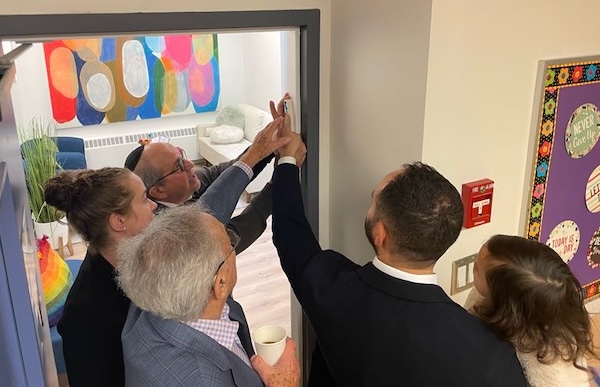
photo - Rabbi Philip Bregman, at back, and Jeffrey Barnett, middle, hang the mezuzah at the door of the Hildy Barnett Wellness Centre, along with Barnett’s daughter, Mira, and son, Joel, who is holding one of Barnett’s grandchildren, Blake
Rabbi Philip Bregman, at back, and Jeffrey Barnett, middle, hang the mezuzah at the door of the Hildy Barnett Wellness Centre, along with Barnett’s daughter, Mira, and son, Joel, who is holding one of Barnett’s grandchildren, Blake. (photo from VTT)

The Nov. 24, 2024, dedication ceremony of the Hildy Barnett Wellness Centre was originally envisioned as a small family gathering to honour Barnett’s legacy, said VTT’s Greenberg. “But, to our delight, she was so beloved in the community that many more people attended.

“I think it was an opportunity for many people to pay their respects to her powerful legacy of believing in children, and the Hildy Barnett Wellness Centre has become a healing place in so many ways, including for those who are grieving Hildy’s loss.” 

Format ImagePosted on February 28, 2025February 27, 2025Author Cynthia RamsayCategories LocalTags health, Hildy Barnett, Jeffrey Barnett, mental health, Vancouver Talmud Torah, VTT, wellness
Healing trauma possible

Healing trauma possible

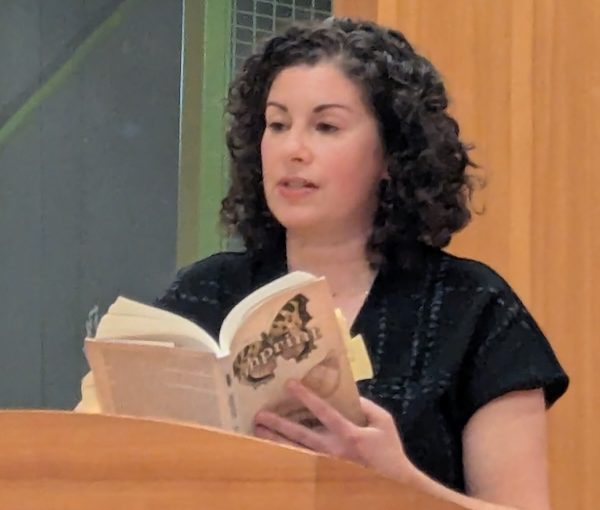
Claire Sicherman read from her book Imprint, about intergenerational trauma, at UBC Hillel on Jan. 21. (photo by Pat Johnson)

Understanding of intergenerational trauma has expanded in recent decades. Two granddaughters of Holocaust survivors discussed the larger phenomenon and their personal experiences recently at the University of British Columbia’s Hillel House, part of Hillel’s Holocaust Awareness Week. 

Claire Sicherman, author, workshop facilitator and trauma-informed somatic writing coach, shared her experiences and read from her book, Imprint: A Memoir of Trauma in the Third Generation, which was published in 2017. She was in conversation with Dr. Abby Wener Herlin, associate director of programs and community relations at the Vancouver Holocaust Education Centre, which co-sponsored the Jan. 21 event with Hillel BC.

Sicherman attributed to psychologist Dr. Arielle Schwartz the definition of intergenerational trauma as the ways in which the unresolved experiences of traumas, losses and griefs of one generation can become a legacy that is passed down to the next generation. 

“In other words,” said Sicherman, “the experiences of my grandparents are passed down through my parents to me.”

In addition to the “nurture” component of family legacies, there is the “nature” component of epigenetics, which Sicherman described as “the study of how genes turn on and off in response to environmental change.”

“I’ve heard it talked about like it’s sort of like light switches switching on and off in the body,” she explained. “Whatever switches switched on for my grandparents would then be switched on, passed down to my parent, passed down to me.” 

Experts in the field say it’s not a biological prison, Sicherman said. “They are actually malleable, so what you’re born with, you are not necessarily stuck with. We do have the ability to change certain things. There is hope in that.”

Growing up, Sicherman knew little or nothing about inherited trauma.

“When I started reading about it, I began to understand that what was going on with me wasn’t really my fault or that it wasn’t really something wrong with me,” she said. “It was just that I was carrying this huge thing.”

Reading excerpts from her book, Sicherman recounted being “disconnected from my body.” The inherited trauma manifested as a nervous system on overdrive and a tendency to hypervigilance. She was always ready to bolt out the door, looking for exit signs, aware of potential dangers, unable to fully rest, and prone to stress and anxiety.

She said that untold stories often pass more powerfully from generation to generation than stories that are recounted.

“When you think about that,” said Sicherman, “it’s what we don’t talk about that has more weight. It’s the silence. It’s the secrets.… That’s why it’s also important to me to speak out about these things, because it’s healing that goes across generations.”

Her survivor grandparents thought they were protecting their children through silence, Sicherman said. In response, the second generation learned not to ask questions.

There were other silences. In addition to the limited discussion around the Holocaust, Sicherman did not learn until well into her own adulthood that, when she was 4 years old, her grandfather had taken his own life, and not died of a heart attack, as she had been led to believe.

As someone who writes about and works with others on issues of healing intergenerational trauma, she urges people to embrace the totality of what they have inherited.

“Aside from trauma, what are the legacies that your ancestors bring to you?” she asked. “What are the gifts? What are the strengths? That’s also an important question to ask yourself, and a way of connecting with Jewish heritage. What are the strengths of your lineage? Is it survival? Is it tenacity? Is it humour? Is it creativity? Those are questions that you can ask yourself.”

Her son, Ben Sicherman, a UBC student, was present and also spoke of his family’s legacy of trauma. He described struggling with anxiety when he was younger and learning mechanisms for addressing issues through his parents’ modeling. He also spoke of carrying the legacy of his ancestors in ways like choosing 18 as his hockey number, not only because it represents chai, life, but because the numbers on his great-grandmother’s Auschwitz tattoo added up to the number 18.

Intergenerational trauma is a major component of her life’s work, said Sicherman.

“I do feel a sense of obligation, as a third generation,” she said. “But I also feel like this is part of my calling, too. It’s very meaningful. It’s an obligation that is not homework. It’s part of what I was set out to do.” 

Format ImagePosted on February 14, 2025February 13, 2025Author Pat JohnsonCategories LocalTags Claire Sicherman, health, Hillel House, Holocaust, Holocaust Awareness Week, Imprint, intergenerational trauma, mental health, second generation, survivors, third generation, trauma, VHEC
The many joys of connection

The many joys of connection

By fostering human connection, creativity and a love for the outdoors, Camp Hatikvah teaches children that true joy doesn’t come from likes or notifications – it comes from experiences shared with others. (photo from Camp Hatikvah)

In today’s fast-paced world, it can feel almost impossible to escape technology. Smartphones, tablets and social media have woven themselves into the fabric of daily life, often at the expense of face-to-face interaction and genuine connection. But, at Camp Hatikvah, campers are given the opportunity to disconnect from devices and reconnect with life’s simpler joys.

The camp has a no-technology policy for all its campers. This means that, for the entirety of their stay at camp, campers are completely unplugged so that they can engage with the world around them – through creativity, camaraderie and the kind of joy that is so often lost in the digital age.

For many of today’s youth, the idea of unplugging might seem daunting. Devices have become more than tools; they’re sources of entertainment, connection, and even identity. At Camp Hatikvah, however, the absence of screens doesn’t feel like a loss – campers quickly discover the delights of old-fashioned fun.

“It’s a precious gift to witness children simply at play,” said Liza Rozen-Delman, the camp’s executive director. “When they’re not tethered to screens, you see their imaginations come alive. They’re dancing, creating skits, and laughing in ways that feel so genuine. It’s the kind of joy you rarely see any more in the city.”

photo - Camp Hatikvah has a technology-free approach
Camp Hatikvah has a technology-free approach. (photo from Camp Hatikvah)

These moments of unstructured play do more than just fill the hours; they foster skills that are crucial for a child’s development. Imagination, problem-solving and cooperation flourish in an environment where kids are free to create their own fun. Campers learn to navigate group dynamics, work through challenges and take pride in shared accomplishments.

One of the most profound benefits of Camp Hatikvah’s technology-free policy is the way it nurtures genuine relationships. Without the distractions of social media, campers are fully present for one another. They form bonds over shared adventures, whether it’s paddling across the lake, tackling a team-building challenge, or simply sitting together under a star-filled sky.

The mental health challenges facing today’s youth are unprecedented. Studies have linked the overuse of technology to increased anxiety, depression and feelings of isolation. Camp Hatikvah offers a much-needed antidote: a space where kids can breathe, laugh and simply be themselves.

“Away from screens, there’s a noticeable shift in the kids,” said Eden Gutterman, associate director. “They start to relax. They’re more in tune with their surroundings and with each other. It’s like they’re rediscovering what it means to just be a kid.”

photo - Moments of unstructured play foster skills that are crucial for a child’s development
Moments of unstructured play foster skills that are crucial for a child’s development. (photo from Camp Hatikvah)

The benefits of Camp Hatikvah’s technology-free approach aren’t limited to the children who attend. Parents also appreciate the impact of the camp’s philosophy. For many, it’s a relief to know their children are spending time away from screens and social media, engaging in activities that promote health and happiness.

“At the end of the day, what we’re giving these kids isn’t just a summer at camp – it’s a gift that will stay with them for the rest of their lives,” said Rozen-Delman. “The friendships they make, the confidence they build and the memories they create – those are the things that matter. And none of it requires a screen.”

Life’s most meaningful moments often happen when we set aside our screens and fully immerse ourselves in the present. By fostering human connection, creativity and a love for the outdoors, Camp Hatikvah teaches children that true joy doesn’t come from likes or notifications – it comes from experiences shared with others. In an increasingly digital world, the lessons learned at the camp are not just refreshing – they’re transformative, equipping campers with the tools to lead more balanced, connected and fulfilling lives long after summer ends.

For more information, visit camphatikvah.com. 

– Courtesy Camp Hatikvah

Format ImagePosted on December 20, 2024December 19, 2024Author Camp HatikvahCategories LocalTags Camp Hatikvah, Eden Gutterman, education, health, Jewish summer camp, Judaism, life skills, Liza Rozen-Delman, technology
Ageism is everywhere

Ageism is everywhere

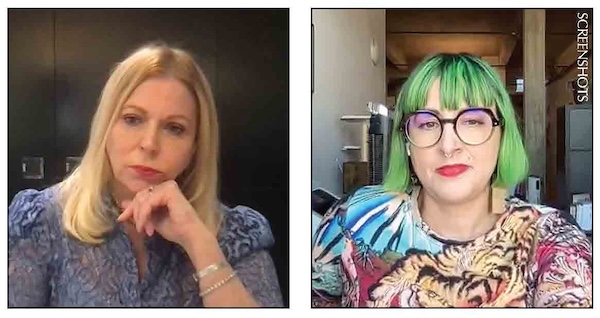
Panelists Margaret Gillis, left, and Dr. Melanie Doucet were the experts featured at this year’s Simces & Rabkin Family Dialogue on Human Rights, which focused on ageism.

“Ageism is anytime we make an assumption, a judgment, a stereotype, or discriminate based on age. And this can go in any direction. You’ve often heard people say, ‘too young to understand,’ ‘too old to understand.’ It can be directed toward oneself. It manifests in our interrelationships with others. And it is evident in our institutions and organizations. In fact, it is everywhere,” said Zena Simces in her remarks at the sixth annual Simces & Rabkin Family Dialogue on Human Rights, which took place over Zoom on Oct. 28.

Ageism impacts many aspects of life, said Dr. Simon Rabkin. “It affects our health, both physical and mental,” he said. “Studies have shown that psychosocial impacts of ageism include low self-esteem, self-exclusion, lack of self-confidence and loss of autonomy, both for older and younger people. The data indicate that workplace ageism is associated with increased depression and long-term illness. Importantly, studies have found that older persons with more negative self-perceptions of aging have significantly reduced longevity.”

Simces and Rabkin set the stage for the dialogue, which was called Too Old, Too Young: A Conversation on Ageism and Human Rights. It featured Margaret Gillis, founding president of the International Longevity Centre Canada (ILCC) and co-president of the International Longevity Centre Global Alliance, and Dr. Melanie Doucet, an associate with the Centre for Research on Children and Families at McGill University, who is a former youth in care. The discussion was moderated by Andrea Reimer, an adjunct professor at the University of British Columbia’s School of Public Policy and Global Affairs, who herself survived as a street-involved youth.

Gillis focused on the impact of ageism on older persons. She gave examples of human rights violations taking place in Canada, including that Canada’s long-term care homes have been under strain and in need of reform for at least two decades. She said an estimated one in 10 older Canadians experiences some form of elder abuse, adding that such abuse is underreported. She spoke about ageist employment practices and negative media representations of older persons.

“Ageism is toxic to the global economy and to health,” she said. “For instance, a US study showed a massive $63 billion per year impact on the economy as a result of ageism in health care. Perhaps one of the most distressing aspects of ageism is its prevalence, the World Health Organization finding one in every two persons is ageist.”

Nonetheless, not much is being done about it, said Gillis.

“I should note that there are protections against ageism in the Canadian Human Rights Code and the provincial human rights codes. But, the problem is, this takes time, money and know-how and our legislation and court process are not well-equipped to remedy complex situations like ageism easily and cost-effectively.”

Gillis encouraged people to join the Canadian Coalition Against Ageism, which she established. It comprises organizations and individuals who are working to confront ageism and bring about changes, based on the WHO global report on ageism. 

She advocates for the adoption of a United Nations Convention on the Rights of Older Persons. 

“In general, a convention is a method to achieve positive change by combating ageism, guiding policy-making and improving the accountability of governments at all levels, which we most certainly need,” said Gillis. “A convention would also educate and empower, and we’d see older people as rights holders with binding protections under international law.”

Doucet spoke about the human rights of younger persons, specifically youth who age out of the care system. She explained that youth age out of care at the age of majority and that, in British Columbia, about 1,000 youth age out annually.

A video Doucet made as part of her doctoral research included data on the difficulties most young people exiting care experience: 200 times the risk of homelessness, post-traumatic stress disorder rates on par with war veterans, and fewer than 50% finish high school.

Statistics Canada Census data from 2016 indicated that nearly 63% of youth ages 20 to 24 were still living with their parents, with almost 50% staying home until the age of 30. “And I’m sure those statistics have even increased since the pandemic,” said Doucet.

“Youth in care don’t have that luxury. They’re legislated to leave the system at age of majority. So, they’re deemed too old to remain in the child-welfare system after they reach age 18 or 19, depending on where they live in Canada, but, yet, too young to be sitting at the table when policy decisions are being made that impact them, sometimes even at their own intervention planning meetings with social workers.”

Additionally, in the last 20 years or so, a new developmental phase – “emerging adulthood,” which occurs between the ages of 19 and 29 – has been acknowledged in the academic literature, said Doucet. “It’s a phase that encompasses young people who are not necessarily children anymore but they’re not quite adults, and it provides room for identity exploration, trial and error, obtaining post-secondary education, and just figuring out one’s own place in the world. Youth in care aren’t able to experience this crucial developmental phase because of the legislated age cutoffs.”

There are studies that measure the benefits to both the youth affected and society at large of extending the age cutoff: “a return of $1.36 for every $1 spent on extending care up to age 25,” Doucet said.

Meanwhile, the cost of not extending care is high. For example, youth in care lose their lives up to five times the rate of their peers in the general population, she said. Poverty is more prevalent, as is homelessness, as previously noted.

“Out of the 36 countries in the global north, Canada is one of the six that does not have federal legislation to protect the rights of youth in care,” said Doucet. “While Canada has ratified the UN Convention on the Rights of the Child [CRC], it only provides human rights protections for children and youth until the age of 18. So, youth in care who are transitioning into adulthood actually don’t fit within the UN CRC because they’re deemed too old, even though they are a vulnerable population that experiences multiple human rights violations. This highlights that age-based discrimination is very much entrenched into the mainstream child welfare system in Canada.”

In the question-and-answer period, Gillis outlined three recommendations in the UN’s report on ageism: education/awareness campaigns; changes to laws, programs and policies, starting with long-term care and other basic human rights; and intergenerational work. We need to look at what other countries are doing, the evidence, best practices, she said, and pensions and other financial programs must keep up with cost-of-living.

Doucet spoke about initiatives she and her colleagues have undertaken.

“We developed what we’re calling the equitable standards for transitions to adulthood for youth in care. We released those in 2021, myself and the National Council of Youth in Care Advocates, which is comprised of people with lived experience from across the country, youth-in-care networks, and a couple of ally organizations, like Away Home Canada and Child Welfare League of Canada. This was our way to provide a step-by-step rights-based approach that centred on lived expertise, research and best practices, to guide how youth in care need to be supported as they transition to adulthood.”

There are eight pillars: financial, educational and professional development, housing, relationships, culture and spirituality, health and well-being, advocacy and rights, emerging adulthood development. And each pillar has an equitable standards evaluation model. For example, about housing: “Every young person should have a place they can call home, without strict rules and conditions to abide by.” 

“The ultimate goal [of] this project for us is, eventually, we are living in a society where the term ‘aging out’ no longer exists for youth in care, that they transition to adulthood based on readiness and developmental capacity instead of an arbitrary age,” said Doucet.

The Simces & Rabkin Family Dialogue on Human Rights was introduced by Angeliki Bogiatji of the Canadian Museum for Human Rights, which is a partner of the annual event. Juanita Gonzalez of Equitas – International Centre for Human Rights Education, also a program partner, closed out the proceedings. 

Format ImagePosted on November 8, 2024November 7, 2024Author Cynthia RamsayCategories NationalTags ageism, discrimination, elder persons, health, human rights, law, Margaret Gillis, Melanie Doucet, policy, Simon Rabkin, United Nations, youth, youth in care, Zena Simces

Ways to defy dementia

Dr. Allison Sekuler of Toronto’s Baycrest Centre for Aging and Brain Health Innovation. (photo from baycrest.org)

On June 5, National Council of Jewish Women Canada (NCJWC) welcomed Dr. Allison Sekuler of Toronto’s Baycrest Centre for Aging and Brain Health Innovation as the featured speaker in the Zoom webinar titled Defy Dementia: Learn How to Reduce Your Dementia Risk.

photo - Dr. Allison Sekuler of Toronto’s Baycrest Centre for Aging and Brain Health Innovation
Dr. Allison Sekuler of Toronto’s Baycrest Centre for Aging and Brain Health Innovation. (photo from baycrest.org)

Sekuler is the Sandra A. Rotman Chair of Cognitive Neuroscience at Baycrest’s research institute and the president and chief scientist at the Baycrest Academy for Research and Education. She is known for her foundational research in perception, cognition and brain function, as well as her clinical and translational work on age-related sensory and cognitive decline. She is the inaugural Canada Research Chair on Cognitive Neuroscience and has received numerous national and international honours, including being named one of Canada’s Top 100 Most Powerful Women by the Women’s Executive Network in 2019.

The recent webinar began with an introduction from Monica Simon, chair of NCJWC’s ageism committee. Then, with the help of AI-generated images, Sekuler presented attendees with an optimistic view of what she hopes the future holds. “We want to see a world where every single person is living a life of purpose, fulfilment and dignity,” she said.

Baycrest is at the forefront of a new field called predictive neuroscience for precision aging – an individualized approach that examines one’s brain, body and environment to detect the best ways to prevent the onset of dementia or delay it for as long as possible. This approach not only encompasses the pre-diagnosis stage, but helps medical professionals and loved ones navigate caring for someone with dementia. 

“If you think about what precision medicine has done for cancer, that’s what we want to do for aging, brain health and dementia,” said Sekuler.

Through innovations in predictive neuroscience, the Baycrest team is working toward a goal of no new cases of preventable dementia being diagnosed by the year 2050 – currently, 750,000 Canadians are living with dementia, and that figure is expected to more than double by 2050.

“What we want to do is nip that in the bud as much as possible,” Sekuler said, acknowledging that, while they cannot entirely eradicate the condition, they can do more to decrease the risk for those who do not already have dementia. Research suggests that, if the onset of dementia can be delayed by even five years, the prevalence of the condition can be decreased by 50% worldwide, she said.

While there are several risk factors – such as age, sex and genetics – that cannot be controlled, Baycrest’s Defy Dementia program raises awareness of the lifestyle changes people can make to reduce their dementia risk and improve their cognitive health.

“At least 40% of the risk factors for dementia are things that we can change by changing our lifestyle,” said Sekuler.

On the podcast Defy Dementia, co-hosts Sekuler and Jay Ingram, one of Canada’s leading science journalists, cover a different risk factor every month. Each episode features a guest with lived experience with dementia and an expert on the risk factor under discussion, such as stress, sleep, diet, exercise and environment.

There are currently 12 episodes available on the website defydementia.org, or any streaming platform. Many episodes have accompanying infographics and minute-long videos summarizing the topic at-hand, also available on defydementia.org.

“Whether you like to listen to things, read things, watch things or look at things, we’ve got you covered,” Sekuler said.

Sekuler gave a high-level overview of the risk factors, sharing how each correlates to one’s dementia risk and what one can do to manage them. She reminded attendees that genetics are not the be-all and end-all, but, rather, a piece of the puzzle that can often be counteracted by managing the risk factors.

Regarding sensory loss, Sekuler explained how strains on one’s hearing and/or vision can negatively impact cognitive abilities. She pointed to tools such as Baycrest’s free online hearing test and the importance of regular check-ups for hearing and vision loss. Further, she explained that loneliness has been proven to increase dementia risk by 50%, and that social engagement in any form is key to maintaining cognitive health. She emphasized that a healthy balance of diet, exercise and sleep helps, as does lowering stress as much as possible and embracing opportunities to try new activities and learn new things.

Sekuler also turned the group’s attention towards the vital role of caregiver. She shared that “one in every two people” will assume this role, if they do not get dementia themselves. However, caregivers often sacrifice a healthy diet, proper sleep and social engagement, she said, making them six times more likely to develop the condition. Sekuler stressed that “a caretaker cannot take care of someone else if they are not taking care of themselves,” and that inviting more professionals, caregivers and loved ones into the equation lessens the burden on one individual and may be a saving grace for that person’s health.

During the question-and-answer period, which was moderated by NCJWC’s Rochelle Garfinkel, Sekuler was asked what organizations like NCJWC can do to fight dementia. She highlighted the importance of sharing information and resources widely, and encouraged involvement in dementia research wherever possible. As well, she said, promoting tools like Baycrest’s online cognitive assessment test to “get your baseline” – as one would do with a regular vision test – is crucial for early detection. 

According to Sekuler, when it comes to protecting your cognitive health, “everyone can make these changes. You don’t have to be perfect, but you do have to start somewhere.” 

Alisa Bressler is a graduate of Queen’s University in Kingston, Ont. She is an avid reader and writer and will be pursuing a master’s of journalism at Boston University in the fall. Bressler is a member of the Vancouver Jewish community, and was the inaugural Baila Lazarus Jewish Journalism Intern.

Format ImagePosted on June 28, 2024June 27, 2024Author Alisa BresslerCategories LocalTags aging, Allison Sekuler, Baycrest, dementia, education, health, innovation, National Council of Jewish Women of Canada, NCJWC, podcasts
Stand Up celebrates 20th

Stand Up celebrates 20th

Stand Up for Mental Health founder David Granirer. (photo from smhcomedysociety.org)

Stand Up for Mental Health (SMH), a program started in Vancouver that teaches stand-up comedy to people with mental health issues as a form of therapy and to destigmatize mental illness, celebrated its 20th anniversary this spring. 

“It feels like such an accomplishment. Helping so many people has been the highlight of my life,” said David Granirer, the founder of SMH. “One thing I am really good at is making other people into stars, and I feel like I have done that a lot. Over the past 20 years, I have trained about 700 comics. So, that’s a lot of stars.

“I had no idea what I was doing when I started out, so I had no expectations about the program being successful or not. I could never have imagined this,” he said.

Granirer, a counselor by profession, as well as a stand-up comic, told the Independent that the two-decade journey has been unforgettable. “Everything stands out,” he said. “Every show, every comic I have ever trained, every laugh we have gotten.”

When considering some of the more memorable bits over the years, he recalled writing a mental health version of the Beatles song “While My Guitar Gently Weeps.” In Granirer’s rendition, the guitar has dizziness, dry mouth and is too depressed to get out of bed.

Granirer, who is open about his own struggles with mental illness, has trained groups in more than 50 cities, in Canada, the United States and Australia, in partnership with various mental health organizations. He plans to continue the program and run it in more cities in the coming years.

The idea for SMH originated from a course Granirer has been teaching at Langara College since 1998 called Stand-Up Comedy Clinic. Occasionally, he would see people have life-changing experiences by getting on stage and using comedy to tell a club full of people who they were.

“One woman had a fear of flying and told me that the day after our event she had to get on a plane and she said, ‘My fear was gone. I felt like once I’d done stand-up I could do anything,’” Granirer said. “And I thought, wouldn’t it be amazing to be able to give this experience to people who wanted to do comedy but who also wanted to change their lives? And since I work in mental health and I also have a mental illness, I thought that would be the perfect place to start.”

For Filomena Black, a graduate of the course, SMH has been a lifeline. An introvert by nature, she said she has been able to be more comfortable around people.

“I’ve lost my self-conscious focus and become more engaged in enjoying other people’s company. I’m now looking forward to successfully meeting challenges in all aspects of my life rather than avoiding them,” Black said.

Asked to tell one of the jokes in her repertoire, Black responded, “I used to run away from home a lot, but my kids always found me.”

Another SMH graduate, April Soon, also speaks highly of the program, lauding Granirer for shining a light on what people with mental health issues can do and not letting finances be a barrier to participation.

Soon, a veteran of public speaking through Toastmasters, did not find standing up before a crowd as intimidating as others might have and, these days, she not only performs at SMH gigs but at other venues around Vancouver.

“When bad things happen to me now, I wonder how I can use it as material,” said Soon. “SMH has helped reframe my thinking and provided good resilience training.”

On a lighter note, she added, “Being involved with SMH has exposed me to many other mental illnesses I want to try out.”

Kevin Scow similarly expresses his gratitude, saying the program has given him his voice and was vital to his recovery.

“This came to me at exactly the right time,” he said. “Instead of seeming strange … now they know I am strange … and they love me all the more for it. Thanks to David and my fellow alumni for nurturing my voice and helping with making it funny. My First Nations side says thanks.”

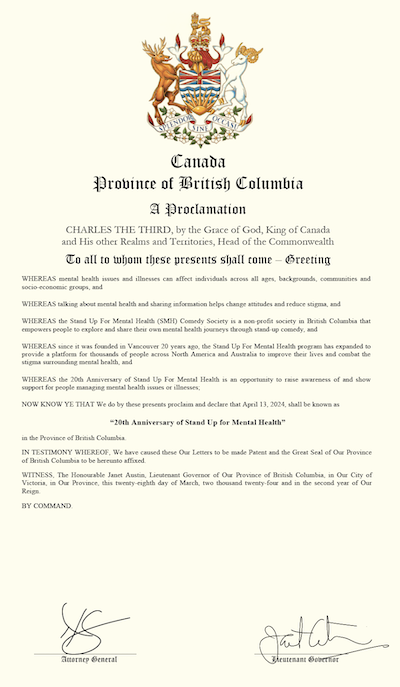
image - SMH’s 20th anniversary was recognized last month with a proclamation from the Province of British Columbia declaring April 13 as Stand-Up for Mental Health Day
SMH’s 20th anniversary was recognized last month with a proclamation from the Province of British Columbia declaring April 13 as Stand-Up for Mental Health Day.

SMH’s 20th anniversary was recognized last month with a proclamation from the Province of British Columbia declaring April 13 as Stand-Up for Mental Health Day. The proclamation reads, in part, that SMH provides a program for thousands of people “to improve their lives and combat the stigma surrounding mental health and … is an opportunity to raise awareness of and show support for people managing mental health issues or illnesses.”

Since 2004, Granirer and his comics have performed more than 500 shows for mental health organizations, government departments, corporations, universities, correctional facilities and the military. Granirer also gives “laughter in the workplace presentations” to organizations across North America, helping them use humour to lower stress, improve wellness and cope with change. Granirer, too, is the author of The Happy Neurotic: How Fear and Angst Can Lead to Happiness and Success.

SMH’s classes in Vancouver last for six months and students step on stage for two shows, a debut and a graduating performance. As Granirer says, “The comics go from knowing nothing about stand-up to killing it.”

Stand Up for Mental Health is currently recruiting for its next class, which starts July 30. For more information, visit smhcomedysociety.org. 

Sam Margolis has written for the Globe and Mail, the National Post, UPI and MSNBC.

Format ImagePosted on May 24, 2024May 23, 2024Author Sam MargolisCategories Performing ArtsTags April Soon, comedy, David Granirer, Filomena Black, health, Kevin Scow, mental health, milestones, performing arts, Stand Up for Mental Health
Klezcadia a June highlight

Klezcadia a June highlight

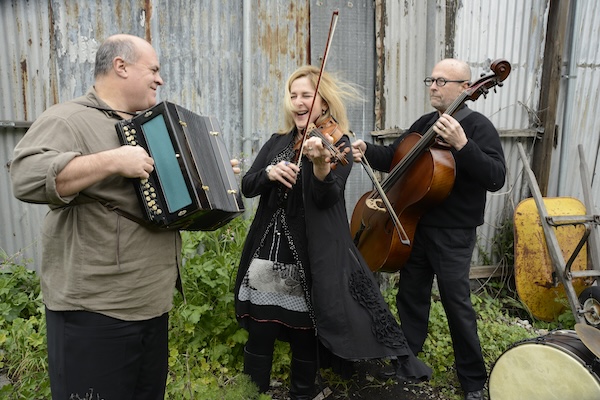
Veretski Pass – Joshua Horowitz, left, Cookie Segelstein and Stuart Brotman – will be joined by clarinetist Joel Rubin to present the world première of music from their new album, Makonovetsky’s Scion. (photo from Klezcadia)

Victoria will host Klezcadia, a hybrid klezmer and Yiddish culture festival showcasing a West Coast lineup of musical mastery and mavenry. Running June 4-9 in-person and online, there is no charge to attend.

According to festival director Laura Rosenberg, Klezcadia intends to position Victoria as a focal point for klezmer and Yiddish cultural tourism. In conjunction with the music, the six-day event will present classes, workshops, lectures, demonstrations and open rehearsals conducted by artists, language faculty and other guests.

“Klezcadia’s audiences can expect cutting-edge performances – including three world premières – by some of the world’s leading klezmer artists. Additionally, participants at any level of experience will have opportunities to attend classes, workshops and presentations by these same artists and their Yiddish-language colleagues,” Rosenberg told the Independent.

“Our guiding principle is to make the safe in-person attendance experience and the virtual attendance experience as equivalent and rich as current technology allows, as well as to give the same level of respect to all attendees,” she said.

Some of the featured artists will be Veretski Pass, a Bay Area trio that will perform with clarinetist Joel Rubin; Vancouver musician Geoff Berner; and Jeanette Lewicki in her new show as Pepi Litman, an early 20th-century Yiddish theatre drag star.

Comprised of Cookie Segelstein (violin), Joshua Horowitz (19th-century button accordion) and Stuart Brotman (bass), Veretski Pass offers a wide mix of East European influences. Reuniting with Rubin, they will present the world première of music from Makonovetsky’s Scion, their new album for the Borscht Beat label. 

Berner, a singer, songwriter, accordionist, novelist and political activist, will stage the première of Second Fleet, the Yiddish song cycle he recently co-wrote with Canadian writer Michael Wex, author of the bestseller Born to Kvetch, a humorous and scholarly look at the Yiddish language.

Lewicki will transmit the spirit of Litman, the original “drag king” of Yiddish theatre, in another première. The Pepi Litman Project will examine the time when a groundbreaking performer literally “wore the pants,” led her own touring troupe, turned taverns into theatres, and tested societal boundaries with her satire. Litman toured Europe and reportedly North America, too, singing, in male garb, at spas, inns and private homes in small towns and large cities alike. 

Some of the talks and workshops on offer at the festival are The Barry Sisters: America’s Yiddish Swingsters, with Andy Muchin, the host of the Sounds Jewish radio show on PRX; Yiddish Through Song Lyrics, with Seattle-based Marianne Tatom, a Yiddish teacher and klezmer musician; and Yiddish Through Conversation, with Sasha Berenstein, a multi-instrument musician and fellow with the Yiddish Book Centre’s Yiddish Pedagogy Program. 

On June 5, Christina Crowder of the Klezmer Institute will speak about the Kiselgof-Makonovetsky Digital Manuscript Project, an international endeavour connecting participants with the work of important klezmer musicians from the late-19th and early-20th centuries.

The festival will take a walk on the vilde side on June 8 with what organizers describe as “musical mash-ups, klezmer-adjacent adventures, song parodies, unusual instruments” and offering the forecast “you never know what will pop up in this clearing in the klezmer/Yiddish jungle.” The evening will feature Seattle neo-vaudevillian Mai Li Pittard, as well as local klezmer bands Kvells Angels and the Klezbians. A new klezmer ensemble, Kvells Angels, gave a concert last fall at the University of Victoria in which they performed works previously unavailable to musicians. The Klezbians, meanwhile, are a well-known band of “chutzpah-licious” musicians, and the group goes back many a year.

Victoria’s Congregation Emanu-El, under whose auspices Klezcadia is being produced, will host the finale concert at the Cameron Bandshell, located in Beacon Hill Park. The closing concert will be a gift to the city in celebration of the congregation’s 160th anniversary. 

Festival organizers have made a concentrated effort to ensure that all participants enjoy a safe experience. The hybrid environment, they stress, will prioritize the well-being of immunocompromised and high-risk participants, for both those onstage and in the audience. Indoor activities will include protective protocols, such as supplemental air purification, required masking and daily onsite COVID testing. 

“Klezcadia was inspired by deep listening to an online meeting of immunocompromised and high-risk musicians and Yiddish-language enthusiasts in early 2023,” Rosenberg said. “During the first two years of the pandemic, they had finally felt included in the klezmer/Yiddish community, since everyone’s only option was to gather online.”

The same groups felt marginalized again when most festivals returned to unmasked, in-person formats. Through dialogue with these groups, Rosenberg realized, Victoria had a chance “to become a host community for an inclusive form of cultural tourism.”

Rosenberg said her 45-year arts administration career came in handy when building a music festival from the ground up; she had already done so with two other festivals. It has been a year’s worth of full-time work to plan the format, bring in the artists and teachers, scout venues, initiate community engagement and, importantly, raise the money.

Locals seem eager for the festival to start. “I am optimistic based on expressions of pride I have heard from Victoria residents, on how quickly Klezcadia’s in-person registration reached capacity and on the eagerness of local tourism-sector businesses to be included in our visitors’ guide,” Rosenberg said.

People from more than a dozen countries have signed up to view events streamed online.

For more information, visit klezcadia.org. 

Sam Margolis has written for the Globe and Mail, the National Post, UPI and MSNBC.

Format ImagePosted on May 10, 2024May 22, 2024Author Sam MargolisCategories Music, Performing ArtsTags Congregation Emanu-El, culture, health, Klezcadia, klezmer, Laura Rosenberg, Victoria, Yiddish

Posts pagination

Previous page Page 1 Page 2 Page 3 … Page 24 Next page
Proudly powered by WordPress