Skip to content
  • Home
  • Subscribe / donate
  • Events calendar
  • News
    • Local
    • National
    • Israel
    • World
    • עניין בחדשות
      A roundup of news in Canada and further afield, in Hebrew.
  • Opinion
    • From the JI
    • Op-Ed
  • Arts & Culture
    • Performing Arts
    • Music
    • Books
    • Visual Arts
    • TV & Film
  • Life
    • Celebrating the Holidays
    • Travel
    • The Daily Snooze
      Cartoons by Jacob Samuel
    • Mystery Photo
      Help the JI and JMABC fill in the gaps in our archives.
  • Community Links
    • Organizations, Etc.
    • Other News Sources & Blogs
    • Business Directory
  • FAQ
  • JI Chai Celebration
  • JI@88! video

Recent Posts

  • Sharing her testimony
  • Fall fight takes leap forward
  • The balancing of rights
  • Multiple Tony n’ Tina roles
  • Stories of trauma, resilience
  • Celebrate our culture
  • A responsibility to help
  • What wellness means at JCC
  • Together in mourning
  • Downhill after Trump?
  • Birth control even easier now
  • Eco-Sisters mentorship
  • Unexpected discoveries
  • Study’s results hopeful
  • Bad behaviour affects us all
  • Thankful for the police
  • UBC needs a wake-up call
  • Recalling a shining star
  • Sleep well …
  • BGU fosters startup culture
  • Photography and glass
  • Is it the end of an era?
  • Taking life a step at a time
  • Nakba exhibit biased
  • Film festival starts next week
  • Musical with heart and soul
  • Rabbi marks 13 years
  • Keeper of VTT’s history
  • Gala fêtes Infeld’s 20th
  • Building JWest together
  • Challah Mom comes to Vancouver
  • What to do about media bias
  • Education offers hope
  • Remembrance – a moral act
  • What makes us human
  • המלחמות של נתניהו וטראמפ

Archives

Follow @JewishIndie
image - The CJN - Visit Us Banner - 300x600 - 101625

Tag: health

Ways to tackle anxiety

“Our thoughts are influenced by our core belief system. Our opinions are shaped from things we have seen and heard in the past and those opinions affect what we see. The problem is our thoughts are not always necessarily true,” writes Michelle Biton in her new book, The Instant Anxiety Solution (Hatherleigh Press).

“Our own thoughts and beliefs often cause us more anxiety than the actual emotion itself,” she writes. “And sometimes our beliefs are faulty or inaccurate. In order to get to the facts, it’s important to question your thoughts and not always believe everything you think.”

But this is jumping ahead to Step 5 of Biton’s five-step program ALARM, which starts with ways in which we can get our bodies “out of ‘the acute stress’ stage and into a calmer state so you can think properly” (activating the parasympathetic nervous system). It moves to labeling what you’re feeling, then acknowledging that emotions are temporary. Step 4 is about how to remember to avoid building narratives around your thoughts and emotions, and Step 5 is how to move forward and take action.
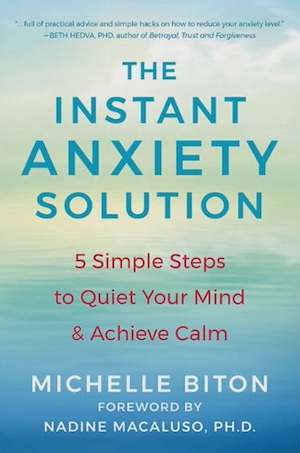
image - The Instant Anxiety Solution book coverOriginally from Vancouver, Biton is a Los Angeles-based coach, author and health educator. She has a master’s in holistic nutrition, a bachelor’s in psychology and a certificate in kinesiology, health and fitness studies. Her reasons for writing The Instant Anxiety Solution are personal.

“I had been trying to deal with anxiety as if it was logical, but anxiety is not logical. It’s primal and cannot be rationalized. My best friend helped me realize that, in order to manage mine and my daughter’s anxiety, we were going to have to look it in the eye and go through the discomfort of it,” writes Biton. “Going through the anxiety was the only way out of the vicious cycle.”

Biton’s own experiences with anxiety inform her approach. “You are re-learning ingrained patterns and behaviours that will take time to unlearn,” she acknowledges, “so be easy on yourself and give yourself time to go through the process.”

The Instant Anxiety Solution comprises a foreword by marriage and family therapist Nadine Macaluso; an introduction in which Biton lays out some of her reasons for writing the book; an overview of what anxiety is and its effects; a chapter for each of the ALARM steps; a brief conclusion; many exercises readers can do to learn how to better manage anxiety; and 20-plus blank pages for the purposes of journaling.

There are many causes of anxiety, including biological makeup, learned behaviour, lack of sleep, trauma, not eating properly, financial difficulties.

“When we get triggered by an event, our amygdala gets activated, causing the impulsive fight or flight response, and the prefrontal cortex, the logical thinking part of the brain, shuts off,” writes Biton. Our bodies focus on one thing: survival. The sympathetic nervous system is activated, “causing your heart rate, breathing and blood pressure to rise dramatically…. You’ll likely even feel shaky and nauseous.

“Many people make the mistake of trying to problem solve when anxiety hits, but it is absolutely impossible to do,” she writes. We can’t think until we have calmed down, and Biton offers many ways to shock the body out of its anxious state, such as splashing cold water on our face or putting a cold pack on the back of our neck; intense exercise, like a sprint to the end of the block or some push ups; and humming or singing.

There are ways a person can semi-instantly calm themselves, but the crux of tackling anxiety is self-awareness and, for that, there is no quick fix. Biton offers advice on how to identify and deal with feelings, but a main takeaway is to train ourselves to not act in those first moments. Apparently, an emotion lasts seven minutes max, then runs out of steam. It’s “the additional energy that is added in the form of our ‘extra’ thoughts and emotions that we ‘attach’ to the original emotion that keeps the feeling alive and the suffering occurring,” writes Biton.

“Do not act on impulse,” she warns, “you will only regret it afterwards.” But don’t numb yourself either. If you feel like crying, cry. Notice and acknowledge your emotions without judgment. When you’re calm, you can figure out what is really going on, consider both sides of the situation – what happened or was said and your reaction. 

We all have pain, she notes: “It is how we ‘react’ to the pain that determines our ‘suffering.’” Suffering, she says, is a sign that you’re not accepting the here and now. Some clues that you might be fighting against reality are that you’re feeling bitter or resentful, or you’re regularly unhappy or frustrated.

“A major reason that many of us suffer from anxiety today is because we have ‘felt unheard’ or ‘dismissed’ in our lives,” she writes. “We were told that we ‘weren’t good enough’ or that we ‘shouldn’t feel a certain way.’ This negative environment taught us not to trust ourselves, and not to trust our emotions. As a result, we have a lot of self-doubt and anxiety.

“On top of that, many of us project fears from the past into the future. Very rarely do we go into a situation without the ‘baggage’ and ‘opinions’ that we have carried from past experiences.”

Biton believes it possible to “become unstuck from the past.” The advice and exercises in The Instant Anxiety Solution may not result in instant results, but they do offer tangible steps to a solution. 

For more information, visit michellebiton.com.
Posted on May 10, 2024May 10, 2024Author Cynthia RamsayCategories BooksTags anxiety, health, mental health, Michelle Biton

Peer support’s long history

The Jewish Seniors Alliance of Greater Vancouver has invited Honoré France, a scholar on aging and expert on peer support, to speak via Zoom on Jan. 22. He will discuss the topic Discovering the Essential Importance of Seniors Supporting Seniors.

France, a professor emeritus in the department of educational psychology and leadership studies at the University of Victoria, will focus on the senior peer support training he developed. The training has been used by JSA for several years to help new volunteers learn how best to connect and liaise with isolated, lonely seniors in the community.

Among the topics France will cover are the early history of seniors peer support, strategies for self-care, information about memory, the value of exercise and the development of a healing presence.

Earlier this month, France shared some of his presentation with the Independent, including a peek at the origins of peer support during the beginning of psychiatry in the late 1700s – through French physician Philippe Pinel and hospital superintendent Jean-Baptiste Pussin. 

The talk will then move to more modern examples of senior peer support, including Indigenous approaches, and the development of group homes and inclusive treatment.

According to France, peer support is successful when various factors are in place, including effective approaches in helping aging populations and the promotion of the concept of self-help and independence among older people. 

Additionally, for peer support to be beneficial, people need to want to help themselves, there needs to be a reserve of talented older people who want to be helpful and, should someone have a problem or concern, there must be a willingness to seek out peers. 

After addressing various aging myths, such as the belief that dementia is inevitable, France will examine ways to stay mentally, physically and spiritually fit. He will explore nature as medicine, practices of letting go and cleansing, positivity (finding purpose and meaning), and mind-body activities like yoga, meditation, art and helping others.

France said he hopes that, by the end of the session, participants will “understand the developmental stage of aging and the central concept from Viktor Frankl about meaning and the crucial role it plays in healthy aging, and to follow their dreams as they age in the same way they did earlier in life.”

Frankl, an Austrian psychiatrist and Holocaust survivor, believed finding meaning in life to be the central human motivational force.

“Aging is natural and part of living,” said France, and people “can be in control physically, mentally, psychologically and spiritually. Aging is what you make of it and learning is a medicine and keeps you mentally fit.”

France emphasized that, no matter what a person’s condition in life is, they can live fully, consistent with their physical and psychological level. 

His talk will look at ways people can train themselves “to listen to others and to be like Frankl – optimistic, resilient, and always ‘moving.’ And, finally, [how to] develop a healing presence, as well as how to empathize at a deep level by bringing ‘light’ into the world to those in need.”

He added, “I will also provide some strategies for dealing with stress that I use. There will be a question period at the end, and Grace Hann will speak about the volunteer program at the Jewish Seniors Alliance along with one or two volunteers,” France said.

Hann is JSA’s senior peer support services trainer and supervisor.

Aside from his role at UVic, France is an artist, writer, therapist and consultant in the field of mental health. He has worked at the Shanghai University of Traditional Chinese Medicine, Addis Ababa University and the University of Massachusetts, where he graduated with a doctorate in counseling.

His academic interests include diversity, group processes and creative arts therapy. His current research involves reconciliation and residential schools, cross-cultural issues, creative arts, spirituality and eco-psychology (an intellectual movement to understand the relationship between humans and nature).

France has written several books and more than 75 academic articles on counseling issues and practices. Further, he has presented more than 80 scholarly book chapters around the world. He is currently re-writing and updating a 1989 publication on senior peer counseling, titled Senior Peer Support/Counselling Handbook: An Interactive Guide, which is set for publication this year.

On a personal level, he keeps active through gardening, playing squash and pickle ball, carving, building furniture and participating in strategic games, such as Go and chess. Currently, he is finishing up a novel based on his experiences hiking the West Coast Trail, his life teaching and backpacking around the world.

France’s talk is part of the JSA Snider Foundation Empowerment Series and the South Vancouver Seniors Network is a co-sponsor of the event. The Zoom starts at 11 a.m. The link to join it will be distributed through JSA’s email newsletter. Those interested in attending can also email [email protected] for the link. 

Sam Margolis has written for the Globe and Mail, the National Post, UPI and MSNBC.

Posted on January 12, 2024January 11, 2024Author Sam MargolisCategories LocalTags aging, health, Honoré France, Jewish Seniors Alliance, JSA, lifestyle, mental health, peer support
Improving mental wellness

Improving mental wellness

Adrianne Fitch is project coordinator for the Vancouver Disability Solutions Network, which is hosting the Mental Wellness for People with Disabilities Forum on Nov. 28 at Heritage Hall in Vancouver. (photo by Adrianne Fitch)

Adrianne Fitch has turned her disabilities into assets. Suffering from severe-to-profound hearing loss and episodes of anxiety and depression throughout her life, she understands firsthand the barriers that people with disabilities face and what could help make life better.

Fitch is project coordinator for the Vancouver Disability Solutions Network, or VDSN, a group of 200 nonprofit organizations and other providers serving people with visible and invisible disabilities. This includes people with physical disabilities, people with a mental health diagnosis, and people suffering from anxiety and depression in a post-COVID world. The network is hosting the Mental Wellness for People with Disabilities Forum on Nov. 28 at Heritage Hall in Vancouver.

“I don’t think the mental health needs of people with disabilities are any different than those of people without disabilities,” said Fitch.

However, depending on the nature of the disability, accessibility can be an issue.

“As someone with a severe-profound hearing loss,” she said, “I would have a really hard time taking part in a group therapy session unless captioning services were available.”

Fitch said many people in British Columbia have faced problems within the mental health system, such as limited access to services, long waiting times, insufficient resources, inadequate service coordination and continuity, and shortages of qualified mental health professionals.

“I think most of us can agree that the COVID pandemic and lockdown resulted in a great deal of isolation and a general decline in mental wellness all over the world.… [W]hen you’re also living with a disability, accessing quality mental health care can be even harder,” she said.

“At the forum, we hope to develop collaborative initiatives to promote mental wellness in our community,” she told the Independent.

Last year’s VDSN forum was on Newcomers with Disabilities. It resulted in a collaborative partnership between MOSAIC and Disability Alliance BC to support immigrants with disabilities receive provincial disability assistance.

At this year’s gathering, Fitch is hoping participants will collaborate to create new mental wellness programming adapted to people with disabilities; extend the reach and impact of what is currently being provided and what could be provided by organizations working together; raise awareness of existing programs geared to mental wellness; and educate families, friends and peer groups on how to support their loved ones to promote mental wellness.

Fitch likes the term “mental wellness” because the term “mental health” is sometimes perceived as medicalizing or stigmatizing something that is universal.

“Our focus for the forum is on improving mental wellness rather than fighting an illness or condition. Whether or not we have an actual diagnosis,” she said, “we can all benefit from practices, strategies and information related to managing our mental wellness.”

In a recent focus group that Fitch led, the people with disabilities participating felt that their mental wellness would be enhanced by exercise and fitness; a place to go to experience spirituality; financial stability; better access to psychiatrists; a compilation of existing services; and education for their families about how to support them.

“I would like to encourage your readers to check in with their friends and family, especially if they show signs that they are struggling with mental wellness,” said Fitch. “Sometimes just knowing you have people in your life who care about you and are ready to lend a hand or a sympathetic ear can make a world of difference.”

Fitch acknowledged that the pandemic was a tragedy, but said it revolutionized her professional life because, for the first time, she could take part in online meetings and events where captioning was provided.

Fitch is a past executive director of the West Coast Mental Health Network, the province’s only completely peer-run organization for people with a mental health diagnosis.

“On a community level, the network allowed me to meet some of the most interesting, compassionate, talented and dedicated people I have ever known,” she said.

The province cut the network’s funding years ago, she said. Today, there are occasional events listed on its Facebook page.

Fitch said she struggles with depression and anxiety but is helped by having many diverse interests, including playing Scrabble, especially with players that are higher ranked than her, and attending folk music festivals.

“On special occasions, like birthdays and anniversaries, I pay tribute to people in my life by writing personalized poetry,” she said, “and I also bake them customized birthday cakes based on their favourite flavours.”

Her other creative hobbies include bead weaving and pottery. She has exhibited her “Creepy Head Menorahs” at the Jewish Community Centre of Greater Vancouver. And, once a year, she likes to write Passover song parodies based on her favourite music, especially songs by the Beatles.

Anyone interested in participating in the Mental Wellness for People with Disabilities Forum on Nov. 28, should contact Fitch at [email protected] or go to eventbrite.ca/e/mental-wellness-for-people-with-disabilities-forum-tickets-723149328107. Everyone is welcome to attend.

Cassandra Freeman is a freelance writer living in Vancouver.

Format ImagePosted on November 10, 2023November 9, 2023Author Cassandra FreemanCategories LocalTags accessibility, Adrianne Fitch, COVID, forums, health, mental wellness, Vancouver Disability Solutions Network, VDSN

Recovery from surgery

Don’t let anybody tell you that recovery from knee replacement surgery is a walk in the park. It’s more like a hobble through hell. A very slow, frustrating, hobble with plenty of hurdles, pain and frustration. But, also, gradual victories and milestones.

My journey started off a bit rocky. One week before my knee surgery, I was diagnosed with severe sleep apnea and had to get a CPAP machine. Getting used to that is like getting used to having someone hold a pillow over your face while you sleep. And the apparatus itself – think Hannibal Lecter. Three weeks after my knee surgery, I had a bowel obstruction and landed back in the hospital for a couple of days.

As for the actual knee surgery, I had a spinal anesthetic and a nerve block. They also gave me conscious sedation, which, quite frankly, was my new best friend. Until I felt the surgeon cut into my leg, heard the electric saw they use to cut the thigh and shin bones, and felt the hammering. An unnerving experience, to say the least, and not one I’d care to repeat.

After surgery, in the recovery room, a young woman with black-and-green hair came over and announced that she was going to take an X-ray of my knee. As she leaned over me, the lanyard around her neck swung near my face. The strap on the lanyard said “Vancouver City Morgue.”  I looked around, paused for a second, and said: “So, is this what hell looks like?” She corrected the misunderstanding and said the lanyard was a joke. I suggested she might want to remove it, lest she scare the next unsuspecting patient.

As for the process of recovery – I realize that each person’s journey is different and the most important piece of advice I can give someone going into knee surgery is this: do not, I repeat do not, compare your progress to others. While some well-meaning physiotherapists and other medical professionals suggested I might want to join a Facebook support group for people who’ve had knee replacement surgery, I strongly advise against this. There are people who will boast that they achieved a 90-degree bend in their knee two days after surgery, while others will bemoan the fact that it’s been 12 weeks and they still don’t have a 90-degree bend. Everyone heals differently and comparing yourself to others will only make you feel crummy. I speak from experience. Don’t do it.

Full recovery from a knee replacement is slow – they tell you it takes anywhere from six months to a year. If you’re an impatient patient like I am, it can be hard. Take the wins where you can, be thankful for every small step forward, celebrate the successes along the way.

Part of every knee replacement is the post-surgery physiotherapy. If I had to compare it to something, it would be like having a 350-pound bodybuilder sit on your newly operated knee, while bench pressing a Ford F-150 full of cement. It is the polar opposite of a pleasant experience. My physiotherapist happens to be a tiny but extremely muscular and strong woman. She’s only doing what she’s been trained to do but, from my perspective, it’s pure torture. Her goal is to get you mobile, bending your knee and active as quickly as possible. Even if that means making you cry and scream during your half-hour sessions. I always thought I had a fairly high pain threshold, but she blew that theory out of the water right at the get-go.

To be clear, I am the most compliant patient anyone could ask for. If my physiotherapist tells me to exercise two to four times a day at home, I do it. Sometimes, it pays off, sometimes it doesn’t. That’s where the frustration comes in. But then you get to a certain point where you wake up one morning and you think, “Hey, I can do the stairs more easily now. How did that happen?” To be sure, there are countless ups and downs during the recovery. The trick is to keep your eye on the prize and know that, at the end of it all, you’ll have a knee that no longer locks or gives out on you.

Recovery would have been much harder had I not had an incredibly devoted husband who did nothing but take care of my every need for more than two months. From helping me shower to doing all the grocery shopping, cooking, cleaning, laundry, driving me to physio and doctor appointments, running errands, and taking care of many other things, Harvey was my rock. He never complained but, not surprisingly, he was exhausted. He’s 74 years old and has some medical issues of his own. More than once I suggested we get a cleaning lady, or do more food takeout, but he wouldn’t hear of it. He recently relented on the food takeout, I’m happy to report.

Here are a few things I’ve learned from this whole experience:

  • Give people what they need and want; not what you think they need and want.
  • Always express your gratitude for kind gestures, large and small.
  • Pay the kindness forward wherever and whenever you can.
  • Use whatever resources are available to keep calm, distracted and positive during the recovery process.
  • You don’t need to fight every fight. Choose your battles and conserve energy.
  • Help others as you would want to be helped.
  • Struggle is optional.

At age 67, I feel like the past few years, with their accompanying health challenges, have been one long audition for old age. Turns out there’s good news and bad news. The good news is that the audition is over. The bad news is that I got the starring role.

Shelley Civkin, aka the Accidental Balabusta, is a happily retired librarian and communications officer. For 17 years, she wrote a weekly book review column for the Richmond Review. She’s currently a freelance writer and volunteer.

Posted on September 22, 2023September 21, 2023Author Shelley CivkinCategories LifeTags Accidental Balabusta, health, knee replacement, recovery, surgery

Walk for empowerment – Aug. 13

In Canada, one woman is killed in a violent act every 48 hours. The spike in domestic violence that began during the pandemic is not diminishing and instead continues to increase. It has increased in Canada by 27% since 2019.

In Israel, the situation is just as critical. In the first year of the COVID-19 pandemic, 20,140 domestic violence complaints were lodged with police, an increase of 12% from the previous year, and, in 2022, the rate of femicide in Israel increased by 50%. In the first five months of this year, 16 women have been murdered.

Join CHW (Canadian Hadassah-WIZO) Vancouver Centre for the CHW Vancouver Walk on Sunday, Aug. 13, from 10 a.m. to noon at Jericho Beach. This annual event raises funds in support of CHW’s SOS – Starting Over Safely – summer campaign to empower victims of domestic violence.

The CHW Vancouver Walk is an opportunity for the community to come together and make a difference. By participating in this event, you will not only support essential programs that empower women to break the cycle of violence, but also raise awareness about the issue of domestic abuse.

The programs supported by this cause are WIZO services for domestic abuse survivors, Michal Sela Forum in Israel and Franny’s Fund in Canada. These programs will:

  • provide help for parents and families in need of an urgent response,
  • provide women and their children with specially trained protections dogs,
  • provide women and their children with the basic essentials to start over safely,
  • provide awareness materials to help women recognize the signs of abuse,
  • fund respite summer camp experiences for at-risk youth,
  • provide access to critical resources, including legal counsel and therapeutic counseling services, and
  • assist with social and personal support to help break the cycle of violence.

CHW encourages everyone to come to Jericho Beach, where the event will kick off promptly at 10 a.m.  To donate and to register to walk, jog or run, go to chw.ca/vancouver-walk (free for kids under 18). Strollers and dogs are welcome. No matter how you choose to participate, your presence and support will make a meaningful impact. Together, we can create a safer and more secure environment for those affected by domestic abuse.

Also, save the date: on Aug. 22, CHW will launch a 27-hour online crowdfunding campaign. Funds raised that day will be matched three more times by a loyal community of donors, the Matching Heroes, so please visit chwsos.ca sometime during those 27 hours and donate.

– Courtesy CHW

Format ImagePosted on July 21, 2023July 20, 2023Author CHWCategories LocalTags Canada, Canadian Hadassah-WIZO, domestic violence, fundraising, health, Israel, SOS, Starting Over Safely, tikkun olam, women
Beautiful life despite illness

Beautiful life despite illness

Rachel Goldman and her husband, Geoff McLennan. (photo by Avi Dhillon)

Rachel Goldman is this year’s Courage to Come Back Award winner in the medical category. She couldn’t be there in person at the Vancouver Convention Centre June 9, but she did accept the honour virtually.

After introducing herself, Goldman said, “Forty months. Forty months! That’s 1,216 days or 29,200 hours. That’s the total amount of time I have spent secluded from the world, due to COVID. Can you even imagine? So, here I am, speaking before 1,700 of you, sharing my story. It’s a surreal and humbling experience, but one that I am striving to embrace with courage and gratitude.”

Goldman explained what it has been like to have been born with CVID, common variable immune deficiency.

“For 40 years, I have caught and recovered from thousands of illnesses – lived through years of isolation and endured the roller coaster that is chronic illness,” she said.

“A common cold is never just a cold. It’s a sinus infection that leads to intravenous antibiotics. It’s a kidney infection that leads to weeks or months in an isolated hospital room. It’s my body triggering anaphylaxis to the antibodies being infused into me. Challenging? Absolutely.

“Not being able to be with you tonight to receive this amazing award in person is just one more of these challenges. I have my incredible father [Paul Goldman] there to accept this award on my behalf. Now, due to his attendance in my place, we will have to stay apart for at least 72 hours in hopes of minimizing my infection risk.

“Life altering? Most definitely,” she said.

“What it hasn’t done is stopped me from doing the best I can to live my life within the realm of what I can make possible, not what seems impossible.”

Goldman and her husband, Geoff McLennan, live in New Westminster and have two young children. A typical day for her starts at 6 a.m. to get their kids ready to go to Vancouver Talmud Torah.

“Once they leave, I am pretty exhausted, so I have to go back to bed and lie down for a couple hours,” she told the Independent. “I try to get outside every day and go for walks around our neighbourhood. With the weather becoming nicer, sometimes I will see a friend very distanced outside on our patio. I get my kids’ stuff ready for the next day for school … try to exercise and rest. I often write and usually have lots of doctors’ appointments, for the most part, over the phone or via Zoom. Then I get ready for my kids to come home. We try to have a normal evening of homework, dinner, bedtime and then time with my husband. Then rest again.”

That’s if she’s feeling OK. “If I am unwell,” she said, “then antibiotics and the meds I have to take to ensure I don’t have an allergic reaction to the meds keeps me mostly in bed. The meds make me feel very ill.

“If the infection is severe, then the antibiotics will require hospitalization, either inpatient or day treatment, to be delivered intravenously through a PICC [peripherally inserted central catheter] line.

“In terms of treatment,” she said, “I give myself weekly subcutaneous intravenous immunoglobulin infusions, which I infuse into my stomach through four needles.”

Because of her health, Goldman, a sports radio and television producer, had to stop working in 2017. She also has had to adapt how she volunteers at VTT, something she loved doing in-person. Unable to go into the school anymore, she said, “I have spent a lot of time volunteering virtually and helping out at home. I think I have become a master at cutting out projects for the school.

“Our Jewish community has been integral to our family,” she said. “Our children’s school has been the one constant in their life when everything else has been very chaotic. We travel 45 minutes each direction every day to bring our kids into Vancouver to attend VTT. We are eternally grateful for the love, support and kindness that the Vancouver Jewish community and Vancouver Talmud Torah has shown our family. They have lifted us up when things couldn’t have been more difficult. In turn, my kids could not feel safer, more well-loved and more connected with the Vancouver Jewish community.”

Goldman is a lifetime member of CHW, formerly known as Canadian Hadassah-WIZO, and has been a supporter of Jewish Federation of Greater Vancouver’s Choices event. In her younger days, she attended VTT and went through the entire Young Judaea summer camp system.

Her parents, Paul and Claudia Goldman, are also involved in the local and national Jewish communities. Her mother has been a volunteer with CHW for four decades, in many capacities, including becoming a national president and its lead representative internationally. Her father has served on synagogue boards and as a member of the Federation task force that led to the establishment of the Richmond Jewish Day School; as well, he has been involved with the Centre for Israel and Jewish Affairs and its predecessor, the Canada-Israel Committee, including as a member of CIJA’s national board.

During the pandemic, said Rachel Goldman, “The only way I could maintain close contact with my parents and my extended family was for them to limit their own activities in compliance with my specialist’s immunological protocols in order to protect me from potential infection. Those precautions are only now being partially loosened by my specialists.

“I had to home-school my two kids for 22 months during the pandemic as per my medical team’s instructions,” she said. “The kids only returned to full in-person schooling in March of 2022.

“If anyone goes into a high-risk environment or is exposed to anyone with COVID, then there is an isolation period of at least 72 hours, as has happened since the gala.

“I am still not able to attend anything at my kids’ school, their birthday parties, dance recitals, etc., any situation that occurs indoors,” she said. “Also, I am not able to travel via commercial airlines currently, which is very difficult since my sister [Naomi] and her family made aliyah eight years ago.”

Goldman wears a mask anytime she leaves her home, which is rarely, unless she is outside with her kids.

“If anyone in the house is sick, masks go on and I am double-masked,” she said. “If anyone is COVID positive, as happened in the last week, I have to leave the house for an extended period of time and we will have to isolate. I have not been inside in public since the beginning of the pandemic outside of medical appointments. I am just starting to have very distanced visits with a few friends now that the weather is getting better. Outside is the best and safest place for me.”

Her immediate family only recently started to take their masks off and, if they go into crowded places, they continue to mask.

Goldman has been to Israel twice for treatment, most recently in January 2020, after two years of constant hospitalizations for infections that stemmed from a sinus surgery she had in the hope of reducing infections. She said her medical team concluded “that the complexity of my condition required highly specialized expertise to determine a plan for continuing treatment, but none was available in Canada…. I conducted an intensive investigation for the relevant expertise, both in the U.S. and internationally, and determined that my best choice was Jerusalem’s Hadassah Hospital. I chose Hadassah because of its reputation as one of the world’s best research hospitals and, in particular, its multidisciplinary approach to diagnosis and treatment.”

Unfortunately, the medical tests – including many not typically available in Canada, as well as a complete set of genome sequencing and genetic testing – were interrupted by COVID. Goldman was urged to return home immediately. “At the time, they did not divulge why but, as time progressed, it became clear that the reason was due to the start of the COVID-19 pandemic,” she said.

Next steps for Goldman would involve establishing a new baseline. Because her current treatment includes the introduction of immunoglobulins extracted from the blood cells of others to boost her immune system, she said many of the tests that look at antibodies give false readings, as they aren’t interpreting her own system. “As a result,” she said, “it will be necessary to take me off all medications in a closely monitored hospital setting to be able to zero in on precisely what is going on with my immune system, in order to determine the best course of treatment going forward.”

The risk of doing this during COVID – and an increase in other respiratory diseases being treated in hospitals – has been too high and Goldman’s medical team is not comfortable with her flying on a commercial flight.

“I am now in the process of working towards re-setting a timetable with Hadassah to continue the process that was interrupted in 2020,” she said. “The logistics are complicated, but I am hopeful that I’ll have some clarity on that very soon so I can restart this process in the hopes of regaining some of my life and freedom back.”

It had been five years that Goldman’s aunt had been wanting to nominate Goldman for a Courage to Come Back Award.

“Finally, while hospitalized over the winter holidays, I agreed,” said Goldman. “I got the call from [chair] Lorne Segal and the Courage to Come Back Awards about winning a few months later … right before my kids’ spring break. I was shocked at first because this was the first time I had ever shared anything about my illness publicly. Even people closest to me didn’t really know the details and extent of my health condition.

“I didn’t realize that the way in which I have dealt with my health condition was something to be celebrated. Once I started thinking about it some more, I was truly humbled and very grateful to be recognized. I realized that this process, for me, was really about giving me a voice and the ability to hopefully help and inspire others with complex chronic medical conditions who are suffering in silence.

“By getting my voice back, it has allowed me to do more than just survive,” she said. “I decided that courage is absolutely something to be celebrated. I want to show my kids that, despite all of the obstacles being thrown at me and our family, we can rise above it all and have a beautiful life.”

Format ImagePosted on June 23, 2023June 22, 2023Author Cynthia RamsayCategories LocalTags chronic illness, common variable immune deficiency, Courage to Come Back, COVID, CVID, family, health, Rachel Goldman
Playfulness & laughter

Playfulness & laughter

Left to right: Gyda Chud, Carol Ann Fried and Tammi Belfer at Jewish Seniors Alliance’s Spring Forum May 28. (photo from JSA)

The first in-person Jewish Seniors Alliance Spring Forum after a pandemic-imposed hiatus was held at the Peretz Centre for Secular Jewish Culture on May 28. It got people out of their seats, moving about, meeting others – and laughing.

Laughing Matters was presented by Carol Ann Fried, an energetic and inspirational speaker and consultant. She was introduced by Fran Goldberg. Tammi Belfer, president of JSA, welcomed the 40-plus people in the audience. Belfer spoke about JSA’s partnerships with other organizations, but especially with every person in the room and all its members.

Most of us who attended Laughing Matters did not expect to have to change tables, to speak to strangers, to scream at others, and then tell them they are awesome. But this is exactly what happened! The session was a whirlwind of movement, playfulness and laughter. Meeting new people is cause for celebration – to do so in the form of a game involves even more fun.

So, we played games. In one, we each took the lead and, while introducing ourselves, made announcements at our respective tables. How else would we learn that Gyda Chud’s mother would turn 100 next Saturday? Or that Naava Soudack’s daughter would be acting in Henry V at Bard on the Beach this summer?

We also imagined holding a cellphone with a photo of an important event in our lives and described it to the group. We learned about mother-of-the-bride/groom wedding dresses, about grandchildren and about trekking trips. All these exchanges were accompanied by laughter and delight.

We then switched tables and initiated a conversation with a total stranger, with the objective of finding commonalities. Some of us discovered that their tablemates grew up in the same city, same neighbourhood and went to the same school, but they had never met – how wonderful to finally do so!

At my new table, we were asked to complain. About what? My partner, whom I had only just met, complained about American politics, but then found a silver lining about the States. In turn, I complained about Israeli politics, but then described the beautiful country I grew up in. Yes, there are always two sides to each coin. We ended our encounter with a high five, exclaiming: “You are awesome!” It was a nice way to make a new acquaintance.

Throughout the entire session, Fried delighted us with her good humour and charm, her creativity of mind and spirit. Gyda Chud, past president of JSA, thanked Fried for introducing us to new people, new friends and new activities.

Tamara Frankel is a member of the board of Jewish Seniors Alliance.

Format ImagePosted on June 9, 2023June 8, 2023Author Tamara FrankelCategories LocalTags Carol Ann Fried, comedy, health, Jewish Seniors Alliance, JSA, seniors

Positives of being older

While some seniors see growing old as a negative, it really is an adventure, said clinical psychologist Miguel Mendez, a facilitator for the Jewish Seniors Alliance of Greater Vancouver’s Peer Support Services program.

Mendez was the featured speaker at the March 28 JSA-Snider Foundation Empowerment Series lecture, which took place over Zoom. His theme? The “Positive Adventures of Being an Older Adult.”

The program was cosponsored by JSA, Jewish Family Services and the Peretz Centre for Secular Jewish Culture. It was opened by Gyda Chud, coordinator of the JSA’s program committee, and concluded with a Q&A facilitated by Tamar Stein, coordinator of the seniors group at JFS.

Mendez shared how he was close to his grandmother and how well she had organized the last 10 years of her life: she volunteered at a stationery shop, loved to dance with her grandchildren and to travel and visit family; she was passionate about talking with people.

How should we feel about growing older? he asked. Should we be afraid, uncertain, reluctant or should we interpret the changes in a positive way? To get to the answers of these questions, he asked another: What is the difference between an emotion and a feeling? The difference is in the interpretation, he said.

The cultural value placed on beauty and youth contrasts with the wisdom and guidance that comes with aging, Mendez argued. All of us will die eventually and ageism ignores this fact, he said. In his view, we need to regard aging as a gift and an opportunity to age with vitality. Seniors definitely experience loss of energy and of physical abilities, he admitted, but they can maintain vitality with friends and family.

Purpose is the most important part of aging (and life overall), said Mendez. If we lose purpose, we can lose our sense of well-being. Currently, there is an epidemic of loneliness among seniors that can lead to physical and cognitive decline. To try and avoid this decline, Mendez suggested “the three Gs”: grow friendships, good relationships and get along well. We should continue making new friends and developing worthwhile relationships, he said. We need to laugh, have fun and enjoy life – take risks. These efforts will give purpose to life, he said, and attitude follows purpose in making life enjoyable.

In the Q&A, Grace Hann, JSA senior peer support services trainer and supervisor, asked about combating ageism. Mendez said that ageism is learned behaviour and that we should listen to our own values and not societal ones.

Tammi Belfer, JSA board president, asked about strategies to keep a person engaged and participating. While Mendez suggested that people should make an effort to participate in activities, because it is, generally, good for them, people should also make sure to give themselves breaks from taking part, ie. take some days off.

Larry Shapiro, an immediate past president of JSA, stressed that there should be purpose in people’s activities and that people shouldn’t do things just to keep busy. We need to feel fulfilment, he said.

Stein wrapped up the event, thanking the speaker and the 60 participants. She noted that the talk had been recorded and would be on JSA’s website in May.

Shanie Levin is a Jewish Seniors Alliance Life Governor. She is also on the editorial committee of Senior Line magazine.

Posted on April 28, 2023April 26, 2023Author Shanie LevinCategories LocalTags aging, education, health, Miguel Mendez, peer support, seniors
Caring in times of need

Caring in times of need

Chaplain Sari Shernofsky (photo by Norwegian Cruise Line)

Earlier this month, Sari Shernofsky described her experiences as a chaplain in a Zoom lecture called Stories from a Narrow Bridge: Meeting People in Time of Need. The talk’s title comes from a quote by Reb Nachman of Breslov: “All the world is just a narrow bridge and the main thing is to have no fear at all.” For Shernofsky, a recent transplant to Victoria from Calgary, those words were a call to pursue training as a multifaith hospital chaplain.

Shernofsky’s talk was part of Kolot Mayim Reform Temple’s current lecture series, Building Bridges: Hineini – Answering the Call to Heal the World. It took place on Jan. 8.

Shernofsky worked in hospital and hospice settings for 15 years, with the objective of offering compassionate care to those in need. She also served as the Calgary Jewish community chaplain where, in addition to visiting individuals, she helped set up support groups and various training workshops for synagogues that wanted to become involved in community care.

According to Shernofsky, to care for others in their time of need – whether it be an illness, end-of-life care or simply to connect with those who are isolated or alone – is not a choice but an obligation she views as a profound Jewish value.

A chaplain provides spiritual and emotional support to people in institutional settings. Healthcare chaplains, such as Shernofsky, are trained to work with people of different faiths. Though derived from a Christian word, a current use of chaplain encompasses the work done by spiritual-care providers. Many who go into the field do so later in life, as life experience is advantageous to the job. Shernofsky had worked in the corporate world before entering the chaplaincy. “I wanted at a certain point to work with my heart and not my head – to [be able to] look back at the end of my life and say I did something to help someone else that was meaningful,” she said.

“Maybe we are the bridge, and we are reaching out our hands to others – that is basically what a chaplain does. And there is a chaplain in all of us, to reach out our hands and make tikkun olam [repairing the world] happen,” she said.

As she explains it, her job was to visit people and let them take her into their world. Among the visits was one to someone she met while studying to be a chaplain. One evening, at midnight, she received a message on her pager notifying her that the daughter of an elderly evangelical man was looking for a Bible so she could read scripture to him. Once brought, the Bible did not create the desired effect, so the daughter asked for a hymnbook. Shernofsky returned with a hymnbook, which didn’t work either.

Silence ensued. Shernofsky finally walked over to the head of the bed and placed her hand on the man’s forehead. “I told him what a special life he led and how loved he was. I talked about the family being around and how much love was surrounding him. As I was talking gently to him, the daughter and her friends started humming ‘Amazing Grace’ in the background. I had a back-up group. And it was the most magical moment, a holy, sacred moment. When it was over, the daughter had a wonderful smile on her face. We gave her a moment that she needed. I walked out of the room at two in the morning and I was higher than a kite.”

In another instance, a Jewish man in his 60s came into the hospital in critical condition. At a certain point, doctors considered removing his life support, but his rabbi objected and he remained in hospital for another month.

“I realized that the family had time during that month to get over the initial shock and get used to the idea. Perhaps more importantly, they did not have to make a decision to pull the plug. And I don’t know how families can do that, and how awful it must be because there has got to be a place in the back of your head that says, ‘What if I hadn’t?’ It was a real learning experience for me about timing.”

She also recounted the lesson she received from a woman who had been bedridden in a hospital for several years. The woman was adored by hospital staff, Shernofsky said. “I learned that, when you have so little, you can still make a difference.”

Shernofsky ended with a few words about medical assistance in dying, or MAiD. “People choose MAiD because they are afraid of suffering, they don’t want to be helpless and don’t want to be a burden to others,” she said. “Maybe some of those reasons are a bit misguided. What happens with MAiD is often poor information. People are not told what other supports are available, like palliative home care and hospice. There are lots of good things about hospice, people are not educated about them and that’s a shame.”

The next speaker in the series is McGill University’s Prof. Morton Weinfeld, who recently published an updated edition of his book, Like Everyone Else But Different. He speaks Feb. 5, 11 a.m. To register, visit kolotmayimreformtemple.com.

Sam Margolis has written for the Globe and Mail, the National Post, UPI and MSNBC.

Format ImagePosted on January 27, 2023January 26, 2023Author Sam MargolisCategories LocalTags chaplaincy, health, Jewish chaplain, Kolot Mayim, Sari Shernofsky
Reflecting on life of creativity

Reflecting on life of creativity

Earlier this year, Claire B. Cohen published a book of her 30-plus years as an artist. She made it for family and friends, as a record of her artistic legacy.

“Art is a powerful and a creative force of self-expression. To create art is to develop an ability to communicate visually what cannot be expressed in words.

“By creating the process of art, we change the way we see the world,” Claire B. Cohen told the Independent. “In understanding ourselves, we find areas where we feel limited. In understanding ourselves, we stand up for ourselves and can present ourselves authentically to others. An artist’s creation is unique and original to their work.”

Earlier this year, Cohen published a slim volume, mainly with images that burst from the pages, outlining her 30-plus years creating art. We glimpse the range of her work – landscapes, portraits, semi-abstracts, flowers, multimedia collages and a compartmental series, in which colourful abstract canvases were “connected sequentially in a zigzag for using piano hinges.” Flow and fun describe this series, her portraits – both colour and black and white – capture the personalities of her subjects, her landscapes and collages are bold and full of movement but also balance. The book touches on her work as an art therapist.

Originally from Israel, Cohen came to Canada in 1964. She studied fine arts at York University in Toronto and the University of Ottawa, and later earned her master’s in art therapy and counseling from U of O in 1987. She had many solo exhibits and group shows in Ottawa, and elsewhere, over the years. The book takes readers to 2006, with an exhibit list to 2009. She moved to Vancouver in 2012.

“I continued to paint after moving to Ottawa, but my move to Vancouver changed my focus, since joining my family had taken much of my time, being richly involved with newborn grandchildren,” said Cohen. “However, I still continued painting and showing new work in Vancouver galleries, as well as donating paintings to different organizations in Vancouver, such as hospitals, Louis Brier [Home and Hospital], friends, and creating more collages and multimedia-based work. I participated in group art shows and sold some to the public.”

Cohen said her reason for producing the book “was to create a place to keep all of my art as a legacy to leave to my family in remembrance of my story. COVID times were affecting my spirit, my mood was down and … the idea came about to focus on creating the book for my family and friends.”

During the pandemic, Cohen said she started to lose her connection to creativity. 

“Friends cut off from each other, as much as children and family,” she said. “I slowly lost my energy and interest, as well as the need I once had to be close to my easel. The paints, the brushes, the colours all lost their meaning and the need I had to paint slowly deteriorated.”

She began to look back at her past, which, she said, “led me to wake up from my dormancy and questions such as ‘what is my meaning of life?’ I discovered my paintings in storage and wanted to create a book.

“I reflected further on my body of work and questioned: why did I dedicate my years to painting? Was there any purpose to it? The answer eventually arrived – yes. There are many purposes to be alive, and work as an artist, investing my life in art. In my case, most of it was to leave a memory to my next generation.”

Cohen’s most recent exhibit and sale was at Britannia Community Centre in 2021. Art can be cathartic, whether one is making it or experiencing it.

“The process of creating art has a great intensity and full force of emotions that lead to a freedom and release when the piece is complete,” she explained. “Looking at these pieces that I created many years ago leads to a sense of nostalgia and a softening of that intensity. These pieces have followed me through many moves and lives, and have a story of their own that has evolved with the emotions that once created them. The language of art cannot be explained in words, the language of these emotions is form, line, colour and brush strokes.”

This language can help heal, as Cohen well knows from her art therapy practice.

“The more we know about ourselves, the more we learn to grow and develop our abilities to stand our ground,” she said.

Describing art as “a powerful and unique way to explore our creative forces,” she explained that people who participate in art therapy use the “materials to express the self and communicate visually,” composing stories. In a group setting, they “collaborate and share with others … connect and integrate parts of his/her inner self, gain confidence and reduce stress in a supportive environment, with the aid of the instructor.”

It was both a dream and a need for Cohen to do art therapy and counseling.

“I realized that art is not just for selling and decorating homes, rather it was a way to find myself, to grow and see who I am, and to help others with their healing.”

To see Cohen’s body of work, go to clairebcohen.wixsite.com/portfolio/home.

Format ImagePosted on December 23, 2022December 22, 2022Author Cynthia RamsayCategories Books, Visual ArtsTags art, art therapy, Claire Cohen, family, health, memoir, painting

Posts pagination

Previous page Page 1 Page 2 Page 3 Page 4 … Page 24 Next page
Proudly powered by WordPress