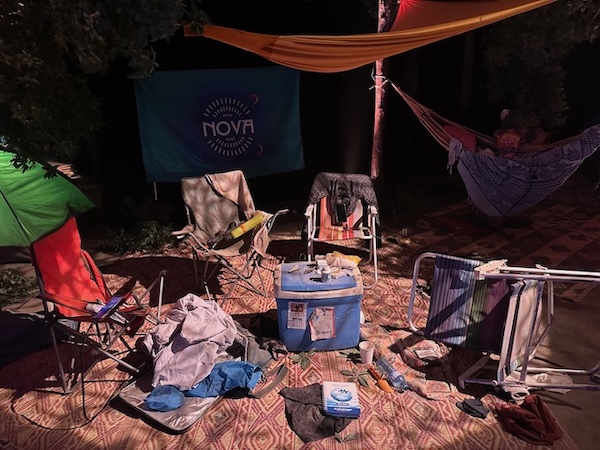
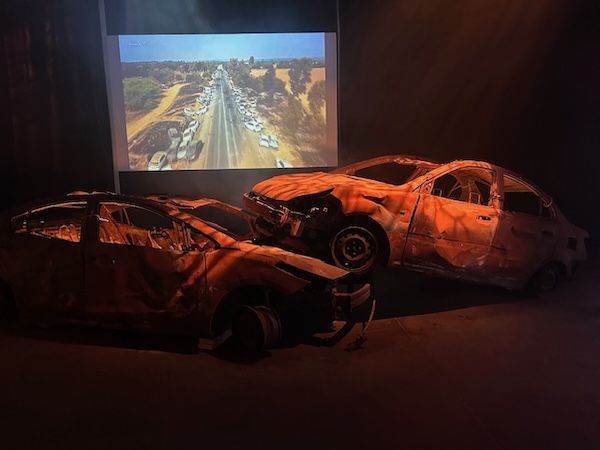
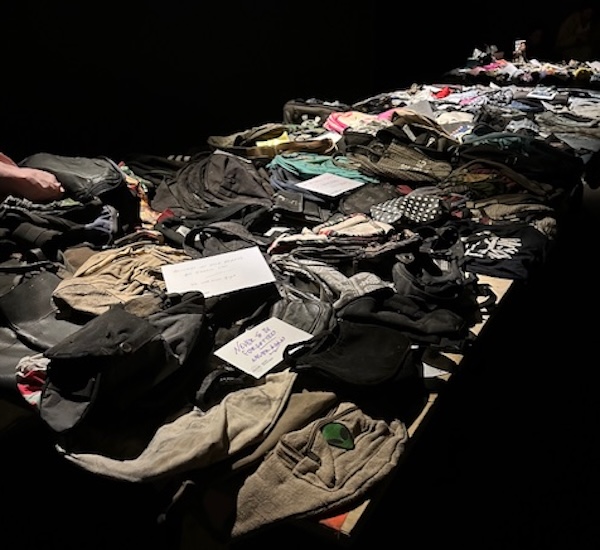
The Nova Exhibition commemorates the massacre at the Nova music festival on Oct. 7, 2023. The exhibit is in Toronto until June 8. (photo by Lorraine Katzin)
My friend Karen Shalansky and I, from Congregation Har El, went on a Jewish National Fund tour to Israel in April 2024, traveling with some congregants from Congregation Beth Israel. We were based in Tel Aviv but drove to the south to see the Nova Festival Memorial and the car cemetery. (See jewishindependent.ca/reflections-on-april-mission.)
When I heard of the Nova Exhibition, which had been traveling to New York, Los Angeles and then Miami, I Googled to see if it was going to be in Toronto. While we live in Vancouver, my husband and I were going to be heading to Toronto for our granddaughter’s Grade 1 siddur celebration. I was able to purchase tickets to the exhibition for May 6, during the time we (and our daughter) were going to be in the city.
Normally, when we go to Toronto, we attend Saturday morning services at our son’s synagogue, the Village Shul. It just so happened that, on the Shabbat of our visit, the guest speaker was Ophir Amir, one of the founders of the Nova music festival and one of the producers of the Nova Exhibition. Amir was shot in both legs by Hamas terrorists on Oct. 7, 2023. He survived, but so many of his friends did not. He shared: “While I was hiding from the terrorists, I thought about my wife, who was pregnant, and that’s what saved me.”
(photo by Lorraine Katzin)
The Nova Exhibition tells the stories of the victims and helps this community begin to heal – we will dance again.
The first part of the exhibit is a movie. It shows people having fun, enjoying life, singing and dancing, until 6:29 a.m. on Oct. 7, when the music stops and security starts shouting “Red alert! Tzeva adom!” as they could see the rockets flying over Israel. They tell everyone to go home. The movie ends.
We were then led to another room for a reenactment of what came next. There were different TV screens showing how the Hamas terrorists came through the fence, the continuous firing of their weapons, the continuous shouting of “Allah Akbar!”
The next area is filled with belongings from the festival, which include tents, sleeping bags, chairs, clothes, snacks, trees, the market, featuring various items, portable toilets, the bar, freezer chests, burnt-out cars, shelters, and more. By each display there is a TV screen with a survivor telling their story. One young girl lost 15 friends, another young man lost more than 40 friends, a mother lost two of her daughters. Many different stories of loss, as well as stories of heroism.
On one wall of the exhibit are photos of the Nova hostages still held in captivity by Hamas. On another wall are photos of all the people at the Nova festival who were murdered on Oct. 7 – as well as their hats, shoes, other clothing and knickknacks.
(photo by Lorraine Katzin)
As you walk through the exhibit, it shows how the larger community is helping with the psychological trauma, the grieving process, the bereavement, the difficulties of survivors to function day-to-day. All the proceeds from the exhibition are dedicated to helping heal and rehabilitate survivors, commemorate those who were lost, and support the bereaved families.
We spent two-and-a-half hours walking around and reading testimonies. We came out emotionally drained. Our Israeli brethren are resilient, they have ruach, spirit, and they are dancing again.
The Nova Exhibition runs until June 8 at 1381 Castlefield Ave., in Toronto. For more information, visit novaexhibition.com.
Images from the exhibition:
(photo by Lorraine Katzin)(photo by Lorraine Katzin)(photo by Lorraine Katzin)(photo by Lorraine Katzin)
The Jewish Regional Communities Conference April 27-28 brought together Jewish communities from throughout the province to network, engage and learn. (photo from Jewish Federation of Greater Vancouver)
The Jewish Regional Communities Conference was the first of its kind. The April 27-28 event included Jewish communities from throughout the province and was a time for everyone to come together, connect, hear various speakers and participate in workshops.
The conference kicked off with a message from Ezra Shanken, chief executive officer of the Jewish Federation of Greater Vancouver. He talked about how the conference was 10 years in the making.
“This conference started with a simple question, how do we support Jewish life, everywhere in BC, in every place where people are trying to connect, trying to build community on their own?” he said. “How do we support them? For years, we’ve been hearing that regional communities want more connection to each other, more access to resources and more chances to share what’s working. So, we listened, we had conversations, we showed up, we learned a lot, and now we’re here together to move the conversation forward – because vibrant Jewish life doesn’t look the same everywhere, and it shouldn’t. What matters is that it reflects you – you in this room, your people and your values. Federation’s job is not to decide what that looks like. Our job is to walk alongside you, to listen and to help open doors.”
Shanken’s statement encompassed what the conference was about: having regional communities coming together to network, engage and learn. The conference had numerous breakout sessions where attendees could learn about different subjects.
One session was on developing leaders in small communities, which was led by Lyssa Anolik, community connector, Squamish/South Sea to Sky, at Jewish Federation. In the workshop, attendees brainstormed on various questions, and ideas were discussed on how to motivate and support volunteers, create visions for each community, and event planning.
Another keynote speaker was Rabbi Mike Uram, chief Jewish learning officer for Jewish Federations of North America. The presentation was held over Zoom and questions were welcomed throughout. One person asked how to maintain relationships within a community, especially if they are challenging. Uram, who had worked with the late John McKnight and John Kretzmann at Northwestern University, said they had advice on this topic.
“If you make a map of everything that’s wrong and then try to fix it, it creates a whole bunch of unanticipated negative consequences,” said Uram. “One of those consequences is that, when you’re thinking about things from a position of scarcity, then there’s always a debate about what is the one magic bullet answer that’s going to solve the issue, and both of them talked about [how,] just by flipping the conversation and beginning with the assets that you have – like, how do you map out what works? – that it actually dispels some political infighting, because you’re not approaching what is the future of the community. So that, I think, works across the board as a way of preventing burnout in leadership.”
He added, “One of the tricks is to make sure that you’re pitching the future and the conversation you’re having as a community way off at the horizon and thinking about all the things we could do, rather than fighting about how we’ve divided the pie as we have it, because that actually does, I think, tend to bring out people’s fear and a little bit of animosity and that kind of zero-sum thinking.”
The rest of the presentation talked about different theories or strategies that can build lasting and prosperous regional communities.
In addition to other speakers and breakout sessions, there was a conversation with Nova music festival survivors Raz Shifer and Inbal Binder, who participated in many activities when visiting Vancouver from Israel. Both talked about who they are and their own experiences on Oct. 7. (See jewishindependent.ca/healing-from-trauma-of-oct-7.)
Nova music festival survivors Inbal Binder, left, and Raz Shifer spoke at the conference. (photo from Jewish Federation of Greater Vancouver)
Having had trouble getting back to work after the horrific tragedy, the two attended a program at Healing Space Rishpon.
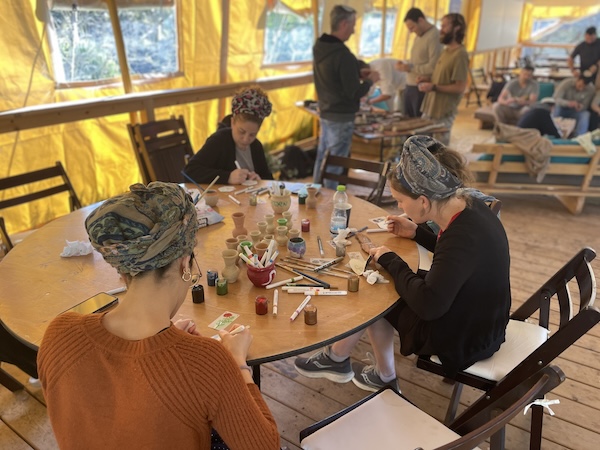
“We went there three times a week … and we made ceramics and candles,” said Shifer. “From just creating with our own hands, it helped us process all the trauma and just feel useful…. For me, it really made movement again in my life and then I met Inbal – we’re good friends now.”
Speaking at the conference was challenging, said Shifer.
“Almost the day before I came here,” she said, “it was like, oh my God, how am I going to do it? I think the twist that came after is the power of the group. I heard that you all came from different places – but we are all Jewish, and it’s something that I expect here in many kinds of communities.”
Chloe Heuchert is an historian specializing in Canadian Jewish history. During her master’s program at Trinity Western University, she focused on Jewish internment in Quebec during the Second World War.
Healing Space has treated more than 20,000 people since it began in response to the trauma caused by the Oct. 7 terror attacks and the ensuing war. (photo from Healing Space)
“It’s important to talk about it because there are still hostages who have been living Oct. 7 every day for over a year-and-a-half. It’s important to talk about it because antisemitism around the world is growing stronger, and there are people who deny or justify the horrors we went through that day. This is not a political matter – it’s a matter of humanity. It’s about human lives,” Raz Shifer, a survivor of Hamas’s horrific terror attack on the Nova music festival, told the Independent.
Shifer, who lives in Giv’atayim, Israel, will be joining Vancouver’s community Yom Hazikaron ceremony on April 29 and Yom Ha’atzmaut celebration on April 30. Another Nova survivor, Inbal Binder, from Petah Tikva, will be coming here as well, and she and Shifer will, among other activities, participate in the events, visit several local Jewish schools and address Federation’s Regional Communities Conference.
Also coming to Vancouver is Dr. Ilana Kwartin, chief executive officer of Healing Space Rishpon, where both Shifer and Binder have participated in workshops and treatments. She has some meetings lined up, but the Israel-related events are the main purpose of the visit.
“In addition, I’m happy to meet people one-on-one or book speaking engagements for groups, communities and teams, where we can share the story of our work and, through that, the story of Israel at this time,” she said.
Healing Space Rishpon was created by Dr. Lia Naor in response to the trauma caused by the Oct. 7 attacks and the ensuing war. With Ra’anan Shaked, therapists and volunteers, Naor set up a centre at Ronit Farm in Sharon that operated for just over a month. With Patrizio Paoletti and Rani Oren, a permanent base was then established in Rishpon. Since Healing Space began, more than 140 therapists have given almost 60,000 hours to treating more than 20,000 people in 16 trauma-healing modalities.
Kwartin became CEO right after Oct. 7. She and her family live in Eliav, a yishuv she helped found, which is in the northern Negev, abutting the separation barrier.
“The Black Shabbat of Oct. 7 upended my life, like it did for so many others, and as we – individuals, families, communities and a nation – mourn, work to pick up the pieces, mend what can be repaired and rebuild where it cannot, I put my personal and professional background to use as the CEO of this one-of-a-kind haven,” she told the Independent.
Dr. Ilana Kwartin, chief executive officer of Healing Space Rishpon, is coming to Vancouver with Nova music festival survivors Raz Shifer and Inbal Binder for Yom Hazikaron and Yom Ha’atzmaut. (photo from Healing Space Rishpon)
Kwartin was born in the former Soviet Union and made aliyah in 1987, growing up in Jerusalem. “As an officer in the IDF, I served as a tatzpitanit [spotter] in Nachal Oz and later as a founding commander of the Netzarim observation post, and the tragedy of the tatzpitaniyot struck me deeply,” she said, referring to the female military unit that warned of a potential terrorist attack and whose soldiers were among the first killed and kidnapped on Oct. 7.
With BAs in law and psychology from Hebrew University of Jerusalem, Kwartin earned an MA in conflict resolution from Ben-Gurion University of the Negev. Her book, Imprisoned, came from her PhD dissertation on honour-based confinement, which she did at Bar-Ilan University. The stories have inspired activist initiatives across Israel and informed legislation, she said.
Kwartin lectured in law at Sapir College, where she built their legal internship placement program and founded a centre of legal activism, A House of their Own. “More recently,” she said, “I spent three years on shlichut in Los Angeles as the director of Jewish Agency operations on the West Coast. With the outbreak of war in Ukraine, I traveled to the Ukrainian border to help rescue Jewish refugees and bring them to Israel.”
Kwartin’s work at Healing Space Rishpon changes every day. “The programs are so varied and cover many groups of the Israeli population,” she said. “But the most meaningful part is the people who work here – very similar to me, they left everything they were doing and started working at Healing Space to repair the emotional damage we all see around us. They work tirelessly, in uncertain conditions, long hours, doing the hardest work imaginable. It is thanks to the team that Healing Space makes such a big difference in people’s lives.”
Binder found out about Healing Space inadvertently.
“I had heard there was a treatment centre you could go to, but I wasn’t in a mental state that allowed me to reach out for it,” she explained.
“Later on, I was looking for something that could get me out of the house in the mornings and help create a daily routine. By chance, I came across an ad for a new rehabilitative employment program at Healing Space and it sounded amazing – working with my hands, being in a warm and supportive environment, where I could focus on myself and begin a new movement in my life.”
Binder worked as a beautician before Oct. 7 and, while not currently working, she is taking courses, most recently completing one in conscious psychotherapy. She started going to Healing Space early in the war. It “was the first time I realized that another way was possible – that someone was truly listening to me,” she said.
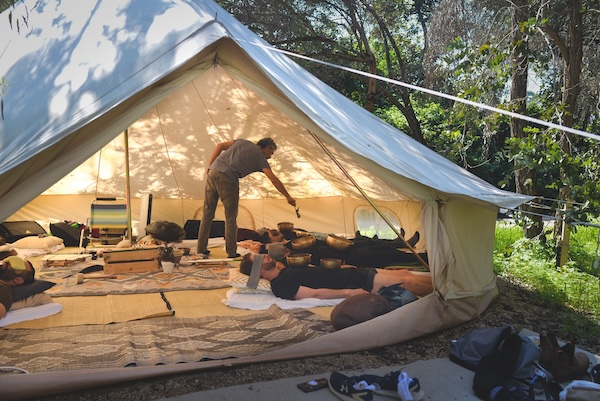
“More than that, I got to experience treatments I never imagined I’d try, like sound healing and yoga therapy. These are treatments I still do to this day, to help maintain my emotional balance and regulate my body.”
At Healing Space, she added, “Even my mom, who was never really drawn to holistic healing, found a deep connection with one of the therapists and opened her heart to her – that really moved me.”
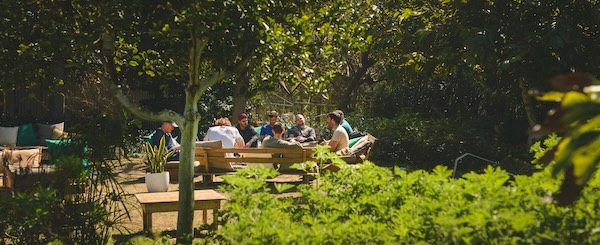
A group gathered outside at Healing Space Rishpon. (photo from Healing Space)
From a place of not wanting to do anything or face anything, Binder said, “I now want to grow. I want to move forward and live a good life. And none of this would have happened without the process I went through over the past six months.”
Binder’s Vancouver visit will be the first time she is telling her story publicly.
“Honestly,” she said, “it’s a little overwhelming to come and talk about my healing journey. It also means recognizing my story – and that alone is a challenge for me. I feel both excited and nervous – telling my story for the first time and receiving acknowledgment for it.
“It’s important for people to hear about the massacre because it was a Holocaust repeating itself,” she said. “The Jewish people are once again in danger, and it’s crucial to echo these stories, to make sure people know and remember.
“Beyond that, the connection between Jews in Vancouver and Jews in Israel – to build strong, deep connections across Jewish communities around the world – that connection is what has always kept us strong as a people.”
Binder attended the Nova festival with her sisters.
“It was actually the first evening that my sister’s boyfriend was introduced to our parents,” she said. “From there, the four of us drove to the party in the south.
“In the morning, when the rockets started, I called my mom to let her know and said we were heading home. We got delayed near the party because one of our friends had a panic attack, and we waited with her.
“We made it to the car, but it took time to decide what to do. At 8:30 a.m., the boyfriend took the lead, called his father, picked us up in the car, and we escaped through the fields. His father navigated him over the phone throughout the whole drive, and that’s how we managed to get out safely. Which is crazy in itself – the reality was so different for so many others. It felt like we were in a divine bubble that protected us.”
“It was the scariest day of my life,” said Shifer of Oct. 7. “I didn’t know if I would make it back home or not, and I didn’t know which of my friends would survive. It was a feeling of helplessness, complete loss of control and sheer terror.”
Unlike Binder, who is only now beginning to share her story, Shifer – who is an actor, singer and artist – has been interviewed by media around the world and has spoken at schools, universities and synagogues.
“I also found myself advocating and telling our story through music during performances,” she said. “In addition, I led tours for people who came to the Nova site and shared my personal story with them.”
Initially, Shifer refused to leave her house after Oct. 7.
“Friends told me there was a place where survivors go to heal, but I was too afraid to go outside and couldn’t bring myself to get there,” she said. “Then, one day, a volunteer came to my home and helped me take that first step – to leave the house and arrive at Healing Space. From that day on, something opened up in me, and I began coming every week.”
Healing Space has helped Shifer cope with her trauma in many ways.
“First of all, the location,” she said. “You arrive at a place full of trees and greenery – everything is peaceful and calming.
“There’s something comforting about sitting among people who have been through something similar to me,” she continued. “The therapists at the centre are kind and embracing. The shared music circles helped me find my way back to music. But, more than anything, it’s the feeling that I’m not alone. That I am seen. That there’s a place that can hold me.”
People at Healing Space Rishpon have had similar experiences. (photo from Healing Space)
The body treatments have allowed Shifer to release some stress and start letting down her defences.
“The long-term project I joined under Healing Space gave me the tools to return to a routine and become an active human being again,” she said. “Healing Space is a deeply meaningful part of my recovery process – and I honestly don’t know what I would have done without them.”
To register to attend Yom Hazikaron or buy tickets ($18) for Yom Ha’atzmaut, visit jewishvancouver.com.