Concerns over inflation

Last fall, the Jewish Federation of Greater Vancouver surveyed the impact of inflation on its community partner organizations. As with many recent reports on the effects of rising prices, the feedback was sobering, said Shelley Rivkin, vice-president of global and local engagement at Federation, which conducted the survey.

When asked about how the rise in food and fuel will affect their ability to provide the same level of service, 95% of the organizations that responded said they were either concerned or very concerned about inflation. A similar response was returned when community members were asked about paying school, camp, synagogue or Jewish community centre membership fees.

For social service and housing providers, the main concerns were the level of care, due to reduced staffing; the number of affordable housing units available; food programs for students and families in need; and low-cost (or free) social and recreational programs for seniors. Other organizations cited concerns about the future of kiddush and seniors lunches, volunteer appreciation, building maintenance and upkeep, prepared meals for food bank recipients, and membership subsidies.

The survey notes that rising costs are affecting, to varying degrees, the ability of agencies to maintain their current level of service, recruit and retain staff, raise funds and balance budgets. Some organizations have been unable to provide staff with a cost-of-living-adjustment raise, thereby threatening their capacity to retain staff and deliver programming, and higher salary expectations mean that positions are vacant for longer, limiting the ability to grow programs. Food costs for hot lunches are up 20% and there has been a 25% increase in salaries for kitchen staff.

Rivkin stressed that, in the four months since the survey was conducted, costs have come down for some items, but the price of food continues to rise.

“Our agencies and synagogues survived COVID, and we thought we were past the difficult times,” she said. “However, we are now seeing the impact of inflation on them. When we decided to undertake the survey, we had no idea about the depth and breadth of the impact of inflation or that these pressures would affect everything from staff salaries to the cost of paper supplies. We are now working with our community agencies to explore ways to reduce costs. We recently hosted a lunch-and-learn featuring speakers from the Buying Networks Canada.”

The Buying Networks Canada is a Toronto-based organization that helps nonprofit, charitable and faith-based organizations across Canada save money on such things as food and beverages, office supplies and equipment, maintenance, and numerous other products and services.

In the summer of 2022, Jewish Family Services (JFS), one of Federation’s community partners, released information on the impact of inflation. Among the points in the JFS report were an increase in the number of clients asking for food voucher assistance, a record number of intakes for home support and the challenges Ukrainian newcomers on a limited income face with rents and food costs.

Food insecurity, according to JFS, has grown in recent months and the organization expects an increase of 150 new clients, if trends continue. Higher prices at the gas pump have resulted in fewer volunteer drivers. The greater need for services has translated into a higher workload for JFS staff.

“Community that JFS serves is on fixed income, and those individuals are the ones who suffer tremendously during this time,” said Tanja Demajo, chief executive officer of JFS. “What that means for JFS is that the number of people reaching out for help is on constant rise. Between the rise in prices, number of clients and cost of staffing, we as an agency have to ask ourselves what is our priority. This is the time when we get clarity, more than ever, who we are and what we need to do. Our goal has always been not to leave anyone behind. We hope that, even during the challenging times such as these, we can remain true to that.

“Since COVID,” she added, “staffing has been a significant challenge. It is very uncomfortable for many agencies to speak about issues of salaries, but the reality is that the professional staff has always been underpaid in the nonprofit world. With inflation, this issue has further grown and, unless taken seriously, it may impact the whole social sector in irreversible ways. Providing social support is based on relationships, and with constant changes those relationships get eroded.”

Anat Gogo, executive director of Tikva Housing Society, another Federation partner agency, is also concerned. “Inflation significantly impacts the delivery of housing programs due to increased costs and reduced availability of resources,” she said. “It can also make it more difficult for low-income households to afford adequate housing, so we are reaching out to our donors to assist us in ‘gapping’ the additional … funding needed to meet our commitment to the delivery of affordable housing and rent subsidies.”

Sam Margolis has written for the Globe and Mail, the National Post, UPI and MSNBC.
Helping feed community

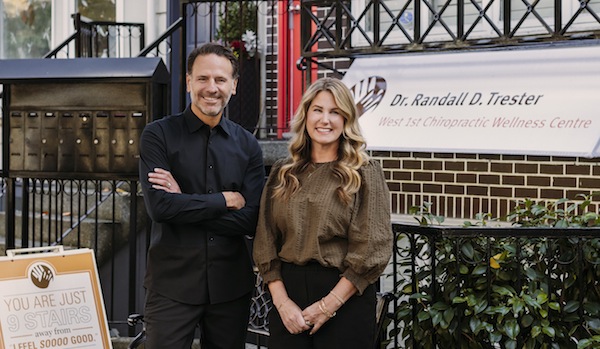
Dr. Randall and Shalene Trester, who run West 1st Chiropractic Wellness Centre. Last year, their food drive collected more than 400 pounds of food for the Jewish Food Bank. (photo by Allison Kuhl)

Since 2016, patients at West 1st Chiropractic Wellness Centre have been bringing in non-perishable food items destined for the Jewish Food Bank. These donations are collected and, in turn, provided to those in the community who face food insecurity.

The Jewish Food Bank struck a particular chord with chiropractor Dr. Randall Trester and his wife Shalene, who run the centre, which will celebrate its 20th anniversary this September.

“I had a few friends that had been helping with the food bank and they told me how difficult the situation is for some people. I felt we just had to get involved,” Shalene Trester told the Independent.

The Tresters hold the food drive every December, reminding clients ahead of time by posting information throughout the centre and via email correspondence.

“Our patients are really the ones who should get all the credit. We organize it every year and it’s amazing to see the generosity of our patients,” said Shalene Trester, who manages the office. “Our patients look forward to participating. It’s awesome to see the overflowing boxes at the end of the food drive. It’s such an awesome feeling to give back to our community every year.”

The most recent drive saw an increase in the amount of food donated. “There was a greater need,” she said.

“The Tresters have been supporting us for many years through their annual food drive and donating all the food to us,” said Carol Hopkins, the coordinator of the Jewish Food Bank. “Last year, they donated 410 pounds of food. We really appreciate their support.”

Distribution for the JFS Grocery Program is held weekly at JFS’s the Kitchen, located at 54 East 3rd Avenue in Vancouver, and at hubs throughout the Lower Mainland. For those unable to pick up their grocery order at one of the hubs, JFS offers a delivery service.

“We currently serve approximately 900 people and provide more than 12,000 kilograms of healthy food every month,” said Hopkins. “The JFS Grocery Program does not offer any meats, poultry or shellfish. We ensure that kosher items are available for clients who do keep kosher.”

The majority of supplies at the Jewish Food Bank are bought, and the team relies heavily on donations – non-perishable food or money. Among the benefits of hosting a food drive, the Jewish Food Bank notes on its web page, are “engaging your community members and helping to spread the word on the issue of hunger, [while] also providing an incredible service to your neighbours in need.”

Some of the best items to donate are rice; canned or dried beans, lentils and legumes; whole grains (oats, barley, millet, bulgur, quinoa, couscous); canned fish (tuna, salmon, sardines); canned tomatoes and tomato sauce; and pasta. According to the Jewish Food Bank, a $10 donation can buy $30 of food at wholesale prices or provide four days of healthy snacks for five children.

Soap, shampoo, toilet paper and diapers are greatly appreciated and needed as well.

The Jewish Food Bank funders include Jewish Women International-B.C. and many community members. Any person or organization wanting to organize a food drive should call 604-558-5698 or visit jfsvancouver.ca/food-drive.

Sam Margolis has written for the Globe and Mail, the National Post, UPI and MSNBC.

Students are learning to cook

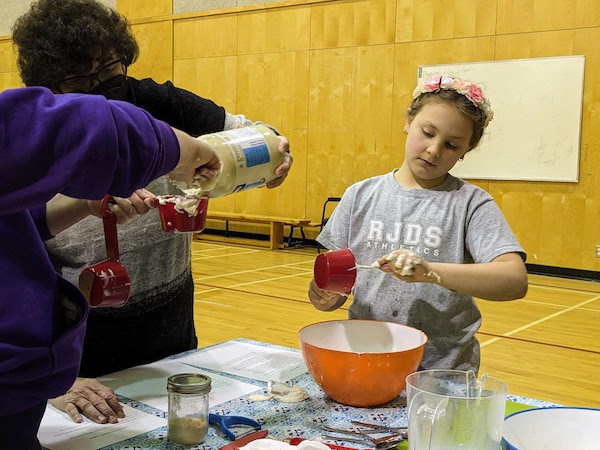
In Richmond Jewish Day School’s Food Lab Program, students help prepare meals once a month. (photo from RJDS)

One by one, students at Richmond Jewish Day School filter down the hallways following the smells of a delicious and nutritious meal. Waiting for them in the gym is lasagna, Caesar salad and a pesto prepared by RJDS students with the help of Jewish Family Services culinary master, Chef Zoe Sorokin.

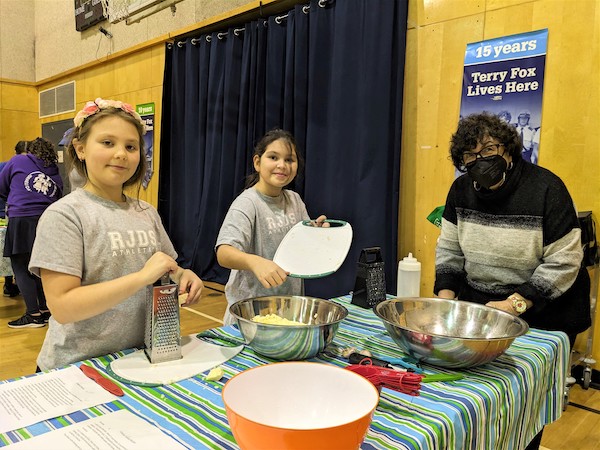
RJDS’s Food Lab Program is the first of its kind in a Jewish day school in Metro Vancouver. It is just one of the current programs running in RJDS to enhance students’ access to healthy and nutritious food in a way that promotes community and inclusiveness. Every week, JFS makes and delivers hot meals at no cost to the students or their families. Once a month, students in grades 4 through 7 take an active part in this, helping with the preparation of the meals, including chopping, grating and cooking the plant-based ingredients.

photo - Once a month, students in grades 4 through 7 take an active part in this, helping with the preparation of the meals, including chopping, grating and cooking the plant-based ingredients
Once a month, students in grades 4 through 7 take an active part in this, helping with the preparation of the meals, including chopping, grating and cooking the plant-based ingredients. (photo from RJDS)

“I enjoy learning new cooking skills,” said Naomi, a Grade 4 student. “My favourite dish was the bean soup.”

“I love that we use all our senses when cooking,” said Ella, who is in Grade 5.

With demand at food banks growing over the course of the pandemic and rising inflation, food insecurity has become a reality for more families. RJDS students and school staff have led several efforts, with the support of social service partners, to help families feeling the pinch. Last year, with the assistance of the Jewish Federation of Greater Vancouver, Kehila Society and JFS, RJDS began a community fridge and pantry program. The partner agencies, plus the Richmond Food Bank, keep the fridge and pantry stocked and RJDS families can access free healthy snacks, dry goods, fresh produce and meals during school hours. The Food Lab represents an expansion of the school’s food programs.

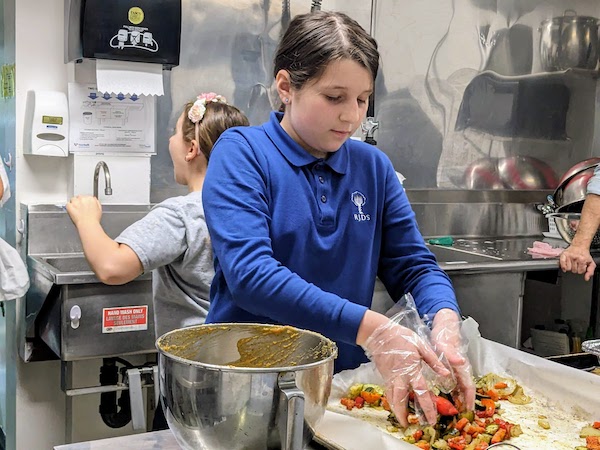
photo - The Food Lab represents an expansion of the school’s food programs
The Food Lab represents an expansion of the school’s food programs. (photo from RJDS)

“The students at Richmond Jewish Day School have absolutely loved the weekly hot lunches,” said principal Sabrina Bhojani. “Our parents have also expressed their delight with this program, knowing that their children are receiving a warm, healthy and nutritious meal at school. The research is clear – good nutrition helps our children to focus, concentrate and self-regulate, which, in turn, results in improved learning and student performance.”

She added, “Not only are the students helping in preparing food to be enjoyed by the school, they are also learning about making informed decisions about food choices, food safety, the importance of food supply and healthy nutrition.”

photo - Students helping preparing food to be enjoyed by the school
Students helping preparing food to be enjoyed by the school. (photo from RJDS)

“I love participating in the Food Lab program,” said Yahel, who is in Grade 5. “It is a fun experience and I get to learn new skills that I can use at home.”

Vienna, also in Grade 5, agrees, saying: “I enjoy learning new cooking skills that I can share with my family.”

The RJDS kitchen has become a place for children to learn new and valuable life skills, to enjoy good food with friends and, most importantly, a place in which they can contribute and build strong relationships.

– Courtesy Richmond Jewish Day School

Building bridges to inclusion

Volunteers from the Jewish community turn up each June to prepare, label and deliver freshly cooked meals to Black families as a sign of community support. (photo by JFS photo by Madison Slobin)

How do you build a more inclusive Jewish community, one that thrives on diversity? For Vancouver’s Jewish Family Services, says chief executive officer Tanja Demajo, resilience starts with building bridges. And it flourishes with finding common links between cultures.

During the last few years, JFS has been expanding the programs it offers to Jewish communities throughout Metro Vancouver, and looking for new ways to enrich conversations around diversity and inclusion. 

Projects like the Shiva Delivers partnership with Vancouver’s Black community and Twice Blessed 2.0: The Jewish LGBTQ2SIA+ Initiative are helping forge alliances and cultural understanding.

Sharing home-cooked meals

Shiva Delivers, which provides traditional home-cooked meals to Black families dealing with loss and grief, was started by Madison Slobin and Becca Schwenk in 2020 following the death of George Floyd, who was killed on May 25 of that year during a routine traffic stop by Minneapolis police. His death ignited protests in cities across North America, including Vancouver. According to Demajo, Shiva Delivers emerged as “a response to the social injustice and the grief that the Black community were experiencing.” (See also jewishindependent.ca/providing-comfort-and-hope.)

Slobin and Schwenk ran the program independently the first year with a cadre of volunteers from the local Jewish community. In 2022, JFS jumped on board, offering its kitchen as an operation centre for the project, which takes place every June. According to Slobin, Jewish families from across Vancouver signed up to cook full-course meals and carry out the deliveries, inspired by the very Jewish tradition of responding to tragedy and mourning with food.

“When someone in our community is grieving, we support them with food and with showing up and saying, ‘we’re here for you,’” Slobin said, noting that the concept was popular with volunteers from the start. “We had young Jews participating, we had Orthodox Jews participating, we had [people] from all spectrums [of the community].”

According to Demajo, news about the program arrived at the right time for JFS.

“JFS was going through this exploration of how do we work with and reach out to different communities,” Demajo said. “What we really learned was, first of all, a large Jewish community was interested in making this connection and intercultural exchange … with the Black community and showing their solidarity. And, on the other hand, the Black community was just touched by the fact that another cultural group offered that support.”

Demajo said she received many expressions of thanks from Black community members stunned by the gesture – and the elaborate dishes. “Are all Jewish people such good cooks?” one person called to find out. “Your food is amazing!”

But the project also helped JFS confirm that there were members of the Black community who were Jewish but not affiliated with the Jewish 

community. Demajo said she realized this when a young woman who had received one of the dinners contacted her to ask why the Jewish community was doing this. 

“Well, you know,” Demajo told the woman, “we have Black people in [our] community as well, and we want to build bridges and reach out [and] learn from each [other’s communities].” A moment later, Demajo said she heard the woman’s child calling to her. The child was speaking in Hebrew. “And that kind of took me back a little bit,” Demajo admitted. 

It turned out the woman had moved here from Israel some years earlier but wasn’t participating in the Vancouver Jewish community. “Even though I lived in Israel,” she told Demajo, “I’ve never felt part of the community here.” 

“And I realized at that moment,” Demajo said, “how important this [program] is, because we don’t know who the people are that we seem to support, until we actually do reach out and hear these stories.”

Slobin said the project not only inspires more opportunities for sharing between the two communities, it’s helping convey an important message to Black Jews that they are indeed a welcome part of the Jewish community. “Every single year that we have done it, we have had Black Jews participate and express how meaningful it is for them to see their own community recognize them in this way,” said Slobin.

Being more welcoming

Twice Blessed 2.0: The Jewish LGBTQ2SIA+ Initiative formed in response to a survey that JFS and JQT Vancouver (a volunteer-run Jewish queer and trans nonprofit) compiled in 2021 to determine the needs of the local LGBTQ2SIA+ community. The results were released earlier this year.

Some respondents said they feel unwelcome in the greater Jewish community, while others stated they feel ostracized by the LGBTQ2SIA+ community because they are Jewish. Most respondents felt that clear “‘indicators of support’ for the LGBTQ2SIA+ community would make them more inclined to participate in the Jewish community.”

“Our commitment to diversity and inclusion must speak through our actions, and not only our words. 

Although not an easy task, it is an imperative one,” wrote Demajo and JQT executive director Carmel Tanaka in the report, which can be found at jqtvancouver.ca/twice-blessed-2. (See also jewishindependent.ca/thirteen-calls-for-action.)

“One of the lessons we need to learn is, how do we make our agency more welcoming for different people?” Demajo said, “And, very simply, how do we do that in a dignified way?”

These questions are also helping JFS reexamine how it’s interacting with other cultures and communities when it’s providing social and economic support to Jewish families.

“I think it’s important for us as a community to understand the clients that we support live in very diverse neighbourhoods, which means that probably, on a daily basis, they see a lot of diversity and they live in those circles. When we as an agency provide certain supports to one targeted group and exclude their neighbours … that creates a lot of tension that gets reflected in their day-to-day life. So, at the end of the day, we all go home but they have to deal with the aftermath of the way we provided services … and this is why, on our end, it became really clear that, in order to support our clients, it’s not just a question of providing services directly to them,” explained Demajo. “It’s also ensuring that they have a safe community, a community of allies, a community that they can rely on when we’re not around. By building these bridges between all these different groups, I believe that we can create that.”

Learning from the past

JFS is currently exploring a number of new projects focused on diversity and social inclusion, both within the Jewish community as well as forming relationships outside its cultural space. JFS’s the Kitchen is often the meeting space.

“I think the beauty of having a kitchen is having a space for, again, sharing the stories and experiences through food,” Demajo said.

Recently, JFS has been partnering with organizations like CIJA and the Jewish Federation of Greater Vancouver to explore ways in which different cultures can share their culinary traditions, stories and passions.

Demajo said JFS is also doing a review of some of the programs it has offered in the past. “We really want to learn from things that went well, things that did not go well, and we understand in this space that there will be a lot of road [to travel], which is not easy. But it takes a lot of courage to step outside of that comfort zone as well.”

About tikkun olam, repairing the world, she said, “Conversation may start with a handful of like-minded people, but it takes diversity and acceptance to build an inclusive community.

Jan Lee is an award-winning editorial writer whose articles and op-eds have been published in B’nai B’rith Magazine, Voices of Conservative and Masorti Judaism and Baltimore Jewish Times, as well as a number of business, environmental and travel publications. Her blog can be found at multiculturaljew.polestarpassages.com.

Community milestones … Roadburg Foundation supports Tikva Housing, Community Garden & more

Tikva Housing Society is thrilled to share that the Ronald S. Roadburg Foundation has provided a grant of $255,000 to support Tikva’s mission to offer affordable housing solutions to the Jewish community.

“A gift of this magnitude provides help and hope at a time when economic uncertainty is definitely impacting housing insecurity,” said Anat Gogo, executive director of Tikva Housing Society. “The Ronald S. Roadburg Foundation’s tremendous generosity means that we will have the financial resources to build capacity on an operational level. Tikva is on an unprecedented growth trajectory and this gift is critical to support our growing housing portfolio, allowing us to say ‘yes’ to a number of new opportunities on the horizon.”

The need for affordable housing continues to be first and foremost on the minds of many in the Jewish community. This gift will be put to work, empowering individuals and families by providing affordable housing – allowing them to build long-term change in their lives and beyond.

Tikva Housing Society is grateful to the Ronald S. Roadburg Foundation for its partnership in addressing the issue of housing insecurity. Tikva appreciates the foundation’s focus on strengthening the capacity of the community’s organizations and its commitment to tikkun olam, repairing the world.

* * *

Vancouver Talmud Torah, Congregation Beth Israel and Jewish Family Services are elated to share with the community that a gift of $100,000 has been received from the Ronald S. Roadburg Foundation to support the Vancouver Jewish Community Garden. This gift enables the building of the garden to begin in earnest and it is anticipated that construction will begin this fall. Thanks to the Jewish Federation of Greater Vancouver’s Transformation Grant and the Diamond Foundation, the garden will be located and built above the shared BI and VTT parkade.

The garden aspires to positively impact many members of the local Jewish community and to be a hub for celebrating and honouring nature, imparting Jewish teachings and values, promoting collaboration, and enhancing the community’s well-being. Studies show that spending time outdoors in nature has been directly linked with lessened anxiety and depression for adults and children alike and helps people better manage stress.

“It is exciting and encouraging to see several important communal institutions come together collaboratively to advance such a positive new opportunity. The Vancouver Jewish Community Garden will be an opportunity to teach community members of all ages about agriculture and the importance of a healthy earth, to enable volunteers to contribute to our community and to help feed those in need. The Ronald S. Roadburg Foundation is pleased to help advance the project towards completion,” noted Bernard Pinsky, Roadburg board chair.

* * *

Jewish Federation of Greater Vancouver is delighted to welcome two new members of its team: Gayle Morris and Alisa Farina.

Morris is the new director of the Federation annual campaign, the community’s central fundraising initiative. Building relationships is central to this role, and Morris brings an incredible depth of experience in that area, and so much more. She is an accomplished and multifaceted sales, marketing and business development leader who has extensive experience in both innovative startups and not-for-profit organizations. She is also an active member of the community with extensive volunteer involvement.

Farina has been hired as the child, youth and young adult mental health worker, and Federation is grateful to the Mel and Gerri Davis Charitable Trust for the support to enable the creation of the new position.

Farina holds a bachelor’s in child and youth care and comes to the job from a 25-year career with the Burnaby School District, the last 10 of which she focused on working with high-risk, vulnerable youth and their families. Farina is currently completing her master’s degree in clinical counseling. She grew up in the Lower Mainland and was involved with BBYO and Camp Miriam.

Thirteen calls for action

The recently released report, Twice Blessed 2.0: The Jewish LGBTQ2SIA+ Initiative, offers a hint of just how diverse the Metro Vancouver Jewish community is. In that diversity lies challenges and opportunities.

“Embarking on Twice Blessed 2.0: The Jewish LGBTQ2SIA+ Initiative has been an important step in acknowledging our gaps and our commitment to learn and work towards diversity and inclusion in the Jewish community,” write Carmel Tanaka, founder and executive director of JQT Vancouver, and Tanja Demajo, chief executive officer of Jewish Family Services Vancouver, in the final report’s preamble. “It is important to identify the work that has and has not been done. Taking pause and asking ourselves: Where are we today? What prevents us from engaging deeper into these conversations about diversity and inclusion? And where do we want to go?”

“The word diversity is used so often these days, but it is not easy to define what it means on a day-to-day basis in an environment such as JFS,” Demajo told the Independent. “This process started simply by acknowledging ‘we don’t know what we don’t know’ but we are willing to learn. Carmel and I started conversations about the LGBTQ2SIA+ community and how open JFS is to their members. Saying everyone is welcome is not enough, it takes much more commitment and work. There could have been other ways to engage in that conversation, but we started with the training and learning about the work done in 2004.”

“We are honoured to have collaborated with Dr. Jacqueline Walters, who did the 2004 survey that never saw the day of light,” said Tanaka. “It is so rare to be able to include those who have come before us in ways that help with continuity and give the opportunity for healing. A lot has changed since 2004, not just in the Jewish community on LGBTQ2SIA+ inclusion, but also more broadly, especially surrounding language and terminology. So, we paid homage to the 2004 questions and updated how these questions were asked in 2022.”

Developed from the 2004 community needs assessment conducted by JFS, many of the 2022 questions were the same, but others were added or reworded to reflect changing times or for clearer results. The survey was distributed over a two-month period this past spring, and 111 people responded, compared to 56 responses in 2004; there were three people who responded to both surveys.

The majority of respondents to the 2022 survey were in the 30-39 age bracket (or older) and ethnically self-identified as Jewish, in addition to being Canadian and of varying European identities. Of the 111 respondents, 31.8% identified as disabled (mental health, chronic pain, etc.) and 24.1% as neurodivergent (ADHD, autism, anxiety, PTSD). In 2022, half of respondents identified themselves as cultural Jews, with one-third practising other religions or ways of life; 50% were in multi-faith/racial/ethnic/cultural relationships.

These were just some of the findings indicating that there is broad diversity within the Jewish community. The findings, in part, were generated by the open-endedness of many of the questions.

“JQT approached the creation of the 2022 survey with great care and intention – a love letter to the Jewish queer and trans community,” said Tanaka. “It was and remains extremely important to JQT that the experience of filling out this survey was not triggering for those who are on the spectrum of Jewish and LGBTQ2SIA+ identities. All too often, these types of surveys, which ‘study’ our communities, don’t allow for self-identification (are not asking open-ended questions), instead forcing those being surveyed into checking boxes – boxes that either don’t fully encompass who we are and/or other us and/or are hurtful to us.”

When she saw the results, Demajo said, “I had this moment of realization that there is much social justice work that we need to do in order to reach out to those who need the support. One of the questions we ask ourselves often is ‘who are we missing and why?’ This survey and the answers we received made it clear that the community we are supposed to serve is very diverse and requires us to wrestle with questions of gender, race and religion. Some may argue that these are political questions but, for us, these are questions that impact our service delivery. If someone doesn’t feel welcomed in our space, no matter how dire their needs are, they will not accept the support.”

image - Twice Blessed 2.0 cover“The finding that most resonated with my personal experience is that, today, so many of us in the JQT community are mixed like me and/or are in mixed relationships like my family – mixed racially, culturally, ethnically, religiously, etc.,” said Tanaka, who self-describes as queer, neurodivergent and Jewpanese. “Growing up in Vancouver’s Jewish community as a mixed kid was pretty isolating. It’s great to see that the future of the Jewish community is mixed!

“The finding that surprised me the most was how many Jewish queer and trans people identify as white or Caucasian when asked about their ethnicity and race,” she added. “It wasn’t too long ago when Jews were not considered white, so it’s sobering to learn of this shift in identity.

“The finding that made me the most sad,” she said, “was how the JQT community, especially our seniors, feel about aging and entering long-term care. Honestly, it’s terrifying.”

Some of the comments made by seniors who responded to the survey were: “As a transgendered Jew long-term care is a frightening prospect as transgendered seniors are often abused in long-term care”; “Worry that my relationship will not be seen as real”; and “I fear that it will be primarily heterosexual and that I will have to go back into the closet.”

Among the 13 calls for actions made in the report are: “Develop inclusive care services for Jewish LGBTQ2SIA+ seniors” and “Ensure that senior care home intake adequately assesses the needs of LGBTQ2SIA+ residents.”

Jewish Federation of Greater Vancouver supported the survey, and one of the other recommendations is to allocate some of the annual campaign funds to the “operational costs of providing year-round Jewish LGBTQ2SIA+ programming for all ages and community outreach in both Jewish and LGBTQ2SIA+ communities.” More education is recommended, including diversity, equity, inclusion (DEI) training, and more “open discussion with rabbis, synagogues and boards to adopt an ‘open tent’ policy regarding intermarriage.” To see the full set of recommendations, visit jqtvancouver.ca/twice-blessed-2.

That all four of the 2004 recommendations still apply – more education of community leaders, a larger Jewish presence at LGBT activities, inclusion of LGBT Jewish community members on Jewish committees and boards, and increased LGBT presence at Jewish events – indicates the challenges of change, the report notes. However, Twice Blessed 2.0 also highlights some progress, including JQT’s recent partnering with the Vancouver Jewish Film Festival on a queer Jewish film, with the Zack Gallery on the first Jewish LGBTQ2SIA+ art exhibit and with the Jewish Museum and Archives of British Columbia on the first B.C. Jewish Queer and Trans Oral History.

As for JFS, Demajo said the agency’s priorities for the next year are “allocating funds for further training and awareness building” and to “partner on initiatives with LGBTQ2SIA+ agencies, ensure LGBTQ2SIA+ friendly Jewish mental health support, [and] adjust our policies to include DEI.”

She said, “JFS is in a unique position in the community to touch lives of a diverse community. At the same time, those we support don’t always reach out to us, we need to reach out to them. And, in order to do that, sensitivity, understanding of social justice and intersection of culture, gender, race and religion is essential for our ability to do the work in a sensitive and uplifting way.”

Another of the calls for action is for the adoption of a “Nothing about us without us” approach and Tanaka thanked Demajo and JFS for doing just that.

“Building trust between the JQT community and JFS, learning from one another, is the key to building a healthier Jewish community,” said Tanaka, noting that JQT is a volunteer-run group and “the only homegrown Jewish LGBTQ2SIA+ nonprofit in Canada in operation today,” funded solely by donations and grants.

JQT has presented the findings to the JFS board and in staff training, and would like the opportunity to present them to other local Jewish organizations. However, response to the report has been quiet, said Tanaka, who postulated that there is a “fear of airing dirty laundry.”

“The truth is that we’re not here to point fingers,” she said. “We’re here so that queer and trans Jews – and, in general, marginalized Jews on the periphery of the Jewish community, whether they be Jews of Colour, patrilineal Jews, disabled Jews, queer and/or trans Jews, etc. – can also benefit and have access to the same infrastructure as the mainstream Jewish community.”

Cynthia Ramsay is a member of the JQT Vancouver board.

Enhanced care for survivors

Jewish Family Services (JFS) and Vancouver Holocaust Education Centre (VHEC) have formed a new partnership to serve Greater Vancouver’s Holocaust survivor community.

Beginning last month, JFS is now administering both the socialization and social services Claims Conference grants, which have traditionally been split between the two organizations. This move consolidates the work of managing and reporting the grant within JFS, streamlining the administrative process, while preserving the delivery of socialization programs through the VHEC.

Holocaust survivor socialization programs include four to six events every year, as well as regular group meeting for Russian-speaking and child Holocaust survivors. Preserving the services at the VHEC means that survivors will continue to access these programs without disruption, as well as maintain their ownership over what the programs entail.

This organizational partnership will also include a JFS case manager on-site at the VHEC one day a week, increasing access to JFS social services and resources among the survivor population. Case management and assistance with Claims Conference applications will continue to be available through the VHEC.

Cindy McMillan, JFS director of programs and community partnerships, said, “JFS and VHEC have always had a close working relationship and we’re very excited for this opportunity to enhance supports in the community. It means that our resources can spread more naturally across the survivor population as we work together to ensure Holocaust survivors are able to age at home safely and with dignity.”

“As a museum founded by Holocaust survivors, the Vancouver Holocaust Education Centre prides itself in being considered a second home to many in our survivor community,” added Nina Krieger, VHEC executive director. “Through strengthening our partnership with JFS, we are very pleased to streamline the administration of survivor services in our community, ensuring that survivors continue to access supports at the VHEC, while enjoying thriving socialization programs such as the child survivor and Russian-speaking survivor groups via the centre.”

The Claims Conference grants are specifically for organizations that assist Jewish victims of Nazism and projects that promote research, education and documentation of the Shoah. Grants are given to social service agencies worldwide that provide vital services for Holocaust survivors, such as home care, food and medicine.

– Courtesy Jewish Family Services and Vancouver Holocaust Education Centre

JFS marks 85 years

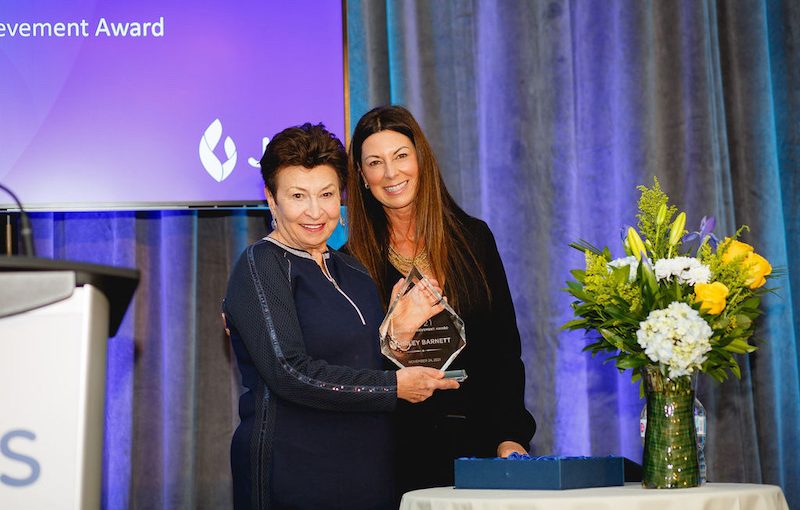
Shirley Barnett holds the JFS Lifetime Achievement Award, which was presented to her by Jody Dales on behalf of the agency. (photo from JFS)

On Nov. 24, Jewish Family Services Vancouver celebrated its 85th anniversary with a mini party at the 110-year-old Heritage Hall on Main Street. It was a fitting occasion and venue to launch the organization’s inaugural Lifetime Achievement Award.

Tanja Demajo, chief executive officer of JFS Vancouver, welcomed guests to the evening’s celebration, which had the theme “SustainAbility: The Power of Local.” Starting off the proceedings was Rabbi Adam Stein of Congregation Beth Israel, who explained some of Judaism’s blessings for the miracles of nature before making a blessing for good health and “for now, a bit less rain,” in recognition of the damage and displacement caused by flooding in the province.

JFS board member Jody Dales then presented the JFS Lifetime Achievement Award, which was established this year, in celebration of the agency’s 85th anniversary. “Its purpose is to honour someone who has demonstrated exceptional leadership over a significant period of time, who has displayed wisdom and depth of service and who has made a [major] difference to the course of our agency,” she said. “The first person who came to mind for this award was Shirley Barnett.”

When Barnett joined the board as president and executive director almost 40 years ago, said Dales, the agency was going through a rough time. Serving on the board – on a volunteer basis – for nearly 15 years, Barnett introduced several new programs, expanded the services available, and increased the fundraising capacity.

In a video about the award, Barnett notes that she joined the board in 1973. She says she was in awe of the older women who were her fellow board members. “We started a newsletter, we started a group of volunteers, we started an employment program, we started an organization that lent people money,” she says, referring to the reestablishment of the Hebrew Free Loan Association.

JFS board chair Bill Kaplan was unable to join the anniversary celebration, but sent remarks that were read by Dales. “JFS is all about service to community and so is Shirley,” he said. “It’s perfectly fitting that she’s honoured on this special birthday because she epitomizes what we strive to be – a difference-maker, uplifting lives in our community.”

Dales spoke of some of the ways in which Barnett has made her a better person, including being a better daughter, community activist and philanthropist, all through Barnett’s example. “I accessorize better because of Shirley,” Dales added, laughing.

On a more serious note, she shared how, on a recent community organization trip to Cuba, while they were having a relaxing moment, Barnett said to Dales, “You know what I’ve learned? I need to laugh more.”

“And that was so incredibly profound, and honest, and vulnerable, and I admire her for being the kind of woman who says things like that very openly,” said Dales.

In accepting the award, Barnett said her connection to JFS began before she was born – her mother’s sister, Sonja (Sara) Victor, was a founder, in 1936, of the organization, then known as the Jewish Family Welfare Bureau of Vancouver.

Barnett shared some of the challenges the Jewish Family Services Agency was facing when she joined them. “We finally hired a remarkable executive director,” she said, referring to Barry Corrin, who was ED for 12 years – “and those years were formative.”

Many of the concerns remain the same today, said Barnett. Food banks and food security, poverty, housing – “these are exactly the same issues we dealt with years ago,” she said.

In addition to honouring Barnett for her service, JFS also recognized several other community members for theirs. Maya Dimapilis, JFS director of development and communications, announced the Community Leader Awards, which went to Michael Cossever, Ewa Gersin, Kerstin Melusin, Laureen Teperson, Sherri Wise, Tamar Bakonyi, Shannon Ezekiel, Candice Thal and Todd Thal. The Community Partner Award was given to the Hebrew Free Loan Association and the Paula Lenga Award for outstanding volunteer service to Stan Shaw.

Keynote speaker Karen Malone, founder of LitPark, a Toronto organization that helps businesses with environmental, social and governance (ESG) solutions, spoke of JFS in the context of sustainability. She lauded the agency for how it has managed to meet the needs of the community for 85 years and counting, operating in an evidently sustainable manner.

Malone framed each of her three main takeaways around the history of JFS, using it as an example of a group that operates according to sound ESG principles, and one that has shown that “small, consistent, local adaptations can add up to significant progress in creating a sustainable future, and they’ve been doing it for 85 years.” From its beginnings, JFS has, among other things, been helping new immigrants integrate into life here, offered employment-finding services and provided programs for seniors who would otherwise be socially isolated. During the pandemic, JFS expanded the food bank into food delivery,  and increased counseling services and housing supports, said Malone.

“It may not have been thought of in 1936 or in the ’60s or ’70s, but this just-in-time response to a change in community has a name: locally led adaptation … [which] recognizes that local communities are best placed to understand their own needs and to develop the most effective solutions.”

Malone’s third main point revolved around the 17 United Nations Sustainable Development Goals, which were adopted in 2015. “The goals encompass a holistic view of sustainable development, recognizing the intersectional nature of poverty alleviation, environmental sustainability, gender equality and systemic justice,” she explained.

She said, “It is inarguable that the challenges faced by the world today are a complicated, interconnected web. Building a sustainable society relies on adopting a holistic approach that embraces this interconnectedness rather than trying to compartmentalize it. JFS has shown they understand this assignment. This is an organization that is deeply connected to its community, that understands that ‘ability’ is the operative part of sustainability – the ability to see the emergent needs of the population it serves and to welcome new populations when they need help, too; the ability to provide just-in-time services in moments of crisis; the ability to learn from a rich history and apply these lessons in new ways to meet modern challenges.”

The Kitchen is new JFS hub

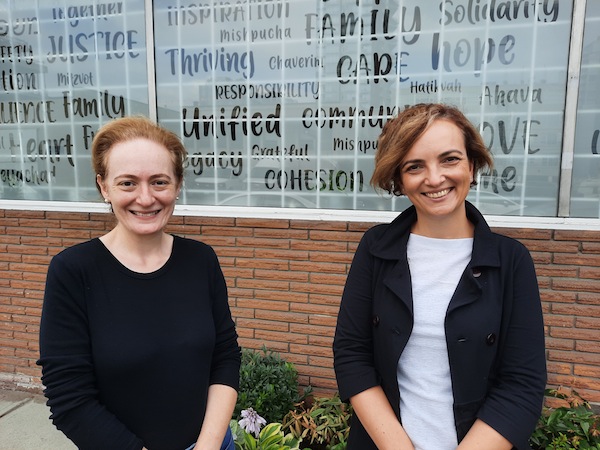
JFS Vancouver staff member Golriz Boroomand, left, and chief executive officer Tanja Demajo. (photo by Pat Johnson)

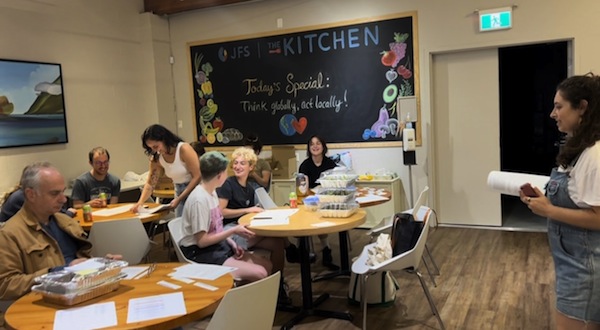
Tucked into a neighbourhood of low-rise industrial buildings, warehouses and mixed-use developments west of Main Street and south of Olympic Village is the new locus of Jewish Family Services Vancouver. The Kitchen, which opened mid-April, is the people-friendly hub for many of the programs JFS delivers to hundreds of clients every month.

“The Kitchen is an integration of a number of services that address poverty issues,” said

Tanja Demajo, chief executive officer of JFS Vancouver, which operates the Kitchen. While some components of the Kitchen’s programs are still on hold pending the end of the pandemic, it is already a busy and social environment. Clients can come weekly to pick up supplies from the Jewish Food Bank. While there, if they want, clients can meet with a caseworker to discuss access to government supports, meet with social workers or housing advocates or access other services. Behind the reception area are three private offices for caseworkers to meet with community members.

JFS still maintains a head office on Clark Drive, where some administrative work takes place, and where services best delivered in a less-social environment – such as counseling programs and services to Holocaust survivors – are offered. But the Kitchen really is the beating heart of JFS now.

“For example, with the seniors, they often have complex needs in terms of health, in terms of managing the relationship with the landlord, with different service providers, and the social worker is pretty much a point person and coordinates all that care for the client,” Demajo said. With many British Columbians, including too many seniors, unable to find a permanent family doctor, JFS can help connect them with help and accompany them to appointments if requested, she added.

“People who don’t have a [general practitioner] come and they need a prescription,” said Demajo. “Often, they aren’t comfortable going to just a general walk-in clinic, but often that’s the way to start. In many situations, our caseworkers would also go with the client to see the doctor, if they don’t feel like they can go on their own. We often try to see if we can find someone who will take them as a [patient] and it’s the same thing with the dentist. That’s how we work with people. When people are struggling to pay some of the bills because, of course, there’s a lot of unexpected emergencies, then we support them with that.”

Poverty is not only an economic challenge, she said, but a social one, too.

“It’s important just to acknowledge that people living in poverty are also dealing with a lot of isolation,” she said. So the busy and welcoming space the Kitchen provides is serving more than one need.

While the food bank has been operated by JFS in partnership with Jewish Women International for 15 years, this is the first time the program has had a permanent, purpose-built warehouse. In the back of the building, in a high-ceilinged space, are food-laden shelves, refrigerators and sorting spaces.

A parallel program is meals for those who are not able to prepare healthy dishes themselves, either temporarily due to illness or more permanently. JFS has had a meal delivery program for some time, but it was supplied through a third party. With a state-of-the-art commercial kitchen, JFS is now making their own plant-based kosher meals for delivery.

This component has allowed JFS to build relationships with farmers, which allows food bank clients the opportunity to select fresh produce.

“There are vegetables, berries, whatever is available on the farm,” said Demajo. “Customers can go to this online platform, choose what they want and pick it up from here on Thursday. The nice thing is that, again, people of different backgrounds can come here and connect with each other without knowing what their needs are.”

At the Kitchen, Tuesday is Breakfast Club.

“It’s a day for families,” Demajo said. “What they receive through the program is fresh vegetables and fruit, milk, cheese, yogurt, eggs, bread, peanut butter and cereals.” (There are dairy products in take-away food programs but the commercial kitchen is strictly pareve.)

Other food-related programs JFS delivers include Cooked with Chesed, through which clients can have five meals delivered every two weeks, featuring plates such as borscht, mushroom penne pasta, vegetarian Cobb salad, coconut chickpea curry and spaghetti and “meat” balls. Also available at the Kitchen are food vouchers that allow people to do their own shopping.

While pandemic restrictions have kept a damper on some of the social aspects, Demajo looks forward to a post-COVID world where the place will be hopping even more than it is now.

“This will hopefully become really a community hub,” she said. “Our hope was really to have a dedicated space for the community that JFS serves because one of the things that we recognized over the years is that JFS clients do not have space for gathering. They could come to different spaces, but they didn’t have their own dedicated space.”

This, she said, is why the Kitchen has a host of homey touches – artwork, photo displays, a play area for kids, a small library and, adjacent the kitchen itself, a café-like space where communal meals will occur when safe to do so.

The combined food programs serve more than 1,600 people. The food bank itself serves about 950 people.

“These numbers are constantly changing because some people stay with us for a long time, some people use the supports temporarily,” said Demajo.

Funding for the programs comes from the Jewish Federation of Greater Vancouver, private donors, and some federal and provincial government funding.

“When it comes to food, we’re also trying to build more partnerships and relationships where there is more in-kind food as well,” Demajo said.

Because they have a dedicated food storage space, including plenty of refrigerated shelves, the agency can now take in more perishable items than they could have accepted in the past. That means more fresh and healthy food for clients.

JFS has relationships with four farms – in Langley, Richmond, Pemberton and Chilliwack – that provide seasonal specialties.

“There are a lot of educational opportunities,” Demajo noted. “They have some animals there and provide not just food … so the plan is that down the road we also do some different programming with them as well.”

Innovators now online

JFS fundraiser takes guests on “plane ride” to a place above the clouds. (screenshot)

Jewish Family Services is doing something new with its Innovators Lunch. Normally a large in-person event, the annual fundraiser this year is an entirely digital experience that forgoes the usual format of lunch and speaker. And, for the first time, registration is free.

In lieu of a ticket, guests receive a “boarding pass” to click on, which will transport them to a virtual plane, rising above the clouds in what feels like a virtual gaming experience. An introductory message appears from Tanja Demajo, JFS chief executive officer. Once at their digital destination, attendees can navigate to learn about JFS services and the impact they have on the lives of clients.

An AI host greets guests, guiding them through the Gallery of Innovation to view stories focused on three different pillars of JFS services: food security, mental health, and wellness and senior care. There is an opportunity to donate and support the areas of greatest need.

“Even though we can’t physically connect with each other, we’re trying, through this experience, to engage people in this space with some imagination and playfulness, so they can see things in a different and inspiring way,” said Demajo. “As JFS’s major annual fundraiser, the funds raised are critical in giving us the assurance that the 3,000 clients who depend on us to feel secure and supported can continue to do so during the third wave of the pandemic.”

The Innovators event went live on May 4 and has been extended due to popular demand. Flights will continue to “take off” for another week. Visit jfsvancouver.ca for details.

– Courtesy JFS Vancouver