Skip to content
  • Home
  • Subscribe / donate
  • Events calendar
  • News
    • Local
    • National
    • Israel
    • World
    • עניין בחדשות
      A roundup of news in Canada and further afield, in Hebrew.
  • Opinion
    • From the JI
    • Op-Ed
  • Arts & Culture
    • Performing Arts
    • Music
    • Books
    • Visual Arts
    • TV & Film
  • Life
    • Celebrating the Holidays
    • Travel
    • The Daily Snooze
      Cartoons by Jacob Samuel
    • Mystery Photo
      Help the JI and JMABC fill in the gaps in our archives.
  • Community Links
    • Organizations, Etc.
    • Other News Sources & Blogs
    • Business Directory
  • FAQ
  • JI Chai Celebration
  • JI@88! video

Recent Posts

  • Legal help for students
  • Revisiting myth of Lilith
  • Wrong person rebuked
  • Canada’s mixed messages
  • Questions for museum
  • Symposium on antizionism
  • Making soccer political
  • CJPAC lauds Pulver’s impact
  • City recognizes Vrba’s legacy  
  • Organ donation saves lives
  • Theodore’s March premiere
  • A healing Shabbaton
  • Supplying healthy food
  • A chime of metal tags
  • Yellowknife seder a first
  • Ishai energizes, unifies
  • A Lag b’Omer to remember
  • Expanding the healing
  • Hannah Senesh – a unique hero
  • Community milestones … May 2026
  • Sharing her testimony
  • Fall fight takes leap forward
  • The balancing of rights
  • Multiple Tony n’ Tina roles
  • Stories of trauma, resilience
  • Celebrate our culture
  • A responsibility to help
  • What wellness means at JCC
  • Together in mourning
  • Downhill after Trump?
  • Birth control even easier now
  • Eco-Sisters mentorship
  • Unexpected discoveries
  • Study’s results hopeful
  • Bad behaviour affects us all
  • Thankful for the police

Archives

Follow @JewishIndie
image - The CJN - Visit Us Banner - 300x600 - 101625

Tag: Jewish Family Services

Mishpacha comes together

Mishpacha comes together

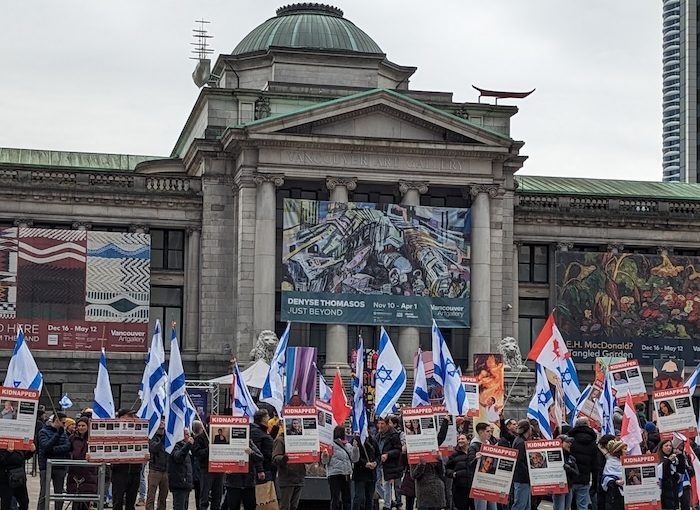
The weekly rally for Israeli hostages at the Vancouver Art Gallery Sunday, Feb. 18. (photo by Pat Johnson)

Family was the theme at the weekly rally for Israeli hostages at the Vancouver Art Gallery Sunday, Feb. 18, the day before British Columbians marked the Family Day holiday. Speakers took to a stage at the edge of the gallery’s north face out of respect for a makeshift memorial to Alexei Navalny, the Russian opposition leader who died in custody two days earlier.

“Family Day will be celebrated here tomorrow,” said Daphna Kedem, organizer of the weekly vigils for the hostages. “But this year casts a heavy shadow over the day for some families of our community here and in Israel…. It is difficult to be happy when families are waiting to be reunited with their loved ones, or for many families who have lost their loved ones.”

Dr. Michael Elterman, a psychologist, spoke of the psychological effects of what is happening in Israel and worldwide.

“We see the indescribable anguish in the families and we easily feel ourselves in their shoes and intuitively imagine what we might feel if that happened to us,” he said. “There has developed a related construct of post-traumatic stress disorder over the past decade … this is the sadness, anger and sometimes spiritual distress that arises from moral outrage. It is a broader set of reactions that arise even when the individual themselves were not present at the trauma but rather are morally outraged and left furious and depressed by events. This is even more likely where we identify so strongly with those who are personally impacted by Oct. 7.”

This anxiety is heightened by increases in antisemitic rhetoric and attacks, including in Vancouver. 

“Some of you may be experiencing the symptoms of post-traumatic stress, such as disturbed sleep, intrusive thoughts, trouble concentrating and being easily startled,” Elterman said, adding that help is available through Jewish Family Services and other resources. Getting involved in the community response can help ease feelings of helplessness and he directed people to the Community Toolkit on the website of the Jewish Federation of Greater Vancouver. 

“Remember to practise self-care in small ways, like proper nutrition and sleep,” he said. “Continue to do the things you previously enjoyed, even if you don’t feel like doing them. Finally, hug each other a little longer and a little tighter.”

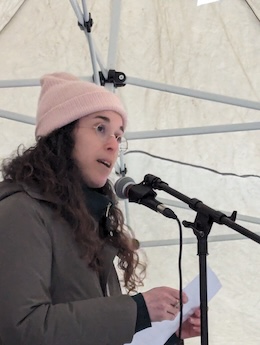
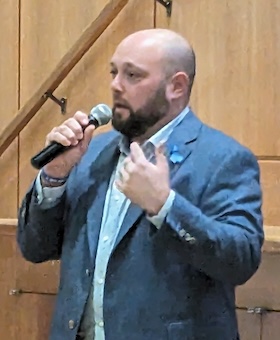
Aviya Kones, who works at Jewish Family Services, spoke not about the services offered by that organization, but about the people of Kfar Aza, where she grew up.

photo - Aviya Kones speaks about the people of Kfar Aza, where she grew up
Aviya Kones speaks about the people of Kfar Aza, where she grew up. (photo by Pat Johnson)

“Kfar Aza was a desert oasis,” said Kones. “It was home, it was love and life, it was filled with unique and quirky and hilarious traditions and it was generations of family. It was also savagely and brutally destroyed after countless and seemingly endless hours of horrors.”

Her own childhood home was destroyed on Oct. 7.

She shared memories of three people who died that day.

“Smadar, a year above me, was tall, slender, so elegant,” she said. “Even as a child, I recall looking up to her. She had big, beautiful brown eyes and thick brown hair. I remember being awed by her grace, kindness and gentle nature.

“Nadav was two years older than me,” she said. “He knew how to make everyone laugh in every situation – not at anyone’s expense but maybe his own.

“Yoav was my age group,” she continued. “He had blue eyes, blond hair and a genuine smile. All the girls thought he was cute and all the guys wanted to be his best friend. He was shy, kind, creative and athletic. He loved his family. He was so close with his parents, his siblings and the many, many cousins he had living on the kibbutz.

“All three, amongst many others, tragically, brutally and with unimaginable cruelty, lost their lives on Oct. 7,” said Kones. “They were living in our beautiful oasis, our safe place, our home. They are survived by a broken and mourning community, generations of family that absolutely adored them and … all three were also survived by their young children. Nadav had two daughters, Smadar had three children and Yoav was a first-time dad to a little girl who was only 10 days old on Oct. 7.”

Rabbi Jonathan Infeld, senior rabbi at Congregation Beth Israel and head of the Rabbinical Association of Vancouver, said that Oct. 7 was not just an attack on Israelis or those living in Israel.

“It was indeed the beginning of an attack on the entire Jewish people,” he said. “It was a catalyst for antisemitism across the world that we have felt even here in Vancouver…. Too many of us have felt the antisemitism that began to boil over on that day.”

Gordon Shank, a First Nations member, a business innovator and a survivor of the Sixties Scoop, which saw Indigenous children abducted from their families and placed with white families, spoke of the centrality of family and the trauma of separation. 

“I’ve known the pain of separation from family, being torn from the embrace of loved ones, albeit under different circumstances,” he said. “The Sixties Scoop and the current crisis in Gaza might stem from vastly different contexts yet, at their core, they resonate with the universal cry for the right to family, to unity and to belonging. This parallel is not to equate the experiences but to underline the shared understanding that every individual deserves to grow, to dream and to thrive within the warmth of their family’s love.” 

Of the hostages and their families, Shank said: “Their pain is our pain. Their hope is our hope. Let our gathering today send a powerful message that we stand together across cultures and histories, united in our resolve to bring the hostages home.”

The march through downtown streets that has been a feature of the weekly events since October will be a monthly activity only for the coming weeks, Kedem told those gathered. The crowd then moved to the sidewalk adjacent Georgia Street for a demonstration, with a brief disruption by an individual waving a Palestinian flag.

Kedem has organized the weekly events since October and, early on, affiliated with the ad hoc international group Bring Them Home which, in turn, is affiliated with the Hostage and Missing Families Forum, in Israel. 

Recently, Kedem also associated her activities with another international group, Run for their Lives, which encourages groups as small as a single individual to demonstrate solidarity with Israel and its hostages by walking, biking or running. 

Format ImagePosted on February 23, 2024February 22, 2024Author Pat JohnsonCategories LocalTags Aviya Kones, Bring Them Home, Daphna Kedem, hostages, Israel-Hamas war, Jewish Family Services, JFS, Kfar Aza, mental health, Michael Elterman, Oct. 7, Vancouver
JFS buys new home

JFS buys new home

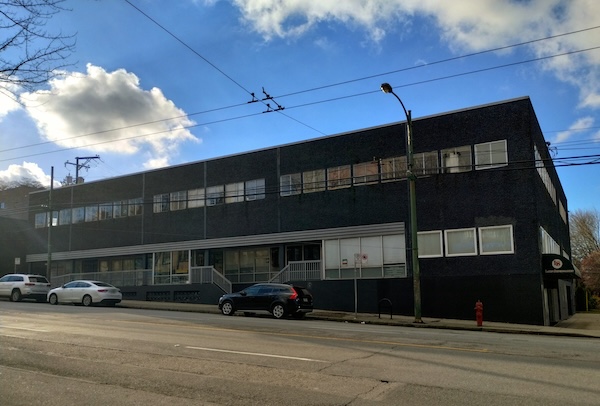
Jewish Family Services of Vancouver has purchased a building at 2929 Commercial Dr. (photo from JFS)

Jewish Family Services (JFS) of Vancouver has purchased a commercial building at 2929 Commercial Dr. to serve as its headquarters and services hub.

“After renovations are completed, the 20,000-square-foot building will offer the necessary space and infrastructure for our social service offerings,” said Tanja Demajo, JFS’s chief executive officer. “Moreover, with ownership, we will finally have a sense of stability after 87 years of frequent moves from one leased premise to another.”

The building, to be named in honour of the Roadburg family, will replace two Vancouver locations that are currently being leased: JFS’s head office at 2285 Clark Dr. and the JFS Kitchen at 54 East 3rd Ave. The new location, just three blocks from the Commercial-Broadway Skytrain station, provides ready access to public transit, which is essential for most JFS clients.

The purchase and a portion of the planned renovations have been financed by generous donations from Harvey and Jody Dales; the Ben and Esther Dayson Charitable Foundation; the Diamond Foundation; the Al Roadburg Foundation; and the Ronald S. Roadburg Foundation.

“We are pleased to support the development of the new facility for Jewish Family Services of Vancouver to carry the Roadburg family name,” said Stephen Gaerber, a director of the Ronald S. Roadburg Foundation and past board chair of JFS. “This provides a long-term solution for JFS, locating JFS’s critical services and administration in a central location near transit and helping ensure more people can get access.”

Services to be offered from the new location will include case management, housing advocacy, clinical counseling, meals from a commercial kosher-certified pareve kitchen, care for Holocaust survivors and a Ukrainian settlement program.

The renovation plans call for, among other things, a multipurpose room that can act as a dining area for meals, event space for programming, and drop-in space for the community. The building will also have a play area for young children, meeting rooms, wheelchair-accessible washrooms, a Jewish Foodbank warehouse, and a truck loading dock. 

– Courtesy Jewish Family Services

Format ImagePosted on December 15, 2023December 14, 2023Author Jewish Family ServicesCategories LocalTags Jewish Family Services, JFS, real estate, social services

Stories of resilience shared

A family fleeing war, aided by acquaintances from a lifetime of hospitality. A person’s choice to be the light in a dark world after a loved one was murdered. The creation of a vital medical resource as a tribute to a father who died too young. These three stories were shared at the event A Night of Hope, which was held at the Jewish Community Centre of Greater Vancouver Nov. 30. The three stories of resilience were intended to give hope in response to the trauma Jews worldwide have experienced since Oct. 7.

Rabbi Susan Tendler, spiritual leader of Beth Tikvah Congregation in Richmond, shared “the unlikely story” of how she became a rabbi, in part because of the trauma of having experienced the murder of a loved one.

In the year 2000, she recalled, “I was living my best life.” She thought she knew who she would marry, she had a dream job as a teacher in Israel and was planning on making aliyah.

photo - Rabbi Susan Tendler
Rabbi Susan Tendler (photo by Pat Johnson)

“I returned to the United States to get my affairs in order before making the big move as the Second Intifada broke out,” she said. Global conflict was compounded in the personal realm when her engagement was broken off. With foreign students avoiding Israel, her job was suddenly eliminated. Things began looking up, though, when she met Mike, “who showed me what partnership might look like.”

“And then, one night, he was brutally murdered,” she said. Five young men, joyriding, had crashed a car and needed another vehicle.

“They came upon Mike and murdered him, not even for his wallet. Just for fun,” Tendler said. “Just to take his car a few miles down the road before they ditched it.”

The murder plummeted her into depths of darkness.

“I couldn’t understand how such palpable evil could exist in the world,” she recalled. “How could a human being, created in the image of the divine, not understand life as sacred? What were the lives of those individuals that they didn’t hold this basic value as truth? And, by doing so, those five young men took the sanctity out of this world for me, for Mike’s family and his friends. I really didn’t care to live in a world with such sheer evil. It wasn’t that I was suicidal – I knew the difference and I wasn’t – I just really didn’t care to live or to die.”

She cited the Israeli poet Yehuda Amichai, who wrote that the Jewish people are “infected with hope.”

“We are taught to love others, to embrace others and to share our burdens with others,” Tendler said. “We need not struggle alone…. So, as I held on, people rallied, surrounded me and guided me through the darkness.”

Overcoming this and other personal and geopolitical traumas led her to an important insight.

“I came to realize that, if I didn’t like living in a world full of darkness and evil, then I needed to be the light,” she said. “I needed to choose life. I needed to choose hope and spread kindness, goodness and godliness to others.

“The world needs us right now,” she continued. “We all have hope coursing through our veins. Certainly, it has been weakened and doubted [since Oct. 7], but that is exactly what they want. We won’t let them win. Let the light created by our hope and optimism join forces, knowing indeed that we are not alone and that this positive energy be magnified as it draws others in. May our light be a beacon for the world.”

Tanja Demajo, chief executive officer of Jewish Family Services, shared her family’s history of survival in the Holocaust and the personal story of her family’s escape from the post-Yugoslavia war in Bosnia, where she was born. She had not shared any of this publicly before.

As a child in Mostar, young Tanja would often come home from school to find strangers at the table. Anyone passing through or needing hospitality was received in their house and welcomed with food.

photo - Tanja Demajo
Tanja Demajo (photo by Pat Johnson)

“My family always kept the door open,” she said. This openness, she believes, helped save her family when war exploded.

In 1992, when she was 11-and-a-half, everything changed, seemingly in a day.

“There were explosions everywhere, there was shooting everywhere, the army was everywhere,” she said. “The city emptied.”

Getting away from the fighting was not easy. Roadblocks were set up by different militias and Demajo could see the fear in her father’s expression as they confronted each successive barrier. 

“We had to stop at three different points and at three different points we came across some people that my parents knew through their life,” she recalled. Keeping an open door meant there were people who knew the family and remembered their hospitality. “In each of these three situations, these friends came forward and put their lives on the line so they could let my family pass through.”

After the war ended, the family reconnected with her grandfather, who they had not seen in years.

“That was the first time actually that my grandfather shared with us his own story,” she said. From a community of 300, the grandfather and an uncle were the only survivors of the Holocaust. 

She asked him why he was so cheerful, despite all he had gone through.

“He had this beautiful way of just hugging people and he would hug me and say, what are the things you remember as a child?” She recalled spending weekends with her grandfather, the meals and stories they shared. “And he said, well that’s how you survive. Because those are the things that matter. The people you have in your life, the friendships that you share with them and the food you share with them.”

The connections she saw her parents forge at the table – which proved potentially lifesaving as the family fled war – are a lesson she has always carried. It is something that Jews worldwide can remember now, she said.

“We need allies and we need to have these conversations to bring people together,” she said.

Jaime Stein shared the story of how the death his father, Howard Stein, in 2006, from acute leukemia, inspired him to help create Canada’s first public

photo - Jaime Stein
Jaime Stein (photo by Pat Johnson)

Early in the last decade, when Stein helped launch the $12.5 million campaign to create the facility, Canada was one of only two G-20 nations that did not have such a service. Umbilical cord blood contains blood-forming stem cells, which can renew themselves and differentiate into other types of cells.

Working with Canadian Blood Services, Stein and the fundraising team for the project decided on a big focal point for the campaign – climbing Tanzania’s Mount Kilimanjaro, the highest peak in Africa.

“We got 25 people to sign up [to climb] and everybody had to raise a minimum of $10,000,” Stein explained.

Stein, in his 30s at the time, when $10,000 was a daunting sum, organized weekly 9 a.m. hikes with friends and strangers, at which he would offer career advice, listen to his hiking mates or otherwise engage, then write a blog post. 

“People started donating and people started telling their friends as well,” he said. 

In the end, he raised $27,000, second only to the chief executive officer of Canadian Blood Services among the 25 climbers. Of course, the money turned out to be the easy part. They still had to ascend the mountain. 

Like many others who climb tall mountains, Stein experienced altitude sickness – so severely he almost had to turn back.

“I could barely make it to camp,” Stein recalls of the onset of the crisis. “I just remember thinking about my dad, thinking of my family, thinking of the training, thinking of everything I did as I tried to get to camp.”

Slowly, his oxygen levels climbed and he was able to complete the trek.

The trip itself raised $350,000 and, eventually, the team raised all the funds necessary. Canada now has a fully functioning umbilical cord blood bank, with four collection sites, including one in Vancouver.

Alan Stamp, Jewish Family Services clinical director, and Ezra Shanken, chief executive officer of the Jewish Federation of Greater Vancouver, contextualized the stories as lessons in resilience community members can use to confront trauma. 

Format ImagePosted on December 15, 2023December 14, 2023Author Pat JohnsonCategories LocalTags blood bank, death, Jaime Stein, Jewish Family Services, Jewish Federation, leukemia, Rabbi Susan Tendler, resilience, Tanja Demajo, war
Prevention is ultimate goal

Prevention is ultimate goal

World Elder Abuse Awareness Day will be marked with a community-wide event hosted by Jewish Family Services, in partnership with many other agencies. (photo from nvrc.ca)

According to a World Health Organization study, half the world’s population bears a prejudice against the elderly. Jewish Family Services in Vancouver, which shares that statistic on its website, notes that roughly 17% of people over the age of 60 worldwide are victims of elder abuse. The agency also notes that about 20% of Canadians believe older people are a burden on society, and that approximately 80% of Canadian seniors report discrimination in health care.

On June 15, at 10 a.m., JFS will host a free community-wide event in recognition of World Elder Abuse Awareness Day (WEAAD) in the Jewish Community Centre of Greater Vancouver’s Wosk Auditorium. Rights Don’t Get Old: Let’s Unite Against Elder Abuse will cover what can be done to prevent – what many recent studies have shown to be – a growing problem. Featured speakers include Michael Lee, MLA for Vancouver-Langara and shadow minister for Indigenous relations and reconciliation; Isobel McKenzie, British Columbia’s seniors advocate; and Linda Youk of Seniors First BC.

“A very important element of elder abuse is that it can happen to anyone,” said Cindy McMillan, director of programs and community partnerships at JFS. “We shouldn’t make assumptions about who is at risk and who is not. Awareness that it exists, and that there are supports out there … is what June 15 is all about.”

For JFS, “a nonprofit that supports up to 1,200 seniors annually to live at home safely and with dignity, elder abuse prevention, detection and response is an essential part of support,” she said. “This year, following several years of COVID, and subsequent isolation of many older adults, I felt it was very timely to bring the community together to create more awareness around this issue.”

Elder abuse comprises varying forms of mistreatment, the most commonly reported being neglect, followed by emotional and financial abuse. Physical abuse is also prevalent, with 8.8% of abused seniors experiencing physical violence, according to data provided by JFS. Elder abuse can occur in numerous settings, including within the home, at care facilities and in the community. Most reported cases involve family members, with adult children and spouses being the most common perpetrators.

A Statistics Canada report released in 2019 stated that nearly one in five seniors had experienced some form of abuse. A report from the Office of the Seniors Advocate in British Columbia, using data from 2017 to 2021, found a 49% increase in neglect and self-neglect, an 87% increase in reported physical abuse and a 49% increase in financial abuse over that five-year period.

Neglect is often underreported, both because of a lack of awareness as to what constitutes neglect and the potential stigma associated with the admission of neglect, explained McMillan. Neglect can manifest in different ways, such as providing insufficient food and water, failing to administer medication, leaving an older adult in dirty and unsafe living conditions, and not seeking medical attention for the elderly person when it is needed.

Financial abuse, or the exploitation of older adults for monetary gain, can have serious ramifications. Despite numerous laws in place to prevent it, B.C. seniors lose an estimated $50 million annually because of financial abuse, with only one in five cases reported.

WEAAD was launched in 2006 by the International Network for the Prevention of Elder Abuse and the World Health Organization at the United Nations.

“JFS has always been involved in WEAAD, primarily through our Better at Home program, where we have partnered with different community organizations to have smaller events that promote awareness,” said McMillan. “Our involvement stems from our connection with the Marpole Community Response Network, who is at the forefront of providing information and education on elder abuse.”

Better at Home is a JFS-coordinated program, administered by the United Way, which helps seniors in Kerrisdale, Oakridge, Marpole, Southlands and Dunbar with non-medical, day-to-day tasks such as housekeeping, transportation, grocery shopping, visits and handyperson repairs. The program’s objective is to assist seniors so that they can continue to live independently in their own homes and remain connected to their communities.

This year’s June 15 event will have numerous resource tables located in the atrium of the JCC. Among the groups presenting are the Alzheimer Society of British Columbia, JQT Vancouver, Kerrisdale Oakridge Marpole Community Policing Centre, L’Chaim Adult Day Centre, ASK Friendship Society and ReAct Adult Protection Program of Vancouver Coastal Health.

In a statement to the Independent, JFS said it “was very grateful to have partners like the Jewish Federation, the JCC, the Better at Home Program and Seniors First BC coming together to put on such an important event.”

To register for Rights Don’t Get Old: Let’s Unite Against Elder Abuse, visit jfsvancouver.ca. Refreshments will be provided.

Sam Margolis has written for the Globe and Mail, the National Post, UPI and MSNBC.

Format ImagePosted on June 9, 2023June 8, 2023Author Sam MargolisCategories LocalTags abuse, awareness, Cindy McMillan, education, elder abuse, JCC, Jewish Community Centre of Greater Vancouver, Jewish Family Services, JFS, seniors, WEAAD
Settling Ukrainian newcomers

Settling Ukrainian newcomers

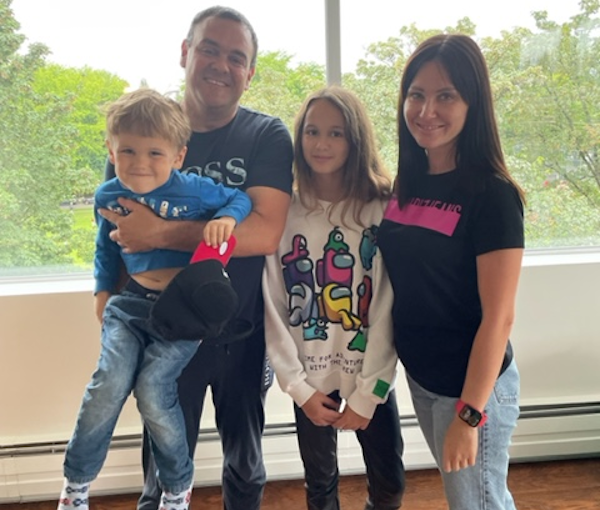
With the help of Jewish Family Services, Belmont Properties and others, the Zubrys family – Alexander, holding Artem, Sophie and Katrina – are getting settled in Vancouver. (photo from JFS)

For Oleksandra Liashyk and her family, who fled the Ukraine-Russia war last year, resettling in Vancouver was an opportunity for a new, though unexpected start. The family of three, who have an apartment and have enrolled their son in public secondary school, are learning English and navigating the ropes that come with resettlement. Still, Oleksandra admitted that it hasn’t been easy, that simply adjusting to a new culture, community and language has been a challenge. “This is absolutely another world,” she said.

It’s a sentiment shared by many of Vancouver’s newest immigrants from Ukraine. Fedor and Yulia, who came from wartorn Chernihiv with their two children, had good jobs as a real estate broker and a fitness instructor. While their children aren’t yet old enough to attend school, the kids are struggling with socialization. “The hardest thing to adjust for our children here was lack of communication with children of their age,” they said. “[E]verything looks quite unusual here.”

Like Fedor and Yulia, many others have left behind established businesses and jobs, professions that will be hard to restart in Vancouver. Lawyers, real estate brokers, accountants, social workers and business owners will need licences, education and a practised familiarity with Canada’s certification processes. But first, they need a place to live and a way to support their families.

According to Tanja Demajo, chief executive officer of Vancouver’s Jewish Family Services, the Ukrainian resettlement program was already in the planning stages when Russia formally announced its intended occupation of Ukraine in February 2022. Well-versed in creating programs to assist new immigrants, JFS knew the program would have to be versatile and able to address the many challenges faced by refugees on the move. Not all immigrants would be able to plan ahead before leaving Ukraine; many would arrive unprepared for their new home.

“Families reach out in many different ways,” Demajo explained. “Sometimes they call us from abroad and they are trying to understand the Canadian systems and how to actually come here. Sometimes we receive a call from other [Canadian] cities when families have already left [Ukraine] and they are thinking about relocating to the Lower Mainland. And sometimes we receive calls from families that are already here and are trying to navigate their next steps.”

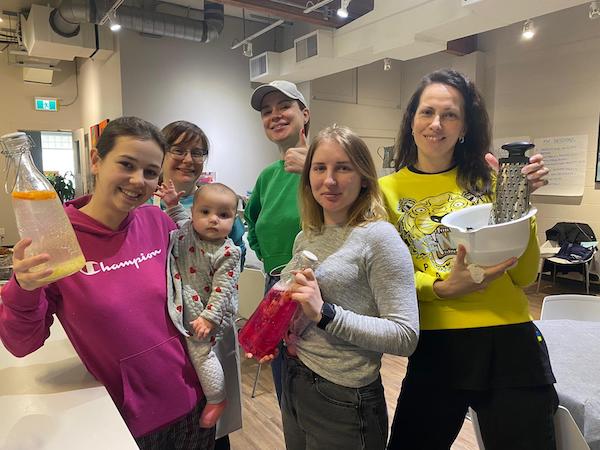
According to Demajo, more than 80% of Ukrainian refugees enrolled in the resettlement program have advanced educations, but lack fluency in English, so JFS partnered with the B.C. Centre for Disease Control to provide its Food Skills program. In it, participants learned how to read labels in grocery stores and purchase food, which then became the ingredients for new Western-style dishes, which they cooked in the JFS Kitchen. “Throughout the cooking, they were also learning English,” Demajo said. “We also had childcare provided as well.” The classes were so successful that JFS is looking at expanding the program.

But the greatest challenge facing new immigrants to Vancouver has been the city’s housing shortage. Residential vacancy rates, which now stand at less than 1%, and the disproportionate cost of rental apartments have made it harder to find housing.

photo - JFS partnered with the B.C. Centre for Disease Control to provide a Canadian food education and cooking class that doubled as an English class for new immigrants
JFS partnered with the B.C. Centre for Disease Control to provide a Canadian food education and cooking class that doubled as an English class for new immigrants. (photo from JFS)

JFS settlement worker Tanya Finkelshtein helps connect new immigrants with “welcome circles” of volunteers that can help get them settled. “Housing is the number one problem in the Great Vancouver area, especially for newcomers. We [are] able to support some of our clients, but it is a serious issue,” said Finkelshtein, who works with about 70 Ukrainian families in JFS’s settlement program.

Affordable housing is key to creating adequate living conditions, including suitable employment.

“We have a family that was initially living outside of Vancouver,” Demajo said by way of example. The family’s efforts to connect with the Vancouver Jewish community were hampered by distance, as was their effort to find suitable employment. By connecting them with Tikva Housing and Temple Sholom Synagogue’s volunteer network, JFS was able to help the family resettle closer to employment opportunities and Jewish community programs. Tikva has since set aside two other units for JFS’s resettlement program.

But the search for housing continues to be a problem for new arrivals, so Demajo reached out to a property management company with well-known connections in the Jewish community. Shannon Gorski, whose family owns Belmont Properties, said JFS was looking for a couple of apartments that could provide temporary housing for Ukrainian immigrants. Gorski, who also serves on the JFS board and is the managing director of the Betty Averbach Foundation, reached out to Belmont’s board of directors “and then I learned … that they had been approached by someone in the rental world, Bob Rennie, and they had already stepped up to the plate.” Gorski said the board agreed to provide four units free of charge for four months.

The offer couldn’t have come at a better time for Alexander and Katrina Zubrys, who had been living out of a hotel since arriving from Kherson. The 1,200-square-foot apartment meant the couple could enrol their two children in a Jewish day school close by.

“The school is located 10 minutes from our house,” said Alexander, who acknowledged that, for his 5-year-old son Artem, “the biggest problem is English.” With the school’s help, Alexander said Artem and Sophie, 13, are adapting to their new surroundings and new language.

According to Gorski, the Zubrys family is the only one so far to request temporary housing from Belmont. “My concern is there are so many other families out there that don’t know that the Jewish community is here to help them,” she said. Thus, the challenge isn’t just finding available housing for current clients, but getting the word out to those arriving who don’t know who or how to ask for help.

As for finding new housing for the program, Gorski encourages other companies to get involved. “We are proud to be able to help the Zubrys family and we would like to help other families once identified,” she said. “And we challenge other property management families to step up as well.”

She is confident that, once alerted that Belmont Properties has donated temporary accommodations to the program, other property owners “would answer the call. I have no doubt that they would.”

Demajo said the settlement program wouldn’t have gotten off the ground without the assistance of the Jewish Federation of Greater Vancouver, which sent out an emergency appeal to the community to fund the project.

“Our community and our Federation have a history of responding quickly and generously whenever and wherever help is needed and we can be incredibly proud of the way our community responded to the crisis in Ukraine,” said Federation chief executive officer Ezra Shanken. “We didn’t spring into action the day the war broke out – we work year-round building communities and partnerships around the world and here at home so that we have the systems in place to make an impact.”

Demajo said Temple Sholom and Congregation Schara Tzedeck are playing a role in supporting new immigrants. Both run their own programs and have collaborated with JFS to make sure new arrivals are supported, she said.

“We continue to support these families now, helping some find vehicles, others looking for new jobs,” said Temple Sholom’s Rabbi Dan Moskovitz.

For the Zubrys family, the support system is what made the 9,100-kilometre migration possible. It’s Gorski’s “big heart” and the help of JFS and other volunteers that made it possible to finally find a new home, said Alexander.

For information about how to offer temporary housing and other help for Ukrainian refugees, contact Tanya Finkelshtein at 604-257-5151.

Jan Lee is an award-winning editorial writer whose articles and op-eds have been published in B’nai B’rith Magazine, Voices of Conservative and Masorti Judaism and Baltimore Jewish Times, as well as a number of business, environmental and travel publications. Her blog can be found at multiculturaljew.polestarpassages.com.

Format ImagePosted on May 26, 2023May 25, 2023Author Jan LeeCategories LocalTags Belmont Properties, housing, immigration, Jewish Family Services, Jewish Federation, JFS, Liashyk, refugees, Schara Tzedeck, Shannon Gorski, Temple Sholom, tikkun olam, Ukraine
Innovators in serving the community

Innovators in serving the community

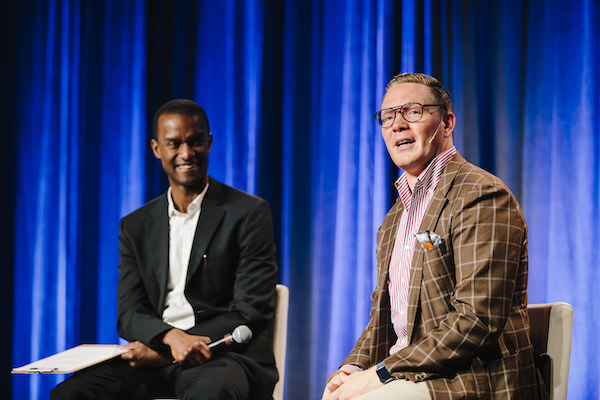
Emcee Michael Newman, left, and keynote speaker Anders Sörman-Nilsson at the Jewish Family Services Innovators Lunch. (photo by Josh Bowie)

“I believe that the next trend is not necessarily digital transformation, but it is the alignment of two of these trends: sustainability and digitalization,” Swedish-Australian futurist Anders Sörman-Nilsson told guests at the 17th Annual Jewish Family Services Innovators Lunch on May 10. Organizations that align digital transformation and sustainability have a 2.5 times better chance of being top performers, he said.

Sörman-Nilsson was the keynote speaker at the lunch, which took place at the Hyatt Regency, the first in-person Innovators since the beginning of the pandemic.

As the founder of Thinque, a think tank and trend analysis firm that reaches global brands across four continents, Sörman-Nilsson is responsible for data-based research and foresight regarding future trends. Beyond his research, he is known for co-creating the Adobe Creative Intelligence test for B2B (business-to-business) marketing. He currently hosts two social innovation podcasts, the 2nd Renaissance Podcast and Entrepreneurs Organization’s Scaling Impact Podcast, and is the author of three books, Aftershock (2020), Seamless (2017) and Digilogue (2013). Sörman-Nilsson’s approach to futurism involves seeking out what he calls “avant-garde ideas” that can drive meaningful change.

Sörman-Nilsson aims to challenge the misconception that integrating technology into an organization’s operations impedes human connection. He gave the example of his family’s business, a clothing store, which thrived on personal interaction out of a brick-and-mortar building in a “highly analogue fashion,” using a pen and paper. He said such an approach is suited “for a world that no longer exists” and that the eventual bankruptcy of the store after 104 years of business was due to the failure to adopt new technologies. He dedicated Digilogue to his parents, exploring in it “how to win the digital minds and analogue hearts of tomorrow’s customers.” He emphasized that technological tools and personable business principles can not only coexist, but enhance one another.

Sörman-Nilsson urged businesses to conduct “pre-mortem” analyses to identify changes that could prevent obsolescence or bankruptcy. He asked people to imagine that it is 2030 and your company has gone under – what were the trends you missed, what were the signs you ignored and what were the investment decisions you delayed that contributed to your company’s failure? To avoid such an outcome, he encouraged organizations to focus on “mega trends” based on the United Nations Sustainable Development Goals, such as prioritizing affordable and clean energy, responsible consumption, and improving global health and well-being. These goals are “a good indicator of where the world and smart capital is moving,” he said, and reflecting one or more of them in the product or service you provide and in your day-to-day operations and external marketing efforts is key for long-term success. “Mega trends are powerful,” he said, “but they’re particularly exponential when you sit at the intersection of two overarching aligning trends, like digitalization and sustainability.”

Sörman-Nilsson uses the UN Brundtland Commission definition of sustainability, which he described as “meeting the needs of the present without hindering future generations from meeting theirs.” He spoke about the concept of “conscious capitalism,” where an organization is purpose-driven and prioritizes stakeholder well-being. Building a sustainable “ecosystem of impact” – otherwise known as a supply chain – is crucial in winning over today’s consumers, he argued, adding that technology is the most efficient way to achieve this. Better data collection, for example, can lead to less waste, or to gauging more accurately consumer needs. In his Innovators Lunch talk, he compared such technological integration to tikkun olam, as it reflects one’s responsibility to repair the world. He also advocated for the practice of “effective altruism,” which, he said, means that “the investment of your dollar in philanthropy should go the furthest,” giving the example of investing in mosquito nets in Africa. He connected this idea – helping the most people as possible – to tzedakah, justice and charity, as well as to tikkun olam.

Sörman-Nilsson reminded the audience that major tech players are raising the bar with predictive technologies that have the power to solve problems before they arise. He challenged businesses to use technology to streamline mundane tasks, which would allow workers to focus on more meaningful and humanistic responsibilities. He emphasized the importance of merging humanism and technology to leverage the best of human intelligence and artificial intelligence. He stressed the need to “ask the right questions” and incorporate human creativity and ethical decision-making when engaging with technological tools. By doing so, he said, brands can enhance their ability to cultivate community.

Headlining this year’s JFS Innovators Lunch, Sörman-Nilsson shared his insights with more than 500 guests. Over the past 16 years, the Innovator’s Lunch has raised more than $5 million for JFS, supporting services such as food, counseling, housing and comprehensive care for children, youth, adults and seniors. Event committee chair Candice Thal said, “I believe that giving back to the community is not only a responsibility but a privilege.” This event, she said, is “our way of caring for others,” the funds raised helping JFS provide services for more than 3,000 community members.

photo - Left to right: Tanja Demajo, chief executive officer of Jewish Family Services, and Innovators committee chair Candice Thal
Left to right: Tanja Demajo, chief executive officer of Jewish Family Services, and Innovators committee chair Candice Thal. (photo by MJ Dimapilis)

The event was emceed by Michael Newman of Global BC News. Following a land acknowledgement from Elder Rose Guerin of the Musqueam First Nation and welcoming remarks from Thal and Tanja Demajo, chief executive officer of JFS, there was a video entitled Building Future, Today, which showcased how JFS not only helps individuals, but their families, creating a ripple effect on the entire community and future generations. Rabbi Dan Moskovitz of Temple Sholom, who did the blessing over the meal, underscored JFS’s mission with the story of “Sam,” a man who sought the rabbi’s help after falling on hard times. “We know many people like Sam,” said Moskovitz. While change is constant, he said, some things never change: “People still get sick, they are hungry, inadequately housed, lonely and vulnerable.” He concluded, “The work of JFS, your support of Jewish Family Services, has never been more important or more necessary.”

Moskovitz’s sentiment was shared by Jody Dales, chair of the JFS board of directors, who shared how the Jewish community helped her after she tried to take her own life when she was 19 years old, living on her own and barely making ends meet at a minimum-wage job. “The blade didn’t cut deep enough to do any real damage but it penetrated enough to scare the hell out of me,” she said. “In the darkest moment of my life, the faintest ray of hope appeared, and I called my mom. And because she was part of the community, thiscommunity, her well-placed phone call set off a chain of events that tracked me into the office of a professional who saved my life. It took me years to ask for help, only days to receive it, but a lifetime to heal.”

In a very different place today, Dales said she shared her story so that people could “understand the complexities of despair, dread and depression. I doubt that there’s a person in this room for whom at least parts of this conversation don’t resonate.”

Among the tools that continue to help her, she said, “is dedicating my life to a life of service. It’s hard to feel bad about yourself when you’re making other people feel good about themselves. And there’s no agency that I know of that makes people feel good about themselves better than Jewish Family Services.”

For Dales, JFS can make such an impact because of the “intangibles” they offer – making all people feel seen and valued. “JFS is overwhelmed with need,” she said, and the only thing holding the organization back from helping more is money. She highlighted the event’s gift-matching sponsor, the Paul and Edwina Heller Memorial Fund, and encouraged people to donate. To do so, visit jfsinnovators.ca/donate.

Alisa Bressler is a fourth-year student at Queen’s University in Kingston, Ont. She is an avid reader and writer, and the online director of the arts and culture publication MUSE Magazine. Bressler is a member of the Vancouver Jewish community, and the inaugural Baila Lazarus Jewish Journalism Intern.

Format ImagePosted on May 26, 2023May 25, 2023Author Alisa Bressler and Cynthia RamsayCategories LocalTags Anders Sörman-Nilsson, Candice Thal, Dan Moskovitz, digitalization, fundraising, Innovators Lunch, Jewish Family Services, JFS, Jody Dales, sustainability, Tanja Demajo, tikkun olam
Garden welcomes visitors

Garden welcomes visitors

Vancouver Talmud Torah students of all ages worked together to prepare the Vancouver Jewish Community Garden. (photo from VTT)

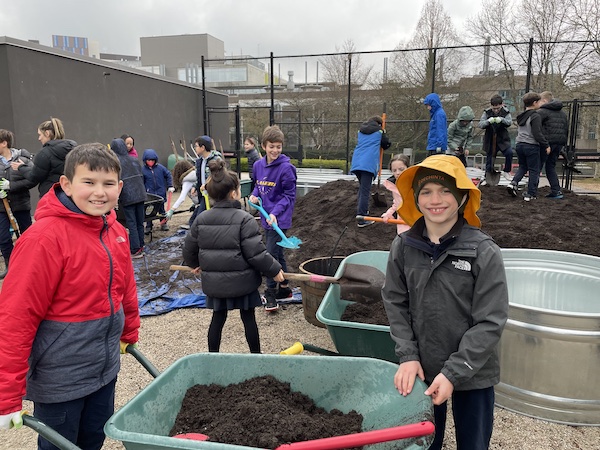
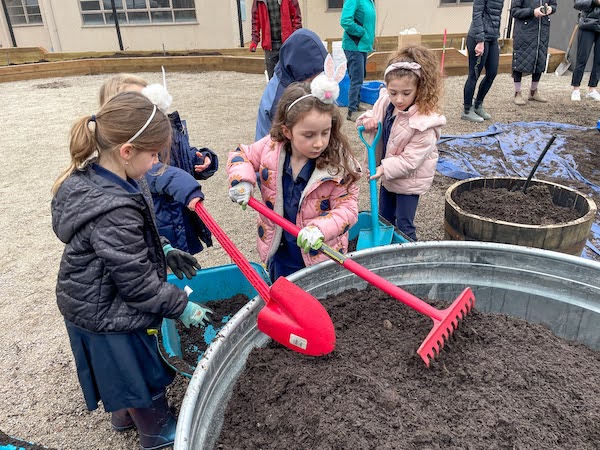
The first few weeks of spring have been a particularly busy time for Vancouver Talmud Torah (VTT) students. Armed with child-size wheelbarrows, shovels, rakes and plenty of enthusiasm, students spent last March preparing the soil for Vancouver Jewish Community Garden. VTT’s head of school, Emily Greenberg, said the formidable task of building up the garden, which will provide crops for a variety of food security initiatives in the community, has been a big hit with the kids.

“We had every single one of our students, including our littlest 3-year-olds, coming out to the garden and helping to move soil into the planter boxes,” Greenberg said, adding that it took about a week to fill all of the planters. “At the beginning of the week, I saw a mountain that was easily over seven feet tall of dirt and, by the end of the week, they had taken it down to the ground.”

Their work paved the way for two community days in early April, in which families from throughout Metro Vancouver turned out to help.

The Vancouver Jewish Community Garden is the brainchild of three Jewish agencies: VTT, Congregation Beth Israel (BI) and Jewish Family Services (JFS). Approximately 1,800 square feet of the 6,000-square-feet garden will be dedicated to growing food to support various BI and JFS initiatives. The property will also include an education centre, walking paths and seating areas.

BI’s Rabbi Jonathan Infeld said the synagogue has been looking for ways to grow food that could support its philanthropic programs, such as the Veggie Club, which cooks up fresh soup that’s distributed through JFS, and One Heart Dinner, which provides sit-down meals to community members experiencing homelessness or food insecurity. He said the new garden will not only supply BI’s programs with freshly grown food, but serve as an outdoor classroom for its Hebrew school and for expanding community education programs.

“We will be creating and using this opportunity for our Hebrew school students to literally learn [about] Judaism connected to the land while getting their hands dirty in the garden,” Infeld said.

According to the rabbi, the garden’s unique gift isn’t just that it can teach community members how to grow food. “This garden is truly about feeding hunger, whether we are talking about those who physically hungry or those who are spiritually and Jewishly hungry as well,” he said, noting Judaism attaches communal responsibility to the act of growing food, instructing Jews to dedicate parts of their crops to those in need, a commandment that dovetails with the garden’s very purpose.

“Judaism [also] commands us to say blessings before and after every time we eat, to recognize that we are given a gift of food from God. When we go to the supermarket and we buy our food and prepare it and make it, it’s easy to forget from where it came.”

The tasks involved in building and tending this garden, he explained, also serve to remind us that food doesn’t arrive easily. “It needs a lot of hard work, it needs our interaction and it needs divine intervention” in order to feed a family. “By being involved in the farming and producing and the growing of food, our community will be able to see in front of their eyes what the Jewish laws pertaining to eating are really all about,” Infeld said.

For JFS, it made sense to support a program that produces food for community sustainability initiatives and also serves as a classroom for youth education, said JFS chief executive officer Tanja Demajo.

“The garden is a very important part of the food justice and inclusion and community engagement [programs] that we are trying to build through the Kitchen and our food initiatives,” she said. “So, it really wasn’t hard for us to lend our support and voice. It was very meaningful, and what’s even more meaningful is this opportunity to build partnerships between VTT and BI. That’s quite unique and amazing.

“It is really neat to see how we can all think through different lenses of the ways to build a community; how to put education … and community engagement and food production together and create this accessible space for everyone to participate in.”

photo - Vancouver Talmud Torah students filling planters at the Vancouver Jewish Community Garden
Vancouver Talmud Torah students filling planters at the Vancouver Jewish Community Garden. (photo from VTT)

Greenberg said this may be the first project of its kind – several Jewish agencies with differing mandates partnering to create a community garden.

“That is something that we are really proud of and we hope it sets a standard for collaboration, because we are always stronger together, and we know that this is something that was only achievable because we were able to work together to accomplish it,” she said.

According to Greenberg, several founding donors played an important role in making the garden possible.

“The Diamond Foundation secured a long-term lease of this land for future development,” she said. “We would like to thank the Diamond Foundation for allowing us the opportunity to use this land for a Jewish community garden on a temporary basis.”

Greenberg said they are also grateful to the Jewish Federation of Greater Vancouver, in partnership with the Jewish Community Foundation and the Ronald S. Roadburg Foundation, for their significant financial seed gifts.

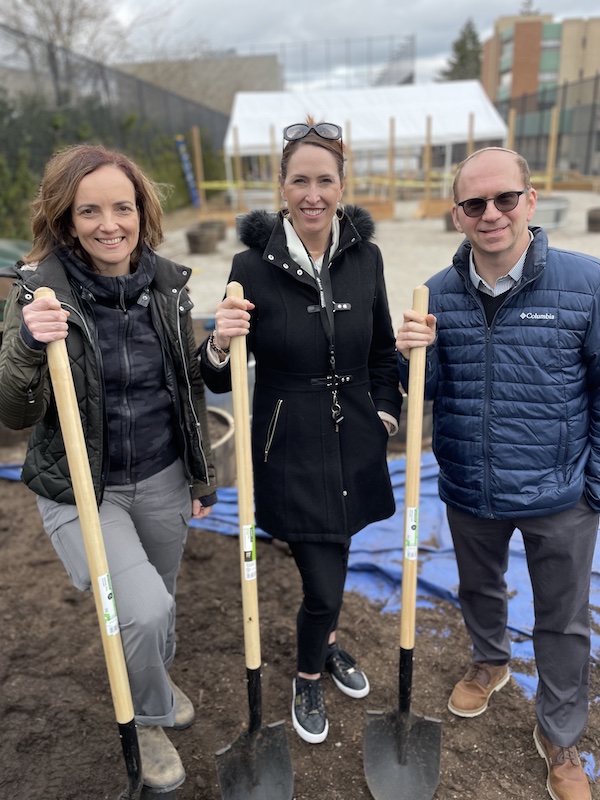
photo - Left to right: Tanja Demajo (Jewish Family Services), Emily Greenberg (Vancouver Talmud Torah) and Rabbi Jonathan Infeld (Congregation Beth Israel) contributed leadership and labour to the new Vancouver Jewish Community Garden, a joint initiative of their respective organizations. The community is invited to an open house May 28
Left to right: Tanja Demajo (Jewish Family Services), Emily Greenberg (Vancouver Talmud Torah) and Rabbi Jonathan Infeld (Congregation Beth Israel) contributed leadership and labour to the new Vancouver Jewish Community Garden, a joint initiative of their respective organizations. The community is invited to an open house May 28. (photo from VTT)

With the planters filled and seeded, the garden is now well on its way. Community members spent April planting a cornucopia of flowering plants like black-eyed Susans, purple coneflowers, sweet peas and sunflowers. Fruit trees, including apple and plum, already had been planted, along with grapes, raspberries, strawberries, and lettuces.

“Once we begin having students regularly in the garden, we will be holding lessons for all students, from rishonim (3-year-olds) to Grade 7,” Greenberg said, noting that the new classroom melds well with the school’s iSTEAM (Israel innovation, science, technology, engineering, arts and mathematics) program. “The garden gives us an opportunity to dive deep into iSTEAM and look at, for example, drip irrigation,” an Israeli invention that the community garden will be using and which is now used globally. “It’s completely transformed the agricultural sector,” Greenberg said. “So, for kids to see how innovation has come out of Israel and is then being transplanted all over the world … [it is] a very meaningful way for them to engage in learning about Israel as well.”

Finding ways to build connections to Israel is also a priority for BI. “We are always looking for opportunities to meet our goals of bringing Jews closer to God, Torah and Israel,” Infeld said. Michelle Dodek has been hired to help teach the Hebrew school students about the ancient and enduring connection between Judaism and the land.

Demajo said work in the garden doesn’t stop now that the plants are in the ground. There will still be room for more volunteers to get their hands dirty and participate in its maintenance.

“There will be a place to engage, whether it is with growing food, whether it is with programs that are more social or it’s more related to education,” Demajo said. Individuals who didn’t have an opportunity to volunteer for the build-up of the garden can reach out to Maggie Wilson at [email protected] for more information and to register as a volunteer.

On May 28, 3-5 p.m., the garden, which is located adjacent to the synagogue, will open its doors to visitors for the first time. Organizers are asking those who would like to attend the open house and fundraiser to register using the link at talmudtorah.com/vjcg, so they have an idea of how many people will be attending.

Jan Lee is an award-winning editorial writer whose articles and op-eds have been published in B’nai B’rith Magazine, Voices of Conservative and Masorti Judaism and Baltimore Jewish Times, as well as a number of business, environmental and travel publications. Her blog can be found at multiculturaljew.polestarpassages.com.

Format ImagePosted on May 12, 2023May 11, 2023Author Jan LeeCategories LocalTags Beth Israel, BI, Diamond family, education, Emily Greenberg, food security, garden, Jewish Family Services, JFS, Jonathan Infeld, Tanja Demajo, Vancouver Jewish Community Garden, Vancouver Talmud Torah, VTT
Creating a new home

Creating a new home

Khalid Aziz (photo from Khalid Aziz)

Khalid Aziz got out of Afghanistan about six weeks before the government fell. Eighteen months later, he has a job here at a local café/bakery and works part-time with a local advisory group on refugees called Diverse City. In his spare time, he volunteers with Jewish Family Services, who he considers family, and attends JFS events.

“Khalid is amazing. He just lights up the room when he walks in,” said Emi Do, former supervisor of the Community Kitchen.

Recently, Aziz planned and led a JFS Community Kitchen event, where he taught participants to cook Afghan dumplings.

“It’s all about community building, celebrating and sharing skills and knowledge about food,” said Stacy Friedman, director of food security at JFS, about Community Kitchen events, where people meet and cook together. She hopes the program will pick up again later this spring.

“Khalid has a very warm presence and is a good communicator,” she said.

But how did Aziz connect with JFS in the first place?

When he was still new to Vancouver, Aziz found the JFS and Jewish Federation of Greater Vancouver websites. He also heard on the news that Israel was taking in 150 to 200 Afghan refugees. That caught his attention and he wanted to find out more about the local Jewish community, so he contacted JFS and spoke to case manager Corrina Frederick. He was going through a rough time and Frederick was happy to listen to him.

“She showed so much empathy towards me … it was unbelievable,” Aziz said.

Soon after, Aziz was invited to a JFS Community Kitchen event, where he chatted with one of the other volunteers.

“While having our coffee, my friend asked me whether I was a Jew. I replied with Muslim. She was surprised and happy that I was among them, sitting next to each other in a beautiful atmosphere, with no hesitation, which was quite amazing to me,” he said.

Since then, Aziz has learned a lot about the Jewish people.

“Obviously, Judaism believes in one God. And its history is phenomenal. And what I learned and liked about the Jewish people is that they practise fasting, almsgiving and follow the dietary laws.” He also learned that Judaism uses the word kosher in the same way that Muslims use the word halal.

Aziz’s gratitude to JFS knows no bounds.

“The JFS assisted me with employment sources and invited me to their educational programs, as well as different events, to have the utmost experience in B.C. It really gives me pleasure to be a part of the Jewish Family Services, which helps others to achieve their goals and live peacefully.”

This is in stark contrast to his life in Kabul, where he received letters containing death threats from the Taliban for his work at the National Bank of Afghanistan, on U.S. embassy projects and at the United Nations, where he supervised and led 16 staff members involved in agriculture projects.

“Definitely, like many others, my life was in danger, without a doubt,” he said. And so were the lives of most of his family members, who were working with other organizations.

While most of his family are now living safely in different countries around the world, Aziz, 30, is still reeling from his experience getting here, and finding food and shelter.

To escape from Kabul, in July 2021, Aziz traveled to Pakistan to apply for a student visa in the United States. He successfully passed his interview at the U.S. embassy and was granted a visa one week before the Afghan government fell. With the help of family and friends, he traveled to the United States to live with his sister.

Due to the financial crisis in Afghanistan, his bank account was frozen. He waited five months for support from the American government. When that fell through, he decided to come to claim asylum in Canada.

It was nightfall and Aziz was able to avoid the U.S. border guards.

“Luckily, I made it to the border and entered Canada with happiness and hope for a better life and leaving all my stress and anxiety behind the crossing line,” he said.

The Canada Border Services Agency stopped him and cuffed him, but told him not to be afraid. They also told him that there was homelessness in Canada and he had better be prepared for that.

Aziz has no ill feelings towards the CBSA, saying they were kind in changing his handcuffs around so that he could have a drink of water.

Even though he had $1,000 when he reached Vancouver, all the hotels he found would only accept debit or credit cards. “After one hour of roaming and looking around for hotels, I ended up spending my night on a footpath downtown in the cold weather of February,” he said.

It was a tough month for Aziz, staying at shelters. “I wasn’t able to sleep well in my first month due to the inappropriate place, with no privacy and I was emotionally and mentally disturbed and stressed about what was going to happen next,” he said.

Aziz finally was able to rent a room and he bought job interview clothing while managing at the same time to volunteer for the Muslim Food Bank as a case worker and translator for refugees – he speaks several languages, including Pashto, Farsi, Urdu, Hindi and basic Arabic.

After about four months, Aziz found a job and, today, lives in a two-bedroom apartment with a roommate in Burnaby.

Aziz hopes to engage in more refugee-related work locally, as well as with the United Nations High Commissioner for Refugees.

Cassandra Freeman is an improv teacher and performer living in Vancouver.

Format ImagePosted on April 14, 2023April 12, 2023Author Cassandra FreemanCategories LocalTags Afghanistan, Community Kitchen, immigration, Jewish Family Services, JFS Vancouver, Khalid Aziz, refugees, volunteerism

Concerns over inflation

Last fall, the Jewish Federation of Greater Vancouver surveyed the impact of inflation on its community partner organizations. As with many recent reports on the effects of rising prices, the feedback was sobering, said Shelley Rivkin, vice-president of global and local engagement at Federation, which conducted the survey.

When asked about how the rise in food and fuel will affect their ability to provide the same level of service, 95% of the organizations that responded said they were either concerned or very concerned about inflation. A similar response was returned when community members were asked about paying school, camp, synagogue or Jewish community centre membership fees.

For social service and housing providers, the main concerns were the level of care, due to reduced staffing; the number of affordable housing units available; food programs for students and families in need; and low-cost (or free) social and recreational programs for seniors. Other organizations cited concerns about the future of kiddush and seniors lunches, volunteer appreciation, building maintenance and upkeep, prepared meals for food bank recipients, and membership subsidies.

The survey notes that rising costs are affecting, to varying degrees, the ability of agencies to maintain their current level of service, recruit and retain staff, raise funds and balance budgets. Some organizations have been unable to provide staff with a cost-of-living-adjustment raise, thereby threatening their capacity to retain staff and deliver programming, and higher salary expectations mean that positions are vacant for longer, limiting the ability to grow programs. Food costs for hot lunches are up 20% and there has been a 25% increase in salaries for kitchen staff.

Rivkin stressed that, in the four months since the survey was conducted, costs have come down for some items, but the price of food continues to rise.

“Our agencies and synagogues survived COVID, and we thought we were past the difficult times,” she said. “However, we are now seeing the impact of inflation on them. When we decided to undertake the survey, we had no idea about the depth and breadth of the impact of inflation or that these pressures would affect everything from staff salaries to the cost of paper supplies. We are now working with our community agencies to explore ways to reduce costs. We recently hosted a lunch-and-learn featuring speakers from the Buying Networks Canada.”

The Buying Networks Canada is a Toronto-based organization that helps nonprofit, charitable and faith-based organizations across Canada save money on such things as food and beverages, office supplies and equipment, maintenance, and numerous other products and services.

In the summer of 2022, Jewish Family Services (JFS), one of Federation’s community partners, released information on the impact of inflation. Among the points in the JFS report were an increase in the number of clients asking for food voucher assistance, a record number of intakes for home support and the challenges Ukrainian newcomers on a limited income face with rents and food costs.

Food insecurity, according to JFS, has grown in recent months and the organization expects an increase of 150 new clients, if trends continue. Higher prices at the gas pump have resulted in fewer volunteer drivers. The greater need for services has translated into a higher workload for JFS staff.

“Community that JFS serves is on fixed income, and those individuals are the ones who suffer tremendously during this time,” said Tanja Demajo, chief executive officer of JFS. “What that means for JFS is that the number of people reaching out for help is on constant rise. Between the rise in prices, number of clients and cost of staffing, we as an agency have to ask ourselves what is our priority. This is the time when we get clarity, more than ever, who we are and what we need to do. Our goal has always been not to leave anyone behind. We hope that, even during the challenging times such as these, we can remain true to that.

“Since COVID,” she added, “staffing has been a significant challenge. It is very uncomfortable for many agencies to speak about issues of salaries, but the reality is that the professional staff has always been underpaid in the nonprofit world. With inflation, this issue has further grown and, unless taken seriously, it may impact the whole social sector in irreversible ways. Providing social support is based on relationships, and with constant changes those relationships get eroded.”

Anat Gogo, executive director of Tikva Housing Society, another Federation partner agency, is also concerned. “Inflation significantly impacts the delivery of housing programs due to increased costs and reduced availability of resources,” she said. “It can also make it more difficult for low-income households to afford adequate housing, so we are reaching out to our donors to assist us in ‘gapping’ the additional … funding needed to meet our commitment to the delivery of affordable housing and rent subsidies.”

Sam Margolis has written for the Globe and Mail, the National Post, UPI and MSNBC.

Posted on February 24, 2023February 22, 2023Author Sam MargolisCategories LocalTags Anat Gogo, economy, food security, housing, inflation, Jewish Family Services, Jewish Federation of Greater Vancouver, JFS, Shelley Rivkin, social services, Tanja Demajo, Tikva Housing Society
Helping feed community

Helping feed community

Dr. Randall and Shalene Trester, who run West 1st Chiropractic Wellness Centre. Last year, their food drive collected more than 400 pounds of food for the Jewish Food Bank. (photo by Allison Kuhl)

Since 2016, patients at West 1st Chiropractic Wellness Centre have been bringing in non-perishable food items destined for the Jewish Food Bank. These donations are collected and, in turn, provided to those in the community who face food insecurity.

The Jewish Food Bank struck a particular chord with chiropractor Dr. Randall Trester and his wife Shalene, who run the centre, which will celebrate its 20th anniversary this September.

“I had a few friends that had been helping with the food bank and they told me how difficult the situation is for some people. I felt we just had to get involved,” Shalene Trester told the Independent.

The Tresters hold the food drive every December, reminding clients ahead of time by posting information throughout the centre and via email correspondence.

“Our patients are really the ones who should get all the credit. We organize it every year and it’s amazing to see the generosity of our patients,” said Shalene Trester, who manages the office. “Our patients look forward to participating. It’s awesome to see the overflowing boxes at the end of the food drive. It’s such an awesome feeling to give back to our community every year.”

The most recent drive saw an increase in the amount of food donated. “There was a greater need,” she said.

“The Tresters have been supporting us for many years through their annual food drive and donating all the food to us,” said Carol Hopkins, the coordinator of the Jewish Food Bank. “Last year, they donated 410 pounds of food. We really appreciate their support.”

Distribution for the JFS Grocery Program is held weekly at JFS’s the Kitchen, located at 54 East 3rd Avenue in Vancouver, and at hubs throughout the Lower Mainland. For those unable to pick up their grocery order at one of the hubs, JFS offers a delivery service.

“We currently serve approximately 900 people and provide more than 12,000 kilograms of healthy food every month,” said Hopkins. “The JFS Grocery Program does not offer any meats, poultry or shellfish. We ensure that kosher items are available for clients who do keep kosher.”

The majority of supplies at the Jewish Food Bank are bought, and the team relies heavily on donations – non-perishable food or money. Among the benefits of hosting a food drive, the Jewish Food Bank notes on its web page, are “engaging your community members and helping to spread the word on the issue of hunger, [while] also providing an incredible service to your neighbours in need.”

Some of the best items to donate are rice; canned or dried beans, lentils and legumes; whole grains (oats, barley, millet, bulgur, quinoa, couscous); canned fish (tuna, salmon, sardines); canned tomatoes and tomato sauce; and pasta. According to the Jewish Food Bank, a $10 donation can buy $30 of food at wholesale prices or provide four days of healthy snacks for five children.

Soap, shampoo, toilet paper and diapers are greatly appreciated and needed as well.

The Jewish Food Bank funders include Jewish Women International-B.C. and many community members. Any person or organization wanting to organize a food drive should call 604-558-5698 or visit jfsvancouver.ca/food-drive.

Sam Margolis has written for the Globe and Mail, the National Post, UPI and MSNBC.

Format ImagePosted on February 24, 2023February 22, 2023Author Sam MargolisCategories LocalTags Carol Hopkins, food security, Jewish Family Services, Jewish Food Bank, JFS, Randall Trester, Shalene Trester, tikkun olam

Posts pagination

Previous page Page 1 Page 2 Page 3 … Page 5 Next page
Proudly powered by WordPress