Connecting with nature

Growing Together – a garden program for young adults with varying abilities, run by the Jewish Community Centre of Greater Vancouver and Jewish Family Services – is facilitated by Ran Keren. (photo from JCC)

This spring, the Jewish Community Centre of Greater Vancouver launched Growing Together, a garden program for young adults with varying abilities, in partnership community with Jewish Family Services (JFS). The program runs biweekly on Sundays through August and is offered free of charge.

“It is well established that spending time outdoors can benefit mental health,” Shiri Barak Gonen, Inclusion Services program coordinator at the JCC, told the Independent. “The JCC wanted to create a safe, welcoming space where members of our community could connect with nature, build meaningful relationships and experience personal growth. 

“We also have a deep appreciation for agriculture. Living in an urban environment, we felt that community gardening would be a meaningful way to introduce participants to the growing process and foster a stronger connection to the natural world. We recognized that experiencing the entire growing cycle – from planting and nurturing to harvesting – would provide participants with a genuine sense of accomplishment and pride. 

“In addition,” she said, “we recognized that our adult inclusion programs serve a broad age range. This initiative was designed to give our young adults the opportunity to connect and build friendships with peers who are closer to their own age and at a similar stage of life.”

It was developed with a clear vision, she said: “to engage participants in gardening and outdoor activities while encouraging connections with one another, with the facilitator and with nature itself. Once we had that vision clear, we began searching for the right location to bring it to life.”

The JCC initially approached Congregation Beth Israel, said Maggie Wilson, coordinator of the Vancouver Jewish Community Garden, which was established in 2020 by Vancouver Talmud Torah, Beth Israel and JFS, and which is situated alongside the synagogue building and behind the school. However, the congregation realized the program would be a better fit for a partnership between the JCC and JFS, she said.

Wilson and Carol Hopkins, director of food security at JFS, explained in an email that “the JCC coordinates the program, managing participant recruitment, registration and the program facilitator” and, through its partnership with JFS, the program takes place in the garden. 

“As part of this collaboration, JFS will lead specialized food literacy programming with the participants,” they said. “The participants have also been given the use of a bed to care for throughout the season. This allows them to experience the full cycle of gardening, from planting seeds and caring for growing plants to harvesting food they have grown themselves, all while building confidence, developing new skills and fostering a sense of ownership and connection to the space.

“By combining expertise in inclusive programming, a shared dedication to food literacy and a vibrant outdoor learning environment, this partnership between the JCC and JFS has created an experience that neither organization could have offered on its own.”

Wilson provides professional guidance and ongoing support for the program, which is designed for young adults aged 18 to 25 with a wide range of support needs. Barak Gonen said the initiative has allowed the JCC “to engage new participants who had not previously taken part in our inclusion programs.”

photo - The JCC-JFS Growing Together program takes place in the Vancouver Jewish Community Garden
The JCC-JFS Growing Together program takes place in the Vancouver Jewish Community Garden. (photo from VJCG)

For the initiative, the JCC recruited Ran Keren, an experienced facilitator, who, Barak Gonen said, “has done an exceptional job leading the gardening activities while also creating engaging outdoor arts, crafts and nature-based experiences that foster learning, bonding and enjoyment.”

“We started our program this spring with learning about the various herbs, veggies, fruits and greens that grow in the beautiful Jewish Community Garden,” said Keren. “Every meeting, we do some work in the garden and connect with the plants in some way; making herbal tea from the garden herbs, printing T-shirts with the garden flowers, putting together birdhouses and bug hotels, and nurturing our own little plot of veggies. There is something dynamic in gardening work, as it depends on the weather and the ever-changing crop growth and cycles, but the most important part in our work and activities is to create space in which we get to know one another, and feel safe and welcome to share thoughts, experiences and feelings. To borrow from [noted Indigenous botanist] Robin Kimmerer, ‘A garden is a nursery for nurturing connection.’ My main goal, and hope is that our program is shaping to be such a space.”

Growing Together is a seasonal initiative, so it will continue for as long as the weather conditions allow. “We hope to extend it through the current growing season and are planning to offer it again next spring, giving participants the opportunity to reconnect with nature and continue building on the relationships and skills developed through the program,” Barak Gonen said. 

“There is still space for new participants to join the current program cycle,” she added, “and we welcome anyone interested in taking part.”

For more information, contact Barak Gonen at shiri@jccgv.bc.ca. For more about the garden, go to jewishcommunitygarden.ca. 

Growing a garden together

Volunteers, seniors and youth dedicate their time each week to tending, planting and harvesting at the Vancouver Jewish Community Garden. (photo courtesy VJCG)

The Vancouver Jewish Community Garden (VJCG), which opened in May 2023, began as a dream – a vision shared by Vancouver Talmud Torah, Jewish Family Services Vancouver and Congregation Beth Israel. The dream was made possible by the Diamond Foundation, which secured a long-term lease of the land for future development and has allowed for the opportunity to use it for a Jewish community garden on a temporary basis. Significant seed gifts from the Ronald S. Roadburg Foundation and the Jewish Community Foundation also played a vital role in its creation.

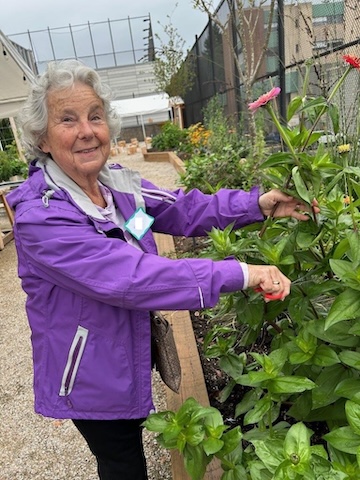
photo - A Vancouver Jewish Community Garden volunteer
A Vancouver Jewish Community Garden volunteer. (photo courtesy VJCG)

Generous donors, volunteers, students, garden experts, builders, designers and a project manager all contribute to its success. Every seed planted, every helping hand and every heart involved makes a meaningful impact – both on those who tend the garden and those who benefit from its harvest. As Rabbi Shimon bar Yochai said, “A garden is not just a patch of soil, but a place for the cultivation of the soul.”

Reflecting on two years of growth – including a full harvest season – it is possible to truly appreciate the impact the VJCG has on the Vancouver Jewish community. Under the care of garden coordinator Maggie Wilson, the VJCG has blossomed into a hub for connection, learning and nourishment. Sacred spaces are woven among beds of fruits, vegetables and flowers. 

“The garden is more than a place to grow food – we’ve built a wonderful community where people can experience the healing effects of digging in the soil, and witness the miracle of nature,” said Wilson. “Some participants are having their first experience planting a seed or picking a fresh bean. They are learning what it takes to grow food, and understanding, in a concrete way, how their work contributes to tikkun olam.”

Volunteers, seniors and youth dedicate their time each week to tending, planting and harvesting, ensuring that fresh, nutritious produce reaches Jewish Family Services to support community members facing food insecurity. Beyond its bounty, the garden is also an outdoor classroom. Students engage in hands-on workshops, learning about sustainability, collaboration and the growth cycle.

The VJCG is a community treasure that needs the community’s support to continue to thrive. Feb. 20 will be the first-ever Day of Giving in support of the VJCG. Donations will help sustain the garden, expand programming and continue to provide nourishment, education and inspiration. To contribute, visit jewishcommunitygarden.ca. 

– Courtesy Vancouver Jewish Community Garden

About the 2024 Summer JI cover

image - JI Summer 2024 cover Vancouver Jewish Community Garden coordinator Maggie Wilson took the photo that graces this year’s cover of the Jewish Independent Summer issue. According to the garden’s newsletter, “A few strawberry plants opted to try their luck in the gravel and managed to produce the season’s first strawberries!”

The garden was established in 2020 by Vancouver Talmud Torah, Congregation Beth Israel and Jewish Family Services. It was made possible by the Diamond Foundation, which secured a long-term lease of the land for future development and is allowing the land to be used on a temporary basis, and the Jewish Federation of Greater Vancouver, Jewish Community Foundation and Ronald S. Roadburg Foundation, who provided significant financial seed gifts.

The recent newsletter shared, “We have already harvested a crop of vibrant radishes, arugula, kale and herbs. Children and adults alike have enjoyed tasting nectar-laced kale flowers, and JFS’s chef used the fresh radishes in her Tuesday salad.

“The peas, seeded by VTT’s Grade 1 students, have started to ripen. The first small batch was harvested for JFS by VTT’s Green Thumb Club.”

Groups from JFS, VTT and BI “have spent time in the garden this spring, contributing their muscles, enthusiasm and appetites! 

“JFS staff came to move wheelbarrows of compost into the garden beds to top-up and replenish the soil. They then enjoyed a picnic lunch in the garden.”

VTT students from grades 1 through 7 have come to help and learn in the garden, as have students from BI’s Hebrew school, and BI staff.

For community members looking to get involved in the garden, its website – jewishcommunitygarden.ca – is now live. Check it out for all things garden, including a continually updated slide show so you can follow along as the garden changes throughout the seasons. Upcoming volunteer opportunities will be posted, and information on how you can get involved. Everyone is welcome – there are tasks for all abilities and experience levels.

Garden welcomes visitors

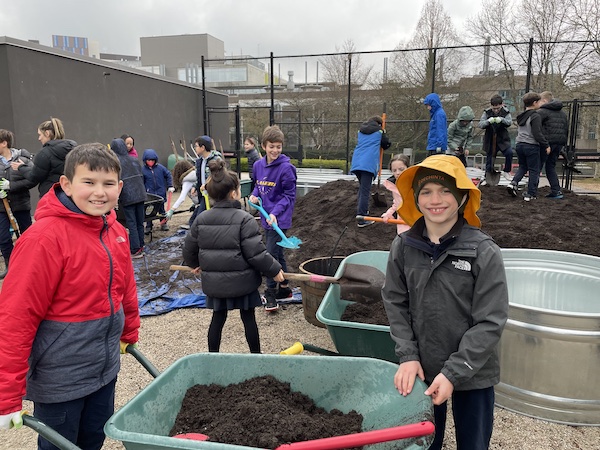
Vancouver Talmud Torah students of all ages worked together to prepare the Vancouver Jewish Community Garden. (photo from VTT)

The first few weeks of spring have been a particularly busy time for Vancouver Talmud Torah (VTT) students. Armed with child-size wheelbarrows, shovels, rakes and plenty of enthusiasm, students spent last March preparing the soil for Vancouver Jewish Community Garden. VTT’s head of school, Emily Greenberg, said the formidable task of building up the garden, which will provide crops for a variety of food security initiatives in the community, has been a big hit with the kids.

“We had every single one of our students, including our littlest 3-year-olds, coming out to the garden and helping to move soil into the planter boxes,” Greenberg said, adding that it took about a week to fill all of the planters. “At the beginning of the week, I saw a mountain that was easily over seven feet tall of dirt and, by the end of the week, they had taken it down to the ground.”

Their work paved the way for two community days in early April, in which families from throughout Metro Vancouver turned out to help.

The Vancouver Jewish Community Garden is the brainchild of three Jewish agencies: VTT, Congregation Beth Israel (BI) and Jewish Family Services (JFS). Approximately 1,800 square feet of the 6,000-square-feet garden will be dedicated to growing food to support various BI and JFS initiatives. The property will also include an education centre, walking paths and seating areas.

BI’s Rabbi Jonathan Infeld said the synagogue has been looking for ways to grow food that could support its philanthropic programs, such as the Veggie Club, which cooks up fresh soup that’s distributed through JFS, and One Heart Dinner, which provides sit-down meals to community members experiencing homelessness or food insecurity. He said the new garden will not only supply BI’s programs with freshly grown food, but serve as an outdoor classroom for its Hebrew school and for expanding community education programs.

“We will be creating and using this opportunity for our Hebrew school students to literally learn [about] Judaism connected to the land while getting their hands dirty in the garden,” Infeld said.

According to the rabbi, the garden’s unique gift isn’t just that it can teach community members how to grow food. “This garden is truly about feeding hunger, whether we are talking about those who physically hungry or those who are spiritually and Jewishly hungry as well,” he said, noting Judaism attaches communal responsibility to the act of growing food, instructing Jews to dedicate parts of their crops to those in need, a commandment that dovetails with the garden’s very purpose.

“Judaism [also] commands us to say blessings before and after every time we eat, to recognize that we are given a gift of food from God. When we go to the supermarket and we buy our food and prepare it and make it, it’s easy to forget from where it came.”

The tasks involved in building and tending this garden, he explained, also serve to remind us that food doesn’t arrive easily. “It needs a lot of hard work, it needs our interaction and it needs divine intervention” in order to feed a family. “By being involved in the farming and producing and the growing of food, our community will be able to see in front of their eyes what the Jewish laws pertaining to eating are really all about,” Infeld said.

For JFS, it made sense to support a program that produces food for community sustainability initiatives and also serves as a classroom for youth education, said JFS chief executive officer Tanja Demajo.

“The garden is a very important part of the food justice and inclusion and community engagement [programs] that we are trying to build through the Kitchen and our food initiatives,” she said. “So, it really wasn’t hard for us to lend our support and voice. It was very meaningful, and what’s even more meaningful is this opportunity to build partnerships between VTT and BI. That’s quite unique and amazing.

“It is really neat to see how we can all think through different lenses of the ways to build a community; how to put education … and community engagement and food production together and create this accessible space for everyone to participate in.”

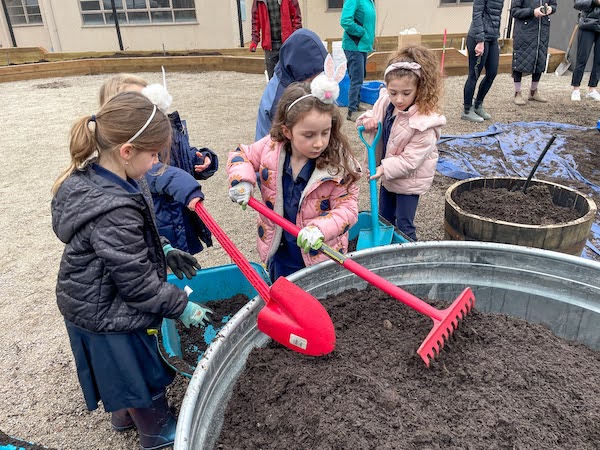
photo - Vancouver Talmud Torah students filling planters at the Vancouver Jewish Community Garden
Vancouver Talmud Torah students filling planters at the Vancouver Jewish Community Garden. (photo from VTT)

Greenberg said this may be the first project of its kind – several Jewish agencies with differing mandates partnering to create a community garden.

“That is something that we are really proud of and we hope it sets a standard for collaboration, because we are always stronger together, and we know that this is something that was only achievable because we were able to work together to accomplish it,” she said.

According to Greenberg, several founding donors played an important role in making the garden possible.

“The Diamond Foundation secured a long-term lease of this land for future development,” she said. “We would like to thank the Diamond Foundation for allowing us the opportunity to use this land for a Jewish community garden on a temporary basis.”

Greenberg said they are also grateful to the Jewish Federation of Greater Vancouver, in partnership with the Jewish Community Foundation and the Ronald S. Roadburg Foundation, for their significant financial seed gifts.

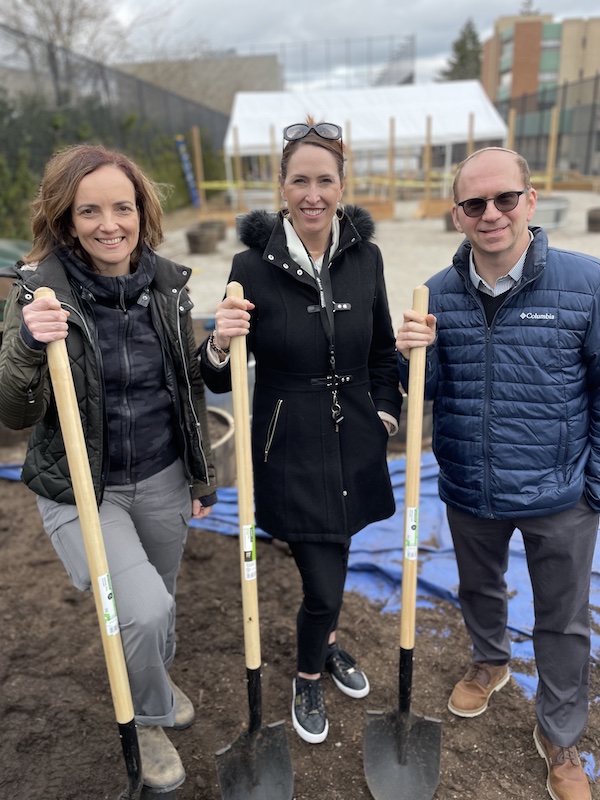
photo - Left to right: Tanja Demajo (Jewish Family Services), Emily Greenberg (Vancouver Talmud Torah) and Rabbi Jonathan Infeld (Congregation Beth Israel) contributed leadership and labour to the new Vancouver Jewish Community Garden, a joint initiative of their respective organizations. The community is invited to an open house May 28
Left to right: Tanja Demajo (Jewish Family Services), Emily Greenberg (Vancouver Talmud Torah) and Rabbi Jonathan Infeld (Congregation Beth Israel) contributed leadership and labour to the new Vancouver Jewish Community Garden, a joint initiative of their respective organizations. The community is invited to an open house May 28. (photo from VTT)

With the planters filled and seeded, the garden is now well on its way. Community members spent April planting a cornucopia of flowering plants like black-eyed Susans, purple coneflowers, sweet peas and sunflowers. Fruit trees, including apple and plum, already had been planted, along with grapes, raspberries, strawberries, and lettuces.

“Once we begin having students regularly in the garden, we will be holding lessons for all students, from rishonim (3-year-olds) to Grade 7,” Greenberg said, noting that the new classroom melds well with the school’s iSTEAM (Israel innovation, science, technology, engineering, arts and mathematics) program. “The garden gives us an opportunity to dive deep into iSTEAM and look at, for example, drip irrigation,” an Israeli invention that the community garden will be using and which is now used globally. “It’s completely transformed the agricultural sector,” Greenberg said. “So, for kids to see how innovation has come out of Israel and is then being transplanted all over the world … [it is] a very meaningful way for them to engage in learning about Israel as well.”

Finding ways to build connections to Israel is also a priority for BI. “We are always looking for opportunities to meet our goals of bringing Jews closer to God, Torah and Israel,” Infeld said. Michelle Dodek has been hired to help teach the Hebrew school students about the ancient and enduring connection between Judaism and the land.

Demajo said work in the garden doesn’t stop now that the plants are in the ground. There will still be room for more volunteers to get their hands dirty and participate in its maintenance.

“There will be a place to engage, whether it is with growing food, whether it is with programs that are more social or it’s more related to education,” Demajo said. Individuals who didn’t have an opportunity to volunteer for the build-up of the garden can reach out to Maggie Wilson at mwilson@jfsvancouverbc.ca for more information and to register as a volunteer.

On May 28, 3-5 p.m., the garden, which is located adjacent to the synagogue, will open its doors to visitors for the first time. Organizers are asking those who would like to attend the open house and fundraiser to register using the link at talmudtorah.com/vjcg, so they have an idea of how many people will be attending.

Jan Lee is an award-winning editorial writer whose articles and op-eds have been published in B’nai B’rith Magazine, Voices of Conservative and Masorti Judaism and Baltimore Jewish Times, as well as a number of business, environmental and travel publications. Her blog can be found at multiculturaljew.polestarpassages.com.