Connecting with nature

Growing Together – a garden program for young adults with varying abilities, run by the Jewish Community Centre of Greater Vancouver and Jewish Family Services – is facilitated by Ran Keren. (photo from JCC)

This spring, the Jewish Community Centre of Greater Vancouver launched Growing Together, a garden program for young adults with varying abilities, in partnership community with Jewish Family Services (JFS). The program runs biweekly on Sundays through August and is offered free of charge.

“It is well established that spending time outdoors can benefit mental health,” Shiri Barak Gonen, Inclusion Services program coordinator at the JCC, told the Independent. “The JCC wanted to create a safe, welcoming space where members of our community could connect with nature, build meaningful relationships and experience personal growth. 

“We also have a deep appreciation for agriculture. Living in an urban environment, we felt that community gardening would be a meaningful way to introduce participants to the growing process and foster a stronger connection to the natural world. We recognized that experiencing the entire growing cycle – from planting and nurturing to harvesting – would provide participants with a genuine sense of accomplishment and pride. 

“In addition,” she said, “we recognized that our adult inclusion programs serve a broad age range. This initiative was designed to give our young adults the opportunity to connect and build friendships with peers who are closer to their own age and at a similar stage of life.”

It was developed with a clear vision, she said: “to engage participants in gardening and outdoor activities while encouraging connections with one another, with the facilitator and with nature itself. Once we had that vision clear, we began searching for the right location to bring it to life.”

The JCC initially approached Congregation Beth Israel, said Maggie Wilson, coordinator of the Vancouver Jewish Community Garden, which was established in 2020 by Vancouver Talmud Torah, Beth Israel and JFS, and which is situated alongside the synagogue building and behind the school. However, the congregation realized the program would be a better fit for a partnership between the JCC and JFS, she said.

Wilson and Carol Hopkins, director of food security at JFS, explained in an email that “the JCC coordinates the program, managing participant recruitment, registration and the program facilitator” and, through its partnership with JFS, the program takes place in the garden. 

“As part of this collaboration, JFS will lead specialized food literacy programming with the participants,” they said. “The participants have also been given the use of a bed to care for throughout the season. This allows them to experience the full cycle of gardening, from planting seeds and caring for growing plants to harvesting food they have grown themselves, all while building confidence, developing new skills and fostering a sense of ownership and connection to the space.

“By combining expertise in inclusive programming, a shared dedication to food literacy and a vibrant outdoor learning environment, this partnership between the JCC and JFS has created an experience that neither organization could have offered on its own.”

Wilson provides professional guidance and ongoing support for the program, which is designed for young adults aged 18 to 25 with a wide range of support needs. Barak Gonen said the initiative has allowed the JCC “to engage new participants who had not previously taken part in our inclusion programs.”

photo - The JCC-JFS Growing Together program takes place in the Vancouver Jewish Community Garden
The JCC-JFS Growing Together program takes place in the Vancouver Jewish Community Garden. (photo from VJCG)

For the initiative, the JCC recruited Ran Keren, an experienced facilitator, who, Barak Gonen said, “has done an exceptional job leading the gardening activities while also creating engaging outdoor arts, crafts and nature-based experiences that foster learning, bonding and enjoyment.”

“We started our program this spring with learning about the various herbs, veggies, fruits and greens that grow in the beautiful Jewish Community Garden,” said Keren. “Every meeting, we do some work in the garden and connect with the plants in some way; making herbal tea from the garden herbs, printing T-shirts with the garden flowers, putting together birdhouses and bug hotels, and nurturing our own little plot of veggies. There is something dynamic in gardening work, as it depends on the weather and the ever-changing crop growth and cycles, but the most important part in our work and activities is to create space in which we get to know one another, and feel safe and welcome to share thoughts, experiences and feelings. To borrow from [noted Indigenous botanist] Robin Kimmerer, ‘A garden is a nursery for nurturing connection.’ My main goal, and hope is that our program is shaping to be such a space.”

Growing Together is a seasonal initiative, so it will continue for as long as the weather conditions allow. “We hope to extend it through the current growing season and are planning to offer it again next spring, giving participants the opportunity to reconnect with nature and continue building on the relationships and skills developed through the program,” Barak Gonen said. 

“There is still space for new participants to join the current program cycle,” she added, “and we welcome anyone interested in taking part.”

For more information, contact Barak Gonen at shiri@jccgv.bc.ca. For more about the garden, go to jewishcommunitygarden.ca. 
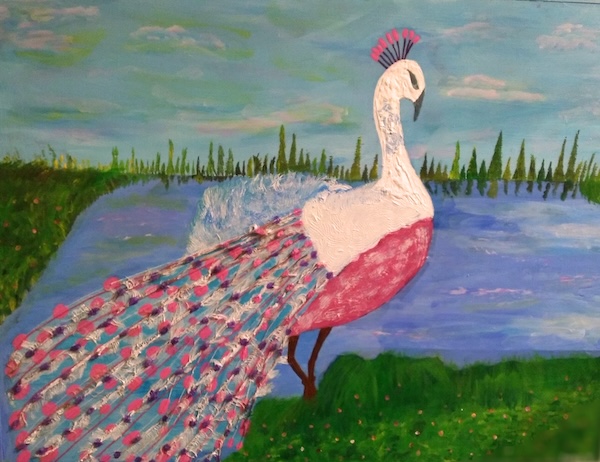
Exhibit inspired by roots and wings

Roots and Wings at Zack Gallery features a wide range of artwork, including the painting “Princess Love” by Grace Tang. (photo by Olga Livshin)

Roots and Wings, the seventh annual exhibition of JCC inclusion services, opened at Zack Gallery on Jan. 30. The show marks February as Jewish Disability Awareness and Inclusion Month. Most participating artists are either members of Art Hive, JCC inclusion services’ art branch, or members of similar programs in other localities. Such programs offer people with developmental disabilities art classes and workshops, and help emerging artists with instructions and materials. 

The show’s theme is Roots and Wings. On the one hand, roots represent a deep connection to our origins: biological, ethnic and geographic. On the other hand, wings denote our striving to fly towards new beginnings and new understandings.

photo - “Shoes” by Jasmine Winkler Stobbe
“Shoes” by Jasmine Winkler Stobbe. (photo by Olga Livshin)

Many artists responded to the challenging theme. The exhibition includes paintings, ceramics and 3D installations. The images vary from detailed beaded jewelry by Mikaela Zitron to the flowery landscape “Walking through the Meadow Land” by Theresa Kinahan. Small raku ceramics of birds and hamsa (hands) by different Art Hive potters stand beside the colourful and whimsical acrylic “Paisley Cat” by Calvin Ho. 

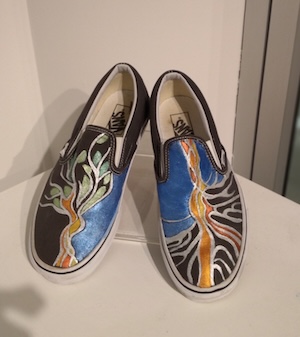
Trees and roots also served as the inspiration for a few pieces. Among them, the most unusual is “Shoes” by Jasmine Winkler Stobbe. Roots painted in a quiet blue palette enhance the standard black fabric shoes’ tops, inviting everybody to try them on. 

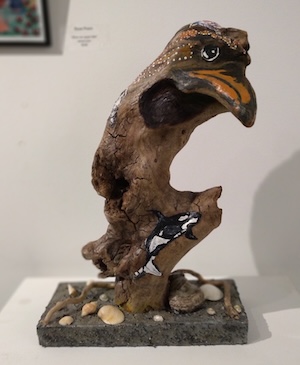
But most artists went with the subject of birds, so fitting to the theme of wings. Small, everyday birds decorate Jerry Zhou’s charming totes. Strange, fantastic birds look haughtily at the viewer from Hadeeb Hamidi’s painting “Mystical Birds.” A regal peacock with its gorgeous tail struts across a simple landscape in Grace Tang’s “Princess Love.” And, while owls in several paintings are instantly recognizable, the driftwood bird sculpture “Fusion of Nature” by Melody Edgars feels like an embodiment of a proud sea bird with a powerful beak and a curious nature. 

photo - “Fusion of Nature” by Melody Lorna Edgars
“Fusion of Nature” by Melody Lorna Edgars. (photo by Olga Livshin)

Many artists depicted chickens: small and large, yellow and multicoloured, familiar and exotic. Matthew Tom-Wing’s humorous “Nobody Here but Chicken” seems to represent this flock of chicken fairly well.

Some artists have participated in these annual shows before. For others, this is their first time at the Zack. One of the newcomers is Shiri Barak Gonen, the new inclusion services coordinator. 

“My career went in a kind of crooked line,” said Gonen in an email interview. “I started working in the Israeli tech industry when I was 23, freshly discharged from military service. I worked with computers in both technical and managerial roles while I completed my bachelor’s degree in psychology, followed by a music therapy program, on evenings and weekends. Afterwards, I worked for a few years as a music therapist with kids of all ages and with a range of challenges. Some years later, I found my way back to the tech industry, until we decided to relocate to Vancouver. We arrived in Canada in 2024.”

Newly hired, Gonen has given lots of thought to her new position. “The inclusion coordinator role is composed of two aspects,” she explained. “First, the managerial tasks such as staff and budget management and strategic planning. The other aspect is the direct and intensive interactions with the inclusion population, which requires sensitivity and a constant awareness of the needs of others. Both aspects are reflected in my personality and in my previous jobs.”

She added: “My current position is very different from my past jobs. In my last role, I was writing software code … and managing teams. Before, when I worked as a music therapist, I had a chance to work with my students and their families, but being a therapist puts you at a different angle than a program instructor. My focus will always be therapeutic, but I find much more pleasure in sharing hot chocolate and a chat with a group rather than analyzing their behaviour as a therapist. The essence of my new job is to establish meaningful relationships and mutual trust. We are building such a connection now.”           

Another newbie at the Zack Gallery is an experienced Vancouver artist – Pierre Leichner. 

“I have always been artistic,” Leichner said in a telephone interview. “Photography, ceramics, other creative outlets. But, when I graduated from high school, my family and I decided that, for better employment opportunities, I should go into science. I didn’t mind. I liked science too.”

He became a psychiatrist and worked in the profession for more than 30 years.  

“In 2002, I decided I couldn’t do it anymore,” he said. “The medical system turned too entrepreneurial, too corporate and dehumanizing.” So, he revisited his first love – art. He enrolled at Emily Carr University of Art + Design and received his bachelor’s in fine arts in 2007. In 2011, he completed his master’s in fine arts at Concordia University in Montreal.              

“Mostly I do visual arts,” he said. “Sculpture, photography, videos and paintings. I also do some performing arts, and I dabble in theatre,” he said. “I have my own YouTube channel, which deals with environmental issues.”    

photo - Some of Pierre Leichner’s GrassRoots Project masks
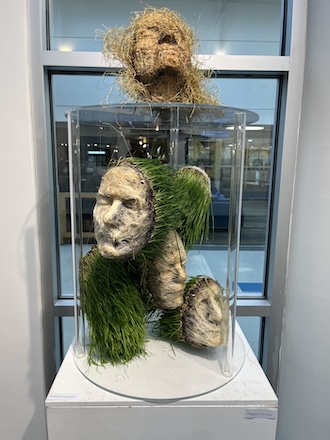
Some of Pierre Leichner’s GrassRoots Project masks. (photo from Pierre Leichner)

A multidisciplinary artist with widespread interests, Leichner considers community involvement of utmost importance. In 2017, he founded the Vancouver Outsider Arts Festival, which provides opportunities to marginalized visual and performing artists. He still serves as its artistic director. He is also a member of the Connection Salon collective and sits on the board of the Community Arts Council of Vancouver.

“I like to explore the possibilities on the cusp of art and science,” he said. “There are similarities between the two, and both examine the foundations of human existence.”

The GrassRoots Project he presented for the current Zack show fuses science and arts and illustrates Leichner’s interdisciplinary approach.

“I saw the call for this show, and it fit my GrassRoots Project perfectly,” he said. “The project started in 2011, when Britannia Community Centre received a grant to celebrate people with the deepest grassroots contributions: teachers, artists, musicians.”

Over the years, Leichner has made about a dozen sculptural masks of those people, plus some of his friends and colleagues, employing a traditional Mediterranean technique. “I use wheatgrass,” he explained. “I make a mold of their face masks and plant wheatgrass within. The roots take the shape of the face, while the grass grows out like hair. It takes about three weeks to grow each portrait. The grass becomes part of the sculpture, the means of my artistic expression.”

Each mask is a symbol, echoing the synergy of humans and nature. “In this way,” the artist said, “nature imitated us in celebrating our community at this time of great ecological concern. We all need roots. We have them within our bodies. We also have them with our family and our community.”

Roots and Wings is on until March 2. 

Olga Livshin is a Vancouver freelance writer. She can be reached at olgagodim@gmail.com.