Dream warms frozen flames

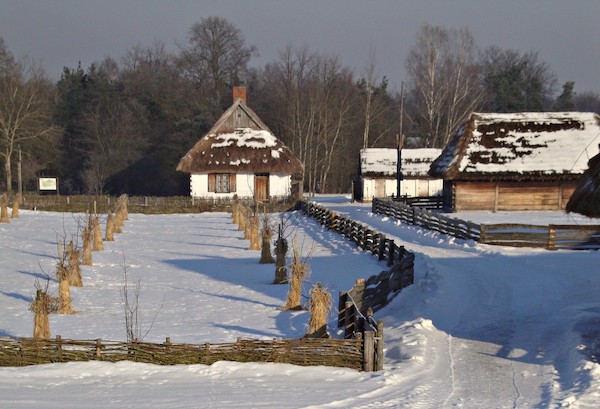
It was just before sunset on the last night of Chanukah, the coldest it had ever been in Chelm. (photo from pxhere.com)

It was a cold day in the village. It was so cold that when Reb Cantor, the merchant, sneezed without covering his mouth, his mucus solidified and blew a hole through the window of his shop, which his wife fixed by throwing a cup of tea at his head. He ducked, and the tea hit the windowpane and froze into place. It was that cold.

It was so cold that the flame of the eternal light in the synagogue froze solid. Instead of flickering brightly, it stood still, like red and yellow glass.

The villagers were frightened. It was just before sunset on the last night of Chanukah. Soup froze on its way from the pot to the table. Vodka oozed as it was poured into a glass. Chanukah candles snapped at the slightest touch. Reb Cantor’s matches broke into splinters. Stoves were almost useless. Warm challahs froze into rocks in seconds. Axes had to be warmed or else, when they struck the firewood, the blades shattered as if they were made of crystal. The Uherka River had frozen solid, trapping in its icy clutches a flock of geese late to leave the area.

It seemed as if the end was near. Everyone was hungry. They were afraid to go outside because the wind sucked the heat from their skin. The air itself left their lips numb. Kissing could be dangerous.

The day had been dark and cold, and the night would be darker and colder. Meals were uncooked and uneaten. Chanukah candles, set in their menorahs, were unblessed and unlit. Families stayed in their homes, huddled together in bed.

Even in the house of the wisest man in the village of fools, the menorah was dark.

Rabbi Kibbitz shivered in his bed with his wife, Channah Chaipul (she kept her maiden name, which, as you know, is another story). The two of them lay fully dressed beneath four sheets, three blankets, two quilts and seven coats – everything warm that they owned. Still, his teeth were chattering. For the first time in his life, he regretted not owning a dog or a cat.

“Channah,” the rabbi said. “We have to light the candles.”

“You do it,” she said. “I’ll watch from here.”

“My hand is too unsteady. The shammos will blow out. You are better at that sort of thing.”

“I’m almost warm,” she said. “You do it.”

“I’m nearly frozen,” he answered.

“So? You want me to get out of bed, light the candles, and come back in with icy cold feet?”

He shuddered. The last time she had put a cold foot on his ankle, his heart nearly stopped.

He sighed and closed his eyes. Maybe in a few minutes he would….

“Are you awake?” she said, elbowing him in the ribs.

“Channah!” he said, suddenly sitting up. “I had a dream!”

“Are you crazy? Lie down, you’re letting in a draft.”

“No, Channah, I’ve had a dream. Quickly! Get up! We need to gather everyone together in the synagogue.”

Mrs. Chaipul squinted at her husband. She hadn’t seen him this excited since he’d beaten Rabbi Abrahms, the schoolteacher, at canasta. “What did you dream?”

“I can’t tell you,” he answered. He slid out of bed and gasped as the frigid air slapped his neck like an icy wet towel. “Tell everyone to bring their menorahs and come to the synagogue. Quickly!”

Grumbling and shivering, Mrs. Chaipul stood, and nearly stopped right there. She wondered if it was possible for blood to freeze. Then, the rabbi went one way and his wife went the other, banging on doors and windows. They ran as fast as they could (which was remarkably briskly, considering their ages), waking villagers and telling them to gather in the synagogue.

“What? Why? Are you crazy?”

“Yes, I am,” said Mrs. Chaipul. “But the rabbi has had a dream. So you can freeze in your house or freeze in the shul. It’s up to you.”

Parents groaned. Children were wrapped in blankets. Doors were pried open. Menorahs were carried carefully, lest they crack into pieces on the short trip to the synagogue.

The small shul filled quickly.

Rabbi Kibbitz stood at the front, on the bimah, with five tallisim wrapped around his shivering old shoulders. He stood beneath the eternal light, staring at the still-frozen flame.

“Is everyone here?” he asked. Everyone looked around and nodded. No one was missing. “Then, please, somebody shut the door!”

“It’s shut,” came a shout from the back.

“Oy,” muttered the chilled rabbi.

“So, Rabbi, what is it?” said Reb Cantor. “What is so important that you asked us to risk life and limb to come to the synagogue on a night so cold my eyeballs almost froze?”

“I had a dream,” the rabbi said.

“So, I heard,” answered Reb Cantor. “You maybe want to tell us what the dream was?”

“I dreamed,” Rabbi Kibbitz sighed, “that all the villagers of Chelm gathered together in the synagogue.”

“Yes? Yes?”

“Well, in my dream, it was a cold, cold night, and the Chanukah candles weren’t yet lit.”

“Yes? Yes?” the villagers repeated.

“And everyone, all of you, came here to the synagogue.”

“Yes? Yes?”

“That’s it.” The wise rabbi shrugged. “We were all here. Then Channah nudged me, and I woke up.”

“That’s not much of a dream,” muttered Mrs. Chaipul.

The citizens of Chelm stared in disbelief at their beloved rabbi.

“You’re crazy!” shouted Reb Cantor. “You yanked us out of our moderately warm beds and dragged us here to tell us that you had a dream that we were all here? That’s it? Rabbi Kibbitz has finally lost his mind! Rabbi Abrahms, it is time for you to become the chief rabbi of Chelm.”

The villagers began to grumble and argue and stamp their feet. A wave of exasperated hot air lifted to the ceiling as their voices rose into shouts.

“Wait, wait!” Rabbi Kibbitz said. “Please, listen.”

Just then a child’s voice shouted, “Look! Look!”

It was young Doodle, the orphan, and one of the most foolish boys in the village of Chelm.

Doodle was pointing up at the eternal lamp. The pale light was thawing – flickering faintly, but growing brighter as it filled the synagogue with its glow of red, orange, yellow and gold.

Reb Cantor himself lifted Doodle up. “Careful, careful now,” he whispered, as the young boy touched his shammos to the light of the eternal flame.

That candle was passed back and forth throughout the shul, as every family lit their own shammos. Everyone held their breath, wondering whether the wind and the cold would extinguish the thin flames.

Then, at long last, the villagers of Chelm said the blessings all together. The shammosim touched the other candlewicks. Soon, for each family, one flame became eight (plus the shammosim).

Now the synagogue was full of light, and the villagers began to sing.

Reb Cantor swept the old rabbi up in a bear hug. “That was some dream!”

Everyone laughed and danced.

They stayed there all night, and the candles burned so slowly that it was well past dawn before the last one burned out.

That morning, when the doors to the synagogue were opened at last, a warm breeze left the shul and spread out over the village.

The ice on the Uherka River cracked, and the flock of trapped geese took flight. All the villagers watched and cheered as the birds sped south.

And, from the east, the sun rose higher, and its rays felt warm with promise.

Izzy Abrahmson is a pen name for author and storyteller Mark Binder, who  lives in Providence, R.I., and tours the world – virtually and in-person. Abrahmson’s Winter Blessings: Warm Stories from the Village was a National Jewish Book Awards finalist.

Milestones … Hart-Rappoport wedding, Canadian Jewish Literary Awards, new BGU residences

With gratitude to HaShem, mazel tov to Shmuel Hart (King David High School Class of 2016) and Reut Rappoport on their joyous and spirited wedding at Sakoya Gardens (just outside Jerusalem) on June 15, 2021. Elated parents – Alexander Hart and Kathryn Selby of Vancouver, and Rabbi Jason and Meira Rappoport of Alon Shvut, Gush Etzion, Israel – are so very proud of the newlyweds. The couple resides in Jerusalem, Israel, and both are currently studying at Hebrew University.

* * *

Now in its seventh year, the Canadian Jewish Literary Awards recognizes and rewards the finest Canadian writing on Jewish themes and subjects. This year, the awards ceremony, which took place on Oct. 17, was presented on Zoom and is available for viewing on the Canadian Jewish Literary Awards YouTube channel.

The winner in the fiction category was Nothing the Same, Everything Haunted: The Ballad of Motl the Cowboy by Gary Barwin (Random House Canada). It follows a wannabe cowboy, Motl, as he and his mother flee Vilna and the Nazis’ massacre of the Jews. The ensuing events, characters and horror are met by Motl with humorous absurdity in the face of tragedy.

Plunder: A Memoir of Family Property and Nazi Treasure (Houghton Mifflin Harcourt) by Menachem Kaiser, which tells the story of the author’s quest to reclaim a residential building his family owned in Poland before the Shoah, won for best biography.

Lisa Richter won the poetry prize for Nautilus and Bone (Frontenac House). A reimagining of the unconventional life of Yiddish poet Anna Margolin, this collection also won the 2020 National Jewish Book Award for Poetry, the first time a Canadian poet has ever received the American honour.

For children and youth literature, the winner was Osnat and Her Dove (Levine Querido) by Sigal Samuel, with illustrations by Vali Mintzi. It is based on a true story. Although girls in 15th-century Mosul were told, “Reading is for boys,” Osnat convinces her rabbi father to teach her to read. As she grows older, she asks her father to seek a groom who will allow her to study Torah, and she helps run her father’s religious school while raising her own children. After her father’s death and, later, her husband’s, Osnat becomes the school’s leader, making her the world’s first female rabbi.

For scholarship, the awardee was Survivors: Children’s Lives After the Holocaust by Rebecca Clifford (Yale University Press), which is an exploration of the life trajectories of 100 children who were 10 years old or younger at the time of their liberation in 1945. Through archives found in 12 countries, including Canada, and through personal interviews, the author follows the impact the events of the Holocaust had on their lives, and on those who educated them.

In the category of writing about the Holocaust, the winner was In the Lights of Days: The Untold Story of Women Resistance Fighters in Hitler’s Ghettos (William Morrow) by Judy Batalion. The book points out the lack of recognition and the misrepresentation of women’s roles during the war, the actions they took to fight, as well as their crucial importance.

The Canadian Jewish Literary Awards jury for 2021 was Edward Trapunski, Pierre Anctil, Rona Arato, Miriam Borden, Rita Davies, Alain Goldschläger and Adam Sol.

For more information, visit cjlawards.ca.

* * *

photo - Ben-Gurion University of the Negev student village
Ben-Gurion University of the Negev student village (photo from CABGU)

Fourteen new buildings have been added to the student village at Ben-Gurion University of the Negev (BGU) in Israel. It will allow more than 1,000 students options from studio apartments to married student housing.

“The student village lets them choose their living quarters in accordance with their personal preference,” said BGU president Prof. Daniel Chamovitz, “while everything they could need is nearby: the north campus and the conference centre, which are in development, a hotel for visiting students and faculty, stores and coffee shops … and the high-tech park, the train station and the university’s country club are just a short walk away.”

The student village offers apartments suitable for religious students and those with disabilities. Any registered student is eligible to apply for a room. The rooms come fully furnished with a smart TV, beds, closets, desks, a full kitchen, a sitting area and a solar water heater. Full maintenance service is offered, as is 24/7 security, a 24-hour service hotline, bicycle rooms, laundry rooms, and more.

“Situated in the country’s southern region, the university is known to be a destination institution,” said Mark Mendelson, chief executive officer of Canadian Associates of BGU. “This means that students who attend the university also live either on campus or in the communities in and around the university, including the city of Be’er Sheva. In addition, almost 60% of the undergraduate student body volunteers in their respective neighbourhoods, which is really something very unique to BGU and has brought outstanding community involvement to the citizens of Be’er Sheva.”

Novels miss the mark slightly

I was very much looking forward to two recent novels. Both are love stories, but unconventional ones. I enjoyed them, and read them cover to cover – generally, I allow myself to stop reading, watching or listening to whatever it is I’m not enjoying, so that I wanted to know how the stories ended is a compliment to the writers. But I was disappointed in the novels, ultimately. In both instances, I felt a little robbed of emotional impact.

Perhaps, given their protagonists, I shouldn’t have been surprised that the cerebral aspects of the books would outweigh, even quash, the heart-rending effects. Morningside Heights by Joshua Henkin (Pantheon Books, 2021) is about an uber-accomplished, hyper-intelligent professor who is struck by early-onset Alzheimer’s. Never Anyone But You by Rupert Thomson (Other Press, 2020) is about two real-life cultural icons who were in the same social circles as people the likes of Ernest Hemingway and Salvador Dalí.

Love faces adversity

Within the first 20 pages of Morningside Heights, I didn’t particularly like either Prof. Spence Robin or his wife, Pru. He is an all-star academic, winning awards and grants of all sorts; he has ambition and has achieved some power in his world, and carries himself as such. He is Jewish but changed his name early in life, “to escape the Lower East Side.” He is Pru’s teacher, though only six years her senior, and downplays her concerns of being seen on campus as just his girlfriend, not as a person in her own right. And it is only after he semi-proposes that he tells her he has a sister with brain damage, who he visits rarely, and that he’d been married before and has an estranged son from that marriage.

For her part, Pru lets Spence get away with all these things. Worse, she abandons her own beliefs and dreams, basically, to be with him. For example, she keeps kosher before she meets him and in their early days together, but lets that go by the wayside. She has her own promising career that she gives up because her own areas of interest overlap with his award-winning expertise. He lets her become his shadow. He lets her main purpose become supporting him, while not reciprocating or appreciating that support at all, it seems.

So, it’s hard to empathize with the individual characters when their lives are completely upturned by Spence’s Alzheimer’s, which begins to affect him in his late 50s. That said, one doesn’t wish ill on anyone. The challenges both Spence and Pru face are severe, and Henkin brilliantly communicates the difficulties on both sides. Spence’s confusions and his not being able to understand fully the state he’s in are as heart-wrenching as his strong will and refusal to step down from work or admit his frailties are frustrating. Pru’s sadness at the loss of her partner and the heavy responsibilities of caring for him are palpable.

Perhaps the weight of these feelings and circumstances is part of what inspired Henkin to give – in my opinion – too much ink to Spence’s troubled son. Spence and Pru’s daughter Sarah doesn’t figure as prominently, but a lot of time is spent on Arlo and, in some respects, Arlo allows readers to get to know more about Spence. But those story threads interrupted, for me, the potential intensity of the Spence-Pru storyline, which, I have to admit, was both a relief and a letdown. I wasn’t surprised that Henkin has personal experience with dementia. In an online interview with the publication Shelf Awareness, he shares, “Although much of Morningside Heights is invented, it is, in many ways, my most autobiographical novel to date. My father, like Spence, was a professor at Columbia who developed Alzheimer’s, though my father developed it much later in life than Spence did. In writing about the ways Pru lost Spence, I was re-experiencing my mother’s loss, and my brothers’ and my loss.”

The rawness of that real pain is tempered in the novel, perhaps out of personal necessity. And perhaps most readers will appreciate that emotional distance, but I was hoping for a more intimate portrayal.

Not-so secret love

Never Anyone But You also lacks intimacy, even though it is about Suzanne Malherbe and Lucie Schwob, who fall in love and become both personal and professional partners. Thomson writes about the real-life French artists in a somewhat didactic and distanced way. He has done all his research but never fully inhabits or gives full life to his characters, who must have been quite passionate and committed people to have accomplished what they did under the circumstances in which they did it.

The women knew each other from childhood but end up becoming stepsisters when Lucie’s father (who was Jewish) connects with and eventually marries Suzanne’s mother (who was Catholic). Suzanne is immediately captivated by Lucie when they meet more formally; Suzanne is almost 17 years old and Lucie a couple years older than that. Never Anyone But You is told from the perspective of Suzanne.

Early on, the two decide to collaborate – Lucie’s words and Suzanne’s drawings. Lucie transforms herself into Claude Cahun before Suzanne reinvents herself as Marcel Moore. But the new persona cannot heal Claude’s bouts of depression and, throughout her life, she struggled to stay alive.

Claude and Marcel were unofficially (because they weren’t men) part of the Surrealist scene in 1920s Paris but their artistic (notably, photographic) success was tempered by the Second World War. They leave Paris in the late 1930s and take refuge in Jersey, where they use their talents to unsettle and educate the Nazi soldiers who occupied the island from 1940. It was their hope that their leaflets would demoralize the soldiers, and even cause some of them to desert. Marcel was fluent in German, so they could make the subversive material appear as if it were coming from one of the soldiers. Eventually, the two would be discovered and arrested. Though they would suffer imprisonment, they survived the war.

The bravery of Claude and Marcel is remarkable, as is their dedication to each other, though Claude is depicted as being unlikeable at times, between her mental health issues and her being more fluid with her sexuality than Marcel, ie. she had other relationships. Nonetheless, for Marcel, there was never anyone but Claude, though it is difficult to see why there was such devotion and loyalty on her side, and Thomson’s novel doesn’t answer that question. Ultimately, the two were together for more than 40 years, until Claude’s death in 1954, so there was, I guess, really never anyone but Marcel for Claude, either.

Heavy summer reads

I recently read two works of fiction by former Winnipeggers. I mention that because, when I think of Winnipeg, where I grew up, I think of the Prairies, I think of wide open spaces. Yet both of these novels portray the bleaker side of life, with characters who can’t get beyond their limitations.

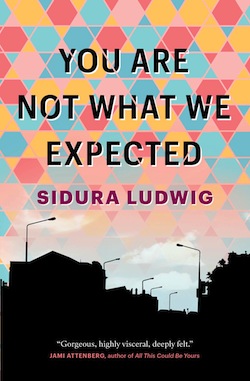
Having read and enjoyed Sidura Ludwig’s first novel some 15 years ago – Holding My Breath (Key Porter Books, 2007) – I looked forward to You Are Not What We Expected (House of Anansi Press Inc., 2020). Set in the Toronto suburb of Thornhill – a heavily Jewish neighbourhood – where Ludwig now lives, the loosely linked stories about the Levine family are wonderfully written, which is not surprising. But they are dark and, at times, brutal. Ludwig’s economical use of language can feel almost like a literal knife in the side or a punch in the gut, when a story switches from a relatively light moment – there is humour in these tales – to a tragic one.

image - You Are Not What We Expected book coverLudwig is a skilled observer of human nature and she creates characters in You Are Not What We Expectedwith whom readers will both empathize and even root for, but also get frustrated with. The first chapter jumps right in and sets the tone with senior citizen Isaac, back from Los Angeles to help his sister out. His fist-waving, shouting and no-spoiler-here reaction to a school’s placing of the Israeli flag below Canada’s on their flagpole is both hilarious, valiant and pathetic. His vitriolic and stubborn behaviours will cause him more than one trouble.

Other characters in the book are similarly limited – as we all are – by their own personal issues, the action or inaction of others, and simple twists of fate. You Are Not What We Expected is well worth reading but maybe not on vacation.

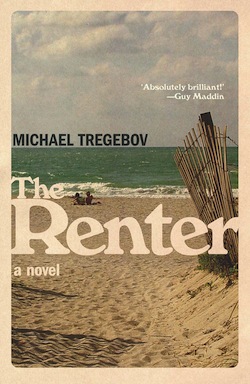
image - The Renter book coverMichael Tregebov’s The Renter: A Novel (New Star Books, 2021) is similarly well-written and also not a light holiday read, which is what I was kind of expecting. Tregebov, who now lives near Barcelona, takes a nostalgic look at Winnipeg Beach, but certainly not the cottage life that I experienced in the area as a kid.

The back cover promises romance in the summer of 1968; rich girl, poor boy, the stuff of rom-coms. But the poor boy in question is a cynical (with good reason) drug dealer who pretty much desires and courts the rich girl because of her wealth, not because he truly likes her at all.

I know there is a lot to appreciate in The Renter and there are many people who would love it – for example, Winnipeg filmmaker Guy Maddin, who, on the book’s cover, calls it “Absolutely brilliant!” – but I can’t honestly count myself among them.

Community milestones … Waldman Library, Kleiner Services, Prairie Sonata

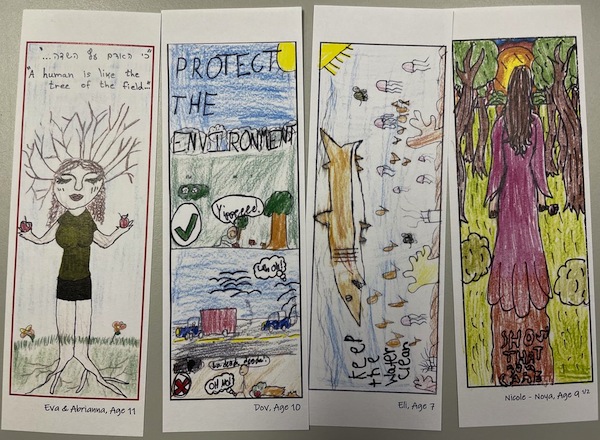
The winning entries of the Isaac Waldman Jewish Public Library’s bookmark contest.

Isaac Waldman Jewish Public Library wishes mazal tov to the winners of its bookmark contest and to all the contest participants. “We really appreciate the efforts of all the participants and the wonderful creativity they have displayed in designing their bookmarks. It was a pleasure to review them all,” said the library in an email. “This year, we have chosen four designs that best reflect the theme of sh’mirat ha’teva, protecting the environment.”

Chosen were the bookmarks by Eli Stefanek, Grade 2, Richmond Jewish Day School; Nicole-Noya, Grade 4, RJDS; Dov Bondar, Grade 5, RJDS; and Eva Rogachevsky and Abrianna Jacobs, Grade 5, Vancouver Talmud Torah.

***

Kleiner Services Inc., owned by Mary and Konstantin Kleiner, was among the top five finalists for the Best Immigrant Entrepreneur Award this year. This award recognizes outstanding new Canadians who, after immigrating, have created successful small businesses while demonstrating leadership and breaking down barriers.

Across four days earlier this month, Small Business BC announced six winners in various categories, capping a competition that saw 937 award nominations in 88 communities across the province. The Best Immigrant Entrepreneur Award went to Charcuterie Vancouver, and the other three finalists were Audielicious Restaurant (Fort St. John), Artemex Mexican Handcrafts (West Kelowna) and Soul Bite Food Inc. (Coquitlam).

Kleiner Services Inc. is a professional moving company that offers pre- and post-moving services, such as packing, storage and assembly. They are based in the heart of the Lower Mainland, servicing Greater Vancouver, Fraser Valley and Vancouver Island.

***

The Independent Press Award recognized Prairie Sonata by Winnipeg-based writer Sandy Shefrin Rabin as the winner in the category of Best Young Adult Fiction.

The competition is judged by experts from different aspects of the book industry, including publishers, writers, editors, book cover designers and professional copywriters. Selected award winners and distinguished favourites are based on overall excellence. This year, the award had entries worldwide – from Australia, Canada, India, Ireland, Japan, Singapore, Switzerland and the United Kingdom, among other countries.

“The quality and quantity of excellent independently published books hit a record…. We are so proud to announce these key titles representing global independent publishing,” said awards sponsor Gabrielle Olczak.

To see this year’s list of winners, visit independentpressaward.com/2021winners. (The JI’s review can be found at jewishindependent.ca/life-changing-impact.)

Life-changing impact

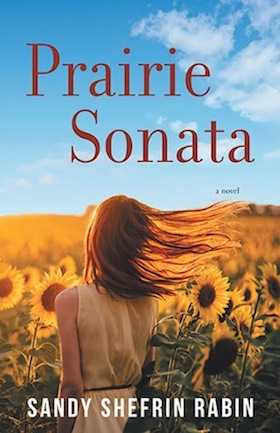
Sandy Shefrin Rabin’s debut novel is a far-reaching account of Jewish life in a small town in the late 1940s and early 1950s. Targeted to young adult readers, Prairie Sonata may focus on 11-year-old Mira’s friendship with her school (and violin) teacher, a Holocaust survivor, but it touches upon countless issues, from dealing with trauma, to preserving a language and a culture (Yiddish), to understanding different musical forms, to interfaith dating, to society’s views of mental illness, to learning about the impacts of physical disease (polio).

image - Prairie Sonata book coverSet in the fictional town of Ambrosia, Man., an adult Mira reflects back on the impact that one of her teachers – Ari Bergman, called Chaver B by his students – had on her.

Chaver B is introduced to his Peretz School Yiddish class by the principal, who only shares, “Chaver Bergman has been living in Europe and just came over to Canada two weeks ago.” But Mira sees his vulnerability right away, the “melancholy about him,” and senses “that this was a man who needed kindness.”

Invited to Friday night dinner by Mira’s mother, Chaver B spots Mira’s violin and offers to teach her. He becomes a friend to the whole family – Mira’s parents and younger brother – but especially to Mira.

The novel is structured in three parts, like a sonata. As Chaver B explains to Mira, a sonata is comprised of an exposition, in which its themes are declared; a development, where the themes are explored and expanded; and a recapitulation, where the themes are repeated, leading to a resolution. In some cases, a coda is added, “to provide a sense of closure.”

Overall, Prairie Sonata is an intriguing novel, and even older readers will enjoy it, especially those who attended a Peretz School or who grew up in the era of the book. At times, when a character is explaining something, it sounds a bit like a Wikipedia entry, but the writing is strong overall and readers will relate to and empathize with the characters. In addition to all of the questions Mira raises throughout, there is a discussion and study guide at the end, with 17 thoughtful exercises for a school group or book club.

Kirman Library spans the arts

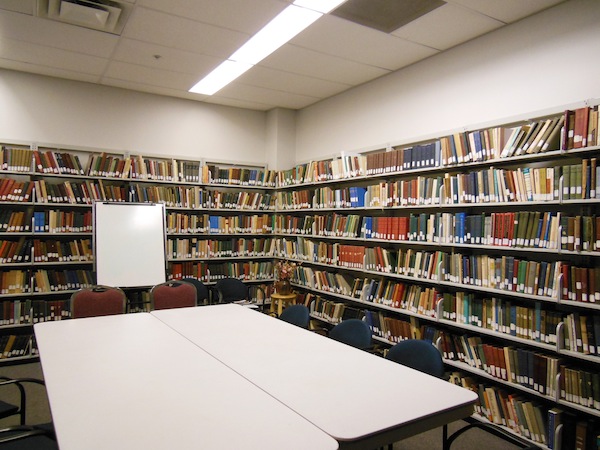
The Kirman English and Yiddish Library at the Peretz Centre for Secular Jewish Culture is available for anyone in the community to access. (photo from Peretz Centre)

“Books are humanity in print” – Barbara Tuchman

The Kirman English and Yiddish Library at the Peretz Centre for Secular Jewish Culture was set up in 1976 by Paula and Shaya Kirman, members of the Peretz Institute – as it was then known – and dedicated Yiddishists. The two main purposes in establishing the library were, first, to collect and preserve the books that were scattered in different places in the community, and, second, to make these books available to the whole community in a lending library.

Paula Kirman, who worked as a cataloguer at the University of British Columbia library, volunteered many hours to set up a card catalogue and shelve the Peretz library in an organized way. Eventually, she resigned from her volunteer position because of a perceived lack of support from the Peretz Institute’s board of directors.

In 1999, in preparation for the construction of the Peretz Centre’s present building (in the same location the institute had been since the 1960s), the library books and card catalogue had to be boxed and removed. With the completion of the new building in 2000-2001, the organization was renamed the Peretz Centre for Secular Jewish Culture and the words of I.L. Peretz, considered by many as the “father” of modern Jewish culture, were prominently displayed above the entrance foyer: “A people’s memory is history; without a history, a people can grow neither wiser nor better.”

Sporadic attempts to restore the library were made, but, when Al Stein returned to Vancouver and joined the centre’s board of directors in 2001, much of the library was still in boxes and Kirman’s card catalogue was in disarray. Stein volunteered to lead the effort to restore the library, if the board would support it in two ways: vote for funding for new shelving and support Stein’s effort to obtain a grant from the Jewish Community Foundation of Greater Vancouver to hire a library technician and digitize the entire library, including the Yiddish books.

The grant proposal was successful. A newly graduated library technician, unfamiliar with Yiddish, was contracted and many hundreds of hours were spent properly transliterating each Yiddish book and journal title, digitizing the entire collection in accordance with the latest electronic library standards, relabeling each book, arranging for electronic hosting of the library catalogue, supervising the installation of new shelving and then, finally, shelving the books and journals in an organized fashion.

Thanks to large and small donations of both English and Yiddish books from individuals, from the Winnipeg Jewish Library and from the Isaac Waldman Jewish Public Library at the Jewish Community Centre of Greater Vancouver, as well as a small number of purchases, the Kirman Library of the Peretz Centre now contains nearly 4,000 books and journals and is almost at capacity. The collection includes titles by kabbalists, rabbis, atheists, historians, politicians, musicians, artists, humourists, and those who wrote fiction, plays and poetry – in other words, the entire spectrum of Jewish creativity, encompassing all the arts.

Most of the collection is now in English and is a unique treasure trove of information and pleasure for the casual reader and the scholar. Two collections are of note. The late Dr. Gersh Winrob donated his English-language collection of Holocaust literature, memoirs, history and analyses, certainly one of the largest in the community. And the late poet Miriam Waddington donated part of her library, mostly English-language literature and essays, with a bit of Yiddish poetry.

The Peretz Centre is a proud member of the Yiddish Book Centre, now the largest Jewish cultural organization in the United States.

The Peretz’s library catalogue may be searched from any computer via the Peretz Centre website, peretz-centre.org: click the Kirman Library tab and then the Catalog link. The library ID is Kirman Library. No password is needed.

Books and periodicals can be borrowed for a $10/year fee. Four items may be borrowed at a time, for a period of four weeks, which may be renewed if no hold has been placed on the item. And the library may be used whenever the Peretz office is open, so call ahead before coming down, or for more information about library policy in general, such as its overdue or lost items policy, or to obtain a library card: 604-325-1812, ext. 1, or execdirector@peretz-centre.org.

If you have any specific questions or comments about the library, or wish to make a donation to it, Stein can be reached at 604 731-1193 or alstein577@gmail.com.

Novel journeys shared

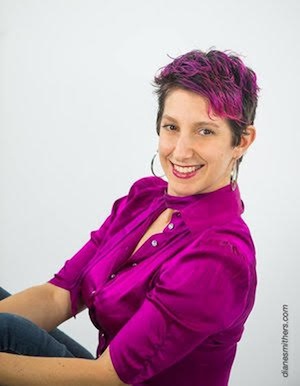
Ilana Masad participates in the Cherie Smith JCC Jewish Book Festival on Feb. 23. (photo from the JBF)

Women are at the forefront of two new books. Specifically, how we perceive their (our) roles. Especially, with regard to motherhood.

photo - Myriam Steinberg participates in the Cherie Smith JCC Jewish Book Festival on Feb. 24
Myriam Steinberg participates in the Cherie Smith JCC Jewish Book Festival on Feb. 24. (photo from the JBF)

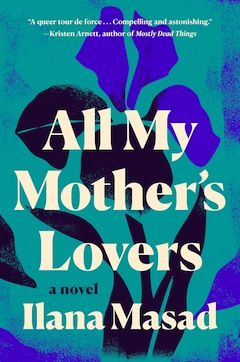
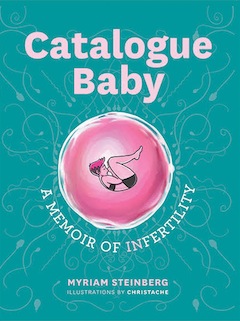
Ilana Masad’s debut novel, All My Mother’s Lovers, is told from the perspectives of a daughter and her mother, and highlights how much we cannot know about the people close to us, while Myriam Steinberg’s graphic novel, Catalogue Baby: A Memoir of Infertility, is a no holds barred sharing of her challenge to become a mom. Both Masad and Steinberg are participating in this year’s Cherie Smith JCC Jewish Book Festival, which takes place online Feb. 20-25.

While the premise is a stretch to my worldview, All My Mother’s Lovers is an extremely relatable read on many levels. Twenty-something Maggie’s mother, Iris, dies in a car crash and Maggie must return home for the funeral and shiva. But, along with her will, Iris has left behind six letters – all addressed to men Maggie hasn’t heard of – and Maggie quickly flees the communal mourning to deliver these missives.

Leaving behind her grief-addled father, who has been the emotional-support parent for her, and her younger brother, with whom she has an older-sister-bossy relationship, Maggie attempts to track down the unknown men. The space from her family and from her current partner, with whom there might actually be a substantial, meaningful relationship brewing, allows Maggie to deal with her long-held insecurities and naïve perceptions of what it means to be married, what it means to be a parent; basically, what it means to be a loving and reliable person. We get to know Iris through the letters and, though Maggie doesn’t get to benefit from these personal musings, she does learn more about her mom, which allows her to connect more deeply with her father, as well as to others in her life.

image - All My Mother’s Lovers book coverMasad’s writing is crisp, intelligent, wry and sensitive. The novel starts with a bang – Maggie answering her brother’s call (telling her about their mother’s death) while having sex with her girlfriend. The pace emphasizes Maggie’s confusion as she tries to understand her mother, and herself. Iris’s letters offer slower moments of reflection, but also were a way for Iris to try and better understand her own missteps and successes.

Steinberg’s Catalogue Baby also took me into a world I’ve never personally experienced, though I do know people who have so wanted to have a child but either could not conceive or had great difficulty conceiving. Steinberg’s refreshing openness on a topic that is often spoken about in whispers, if at all, is most welcome. And her voice is amplified by the colour-bursting, energetic and imaginative illustrations by Christache Ross, which take readers right close up into the physical and emotional upheaval and turmoil that Steinberg has lived.

image - Catalogue Baby book coverCatalogue Baby takes readers from Year One (starting January 2014), and Steinberg’s admission that her dedication to work, organizing the In the House Festival for 11 years, only occasionally gave her the time to put her “loneliness and unrequited motherhood” front of mind. Almost 40 years old at this point, she “didn’t have time to waste with someone who didn’t eventually want a family.” But, people being who we are, Steinberg nonetheless tries to make an unsatisfying relationship work, all while her biological clock (which follows her throughout the novel’s journey) ticked away. From when she finally decides to go it alone to when she gives birth to twins in late 2018, she goes through much. The list includes 123 blood draws, 31 ultrasounds, multiple fertility treatments, five pregnancies, thousands of supplements, about $100,000, help from dozens of family and friends, etc., etc. – and “25 litres of tears.”

To hear more about and from Steinberg, Masad and many other fabulous writers, check out this year’s Jewish Book Festival: jccgv.com/jewish-book-festival.

Interview insightful, fun

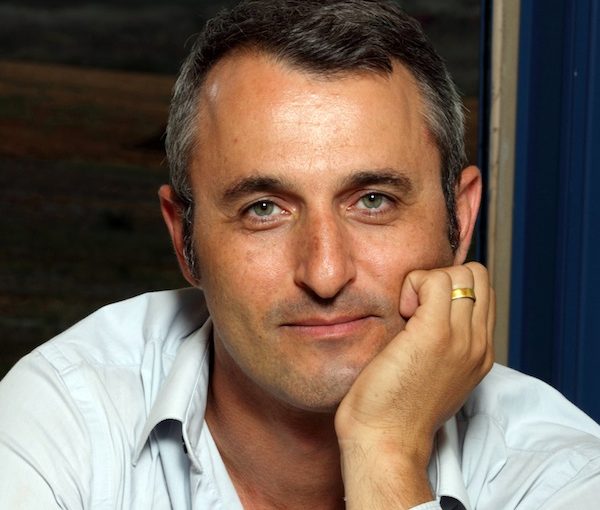
Israeli writer Eshkol Nevo, whose latest novel is The Last Interview, opens the JCC Jewish Book Festival Feb. 20. (photo from JBF)

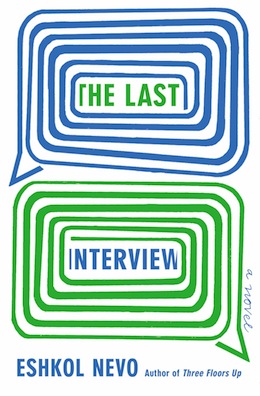
This year’s Cherie Smith JCC Jewish Book Festival opens online Feb. 20, with Israeli writer Eshkol Nevo, whose latest novel, The Last Interview, brilliantly sprinkles facts amid a lot of fiction and interjects humour into much pathos. It entertains, of course, and, as all good books do, it raises many salient points that will get readers thinking – and feeling – about, in this case, storytelling, marriage, truth, parenting, friendship, lies, family, identity, media, politics and relationships. So, life.

In The Last Interview, the protagonist, who is suffering from a chronic form of depression and writer’s block, responds to an interview sent to him “by an internet site editor who collected surfers’ questions.” He later notes, “It was supposed to be only an interview, nothing else, but slowly – it seems I can’t do it any other way – I’ve been turning it into a story. I was supposed to leave Dikla and the kids and the dysthymia out of it. And all of them are in it.” This inability to stop himself from telling stories about others in his published writing is an Achilles’ heal in his personal life, but a boon to his professional one.

His interview answers are sometimes short and direct:

“How do you manage to deal with the loneliness that’s part of writing?

“I don’t.”

But, most often, they are quite involved, going into more detail, retrospection and introspection than the questioners would ever have expected. We learn about his failing marriage, but also its sweet beginnings. We are privy to his feelings about his best friend, who is dying of cancer. We see how he struggles to be a good father to his three kids. We hear some of his travel adventures. We witness his attempts to extricate himself from an unwanted speech-writing gig. We share his discomforts with the Israeli-Palestinian situation. We find out a bit about his motivations for writing:

“If I don’t write, I have nowhere to put my memories, and that’s dangerous. I have a problem. I don’t forget anything. My forgetting mechanism is completely screwed up. All the partings, the deaths, the unexploited opportunities. They are all trapped in my body, and writing is the only way to release them … if I don’t occasionally unburden myself of the weight of some of those memories, I won’t be able to breathe. No air will enter my body. Or leave it.”

Part of his current creative block – “I was supposed to be writing a novel this year. Instead, I’m writing answers to this interview” – is that he and his wife are becoming more distant. “I can’t say that I became a writer to win Dikla’s heart, but I can assume that with another, less stimulating woman, I wouldn’t be writing.” He notes that, since his first letter to her, “In fact, everything I’ve written since then, eight books, is one very long letter addressed to her.” At the end of a lengthy response to the question, “All of your books are written in the same style. Have you ever thought of writing something completely different? Maybe science fiction? Fantasy?” he says that genre wouldn’t make any difference: “In any case, it would turn out that, once again, I wrote about an impossible love.”

image - The Last Interview book coverWhile the overall mood of The Last Interview is solemn, there are many funny parts. One especially hilarious section is the writer’s response to the question, “When will they produce a film adaptation of your latest book? When I read it, I could actually imagine the movie.” As the writer shares the details of an encounter with a filmmaker of a similar opinion, the conversation cynically – but with the ring of truth – moves from flattery to the many ways in which the movie will ultimately be unrecognizable from the book, yet concluding nonetheless with the filmmaker enthusing, “The minute I finished it, I said to my wife: This is a movie!”

With a writer as intelligent, sensitive and amusing as Nevo and an interviewer as experienced as the Globe and Mail’s Marsha Lederman, the book festival’s opening event should be well worth attending. For tickets to it, and for the full lineup of events, visit jccgv.com/jewish-book-festival. The festival runs to Feb. 25.

Golem dances tango & more

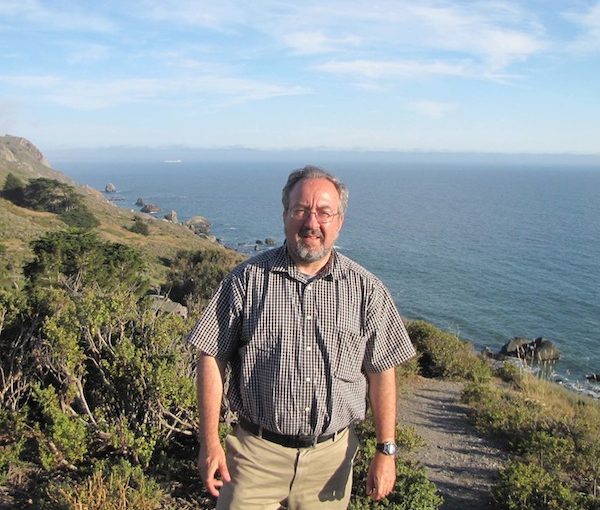
University of Victoria’s Prof. Dan Russek spoke about Jewish writers in Argentina and Mexico, as well as Jorge Luis Borges’ Jewish-related writings. (photo from Dan Russek)

Dan Russek spoke on 20th-century Latin American writers, both Jewish and those who have been influenced by Jewish themes, at a Jan. 10 Zoom event organized by Congregation Emanu-El in Victoria.

Entitled The Golem Dances the Tango, the talk began with discussion of four Jewish authors – Alberto Gerchunoff and Ana Maria Shua of Argentina and Margo Glantz and Myriam Moscona of Mexico – before examining Argentine Jorge Luis Borges’ Jewish-related writings.

Gerchunoff (1883-1950) painted an idealized version of Jewish life in the Argentine countryside in his writings, with religious Jews as peasant farmers in a new land, explained Russek, an associate professor in the University of Victoria’s department of Hispanic and Italian studies.

In his best-known work, The Jewish Gauchos of the Pampas, a series of vignettes, “Gerchunoff was keen to find parallels between peasant life in Argentina and the Bible, and explore the interaction between Jews and the local residents,” Russek said. In one story, El Episodio de Myriam, a Jewish girl from a pious family elopes with a non-Jewish boy, causing uproar in the community.

Shua represents a more modern writer, less attached to traditions, said Russek. In her 1994 novel The Book of Memories, an anonymous narrator tells the story of the Rimetka family. “Gossip reigns supreme in this fictionalized account of a family. One feels as though we are witnessing a family dinner, perhaps a seder,” Russek explained. The narrator presents different and sometimes contradictory accounts, he said, creating a “series of foibles and misadventures with no end.”

Mexico’s Glantz incorporates much of her family story into her most-recognized book, The Genealogies, published in 1981. The daughter of immigrants from Ukraine, her father, Jacobo Glantz, was a promoter of Jewish intellectual life in Mexico, and once penned a poem about Christopher Columbus in Yiddish.

The Genealogies “is a form of literature as transcription and personal document,” Russek said. “It is a family story centred on her parents and her own coming of age. In Glantz, we see an adoption of Jewish culture but not of Jewish faith nor a strong sense of belonging.”

Moscona, a poet, journalist and translator, was the most contemporary writer of the four. Born in Mexico City to Ladino-speaking Bulgarian immigrants, her autobiographic novel Tela de sevoya explores her quest to find her cultural and linguistic heritage.

Russek then discussed Borges, a Judeophile who had several Jewish friends, from his time studying in Geneva, as well as literary mentors, such as Baruch Spinoza and Franz Kafka. Borges credited his English Protestant grandmother for providing a passion for Israel through a love of the Bible, and recognized Judaism as a pillar of Western Civilization.

In 1934, early in his literary life, Borges wrote an article called “I, A Jew,” which was a defence against an attack from a fascist magazine accusing him of hiding his Jewishness. In it, Borges says he would not mind at all being Jewish.

Borges lauded Israel in his poetry. In his 1969 collection In Praise of Darkness, he views Israel as a place that transcends Jewish history and the stereotypes associated with Jews. Two of the poems were written after the Six Day War and herald Israeli heroism on the battlefield.

In “Israel, 1969,” Borges writes, “You shall forget your parents’ tongue and learn the tongue of Paradise. / You shall be an Israeli. / You shall be a soldier. / You shall build the homeland with swamps, you shall erect it in deserts.”

Jewish characters and themes appear in “The Secret Miracle” and “The Death and the Compass.” And Borges had an abiding interest in kabbalah, which is documented in his essays and lectures. About his story El Aleph, Borges wrote: “In the kabbalah, that letter [aleph] signifies the En Soph, the pure and unlimited godhead; it has also been said that its shape is that of a man pointing to the sky and the earth, to indicate that the lower world is the map and mirror of the higher.”

Russek concluded with Borges’ poem “The Golem,” from the 1964 book El otro, el mismo. “Despite the logical structure of the poem, the theme deals with magic, myth and religion. The main philosophical/theological subject is the relationship between the creator and its creatures,” Russek said.

Russek is the author of Textual Exposures: Photography in 20th-Century Latin American Narrative Fiction and the upcoming Exercises in Urban Mysticism, a book of illustrated poetic prose. He coordinates Victoria’s annual Latin American and Spanish Film Week at Cinecinta.

Sam Margolis has written for the Globe and Mail, the National Post, UPI and MSNBC.