Skip to content
  • Home
  • Subscribe / donate
  • Events calendar
  • Business Directory
  • FAQ
  • News
    • Local
    • National
    • Israel
    • World
    • עניין בחדשות
      A roundup of news in Canada and further afield, in Hebrew.
  • Opinion
    • From the JI
    • Op-Ed
  • Arts & Culture
    • Performing Arts
    • Music
    • Books
    • Visual Arts
    • TV & Film
  • Life
    • Celebrating the Holidays
    • Travel
    • The Daily Snooze
      Cartoons by Jacob Samuel
    • Mystery Photo
      Help the JI and JMABC fill in the gaps in our archives.
  • Community Links
    • Organizations, Etc.
    • Other News Sources & Blogs
  • JI Chai Celebration
  • JI@88! video

Recent Posts

  • Federation now across BC
  • Israel fighting for its existence
  • Deal strengthens Iran
  • Patriotic belonging diminishes
  • A campaign to engage
  • Upstanders’ first live event
  • Responding to Carney
  • Having your own home
  • Music a family tradition
  • Musical to warm heart
  • Community milestones … June 2026
  • Sharing her passion for Israel
  • Or Shalom reopens its doors
  • JFS from past to future
  • Need holistic approach
  • Sharing stories, advice
  • Journalist shares fears
  • Skills to live together
  • Road to independence
  • Cutting grass with scissors
  • Zionism as a solution
  • Deceit, desire & the divine
  • Reclaiming sacredness
  • Creative project ideas
  • Summer squares and cobbler
  • Thou shalt … summer commandments
  • Legal help for students
  • Revisiting myth of Lilith
  • Wrong person rebuked
  • Canada’s mixed messages
  • Questions for museum
  • Symposium on antizionism
  • Making soccer political
  • CJPAC lauds Pulver’s impact
  • City recognizes Vrba’s legacy  
  • Organ donation saves lives

Archives

Follow @JewishIndie
image - The CJN - Visit Us Banner - 300x600 - 101625

Tag: fiction

Resettling Eretz Yisrael

Resettling Eretz Yisrael

Alison Pick discusses her new novel, Strangers with the Same Dream, at the Cherie Smith JCC Jewish Book Festival Nov. 25. (photo by Emma Lee)

“Here they were, she thought, in this remote land of Palestine, far from their homes and families. They had left their lives as they knew them to turn the Balfour Declaration, and the idea of a homeland for the Jews, into truth. They were strangers with the same dream…. But this was the thing: Zionism was not just an idea. It was something that was happening, now and now and now. It was something she could make happen.”

So thinks Ida, one of the three main characters in Alison Pick’s latest novel, Strangers with the Same Dream (Knopf Canada, 2017). Pick will be in Vancouver to open the Cherie Smith JCC Jewish Book Festival on Nov. 25, 7:30 p.m., at the Rothstein Theatre. Appropriately enough, the title of her conversation with Jerry Wasserman is Idealism vs. Reality.

Ida has come to Palestine, to Eretz Yisrael, the Land of Israel, on her own from Russia, having seen her father killed and knowing that the brutal attackers also raped her mother; her sister, “Eva, thank God, had been at school.”

It is 1921. Ida is part of the Third Aliyah, one of many other young idealists, most of whom had no idea at the harsh conditions that awaited them – the heat of the dessert, the abundance of malaria-spreading mosquitoes, the backbreaking work, the relinquishment of individuality and, of course, their new Arab neighbours, who were displaced by their arrival.

The leader of Ida’s particular group is David, who immigrated during the Second Aliyah, in 1910. He “had helped establish the moshava [settlement] at Kinneret, planting eucalyptus trees along the muddy banks, negotiating with the fellaheen [farmers]. Ida heard he had traveled the entire length of Eretz Yisrael on horseback, meeting the Arabs in every tent and marketplace, learning their various customs so as to help in the purchase of land.”

And there is David’s wife, Hannah, who, “like David, had arrived in the Second Aliyah, which meant the halutzim [pioneers] instantly respect her.” While the “historic speeches fell to David; Hannah was left with the logistics.” For example, Hannah was the one to request that the new olim (immigrants) voluntarily surrender all of their valuables “to the enterprise they were building together. She did not want strangers circulating like policemen to take each other’s belongings. Especially not after what so many of them had been through in Czarist Russia.”
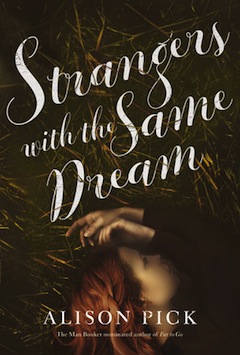
photo - Strangers with the Same DreamStrangers with the Same Dream is divided into three sections, each of which is written from the perspective of one of the three protagonists – Ida, David and Hannah – about the same series of events.

“Following the writing of my memoir Between Gods, I was very interested in the relationship between truth and memory, and the ways in which different people (family members, as one example, or characters) experience the same events very differently,” Pick told the Independent. “I love to challenge myself with each new book and so I decided to try and tell the same story through three different sets of eyes. I wanted the reader to have the pleasure of seeing things the characters did not; that is, miscommunications, misunderstandings, falsely attributed motivations.”

The protagonists could be considered archetypes of a sort. “Although I didn’t set out to write it that way,” said Pick, “Hannah certainly has some of the Mother in her, and Ida has the Maiden. David, I suppose, could be seen as a Trickster, although that might be a generous way to characterize him.”

The novel is introduced by a short prologue, written in the voice of a ghost – a former halutza – who sets up the narrative and then enters it occasionally.

“The ghost is a link between the past and the present,” explained Pick. “Because the three narrative voices were necessarily so limited, I wanted an additional over-arching outside view – outside of time, even – who could reflect both backward and forward. I was also thinking about the idea of haunting – that Israel today (as with Canada, as with many other places) is haunted by history, by the very real lives of those who came before us and influence how we live and how we understand our own stories.”

Pick chose to set the novel in 1921 for a number of reasons.

“I’m not an historian, although I do love writing historical fiction – and, while there is a lot of leeway in fiction as a genre, it is important to me to get the historical facts right. So, I set relatively narrow parameters for myself – all the action takes place roughly over the course of one year. The kibbutz in Strangers with the Same Dream is fictional, but it is loosely based on Kibbutz Ein Harod, established in 1921. While there had been other, smaller attempts at kibbutzim, Ein Harod was the first attempt on a bigger scale, and it is a kibbutz that has, still today, a mythical presence in the collective psyche of Israel.”

The novel took Pick about three years to write, and she did research in Israel.

“At Kibbutz Ein Harod, there is an incredible archive about the early years of kibbutz life,” said Pick. “I was able to access first-person diaries, many written by the female pioneers, which I had translated from Hebrew. Both the translator and the archivist herself were wonderful sources of information about the early years, and they introduced me to an elderly man (who has sadly since passed away), who was there at the establishment of the kibbutz in 1921. So, I read, I researched, I listened, I imagined. And then I tried to breathe life into a world of the past, to bring it to life for readers today.”

While some readers might find the ghost an intrusive presence, I found the novel completely engaging, in part because it shows some of the grim realities the halutzim faced, not only from the land and their Arab neighbours, but from one another. Readers will be able to picture what it was like in those early days. If I wasn’t sure before, I am now that I would have made a poor halutza – the hard work and strange surroundings wouldn’t have been nearly as daunting as the high risk of malaria and the challenges of living in a collective with few resources. I came away from the novel with more admiration for (most of) those who worked to make the idea of Zionism a reality. At least one reviewer, though, has imputed an anti-Zionist message to the novel.

“I confess I have been surprised by the (few) reviews that take the novel as anti-Zionist,” said Pick. “Perhaps I’m naïve – and I am certainly a newcomer to Judaism, which is no secret – but I adore Israel. I traveled there three times during the writing of the book and, each time, I fell more madly in love with the place.

“It did not occur to me that exploring the psyche of those early Zionists – who at the very least did realize that the place they were ‘settling’ was already populated – would be construed as anything other than telling the simple truth. I did not start out with a political message and, indeed, I think to do so is anathema to good fiction. The role of art, as I see it at least, is to open, to unravel, to make space for more questions rather than to judge, decide or condemn. Although one of the characters [David] is decidedly a villain, albeit I hope one in whom the reader sees humanity, the other two main players (Hannah and Ida) are, to my mind, hugely sympathetic. Everyone in the novel – Jews and Arabs alike – are simply trying to make do in a both remarkable and remarkably difficult situation.”

For tickets to hear Pick, and for the full book festival lineup, visit jewishbookfestival.ca.

Format ImagePosted on November 10, 2017November 9, 2017Author Cynthia RamsayCategories BooksTags aliyah, fiction, history, Israel
A novel born of heartbreak

A novel born of heartbreak

Nathan Englander will be in Vancouver on Oct. 22 to discuss his latest novel, Dinner at the Center of the Earth, at a salon hosted by the Cherie Smith JCC Jewish Book Festival. (photo from Cherie Smith JCC Jewish Book Festival)

You won’t have to travel to the centre of the earth to meet award-winning, bestselling American author Nathan Englander. On the afternoon of Sunday, Oct. 22, he will be in Vancouver for a writers salon hosted by the Cherie Smith JCC Jewish Book Festival.

The Jewish Independent spoke to Englander by phone last week. He had just arrived in Seattle by train, his flight there having been canceled. In the midst of a tour for his latest novel, Dinner at the Center of the Earth (Alfred A. Knopf, 2017), he spoke to the JI between back-to-back events.

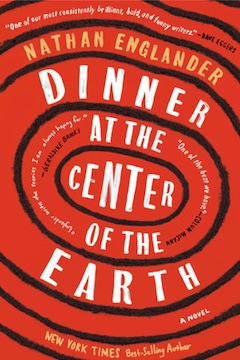
Englander’s novel is a compelling read in which he explores the Israeli-Palestinian conflict via five characters. To simply quote from the publishers, who sum it up succinctly: “A prisoner in a secret cell. The guard who has watched over him a dozen years. An American waitress in Paris. A young Palestinian man in Berlin who strikes up an odd friendship with a wealthy Canadian businessman. And the General, Israel’s most controversial leader, who lies dying in a hospital, the only man who knows of the prisoner’s existence.”

Each of these characters is fascinating, and Englander displays a remarkable talent for being able to put himself inside people’s heads, to clearly and realistically explain their feelings, their motivations. The characters both set events in motion and are carried along by events out of their control. One of the main characters, “the General,” lies in a coma and yet Englander fully develops him as a living, breathing human being.

The General is obviously based on former Israeli prime minister Ariel Sharon, who died in 2014 after having been in a coma since 2006. Englander’s character is a large man, he has been in a coma for years, he once ruled the country and was a tough, controversial military figure (“an unrelenting warrior”), his wife was named Lily, one of his sons was shot and killed, etc., etc. Nonetheless, Englander was adamant that the character not be seen as Sharon, but as “inspired” by him.

Englander said he knew people would come “locked and loaded with [their] politics to this story…. I thought it was really important that, wherever the parallels are [from] one reality to my fictional reality, that my general be his own character … so that I could fully empathize and fully get into his head. Even for me, I needed to build my own person, whatever the warring personal parallels are.”

book cover - Dinner at the Center of the EarthReading Dinner at the Center of the Earth, one does get the impression that Englander was trying to sort out his own views about the conflict, rather than make any pronouncements or come down on any particular side.

“It was imperative to me that this not be didactic and not be a big lecture,” he said. “I have a 500-page version of the book that I cut in half. I just wanted it to be story-driven and character-driven, for people to be able to enter into the discussion or to reflect on where they entered the book and where they left it, on their own positions.”

For his part, he said he’s learned a lot about the book from being on the road. One of his first tour events was with fellow writer Jonathan Safran Foer, who commented on the parallels between the dinner of the book’s title and a dinner that takes place between the guard and the prisoner; an aspect that Englander hadn’t considered. “I wish I had been smart enough to consciously think of it,” he said, “but the subconscious takes care of that for you.”

While Englander insists that “there’s no position in this book,” one woman, after a tour event, argued that it takes “a position on peace,” that it’s hopeful about the prospect. From this and other exchanges, Englander admitted, “I really do believe that the more it [peace] seems impossible, the more I believe we have to make it possible.” But, he said, about writing any messages into the book, “I can’t tell you how much of it was conscious intent versus subconscious work. For me, all my conscious intent was this idea of it to land on no side, for us to explore.”

For Englander, two lessons learned from being a reader himself helped shape this novel. One is that a well-functioning book represents a shared experience between an author and a reader. “I used my brain to write it and then there’s this physical thing that you can pick up and read,” he said, and so, in writing Dinner, he fought “against all punditry and ‘mansplaining’ and lecturing and … didactic” inclinations.

The other aspect he keeps in mind while writing, he said, is all the unanswered questions he had as a boy growing up in a religious environment. “It’s the books where people were brave enough to wrestle with the questions that changed me. All of the books that changed my life, that saved me, none of them had answers, they just were by authors who truly were willing to wrestle with terrifying questions. So, for me, I really wanted to structure this [novel] to swing back and forth and back and forth…. I wanted to mirror the circles of the conflict, these unending cycles.”

The story of Dinner at the Center of the Earth had been percolating since Sharon became prime minister of Israel in 2001. About the Second Intifada and Sharon’s election win, Englander said, “That was my first adult political heartbreak of that size…. All those years of work [on peace], it was right there.”

The more distant we get from peace, he said, the more “you may think it’s impossible, but it was really right there for the taking. I just couldn’t shake it. I was desperate to explore this unending conflict. So, yes, it may be just the tiniest glimmer of optimism [in the novel] but I do think it’s optimistic in the end, however dark some of the turns are.”

He hasn’t been writing the novel for 16 years, of course. He had the idea and needed a structure for it, which he found on his last book tour, while in Israel. The front page of the newspaper he was reading had a story on “Prisoner X, this Australian guy [who had a life] so similar to my life in a lot of ways – maybe he got more Zionism and I got more Bible but [he was] a religious, Anglo Jew who ends up moving to Israel.” This man not only “adopted an ideology” but joined Mossad, did “scary deep undercover stuff and then becomes a traitor.” His situation made Englander wonder, “What would it take to flip someone for empathy, out of feeling for the other side? That’s what would interest me,” so Prisoner X became Dinner’s Prisoner Z.

The other notion about Prisoner X that intrigued Englander was that the public only found out about Prisoner X’s existence after the man hanged himself. “He only lived in the moment he died, and there was no X and no cell until the moment he hanged himself.”

Englander’s imagination seems to know no bounds. His stories and novels are set in various countries (Russia, Israel, United States, Argentina, to name a handful) and his characters range from an Orthodox rabbi who supplements his income by being a mall Santa Claus – one of the many people readers meet in Englander’s first book, the collection of short stories For the Relief of Unbearable Urges (Alfred A. Knopf, 1999) – to the General of Dinner, his fourth book. Englander is also working on a second play because, he joked, with 10 years between his first and second book, he had to tell people he “wrote book” for a living and, since his first play in 2012, he’s been writing “books and play.”

One theme that runs through all his work, regardless of form, topic or setting, he said, is that they explore “grey space, or Schrödinger’s cats, multiple realities.”

“As the books go by, I see that I’m clearly … obsessed with this grey space, which I think is probably from having a black-and-white education and growing up in a black-and-white reality,” he said. “Especially now, I can’t understand people who can’t see the other side.”

By way of example, he said, “I learned that in Israel, where I was a Jew living in Jerusalem, whose holy site was the Temple Mount … it became clear to me this wasn’t a disagreement, or something on a spectrum, that my Palestinian neighbour, she is living in Al-Quds and Haram al-Sharif is her holy site. We were living in the same physical space but in literally separate realities.”

This is also the case in the United States now, he added. “There are regular citizens that, because of the dual realities we now have here … you could show them two pictures of an inauguration, one with more people and one with less, and you’d have regular folks say, yes, the picture with less people has more people in it. That’s not an opinion, that’s inhabiting a different reality.”

Human beings can make anything happen, said Englander. “We’ve sent people to the moon and brought them back,” he said, and our cellphones have far more power than did any Apollo mission. So, you want to make peace? “Everyone knows the math there. Don’t anybody pretend they don’t know who’s going to trade what. There are some very minor, tweakable things. Don’t tell me everybody doesn’t know what they need to do to make that peace happen tomorrow, if they wanted it to happen.”

Englander immerses himself in his work. For The Ministry of Special Cases (Alfred A. Knopf, 2007), a novel about Argentina’s Dirty War, he did years of research. “You need to own that world,” he said, in order “to drop my own ministry on top of that city [Buenos Aires].” He said it is akin to being an artist in, say, Cubism: “You need to know how to paint before you can put both eyes on one side of the face.”

With Dinner at the Center of the Earth, Englander said he was returning to familiar ground, which required much less research.

“I’ve had so many different sides of the experience, from the Jerusalem of the Bible that I had my whole life, to living in Israel in the First Intifada to getting a degree in Judaic studies to living in Israel for another five years, to watching the news a million hours a day to reading the papers.” He’s also on the faculty of New York University, which has taken him to cities like Paris and Berlin, both of which are integral places in his latest novel. “I was very interested in exploring territories that felt like ‘my territories,’ including historical [ones],” he said.

For things he didn’t know, he sought advice, such as speaking to a doctor friend about what it means to be in a coma and learning about boats and the mechanics of sailing from people who knew about those things.

As for the writing of the book and how it came out, he said that he reworked the rough draft of the novel for almost a year, while he and his family were in Zomba, Malawi, where his wife, Rachel, was doing research for her PhD. “It was an extraordinary place for me to be, somewhere so far and so radically different from my own realities and where I’d lived…. It was a very special place from which to imagine these places and draw off memory.”

The pre-book festival salon will take place Oct. 22, 2-4 p.m., at a private residence (address will be given to ticket buyers). Tickets are $72, which includes copy of Dinner at the Center of the Earth and a reception. Visit jewishbookfestival.ca to reserve your place at the salon and for more information about this year’s festival, which takes place Nov. 25-30.

Format ImagePosted on October 6, 2017October 5, 2017Author Cynthia RamsayCategories BooksTags fiction, Israel, Israeli-Palestinian conflict, Nathan Englander, peace
Exploring power of women

Exploring power of women

Expectations – our own and others’ – can motivate us or constrain us. Two recently published novels feature strong (Jewish) women who must fight for their independence, battling not only parental, societal and other judgments, but their own self-conceptions. One book takes readers to the wilds of Arizona more than a century ago, the other takes us to a contemporary world of privilege in Boston. Both are internal, as much as they are external, journeys, and both are journeys worth taking.

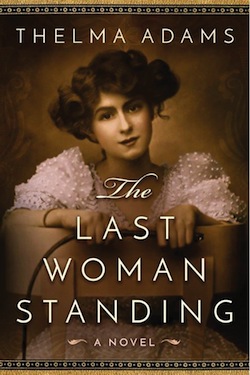
The Last Woman Standing: A Novel by Thelma Adams (Lake Union Publishing, 2016) is a fictional account of how Josephine Marcus met and fell in love with Wyatt Earp (and he with her). While the real-life Josephine apparently tried very hard to keep her and Wyatt’s private life private, Adams has mined what information exists and creatively filled in the blanks for the beginning, in 1880-1881, of their infamous romance.

Josephine defied all expectations when she ran away from home as a young teen in the 1870s and, though she returned, she didn’t do so for long. She left home again in 1880, at age 19, with a promise of marriage from Johnny Behan, a man she met on her first foray into the Wild West from the relative safety and security of San Francisco.

book cover - The Last Woman StandingThe daughter of Prussian Jewish immigrants who eked out a living on her father’s income as a baker, Josephine cannot bear to be contained by the strictures of society, her religion and her mother, whose story of coming to America is truly tragic. “I loved my mother but wouldn’t follow her down her path of righteousness and sorrow,” says Josephine in The Last Woman Standing. “We lived in a new world. She dwelled among old dybbuks.”

While the spirits of the dead might have haunted her mother, Josephine learned how brutal the living world could be when she arrived in Tombstone, Ariz. A shonda (shame) to her family – though her father and three siblings are portrayed as more understanding than her mother – Josephine becomes a shame to herself.

Johnny doesn’t follow through on his promises; in fact, he’s a cad who cheats and lies to get his way, including betraying Wyatt in order to become sheriff of the county. The position came with power, and money, but Johnny also knew of Josephine and Wyatt’s attraction to each other, so revenge was also a motivation. As well, Wyatt was a marshal – a position that deals with federal issues – and there was still unrest stemming from the Civil War. Johnny was friendly with the cowboy crowd, which generally voted Democrat and were sympathetic to the Confederates, if not Confederate veterans themselves, while Wyatt and his brothers were Republicans. These political differences no doubt played a part in the men’s animosity for each other.

Josephine eventually leaves Johnny, after one particularly harrowing experience in which he places her as a bet in cards and loses, and another in which she catches him mid-dalliance. On her own, she finally starts to understand a woman’s terrifyingly narrow set of survival choices – not that men were much more secure at that time and in that place. Wyatt must also fend for his life, and not just at the shoot-out at OK Corral.

All told, The Last Woman Standing is a fascinating tale, a western from a woman’s perspective, though it does drag a bit in places. It takes a long time in the narrative for Josephine and Wyatt to finally get together and they aren’t together for that long before Wyatt is a wanted man and must fight for his life. There’s a little too much of Josephine’s pining in the sections in which the lovers are separated, but, otherwise, this is a great read.

* * *

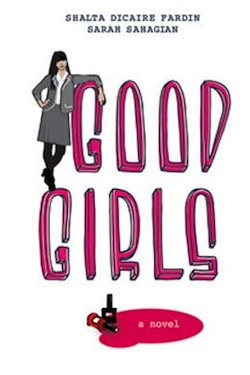
Good Girls by Shalta Dicaire Fardin and Sarah Sahagian (Inanna Publications and Education, 2016) is a young adult novel that not-so-young adults – women mainly – will also enjoy very much.

When we meet Octavia Irving, 15, she’s in the middle of hosting the party of her life at her family’s summer home. And she’s loving it, until her 19-year-old boyfriend leaves early with a bunch of his friends. Fortunately for her, as it turns out, one of those friends vandalizes a neighboring home.

book cover - Good Girls
Good Girls book cover

Octavia’s father gets the news during the bar mitzvah of his wife’s nephew. We find out that this is his second marriage and that he had walked out on Octavia’s mother during her pregnancy, “because his parents found her bohemian nature objectionable.” We also find out that he has issues with “her lax parenting style.”

So, while Octavia may come from a family with money to spare, the family dynamic is complex. As well, the expectations her parents have of her, and that she has of herself, are low. However, when Octavia tells her father the name of the culprit, and he calls her mother, she knows things are about to seriously change – “No matter how badly she misbehaved, her parents had never teamed up against her before.”

Allie Denning, on the other hand, is one of the “good girls.” She loves being a student at Anne Bradstreet College, an all-girls prep school in Boston. She follows the rules to the letter and is totally focused on doing the best she can. But, no matter what she does, because it comes from a place of privilege, it doesn’t seem good enough for her mother, the daughter of immigrants, who grew up in poverty but managed to get a scholarship to Columbia then go on to graduate with a PhD from Harvard. Allie’s father also went to Harvard and her great-grandfather was a president of the university, so expectations all round are that Allie will continue the legacy.

Again, a complex family dynamic. But one with which Allie more or less knows how to deal. As long as school is good, life is good. And that’s how Octavia throws a wrench into Allie’s world; she’s the bad girl who has been banished to the all-girls school, and she has the attitude to prove it.

One of Allie’s main sources of pride is being “the first 10th grader in ABC history to make captain of the debate team.” When Octavia tries out for the team at the behest of the school’s new guidance counselor, and makes it – showing a natural talent for debating – both Allie and Octavia must adjust. And, as the team gears up for a big competition, the girls must decide the person they want to be, whether or not that person meets their, or anyone else’s, expectations. The tension leading up to the debate is palpable and the reading compelling.

The cast of characters in Good Girls is diverse, and Allie and Octavia are not the only ones facing challenges and trying to figure out who they are. We meet fellow students and get to know the guidance counselor and other teachers, as well. The storyline doesn’t always go in the direction one expects, which is a great attribute for a novel. And, since it is a novel that is intended to be part of a series that will follow Allie, Octavia et al through their time at ABC, not everything gets resolved in this first instalment.

One of Inanna Publications’ priorities is “to publish literary books, in particular by fresh, new Canadian voices, that are intellectually rigorous, speak to women’s hearts, and tell truths about the lives of the broad diversity of women – smart books for people who want to read and think about real women’s lives.” With Good Girls, they have done just that.

Format ImagePosted on December 16, 2016December 14, 2016Author Cynthia RamsayCategories BooksTags fiction, women, young adults
Did Franz Kafka have a son?

Did Franz Kafka have a son?

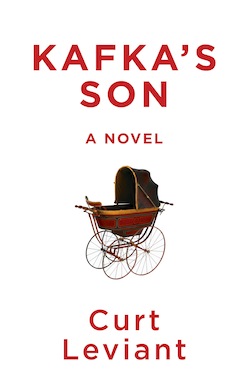
Before you begin reading Curt Leviant’s latest novel, Kafka’s Son (Dzanc Books, 2016), you are confronted with a curious bit of information. There are a dozen quotes from French reviews before the title page. Why? Because the book first appeared in French translation a few years ago before its publication earlier this year in the original English, and garnered incredible reviews. One reviewer on French national TV called Kafka’s Son “a work of genius.”

Kafka’s Son is a roller-coaster ride of a novel that is a mystery, travelogue, love story, literary analysis (Metamorphosis as comedy) and, most important, a challenge to our sense of historical timelines.

As our narrator meets one memorable character after another, the action rushes forward until the last page, which will astonish and surprise the narrator and delight the reader.

The big question is, did Franz Kafka have a son?

Leviant opens the novel with no fewer than seven beginnings, and concludes with an equal number of endings.

Beginning #1 is a nod to Herman Melville and Moby Dick: “Call me Amschl. All right, so don’t call me Amschl. Nobody does anyway. Except when I’m called up to the Torah by my Hebrew name: Amschl ben Moshe.” He is our narrator.

Beginning #2 tells readers they are entering a world where imagination and suspension of disbelief will launch them on a great adventure: “This is a true story. True story!? Humbug…. Either a narrative is true or it’s a story. It cannot be both. Period. End of story.”

Let me unfold the plot just enough to get you started. Giving you too many details will spoil the fun. You will want to be puzzled, startled and enlightened as you travel along with our questing narrator.

Amschl, a documentary filmmaker, is prompted by an elderly Czech Jew he meets in Eldridge Street Synagogue in New York to go to Prague and make a film about the true history of his idol, Kafka.

book cover - Kafka’s Son Everything seems possible in Prague, a mystical city. With camera in hand, he visits the oldest synagogue, Altneuschul, where the legendary Golem is said to be asleep in the attic. Another character says he survived the German invasion in that same attic.

Amschl’s other encounters include a man with a “golem’s” face; the old beadle of the synagogue who insists there never was an attic; Katya, the beautiful girl in the blue beret who knows more than she tells our narrator, agrees to go to a concert with him and then disappears for a spell; a man who swears he is Kafka’s son and then he too disappears; and the enigmatic Mr. Klein, who does not disappear.

Mr. Klein becomes a companion, but raises additional questions. His very high energy level and obvious old age is puzzling. Katya reappears and leads our narrator to a synagogue not listed in the Jewish sites brochure, where he spots Mr. Klein praying quietly. The plaster lions guarding the holy ark leap off and come alive. Amschl is both frightened and frustrated because he does not have his camera to record this fantastic scene. Katya and Mr. Klein share knowing glances and a few words to add to the puzzle.

“The whole thing didn’t make sense” to Amschl but he plods on hoping to clear up one implausible “fact” after another. At one point, the absurdities pile up and he thinks, “It reminded me of what I learned in geometry, maybe algebra: multiply two negative numbers and you get a positive…. You add up two absurds and get one truth.”

The puzzle is compounded by the fact that all of these characters are breathing, rational, real people. Along with our narrator, you want to believe them. You will also note that most of them have a “K” beginning their first or last name.

The narrator keeps moving forward, looking for the breakthrough, and takes the reader, who becomes a willing partner on this whirlwind journey, to the startling ending I promised in my third paragraph.

Kafka’s Son is a superb novel that can be enjoyed on many levels. It keeps you guessing and turning pages to uncover the truth, and I agree with the French reviewer from Lire, a leading literary journal, who is unequivocal in his praise: “As to whether Kafka had an heir, the answer is obvious. His name is Curt Leviant.”

End of story!

Sidney Kessler, z”l, was a freelance writer in Glen Allen, Va. His articles appeared in the Wall Street Journal and the Richmond Times-Dispatch, among other publications.

Format ImagePosted on September 23, 2016September 21, 2016Author Sidney KesslerCategories BooksTags fiction, Kafka, Leviant
Quirky fiction meets history

Quirky fiction meets history

Two quirky books. Both historically based, both written with humor, both dark and light. But there the similarities end.

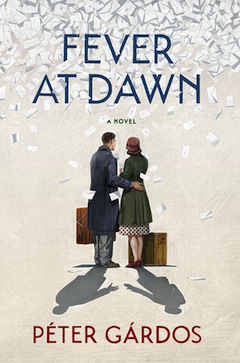
The quiet and quirky Fever at Dawn by Péter Gárdos is based on letters his parents sent to each other immediately following the Holocaust, as they recovered from their physical ailments in Sweden. The raucous and quirky Two-Gun & Sun by June Hutton takes its inspiration from Morris “Two-Gun” Cohen and Dr. Sun Yat-sen, who actually did know each other, and Puccini’s La Fanciulla del West, to tell the story of a young woman who heads to a northern B.C. mining town in 1922 to revitalize her uncle’s newspaper, which he left her in his will.

book cover - Fever at Dawn

Fever at Dawn (House of Anansi Press, 2016) begins with a note from Gárdos about the letters his parents – Miklós and Lili – sent to each other from September 1945 to February 1946. Until his father died, Gárdos had no idea of their existence, though his mother had told him, “Your father swept me off my feet with his letters.”

The main quirky thing about this story (there are others) is that Miklós tried to sweep no fewer than 117 women off their feet with his letters. Told by his doctor that he would not survive his tuberculosis, Miklós defiantly decides he wants to get married. He inquires for the names and addresses of all the women survivors being treated in Sweden, and sends all of them the exact same letter. He determines pretty quickly that Lili is “the one,” though 18 women respond.

The secondary characters are well-conceived and play important parts in Miklós and Lili’s developing relationship. It is a beautiful and uplifting story – love and hope from hatred and tragedy. It brings up many issues, in Lili’s wanting to renounce her faith and in how the survivors are treated, for example. The translation into English from Hungarian by Elizabeth Szász is a bit awkward in parts, but otherwise does justice to the work. And some of the awkwardness might be due to the fact that Gárdos, who is a filmmaker and theatre director, originally envisioned the story as a film – which was released last year – but also wrote it as a novel.

book cover - Two-Gun & SunTwo-Gun & Sun (Caitlin Press Inc., 2015) might also make a good film. It brings to mind Joss Whedon’s Firefly, mixing science fiction (specifically steampunk) with opera’s larger-than-life and often unbelievable drama with history. It’s a very stylized novel, which, more than other books, means that it will be loved by some readers, and not so much by others.
While loosely historical, it does strongly evoke the era and how hard it must have been to survive back then, especially in a remote town, especially if you were a minority, and very especially if you were a woman. The central character, Lila Sinclair, arrives in Black Mountain from Nelson, given by her uncle’s death a more adventuresome, “manly” economic opportunity than marriage, teaching or prostitution, which seem to have been women’s main choices at the time.

Some of the more fascinating aspects of this novel are the daily-life moments, what people ate, how they earned a living, the excitement a traveling troupe generated, the dangers posed by a lack of law. Anyone in the publishing industry will also appreciate Lila’s struggle to get the printing press up and running, and how newspapers once operated. As well, while her relationship with Vincent, a Chinese printer, runs a predictable course, it offers a chance for Hutton to address the racism of the day.

Two-Gun & Sun is a unique twist on the traditional western and, while the ending wasn’t quite satisfactory for this reader, its originality and oddness were entertaining and energizing.

Format ImagePosted on September 23, 2016September 21, 2016Author Cynthia RamsayCategories BooksTags fiction, Holocaust, science fiction, steampunk, Two-Gun Cohen
Can murder become extinct?

Can murder become extinct?

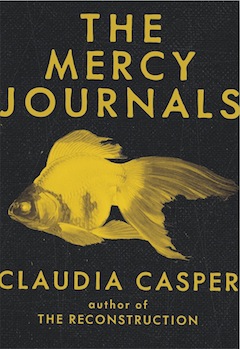
The Mercy Journals is a new novel by Claudia Casper, author of The Reconstruction and The Continuation of Love by Other Means. In it, she creates a compelling post-climate change West Coast, where nations no longer exist. Her hero, Allen Levy Quincy, lives in Seattle, now called Canton #3, Administrative Department of Cascadia, and the novel consists of the journals he writes in a desperate attempt to evade suicidal urges, brought on by post-traumatic stress disorder. In this layered, hopeful post-apocalyptic novel, Casper looks at the future through the story of Cain and Abel. In fact, one of the early titles for the novel was The Last Murder, as a bracket to the story of that first murder.

Jewish Independent: The novel takes place in the (near) future in a climate-changed world. Is it a dystopian novel, science fiction or eco-fiction? How would you describe it?

Claudia Casper: Genre-bending fiction was being written well before the advent of ebooks, Amazon and the internet’s stretching of the forms of fiction, but I would say there are a number of writers who pay less mind to the dictates of genre and simply go wherever the story takes them. One example would be The Yiddish Policeman’s Union. [Michael] Chabon combines detective noir with fantasy or alternative history to create a miraculous new, possibly one-of-a-kind thing.

Science fiction readers have proven a generous and open-minded community and seem to have embraced the new raft of novels whose driving force is the environment and climate change. Margaret Atwood’s Oryx and Crake trilogy, Cormac McCarthy’s The Road, Hilary St. John Mandel’s Station Eleven – all are “literary” (I use the air quotes not to comment on these novels’ literariness, but because “literary fiction” is an over-precious, stifling term for a genre) novels written in the future, with only Atwood using some of the classic tropes of science fiction. This kind of writing, trying to find a place in the speed-of-light marketing world, calls itself variously eco-fiction, cli-fi, post-apocalyptic, dystopian, speculative fiction, each sub-genre carrying its own nuance. I would place The Mercy Journals in all these categories except dystopian, as the government imagined in 2047 is actually pretty good.

JI: While the book does not explicitly make reference to Judaism, there are parallels between the story of Allen Quincy and Leo (Quincy’s brother) and the biblical tale of Cain and Abel.

CC: I read the story of Cain and Abel closely, using the Jewish Publication Society of America translation, and studied the midrash on the text. The language is so rich and layered, from “Am I my brother’s keeper?” to “You shall be more cursed than the ground, which opened its mouth to receive your brother’s blood from your hand.” The story in the Torah is short but its power resonates throughout our literature and our culture.

In The Mercy Journals, I sewed in references to Cain and Abel throughout the text. At one point, when Leo, the long-lost, nihilistic brother of my main character, Allen Quincy, returns, Allen says wryly, “I suppose that means I have to keep you?” The earth drinking blood, also an image I use at least twice. The final scene, which I cannot give away, reenacts Cain going out to the field.

What I wanted to do in this novel was bookend the Cain and Abel story with a metaphorical last murder, as opposed to the first murder, to write the murder of Cain by Abel, a closing of the circle. Of course, I could not believably write about a time when humans completely stop murdering each other, but I do carry the narrative of our species to a possible turning point, where we turn away from murder and its practise becomes truly taboo and despised in every context.

JI: When Quincy, a soldier, is ordered by his superiors to do something against his own moral code, he obeys, though reluctantly, and with some subversive evasions. Although genetics and environment affect who we may become, Judaism teaches us that we have free will and can choose to do right or wrong. Quincy suffers from PTSD partly because of the unresolvable internal conflict following those orders causes in him. What influenced you to make your main character an individual suffering from PTSD? How do we reconcile liking him with the fact that he is complicit in two of humanity’s worst sins?

CC: After the genocide in Rwanda and post-9/11, I felt deeply uneasy at the rhetoric used by the media and by politicians, in which it was implied that only “those” people, “those” cultures – read Africa, Cambodia, Germany, the Arabs – commit atrocities. First Nations people must have read those articles with a deep sense of irony. Because the lens through which I look at the world is always informed by evolution, I believe that genocidal behavior, for example, is a part of our species. It has been documented in chimpanzees and any behavior that exists both in living primates and ourselves is behavior that was very likely present in our ancestors.

book cover - The Mercy JournalsThere’s a kind of implied self-righteousness and superiority in that kind of distancing rhetoric that seeks to separate us from the behavior of the “bad” cultures. I felt very deeply that, if we are to have any hope of truly limiting atrocities within our species, we have to accept that they are part of who we are. Part of the reason The Mercy Journals was set in the future in the first place was because I wanted to write about a genocide that hadn’t happened yet, and that happened in North America, that was committed by “our” culture, “our” team.

Allen Quincy is a good man, a decent man, even though he’s haunted by the sins – and he counts them as sins – he has committed in the past. His brother Leo, the Cain figure, also is pushed towards sin, and there is even a scene where Leo literally crouches at Allen’s door and Allen writes wryly in his journal, “Salvation comes in many forms.” The novel really is about whether Allen Quincy, standing in for our species, has the possibility of moving forward, of living a life with his dark legacy.

JI: Quincy carved a covenant on a rock, which seems a very Jewish thing to do. After Cain murdered Abel, God said to him: “… your brother’s blood cries out to Me from the earth.” As the word used for blood is plural, does this mean that what cries out is not only Abel’s blood but all of his descendants that will never be born? Was that what Quincy was saying about murder when he said the murder of one is the murder of all? How does a person atone for murder?

CC: Yes, Rashi says that the plural here indicates also the extinguishment of all Abel’s descendants with his murder. Because The Mercy Journals is about the future of our species, compressed in the suspenseful tale of a West Coast, post-apocalyptic, post-climate change tale, I take it one step further. The murder of Abel, the murder of anyone, is expanding the place of murder in our species, is further entrenching its place in our repertoire. Thus, the murder of one is the murder of all. Thinking about climate change shows us again how deeply connected we all are, that we can never really escape each other, we have to find a way to deal with one another, and murder is always a failure. There is no possible atonement for murder in my mind, it is irrevocable, yet still, short of suicide, one must find a way forward. Who is without sin? And whose life exists without the legacy of murder at its very root? God’s punishment of Cain seems to acknowledge this.

JI: Quincy’s brother Leo was jealous of Quincy as was Cain of Abel. Why did God reject Cain’s offering? Why did Leo’s parents reject him?

CC: Without being an expert in midrash, I believe one of the main interpretations these days is that Abel, as a shepherd and a man who did not gather possessions, represents a nomadic, hunter-gatherer existence, while Cain, as a farmer who cultivated the fields and, therefore, had property, represents an agrarian one. God’s preference for Abel’s offering can be understood to be preferring nomadic values over agrarian ones, or the old ways over the new.

That being said, if we interpret God in this story as in a parental role, the choosing of favorites is always destabilizing to family unity, creating deep wounds and lasting resentments. From an evolutionary perspective – so, viewing our behavior with the understanding it arose in a pre-birth control context – such favoritism can result in a life and death situation for an individual. We are living in a time of relative wealth, but it wasn’t long ago when a family could easily have eight or nine children and be faced with drought or famine. The favored child would thus be the one who received a little more food, a little more medicine, the one who would be picked, even if unconsciously, to be prioritized to survive. Studies of mothering behavior in human evolution bear this scenario out.

When I reread the story of Cain and Abel eight years ago as I was beginning this novel, I felt sympathy for Cain, and felt that God was shirking responsibility a bit. Why can’t God see Cain’s pain? Surely telling the less-favored child to not worry about the advantages their sibling is getting and take their own good behavior as its own reward, doesn’t pass muster in a family. Why doesn’t God see Cain murder Abel? Why doesn’t God punish Cain with death? Why does God decide, when Cain cries out that he will surely be killed by strangers if he’s banished, to put his divine mark on him to protect him from death? Is there an implicit acceptance of the fact of murder in this story? And, if so, I wanted to imagine forward to a time when God would find murder utterly unacceptable, as taboo as incest, for example. In our society, murder is still seen as inevitable between human beings in certain circumstances; in wartime, it’s accepted. What would the world be like if humans were starting to evolve past murder, past genocide? Those seeds are at the core of The Mercy Journals.

Barbara Buchanan, QC, is a Vancouver lawyer who provides practice advice to other lawyers. She and Claudia Casper are longtime friends who are in the same book club. Buchanan recently attended the Los Angeles launch of The Mercy Journals with Casper, who was introduced by actress Jamie Lee Curtis, a big fan of the book.

Format ImagePosted on July 22, 2016July 19, 2016Author Barbara BuchananCategories BooksTags biblical, Cain and Abel, Casper, cli-fi, climate change, eco-fiction, fiction, Mercy Journals, murder, post-apocalyptic

Posts pagination

Previous page Page 1 … Page 4 Page 5
Proudly powered by WordPress