

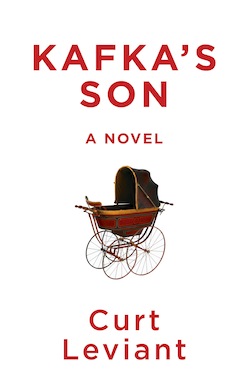
Before you begin reading Curt Leviant’s latest novel, Kafka’s Son (Dzanc Books, 2016), you are confronted with a curious bit of information. There are a dozen quotes from French reviews before the title page. Why? Because the book first appeared in French translation a few years ago before its publication earlier this year in the original English, and garnered incredible reviews. One reviewer on French national TV called Kafka’s Son “a work of genius.”
Kafka’s Son is a roller-coaster ride of a novel that is a mystery, travelogue, love story, literary analysis (Metamorphosis as comedy) and, most important, a challenge to our sense of historical timelines.
As our narrator meets one memorable character after another, the action rushes forward until the last page, which will astonish and surprise the narrator and delight the reader.
The big question is, did Franz Kafka have a son?
Leviant opens the novel with no fewer than seven beginnings, and concludes with an equal number of endings.
Beginning #1 is a nod to Herman Melville and Moby Dick: “Call me Amschl. All right, so don’t call me Amschl. Nobody does anyway. Except when I’m called up to the Torah by my Hebrew name: Amschl ben Moshe.” He is our narrator.
Beginning #2 tells readers they are entering a world where imagination and suspension of disbelief will launch them on a great adventure: “This is a true story. True story!? Humbug…. Either a narrative is true or it’s a story. It cannot be both. Period. End of story.”
Let me unfold the plot just enough to get you started. Giving you too many details will spoil the fun. You will want to be puzzled, startled and enlightened as you travel along with our questing narrator.
Amschl, a documentary filmmaker, is prompted by an elderly Czech Jew he meets in Eldridge Street Synagogue in New York to go to Prague and make a film about the true history of his idol, Kafka.
 Everything seems possible in Prague, a mystical city. With camera in hand, he visits the oldest synagogue, Altneuschul, where the legendary Golem is said to be asleep in the attic. Another character says he survived the German invasion in that same attic.
Amschl’s other encounters include a man with a “golem’s” face; the old beadle of the synagogue who insists there never was an attic; Katya, the beautiful girl in the blue beret who knows more than she tells our narrator, agrees to go to a concert with him and then disappears for a spell; a man who swears he is Kafka’s son and then he too disappears; and the enigmatic Mr. Klein, who does not disappear.
Mr. Klein becomes a companion, but raises additional questions. His very high energy level and obvious old age is puzzling. Katya reappears and leads our narrator to a synagogue not listed in the Jewish sites brochure, where he spots Mr. Klein praying quietly. The plaster lions guarding the holy ark leap off and come alive. Amschl is both frightened and frustrated because he does not have his camera to record this fantastic scene. Katya and Mr. Klein share knowing glances and a few words to add to the puzzle.
“The whole thing didn’t make sense” to Amschl but he plods on hoping to clear up one implausible “fact” after another. At one point, the absurdities pile up and he thinks, “It reminded me of what I learned in geometry, maybe algebra: multiply two negative numbers and you get a positive…. You add up two absurds and get one truth.”
The puzzle is compounded by the fact that all of these characters are breathing, rational, real people. Along with our narrator, you want to believe them. You will also note that most of them have a “K” beginning their first or last name.
The narrator keeps moving forward, looking for the breakthrough, and takes the reader, who becomes a willing partner on this whirlwind journey, to the startling ending I promised in my third paragraph.
Kafka’s Son is a superb novel that can be enjoyed on many levels. It keeps you guessing and turning pages to uncover the truth, and I agree with the French reviewer from Lire, a leading literary journal, who is unequivocal in his praise: “As to whether Kafka had an heir, the answer is obvious. His name is Curt Leviant.”
End of story!
Sidney Kessler, z”l, was a freelance writer in Glen Allen, Va. His articles appeared in the Wall Street Journal and the Richmond Times-Dispatch, among other publications.

 The two stories, solving his father’s murder and getting to the bottom (and the top) of Malina, are interspersed narratives that keep you guessing and entertained. Along the way, the reader encounters a Chassidic un-kosher kidnapping that goes awry (imagine the Marx brothers in black hats) and a bris (kosher or not depending on whether you are Orthodox or Reform) that are grist for Leviant’s mill of linguistic tomfoolery. You meet other academics, letting you in on university rivalries and gossip. Believe it or not, but a cookie with an incredible miniature topping in a Vienna café is an important character in the plot development that might have been written by Kafka, Borges or Nabokov, but it is pure Leviant, plying his considerable art as a fabulist.