Skip to content
  • Home
  • Subscribe / donate
  • Events calendar
  • Business Directory
  • FAQ
  • News
    • Local
    • National
    • Israel
    • World
    • עניין בחדשות
      A roundup of news in Canada and further afield, in Hebrew.
  • Opinion
    • From the JI
    • Op-Ed
  • Arts & Culture
    • Performing Arts
    • Music
    • Books
    • Visual Arts
    • TV & Film
  • Life
    • Celebrating the Holidays
    • Travel
    • The Daily Snooze
      Cartoons by Jacob Samuel
    • Mystery Photo
      Help the JI and JMABC fill in the gaps in our archives.
  • Community Links
    • Organizations, Etc.
    • Other News Sources & Blogs
  • JI Chai Celebration
  • JI@88! video

Recent Posts

  • Federation now across BC
  • Israel fighting for its existence
  • Deal strengthens Iran
  • Patriotic belonging diminishes
  • A campaign to engage
  • Upstanders’ first live event
  • Responding to Carney
  • Having your own home
  • Music a family tradition
  • Musical to warm heart
  • Community milestones … June 2026
  • Sharing her passion for Israel
  • Or Shalom reopens its doors
  • JFS from past to future
  • Need holistic approach
  • Sharing stories, advice
  • Journalist shares fears
  • Skills to live together
  • Road to independence
  • Cutting grass with scissors
  • Zionism as a solution
  • Deceit, desire & the divine
  • Reclaiming sacredness
  • Creative project ideas
  • Summer squares and cobbler
  • Thou shalt … summer commandments
  • Legal help for students
  • Revisiting myth of Lilith
  • Wrong person rebuked
  • Canada’s mixed messages
  • Questions for museum
  • Symposium on antizionism
  • Making soccer political
  • CJPAC lauds Pulver’s impact
  • City recognizes Vrba’s legacy  
  • Organ donation saves lives

Archives

Follow @JewishIndie
image - The CJN - Visit Us Banner - 300x600 - 101625

Tag: fiction

Shalev’s latest not her best

Shalev’s latest not her best

In an interview with the Jewish Independent in 2014, after her book The Remains of Love came out in English, Israeli writer Zeruya Shalev said that, until that novel, she had been avoiding writing directly about what she called “the Israeli reality.” She said at the time: “And yet, still I am wrestling with the dominance of this reality, and try not to let it take over my books – it’s enough that it controls my life.”

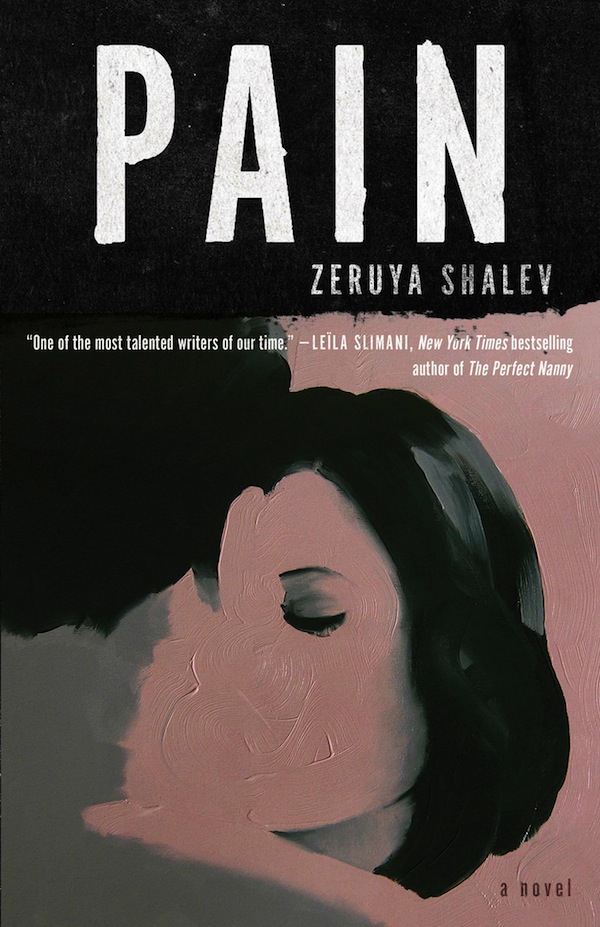
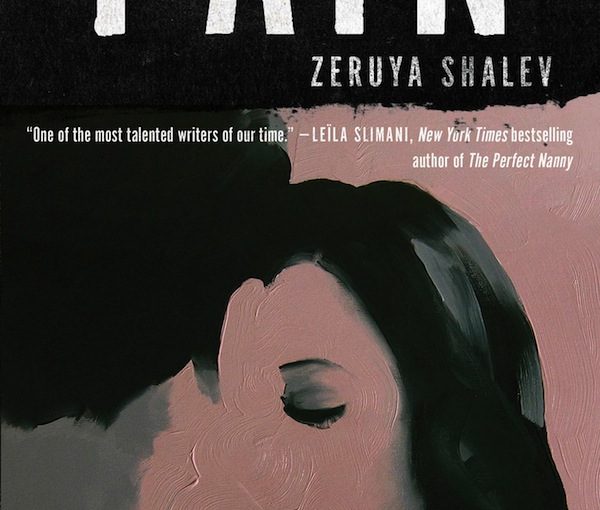
Shalev’s latest novel to be translated into English is all about the Israel reality, but not in the engaging and provocative way that The Remains of Love was (see jewishindependent.ca/zeruya-shalev-opens-jewish-book-fest). Concisely called Pain, Shalev’s story about a Jerusalem woman suffering post-traumatic stress syndrome, which flares up on the 10-year anniversary of when she was seriously injured in a terrorist attack, is anything but concise. Translated ably by Sondra Silverston, the book needed a better editor, as Shalev gets lost in the physical and emotional suffering of her protagonist Iris, who is not portrayed likeably.

image - Pain book coverDespite being the respected principal of a successful school, despite being married to a perhaps dull but well-meaning husband (who could well be distant because of his wife’s indifference to him) and despite raising two competent and kind but vulnerable children, one of whom desperately needs her help, Iris cannot let go of a lost love from her teenage years. When, by chance, at a clinic, she meets Eitan, the man who left her so abruptly so long ago – he is now a doctor who specializes in the treatment of pain – Iris goes headlong into the fantasy of what her life could have been with him, despite all indications that he’s a selfish and emotionally stunted ass. She considers leaving everything tangible and good that she has built for herself for a life that never was.

There are some astute observations in this novel – about trauma and how it affects not only the person injured but those who love them, about the harmful effects of living in the past, about forgiveness, about the fickle nature of life, and more – but it gets lost in Iris’s nearly interminable self-pity and self-delusion. Pain is not Shalev’s best work.

Format ImagePosted on April 3, 2020April 2, 2020Author Cynthia RamsayCategories BooksTags fiction, health, terrorism, Zeruya Shalev
Magnifying emotions

Magnifying emotions

Gila Green will talk about her two latest books at the Jewish Book Festival on Feb. 9. (photo from JCC Jewish Book Festival)

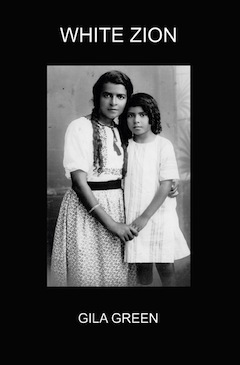
From the first page, White Zion reads like a memoir. Through 16 short stories, we get to know Miriam and her family, from her great-grandparents to her own children, as well as the places they are from, including Yemen, Israel at various points in its history and Canada. It is easy to wonder how much of Miriam is her creator, Israeli-based writer Gila Green, who will be at the Cherie Smith JCC Jewish Book Festival Feb. 9.

“The stories in White Zion are all about emotional truths,” Green told the Jewish Independent. “So, if that’s what’s coming across, that is some measure of success. I did not say this but Alice Munro did – I recall reading an interview with her in which she said: ‘If your audience thinks all you did was wake up and write down everything that happened to you yesterday, then you’ve succeeded.’ I would love to hear about how readers relate to these emotional truths, how they connect.”

Green will also bring her young adult novel No Entry to the festival, for which she will talk at both the Jewish Community Centre of Greater Vancouver (12:30 p.m.) and the White Rock/South Surrey Jewish Community Centre (4 p.m.) that Sunday.

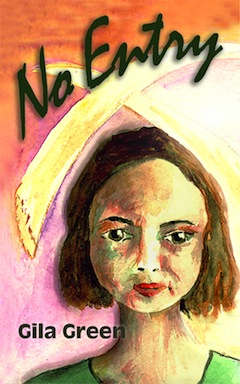
The heroine of No Entry is Yael Amar, a teenager from Ottawa, which was where Green was born and has lived. Yael has traveled to South Africa to intern for a spell at a private bush camp near Kruger National Park. (Green’s husband is South African, and Green has lived in the country.) There with the intent of helping protect elephants from poachers, Yael ends up in danger herself.

Despite the connections her books may, or may not, have with her own family, Green prefers to write fiction. She described nonfiction as “limiting” for her.

“As soon as someone tells me to write a true story, I’m suffocating,” she said. “I have to start questioning what is fact, what is memory, what lacks context, what is something I’ve just convinced myself is true and on and on. I spent four years at Carleton [University in Ottawa] studying for a journalism degree, so all of that kicks in. In the end, the short story is a wrung-out sock, more like a dozen tangled wrung-out socks. No one wants to read a sock. There is no connecting with it.”

Fiction allows for the expression of emotional truths that would be impossible to express otherwise, she said.

“Writing fiction allows me to hone in on a feeling – something I want my audience to feel, which is how I start every story I write. I ask myself, ‘How do I want this story to make the reader feel?’ and I start from there – and I can hold that emotion under a magnifying glass. I can distort it, blow it sky high, cut interference to ant height or delete. I can take one characteristic of one person on a single day about a single event and I can magnify it, so that the rest of the human being is rendered invisible. These were some of my goals with White Zion. The characters are all gross distortions of one human trait or another.”

But that doesn’t mean that facts don’t enter her work.

image - White Zion book cover“I tried to be as faithful as possible to the historical period,” she said, referring to the stories in White Zion, “and I spent months researching everything, from what vegetables they could have been selling in the Jerusalem market post-1948 to how they could possibly have been heating their homes. I also used the same biographical details for two of the characters, Miriam and her father. It was important for me that Jewish fiction expand to include Yemenite voices, religious voices, gay voices, the more voices the better.”

Green also did much research for No Entry and, in addition to crafting an entertaining, at-times tense, thriller-like novel, she educates readers on the nature of elephants and the very real threat of their extinction.

“Yael is a Jewish eco-heroine,” said Green, who noted that the character’s boyfriend, David, is also Jewish. “She’s not religious but both of her parents are Jewish – she mentions in No Entry how the South African traditional dish she tastes for the first time reminds her of her mother’s chulnt on the Sabbath and, in No Fly Zone, she has an Israeli-themed dinner with her parents. None of the other characters are Jewish…. I do like exploring different kinds of Jews though. If readers want a more obvious Jewish heroine in the sequel[s], please write to me.”

Green has finished writing No Fly Zone, the next book in what might become a series. In it, she said, “Yael Amar is back with her best friend Nadine Kelly, this time protecting Kruger National Park from the skies. But she is about to learn a big lesson when it comes to moral relativity and friendship.”

image - No Entry book coverGreen added, “I set out to thread the senseless loss of human life with the equally nonsensical destruction of animals in No Entry and I continue this in the sequel. I did this not because I’m trying to make a point about the connection or status between humans and animals – that’s the wrong way to understand my motivation. Rather, I’m trying to weave together the criminals who commit these inhuman acts: they’re connected.

“Often,” she said, “the same people willing to sell illegal blood ivory are involved in terrorism, human slavery and other acts that bring nothing but grief to the planet. I wish to emphasize this linkage, to shout it from the rooftops. But, in real life, I figured an exciting, adventurous, teen novel was a more effective way to go.

“I purposely made the terrorist event [in No Entry] happen in Canada because I want to get the message across that fatal betrayal doesn’t just happen in Africa or the Middle East. That attitude might allow some of us to feel off the hook. It happens everywhere and we all have to make sure we are part of the solution or there won’t be one and that thought is too devastating to imagine. I refuse to go there and No Entry ends on a victorious note for a reason.”

Though the sequel has been written, its publication date will depend on what happens in Australia and the bushfires that continue to destroy the country. Green shared, “I am very sad to say that my publisher Stormbird Press was on Kangaroo Island and has burned to the ground. The staff was evacuated on Dec. 20th. We are all praying for their safety and that they fully recover but, for now, everything is at a standstill and there is terrible devastation.”

Green is already working on her next novel. In A Prayer Apart, her main character, for the first time, is male, she said. “He’s an Israeli-Jewish teenager living through the 2014 war with Hamas, knowing he’s next in line for the front line. By the same token, he’s had it with his parents and school and his rebellious behaviour lands him in lockdown, one step away from juvenile jail.”

She said she will let readers know on her website, gilagreenwrites.com, when the publication details are finalized.

An avid reader since childhood and now a prolific writer, with four books published since 2013 and two more on the way, Green said, “Mankind cannot live without stories. Period. We are our stories. When people are down, what they are really saying very often is they don’t feel connected. Stories connect us.”

For the Jewish Book Festival lineup and schedule, visit jewishbookfestival.ca.

Format ImagePosted on January 31, 2020January 28, 2020Author Cynthia RamsayCategories BooksTags fiction, Gila Green, JCC, Jewish Book Festival, memoir, storytelling, young adults
The real and imaginary mix

The real and imaginary mix

Norman Ravvin (photo by Allen McInnis/The Gazette)

For anyone interested in the history and landmarks of Vancouver, especially, but also cities in Poland, reading Norman Ravvin’s new novel, The Girl Who Stole Everything (Linda Leith Editions, 2019), will take longer than its 310 pages would suggest. You’ll want to allot time for side trips to the internet to see what the Army & Navy building on West Cordova Street looked like in the middle of the last century, for example, or Stan Douglas’s mural at the Woodward’s complex of the 1971 Gastown riot. Stalin’s Palace of Culture and Science in Warsaw? The main square in the town of Radzanów, Poland?

While The Girl Who Stole Everything is set in real places described in detailed accuracy by Ravvin, there is still much left to the imagination. The discovery of family secrets – in one case, which were literally buried; in the other, figuratively – leads to events that bring Vancouver dulcimer musician Nadia and bookseller-café owner Simon together and, eventually, take both to Poland. Nadia’s father never told her that her uncle, who owned a pawnshop on West Cordova, was murdered in 1962, beaten to death in a robbery gone wrong, and Simon’s father told him nothing of their prewar Polish heritage. Both a little lost in life before friends drop these revelations on them, Nadia and Simon find meaning and direction as they search out the truth of their histories.

The Jewish Independent interviewed Ravvin, who lives in Montreal, about his novel, which is available for purchase most anywhere. Ravvin said he will be in Vancouver for the Cherie Smith JCC Jewish Book Festival in February, for readers who would like the chance to speak with him themselves.

Jewish Independent: I was struck by your attention to detail in the history and geography of Vancouver, and I imagine the same with Warsaw and Radzanów, though I wouldn’t know that from personal experience. Have you lived in all these places? If not, from where did you gather your local knowledge?

Norman Ravvin: I came to know Vancouver as a child, traveling from Calgary with my family to visit my mother’s mother, who lived on Willow Street. Those trips and her presence in the city contributed to my coming back to study at UBC, where my dad went for a few years in the wartime before enlisting in the Navy. I did my undergrad degree and a one-year MA in the English department.

So, I lived in the city, altogether, only about six years. I lived at UBC, then on the West Side, then in the West End, which I came to think of as “my neighbourhood.” Having left in the mid-80s, with family still there, I continued to come back and never really let go of it as “home,” or maybe a “second home.” We tend to spend two or three weeks in the city in the summer each year. My background knowledge of the city then is also connected with my mom’s youth in the city, my dad’s time there in the wartime, and my grandmother’s life in the city.

Radzanów requires a longer answer. It is my ancestral place on my mother’s side. I first visited it in 1999. I have traveled to Poland seven or eight times since then, making three follow-up trips to Radzanów. I went with different guides in each case, so some of the visits were more revealing than others. In a few cases, standing in the village square, we ended up talking to locals and, in one case, sitting for a beer in a local kufelek, or little beer hall. Going with Poles is key: you cannot access the locals or understand the scene or get a feeling for things otherwise. I met people who remembered my family. I was shown the interior of the intact synagogue building.

More recently, I was back as part of an event organized through a high school class and teacher from a larger nearby place called Mława. The students and their teacher took part in a program that Polish schools follow, called To Bring Memory Back. In their case, they held an event to “open” the synagogue – which took place in the village community centre, since the synagogue is a hollow shell – hoping to raise interest and funds to have the building renewed in some way.

As you’d expect, I added great amounts of reading and research to these visits, in order to try to understand Radzanów from a contemporary as well as historical perspective. I did not want to make up things on this front. The scenes with a film crew are imagined, but a film on the wartime was in fact filmed in the Radzanów square, a kind of lucky coincidence for me. I looked at how that film looked. And research into the Germans’ activities in the area is quite developed, since there was an SS headquarters in the nearby town of Ciechanów. I have not had the guts or the opportunity to live in Radzanów. That aspect of the book is built from all the other related work and research and visits.

JI: In a similar vein, your references to music seem from an insider’s view. What instruments, if any, do you or have you played?

NR: I play the guitar. My son is a first-rate musician, which I am not. So, music is a very established fact in our home life. I am interested in things that overlap between Jewish and Polish identity and, certainly, along with food, music was an area of shared culture and knowledge before the war. Aspects of this inhabit the realm of cliché in contemporary “world music” culture. Klezmer, as it was played before the war, and its nearness to other Polish folk music, is really a kind of untapped source of possible nearness between the two groups. So my character, Nadia, almost inadvertently stumbles into this territory. She finds her way to Eastern European music and is drawn, without her meaning it to happen, to Poland.

JI: The Night Jew, Gentle Jew, Dulcimer Girl, Typewriter Girl … could you talk a bit about these “labels” that appear in the novel? Are they to evoke an archetype, a uniqueness or something else?

NR: This is a challenging query, which goes to the matter of how this book changed over time, through different drafts, and also points to other key aspects of the book.
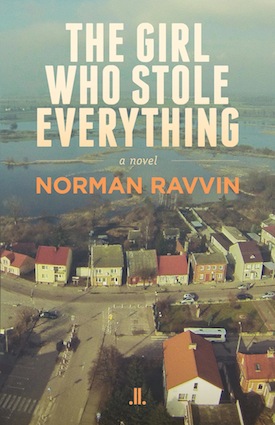
image - The Girl Who Stole Everything coverFor a long time it had the title The Dulcimer Girl, which is one of Nadia’s alter egos once she arrives in Poland. And the instrument itself, key to early klezmer, in its Polish guise, as a hammered instrument, was something I thought of as a talismanic object, which evoked the locale, the culture of Jews and Poles in another time.

The Typewriter Girl was also an early title that fell by the wayside, and relates to the other main female character, Ania. She is “the Typewriter Girl” by way of her work for a Polish government bureaucratic special office, which is tasked with investigating the files kept on people during the communist era. Understanding the typewriters used on each file is a way of verifying the files or revealing fraudulence.

The typewriter, like other technologies in the book – cars, books, recorded music – is evocative of a time when things worked in a way that they no longer do. So, the dulcimer and the typewriter, even hardcover books, are surely objects of nostalgic and loveable possibilities.

The Night Jew is central to the novel’s sense of Poland being haunted by the Jews murdered in the wartime. One can spend time in Poland and either look for these Night Jews or, as I sometimes feel, be one. There are plenty of real Jews in Poland today. But the Night Jew must be someone from another world altogether.

The Gentle Jew is in fact a particular nickname for a key figure in the narrative. He is an early ’60s denizen of West Cordova Street.

JI: There are many parallels in the lives of Simon and Nadia – a father’s secrets, their love of walking, etc. – and their lives do overlap, of course, but what inspired you to connect these disparate stories?

NR: Some of these parallels develop intentionally, but then others work themselves out as a book goes through drafts. Certainly, you’re right, walking is a returning motif. Nadia does seem to walk cities after the example of her father, as if she walks to be like him when she cannot know him.

The secrets of fathers: I guess, in this book, one of the premises is that ancestral stories, which go untold, can irrupt without warning. So, in the case of the younger characters in Canada, Simon and Nadia, they share this predicament, and their own lives are changed by the irruptions when they finally happen. It is satisfying when these kinds of patterns develop almost without meaning them to. This is where writing can be a bit like making music, where refrains, verse and chorus structure allow for such catchy and satisfying effects – a rhyming of sound and idea.

JI: If there is anything else you’d like to add, please do.

NR: I guess it’s important to say that I’ve returned to Vancouver in fiction for another try at it. My second novel, Lola by Night, was a Vancouver book. And, in The Girl Who Stole Everything, I felt strongly about doing things with the city that others hadn’t. I’m a walker in Vancouver, whenever I can be, so that element, which you ask about, is motivated by my own appreciation of what different parts of the city have to offer. When I walk, I do think of what’s changed since my last visit, so it may be that writing about a place can be well done from afar, as long as you keep it close enough and periodically in view. It’s interesting to have a Vancouver book come out in Montreal, where the West Coast is a kind of terra incognita.

Format ImagePosted on December 13, 2019December 12, 2019Author Cynthia RamsayCategories BooksTags Cherie Smith JCC Jewish Book Festival, fiction, history, Norman Ravvin, Poland, Vancouver
Choosing life, despite lament

Choosing life, despite lament

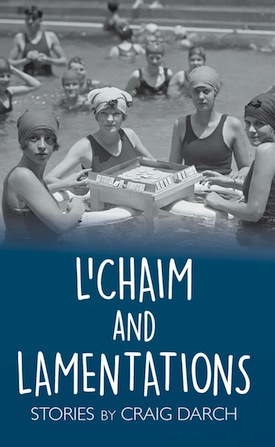
Craig Darch’s L’Chaim and Lamentations (NewSouth Books, 2019) is a bittersweet collection of seven short stories. Most of the characters in his first foray into fiction are older Ashkenazi Jews whose pasts are almost characters themselves. Yet, as strong as are their memories, these Jews are doing their most to live in the present, and to even assure the future.

Darch is the Humana-Sherman-Germany Distinguished Professor of Special Education at Auburn University, in Alabama, where he has taught for 37 years. He has lived several places in the United States, but New York City and Poland are the locations of import in these stories. At least one – “Who’s the Old Crone?” – was inspired by his birthplace, Chicago.

Having moved to South Bend, Indiana, with his family when he was 6 years old, Darch shares in an article on the Auburn website, “We attended synagogue in South Bend and continued to travel to Chicago to see my grandparents, where we frequented the famous Jewish deli called Ashkenazi. I remember always seeing the same three old men in there. I wondered about them, about their lives. Now, through fiction, I can give them names and their own story.”

image - L’Chaim and Lamentations coverIn the humorous tale Darch has imagined, Rabbi Fiddleman, “held court each day in Schwartzman’s with his two followers – Pincus Eisenberg and Mendel Nachman.” As described by another customer at the deli, the “group of three old men, the only other customers in the place, huddled together with covered heads at a booth in the far corner, all remnants from the Romanian synagogue, bankrupt and boarded up years ago. Now, with no place for them to go, the octogenarians arrived early each morning and stayed for several hours – sipping tea, noshing on the cheapest fare, and kibbitzing about spiritualism and life after death, debates that frequently drifted into polemical arguments concerning the metaphysics of Spinoza and Kant. Though generous with their opinions, when it came to money each one was more frugal than the next, and each had a knack for consuming great quantities of Schwartzman’s tea while nibbling a single bagel over the course of several hours.”

Darch’s characters are recognizable people with whom readers will feel loneliness and friendship (“Sadie’s Prayer”), fear (“Wasserman’s Ride Home”), heartache and bewilderment (“Kaddish for Two”), justice tinged with bitterness (“Leonard Saperstein & Company”), mystery and hope (“The Last Jew in Krotoszyn”), joy and possibility (“Who’s the Old Crone?”), acceptance and perseverance (“Miss Bargman”).

The young people in these stories represent both forces of change and the need for new traditions, as in the emotional story “Kaddish for Two,” in which a son finally gets the courage to tell his Orthodox parents that he is gay, and as preservers of the past, as in the somehow cheering “The Last Jew in Krotoszyn,” in which Magda, a 13-year-old non-Jewish girl, befriends Ruta, the story title’s last Jew.

“Ruta watched Magda run out the cemetery gate, heading toward home,” writes Darch. “Then Ruta shuffled slowly away, each step more difficult than the last. She stopped for just a moment to catch her breath. Bone tired, she rested her hands on her hips. She understood such fatigue was just one more signal, a tweak from the Almighty himself; her time in this world was coming to an end. But strangely, she had no fear of dying. She had faith that Magda would tend the cemetery and pass on the stories, the truth of Krotoszyn.”

Human connections – positive, negative and in between – are at the foundation of every story in L’Chaim and Lamentations. Enjoy.

Format ImagePosted on December 13, 2019December 12, 2019Author Cynthia RamsayCategories BooksTags Craig Darch, fiction, Judaism, Poland, United States
Spinning joy for Chanukah

Spinning joy for Chanukah

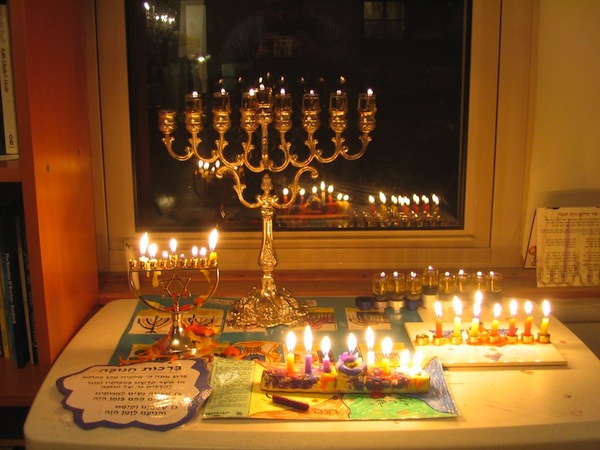
The lights of chanukiyot could be seen in the neighbourhood windows. (photo by Neil Harris/uberdox.aishdas.org)

There once was a dreidel named Dreidelhead. Dreidelhead had three brothers and lived with his parents in Flushing, N.Y. His first name was Noon but everyone just called him Dreidelhead because his head and body were shaped like a big dreidel. His three brothers were named Gimel, Hay and Shin.

Dreidelhead’s parents taught all of the children how to sing, dance and, of course, spin. So, during the holiday of Chanukah, all four children would sing, dance and, of course, spin at Chanukah parties and celebrations in their neighbourhood. Noon, Gimel, Hay and Shin would link their arms together and dance around the chanukiyah, singing Chanukah songs. It was quite a sight to see, the four dreidel brothers dancing together and spinning around the table. Everyone, especially children, loved to watch them.

Dreidelhead, like his brothers Gimel, Hay and Shin, was named after a Hebrew letter. Each brother had their letter stitched onto the front of their shirt, so that, when people saw them standing together, people would be reminded of the great miracle that occurred.

Dreidelhead’s letter, Noon, represented the word nes, miracle. Gimel’s letter represented gadol, which means great. Hay’s letter represented hayah, which means happened, and, finally, Shin’s letter, which is one of the last letters of the Hebrew alphabet, represented sham, the Hebrew word for there. So, when Noon, Gimel, Hay and Shin stood together, they reminded people that Nes gadol hayah sham, a great miracle happened there, in Israel, many years ago.

On the first night of Chanukah, after lighting the candles and singing songs, and before they were about to eat the scrumptious latkes that their mother and bubbie had made, Dreidelhead’s zaide would always tell the boys the story of the miracles that took place during the Festival of Lights. As their mom put down a plate of golden brown potato pancakes on the table and some sticky jelly doughnuts, their zaide recounted the tale of a band of Jewish rebels named the Maccabees, who were led by Mattityahu, a Jewish priest, and his five sons.

“A long time ago,” Zaide began, “there was an evil king of Syria named Antiochus, who forbade the study of Torah and wanted Jews to bow down to idols and eat pork. He also put idols right in the Holy Temple in Jerusalem.”

“I’d rather eat latkes and jelly doughnuts than pork,” Dreidelhead announced as he glanced hungrily at the plate of steaming latkes and sufganiyot.

“Yeah, me too,” chimed in Hay.

“Well, you’ll be eating some soon, just let your zaide finish his story,” Dreidelhead’s mom interjected.

“But, we already know the story of Chanukah,” Dreidelhead whined. “We learn it in Hebrew school every year.”

“I know you do,” Zaide patiently replied. “So, nu, if you know the story, tell us what happened next.”

“Well, um, the Maccabees, who were led by Judah the Maccabee (the Hammer) overthrew Antiochus and came to the Holy Temple to light the menorah and to cleanse it of all of the idols that were placed in it. When they came to light the menorah, there was only enough oil to last one night, but a miracle occurred and the oil lasted for eight days and eight nights,” Dreidelhead replied all in one breath.

“And so what do we do to commemorate the miraculous victory and the miracle of the oil?” Zaide asked.

“Well,” replied Dreidelhead, “uh, well, we light the candles for eight nights and put the chanukiyah in the window, we tell the story of Chanukah and eat potato latkes fried in oil. And we can also eat jelly doughnuts fried in oil. That’s what they do in Israel. Oh, yeah, and dreidels like us spin on Chanukah!”

“Don’t forget the part about the Chanukah gelt,” Gimel said.

“Oh, yeah,” said Dreidelhead. “We also get money or Chanukah gelt.”

“That’s true,” Zaide replied. “But, try to remember, boys, that the most important part of Chanukah is not getting money or presents, but lighting the candles, remembering the story and the miracles, and spinning for children during Chanukah. In fact, before your bubbie and I came to America, we would spin for all of the children in our little village in Russia on Chanukah.”

“Your zaide’s right boys,” Bubbie piped in. “And, back in the Maccabees’ time, according to an old legend, we dreidels were used to warn students studying Torah that Antiochus’s troops were coming.”

“So our ancestors helped save people’s lives – they were heroes!” exclaimed Hay.

“That’s right,” Dreidelhead’s father acknowledged. “So, you boys should be proud to be dreidels. Anyway, after you thank your bubbie and zaide for their wonderful Chanukah stories, I want you to wash your hands and then you can eat. You’ll need lots of energy if you’re going to dance for the boys and girls in the neighbourhood tonight.”

Later that evening, the dreidel brothers roamed the neighbourhood searching for Jewish families who were celebrating Chanukah. They were easy to find. The dreidels just looked for houses that had a chanukiyah displayed on the windowsill. They knocked at people’s doors and announced in unison, “Happy Chanukah! It’s the dreidels!” If there were any children in the household, they would jump up and down and shout at the top of their lungs, “The dreidels are here! The dreidels are here!” The children would plead with their parents to invite the dreidels into their home. Once inside, the dreidels would spin and sing for the children, just as their parents and grandparents did before them.

And so, during the eight nights of Chanukah, while the candles were burning, Dreidelhead and his brothers would dance and spin, bringing joy wherever they went.

David J. Litvak is a prairie refugee from the North End of Winnipeg who is a freelance writer, former Voice of Peace and Co-op Radio broadcaster and an “accidental publicist.” His articles have been published in the Forward, Globe and Mail and Seattle Post-Intelligencer. His website is cascadiapublicity.com.

Format ImagePosted on December 13, 2019July 2, 2020Author David J. LitvakCategories Celebrating the HolidaysTags Chanukah, dreidel, fiction, Judaism
The Ornithologist

The Ornithologist

Raizel does not like to leave her apartment during the long, cold, season. She sits perched at the windowsill, torn bits of challah portioned beside her on the ledge, waiting for her feathered friends. A robin’s egg blue pashmina draped loosely across her thin shoulders.

On the Esplanade below, her neighbour Malka is carrying grocery bags on her way back from St-Viateur. It’s almost Shabbat and she is hurrying home to prepare the flanken, matzo ball soup and lokshen kugel. Raizel, on the other hand, makes cholent. She has everything she needs. Sometimes a bit more, sometimes a bit less.

Before Abe passed, Raizel would prepare a proper erev Shabbat meal; never went without kreplach or tzimmes. Now, she doesn’t even light the candles. There’s no one to say the brachah with, no one to make Kiddush. It’s all too quiet. She goes to bed early. When the children call, she’s taken the phone off the hook; doesn’t want them to know she’s alone in the dark.

In the morning, Raizel props open the bay window and rolls over the heavy oak desk chair. The one Abe sat in for 62 years preparing client accounts and tax returns; the threadbare cushion still warm. She picks up the binoculars, placing her elbows firmly on the ledge, and straightens her arthritic back. The air is fresh. A light snow is falling. The parade of black-capped chickadees, blue jays and purple finches remain hidden until she drizzles sesame seeds and the bread along the sill. But, today, she is looking elsewhere. They will have to wait.

Scanning the park, past the wrought iron fencing and its pointy spires, and past the rose garden buried under tufts of snow, she spots Malka. And Chaim, trailing close behind. A pleasure to see him. Raizel first began to notice Chaim only after her daughter bought her the binoculars, “to give her something to look at,” her daughter had said, “since she was refusing to go out.”

At first, Raizel thought she must be imagining things, thought maybe she should call Dr. Lipschitz to make an appointment. But, no, it was him. Chaim would swoop down close behind Malka, a few feet off the ground, his arms gently flapping, like a midnight black crow. He would accompany Malka as she walked along the stone pathway, always just as far as the gate leading onto Fairmont Avenue. And he would be dressed for the season: pastel peach plumage in summer and shimmering black feathers fringed with vanes of barbs in winter; how did he know?

Raizel and Abe had gone to the funeral, they went to the shivah, they consoled Malka and her children; there was no doubt, Chaim was gone. But now, here, there he was, fawning over Malka all over again, her constant companion. Raizel had been curious how it was that Malka couldn’t see Chaim, didn’t seem to even know he was there. No hidden smile, no look back, no small wave. Nothing. So, it was strange when Malka started spending so much time promenading around in the park, no matter the weather, or time of day.

Raizel felt a little chilled. She had been watching them for nearly an hour. She pushed the window closed and began to set the table for lunch. Cholent. It would warm her up.

Before sitting down to eat, Raizel picked up the binoculars again and scanned the apartment. Would she be so lucky? Would it be one or two for lunch today?

Karen Schauber is a family therapist practising in Vancouver. Her earlier writing is non-fiction and details three decades of psychosocial and analytical cases. Flash fiction is a new adventure for her, and her work has been published in literary magazines and anthologies, including Brilliant Flash Fiction, Bending Genres, CarpeArte, Ekphrastic Review, Flash Boulevard and Blood Puddles: An Anthology. The upcoming Group of Seven Flash Fiction anthology, celebrating the Canadian modernist landscape painters, is her first editorial flash venture. Schauber manages vancouverflashfiction.weebly.com and can be reached at karenschauber.weebly.com.

Format ImagePosted on May 3, 2019May 2, 2019Author Karen SchauberCategories Arts & CultureTags death, fiction, ornithology
Persistence a common theme

Persistence a common theme

There is a bounty of books to read and review at the Jewish Independent. One of the many perks of my job is that I have so much culture literally at my fingertips. But, given the weekly deadlines and other demands of running a newspaper, I can’t always be au courant. So, hopefully I will be forgiven for reviewing four books published last year for this Passover issue: a memoir, a work of fiction (perhaps 😉 and two young adult novels. I’m excited to report that two of the books were written by people who have written for the JI and one was written by a local community member.

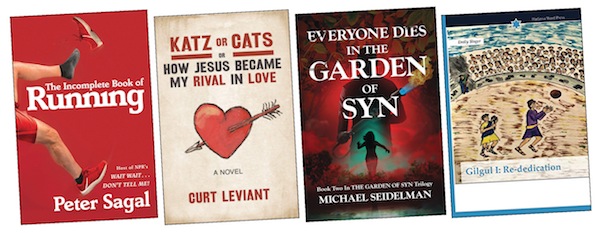
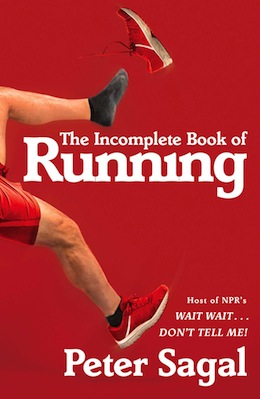
My favourite podcast is Wait Wait … Don’t Tell Me! And, even though I don’t run, one of my favourite magazines is Running Room. I’m not sure how I got onto their mailing list, but I always enjoy reading people’s inspirational stories of why they started running, I like the recipes and nutritional advice and the training tips, which are useful for other types of exercise. Anyway, all that to say I was excited when the host of Wait Wait, Peter Sagal, who is Jewish, came out with his new book, The Incomplete Book of Running (Simon & Schuster, 2018).

book cover - The Incomplete Book of RunningSagal shares personal stories about why he started running, some of the marathons in which he has participated and people he has met along the way, notably a couple of runners who were blind (or almost), for whom he acted as a guide. Scattered throughout, he offers various facts and figures about running; its health benefits, as well as its downsides (I did not know about, to put it delicately, the digestive issues long-distance runners can face). He speaks somewhat vaguely but openly about the dissolution of his first marriage and he is refreshingly honest about his struggle with depression.

Running has helped Sagal deal with difficult circumstances, and continues to not only be a form of exercise for him, but something that informs how he lives. Among other things, running has taught him persistence and has made him more courageous; it has contributed to his “faith in the possibility of positive change” and his realization of just how enduring is love.

I admit that, despite Sagal’s enthusiasm, reading about multiple marathon experiences, as a non-runner, got a little tiresome. And the book isn’t chronological, so I wasn’t always sure of what point we were at in Sagal’s life. But, those minor criticisms aside, I enjoyed the book a lot, especially Sagal’s conversational style of writing and his humour. Having listened to him almost every week for so many years, it felt, at times, that he was right there, telling me his story; that I was listening to him, rather than reading him.

* * *

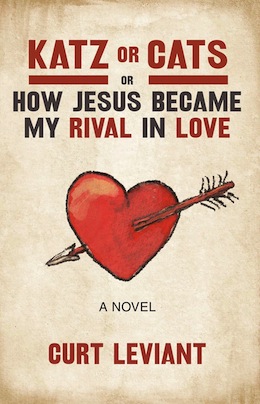
There is no doubting that Curt Leviant is a talented writer, that he has a wicked sense of humour and a heightened sense of observation and awareness. Katz or Cats; Or, How Jesus Became My Rival in Love (Dzanc Books, 2018) is his most recent of many novels and fans will not be disappointed.

A book editor, John, and a writer, Katz, meet on the subway. On their commutes into New York, Katz shares what is ostensibly his brother’s love story, though it may be Katz’s. Part of the novel’s plot revolves around just how true, or fictional, is the story of Katz’s brother, who also goes just by his surname, Katz.

book cover - Katz or CatsAs the story goes, Katz (or Katz) meets a woman on a train. Maria is supposedly a devout Christian, but she has no trouble permitting a stranger to put his arm around her on first meeting, nor having sex pretty soon thereafter with said stranger, Katz, who she thinks might be married. Their relationship – and the novel – comprises much sex, a lot of talking about sex and many discussions about religion – Jesus, specifically, and Maria’s recurring feelings of guilt for not being what she thinks a good Christian should be.

As Katz relates the tale to John, the editor interjects every once in awhile to question apparent contradictions or errors in the telling. Some aspects – Katz’s marital status, for instance – remain unclear, and purposefully so.

Ironically, perhaps, given that the premise of the novel is a writer telling a story to an editor, Katz or Cats would have benefited from some tighter editing. More than one topic recurs and some points are made multiple times. While Katz’s wit and intelligence provide much to think about, I didn’t find him to be a sympathetic character, so “listening” to him became difficult. And, while I’m not a huge fan of political correctness, I found his treatment of Maria to be condescending and rude at times, and some of his quips to be on the edge of disrespectful towards other cultures. Though Katz refers to Maria more than once as smart, her waffling and some of her responses to Katz – and his reactions to her – don’t really support that notion.

Overall, while provocative in many ways, I found Katz or Cats to read like a book from another era. Many male writers, from Seneca to Henrik Ibsen to Thomas Mann to Leviant himself, come up in conversations in the novel, reinforcing my feeling that this book would be most appreciated by older, male readers. But I could be wrong. When I shared my views with Leviant – who regularly writes for the Jewish Independent’s holiday issues (see page 34 of this issue, for instance) – he shared that a similar novel of his, translated into French, got great reviews from young women critics.

* * *

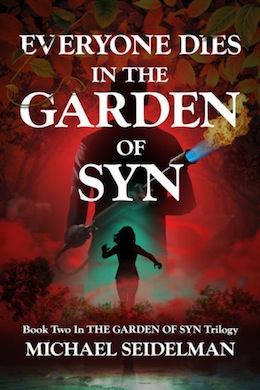
Ever since reading No One Dies in the Garden of Syn in 2016, I have been waiting for the second book of local writer Michael Seidelman’s trilogy featuring teenage heroine Syn. And, late last year, my wait was over.

book cover - Everyone Dies in the Garden of SynEveryone Dies in the Garden of Syn (Chewed Pencil Press, 2018) starts with a violent prologue that both heralds what’s to come and starts to explain the “Creepers” – weird-looking creatures that seem to be combinations of two people or a person and an animal or insect – we met in the first novel.

In the introductory pages of Everyone Dies, Seidelman, in addition to moving the story along, reminds readers of what has come before. The action in this book centres around Syn’s need to rescue her sister, who has been kidnapped by Cole, a “boy” who befriended and then betrayed Syn – or, from his point of view, was befriended and betrayed by Syn.

Still missing as Everyone Dies starts are Syn’s parents, who disappeared when she was 5. Because of Syn’s actions in the first book, the garden, which once had healing powers – “no one dies” – has lost them, so now “everyone dies,” or can die, in the garden. Therefore, the situation is that much more dangerous now for Syn, who suffers from cystic fibrosis. Whereas she didn’t have to worry about her health in the first novel, it becomes another thing she has to battle in the second.

And there is many a battle in Everyone Dies, and lots of running and chasing. There were a few times I lost track of which universe (there are multiple) we were in, and, sometimes, who was fighting whom, but the action moves along and the tension builds. There’s a wonderfully satisfying twist at the end. And so begins the wait for Book 3.

To read more about Seidelman’s first Syn novel, visit jewishindependent.ca/first-book-of-trilogy-now-out.

* * *

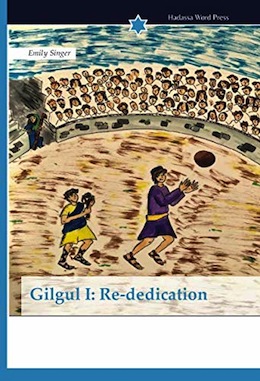
“When my 13-year-old son devoured Bulfinch’s Mythology after reading Rick Riordan’s Percy Jackson, I realized we need an exciting, thought-provoking series based on Jewish history, something that will send our kids reaching for a Torah, a Talmud or a Book of the Apocrypha,” wrote Emily Singer to the Jewish Independent in an email about her new book, Gilgul I: Rededication (Hadassa Word Press, 2018).

Singer, who lives in Israel, is a writer and a high school teacher. When she and her family lived here, she taught at Vancouver Talmud Torah. She has written several articles for the Jewish Independent so, when she contacted the paper about Gilgul, I happily agreed to review it.

book cover - Gilgul INot surprisingly, knowing Singer’s skill as a writer, Gilgul is a compelling and radical take on the Chanukah story. While all the book’s hero David wanted to do was to play the game skyros with his friends, the game takes on a deadly seriousness for the 15-year-old when King Antiochus sacks the Temple and starts a war against the Jews.

David must be smart, brave, strong and compassionate to stay alive and save his family and his people. He must figure out who to trust, and the fact that it’s not always clear who the good guys and bad guys are adds tension and meaning to the novel. Even with the help of his equally heroic sister Leya, some unexpected courageous allies and a little magic, David has his work cut out for him. Gilgul will leave readers thinking anew about Chanukah, the rededication of the Second Temple, the Maccabees, the miracle of oil, and more.

Format ImagePosted on April 12, 2019April 17, 2019Author Cynthia RamsayCategories BooksTags Curt Leviant, Emily Singer, fiction, Gilgul, memoir, Michael Seidelman, Peter Sagal, Syn, writing, young adults
Meet new or favourite writers

Meet new or favourite writers

The Cherie Smith JCC Jewish Book Festival starts this Saturday night (Feb. 9) with Joshua Cohen, author of Moving Kings and ATTENTION: Dispatches from a Land of Distraction. It continues for five literary-filled days at the Jewish Community Centre of Greater Vancouver, and here’s a sampling of books you might want to add to your reading list, and authors you might like to meet.

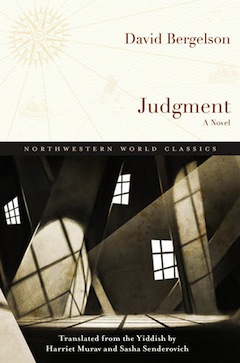
book cover - JudgmentSet in 1920, in the fictional shtetl of Golikhovke during the Russian civil war, Judgment, by David Bergelson (1884-1952), is a melancholic novel about humanity in a time of uncertainty, where different political factions are warring, each under their own ultimately meaningless banner; neighbours cannot trust one another, let alone strangers; and justice is meted out randomly by a cruel, indifferent force.

Stationed in an also fictitious abandoned monastery called Kamino-Balke, near Golikhovke, the sickly Bolshevik Filipov is in control of the area along the Ukraine-Poland border. There are smugglers who travel across the border for commercial reasons and Socialist Revolutionaries who travel across it in preparation for an uprising against the Bolsheviks. Jews and non-Jews live together in relative tolerance but political loyalties, ethnic ties and differing ideas of morality ensure a constant tension. All live in fear of being captured by one of Filipov’s agents, as guilt of a crime does not need to be proven for a person to be beaten, imprisoned and/or shot.

What makes this novel beautiful is Bergelson’s prose. Imaginative metaphors: “Large, invisible hands merrily picked up whole heaps of snow and just as merrily released them.” Animated objects: “… the coat lay there bent over, dejected, as if it had made a long, pointless, idiotic journey” and “The cannons’ muzzles – black, fat and eyeless – stared longingly in the direction of the forests around Moshne….” Humour: “Stone fences suited the inhabitants of Yanovo, for all of them were as stubborn as their stone fences: stone upon stone.” And empathy, in this case, for the undercover agent Yokhelzon, whose “eyes (which inspected everything, people said) had already taken in the horror of death – they winked joyfully, so that the horror would not show afterward.”

As should be obvious, Harriet Murav and Sasha Senderovich have done a masterful job of translating Judgment from Yiddish to English. They also provide a fascinating introduction to the novel, its historical context, the author and his other works (Bergelson was executed in 1952, on Stalin’s orders), the book’s title, form, themes and use of language.

Senderovich will be at the book festival on Feb. 10, 3:30 p.m.

***

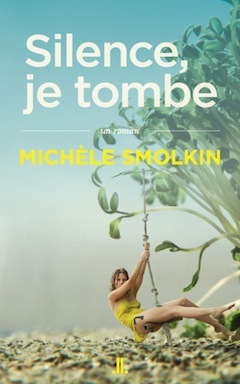
book cover - Silence, je tombeMichèle Smolkin’s novel Silence, je tombe is a witty, philosophical novel that explores how people can become isolated from one another, including themselves. Told from the perspectives of a few protagonists, readers will likely relate to many of the feelings expressed.

The novel starts with a pregnant Tania, as she, her husband Paul and their toddler Margot are making the drive to their new home in “Manhattan, Kansas, The Little Apple,” from Vancouver. Tania’s disenchantment is obvious and she expresses her anger towards her husband – who, as a professor of philosophy, couldn’t find a job elsewhere – with vicious (and very funny) sarcasm, mostly in her thoughts, but aloud, as well. She had imagined a different life for herself – living in New York, the Big Apple, for one thing; and certainly not in the Bible Belt. As a Francophone Jew, she anticipates that fitting in might be a problem.

As the book progresses, we get to know Tania, Paul and a disturbed man named Kevin, plus a couple of other minor but important characters. Through them, we contemplate love, what attracts people to one another and what forces them apart, what happiness is, what actions might be unforgivable, how our childhoods influence our adulthoods, and, of course, the inadequacy of words for certain situations, and understanding why, sometimes, silence is the only possible response.

Smolkin’s talk – the book festival’s first-ever French-language event – will take place Feb. 10, 5 p.m. (Note: Festival program shows incorrect time.)

***

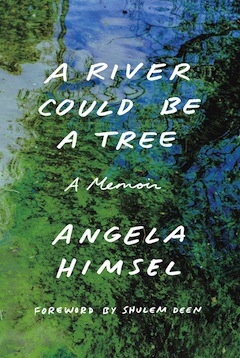
book cover - A River Could Be a TreeA River Could Be a Tree is, thankfully, not the memoir of a person who goes from believing fanatically in one religion to being swept away as unquestioningly into another, though it might seem like it would be, given some aspects of the press material. “How does a woman who grew up in rural Indiana in a fundamentalist Christian cult end up a practising Jew in New York?” asks part of the blurb on the book flap. Well, for starters, Angela Himsel seems to always have been an inquisitive person, and never an avid follower of Herbert Armstrong’s Worldwide Church of God. She was an obedient child, but is still struggling with understanding how her parents believed so much in the church doctrine that they didn’t give her sister the care that might have prevented her death at a young age.

A River Could Be a Tree is a measured, often humourous, always intelligent memoir. Himsel starts with a prologue that gives readers a very large hint as to what led her to ultimately convert to Judaism: she and her boyfriend Selig were, “just once … careless about birth control.”

But the journey to that point is long and more complicated, and Himsel takes readers through it with the benefit of hindsight, hard-won insights and a writing style that is serious, honest but unsentimental, and filled with initially unexpected levity. As but one example, a mere three paragraphs into Chapter 1, in which Himsel talks about her parents’ religious heritage, Roman Catholicism and Lutheranism, she writes about Martin Luther, that, at age 41, he “married a nun, a woman he had helped smuggle out of a convent in a herring barrel. While irrelevant to Luther’s religious beliefs, a nun in a herring barrel is always worth mentioning.”

And A River Could Be a Tree is well worth reading. Himsel will speak at the book festival on Feb. 11, 7:30 p.m.

***

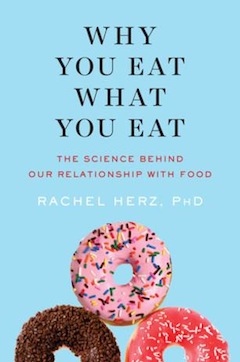
book cover - Why You Eat What You EatThere is so much information in Why You Eat What You Eat: The Science Behind Our Relationship With Food by Rachel Herz. And a refreshing aspect of the book is that it’s not written from a dogmatic, all-knowing viewpoint. Herz acknowledges that sometimes studies come to different conclusions, sometimes scientific progress means that what was once thought true is disproven, and that different people will experience food, exercise and other things differently. Readers looking for certainty might be disappointed, but those wanting to learn will learn a lot. Who doesn’t want to know, for example, why tomato juice is one of the most popular drink orders on planes? Does sugar really help the medicine go down, so to speak, i.e. reduce the effects of pain? And why can buying ethically branded or organic products make us less charitable?

But Why You Eat What You Eat is more than an amalgamation of trivia. Herz has compiled a very readable and relatively comprehensive resource that will, as the title promises, help explain why we eat what we eat; how all of our senses – taste, smell, sight, touch and hearing – affect how we experience food. And knowing these things just might make us feel better about ourselves, and make choices that would serve us better.

Herz will be at the book festival on Feb. 13, 6 p.m.

Format ImagePosted on February 8, 2019February 7, 2019Author Cynthia RamsayCategories BooksTags Angela Himsel, Cherie Smith JCC Jewish Book Festival, David Bergelson, fiction, food, French, memoir, Michèle Smolkin, non-fiction, Rachel Herz, science, translation, Yiddish
JCC Book Fest awards given

JCC Book Fest awards given

Western Canada Jewish Book Award 2018 winners, left to right: Roger Frie, Deborah Willis, Kathryn Shoemaker and Irene Watts. Missing: Tilar Mazzeo. (photo by Cynthia Ramsay)

Deborah Willis became a writer, in part, because it is a way “to learn about the things that you’re curious about.” Irene N. Watts and Kathryn E. Shoemaker were motivated to reimagine a decade’s-old story in light of its relevance to pressing issues of today. And, in his latest work, Roger Frie found a way to discuss a past for which, previously, “the words were missing for how to speak about it.”

The Western Canada Jewish Book Awards, presented by the Cherie Smith JCC Jewish Book Festival, took place on April 26. Self-proclaimed book lover Daniella Givon, who is part of the JBF committee and was chair of the awards committee, introduced the evening.

“As I looked for ways to enhance the Jewish Book Festival,” she said, “I had a vision that book awards would marry the goals of the festival with the celebration of, and support the achievements of, local Jewish writers from Western Canada and showcase the winning authors. Since then, we’ve already gone through the process of bringing the ideas to fruition with the help of a subcommittee and the first round of awards … a beautiful ceremony was held here two years ago, recognizing five best-deserving authors.”

This year, four awards were presented, as chosen by the selection committee of former librarian Linda Bonder (Victoria); author and librarian Elisabeth Kushner (Vancouver); author and poet Dave Margoshes (near Saskatoon); writer, teacher and critic Norman Ravvin (Montreal); and Judith Saltman, professor emerita at the University of British Columbia School of Library, Archival and Information Studies. The winners were Calgary-based Willis for The Dark and Other Love Stories (Diamond Foundation Prize for fiction); Tilar J. Mazzeo, who divides her time between Maine, New York and Vancouver Island, for Irena’s Children (Pinsky Givon Family Prize for non-fiction); Vancouver’s Watts and Shoemaker for Seeking Refuge (Jonathan and Heather Berkowitz Prize for children and youth literature); and Frie, professor of education at Simon Fraser University and affiliate professor of psychiatry at UBC, for Not in My Family: German Memory and Responsibility after the Holocaust (Kahn Family Foundation Prize for writing on the Holocaust).

At the awards ceremony, each of the donors, or their representative, announced the winner of their sponsored award, which included a cash component. The winners – except for Mazzeo, who could not attend – read excerpts from their books and were interviewed briefly by Marsha Lederman, Western arts correspondent for the Globe and Mail.

Frie, who seven years ago discovered his maternal grandfather’s involvement with the Nazis, told Lederman, “This was a past no one had spoken about and, as I soon learned to understand, I think the words were missing for how to speak about it.” About the war in general, he said, his parents – who immigrated in the 1950s to Canada (Frie was born here) – talked about Germany’s responsibility for the Holocaust, however they did not speak about what his grandparents believed or what their involvement was in the war. He has found, in his research, that this “is a common dynamic amongst Germans in the postwar period.” He said that, while Germany has faced its past, “the emphasis on collective memory and collective understanding and collective responsibility has, in some way, allowed individual families to avoid confronting the past, and this book [Not in My Family] is very much a representation of that.”

Lederman described Mazzeo’s book as “astonishing.”

“I knew nothing about Irena Sendler before I picked up this book, so this has been a gift,” she said. “Irena Sendler was a Polish woman who saved … thousands of Jewish children during the Holocaust with amazing feats of courage, often in the Warsaw Ghetto. Her story is incredible, this book is incredible, and I can only hope that Steven Spielberg gets his hands on a copy.”

Shoemaker gave a brief presentation on the creative process she and Watts went through to create the graphic novel Seeking Refuge, which is based on Watts’ book Remember Me (first published in 2000). And Watts spoke of the challenge of cutting 27 chapters down to nine. “What I had to keep in mind,” said Watts, “is you can get so carried away by cutting and changing the language to make it more dynamic that you lose the story a little bit, and I had to watch that I didn’t diminish the characters.”

About the cover of the graphic novel, which features a girl sitting on a suitcase looking forlorn, Watts said Shoemaker “told the story in that one image.” Later, in response to a question from Lederman, Watts said the current refugee crisis was “the major reason to bring this book back in a different format.”

As for Willis, she spoke with Lederman about her winning collection of short fiction. “I was writing the stories for about five years, and I actually started noticing that the word ‘love’ was coming up over and over again. I was at first a little dismayed by that because I was thinking, oh, love stories, that’s been done. But then I embraced it and I wanted to try and explore that theme in a way that was true to my esthetic, or my goals as a story writer. I set it almost as a challenge.”

After an open Q&A with the authors, JCC Jewish Book Festival director Dana Camil Hewitt wound up the event with thanks to the sponsors, judges, awards committee and audience.

For an interview with Watts and Shoemaker, visit jewishindependent.ca/meet-award-winning-artists and, for a review of Not in My Family, visit jewishindependent.ca/a-grandfathers-sins.

Format ImagePosted on May 4, 2018May 2, 2018Author Cynthia RamsayCategories BooksTags children, Daniella Givon, Deborah Willis, fiction, Holocaust, Irene Watts, Jewish Book Festival, Kathryn Shoemaker, Marsha Lederman, memoir, Roger Frie, Tilar Mazzeo
Separate but connected lives

Separate but connected lives

“I remember the deep pleasure I had as a child when I first began reading,” author Méira Cook told the Independent. “It was like climbing into a book and pulling the covers down over my head. When I write, I feel as if I’ve returned to that world. My greatest wish is that readers experience the absorption in reading my novels as I’ve had in writing them.”

Cook’s latest novel – her third – is Once More With Feeling (House of Anansi Press Inc., 2017). Readers will be immediately drawn in by the cheerful, optimistic and a bit naïve Max Binder, whose “many friends tend to exaggerate the dozens of half-full glasses – and some of them considerably less than quarter-full, it’s been pointed out by a couple of the more sour and dill-picklish ones – that he has eagerly poured into another until presto, not only is the glass full but it runneth over.”

Because, for Max, “hope is not merely a feathered thing, a bird, or an equation for water and glass. Hope is where he lives, where he hangs his hat and unbuckles his belt.”

So begins Once More With Feeling, with Max at the airport – where he’s never been “without running into someone he knows, however tangentially” – to pick up a visitor he’s invited as a surprise for his wife Maggie on her 40th birthday. The light tone lulls readers unfamiliar with Cook’s previous work into the expectation of a nice, light read, albeit one full of insight into human nature and wry observations on life. But, while there is much humour throughout, the novel is substantive and serious, and the writing demands that readers do some work.

The story of the Binder family – Max, Maggie and their two sons – and the community they live in, Once More With Feeling “explores how different family members are affected by tragedy, and how the Binder family’s trauma ripples out into the larger community,” explained Cook. “The novel began as a series of linked short stories centring on the Binders, but also veering off into other characters and situations. The structure I’d envisioned was of a year in the life of a city (Winnipeg), with each story taking place during a different month. I loved that sense of turning seasons and changing weather that we prairie folk experience so keenly.

“In the process of writing Once More With Feeling,” she continued, “I began to realize that, while we often like to believe that we are the protagonists of our own autonomous stories, really we are all connected, all linked in hidden and sometimes unexpected ways, all parts of a larger novel. In Winnipeg, we cherish the fond belief that we’re connected by two degrees of separation rather than the customary six degrees. I wrote my novel with this in mind – that people who live in different parts of the city, different neighbourhoods, are nevertheless connected not only through mutual friends and acquaintances but also in their shared humanity.”

The connections aren’t always easy to make in Once More With Feeling, and readers who like linear narratives will find the novel challenging. Some of the chapters have little to nothing to do with the Binders. But Cook is a master at creating characters – and Winnipeg would be one of the many in this book – that seem real, like people we know or have known, or who resemble ourselves in ways. The writing is excellent; many passages are hilarious, others are breath-catching. Cook is a perceptive observer and intelligent commentator. Perhaps not surprisingly, she was a journalist in her home country of South Africa.

“I came to Canada in the early nineties and lived for a couple of years in a small town three hours north of Winnipeg,” she said. “I’d previously lived an entirely urban existence in a large, bustling city, Johannesburg, where I was a film and drama reviewer. Suddenly, I found myself in a very small town (the population was about 500), where I could no longer work as a journalist. I’d never seen snow before and, since I’d arrived in February, there was an awful lot of it. I experienced culture shock as a devastating loss of identity, the loss of everything I’d known before. When I looked out my window, the snow seemed as white and blank as a page. I began to write – first poetry, later fiction – as a way of leaving my mark on that page.”

In addition to her three novels, Cook has published five books of poetry. In Canada, she also has lived on the West Coast for a spell.

“My husband and I lived in Vancouver for four years while we were studying. In those four years, I received my PhD in Canadian literature and had three children,” she said. “Despite how fertile a place Vancouver was for us, we returned to Winnipeg for work reasons. (Perhaps we were afraid that if we remained in Vancouver we’d have another three children!) My daughter had her naming ceremony and my twin sons had their britot at Beth Israel Synagogue on Oak.”

image - Once More With Feeling coverOnce More With Feeling has numerous Jewish aspects, from several characters, including Max, to topics such as the Holocaust, and how we remember and learn from it.

“Maggie isn’t Jewish but I didn’t have a specific reason for this in the sense of wanting to portray an intermarried couple,” said Cook. “I was interested in representing a city that is as diverse and vibrant as the Winnipeg I live in.”

For Cook herself, she said, “Judaism has always been important to me but I didn’t always feel that I was important to Judaism. When I was growing up in Johannesburg, my family attended an Orthodox synagogue and I often felt excluded and sidelined as a young girl and, later, as a woman.

“Through the years, I found my way back to my lost religion via the Conservative movement. My family attends an egalitarian synagogue in Winnipeg, where we sit and pray together, and where my daughter had her bat mitzvah six years ago. Watching my daughter reading from the Torah was such a deeply meaningful experience; it inspired the section of the book related from the point of view of the mothers watching their children grow up and become sons and daughters of the commandments.”

This chapter – called “Tree of Life” – is especially poignant, while also providing a critique of various social mores with wit and tenderness. And Cook doesn’t only put a lens on the Jewish community, but also on larger societal issues, such as racism toward First Nations people and the problem of homelessness.

“I don’t censor myself when I write but I certainly do when I revise,” she said about tackling controversial subjects. “Stephen King once said: ‘Write with the door closed, edit with the door open.’ And Hemingway is supposed to have advised: ‘Write drunk, edit sober.’ The model I follow is less decadent but similar in intent: write in a dream, edit when you wake up.”

And how does she know when to step away from the keyboard?

“There is a point where the writing doesn’t feel personal anymore. The story that has for so long been floating in your head or been messily transcribed from longhand notes to a Word document, that story hardens into conviction, becomes real.”

Format ImagePosted on March 23, 2018March 23, 2018Author Cynthia RamsayCategories BooksTags fiction, Méira Cook, Winnipeg

Posts pagination

Previous page Page 1 … Page 3 Page 4 Page 5 Next page
Proudly powered by WordPress