Cultural constellations

Lindsey Tyne Johnson has a new show at the Zack Gallery: The Irish Mazzaroth & Hebrew Spelled Backwards. It comprises two separate parts.

Hebrew Spelled Backwards debuted at the Kamloops Art Gallery in 2023. It is a series of illustrations in which the artist explores her Jewish heritage.

“When the show finished in Kamloops, the Zack Gallery director contacted me,” Johnson told the Independent. “But the show had only seven pieces, and the Zack Gallery is large. It needed more art.”

At about the same time, Johnson decided to delve deeper into her ethnic roots. “My mother’s family were Irish Jews,” she said. “Not a usual combination. I went to Ireland in February 2024 to find out more.”     

She was fascinated by what she discovered. “Jews appeared in Ireland in the 1500s,” she shared. “Later, antisemitism forced many of them to leave, but they came back again. Then, there was a wave of Jews who came to Ireland and Northern Ireland from Russia in the beginning of the 20th century – they were escaping pogroms. Someone tricked them, sold them tickets to New York, but delivered them to Ireland instead and kicked them off the ship there. Some persisted in traveling to America, but others settled in Ireland. And then, there were the Jewish children escaping the Holocaust in Europe, Ireland took them in.”        

When Johnson visited the Irish Jewish Museum in Dublin, she found a number of her ancestors. “Their names were all written up in the Book of Irish Jewry there,” she explained. “The museum staff asked me if I wanted my name to be added to the new edition of the book. Of course, I said yes.”

The second part of the show, Irish Mazzaroth, started taking shape in her mind while she was in Ireland. The 12 black and white illustrations on the gallery walls reflect Johnson’s take on the zodiac’s traditional imagery. Mazzaroth means constellations in Hebrew.

Both Jewish and Irish lore have a long record of zodiac interpretations, from Greco-Roman mythology to the Zodiac Wheel, the centrepiece of the sixth-century mosaic at Beit Alpha in Israel. 

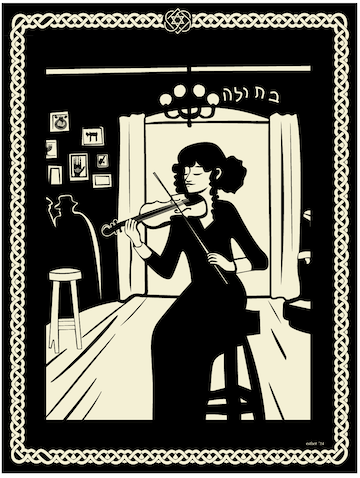
image - “Virgo” by Lindsey Tyne Johnson, part of Johnson’s solo exhibit at the Zack Gallery until May 9
“Virgo” by Lindsey Tyne Johnson, part of Johnson’s solo exhibit at the Zack Gallery until May 9.

Johnson, a young Canadian artist, has succeeded in meshing seamlessly Celtic symbolism and Jewish mysticism into a series of computer illustrations that are uniquely hers. 

“I started the first one in January. I finished the last one just before the show,” she said. “Each one is a well-known astrological sign, and each involves some aspects of both Jewish and Irish culture.” 

Every illustration is a whimsical little story, a playful tale that connects all earth cultures to one another. The images are clean and austere, uncluttered by unnecessary details. The twin girls in Gemini smile at the viewer. In front of them are Shabbat candles and a challah. Behind them, a leafy tree rises in the Irish countryside. Their quiet joy is unmistakable. 

On the other hand, the lone girl in Scorpio is solemnly considering the riches of ancient books in the famous Old Library in Trinity College in Dublin. She seems breathless with excitement at the abundance of choices in front of her, her braid curling up defiantly like a scorpion’s tail. The Jewish thirst for knowledge is given form in the context of the historical Irish library.

In another famous location in Dublin, the Temple Bar pub, Johnson features, in Virgo, an Irish Jewish woman playing a fiddle, merging lively Jewish klezmer and Celtic tunes.

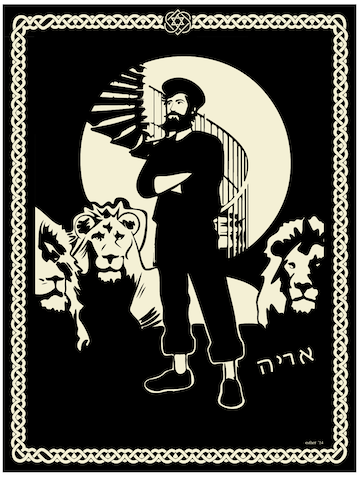
image - “Leo” by Lindsey Tyne Johnson
“Leo” by Lindsey Tyne Johnson.

In Leo, the backdrop is grimmer. It depicts the Crumlin Road Gaol, hinting at the political strife in Ireland, while the man in front reminds us of the story of Daniel and the lions. “One of my distant relatives worked as a prison guard there,” Johnson said. 

The frames of every illustration are identical: a rounded rectangle of Celtic knots, tied together at the top by a Magen David, which also emphasizes the affinity of two cultures.

The Irish Mazzaroth & Hebrew Spelled Backwards is on display at the Zack Gallery until May 9. To read more about Johnson and Hebrew Spelled Backwards, go to jewishindependent.ca/artfully-exploring-heritage. 

Olga Livshin is a Vancouver freelance writer. She can be reached at olgagodim@gmail.com.

Immersed in animation

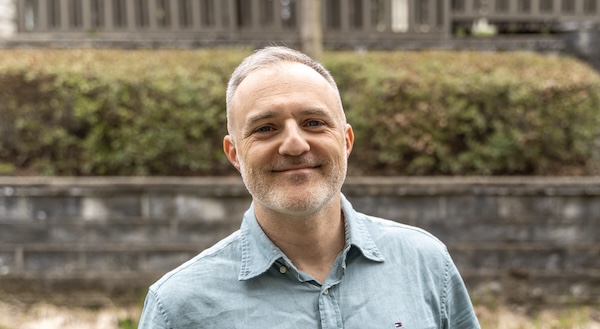
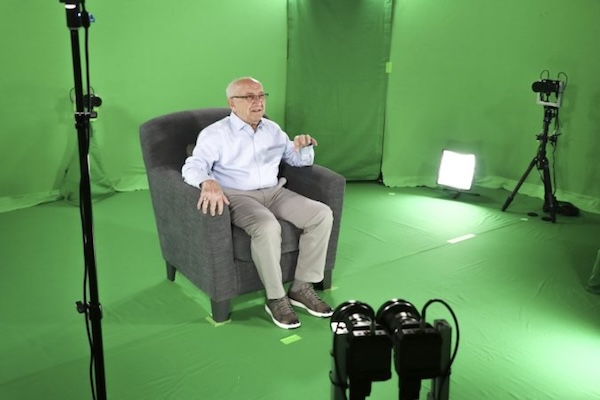
Alex Greenberg’s family experience drove his work for the Dallas Holocaust Museum. (photo from Alex Greenberg)

It was a winding road for Alex Greenberg to become head of animation at a leading creative technology firm in Vancouver. 

Born in Moldova, Greenberg and his family made aliyah in 1990, when he was 11 years old. After a “pretty regular childhood” in Israel, high school graduation, military service and a bit of travel around the world, Greenberg settled down to study animation.

“Unfortunately, two months into school, the director of the school took the money and split,” he said. “My luck. All the money was gone, the money I got from my [military] service.”

He started looking for schools in Canada and the United States where he could continue his studies. He discovered the Art Institute of Vancouver and moved here, by himself, in 2003.

Fast-forward … Greenberg is immersed in immersive technology. As head of animation for ngx Interactive, he has his finger in many projects – including one that shares the testimonies of Holocaust survivors and which, of everything he has worked on, is closest to his heart.

Founded more than two decades ago in Vancouver, ngx’s 80 or so employees, according to the company’s website, help clients “reimagine what’s possible in physical and digital spaces.”

“We work with four main sectors,” said Greenberg. 

The museum sector is a big one. The company took part in a major re-envisioning of the National Portrait Gallery in London, UK. It reopened last year featuring 41 multimedia exhibits, including an artificial intelligence-powered portrait experience, an animated projection wall featuring some of the gallery’s most stunning portraits, interactive touch screens, and documentary films produced by ngx.

The medical sector is another area and, if you have ever taken your kids or grandkids to BC Children’s Hospital, you may have seen the interactive aquarium ngx developed for the emergency room so that young patients and their families have something to take their minds off the stressful reasons for their visit.

A third area is themed attractions, which have engaged audiences in such diverse spaces as Vancouver’s Science World, SeaWorld Abu Dhabi, Jurassic World in Beijing and the Canada Pavilion at Expo 2020 in Dubai.

Their corporate and institutional work, another core area for ngx, includes an interpretive exhibition in the pharmaceutical sciences building at the University of British Columbia, where visitors explore the world of health, and a project for Roche Canada, in the Toronto area, where the global pharmaceutical company has an interactive space for employees to engage with the Roche brand story.

Other projects help visitors explore cultural institutions like the Citadel Heritage Centre in Halifax, Indigenous cultural storytelling at Wanuskewin Heritage Park in Saskatoon, and interpretive exhibits about nature at Wind Cave National Park in South Dakota.

Greenberg’s specific role in ngx projects is lighting and look development.

“When you are working on a project, there’s a certain style to it, lighting, a certain mood, something that will convey the story,” he said. “We don’t just create these experiences to make them look cool. There’s a lot of thought that is being put behind them, thinking about the colours and thinking about the movement and [in the case of the BC Children’s Hospital virtual aquarium] how kids are going to interact with it to help them relax.” 

In his seven years with the company, one project stands out among the rest for Greenberg.

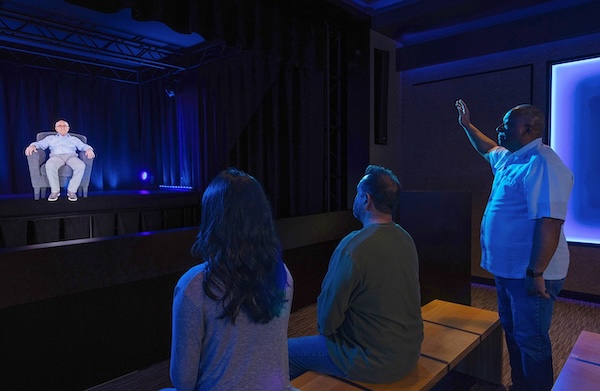
Visitors to the Dallas Holocaust Museum, in Texas, enter a room that transforms into a home in eastern Europe at the start of the Holocaust. Survivors share their testimonies as the home becomes no longer a refuge but a backdrop for the projection of scenes of atrocities. Then the screen rises and a holographic version of a survivor engages with the audience.

Hundreds of hours of interviews with survivors using 360-degree cameras allow for the realistic perspective of meeting these individuals in person. The project, called Dimensions in Testimony and developed in partnership with Steven Spielberg’s USC Shoah Foundation, introduces school groups and other museum visitors to a different survivor and their experiences each week of the year.

“This was one of the most impactful projects that I ever worked on,” Greenberg said. “You feel like you’re sitting in their living room. As you hear the story, the room begins to change. Lights going off, you hear marching of the boots outside, the rooms become slowly, almost unnoticeably dilapidated, just to show that the people were driven out of their homes and these homes are left with nothing but memories and a few photographs.

“After that introduction, the screen goes up and there’s a hologram production of that survivor. That’s the technology that the USC [Shoah] Foundation has developed. You can ask a question – for example, ‘What was your favourite sport when you were little?’ – and that would trigger a story where the survivor will be talking about where he used to play soccer with his friends when they were little.”

The project was close to home for Greenberg, whose grandfather lost his entire family in the Shoah.

“There was a big part of me in that experience,” said Greenberg. “I can tell and I can educate other people, people that are coming to this museum and people around the world that still don’t know what the Holocaust is, don’t know what a genocide is. It’s almost like I was telling my story.” 

Celebrating two new years 

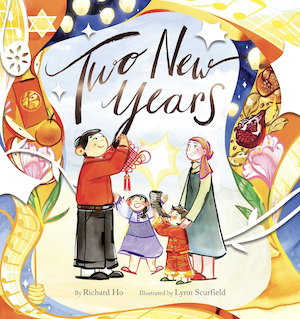
It would be fun to be a fly on the wall at Vancouver Talmud Torah on Feb. 14 as Richard Ho reads from his book Two New Years, illustrated by Lynn Scurfield, and discusses it with the children. Being that the story is based on his own life experience, he will likely be quite animated (pun intended) and his enthusiasm, combined with Scurfield’s bright, colourful and joyful art, will no doubt hold their attention.

image - Two New Years book coverHo has several kids books to his credit and, according to his website, more on the way. Two New Years highlights the differences and similarities between Rosh Hashanah and the Lunar New Year, both of which he celebrates.

The book notes the differences first: Rosh Hashanah takes place in the fall, is based on the Jewish calendar and began in the Middle East, and the Lunar New Year generally falls in spring, is based on the Chinese calendar and began in East Asia. “They represent different peoples with different histories, cultures and traditions,” he writes. “But in many ways they are also alike.” The many similarities include that each holiday is a chance to “try on new beginnings,” to “bring family home” and “remember the ancestors who live in our hearts,” to eat “foods that symbolize togetherness and the heartfelt sharing of good wishes,” among several other things.

In the author’s note, Ho shares that he converted to Judaism as an adult and that “the blending of two cultures was a conscious choice” for him. These days, he revels in experiencing both new years through the eyes of his children. “The best part?” he asks. “They’re not alone! All over the world, families with mixed backgrounds are blurring the barriers between cultures and customs. With the guidance of parents, grandparents and extended family on all sides, many children are weaving an increasingly diverse tapestry of celebration.”

The book features an eight-page illustrated glossary that’s as interesting to read as the story: it explains what a lunisolar calendar is, and some of both holidays’ rituals and symbols. It is followed by questions that readers can use to facilitate a discussion with others about their own traditions.

Ho’s presentation at VTT is part of the Cherie Smith JCC Jewish Book Festival (jccgv.com/jewish-book-festival). 

Jewish comedy history

“Jews have always turned and continue to turn to humour as a cultural touchstone and a way to make meaning,” said Dr. Jennifer Caplan, author of Funny, You Don’t Look Funny: Judaism and Humor from the Silent Generation to Millennials, which was published earlier this year.

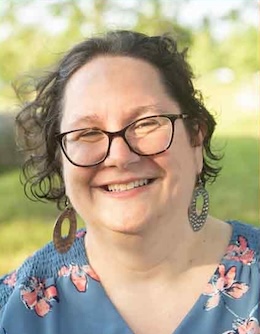
photo - Dr. Jennifer Caplan spoke Dec. 3, as part of the L’dor V’dor lecture series organized by Victoria’s Kolot Mayim Reform Temple
Dr. Jennifer Caplan spoke Dec. 3, as part of the L’dor V’dor lecture series organized by Victoria’s Kolot Mayim Reform Temple. (photo from Kolot Mayim)

Caplan, who is an associate professor and the Jewish Foundation Chair in Judaic Studies at the University of Cincinnati, was the second presenter of the 2023-24 L’dor V’dor (Generation to Generation) Zoom lecture series organized by Victoria’s Kolot Mayim Reform Temple. On Dec. 3, she spoke about the past several decades of Jewish humour. Similar to the approach she took for her book, her presentation explored the changing relationship to Judaism of four generations of Jewish funny people.

According to a 2013 report by the Pew Foundation, called A Portrait of American Jews, 42% of American Jews thought that having a sense of humour was integral to their Jewish identity, said Caplan. In the survey, in terms of what American Jews deemed important to their identity, a sense of humour came out far behind Holocaust remembrance and intellectual curiosity, just under support of Israel, and well ahead of belonging to a Jewish community or eating traditional Jewish food.

“The report set off little bells in my brain which pushed me to say that there’s something here and that there’s something I want to think about,” she said.

There were Jewish commentators who pointed to the Pew survey as an alarm bell for the dangers of the rise of cultural Judaism. To Caplan, the TV show Seinfeld, which premièred in 1989, encapsulated what worried some about the culturally Jewish experience.

“It was this group of people who seemed Jewish, even though Jerry (the title character) is the only character on the show who is actually Jewish,” she said. “They all sort of felt Jewish, but they never did anything Jewish and nobody ever went to synagogue and they didn’t even have a menorah like Rachel and Monica did in their apartment on Friends.”

In Caplan’s view, this fear of cultural Judaism aligned with the way that Jews were being portrayed in popular comedy and media, as Seinfeld led to a boom in Jewish sitcom characters – in shows like Mad About You and Anything but Love, for example. She thought there was something important in the way Jewish comedians were using Judaism in their humour to think about themselves and their Jewish identity, and what it means for them to be Jewish.

Moving forward to the present and, according to Caplan, one finds that the younger generation, the millennials, are even more culturally tied to their American generational cohort and less so to being the grandchild or great-grandchild of Jewish immigrants.

“It’s a story about comedy and it’s a story about the way that Jewish comedians have related to Judaism in their comedy, but it’s also a story about Americanization. It is a story about the way that Jews in the United States became more and more embedded within their broader cultural milieu,” Caplan said, explaining the thought process that led her to write her book.

Caplan pointed out that counterculture, in Jewish comedy, was represented in the 1950s – a time generally associated in the popular sense with Leave It To Beaver and The Adventures of Ozzie and Harriet – by books like those by Philip Roth. His works, well before the broader 1960s counterculture movement, were critical of institutions but defensive of the Jewish community – viewing organized religion as something that was hurting Jews, but seeing the need for Jews to be protected.

What intrigued Caplan was that the pendulum had swung in the other direction for Generation X. “What I found was a fascinating reincorporation of Jewish ritual into the writing and the movies and the comedy of Generation X comedians. Jews themselves are being made fun of, but their engagement with Judaism is actually the thing that humanizes them,” she said.

In the 2001 film Kissing Jessica Stein, for example, the characters can be perceived as stilted, neurotic, self-absorbed Jewish caricatures, yet scenes at a Shabbat dinner and a wedding ground the characters and are not the subject of ridicule.

“It’s not that Generation X suddenly believes in God more than the previous generations did. It’s that they believe more in the power of ritual and tradition because it binds you. You’re not doing it necessarily because you have some sort of theological belief,” Caplan said.

As for millennials, among whom the oldest in the cohort is presently 42 years old, their story is still being written, she said. 

“It seems as though they are willing to ridicule both Jewish identity and Jewish religious interaction at various times, depending on what suits the comedy,” she said. “They neither have a sense of oppression about their Judaism, nor do they have a sense of embarrassment about their Judaism.”

Caplan is currently researching and writing her next book, Unmasked: Jewish Identity in Comic Books.

The next speaker in the L’dor V’dor series is psychotherapist and author, and member of the second generation, Rabbi Dr. Tirzah Firestone on Jan. 14. Firestone will talk on the topic Healing Intergenerational Jewish Trauma. For more information, visit kolotmayimreformtemple.com. 

Sam Margolis has written for the Globe and Mail, the National Post, UPI and MSNBC.

Educating differently

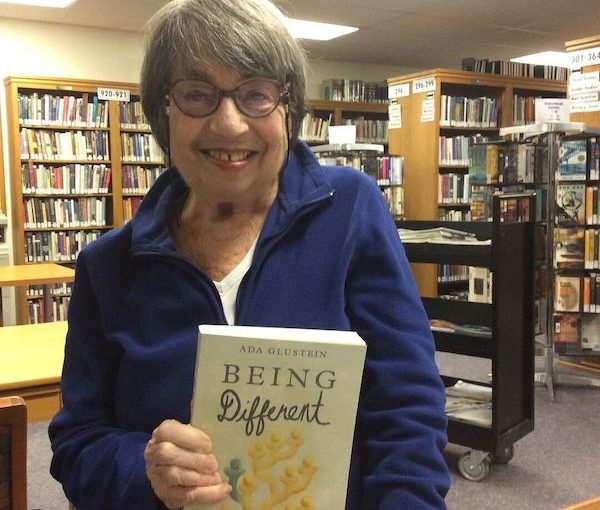
Ada Glustein’s passion for learning and teaching shines through in her self-published memoir Being Different. (photo from Ada Glustein)

Duke’s father would beat him. Tien, a refugee from Cambodia, had witnessed unimaginable violence. Louise was in and out of foster care because her father had drug addictions and her mom was emotionally unstable.

These are just a few of the countless children Ada Glustein encountered in her time as a teacher. Many of her young charges – she taught kindergarten mostly – faced harsh conditions at home and adult-sized problems. She shares her and their experiences with kindness and compassion in her memoir Being Different: From Friday Night Candles to Compassionate Classroom, which she self-published last year. She dedicates the book to her “parents, grandparents and ancestors whose struggles and strengths brought them to Canada, where at last they found their place to call home.” She also writes, “To my children and grandchildren, whose journeys bring the hope for a future of respect, social justice and belonging for all.”

While Glustein was born and raised in Ottawa, her Jewish Orthodox grandparents and parents came from Russia, from an area that became Ukraine. Part 1 of Being Different – Where I Am From: Stories of Home and Community – is about Glustein’s family and her early years. “Though my parents considered themselves to be modern,” she writes, “to me they seemed to live in a world caught between the old and the new.”

From her perspective, her father believed she asked too many questions and her mother fretted too much over her safety. But they came from a different time and place, more traditional and more dangerous. “My family comes from a place where the grass is greener somewhere else. Any place that is not Eastern Europe, not within the Pale of Settlement. Any place to leave behind the pogroms and the poverty, the losses of children who died in childbirth or wasted away from consumption. I do understand the silence,” she writes.

“But I also understand the richness of life’s difficult experiences and their inevitability. To allow those experiences to touch me, even to hurt me, helps me to live a full human life, to live with the reality of how things are.”

Part 1 of Being Different is about Glustein’s efforts to understand her place and who she is within her family. Part 2 – Where Do I Belong? Lessons at School – takes that exploration of identity and differentness into the broader world, where Glustein has to confront Christmas plays, lecherous older men, peer dynamics and a mix of teachers with different approaches, among other life lessons. In Part 3 – Becoming a Teacher: Finding My Way Home – we see how Glustein translates what she has learned into being an educator. And, honestly, if only every teacher could be like Glustein – not because she is perfect, but because she cares, and is continually learning.

Glustein graduated from Ottawa Teachers’ College, completed her bachelor of education at the University of British Columbia and her master of arts at Simon Fraser University. She taught for many years – in Ottawa, Toronto and Vancouver – and also became a faculty associate and sessional instructor at SFU, where she taught teachers. After she retired, she became a member of two writing groups and has had several of her works published. Being Different won a silver medal for Canada-West Region, non-fiction, in this year’s Independent Publisher Book (“IPPY”) Awards, and deservedly so.

Being Different is charming and heartbreakingly honest, written in short, crisp chapters, giving it a sense of immediacy. It is a call for all of us to be more patient with one another, to keep an open mind and to understand the impact our actions have on other people, especially children. In her openness about her own imperfections and missteps, Glustein is also asking us to be kind to ourselves. A more accepting and inclusive world begins with us, after all.

Being Different will be engaging to any reader – it will foster many a childhood memory – but should be a must-read for anyone interested in becoming an educator. It is available on Amazon.

The first step is the to-do list

Yesterday, I shared my to-do list with a friend via email. She responded with “Ahh! I’m tired just reading this!” What I didn’t mention is that I had to do all this plus other chores, thrown in, which I had either forgotten to write down or were such household habits that I didn’t list them. For many caregivers who work and manage households, this sounds familiar. It’s the list that is the first step. Write it down. Name the obligation. Then release yourself from trying to remember it all. Finally, cross it off the list later.

This isn’t a new phenomenon. Studies have shown how much of this organizational and emotional labour falls to women. For example, a recent National Public Radio piece from the United States covered research by economists, which showed that women (mothers) were almost always contacted by schools first, no matter which parent was designated as the “first contact” on the emergency form. The social media chatter that followed remarked on how female medical residents or surgeons, working hours away from their children’s schools, were still called first even though the primary caretaker was the father. In the study itself, one economist described the mental load of planning ahead for “if the school called” and how women’s workload could be managed in such situations. She noted that, even though her husband was the vice-president of the Parent Teacher Association, the school always called her first.

In economic terms, women then self-select for lower paying, more flexible work simply to manage these challenges, resulting in lower income and fewer opportunities for career growth. Societal obligations placed mostly on women create a lifelong effect on earning power and household income.

This morning, as I bake bread, make chicken broth in two slow cookers, write this article and air out the house with fans because of an unexpected drop in temperatures due to a rainstorm, I time everything to fit into the hours between when I drop kids off at 9 a.m. and pick them up at noon for their half day of camp. This is, of course, not a specifically Jewish problem, but aspects of it are in our house.

We have twin 12-year-olds, with both kids doing b’nai mitzvah lessons at the same time. These kids come with different challenges. Like all learners, they may need different supports to master chanting trope. Amid the meltdown tears last night, it became clear that what was necessary was for each kid to have 15 minutes to practise separately every day with me. As the crying continued – and I include myself in the crying – my partner tried to help.

This is when you might wonder why all this falls to me, and you’d be right to ask. My partner told us that the year before his bar mitzvah involved a lot of crying. He was so overwhelmed that he quit playing drums at school, because he couldn’t manage both things. His mother had been given no Jewish education. She couldn’t read Hebrew and didn’t know the prayers. His father worked late every day, coming home at 11 p.m. My twins’ dad was truly on his own, with a cassette tape. He never learned the trope and struggled with short-term memory issues. Mastering his bar mitzvah portion took him a long time. As an adult, he never gained some of these prayer skills. A demanding job means now is not the time for him to catch up. The obligation’s all mine.

We’ve now been married for 25 years and I just learned last night about this tough path my husband took towards bar mitzvah. By comparison, I had supportive parents with some Jewish literacy, plus we attended services regularly. I was self-directed as a learner. Mastering everything for my bat mitzvah was interesting and challenging but not a struggle. I continued learning through university and graduate school and beyond, as I continue to study Talmud when I can. We chose a bilingual Hebrew/English elementary school for our kids partially because it would make bar mitzvah study easier for them.

Few people see what my lists of work and household obligations look like. I tell even fewer people about fitting in 20 minutes of Daf Yomi, a page of Talmud every day. When I mention the Talmud study, I’ve been asked why I bother. The minutiae of discussions of Jewish law that rabbis conducted so long ago is of no interest to most. Sometimes, if the person wants to know why, I explain that I learn things about Jewish tradition, history and daily life from these debates.

I also admit to myself that I find some reassurance in these pages. Although the specifics might have been different, life’s minutiae is pretty much the same. The rabbis struggled over multiple daily tasks, relationships and household concerns in many of the ways I do. They sweated the details, even if they didn’t do them all personally.

If everything works out, in June 2024, my kids will step up to the bimah (pulpit) and become bar mitzvah boys, which is a huge lifecycle event. Between now and then, practising with them will be another part of my to-do list. Good study habits mean you do a little every day until, suddenly, you learn something new. Just like my lists, nothing is insurmountable if you name it, take it step by step, and cross it off the list when the task is complete.

Like many women, I get bogged down by the minutiae. I wish I could share more of the household labour and emotional load. Even men who try to assume more of these tasks have to struggle against the societal expectations our culture wields. Step by step, we make change in our lives, our lists and our expectations for one another. It’s not a sprint. You can’t cram the night before to pass this exam. Life is a series of chores, moments, obligations and, well, joys.

Early this morning, I leashed up the dog while I sang the first Haftorah blessing aloud. I try to put the melody into the twins’ heads while donning my shoes and raincoat as I head out. Each step makes a difference to hopefully hit one very big milestone ahead.

Joanne Seiff has written regularly for CBC Manitoba and various Jewish publications. She is the author of three books, including From the Outside In: Jewish Post Columns 2015-2016, a collection of essays available for digital download or as a paperback from Amazon. Check her out on Instagram @yrnspinner or at joanneseiff.blogspot.com.

Designing the 12 tribes

Artist Anna Marszalkowska stands in front of “Levi,” which is part of her Tribes series, which is on exhibit at the Zack Gallery until May 4. (photo from Anna Marszalkowska)

The challenge of visually depicting the tribes of Israel has attracted many famous artists over the centuries. For example, on the 25th anniversary of the state of Israel, Salvador Dali, inspired by descriptions in the Torah, created a series of watercolours, “The Twelve Tribes of Israel.” Before that, in 1962, Marc Chagall made his famous stained-glass windows, “The Twelve Tribes,” for a synagogue in Jerusalem. Anna Marszalkowska, a local Vancouver artist of Polish origins, fits easily into this august company. Her solo show, The Tribes, opened at the Zack Gallery on March 29.

Marszalkowska grew up in Poland, but studied graphic design and worked as a graphic designer in London, England. “Diversity is what made my design path exciting,” she said in an interview with the Independent. “I started my career as a freelance web and graphic designer and then moved to video design and editing, as well as motion graphics and animation.”

Five years ago, she and her husband moved to Canada, but they lived and worked in the eastern part of the country. They relocated to Vancouver two years ago.

“We came here during the pandemic,” she said. “We wanted to try something different. For an outdoor person like myself, this is a great place. The nature is beautiful, and everyone is very friendly.”

She also changed the direction of her professional life. “I work with artists in the movie industry, but not as an artist myself,” she said. “I understand artists because of my past as a graphic designer, but I wanted less time at the computer screen. I wanted to free my creativity for more personal projects, which was hard to do while working as a graphic designer. Then, my creativity was fully engaged in my professional activity, but, on the other hand, I was limited by clients’ requirements. After a full day of work … I was often tired, I wanted to relax. Now, my creativity is freed. I have more time for my artistic experiments. I started abstract painting and I love it. Just me and a painting – it calms me.”

But even while working full time as a graphic designer, she still found energy to search for her individual style and themes. One of them was her Tribes series. “In 2010, I completed a print production course, and this series was the result.”

The series consists of 12 large digital prints, each one corresponding to one of the tribes of Israel. Although Marszalkowska’s version is an entirely modern take, it involves ancient symbolism, which originated in the Hebrew Bible. The artist conducted deep research for this project, and the end results are simultaneously stunningly simple and visually compelling.

“I had a blog before and, when I put the images online, many people expressed their interest. They wanted to buy one or several or all of the images.”

For the artist, this body of work has meaning beyond its commercial success. “It was a personal journey. I was searching for my Jewish ancestry. My grandmother grew up in a town in Poland where most citizens were Jewish before the war. She might have been part Jewish herself, but after the Holocaust, I had no one to ask.”

Instead, she studied the Bible and tried to interpret the narratives within a cultural context. “The symbols of the tribes are by no means fixed,” she explained. “Every artist could have their own interpretation, as the biblical texts describe the sons of Jacob allegorically.”

In her interpretation, the traditional symbols are given a contemporary, stylized appearance. “I explored the relationship between geometric shapes and lines,” she said. “I used repetition and symmetry to keep balance in each individual design and all 12 together.”

She also leaned towards a minimalistic approach, where a symbol of the tribe is centred on a one-colour background, with no other embellishments to attract a viewer’s attention. “In the original design, I had an ornamental frame around each image, but I got rid of them. I think less is more,” she said. “COVID made me realize that my focus should be the meaning, not the decorations.”

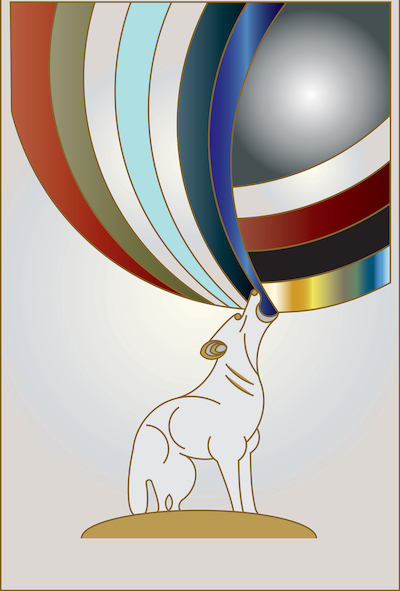
“Benjamin” by Anna Marszalkowska.

In most images, the background colour palette reflects that of the tribe, except for Benjamin, the youngest. “His symbol is a wolf,” Marszalkowska said. “He represents all colours of all tribes. To reflect that, I placed a ‘rainbow’ above the wolf. I think it is his spirit or maybe his song, Or his breath. It would depend on your own interpretation.”

In some of the designs, she incorporated photography for texture. “I used Adobe Illustrator to combine my photographs with my digital illustrations,” she said. For Simeon, her symbol is a tower, and she put her photos of bricks to good use in her pictorial tower construction. For Zebulun, whose symbol is a ship, she employed photos of water. “Issachar’s symbol is a donkey with a burden,” she said. “I used my photos of wood for the donkey’s load.”

When different sources offered different visual symbolisms for a tribe, the artist’s scholarly touch led her towards her own esthetic. For example, in the case of Levi, some documents don’t count him as a tribe and don’t offer any symbols for him. Historically, the Tribe of Levi wasn’t given any land, but its men served as religious leaders and teachers. Maszalkowska decided that Levi’s description as God’s Chosen Tribe warranted its own image: a breastplate of a high priest. The breastplate is embedded with 12 gemstones, each inscribed with the name of one of the tribes in Hebrew.

“Overall, the series is an invitation for everyone to embark on their own journey, to reflect on their own purpose and fulfilment,” said Maszalkowska. “Ultimately, I hope that my art will connect with the viewers and inspire them.”

Tribes runs until May 4.

Olga Livshin is a Vancouver freelance writer. She can be reached at olgagodim@gmail.com.

Supporting arts, community

Residents of Prince George might be forgiven for thinking there is more than one person named Eli Klasner in their midst. Among his many concurrent pursuits, the Toronto native is directing the Community Arts Council of Prince George, leading a fundraising initiative for Ukrainian refugees and serving on the board of the Jewish Museum and Archives of British Columbia.

Living in Prince George is the fulfilment of a lifelong dream for Klasner. Since childhood, he had entertained the notion of living on the Canadian frontier or the Far North. When he was younger, he also made a commitment to himself that, by the time he celebrated his 40th birthday, he would do whatever it was that excited him.

photo - For philanthropist Eli Klasner, living in Prince George is a dream come true
For philanthropist Eli Klasner, living in Prince George is a dream come true. (photo from Eli Klasner)

As events unfolded, he was able to do just that after running businesses in Toronto and Vancouver. In 2017, while Klasner was working for a nonprofit, the possibility of moving to Prince George presented itself.

“I was just charmed by the roughness and climate adversity and, significantly, by the opportunities I saw both as a participant in arts and culture but also to identify that there are Jewish people here and in this area,” Klasner told the Independent.

The friendliness and accessibility of locals reaffirmed his desire to stay. “Soon after I was here, I visited City Hall and asked who is the mayor? ‘Well, that’s his office there. If you want to say hello, just go on in and introduce yourself.’ I like that. Coming from Toronto, you don’t just walk in and put your feet up on the mayor’s table. I thought that was very appealing,” Klasner recalled.

His executive director position with the arts council quickly transformed into a full-time schedule as he came to realize that the city could use support with its arts facilities. Klasner’s role in Prince George’s artistic rejuvenation includes working on a new creative hub, a new performing arts centre and, in March, the gala opening of a retired heritage church that was turned into a concert hall.

“Taking the executive director job here helped solidify that I need to settle down and find a place to live permanently. At that point in my life, I thought a lovely arts council with a lovely little gallery and gift shop would be a lot of fun,” said Klasner, who during his youth studied music in various European capitals.

For two years of his stay in Prince George, Klasner lived in a cabin in the woods, along with two hound dogs and two cats. “I moved a little off the grid,” he said. “That, for me, was the boyhood dream of living in the woods, chopping wood, growing a garden in the summer and being close to wildlife and nature. It was an amazing experience.”

Then came 2020. Klasner contracted the coronavirus at the outset of the pandemic. “COVID is an interesting part of the journey of being up here in this odd, unusual place,” he said. “It was certainly a challenge, but, also, when you live through something like that, you really come to appreciate life when you have good health, and the bounty that comes with good health.”

From a Jewish cultural perspective, one of Klasner’s recent projects has been the performance of Different Trains, a piece written for string quartet, with pre-recorded tape, by American Jewish composer Steve Reich that revolves around the Second World War and the Shoah. After being approached last year by the Prince George Symphony Orchestra, Klasner was able to arrange to have the work performed to mark Holocaust Remembrance Day this past January.

“I found it to be a remarkable process of respect and inclusion and terrifically ambitious for a small-town symphony to want to take on such a challenging and groundbreaking piece of music,” Klasner said.

Afterwards, several members of the local Jewish community were invited on stage to say a few words. The crowd, according to Klasner, was very moved by the event. “People got to sit, ask questions and talk about Holocaust and persecution. I found it a unique thing to happen in a place like Prince George. Where else is something like this done in Canada that does not have a significant Jewish population?”

Prince George, like other parts of northern British Columbia, Klasner noted, used to have a thriving Jewish community, starting with the immigrants who arrived in the 1880s. Many of the first local businesses were started by Jews, and the first Jewish female elected to public office in Canada was in Prince George, when Hanna Director became chair of the city’s school district.

From the Second World War to the 1970s, the community dwindled. The Sefer Torah that was in Prince George was sent down to Vancouver and is in storage.

However, there has been a resurgence in Jewish life, Klasner said. “What we started to do is hold community events around holidays and festivals, wanting to expose the young generation to the culture and history of Jewish celebrations and milestones, holidays and festivals. We are quite open to people who might want to come but who are not Jewish to see a Hannukah celebration and what kind of foods we eat around Rosh Hashanah, etc. There has been a lot interest in the community.”

The Jewish Museum and Archives, Klasner said, helped him understand some of the history and heritage of the Jewish community in the area. This, in turn, helped Klasner get other members of the community involved to share stories about what life in Prince George was like at one time or another. For example, there were photos of a seder in Prince George just after the war, when so many Jews wanted to be involved that a community hall had to be used.

“When there was an opening on the board of the Jewish Museum and Archives, I thought it was an opportunity to help them have province-wide representation, rather than just the Lower Mainland, the Island and the Okanagan,” he said.

Jewish values were integral in Klasner’s recent efforts to assist Ukrainian refugees in his community. When a new endowment fund was created to help the newcomers, he reached out to the organizers to help propel their fundraising.

“I was overwhelmed at the possibilities of life when people open up their hearts to strangers in their land and by the idea of opening up one’s heart and mind and wallet to people in the community – and what a Jewish attribute as well. Our families were once accepted here as refugees,” he said. “Our life on earth depends on the fact that Canada accepted refugees.”

From June 9 to 11, Prince George will host another of Klasner’s ventures, the B.C. Gourmet Arts Festival. Now in its second year, the event features scores of local artisans and presents culinary delights of the region and country.

“I love life and the opportunity to be busy and creative and help people and get involved,” Klasner said. “Life is awesome.”

Sam Margolis has written for the Globe and Mail, the National Post, UPI and MSNBC.

Who decides what culture is?

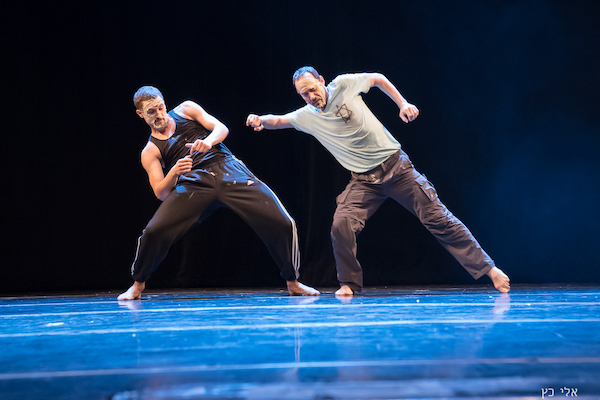
Mourad Bouayad, left, and Hillel Kogan in We Love Arabs, which is at the Dance Centre April 13-15. (photo by Eli Katz)

“I don’t have answers so I can only ask questions,” Israeli choreographer Hillel Kogan told the Jewish Independent. “If this is changing people’s political views, I doubt it, but at least what I’m trying to do is to put the questions on the table and make people, audiences, and myself see that art is not a separate sphere, that art is part of politics and social and cultural systems … and this is what I’m trying to expose in my pieces.”

The JI interviewed Kogan in advance of the Vancouver run of We Love Arabs, which is being presented at the Scotiabank Dance Centre by the Dance Centre and Théâtre la Seizième April 13-15. There will be both English- and French-language performances of this work, which also has Hebrew and Spanish versions. Kogan will dance the duet here with Mourad Bouayad.

We Love Arabs premièred at the 2013 Intimadance Festival in Tel Aviv. The brief outline for the piece, which Kogan has on his website, begins: “I address the audience, my name is Hillel Kogan. Some say that I do political art. I want to show you today how dance has the power to promote coexistence between Arabs and Jews in Israel. I invited an Arab dancer here….” The video teaser offers a glimpse of Kogan’s physicality, humour, tenderness, intelligence.

Born in Tel Aviv, Kogan has performed with and created for companies and choreographers around the world. At Batsheva Dance Company, he is director of educational programs. He is pursuing a master’s degree in cultural studies.

We Love Arabs garnered awards, and it has traveled to more than a dozen countries. The Vancouver show was postponed twice, said Mirna Zagar, executive director of the Dance Centre. First due to a scheduling conflict and then due to COVID. “However, I believe the work is just as relevant now as it was when we started,” she said. “It is an exceptional work that continues to engage audiences internationally.”

The Dance Centre often partners with other arts organizations, as a means of pooling resources and amplifying opportunities to show international artists. “This collaboration is along these lines,” she said. “I have known Esther Duquette, the now-outgoing artistic director at Théâtre la Seizième, for some years and the nature of this piece – multilingual and straddling theatre as well as dance – made it a perfect opportunity for our organizations to work together.”

The April 14 performance and talkback will be in French; the other two shows and the April 15 talkback in English. Kogan speaks six languages: Hebrew and Russian because his parents were born in the Soviet Union and he was born in Israel; he studied English in school; he learned French from working two years in Switzerland, and Portuguese and Spanish from working in Portugal for seven years. He doesn’t speak Arabic.

“This is interesting,” he said, “because this piece, We Love Arabs, is an autocritical peace that asks exactly this. Why am I facing the languages and cultures of the West and not the languages of my neighbours and of my co-citizens in Israel? Why don’t I read the books of Arabic writers? Why doesn’t Arab culture interest me, and why do I identify myself as ‘Western,’ which is a bit strange?”

It is both a geographic question, he said, living as he does in Israel, and a social, historical, cultural and political question. “And the piece deals with this question: who decides what the general culture is, and why I am – and why the Israeli art field, at least as I see it, is – so orientalist, which means looking at the Orient, at the Arab as inferior and wanting to impose on it the Western culture.”

The different versions of We Love Arabs resulted from Kogan’s wanting to perform the piece abroad, in the language the audience speaks. “I think it brings more this idea of relevance to the space,” he explained. “If I did the piece in Hebrew with subtitles, it would be more like a piece from Israel … and be framed as something local and in my perspective. The universality of the piece is one of the ideas – I want people to identify with it and, by choosing their own language, I feel there is more chance to make them sense that they are part of it as well.”

Kogan had no idea of how much impact We Love Arabs would have. “It was created for a small niche festival in Israel,” he said, and “for a specific audience who is already convinced in the political opinions that I hold. So, I didn’t imagine it ‘big.’… As I performed the piece out of Israel, I understood that the question of Jews and Arabs in Israel is just a microcosm of a more universal question: of the situation of power between minority and majority, and the way we see ‘the other’ – who is the master of the culture in any nation?”

In looking at the question, Kogan asks: “Who is invited to participate in creating a national identity, what is Israeli or what is Arab Israeli? It is not very different than the question of, I don’t know, for example, in Canada: who is invited, what is Canadian? Is it French? Is it American? Is it English? I don’t know the minority situation in Canada, but I know there is a history with Native Canadians. So, are they also invited to take part in culture? How much are they participating in mainstream dance, literature, music? How do we define what is high art and what is popular art? What is folk and folklore? And what is universal art?”

Initially dancing the duet with Kogan was Adi Boutrous, an Israeli Arab dancer who is also a choreographer and so not always available. Bouayad, who is French, danced in Israel in the Batsheva junior company. “This is how we met, so I invited him to perform with me,” said Kogan. “And, of course, it’s very different for an Israeli Arab to play the role of an Israeli Arab than for a French half-Arab person, because to be an Arab in France is different than to be an Arab in Israel.”

Not wanting to speak for Bouayad, Kogan noted that, while Bouayad may define “himself first as French, and his relationship with his Arab origins are just an extra part of his being,” for Israeli Arabs, he said, “I’m not sure that they are first Israeli and then Arab because of their own perception of themselves – but also the way the majority looks at them, the state looks at them, society looks at them, Jewish society looks at them.

“We often make the mistake even in the language, and we forget to say that Arabs are Israeli as well. We say Israelis and Arabs – even when we refer to Arabs who are citizens of Israel and who hold an Israeli passport, we call them Arabs, and we call ourselves, the Jews, Israelis…. We are both Israeli and the difference between us in definition is our religion. In a country like France, where it’s a republic and religion has at least formally not such an important role in the definition of citizenship and of nationality, then, of course, the change of cast is also changing the relationship.”

Kogan has no illusions that art can change the world. Elected politicians “are the ones who should change the world,” he said. For him, art is there to reflect, to inspire. “Art, for me, is a place for the imagination, for the possibility of not necessarily escaping reality, but giving an alternative to reality…. If art can feed the imagination and then, as an outcome of this feeding of imagination, can change the reality, OK, that’s great. But I think that … when artists try to change the world by their art – in history, at least as far as I see, it ends in political propaganda and just serves the hands of politicians.”

As many funny moments as there are in We Love Arabs, they have a profound purpose.

“I have anger towards some of the cultural systems, and the questions that I’m asking are involved with hard emotions. I feel that humour allows me to take some distance from the aggression and from being so emotionally involved,” said Kogan. “It allows me to laugh about myself as well. It allows me to invite people to laugh about a question without making it not serious. The laughing, I feel, is a tool to invite people to enter a conversation, to agree to criticize, to agree to ask questions … to see the bias, to be aware of the stereotypes, to be aware of the prejudgments that we have…. The laughter is just a means in order to speak about something very serious.”

For tickets to We Love Arabs, call 604-736-2616 or visit thedancecentre.ca.

Time of change at the Peretz

“I like to dabble in things, I like to learn about things, and I think that’s where Peretz really shines,” says Maggie Karpilovski, executive director of the Peretz Centre for Secular Jewish Culture. (photo from Peretz Centre)

At 78, the Peretz Centre for Secular Jewish Culture may be an old dog among community organizations. But it is enthusiastically trying new tricks. The institution has undertaken a strategic planning process to reconsider everything they do, and to make sure they are responding to what their community wants and needs. Not least among the changes is a new face at the helm.

Maggie Karpilovski has been executive director of the Peretz Centre since last June and brings a breadth of experience in the not-for-profit sector and academia.

At a time of significant change for the organization, Karpilovski is applying skills garnered as a senior manager at United Way of the Lower Mainland and as national director of community impact and investment for United Way Centraide Canada. Previously, after completing a master’s degree, she worked at the Surrey school board developing and overseeing programs for vulnerable children.

Born in Kyiv, Ukraine, Karpilovski moved with her family at a young age to Holon, Israel, where she received her elementary and secondary education. After her army service, she came to Vancouver to study cognitive science at Simon Fraser University.

Throughout her career, Karpilovski has merged research and practice.

“I really believe that practice has to be informed by research and research can’t be good research unless it’s grounded in practice,” she said.

The senior roles locally and nationally with United Way were fulfilling but Karpilovski got restless.

“Sitting in that kind of role – very, very high level, which was really interesting and very fulfilling, but we were talking about how to raise capacity for smaller organizations on the ground – I was saying, instead of teaching people how to do it, I wanted to get my hands dirty and do it myself,” she said. “I wanted to be closer to the impact.”

The planning process into which Karpilovski arrived resulted in the creation of several unique pillars within the centre. Notable among these is the creation of a distinct Yiddish Institute at the Peretz Centre, which is headed by Donna Becker, Karpilovski’s predecessor as executive director. Other pillars include art and culture, Jewish secular humanism, and Beit H’Am, which focuses on Israeli culture in Hebrew.

The Peretz is home to Western Canada’s most significant library of books in and about Yiddish. It hosts classes in Jewish culture, language learning, holiday celebrations and commemorations, a folk choir, and other offerings.

Karpilovski said the centre is committed to innovation while maintaining the roots of the organization, which originated in 1945 as the Peretz Schule. It is part of a network of schools, cultural centres, libraries and organizations honouring the legacy of Isaac Leib (I.L.) Peretz, one of the leading writers and thinkers of the Haskalah, the Jewish enlightenment.

Vancouver’s Peretz Centre was founded by a diverse group of Labour Zionists, socialists, communists and others who shared a goal of establishing a school to provide children with a nonpolitical, secular Jewish and progressive education. The shule’s first principal was Ben Chud who, in 1945, had just returned from the war and was active in the United Jewish People’s Order. He and his wife, Galya, were stalwarts of the centre, as is their daughter Gyda Chud, who currently sits on the board.

“We really try to balance the history as well as modernity and recognizing that, [for] people in 2023 in Vancouver, their connection to Judaism can be complex and interesting and multifaceted and we really try to meet people where they are at, to satisfy their curiosity and make sure we’re both providing a space of comfort and familiarity, as well as a space of stretch and of deeper interest and insight,” said Karpilovski.

Given that a majority of Jews in Metro Vancouver now live outside the city proper, the Peretz Centre, which is located on Ash Street near Cambie and 45th, is developing outreach programs and partnerships to reach those audiences. They have also removed their membership model, which may have acted as a barrier to access for some. The doors are open to all, she said.

They are partnering with like-minded organizations, including Camp Miriam and JQT Vancouver, the Jewish LGBTQ+ organization, offering space and learning to be supportive allies.

“What we really don’t want is to replicate efforts,” said Karpilovski. “We really want to find our niche and make sure that we are creating offerings that are unique and that complement and add to that broad constellation of things that are happening. We really see our space in Yiddishkeit as one that is not really offered anywhere else.”

One of the centre’s most unique offerings is its P’nei Mitzvah program, a two-year track for bar/bat mitzvah-aged young people to delve into Jewish history and culture, ancient and modern, but from a non-religious perspective. In addition to the overarching lessons, participants focus down into an area of particular interest for a major research project, which they then present at the graduation celebration.

This Passover, in addition to the traditional secular seder, a popular event that generally attracts more than 100 people, they are holding a family-friendly “un-seder” or “seder balagan.”

“We really turn the seder on its head and focus on activities, engagement, things like that,” she said. “Not something that is necessarily going to be offered at your traditional synagogue.”

An unexpected boon for the Peretz came from the redevelopment of the Oakridge shopping complex, which has turned a huge swath of the neighbourhood into traffic, construction and parking mayhem. The Oakridge branch of the Vancouver Public Library has taken up temporary quarters on the first floor of the Peretz Centre, which has provided the welcome influx of funds that enabled the centre’s strategic planning process. It also brought fresh walk-in traffic from locals, many of whom had no idea there was a Jewish space on the street and who are getting their first introduction to the centre.

“It takes a lot for an 80-year-old organization to turn itself into a learning organization and a curious organization and a brave organization,” Karpilovski said. “We might misstep, [but] we’re going to be brave and try something different. We’re going to listen to our community and not assume that we know everything. It’s a little scary, but it’s a lot exciting because there’s a lot of interesting spaces and interesting innovations that are happening.”

The time of change and exploration at the organization suits Karpilovski fine, she added.

“My own journey with Judaism has been complex and interesting and is incomplete,” she said. “I like to dabble in things, I like to learn about things, and I think that’s where Peretz really shines. There is no judgment. People are really welcome to come, experience, try things for size.”

For more on the Peretz Centre, visit peretz-centre.org.