
Skip to content
  • Home
  • Subscribe / donate
  • Events calendar
  • News
    • Local
    • National
    • Israel
    • World
    • עניין בחדשות
      A roundup of news in Canada and further afield, in Hebrew.
  • Opinion
    • From the JI
    • Op-Ed
  • Arts & Culture
    • Performing Arts
    • Music
    • Books
    • Visual Arts
    • TV & Film
  • Life
    • Celebrating the Holidays
    • Travel
    • The Daily Snooze
      Cartoons by Jacob Samuel
    • Mystery Photo
      Help the JI and JMABC fill in the gaps in our archives.
  • Community Links
    • Organizations, Etc.
    • Other News Sources & Blogs
    • Business Directory
  • FAQ
  • JI Chai Celebration
  • JI@88! video

Recent Posts

  • עשרים ואחת שנים בוונקובר
  • Supporting the Iranian people
  • The power of photography
  • A good place to start
  • When boundaries have shifted
  • Guitar virtuosos play
  • Different concepts of home
  • Broadway’s Jewish storylines
  • Sesame’s breadth and depth
  • Dylan Akira Adler part of JFL festival
  • Mortality learning series
  • A new strategy to brighten up BC
  • Sharing latkes and light
  • Johnson awarded for human rights work
  • Cherished tradition ensured … Silber Family Agam Menorah
  • Nothing as lovely as a tree
  • Camp welcomes new director
  • Popular family camp expands
  • A life-changing experience
  • Benefits of being a counselor
  • Camper to counselor
  • האלימות בישראל מורגשת בהרבה מגזרים
  • טראמפ עוזר דווקא לנושא הפלסטיני
  • New rabbi settles into post
  • A light for the nations
  • Killed for being Jewish 
  • The complexities of identity
  • Jews in time of trauma
  • What should governments do?
  • Annie will warm your heart
  • Best of the film fest online
  • Guitar Night at Massey
  • Partners in the telling of stories
  • Four Peretz pillars honoured
  • History as a foundation
  • Music can comfort us

Archives

Follow @JewishIndie
image - The CJN - Visit Us Banner - 300x600 - 101625

Tag: Arab Israelis

Learning, living coexistence

Learning, living coexistence

Hand in Hand (Yad b’Yad) is a group of Israeli schools where Jewish and Arab students learn together. Its co-founder, Lee Gordon, was in Vancouver last month (photo from Hand in Hand)

Lee Gordon, co-founder of Hand in Hand (Yad b’Yad), a group of Israeli schools where Jewish and Arab students learn together, spoke at Vancouver’s Or Shalom Synagogue and met with members of the community at large last month.

“We are always eager to have more friends and supporters for what Hand in Hand is doing, especially in the current very dark situation in Israel and in Gaza,” Gordon said in an interview with the Independent. “Hand in Hand is a beacon of light in a place where coexistence is not widespread enough.”

Gordon, who first moved to Israel in the 1980s, launched Hand in Hand with Amin Khalaf in 1997. The first classes started in September 1998 with 50 students on two campuses, in Jerusalem and in the Galilee. Today, there are more than 2,000 students, who study in Hebrew and in Arabic, on six campuses throughout Israel.

The bilingual schools were established to combat the threat posed to Israel by growing social alienation and lack of trust between Jewish and Arab citizens. Education, in the view of Hand in Hand’s founders, was – and still is – instrumental in changing this.

Gordon, who lived in Israel for 20 years before returning to the United States, became involved in Jewish-Arab dialogue while pursuing a master’s degree in social work from Hebrew University. Though the university was integrated, he observed, there was not a great deal of interaction between Jewish and Arab students, aside from weekly dialogues in which Gordon and others from the two groups would engage on campus.

While those meetings were clearly a step in the right direction, he felt they were lacking. “Dialogue is superficial. People can have lovely feelings afterwards but don’t see each other again,” said Gordon, who is currently the director of American Friends of Hand in Hand. 

Later, when working on a fellowship project through the Mandel Institute, Gordon spent time looking at schools in Israel and analyzing what makes them succeed or fail. In the backdrop was the reality that the school system in Israel is completely segregated, even in mixed communities, such as Jerusalem and Tel Aviv.

“I started building a rationale for a school being a wonderful venue for bringing Arabs and Jews together, because it is not just for one hour a week. Once students are in school, they are there all day, all week, all year, and have a chance to truly get to know the other,” Gordon said.

Realizing that he needed an Arab partner for his goal of creating an integrated school to reach fruition, Gordon was introduced to Khalaf, an educator whose hope was for his children to grow up feeling as equals in Israeli society.

Hand in Hand was officially registered in spring 1997 and, for a year, Gordon and Khalaf scouted the country, trying to locate an ideal spot to start the school.

“We knew we wanted one in Jerusalem but also wanted a backup,” said Gordon. “We settled on an area in the Galilee where the Jewish and Arab towns are close together.” 

When the first schools opened in fall 1998, the primary challenges consisted of hiring teachers, raising funds and recruiting Jewish students.

“We knew Arabs, as the minority, would flock to our schools, it would be seen as a step up for them,” said Gordon. “Jewish parents would be more of a struggle. We wanted our schools to be accredited and not be viewed as boutique, esoteric schools lacking legitimacy.”
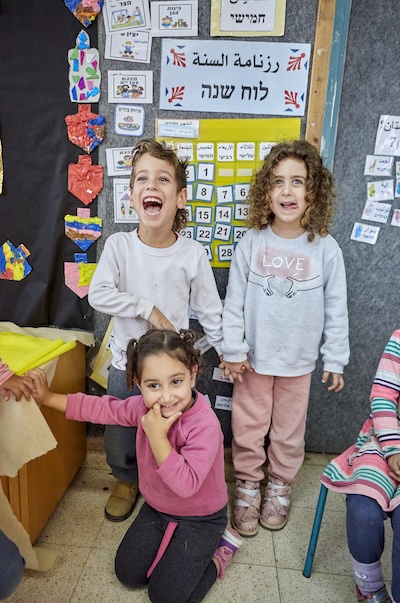
photo - Hand in Hand kids
(photo from Hand in Hand)

Though never without obstacles, as the schools grew each year, it became easier to recruit new parents because Hand in Hand presented an attractive educational possibility – students were learning two languages in a vigorous academic environment, they were happy and the class sizes were smaller.

Even today, Gordon admitted, Hand in Hand still has to work harder to recruit Jewish parents, particularly after the Hamas attacks on Oct. 7.

“This is the worst war of the four since Hand in Hand has been in existence,” he said. “Jewish families often know someone who was killed or taken hostage, and many of the Arab families have relatives in Gaza.”

While there were concerns that Jewish families might withdraw their children from classes following the attacks, that has not happened yet.

“Bringing people together is really the only way there is any hope of this conflict ending because it is not happening on political levels,” Gordon said.

Multiple researchers have shown that there are many benefits from bilingual education, such as more empathy, better academic performance and improved engagement. Beyond those benefits, Jewish and Arab students at the Hand in Hand schools develop close friendships, which start through childhood sleepovers, birthday parties and play dates. Moreover, adults have formed long-lasting bonds with one another.

“Many parents have spoken of how they have been transformed by the experience,” Gordon said.

Hand in Hand schools are public, recognized and overseen by the Israeli Ministry of Education, and open to all parts of the Arab and Jewish populations in Israel. Government funding is supplemented by philanthropy and parents’ fees.

Besides Jerusalem and the Galilee, Hand in Hand operates schools in Haifa, Jaffa, Kfar Saba and Wadi Ara.

For more information about Hand in Hand, visit handinhandk12.org. Canadian residents can make a tax-deductible donation to Hand in Hand through the Jerusalem Foundation of Canada, 1-877-484-1289. 

Sam Margolis has written for the Globe and Mail, the National Post, UPI and MSNBC.
Format ImagePosted on January 12, 2024January 11, 2024Author Sam MargolisCategories IsraelTags Arab Israelis, coexistence, education, Hand in Hand, Israel, Jewish Israelis, Lee Gordon, Or Shalom, Yad b'Yad
Who decides what culture is?

Who decides what culture is?

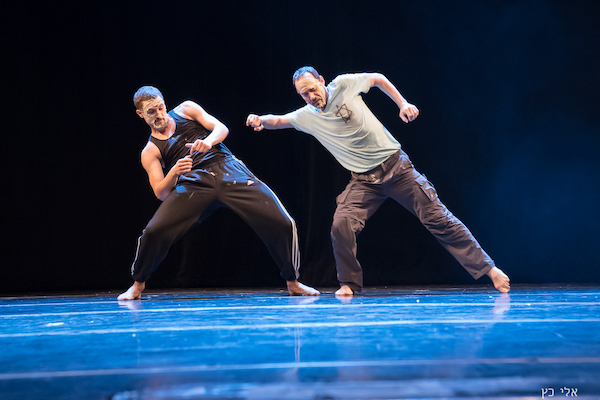
Mourad Bouayad, left, and Hillel Kogan in We Love Arabs, which is at the Dance Centre April 13-15. (photo by Eli Katz)

“I don’t have answers so I can only ask questions,” Israeli choreographer Hillel Kogan told the Jewish Independent. “If this is changing people’s political views, I doubt it, but at least what I’m trying to do is to put the questions on the table and make people, audiences, and myself see that art is not a separate sphere, that art is part of politics and social and cultural systems … and this is what I’m trying to expose in my pieces.”

The JI interviewed Kogan in advance of the Vancouver run of We Love Arabs, which is being presented at the Scotiabank Dance Centre by the Dance Centre and Théâtre la Seizième April 13-15. There will be both English- and French-language performances of this work, which also has Hebrew and Spanish versions. Kogan will dance the duet here with Mourad Bouayad.

We Love Arabs premièred at the 2013 Intimadance Festival in Tel Aviv. The brief outline for the piece, which Kogan has on his website, begins: “I address the audience, my name is Hillel Kogan. Some say that I do political art. I want to show you today how dance has the power to promote coexistence between Arabs and Jews in Israel. I invited an Arab dancer here….” The video teaser offers a glimpse of Kogan’s physicality, humour, tenderness, intelligence.

Born in Tel Aviv, Kogan has performed with and created for companies and choreographers around the world. At Batsheva Dance Company, he is director of educational programs. He is pursuing a master’s degree in cultural studies.

We Love Arabs garnered awards, and it has traveled to more than a dozen countries. The Vancouver show was postponed twice, said Mirna Zagar, executive director of the Dance Centre. First due to a scheduling conflict and then due to COVID. “However, I believe the work is just as relevant now as it was when we started,” she said. “It is an exceptional work that continues to engage audiences internationally.”

The Dance Centre often partners with other arts organizations, as a means of pooling resources and amplifying opportunities to show international artists. “This collaboration is along these lines,” she said. “I have known Esther Duquette, the now-outgoing artistic director at Théâtre la Seizième, for some years and the nature of this piece – multilingual and straddling theatre as well as dance – made it a perfect opportunity for our organizations to work together.”

The April 14 performance and talkback will be in French; the other two shows and the April 15 talkback in English. Kogan speaks six languages: Hebrew and Russian because his parents were born in the Soviet Union and he was born in Israel; he studied English in school; he learned French from working two years in Switzerland, and Portuguese and Spanish from working in Portugal for seven years. He doesn’t speak Arabic.

“This is interesting,” he said, “because this piece, We Love Arabs, is an autocritical peace that asks exactly this. Why am I facing the languages and cultures of the West and not the languages of my neighbours and of my co-citizens in Israel? Why don’t I read the books of Arabic writers? Why doesn’t Arab culture interest me, and why do I identify myself as ‘Western,’ which is a bit strange?”

It is both a geographic question, he said, living as he does in Israel, and a social, historical, cultural and political question. “And the piece deals with this question: who decides what the general culture is, and why I am – and why the Israeli art field, at least as I see it, is – so orientalist, which means looking at the Orient, at the Arab as inferior and wanting to impose on it the Western culture.”

The different versions of We Love Arabs resulted from Kogan’s wanting to perform the piece abroad, in the language the audience speaks. “I think it brings more this idea of relevance to the space,” he explained. “If I did the piece in Hebrew with subtitles, it would be more like a piece from Israel … and be framed as something local and in my perspective. The universality of the piece is one of the ideas – I want people to identify with it and, by choosing their own language, I feel there is more chance to make them sense that they are part of it as well.”

Kogan had no idea of how much impact We Love Arabs would have. “It was created for a small niche festival in Israel,” he said, and “for a specific audience who is already convinced in the political opinions that I hold. So, I didn’t imagine it ‘big.’… As I performed the piece out of Israel, I understood that the question of Jews and Arabs in Israel is just a microcosm of a more universal question: of the situation of power between minority and majority, and the way we see ‘the other’ – who is the master of the culture in any nation?”

In looking at the question, Kogan asks: “Who is invited to participate in creating a national identity, what is Israeli or what is Arab Israeli? It is not very different than the question of, I don’t know, for example, in Canada: who is invited, what is Canadian? Is it French? Is it American? Is it English? I don’t know the minority situation in Canada, but I know there is a history with Native Canadians. So, are they also invited to take part in culture? How much are they participating in mainstream dance, literature, music? How do we define what is high art and what is popular art? What is folk and folklore? And what is universal art?”

Initially dancing the duet with Kogan was Adi Boutrous, an Israeli Arab dancer who is also a choreographer and so not always available. Bouayad, who is French, danced in Israel in the Batsheva junior company. “This is how we met, so I invited him to perform with me,” said Kogan. “And, of course, it’s very different for an Israeli Arab to play the role of an Israeli Arab than for a French half-Arab person, because to be an Arab in France is different than to be an Arab in Israel.”

Not wanting to speak for Bouayad, Kogan noted that, while Bouayad may define “himself first as French, and his relationship with his Arab origins are just an extra part of his being,” for Israeli Arabs, he said, “I’m not sure that they are first Israeli and then Arab because of their own perception of themselves – but also the way the majority looks at them, the state looks at them, society looks at them, Jewish society looks at them.

“We often make the mistake even in the language, and we forget to say that Arabs are Israeli as well. We say Israelis and Arabs – even when we refer to Arabs who are citizens of Israel and who hold an Israeli passport, we call them Arabs, and we call ourselves, the Jews, Israelis…. We are both Israeli and the difference between us in definition is our religion. In a country like France, where it’s a republic and religion has at least formally not such an important role in the definition of citizenship and of nationality, then, of course, the change of cast is also changing the relationship.”

Kogan has no illusions that art can change the world. Elected politicians “are the ones who should change the world,” he said. For him, art is there to reflect, to inspire. “Art, for me, is a place for the imagination, for the possibility of not necessarily escaping reality, but giving an alternative to reality…. If art can feed the imagination and then, as an outcome of this feeding of imagination, can change the reality, OK, that’s great. But I think that … when artists try to change the world by their art – in history, at least as far as I see, it ends in political propaganda and just serves the hands of politicians.”

As many funny moments as there are in We Love Arabs, they have a profound purpose.

“I have anger towards some of the cultural systems, and the questions that I’m asking are involved with hard emotions. I feel that humour allows me to take some distance from the aggression and from being so emotionally involved,” said Kogan. “It allows me to laugh about myself as well. It allows me to invite people to laugh about a question without making it not serious. The laughing, I feel, is a tool to invite people to enter a conversation, to agree to criticize, to agree to ask questions … to see the bias, to be aware of the stereotypes, to be aware of the prejudgments that we have…. The laughter is just a means in order to speak about something very serious.”

For tickets to We Love Arabs, call 604-736-2616 or visit thedancecentre.ca.

Format ImagePosted on March 24, 2023March 22, 2023Author Cynthia RamsayCategories Performing ArtsTags Arab Israelis, culture, dance, Dance House, Hillel Kogan, Israel, Jewish Israelis, Mourad Bouayad, social commentary, theatre
Proudly powered by WordPress