Skip to content
  • Home
  • Subscribe / donate
  • Events calendar
  • Business Directory
  • FAQ
  • News
    • Local
    • National
    • Israel
    • World
    • עניין בחדשות
      A roundup of news in Canada and further afield, in Hebrew.
  • Opinion
    • From the JI
    • Op-Ed
  • Arts & Culture
    • Performing Arts
    • Music
    • Books
    • Visual Arts
    • TV & Film
  • Life
    • Celebrating the Holidays
    • Travel
    • The Daily Snooze
      Cartoons by Jacob Samuel
    • Mystery Photo
      Help the JI and JMABC fill in the gaps in our archives.
  • Community Links
    • Organizations, Etc.
    • Other News Sources & Blogs
  • JI Chai Celebration
  • JI@88! video

Recent Posts

  • Or Shalom reopens its doors
  • JFS from past to future
  • Need holistic approach
  • Sharing stories, advice
  • Journalist shares fears
  • Skills to live together
  • Road to independence
  • Cutting grass with scissors
  • Zionism as a solution
  • Deceit, desire & the divine
  • Reclaiming sacredness
  • Creative project ideas
  • Summer squares and cobbler
  • Thou shalt … summer commandments
  • Legal help for students
  • Revisiting myth of Lilith
  • Wrong person rebuked
  • Canada’s mixed messages
  • Questions for museum
  • Symposium on antizionism
  • Making soccer political
  • CJPAC lauds Pulver’s impact
  • City recognizes Vrba’s legacy  
  • Organ donation saves lives
  • Theodore’s March premiere
  • A healing Shabbaton
  • Supplying healthy food
  • A chime of metal tags
  • Yellowknife seder a first
  • Ishai energizes, unifies
  • A Lag b’Omer to remember
  • Expanding the healing
  • Hannah Senesh – a unique hero
  • Community milestones … May 2026
  • Sharing her testimony
  • Fall fight takes leap forward

Archives

Follow @JewishIndie
image - The CJN - Visit Us Banner - 300x600 - 101625

Tag: culture

Being kosher in today’s world

On Dec. 7, Temple Sholom Sisterhood hosted a discussion on the relationship, history and relevance of today’s kosher practices. The panel aimed to “explore, broaden and in some cases challenge the term kashrut” and “explore integrating values such as ethics, community and spirituality as it relates to food.”

The panelists were Rabbi Lindsey bat Joseph, executive director of the Centre for Jewish Excellence; Michael Schwartz, director of community engagement at the Jewish Museum and Archives of British Columbia; and Noam Dolgin, a Jewish environmental educator and “sustainable realtor.”

As participants ate baked organic apples – sourced locally and made with gluten-free oats – Dolgin began at the beginning, discussing the Garden of Eden and asking the audience to name the first mitzvah (commandment) given to human beings alone. Although many people think it was “be fruitful and multiply,” that commandment was given to animals as well. The first human commandment, Dolgin said, was to “work and protect” the garden. After leaving the hunter-gatherer society of the garden, we became farmers able to produce surplus food and wealth, he explained, and so came the laws around our relationship to the land and to other people, which aimed to promote justice towards the earth and to each other.

Dolgin gave an overview of the development of Jewish law in relation to land, animals and people, touching on such core rabbinic laws as ba’al tashchit (do not waste) and ba’al tzarei chayyim (do not be cruel to animals). Dolgin said, although there are biblical laws protecting the land, there has been a shift in recent years from an emphasis on immediate human concerns – “don’t pollute upwind,” for example – to deeper ecological concerns, such as “don’t pollute at all.”

Schwartz spoke about how Jewish culinary traditions go beyond the legalities of kashrut. He focused on the home as the locus of cultural preservation, and noted the museum’s recent initiative to collect and share Jewish cultural stories around food. As part of this project, he said, one Jewish woman talked of her memories of food from Second World War-era Bangalore, India; another spoke of her Mizrahi Jewish family who had lived in China for years and were more comfortable in Vancouver’s Chinatown than in other parts of the city, including Jewish institutions.

Schwartz also discussed efforts to bring Jewish ethics to bear on food, describing the community’s creation of a food bank, and of other food-justice-related organizations.

“The alert among you will notice that I have made it this far into my talk without mentioning the word kosher,” he said. “That is not an accident. The reason for this is that I wanted to demonstrate that there are many ways that food can preserve our identity and inform our morals.”

Rounding out the discussion, bat Joseph explored the architecture of kosher law and the way it was built out of biblical law. She explained how kosher laws are traditionally considered to be transrational, or beyond human understanding. She said, despite our not understanding the details, the Torah suggests two primary purposes of kashrut: to make us distinct from the nations around us and to promote a holy lifestyle, to encourage mindfulness and “a sense of priestliness in the most mundane things.” She debunked the commonly held idea that kosher laws may have had a connection to health.

A wide-ranging question-and-answer period included humourous stories of trying to live kosher, different family traditions, and the struggle to balance inclusivity both among Jews and between Jews and non-Jews while observing kashrut.

Matthew Gindin is a freelance journalist, writer and lecturer. He writes regularly for the Forward and All That Is Interesting, and has been published in Religion Dispatches, Situate Magazine, Tikkun and elsewhere. He can be found on Medium and Twitter.

Posted on December 15, 2017December 14, 2017Author Matthew GindinCategories LifeTags culture, Judaism, kashrut, Temple Sholom
Can you hear me now?

Can you hear me now?

The black dial phone in the Jerusalem residence of former prime minister Levi Eshkol. (photo by Sharon Altshul)

Around Rosh Hashanah, some of us do this back-and-forth dance, reflecting on things past while looking ahead. As I live in Israel, I am going “to dance” to what I believe is the most pervasive part of our daily existence – our (some would say obsessive) phone use.

In the days prior to Israel’s becoming a “start-up nation,” telephone service was in pretty sad shape. For many years, most Israelis did not have phones in their homes. So, in the evening, you would wash up, dress up and go outside to use a public telephone. To make your call, you would load your pockets with asimonim, round, grooved, metal tokens. If you were calling someone outside your area code, you would hope that the weight of all the necessary asimonim would not tear your pockets.

photo - In the old days, Israelis would need to gather up their asimonim and head to the public payphone to make a call
In the old days, Israelis would need to gather up their asimonim and head to the public payphone to make a call. (photo by Hidro for Creative Commons)

Talking on payphones was fraught with problems. For starters, how would the person at the other end know you wanted to chat? Answer: the call had to be carefully arranged in advance, with both sides knowing the time, location and telephone numbers of the public telephones that were to be used.

It was an event requiring lots of patience. You had to stand in line with your neighbours, who also wanted to use the phone. You had to ignore the pressure from those behind you, telling you to hurry up and let someone else have a turn. Loud “discussions” occasionally broke out. People claimed they had a dahuf (urgent) call to make or receive. (In Israel, the term dahuf is thrown around a lot.) Thus, the beginning of the Israeli telecommunication era is essentially a study in how people function in groups.

Moreover, Israeli payphones seemed to have a mind of their own. You would be talking when, suddenly, in one big gulp, the telephone cruelly swallowed all your tokens. No amount of whacking the sides of the phone box or banging the receiver in its cradle would return the tokens. You were simply finished for the night. Talking on a payphone was such a tricky business, people would resort to sending postcards, as it was an easier way to relay a message.

By and large, Israeli households did not have telephones until the 1960s – as late as 1964, 55,800 Israeli homes were waiting for phones. If someone had acquired a telephone before the sixties, the person was either suspected of, or envied for, his or her protectzia, the fact that s/he “knew” somebody.

After a long wait – possibly for years – the phone company gave a household a black stationary phone with a short cord. Meaning that, to talk, you had to stay in one place. If you were lucky, nobody’s line would cross yours. If it did, you were stuck listening to their private affairs. People didn’t hang up right away because they didn’t know how long it would take to reconnect with friends. And, while on the subject of talking on the phone, to counter the high cost of doing so, employers with chatty employees or families with talkative children (or adult family members) went to the extreme of putting a lock on their dial phone.

After the implementation of the black telephones, changes came faster. Although the colour choice remained limited, Israelis could choose something other than a phone. They could also order a long phone cord or a press-button phone. Likewise, people could have phones in more than one room. Some advances have gone smoother than others. For example, fax installation and transmission continues to gravely challenge Bezek (the Israeli telephone company, established in 1984) and Bezek users.

In the international sphere, things also changed, albeit unevenly. In the late 1950s, Israel got hooked up to five continents. To place or receive an overseas call, you had to go to the central post office. You sat in a special glassed-in wooden booth while a special operator made the connection.

After a period of time, there were telecartim, or insertable phone cards for public phones. These cards became quite popular and many Israelis became phone card collectors and traders. I remember attending a telecart exhibit in Tel Aviv.

photo - There are a few remaining payphones in Israel
There are a few remaining payphones in Israel. (photo by Deborah Rubin Fields)

What feels like light years later, Israelis started equipping themselves with cellphones and, not long after that, with ear sets. Suddenly, it seemed that many people were experiencing severe mental health problems. In public, flaying arms and shouting at invisible people became rampant. I remember the first time I spotted a person exhibiting this behaviour. Only when he drew near did I see a thin black wire around his jaw and ear. I sighed, “another cellphone casualty.”

Israelis are apparently now making up for lost time by being glued to their mobile phones. They converse everywhere (on dates, in toilets, on trains and buses) about everything.

Some of the usage issues are (pretty close to being) unique to Israel. If you were under the impression that kashrut (kosher) is a food-related concept, think again. In Israel, as well as in a few Western countries, there are kosher cellphones. While they are not edible, they have been a boon to Israel’s ultra-Orthodox community. According to Cellular Israel, “a kosher phone is any phone that is approved and certified by vaad harabonim” (the rabbinic committee for matters of communications).

A kosher phone can only make and receive voice calls. Text messaging and emails will not work on a kosher phone. Moreover, for health, security, public services, water and electricity personnel, there is even a kosher phone designed to avoid breaking the laws of Shabbat. Technically, this mobile device may be dialed without connecting. There is even a kosher de-smarted (meaning that it has no web-browsing capability) smartphone.

Not all the changes appear to be positive. While more studies need to be done, Israeli researchers are beginning to think there is a real downside to cellphone use – it might even interfere with the biblical injunction to “be fruitful and multiply.”

As reported in Reproductive BioMedicine Online, there appears to be an association between higher rates of abnormal semen concentration and talking on cellphones for an hour or more a day, and talking on the devices as they are being charged. Among men who reported holding their phones within 50 centimetres of their groin, a higher rate of abnormal sperm concentration was found. Semen concentration was abnormal among 47% of those who stored their phone in their pants pockets, while it was abnormal in only 11% of the general male population. In brief, Israeli men might need to curb their cellphone use.

There might be another advantage to having an alternative to cellphones. Several years ago, when there was a wave of terrorism, having old-fashioned payphones around turned out to be beneficial. When an attack occurred, Jerusalemites whipped out their cellphones “to report in” with their families. With so many people simultaneously calling, the system crashed. It was the city’s remaining public phones that allowed people to reassure worried loved ones.

Admittedly, many of the above changes likewise happened elsewhere in the Western world; the telecommunication revolution has been a global revolution, after all. But, for many in Israel, each change or step of the way was met with a kind of curiosity or wonder that may have been singular to Israel. Today, that innocence has disappeared. For better or for worse, I’m not sure.

Deborah Rubin Fields is an Israel-based features writer. She is also the author of Take a Peek Inside: A Child’s Guide to Radiology Exams, published in English, Hebrew and Arabic.

Format ImagePosted on September 15, 2017September 14, 2017Author Deborah Rubin FieldsCategories IsraelTags communications, culture, Israel, technology
Telling our stories with food

Telling our stories with food

Michael Schwartz, director of community engagement at the Jewish Museum and Archives of British Columbia, speaks to guests at a Chosen Food Supper Club gathering. (photo from JMABC)

This spring, the Jewish Museum and Archives of British Columbia began airing the podcast The Kitchen Stories. The series, which is focused on Jewish food, is the brainchild of Michael Schwartz, the museum’s director of community engagement.

“A podcast is not so different from a museum exhibit,” said Schwartz in an interview with the Independent. “It is a way to present a story…. It doesn’t have a visual component but, unlike a museum exhibit, people can take a podcast with them, listen to it whenever they have the time.”

While podcasts have evolved on and from the internet, Schwartz considers the format a renaissance of a much older type of media – the radio talk show. “Like radio, a podcast is an audio presentation, but on a different technological level. In the past couple of years, there have been some creative and innovative podcasts, and we’re trying to add to their number.”

The idea of a food-related podcast came to him after he experimented with a couple of other topics. “My role at the museum is to make people, both Jews and non-Jews, more aware of our museum. I tried several different themes – architecture, photography – but food seems to be universal. Everyone is interested in food, especially in Vancouver. We are a foodie city, so it seemed appropriate to ride that momentum, to let people tell their stories about food. That’s what a museum does: it lets people tell their stories. Ideally, the museum staff should be invisible.”

The Kitchen Stories concept, as well as the museum’s Chosen Food Supper Club – a dinner series where people meet each other, learn about and enjoy the food being served – crystallized for Schwartz simultaneously. “We started the podcasts a bit earlier, in March, and the supper club in April…. Lots of storytelling happens during the club meetings,” he explained. “Like the podcasts, each club meeting has a theme. Sometimes, it is geographical: food from different parts of the globe. Sometimes, thematic, like holiday food.”

photo - Chef Lior Ben-Yehuda puts the finishing touches on a salad as Erika Balcombe, left, and JMABC archivist Alysa Routtenberg look on
Chef Lior Ben-Yehuda puts the finishing touches on a salad as Erika Balcombe, left, and JMABC archivist Alysa Routtenberg look on. (photo from JMABC)

A similar variety of themes characterizes the podcasts. To date, shows have examined food links to family dynamics and worldwide migrations, climate and gender roles, cultural customs and regional culinary quirks.

“We brainstormed the possible themes as we listened to other podcasts, read books on culinary history. We tried to pinpoint what is missing and use those points as our guidelines. One of the underlying themes in our podcasts is the tension between traditional and modern. How people adapt to the local food sources when they move, how the familiar recipes change with times and places. How those recipes diverge when members of one family move to different countries, or continents, and the usual ingredients become unavailable.”

Schwartz believes that the museum has to be open to the stories of all Jews, regardless of their religiosity, affiliation or geographic roots. “The museum’s role is not to provide answers but to discuss a question, to open a forum for conversation. In The Kitchen Stories, food is a medium of telling stories. We explore healthy food choices and how they change with generations: what our grandmothers thought healthy and what we think healthy could be different. We talk about kosher food and organic food. And, of course, when people talk about food, everyone has an opinion.”

The topics are approached often from an historical perspective. “Food is a way to keep history alive,” Schwartz said. “When a kid asks his parents or grandparents why do you cook this way, stories emerge. We wanted to showcase those stories. Food is also a way towards peace and harmony. When we share food with friends, we talk and try to understand each other. Food is a means of communication.”

Schwartz doesn’t create the podcasts alone. Co-producer April Thompson has been working for the museum for the past year.

“I do research on the theme we select, I conduct the interviews,” Thompson said. “Sometimes we interview people in their homes or their businesses. Other times, they come here to the museum; we use a quiet room for the interviews. The museum has had an oral history program for decades, so we use the existing museum equipment for recording. Then I do the editing, choose the music. After I’m done, Michael listens to my material. He records the narration, inserts special terminology sometimes, or we move the pieces around to structure the story better.”

“April is very important to the series,” said Schwartz. “She is not Jewish, and that fact has given her an interesting angle on the project. She brings necessary curiosity to some things those of us within the Jewish community take for granted.”

“Yes,” Thompson agreed. “I’m like a child. I ask: why do you do this, because I don’t know. I want to know. I’m now working on a podcast about [dealing with] grief through food, about the Jewish shivah custom. It’s different from many other cultures.”

All of the podcasts can be found at jewishmuseum.ca/the-kitchen-stories.

Olga Livshin is a Vancouver freelance writer. She can be reached at [email protected].

Format ImagePosted on July 14, 2017July 11, 2017Author Olga LivshinCategories LocalTags culture, food, Jewish museum, JMABC, Michael Schwartz, podcasts
Diverse DOXA festival offerings

Diverse DOXA festival offerings

In the very talented ensemble of The Road Forward by Marie Clements are Michelle St. John, left, and Jennifer Kreisberg. (photos from National Film Board of Canada)

This year’s DOXA Documentary Film Festival features several films with Jewish community connections. They explore a wide range of topics: First Nations activism, Fort McMurray and the oil sands, real-life mermaids, bigotry against larger people, and being a freelance journalist in the Middle East. They will make you question your assumptions, ponder the various ways in which humans find connection, and introduce you to ideas, people and places you probably didn’t know existed.

Opening the festival, which runs May 4-14, is The Road Forward. In the very talented ensemble of this musical documentary by Marie Clements are Michelle St. John and Jennifer Kreisberg. As many of us do, St. John and Kreisberg have multiple cultural heritages that form their identity; in their instances, First Nations and Jewish are among them. In addition to performing, Kreisberg also composed and/or arranged many of the songs; the main composer is Wayne Lavallee.

The Road Forward began as a 10-minute performance piece commissioned for the Aboriginal Pavilion at the 2010 Olympics, and premièred as a full-length theatre show at the 2015 PuSh Festival. The documentary has mostly traditional components – interviews, archival footage, news clips – but these are broken up by a number of songs, which add energy and emotion to the film.

The documentary uses as its starting point the Native Brotherhood and Sisterhood, which were established in the 1930s, when First Nations people were not permitted to meet and organize. The groups’ “official organ,” the Native Voice, was the first indigenous-run newspaper in Canada.

“The idea was to honour B.C.’s history, so I started researching and reading online and came across the archives of the Native Brotherhood and Sisterhood, the oldest Native organization in the country. Their parent organization, the Native Fishing Association, is located in West Vancouver, close to me,” explains Clements in the press material.

The Road Forward touches on many issues along its journey to current-day First Nation activists, who carry on in their ancestors’ paths. Though their goals are varied – some fight for particular legal or policy changes, others for restitution and reconciliation, yet others for their own voice and place in the world – they are all seeking justice, equality, understanding.

The songs highlight the immense struggles. As but two examples, “1965” is about the decades upon decades that First Nations have been denied the basic rights that most other Canadians have long enjoyed, and “My Girl” is a heartbreaking tribute to the aboriginal women who have been murdered along British Columbia’s Highway 16, the “Highway of Tears.” The Indian Constitution Express, a movement organized by George Manuel in 1980-81 to protest the lack of aboriginal rights in then-prime minister Pierre Trudeau’s plans to patriate the Canadian Constitution, receives somewhat more attention than other activist achievements, and the song “If You Really Believe,” based on a speech by Manuel, is quite powerful.

The May 4 gala screening of The Road Forward is the official launch of Aabiziingwashi (#WideAwake), National Film Board of Canada’s Indigenous Cinema on Tour. For the length of 2017, NFB is offering films from its 250-plus collection to all Canadians via [email protected]. The film also runs on May 10 and Clements will participate in a Q&A following both screenings.

* * *

Limit is the Sky follows a handful of 20-somethings who have moved to Fort McMurray to follow their dreams. A few years before the price of oil plummeted in 2015 and the 2016 wildfire decimated the northern Alberta city, the average family income in “Fort Mac,” was $190,000 a year, according to the film. Working on the oil sands was where the real money lay, but others were drawn to the college or to places that serve the oil workers (and others), such as hairdressing salons and restaurants.

photo - The seven young dreamers featured Mucharata, from the Philippines, who had to leave her 2-year-old son behind initially (for fours years)
The seven young dreamers featured Mucharata, from the Philippines, who had to leave her 2-year-old son behind initially (for fours years). (photo from NFB)

Most striking about the population we meet in Limit is the Sky is their diversity: they not only come from other Canadian provinces and the United States but from much further afield. The seven young dreamers featured include Max, from Lebanon; Mucharata, from the Philippines, who had to leave her 2-year-old son behind initially (for fours years); and KingDeng, a former child soldier from South Sudan, who had to help support his wife and children (in Edmonton) while at school in Fort McMurray.

“I was looking for young people who’d just recently arrived in Fort Mac, full of hopes, dreams and naïveté,” says filmmaker Julia Ivanova in the press material. “I wanted to walk the viewer through their ups and downs in a place where the men seem tough and the women even tougher. I wasn’t looking for tough characters, though: sensitivity and beauty – both inner and physical beauty – were important to me.”

Ivanova, who has Jewish roots, migrated to Canada from Russia many years ago.

“Being an immigrant myself,” she notes, “I could feel what was at stake for these young people and the challenges they face on a very intimate level.”

The main filming ran from fall 2012 to spring 2015. She felt welcomed by the people in the city, though not by the industry. “That was a brick wall I hit over and over again,” she says. “There was no filming of anyone allowed, anywhere, period.”

By the end of the film, most of the millennials featured had left the city, along with many others. “The town felt almost deserted, compared to how I had seen it in 2012 and 2013,” says Ivanova. “So many people were leaving. There was so much anxiety. I went to all the places I loved – and they’d all changed.”

Ivanova’s film shows the hope, the drive, the challenges, the loneliness of her interviewees. The dynamics are much more complex than one might assume of a city that relied on the oil sands for its prosperity. The environment is of crucial importance, obviously, but people matter, too, and this documentary shines a necessary light on that fact.

Limit is the Sky screens May 5.

* * *

Falling into the who-ever-would-have-thought category, Ali Weinstein’s Mermaids introduces viewers to real-life mermaids, of a sort.

photo - Rachel’s underwater job at the Dive Bar in Sacramento, Calif., helps her deal with a family tragedy
Rachel’s underwater job at the Dive Bar in Sacramento, Calif., helps her deal with a family tragedy. (photo from DOXA)

Rachel’s underwater job at the Dive Bar in Sacramento, Calif., helps her deal with a family tragedy. Vicki and a group of former Weeki Wachee Resort (in Florida) swimmers recall their mermaid days, including a show for Elvis and a 50th anniversary performance. Being a mermaid helps Cookie, who was abused as a child and has mental health issues, manage life, and she and her soulmate, Eric, who makes her mermaid tails, are married in a mermaid wedding, after being together for some 30 years. Last but not least, Julz, a transgender woman who was bullied as a child and disowned by her father, discovers acceptance and love in a Huntington Beach, Calif., mermaid group.

Weinstein intersperses these stories with brief summaries of long-told mermaid tales, “from the 3,000-year-old Assyrian figure of Atargatis to the Mami Wata water spirits of West Africa.”

It really is a fascinating documentary, showing just how resilient and resourceful the human spirit is.

Mermaids plays twice during DOXA, on May 6 and 13, and Weinstein will be in attendance at both screenings.

* * *

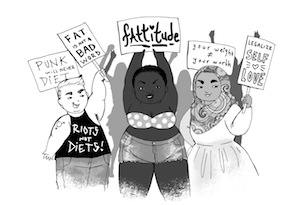
Think of the cartoon villains and the hapless sidekicks. How are they often portrayed? As fat, dumb and/or oversexed? If those weren’t your first thoughts, think again. The documentary Fattitude convincingly shows how widespread bigotry against larger people is – so much so that it can be overlooked, until pointed out. Then, you wonder how you ever missed it.

image - From the age of 3, the film notes, we are already programmed with negative stereotypes
From the age of 3, the film notes, we are already programmed with negative stereotypes. (image from DOXA)

From the old woman in the candy house that eats Hansel and Gretel, to Star Wars’ Jabba the Hut, to the evil squid in The Little Mermaid, these are just a few of the villains. Then there is the heavyset and dumb Hardy, sidekick to thin, smart Laurel; the stereotypical chubby best friend in so many movies; and the archetypal black nanny, forever cast in the caring, subservient role. Miss Piggy is a more complex character, both strong and confident in herself, but also sex-crazy over Kermit. And, in the entire Star Trek franchise – where have the larger people gone?

From the age of 3, the film notes, we are already programmed with negative stereotypes. When all put together, it’s quite depressing. However, Fattitude is a rather upbeat documentary, as its interviewees are spirited, determined and intelligent enough to effect some change, mainly via social media.

Filmmakers Lindsey Averill and Viridiana Lieberman speak to almost 50 people and, to a person, they provide an interesting perspective, connecting the body images depicted in films, television shows, cartoons, magazines and advertisements with their effects on viewers and on our perceptions of ourselves and others. The film discusses the links between race, socioeconomic status and weight, as well as the reasons why Michelle Obama’s campaign to end childhood obesity was misguided.

Fattitude screens May 9.

* * *

Being a journalist in a war zone seems dangerous and frightening, and it is. But it is also tedious and lonely. At least this is what it seems from watching Santiago Bertolino’s Freelancer on the Front Lines.

photo - Jesse Rosenfeld with peshmerga combatants, Santiago Bertolino and Ayar Mohammed Rasool
Jesse Rosenfeld with peshmerga combatants, Santiago Bertolino and Ayar Mohammed Rasool. (photo from NFB)

Bertolino follows Toronto-born, Beirut-based freelance journalist Jesse Rosenfeld as Rosenfeld hustles to get story ideas and budgets approved, waits in sparse hotel rooms for fixers to connect him with interviewees, and ventures into Egypt during its post-Arab Spring elections, the West Bank during an Israeli-Palestinian conflict, a Syrian refugee camp in Turkey and to Iraq, where they witness the fight against ISIS from the front lines.

Some of the more disturbing images are of the bodies of Palestinians gunned down in a home by undetermined executioners and the corpses of dead ISIS fighters dumped in the back of a truck, as well as tied to its back bumper. In another memorable part, Rosenfeld yells questions to a caged Mohamed Fahmy, when Fahmy and two fellow Al Jazeera journalists were on trial in Cairo. (Fahmy, who holds both Canadian and Egytian citizenship, spent almost two years in jail of a three-year sentence.)

Rosenfeld has strong views and isn’t afraid to share them, though he struggles to make eye contact with the camera when he makes his pronouncements. Some of the best exchanges in the film are between him and Canadian-Israeli journalist Lia Tarachansky, who hold different opinions on the Israeli-Palestinian conflict.

Freelancer on the Front Lines screens May 13 at Vancity and will include a post-film discussion.

For tickets and the full DOXA Documentary Film Festival schedule, visit doxafestival.ca.

Format ImagePosted on April 21, 2017April 20, 2017Author Cynthia RamsayCategories TV & FilmTags activism, culture, documentaries, DOXA, First Nations, journalism, mermaids, Middle East, National Film Board, NFB
Mixing of cultures, religions

Mixing of cultures, religions

Helen Kim and Noah Leavitt, authors of JewAsian, will be at the Jewish Book Festival on Nov. 28. (photo by Matthew Zimmerman Banderas)

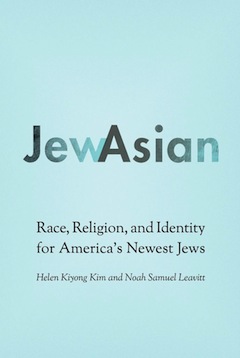
The recently published book JewAsian: Race, Religion and Identity for America’s Newest Jews by Helen Kim and Noah Leavitt was crafted out of a seven-year study of 39 mixed couples, as well as their own successful marriage. The couple will be in Vancouver later this month to share their findings at the Cherie Smith JCC Jewish Book Festival.

For Kim, who was born a few years after her parents moved from Korea to the San Francisco Bay Area in the late 1960s, finding a Korean guy to date was a virtual mission impossible, so looking outside the community was accepted.

“My mother was totally fine with it, in large part because she’d thrown away her expectations that I marry somebody Korean a long, long time ago,” said Kim of her marriage with Leavitt. “I think, in part, because I grew up in a community that was predominantly white with very few people of color, I think she quickly realized that, demographically speaking, it was probably going to be unlikely I’d meet, date and eventually marry someone of the same ethnic background as me.”

Leavitt, who is of American Jewish origin, said, “My mom was super-excited about the fact I had met somebody I was so smitten with. She and Helen, early on, established a great rapport that has continued ever since. I think my mom just had an expectation that I’d settle down with somebody I really loved, who I was challenged and inspired by, and saw that in Helen … so she was excited.”

Leavitt grew up in a household that was somewhere between the Reform and Conservative denominations. He went to a Jewish community Sunday school growing up that was housed at Cornell University and he had his bar mitzvah at Ithaca College through their Hillel.

Kim and Leavitt met in 1997 and both were drawn to the complexity of their Jewish-Asian mix, an interest that increased with the births of their children.

“This was the era where, I think, we started to see a lot of interracial pairings, dating and marriages,” said Kim. “And it was also right before the U.S. census gave multiracial individuals the option of choosing more than one race on the census … really, an interesting time, demographically speaking, where the context around us was contributing to our thinking about how common are pairings like ours and maybe other interracial or Jewish-not Jewish pairings.”

Leavitt and Kim contacted a number of universities that were repositories of large-scale demographic studies. They were aware that the study of intermarriage to that time had been focused on interfaith marriage, but had not delved into how interracial marriage factored into the larger picture.

The couple reached out to the Institute for Jewish and Community Research. Through this connection, they were able to do an initial recruiting of couples with whom to speak for their book. In the end, their study included 39 couples from the San Francisco Bay Area, Los Angeles and Orange County, and from the New York and Philadelphia metropolitan areas.

book cover - JewAsian“We focused there, in part, because of the high percentages of individuals who identified as Jewish and Asian,” said Kim. “Then, there was the likelihood and demographic reality that interracial marriages are taking place predominantly in those areas … with the West Coast having, by far, the highest rates of interracial marriages.”

“We had a lot of people volunteer to be part of the survey and what we made a decision to do was to try to find the most expansive look at Jewish-Asian combination that we could,” said Leavitt.

Within the 39 couples, one was gay and three were lesbian, with the remainder being heterosexual. The study also included a second set of interviewees who were young adults that were children of Jewish-Asian households.

“The first thing by far that I think was quite surprising that we found was that, for the couples as well as the adult kids, they are definitely Jewish – not just in terms of the self-identification perspective, but in terms of some strikingly traditional religious practices,” said Kim. “So, the couples we interviewed were in the midst of or had created homes where there was a lot of traditional Jewish religious practice – everything from observing Shabbat consistently, to consistent synagogue attendance, to kids becoming bar or bat mitzvah, to children going to Jewish day schools.

“Then, for the adult kids we interviewed, they affirmatively claimed they were Jewish. But, they also talked about having been raised in traditionally religious households and communities that, to a great extent, mirrored what we were finding with the couples we interviewed.”

While only six of the racially Asian individuals had converted to Judaism, the overwhelming majority of couples celebrated Jewish religious events and cultural tradition alongside Asian ethnic traditions.

“There was neither a conflict of religion nor a blending of religions,” said Kim. “It was more of a cultural hybrid, but steeped in Judaism as the religion of the household.”

“I would go broader and say that, for the most part … we didn’t really hear too many stories about conflicts related to religion overall,” added Leavitt. “There were a few examples where the non-Jewish partner had a religious or spiritual practice that they adhered to, but it was something they did on their own and didn’t bring into the household.”

Both Kim and Leavitt said the findings were representative of their own Jewish-Asian mix. “Judaism, for me, is a religion and a cultural tradition that is easier for me to instil in my family,” said Kim. “I, as a second-generation child of an immigrant family, did not grow up with a lot of Korean ethnic and cultural traditions.

“Through the adult kids [in the study], it was reinforced repeatedly that you have to expose [them to the culture], no matter what your comfort level as a parent, no matter your knowledge as a parent. The kids really appreciated when the parents went all out in terms of trying to expose them to a particular culture or ethnicity, though they themselves as parents were afraid they might not do it right.

“So, I think just hearing from the kids and imagining my own kids in 10 to 15 years was kind of affirming to me, [that I just need to] try as much as I possibly can. The kids will end up picking up things here and there and will then, on their own, become curious and want to learn on their own. That was reassuring for me.”

“I had a lot of the same reactions,” said Leavitt. “For me, when Helen and I decided to make a commitment to this project, it was fairly close in time to when we were also starting to think about having our own family. When we got this investigation underway, our son Ari arrived. As a first-time parent, I had a lot of worry and anxiety about a household that seemed to combine so many different kinds of traditions, cultural heritage markers and, to some extent, religious differences. I think I had a lot of worry about the ability of all those things to be in a household together … in part, because I didn’t have an upbringing where there were lots of differences within the household. So, I had a lot of fear about that.

“One of the things I’ve been liberated by, in working on this project and having two children arrive, is there is a lot of flexibility and resilience in households. Where even something may seem like a long list of differences, the people inside that household are able to find ways where things can come from different directions, but meet at the same point.”

Kim is excited about coming to Vancouver, especially to have the opportunity to speak with a non-American audience, “to understand how it is that they think about these different dimensions of identity, tradition, culture and religion, as a way of getting out of our predominantly U.S.-focused lens. I’m really looking forward to that comparative perspective.”

Leavitt said, “I think the chance to be in as diverse, global and multicultural a city as Vancouver … maybe there are lots of households coming together with this mix of Jewish-Asian backgrounds in Vancouver. I think this may propel us to continue researching more in this international comparative way.

“Helen and I feel very fortunate to have been working on this project at a time in the U.S. when the exploration about the diversity of the Jewish community in our country is really something that is front of mind for so many congregations, synagogues. We aren’t the same people we were years ago.”

“If we are acknowledging that this is what American Judaism looks like,” added Kim, “what then is the responsibility we have in regards to action based on the changes in the demographic and how do we act based on how we’ve changed?”

Kim and Leavitt are on a panel with Daniel Kalla on Nov. 28, 6 p.m., at the Jewish Community Centre of Greater Vancouver. For more information, visit jccgv.com/content/jewish-book-fest.

Rebeca Kuropatwa is a Winnipeg freelance writer.

Format ImagePosted on November 11, 2016November 11, 2016Author Rebeca KuropatwaCategories BooksTags continuity, culture, intermarriage, interracial marriage, JewAsian, Judaism, religion

Consumerism meets identity politics

This is Part 2 of a two-part series. The first examined Oberlin College’s “Jewish problem.”

When Nathan Heller’s “Letter from Oberlin: The Big Uneasy” appeared in The New Yorker (May 30) his sub-headline asked: “What’s roiling the liberal-arts campus?”

At least for some Jewish students, Oberlin’s obstacles to Jewish life are signs of two roiling processes: “identity politics” and higher education’s drift toward business models in which students primarily are customers.

From its origins in 1833, Oberlin College has been at the forefront of social changes. In particular, no institution in the United States has an older coeducational baccalaureate program. As well, before the Civil War, members of the Oberlin community were active in movements to abolish slavery. The college advertises that it “regularly admitted African American students beginning in 1835.”

Oberlin’s avant-garde history influences student applications and admissions, as well as faculty recruitment – and some unexpected campus activities. For example, in December 2015, unnamed members of the Africana community referred to Oberlin’s legacy and/or public relations when they delivered to the administration an undated multi-page list of “demands not suggestions,” which included a “four percent annual increase in black student enrolment”; “divestment from all prisons and Israel”; “that spaces throughout the Oberlin College campus be designated as [segregated] safe space for Africana identifying students” (exclusively?); that several professors (identified by name) should be subject to “immediate firing”; and that other professors should be given preferential treatment.

Oberlin College proclaims efforts to ameliorate affronts or afflictions perceived by cohorts such as African-Americans, Muslims, students with physical handicaps and non-heterosexual students. A “Campus Climate Report” (May 19, 2016) also includes a section on problems experienced by some Jewish students, but does not specifically deal with reports that “progressive” protesters who confront other forms of bigotry often deny the significance of antisemitism.

This phenomenon occurs on other campuses, too.

In August, the Washington Post published an op-ed focused on “an Iranian Jew,” Arielle Mokhtarzadeh, who traveled “to attend the annual Students of Color Conference” at the University of California, Berkeley. There she found: “Over the course of what was probably no longer than an hour, my history was denied, the murder of my people was justified, and a movement whose sole purpose is the destruction of the Jewish homeland was glorified. Statements were made justifying the ruthless murder of innocent Israeli civilians, blatantly denying Jewish indigeneity in the land, and denying the Holocaust in which six million Jews were murdered.”

Also in the Post, Molly Harris, a student at McGill University, addressed students just beginning post-secondary education: “Get ready to meet new people, learn things that fascinate you, and figure out who you are and who you want to be.

“If you’re Jewish, you should probably also prepare yourself for the various forms of anti-Israel sentiment, and maybe even antisemitism, you’re likely to encounter on your new college campus.

“In the past year alone, as a Jewish student at McGill University in Montreal, I’ve been called a ‘Zionist b—.’ I’ve been told several times that Jews haven’t suffered (never mind the Spanish Inquisition, Eastern European pogroms and centuries of violence and marginalization leading up to the Holocaust). I’ve seen my friends mocked for their Judaism in crude, hateful language on popular anonymous social media platforms.”

Following his May “Letter from Oberlin,” Heller again wrote in The New Yorker (Sept. 1): “Students … may try out defensive ethno-racial flag waving, religious and political dogmas, athletic and fraternal self-segregation…. My work elsewhere has made me think that this isn’t just an Oberlin, or liberal, thing.”

Indeed, on Aug. 5, the New York Times printed a front-page article about racial and identity politics at many campuses. This reporting was not about Oberlin, but it named other “small, selective liberal arts colleges” as well as Ivy League universities. An Amherst graduate said, “As an alumnus of the college, I feel that I have been lied to, patronized and basically dismissed as an old, white bigot….”

But perhaps Oberlin still is a cultural leader. In an Aug. 27 article, the Times mentioned Oberlin as a counter example to the University of Chicago, which sent first-year students a letter saying Chicago did not support “trigger warnings” and did not condone “safe spaces” nor disruptions of speakers. (Disclosure: I was a Chicago faculty member from 1968 to 1970.)

In Frank Bruni’s June 23 New York Times essay about Oberlin – as one of the campuses “roiled the most by struggles over political correctness” – he wrote: “Students at Oberlin and their counterparts elsewhere might not behave in such an emboldened fashion if they did not feel so largely in charge. Their readiness to press for rules and rituals to their liking suggests the extent to which they have come to act as customers – the ones who set the terms, the ones who are always right – and the degree to which they are treated that way.”

Bruni built upon a poignant essay about “Customer Mentality,” written in February 2014 for Inside Higher Ed by a Western Carolina University assistant professor of English, Nate Kreuter. When students transformed into customers, Kreuter observed concomitant re-purposing of campus infrastructure, curriculum and faculty.

Bruni provided photographs of water parks with pools and slides on campuses, and described campus entertainment complexes, golf putting greens and other resort-like amenities. He also wrote: “Small wonder that grade inflation is so pronounced and rampant, with A’s easy to come by and anything below a B-minus rare.”

Barry Schwartz, professor of psychology at Swarthmore, told Bruni: “There’s a big difference between teaching students and serving customers.”

Kreuter in 2014 noted that the student-as-customer business model had adverse consequences within and beyond academic programs: “The impulse to protect the brand also frequently compels universities to shirk responsibility when missteps or scandals occur, rather than immediately taking responsibility and corrective action.” He argued that administrators may “protect the brand” in instances of “high-profile college athlete crime” or sexual assaults or injuries from fraternity hazing.

A Times essay (Sept. 4, 2016) by a Yale faculty member, Jim Sleeper, argued that right-wing “wealthy donors” exaggerate negative impacts of political correctness, while they promote more potent poisons. But he also agreed that: “Most university leaders serve … pressures to satisfy student ‘customers’ and to avoid negative publicity, liability and losses in ‘brand’ or ‘market share.’…”

Oberlin College’s publicists like to recall the institution’s abolitionist era rather than its place in the history of the Anti-Saloon League and Prohibition. So perhaps it is not surprising that Prof. Joy Karega could post anti-Jewish materials and conspiracy theories for many months, and that Oberlin administrators and trustees reacted only last March, after Karega generated condemnation both online and in worldwide print media – likely to harm Oberlin’s brand.

At the University of Lethbridge, Prof. Anthony Hall’s “globalization studies” promoted “open debate on the Holocaust” and claims that the 2001 destruction of New York’s World Trade Centre was a “Zionist job.” Administrators tolerated Hall for 26 years – suspending him only this month, after news stories about “possible violations of the Alberta Human Rights Act.”

During my one-to-one conversation with Oberlin College president Marvin Krislov in April, he told me that many students gave Karega high ratings. From a marketing perspective, favorable student evaluations may help justify annual tuition above $51,000 – costs above $66,000 including room and board. But if students give high ratings to a predilection for bigotry and conspiracy theories (and lack of scholarly accomplishment) then something has gone wrong with their education.

Bruni’s essay asked, “But what does the customer model [of college students] do to their actual education?” One Oberlin graduate responding to The Atlantic in December 2015 wrote: “There is now an atmosphere of close-mindedness, intellectual submission, conformity and fear.”

College and university emphasis on marketing to customers likely is linked to cost.

Tuition – and every other post-secondary education expense – has increased at a pace beyond general inflation (or household income gains). Consequently, total student debt in the United States now is about $1.2 trillion, according to the August Forbes – exceeding total credit card debt or the total of automobile financing in the entire American population.

This precarious state of affairs may be a response to reported correlation between higher education and greater lifetime earnings or lower unemployment; but correlation does not indicate cause and effect. Bruni refers to “an expectation among many students that their purchase of a college education should be automatically redeemable for a job….” But, as Kreuter wrote, “A post-secondary education is not a guarantee of success. It is not the straightforward purchase of a better future. It never has been.”

At Oberlin, in fact, the student newspaper published an article in March 2014 stating that “40% of [our] 2013 graduates are unemployed, and one-third of graduates are working in positions that do not require a degree.”

Of course, many Oberlin students and graduates have priorities other than high-income jobs; but one unidentified correspondent, writing to The Atlantic in December 2015, stated: “Oberlin students [do] want what other college students are asking for, whether they phrase it this way or not: better control of the college’s money.”

Oberlin, unlike most American campuses, has no fraternities or sororities. Historically, students lived in residences supervised by the administration, which also oversees most meals. So, students see what Oberlin does with funds for their food. But why have many top-tier media published articles discussing campus food complaints at the college?

The emphasis of complaints has not been that the food tastes bad, has dubious nutritional value, etc. Oberlin food complaints instead focus on meals that particular students deem to be culturally inappropriate or disrespectful. Mainstream media regard Oberlin’s food criticisms as curiosities sufficiently ludicrous to entertain a wide range of readers; but these cultural food fights are quite logical outcomes when the student-as-customer model meets racial and identity politics at the topic of food.

Likewise, identity issues can lead students to denounce “cultural appropriation,” not only in meals, but also in other aspects of life – clothing, terminology, music, books, even the curriculum. Novelist Lionel Shriver says that, if she did not reject criticisms of “cultural appropriation” in literature, then “all I could write about would be smart-alecky 59-year-old, five-foot-two-inch white women from North Carolina.”

And, as customers, students can demand not to take certain courses. At Oberlin, one of the “unmalleable” demands in December 2015 was that, in the Oberlin Conservatory, “seeing as how most jazz students are of the Africana community they should not be forced to take courses rooted in whiteness” of classical music.

In the New York Times, Krislov wrote: “American higher education is at a crossroads, as it was in the 1960s when college students were galvanized by the Vietnam War and the civil rights movement.”

But I do not accept that anti-Zionist petitions or Africana demands for specific foods and segregated “safe spaces” in Oberlin buildings somehow are comparable to my classmates’ efforts in the 1960s civil rights movement and later protests against U.S. war policy in Vietnam. (On the campus of Kent State, one of Oberlin’s neighbors, U.S. National Guard troops shot and killed unarmed students during anti-war protests in May 1970.)

In spring of 2016, one student on the cusp of graduation said, “I’m going home, back to the ’hood of Chicago, to be exactly who I was before I came to Oberlin.”

Marc Chafetz explained – in the New York Times – why that remark disturbed him: “I graduated 41 years ago…. Oberlin changed me profoundly. I found out how little I actually knew about the world, and it unleashed a hunger to learn that has never dissipated.”

No matter what identities students bring or what paths they follow afterward, higher education should involve them in exploration and intellectual discovery – and civil encounters with one another.

Ned Glick lives in Vancouver. His baccalaureate is from Oberlin College and his PhD is from Stanford. After teaching at the University of Chicago, he had University of British Columbia appointments in mathematics, in statistics and in the faculty of medicine. He retired to emeritus faculty status in 1992.

Posted on October 14, 2016October 27, 2016Author Ned GlickCategories Op-EdTags anti-Israel, antisemitism, consumerism, culture, free speech, identity politics, minority rights, university

A complex cultural mosaic

Think you know everything about Israel? Looking for an extraordinarily special book to give to someone who has been to Israel or is interested in the unusual aspects of the country that rarely, if ever, get press coverage? The answer to both of those questions is Unexpected Israel: Stories You Never Read in the Media (Gefen Publishing House, 2016) by Ruth Corman.

Corman is a British photojournalist and art consultant who splits her time between London and Jerusalem. Her first publication was with photographer David Rubinger, and his book Israel Through My Lens: Sixty Years as a Photojournalist, which she co-authored and edited.

book cover - Unexpected IsraelWith her latest book, with 84 vignettes, she writes, “I decided to try a side of Israel that rarely receives attention – the creative, amusing, quirky and moving aspects of the country.” She used the services of Alon Galili, a guide, and John Harlow, a consultant. Many of her tales have appeared in the Jerusalem Post. Her husband, Charles Corman, was the book’s editor.

Writes Corman on the publisher’s website, “Four years ago, I embarked on an expedition through the complex cultural mosaic that is Israel to introduce readers to aspects of the country that never appear in the media…. I was introduced to places that few know about, fossilized trees in the Negev dating back 120 million years and a leopard shrine from a mere 10,000 years ago. I marveled at magnificent pure white chalk hills near the Egyptian border and discovered sculptural rock forms near Timna, the remains of copper mining. I was delighted by a derelict Mandate-era spa by the Dead Sea where hand-painted murals depicting regional topography adorn the walls, and fascinated by the history of perfume production at Ein Gedi and the efforts to recreate the scent that so captivated our ancestors.”

Corman also “encountered some unforgettable individuals.” Her entries begin with Tsegue-Mariam, a 93-year-old Ethiopian nun who has written original music and plays the piano. It ends with “A Happy Ending: Rescue in the Skies,” the story of a young child who was on an El Al flight with her. The child was heading to London to undergo a liver transplant, and Corman helped raise from the passengers the money the girl needed. Corman did not keep in touch with the child, who must be over 30 by now.

In between are stories about typical and atypical Israeli aspects – the camel, falafel, floor cleaning (sponga), garinim (sunflower seeds), folk dancing, Machaneh Yehudah (where this author leads weekly walks in English), sabras (the fruit), standing in line, sheshbesh (backgammon), the Temple Mount sifting project (which originated with a friend of this author, Prof. Gaby Barkay), volunteerism and more.

For those who know – or want to know – Israel, it is a delightful read that you won’t be able to put down. There is humor, there is wit, great research and special photographs.

If you happen to be in Jerusalem on May 15, the official book launch of Unexpected Israel will take place at Menachem Begin Heritage Centre. Guests will include Daniel Taub, former ambassador to the Court of St. James, and Steve Linde, editor-in-chief of the Jerusalem Post. Corman will present stories and images from the book. RSVP to [email protected] or via gefenpublishing.com (or 02 538 0247).

Sybil Kaplan is a journalist, foreign correspondent, lecturer, food writer and book reviewer who lives in Jerusalem. She also does the restaurant features for janglo.net and leads weekly walks in English in Jerusalem’s market.

Posted on May 6, 2016May 5, 2016Author Sybil KaplanCategories BooksTags Corman, culture, travel, Unexpected Israel

Posts pagination

Previous page Page 1 … Page 7 Page 8
Proudly powered by WordPress