When I was very young, I learned to embroider. My mother was a fabulous seamstress, but sewing was not my thing. Later, around middle school, an aunt taught me how to knit. I picked up crocheting but never really liked it or excelled at it. However, I took knitting to all levels, including a dress for myself, and, later, I returned to various kinds of needlepoint, coming to love them.
On my and my husband’s bedroom wall, there are framed embroidery pieces, each with its history, which I collected in the 1970s. I would have liked to have in my collection some work from Jewish women, who had done embroidery before immigrating to Israel from various countries, but they had stopped doing such work, and all the pieces I have were made by Arab women, who continued the craft.
It was with this background that I thoroughly enjoyed perusing the new-to-me pages of Jewish Threads: A Hands-on Guide to Stitching Spiritual Intention into Jewish Fabric Crafts by Diana Drew with Robert Grayson (Jewish Lights Publishing, 2011). The author explains her journey from sewing to fabric crafts, from editing for the division of Random House that published books on handicrafts to being awakened spiritually while editing for spiritual book publisher SkyLight Paths.
In Jewish Threads, there are 30 projects and 30 interesting stories (written by the author’s husband) about each artist and their project. The contributors come from the United States – Alabama, California, Kentucky, Massachusetts, Minnesota, New Jersey, New York, Pennsylvania, Vermont, Washington – and Israel.
The book has four parts: at home, in the synagogue, celebrating holidays and through the Jewish lifecycle. For the home, there are wall hangings, a needlepoint and a purse. For the synagogue, there is a runner, a Shulchan Aruch cover, placekeepers and Torah mantles. The holiday section includes challah covers, a quilt, a vest, puppets, a matzah cover, an afikomen holder and a seder plate. And, lastly, the Jewish lifecycle section includes quilts, a challah cover, a tallit and tallit bags. Another five “inspirations” include several chuppahs, a tallit bag, a wall hanging and a bimah cloth.
The techniques include quilting, appliqué, embroidery, needlepoint, cross-stitch, crochet, knitting, felting and needle felting.
Although decidedly not for beginners, each project lists details for getting started, what you’ll need and step-by-step instructions, sketches and how to finish. The “final threads” chapter offers how-to’s for quilt-making, lettering, a stitch guide, resources and projects for sewing circles, parents and children and holidays.
Sybil Kaplanis a journalist, lecturer, book reviewer and food writer in Jerusalem. She created and leads the weekly English-language Shuk Walks in Machane Yehuda, she has compiled and edited nine kosher cookbooks, and is the author of Witness to History: Ten Years as a Woman Journalist in Israel.
Chanukah came early this year, and I hope you had a fun one. Now that it’s almost over, it can be a long dark vacation for those of us who do not observe anything on Dec. 25.
I say this because, although my family is clearly in the “Chanukah only” category, I know other families handle this differently. Some families are multifaith and observe several winter holidays. There are even (this was a surprise to me) Modern Orthodox Jewish families who have used Dec. 25 to create an entirely kosher Christmas dinner – because everyone had the same day off of work. Some Jewish people choose to observe aspects of Christian or pagan holidays, and, well, that’s up to them. It’s not the custom in my home, but we’re all lucky to be in a place where we are free to choose our own traditions.
A strange thing happened to me this fall. A friend of a friend put together a “women-owned businesses” shopping guide. It had a hashtag of #ShopWithHer. My work includes writing and editing, which can be hard to advertise. The other part is that I write downloadable knitting patterns. That means knitters, or those who love them, can go online and download a pattern I wrote for the price of a big cup of coffee. It’s not a huge earner, but I have a “woman-owned” business, so I asked to be included.
The emphasis of the guide’s creator was to highlight women and minorities. It was the week after the Pittsburgh massacre, so when I got to that question, I said something like, “I’m Jewish and an immigrant and now a dual-citizen. I moved from the U.S. to Canada.”
Why did I mention being Jewish? Jews are a minority in North America. While it has been popular in recent years to downplay any issues of our minority status, the truth is that there are still challenges to being Jewish here. For instance, violence like in Pittsburgh – and the assumption that, if we want to pray in peace, we should be hiring armed security.
If we just go back in history a little ways, we should think about quotas at universities, country clubs and other organizations that didn’t admit Jews at all. There were countless other places with no formal policy, but where folks made sure that we knew we didn’t belong.
For those who think that’s all in the past, I can say sarcastically, sure it is – my father’s university (Duke) had quotas when he attended it. The Women’s Junior League in Virginia did not accept “our kind” when I was a kid. The issue of “anti-Jewish” or antisemitic discrimination is not new, nor is it going away. The recent rise of hate crimes is well-documented in the news. Some American universities and colleges are canceling study-abroad programs to Israel, or their faculty members refuse to write letters of recommendation to Israeli study-abroad programs. I get e-newsletters from JTA and other Jewish organizations – and the news is clear.
When the #ShopWithHer guide came out, I was excited – and then shocked – to see my entry. Where other minorities were labeled “WOC” for “Woman of Colour” or “LGBT” or “Disabled,” mine read “Immigrant, Other.”
I’m proud of being Jewish and it’s not a part of my identity that I hide. I shouldn’t need to feel ashamed of it. I’m also well aware of our minority status, particularly when we’re surrounded by a holiday that celebrates the birth of another religion’s messiah. However, I didn’t include my business in this guide so I could be made “other” all over again. Why was I labeled “other”? Was it an attempt to protect me from hate? Or do I belong to a category that the guide’s creator didn’t feel was valid?
“Othering” isn’t my invention – if you’ve taken social science, religious or cultural studies, philosophy, history or other humanities classes at a university, you’ve likely heard of it. There are academic conferences and teacher in-services on the topic. A simple definition? It’s the action of deciding someone else is different or alien to you, “not one of us.” It’s a very primitive tribalism that helps people survive in adverse conditions. Some theorists think it references early human civilization, and others think it comes from times of war, famine and other natural disasters.
You can read about the “in group” of the Israelites and “others” in the Torah. There’s a lot of tribalism at work in some of our most common stories of identity. At the same time, we’re reminded, “You should love the stranger,” for “We were strangers in the land of Egypt.”
That’s right, Jewish tradition teaches us to love the “other.” In the face of increased hate crimes, discrimination and erasure, it can be hard work to keep reaching out and loving others. Perhaps it is ignorance that allows our identities to be ignored or disregarded; I’d like to think that, because the alternatives aren’t nearly as harmless.
It feels awful to have one’s own religious tradition erased. This time of year, it happens a lot. We’re faced with holiday greetings, music, customs, lights and foods that aren’t ours. When Chanukah is long over, it also feels ridiculous to wish someone or thank someone for a “Happy Chanukah,” even though it’s well-intentioned.
I’m still struggling with what to say to this shopping guide’s organizers. Saying nothing is an option, as is trying to engage in a dialogue. Maybe it’s enough to send along a copy of this column. There are so many ways to divide and diminish others, rather than celebrating and boosting our identities and differences. Chanukah is a holiday that, unmistakably and militantly, celebrates religious freedom. Perhaps it’s time for us to be our own modern version of Judah Maccabee, strong in the face of dangerous discrimination, but also trying to embrace the Jewish notion of loving the stranger rather than “othering” her.
Joanne Seiffwrites regularly for CBC Manitoba and various Jewish publications. She is the author of three books, including From the Outside In: Jewish Post Columns 2015-2016, a collection of essays available for digital download or as a paperback from Amazon. See more about her at joanneseiff.blogspot.com.
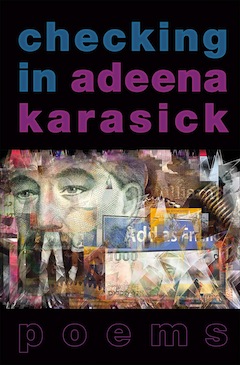
Almost half of Adeena Karasick’s latest volume of poetry, Checking In (Talonbooks, 2018), is comprised of whimsical Facebook status updates, most of which have deeper meaning on second and third thought. Together, they speak, as the book’s description notes, “to our seemingly insatiable desire for information, while acknowledging how fraught that information can be.”
“It was a totally compulsive exercise over four years, where literally everything I read or watched or where I went or what I heard was fodder for the text,” Karasick told the Independent about the faux updates’ origins. “And, I must admit, I threw away as many lines as I kept.
“Sometimes, it was just that I couldn’t get a song out of my head and then would just riff on it,” she said, giving as examples, “Ulysses is listening to Siren Song on Spotify”; “Gustave Klimt is listening to KISS”; and “Salvador Dali is doing the Time Warp. Again.”
Sometimes, she said, it was linguistically driven, such as, “E & G are saying F off” and “Bold italics are refusing to move into an upright position.” Or, “it was just pure, silly fun” to create updates like “William Wordsworth is wandering lonely on iCloud,” “Edvard Munch is watching Scream 3,” “Google is mapping the territory” and “Narcissus is using his selfie stick.”
“It was so obsessive,” said Karasick, “that even now that the book’s been published, my brain is so wired to creating those one-liners, I walk around the streets reading every sign and riff on them: ‘Thin Lizzy is watching her carbs,’ ‘Fatwa is doing a cleanse,’ ‘The Pre-Pesach Jew is clearing her cookies,’ ‘The Long, Long Sleeper is Woke.’”
Karasick’s sense of play is evident throughout Checking In. Even when describing heartbreak, confusion and other emotionally charged states, the joy she derives from words, from language and from constructing layers of meaning, is obvious.
“I think I’ve always had a really dark sense of humour,” she said, “and there’s something about taking that which is frightening or deeply disturbing and disempowering it – by not so much making fun of it, but ironically or parodically making it strange, decontextualizing it, hyberbolically defamiliarizing it.
“A lot of my work takes hard-hitting political issues, whether that be the Holocaust in Genrecide (Talonbooks, 1994) and superimposing it with the policing and massacring of language, or dealing with 9/11 in The House That Hijack Built (Talonbooks, 2004).… ‘There was a Big Building that Swallowed a Plane … How Insane to Swallow a Plane….’ A sense of jouissance (pleasure, play) really permeates all that I do. There’s nothing more exhilarating for me than playing inside language, finding unexpected liaisons, connections, sound clusters. It’s a type of erotics of the text that is for me very jewy; that jouissance, a jewy essence: all diasporic, nomadic, exilic, ex-static.
“I see this ‘play’ as operating with an ‘assimilationist’ brand of Jewish humour,” she explained, “not of bombastic neurosis, but one that threatens to unleash chaos, creates unsocialized anarchy, embodies unpredictability – impassioned, engaged, shticky, outrageous and earnest all at the same time – in a post-Woody Allen/Jon Stewart/ Sarah Silverman/Sandra Bernhardish kind of way. And, sometimes, it’s audacious, subversive, provocative and, in the true definition of ‘irony,’ explodes ontologically and cuts into the fabric of things; the smooth functioning of the quiet comfortability or the ‘homeyness’ of our world. That is the role of art.”
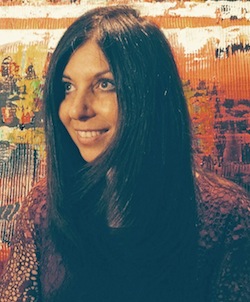
Adeena Karasick’s newest collection of poetry is Checking In. (photo by Safia Karasick Southey/talonbooks.com)
And one cannot separate Karasick’s art from her Jewish heritage – it’s “part of my DNA,” she said – and from her study of Jewish texts. With a PhD in kabbalah and deconstruction, it is not surprising that, in speaking about the concept of play, she pointed to 13th-century kabbalistic mystic Avraham Abulafia’s Science of the Combination of Letters, in which, she said, “we are instructed to play inside the language, using ancient practices of recombinatoric alchemy, gematriatic (numerological) substitution, combination, and, through lettristic ‘skips’ and ‘jumps’ slippage, meaning is infinitely re-circulated.
“According to kabbalistic thinking,” she said, “we are commanded to permute and combine the letters; focus on them and their configurations, permutations; combine consonants into a swift motion, which heats up your thinking and increases your joy and desire so much, that you don’t crave food or sleep and all other desires are annihilated. And nothing exists except the letters through which the world is being recreated, through a continual process of constructing and reconstructing borders, orders, laws, mirrors, screens, walls…. And, in accordance with the strictures of Abulafian play, to properly play is to travel inside the words within words, traces, affects, projections, sliding and slipping between the forces and intensities distributed through the texts’ syntactic economy. And this very play speaks both to how everything is infinitely interconnected – reverberant with our social, consumerist, communicative patterns – generating a contiguous infolding of meaning.”
She connected this type of play to “the actual conversation habits of Yiddish.”
“According to etymologist Michael Wex – in his Just Say Nu (Harper: New York, 2007) – Yiddish itself is inscribed in derailment, evasion, avoidance, where the norm is not to be ‘clear’ but to ‘seduce and lead astray,’ to say the reverse of whatever’s been said. For example, as we know, to say, ‘Hi, how are you,’ ‘Shalom aleichem,’ the answer is ‘Aleichem shalom.’ Answers are answered with a question, repetition, reversals, circumlocutions, interruptions, insertions (ptoo, ptoo, ptoo). Compliments are avoided in favour of their opposite. Or, like how you should never say what you mean because naming something (such as cancer, leprosy, pig) could bring it into existence.”
As for her own existence, Karasick said, “All my life, I’ve been fiercely drawn to all that seems enigmatic or paradoxical, and get great pleasure in connecting the unconnectable; drawing from different genres, lexicons or mediums and reveling in ways they inform each other in radical and innovative ways, inviting us to see the world anew.”
While she has spent years teaching philosophic and critical theory, and media and pop culture at various universities, as well as attending lectures on media ecology and ontology, she also watches “a lot of trashy TV,” she said. “I like classical jazz and MTV videos. I read [Louis] Zukofsky, [Slovoj] Zizek and Vogue magazine. And my favourite thing to do is to mash these language systems together into a kind of linguistic tzimmes; each flavour, taste, texture informing the other, expanding the palette.
“It’s especially exciting for me to break down that binary between high and low culture; draw from the music hall and the circus, erotics and spirituality; and play with ways all of this information erupts as a palimpsestic web of both sacred and secular echo-poetic referents.”
Karasick writes “on the road, on buses, trains, subways, boats; in motion,” she said. “I write best amid the bustle of life and, oddly, when I’m really busy is when I’m most inspired. I’m always hunting and gathering, drawing on the world around me. Though, I must say, when drenched in aching nostalgia, frustrated by contemporary politics or steeped in throbbing desire is when the work especially flows.”
Approaching the poetry
“Contour XLV: With Asura,” “Lorem Ipsum” and “In Cold Hollers” are all “homophonic translations, and so they all fall under the same rubric,” said Karasick of three of the poems in Checking In during a brief poetry lesson over the phone.
She explained, “Each of these [works] take the same sounds of an original poem by somebody else and I’ve translated them. I’ve done an avant-garde, post-modern translation by using the same sounds and rhythms of the original poems but changing all the words, so that if one read it simultaneously with the original poem, it would sound like the same poem, but it’s completely different. It’s a way of commenting on the previous piece; it’s translating it, moving through and across different modes.”
“In Cold Hollers” is a translation of Charles Olson’s 1953 poem “In Cold Hell, In Thicket”; “Contour XLV: With Asura” is based on “Canto 45 with Usura,” a poem by Ezra Pound, which Karasick described as a “famously antisemitic, women-hating, Jews and women are pigs kind of poem”; and “Lorem Ipsum,” which is in English, but plays on the sounds of the Latin of Cicero’s “De finibus bonorum et malorum” (“On the Ends of Goods and Evils”). “Lorem ipsum is the standard placeholder text used to demonstrate the graphic elements of a document or visual presentation,” writes Karasick elsewhere. “I am interested in exploring how the notion of ‘place holding’ gets reworked through an impossible relationship both in love and in language.”
As to how to approach a poem that you’ve never read before, Karasick said, “On one level, it depends on how deeply one wants to penetrate the text. The way I like to read is to not worry about what everything means per se, but rather … in reading, I think the most important thing is to feel the text, to go inside and feel its rhythms, its textures…. I work a lot with sound, so I’m really interested how sound itself communicates meaning and so, therefore, a lot of this type of work is about moving with the rhythms and the textures and some of that crazed emotion, how that bleeds through, just through the way that it sounds and feels in your mouth.”
Turning to the poem “Lorem Ipsum,” she said the words mean “pain itself.” She has translated Cicero’s treatise on the theory of ethics into a “passionate love poem” about the “difficulties and grueling angst that one traverses through that. Just like love itself, or pain itself, isn’t something that’s easily definable, so it is with the poem itself, which takes us through this journey of multiple ways that are easily comprehensible and other parts that are strangely defamiliarized and confusing because these very strong emotions are fiercely that…. Just like in life, you come across things that are completely foreign and impenetrable, so, similarly, the poem interweaves through the familiar and the defamiliar, the expected and that which completely takes you into new arenas of wonder and confusion.”
Karasick similarly takes Pound’s “Canto 45” and, playing with the Yiddish word asura, which means forbidden, and the English word usury, creates a new work that’s both a scathing commentary on Pound’s, as well its own poem, with its own meanings.
About “In Cold Hollers,” Karasick said she used the word “hollers” because it’s “homophonically related to hell, but it’s hollering in, calling back into Charles Olson’s original ’53 piece; and his original title, ‘In Cold Hell, In Thicket,’ refers to the opening of Dante’s ‘Inferno.’ What seems simple, it just has layers and layers and layers of history, literary history, philosophical history, as well.”
The title of Olson’s poem refers particularly to “selva oscura,” she said, “which is the dark wood that Dante wanders into in the middle of his life … so Olson’s poem, which riffs on that, is a similar excursion into a visionary experience, where he struggles to come up with a new understanding … from his own midlife … putting a voice to his own time. It is a personal drama of experience, conflict; it really speaks to the wrenching process of living and loving that, by turns, is grueling and funny and dramatic and trivial. My translation of that is dealing with all of those things and, in a way, it’s like, do you remember that old Gwen Stefani song, ‘I Ain’t No Hollaback Girl’? – I am a hollaback girl. I am hollering back, in cold hollers, to this cold hell, and basically calling into that history of both Dante and Olson, the history of post-modernism, 65 years later.”
In talking about Olson’s work and hers, Karasick said, “I sometimes like thinking of translation as trans-elation because you can never really translate anything because of culture and all the different references – in my piece, in my trans-elation, the attention is focused on a world of connected life, the personal, the political, the poetic as a system of relations. And, lastly … highlighting how the words themselves are imaginative participants; the words themselves are creating and recreating the sense of connecting the personal, the political, the poetic.”
And it’s not just the words, but how they are placed on a page that matters in poetry. So, for example, Karasick’s “In Cold Hollers” not only plays on the sound and meaning of Olson’s poem, but also mirrors its typography. “I wanted to keep it very much as he had it,” she said of where the lines break and other aspects of the formatting.
“The notion of the physicality and the materiality of where the words are placed on the page has just as much meaning as what they are communicating. We’re so often used to looking at the left margin … but I want the phrases to be moving and fluid, and that sense of how the white space between the words is equally as important as the words themselves. We can go back to kabbalah and the black fire on white fire, that the whole page becomes a series of fiery energy.”
Shira Geffen shares how she met her husband, Etgar Keret, in the film Etgar Keret: Based on a True Story, which screens Nov. 14. (photo from facebook.com/etgarkeretfilm)
“I want to write stories so the readers will like mankind a little bit more,” says Israeli writer Etgar Keret in the documentary Etgar Keret: Based on a True Story. Similarly, as depicted in another film, the Israel Museum aims to uplift and educate visitors with its artistic, cultural and historical displays, and The Museum offers a glimpse into the breadth of its collections and the diversity (and quirkiness) of its employees. Both of these award-winning films screen during the Vancouver Jewish Film Festival, which started this week.
Danish filmmakers Stephane Kaas (director) and Rutger Lemm (writer) do an excellent job of introducing viewers to what makes Keret tick. They do so using a creative mix of interviews with Keret and his family, friends and colleagues; reenactments of sorts of a few key points in Keret’s life; and a few of Keret’s stories, the portrayal of which is mainly done in animation. Not surprisingly for anyone who has read Keret’s short stories, there are several laugh-out-loud moments in Etgar Keret: Based on a True Story, but there are also sombre elements, as we learn about how Keret has been impacted by tragedy, including the suicide of one of his best friends.
One of the funniest scenes is when Keret shares his first story with his brother, Rodi (Nimrod). Rodi brings his dog along for the walk and, after he finishes reading Keret’s story and praises it, he asks whether the typed copy he’s holding is the only copy. When Keret says no, Rodi uses the paper to pick up his dog’s poo. Perhaps a lesson in humility, Keret explains that it was at this moment he realized that a story is not in the piece of paper on which it has been written or typed – once a story has been read, it is in the mind of the reader. Keret calls this ability of a writer to transfer their ideas to another person a “super power.”
While many of Keret’s stories have gloomy aspects to them, the stories as a whole generally leave readers feeling good. He describes his stories as “an advertisement for life,” saying that he writes to answer the question of why he wants to live.
“I think the need to tell stories is, basically, the need to put a structure to the reality around you. And I feel that the more chaotic and the less sense it makes, the stronger the need I have to tell a story about it,” he explains in the film.
Etgar Keret: Based on a True Story screens Nov. 14, 8:45 p.m., at Fifth Avenue Cinemas (19+), following the 22-minute short Large Soldier, directed by Noa Guskov. “It’s 1973 and all that Sherry, a 15-year-old Israeli girl, wants is a boyfriend,” reads the synopsis of the film, which is in Hebrew with English subtitles. “A letter exchange with an unknown soldier makes her believe that it’s going to be her first love. But what will happen when the imaginary soldier becomes real?”
* * *
A scene from The Museum, which screens Nov. 17. (photo from goelevent.com)
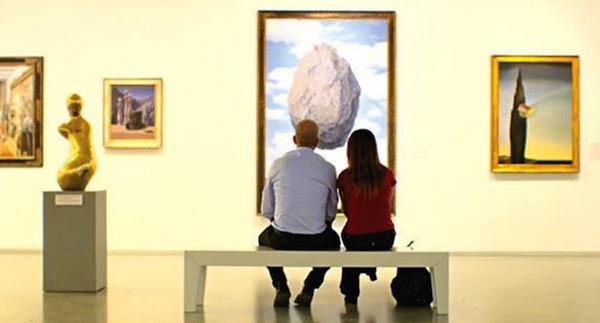
The opening of Ran Tal’s documentary The Museum grabs viewers’ attention: a black screen, the sound of footsteps, some shuffling about, then a woman asks a man, “What do we have?” “That’s a huge painting,” he begins. When the scene is revealed, we see the man and woman sitting on a bench, looking at the painting, but the woman seeing it only through his eyes, as she is blind. Later in the film, this woman is part of a group of blind people visiting the museum – she and others touch various sculptures, feeling how the works are made.
The Museum makes clear the enormous responsibility and privilege of caring for, handling and presenting art and artifacts. Over a period of one-and-a-half years, Tal interviewed several museum staff – including a security guard who is also a cantor; the institution’s kashrut inspector, who notes that “a museum doesn’t replace spirituality”; and the then-museum director, who sadly had to miss his mother’s funeral because it took place on the day the museum reopened after an extensive renovation. Tal also films visitor interactions over that time, and highlights a 50th anniversary event (in 2015) featuring Prime Minister Binyamin Netanyahu and members of his government. Netanyahu remarks that the museum shows three things: “One is our bond to this land in a very dramatic display, and one of humanity’s most significant archeological finds, the Dead Sea Scrolls. Another is the great cultural treasure of the Jewish people in Israel and the world over, which symbolizes our contribution to humanity.”
Admittedly, The Museum only touches upon more serious concerns – there is a scene where a group of museum staff discusses a collection of traditional Palestinian clothing that is in storage, and the potential impacts of displaying (and not displaying) them – but it at least does bring up such issues, which will hopefully open the door for more in-depth discussion.
The Museum screens on Nov. 17, 6:45 p.m., at the Rothstein Theatre. For the full festival schedule and tickets, visit vjff.org.
I am not normally someone who is especially active on social media. I am not normally someone who curates current events, even though I consume them like undergrads do coffee – habitually, obsessively, out of necessity.
For a long time, my political associations and the extent to which I follow world news have been largely separate from the image I have cultivated for public view. As far as Facebook is concerned, I am represented through dog videos, feel-good intercommunity displays of solidarity, recipes and the occasional satire poking fun at the absurd and horrifying climate we’re living in – but there has been a shift. A shift toward police brutality, transphobia, racism. A shift toward synagogue shootings.
I do not share news stories on such topics because I enjoy doing so. I don’t enjoy reading about things that make my heart heavy, nor offering vulnerabilities to people who do not see me as a person, but rather the embodiment of an idea they disagree with. I do not take pleasure in sharing pain. It is my very nature to shield myself and others from it. Although part of love is letting others learn, and that involves experiencing pain and hurt.
It is easier to stick one’s head in the sand, but it doesn’t make it right. It is important to denounce insidiousness and nefariousness when you see it, especially if it does not directly affect you. It is important to hold space for those who are impacted by the injustices of the world, to hold them up and offer your strength. In doing so, we hope others do the same for us, and perhaps that is the only way we can get through these dark times with any semblance of sanity, of humanity.
I used to make a point of sharing light-hearted, feel-good posts, cognizant of the “bad news,” which is in no short supply. I believe my intention to provide some degree of respite from the political apocalypse we’re currently observing was a good one, but I would wager also misguided. To curate news is one thing, to disengage from it is another.
It became clear to me that, just because I am kept abreast of political happenings, and that I see them all over social media, does not mean others do; a classic cognitive bias that I should have spotted much earlier. This is true of what is happening in Trump’s America, to people of colour, LGBTQ folks, indigenous peoples, immigrants and refugees, Muslim communities. This is true of issues and current events related to antisemitism – I am now startlingly aware just how little people know about it. Not only the frequency of antisemitic incidents in North America and Europe, but, at a much more basic level, what antisemitism is and how to spot it.
For many of my friends, especially those who I’ve met in London, I am the only Jewish person they know. While it shouldn’t significantly impact the way I conduct myself, the weight my actions carry is not lost on me when I am the entire schematic representation of “Jew” for many of the people I come across. There is a pressure to behave in a way that is contrary to the many persistent stereotypes that precede my traditions and my culture. I must be generous to a fault lest I be stingy. I must laugh off antisemitism and micro-aggressions lest I be perceived as a paranoid, uppity Seinfeld type. I must be soft and kind and open, I must not have strong opinions lest I be the overbearing, naggy Jewish woman. I must downplay my love of bagels (they’re so damn good).
I also must be a political chameleon, dodging demonization from the left and right for equal and opposite accusations: we are the puppet masters, yet the infiltrators. We are the root of capitalism, yet the root of communism. We are somehow the one percent who controls the world’s wealth, yet we also fund the movement that rallies against it. We are insular elitists, yet permeating globalists. Those of us who look like me have assimilated to whiteness and reap the benefits, yet we will never be “white enough” to those who would see us dead.
Over time, the belief sticks: “I must not behave in any way, shape or form, in any manner that would give credence to the ideas that this is how Jews are, as I represent them to so many.” Yet it’s as exhausting for me to keep up as it is to keep this narrative straight.
I thought that, perhaps if I wanted to be a socially engaged citizen of the world, I could avoid these pitfalls by sharing information about the world as neutrally as I could. I could be the “impartial reporter,” make the news palatable, make it sterile. I could be taken more seriously, sanitized of emotional attachment that would otherwise be paint me as “irrational,” which is the ultimate insult in political and academic discourse. (Undoubtedly rooted in sexism and undoubtedly seen as weak, as it is perceived as feminine.)
But to do this serves no one well. It is inherently more harmful to the people who are affected by the issues being reported. To be “unbiased” in the wake of something that should not be polarizing, yet somehow is, ultimately reflects complicity. It is contrary to my values as a person. It is contrary to my values as a Jew.
This confuses many people, who know I am largely secular and open in my agnosticism. How can I profess myself to be as Jewish as I do, while maintaining such a wide berth from religiosity and theism? By that definition, I’m not “that Jewish.”
I may not believe in a God, but I do believe in my people, and in the traditions that shaped me to be who I am. I am Jewish insofar as my birth and upbringing, in my values and my conduct, in my pursuit of tikkun olam, repairing the world. I am “Jewish enough” to lead services despite my relationship with my faith. I am “Jewish enough” to abstain from pork but not “Jewish enough” to abstain from shellfish or cheeseburgers. I may not be “so Jewish” as to observe Shabbat to the letter, but I am Jewish enough to be gunned down in a synagogue.
My tradition is one of orthopraxy, of deed over creed. We are meant to “pray with our feet” as well as with our words. The Talmud teaches us not to be overwhelmed by the enormity of the world’s grief, but rather to do justly now, love mercy now, walk humbly now; that we are not obligated to complete the work of repairing the fractures and chasms in our world, but neither are we free to abandon it.
There is the story in the Talmud of a man who came to the great rabbis of the day and told them to teach him Torah while he stood on one foot. He did this to mock them. He first went to Rabbi Shammai, who refused to engage when he recognized the man’s intentions. The man went next to Rabbi Hillel and made the same challenge: teach me your Torah while I stand on one foot. Rabbi Hillel knew this man’s intention as well, but he was patient. He simply said, “What is hateful to you, do not do to others; all the rest is commentary. Go and study this.”
It should be that simple. If only it were that simple. I don’t know if the reason it isn’t is because of psycho-schematic representations in our minds, or nationalism, or capitalism, or groupthink, or whataboutisms, or strawmen, or ego, or that we forget that, when we bleed, we all bleed the same. I don’t know if it’s because we’ve forgotten how to be empathetic, or we’ve stopped doing it because it hurts, or that we feel powerless and that feels worse.
A friend told me recently that they don’t engage with this stuff because they’ve become numb to the horrors of the world. I can understand that, truly. Although I think it is precisely because of the commonplace, routinized nature of these injustices that we must engage because, when we don’t, they become routine, and they become a part of the fabric of our society that we will forget shouldn’t be there in the first place.
We have a saying in Judaism, “tzedek, tzedek, tirdof,” “justice, justice, you shall pursue.” But our understanding of tzedek is different to that of mishpat or din, other Hebrew words referring to justice or law in a strictly legal sense. Tzedek is tempered by compassion, of doing not necessarily what is lawful, but what is the right thing to do. And there is an emphasis on the action, on the doing. This may very well be rooted in some of the many names Jews use to refer to God, and the concept that people are made in God’s image.
In our tradition, there are many different names for God to reflect different aspects of God’s characteristics. Elohim is common, derived from the ancient word for judge. Certainly, people who are unfamiliar with the Torah often criticize the “Old Testament” for barbarism, for a wrathful, vengeful God that falls uncompromisingly into this depiction of an impartial, removed judge who delivers reward or punishment in accordance with the word that was given. I’m not about to unpack that, that’s a whole other essay in itself.
Unquestionably, the most sacred name we have for God is one we don’t even know how to pronounce, and are not supposed to pronounce, that is often anglicized as YHVH. It is derived from the Hebrew word for “to be,” and it is sometimes understood to translate roughly as “the Essence of Being.” This name is said to reflect an intimacy, a mercy, a love that perhaps we don’t even know how to name.
These different names may suggest a God of multiple beings, or even multiple gods, but Judaism is quite strict in its monotheism, and these names are used in scripture deliberately in ways that are context-dependent: Elohim deals justice, YHVH deals in mercy.
“Genesis tells two creation stories,” writes Rabbi Mark Glickman, “in the first, Elohim is the Creator, in the second, the creator is YHVH Elohim. To reconcile the accounts, ancient rabbis argued that God first tried to create the world using only justice, and it didn’t work.”
I’m very much a Darwinist by trade, but the message of this rings true to me. To exact change, to make something sustainable, we must do so with justice that is tempered by compassion.
Now, compassion does not mean, “try to understand neo-Nazis and justify their actions.” What compassion does mean, at least in part, is to show kindness and solidarity to other groups who are being hurt, even when we ourselves are licking our wounds and trying to find our feet. It means to support one another, even when we ourselves have trouble standing. It means speaking up for those whose voices are hoarse and raw from screaming. It means using our visibility to shed light on stories that are sequestered to shadows. It means form a patchwork quilt of community, which, when stitched together and reinforced, is warm, strong and unbreakable.
These are dark times. I say this not with the intent to be dramatic or prosaic, but simply factual. But that doesn’t mean we can’t kick at it until it bleeds something more hopeful. That being said, if we want any chance of making it out alive, we’ve got to get to work.
Sasha Kaye is currently studying in London, England. An alumnus of King David High School and the University of British Columbia, she enrolled at the Royal College of Music in London in performance science after her studies in classical voice performance and psychology at UBC. She was recently awarded a master’s of science with distinction for her research on the use of simulation technology as part of an intervention strategy to manage performance-anxiety symptoms. Now a doctoral student at RCM, Kaye is working to identify areas where elite musicians may require additional support to thrive in life, rather than simply survive.
The Jewish Seniors Alliance fall symposium on Oct. 28 was about aging across cultures. (photo from JSA)
The Jewish Seniors Alliance fall symposium, Aging Across Cultures, took place on Oct. 28. The program dealt with inclusivity while Jews everywhere were trying to cope with the horrors of what hatred can do. Still newly mourning the victims of the shooting at the Tree Of Life synagogue in Pittsburgh, attending the symposium seemed strange, but it had healing properties.
The afternoon program was a time of unity and solidarity with other cultures. Attendees learned that loving and caring for seniors in our community and for our family elders is a universal value and touches all hearts in much the same way, as well as presenting similar challenges.
In welcoming the crowd, Ken Levitt, president of Jewish Seniors Alliance, turned the subject of the Pittsburgh shooting over to Rabbi Philip Bregman, who was the event chairperson. Bregman served as senior rabbi at Temple Sholom from 1980 to 2013. He is a founding member of Jewish Christian Dialogue (since 1995) and he now functions as Jewish chaplain for the University of British Columbia and is involved with Hillel BC.
Bregman spoke about the brutal murder of people at prayer. He highlighted the many calls he has received expressing sympathy and condolences. He recalled standing outside a mosque in Vancouver after the shootings at a Quebec City mosque in 2017, where six Muslim worshippers were murdered and 19 others wounded. Among the condolences he received after the murders in Pittsburgh was a message of sympathy from the imam in Quebec.
Bregman emphasized the difference between the word “killing,” which he categorized as meaning accidental, and the word “murder,” which is intentional.
“Where do we go from here?” he asked. “We bury our dead, we mourn and we meet as a community,” he said. “We must never allow hatred to win.”
The audience stood for a moment of silence in commemoration of the 11 murdered and those injured, including several police officers.
The afternoon’s program featured a panel consisting of three accomplished women of diverse ethnic origins.
• Zarghoona Wakil is the manager of the Settlement and Integration program at MOSAIC, a nonprofit organization that helps newcomers to Canada. She also supervises MOSAIC Seniors Club, which provides services to seniors of different cultural backgrounds.
• Sinder Kaur is the executive director of health services at SUCCESS, providing a continuum of quality, culturally appropriate care services to seniors with different needs. She has worked in different leadership roles with a passion to help seniors age in place.
• Deanna Lewis, known as Kalkalath, her ancestral name, was recently elected to the Squamish Nation Council, focusing on elders and their care. Kalkalath is a former teacher, working to preserve her Skwxwu7mesh culture, spirituality and language. Raised with the teachings of her grandfather, she knows the importance of knowing who you are and where you come from.
When Bregman introduced the three panelists, he asked them to share a little about themselves and to address the issue of how their various cultures celebrate seniors.
Wakil shared that she is originally from Afghanistan, then lived in Russia. She came to Vancouver 12 years ago and is now studying at Simon Fraser University for a master’s degree in public health. Kaur is Punjabi-born, lived for 20 years in Hong Kong and moved here 17 years ago. Kalkalath’s Squamish Nation family was removed from Khatsahlano (Kitsilano) in the early 1900s and her main efforts are to teach both adults and children the Squamish language.
Despite differing cultures and traditions, Wakil and Kaur both emphasized that it is seniors who hold history in their hands and only upon opening up their hearts are they able to tie generations together and build upon that knowledge for the future generations.
It was difficult to hear that Kalkalath had to learn about her heritage from others, as her history was erased and harshly taken from her elders. It was she who sought to learn about that past and is now feeling connected again, through the learning of her own language and the ways of her people from her grandfather.
A common thread between all the panelists was that grandparents and grandchildren have a special link that allows them to relax and truly enjoy one another while parents are occupied with the comfort and needs of both these family groups.
All three speakers provided vivid descriptions of the issues and areas of concern regarding elders in their cultures. JSA thanked them for their willingness to share personal stories and stories from their communities. The similarities between cultures superseded any differences.
Claudine Malto, director of community programs at Mount Pleasant Neighbourhood House, then spoke about the house’s new initiative: multicultural circles, where seniors share stories, food, textiles, cooking classes, dance and exercise. She noted that people generally like to sit in “pockets,” which creates a divide. The motivation for this project is to answer the question, “How can we best coexist?”
Larry Shapiro, JSA board member and second vice-president, wound up the afternoon with one of the best vocal advertisements for the Jewish Seniors Alliance that we have ever heard.
Attending the symposium made the sun come out, even on a rainy, tear-filled day.
Binny Goldmanis an honorary life board member of Jewish Seniors Alliance.
In the fifth and final articles of a series on sexual harassment and violence, the Jewish Independent speaks with Montreal writer April Ford.
As the late Maya Angelou wrote in I Know Why the Caged Bird Sings, “There is no greater agony than bearing an untold story inside you.”
Montreal-born fiction writer and essayist April Ford, who has been working as associate publisher for Southern Fried Karma, a literary press in Atlanta, Ga., since December 2017, knows this all too well.
“I’m honoured to stand alongside any woman who’s been mistreated, whether or not there’s a hashtag appended to her experience,” said Ford, a bold, heart-on-her-sleeve survivor of abuse. “The #MeToo movement, like any grassroots quest for equality, is one of unleashed compassion, controversy and confrontation … and, right now, it’s a mess. Sometimes, it seems more interested in the public shaming du jour of a celebrity sexual predator than in collective healing, and that frustrates me.”
Ford said she is not a believer in public shaming. “Black Mirror brilliantly depicts this nastiness in White Bear, season 2, episode 2,” she said.
“I’m even skeptical about how much the #MeToo movement can help women who’ve been abused, but who don’t have Twitter accounts, blogs or access to other popular venues for the dissemination of dark secrets to the masses … in exchange for emoticons and the chance to go viral,” she added.
In terms of some of the stories that have come out of the movement and how they have affected her, Ford said, “The story I’ve followed most closely is that of Concordia University in Montreal, where I completed the undergraduate creative writing program in 2007. Throughout the course of my degree, I spent a lot of time on campus as an aspiring but uncertain writer, and I sought mentorship from a handful of professors. I was consistently treated very, very well – there were no strings, pressures or consequences attached to the help and encouragement I received. That said, thanks to rumours, I knew to stay away from certain individuals within that concentrated world.
“Also, I started the program when I was 23 and, I think, being a few years older than the typical undergraduate student buffered me against harassment. Or maybe the negative experiences in my life outside of the program had trained me how to get through a situation as cleanly as possible, without giving anything away that wasn’t part of the experience I had signed on for, or having it taken from me without my consent.”
Regarding some of the high-profile people who have been outed as abusers via the #MeToo movement, Ford said, “I certainly have an opinion about how to cope with the abusive actions of people, whether family members, friends, mentors, celebrities or demi-gods. First, you have to be clear on your definition of abuse … and consistent. If you’re going to accuse one person of abusing you, then you can’t switch to a sliding scale when some actor or comedian you love is proven guilty of the same offence. And, no, I don’t believe you can separate the teacher, leader or artist from the abuser. That’s like saying you can separate all the white fur from the cream fur in a cat the colour of sand. It’s ridiculous.”
Ford was adopted as a child and only discovered after marrying a Jewish man (they have since divorced) – that her birth family may have Jewish roots.
When she was 15 years old, her adoptive parents, who had been fighting for years, decided to call it quits. Her mother left their home. Not long after, Ford lost her virginity to Bruce, a 34-year-old man. Up until then, she said, she “had hardly kissed a boy.”
Bruce instructed her to start taking birth control, “which I did,” said Ford, “as soon as I found a clinic that would dispense the pill to me for free and without questions like, ‘Where are your parents?’
“While my parents were dealing with the failure of their marriage, I was dealing with the euphoria and confusion that come with being a 15-year-old girl with no adult in her life to anchor her to a safe place. My mother, in trying to move forward from the damage my father’s abuse had caused her, was unable to be a mother to me. My father, in trying to hold his world together with rage, essentially fast-tracked me into the hands of a man who … [abused] me. I did my best to keep quiet – to hide the fact that this man I had rebelliously told everyone that I loved more than life itself was raping me every weekend.
“A lot of people in my life at the time could sense there was more to the story,” she said. “But, instead of getting involved or simply buying me a hot chocolate and asking how I was doing, they stopped being my friends.”
At that time, the mothers of Ford’s former friends insulted her with terms like “slut” and “whore” and said she had no business being anywhere near their daughters, sons and husbands. Ford went from being a decent student at a private Catholic high school for girls, a horse-lover and aspiring Olympic rider, to being what she referred to as “someone to be ashamed of, an afterthought.”
Ford can still vividly recall the whispers that, to her ears, were like screams of “all-knowing” grownups predicting that she was – at that young age – already done for; that she would end up pregnant, hooked on drugs and collecting welfare.
“None of that happened,” said Ford. “Not even close. Over the years, I’ve occasionally reconnected with people from that period. And, after they express exaggerated delight to see how well I’ve done for myself, they’d defensively stammer things like, ‘You seemed so mature and into your own thing … we just figured that’s how it was…. You said you were happy. Anyway, look at you now. Everything happens for a reason, right?’ No, it doesn’t.
“I’m sure some survivors can relate to my next statement: Bruce didn’t abuse me all the time. Not every time we had sex was rape, and there were times when he tried to initiate and I refused, and my wish was granted.” But there were several instances, as well as other types of abuse, that are too graphic to describe here.
Ford finds the whole concept of “moving on” troubling.
“It’s not a tidy process and it takes time,” said Ford. “It takes a lifetime. For me, moving on involved a lot of self-injurious behaviour in my late teens through to my 20s, and a lot of self-hate that I eventually learned to disguise as wit.
“My ‘disguise’ actually helped me push forward, to appear exponentially more confident than I was, so that I could create opportunities for myself. I’ve found there’s an expectation of real-life survivors of abuse to tell our tales demurely, to dab our eyes and conclude with, ‘But that was then, and I am stronger for it.’”
One message Ford has for other survivors is to not assume that people, including family and friends, will protect the deeply personal stories and truths you tell them. She advised that survivors tell their stories to the authorities and to people in positions to protect them, physically and legally. Most importantly, Ford stressed that survivors take charge of their emotional safety.
“In the years immediately following my break up with Bruce, I felt constantly in need of confessing my unworthiness to anyone who didn’t know the story, from new acquaintances to college professors to bartenders,” said Ford. “Thankfully, there haven’t been many cases where someone I’d confided in judged me unfairly. Mostly, people are compassionate and kind. But then, just last year, a pair of colleagues at the university where I had taught for eight years ‘profiled’ me, let’s call it … because they disagreed with a choice I’d made in my private life. They accused me of victimhood, based on what I’d shared with them in our friendships. We are no longer friends.”
As a self-described atheist, when in need of support, Ford prefers systems she can interact with directly, such as “proper nutrition, regular exercise and sleep hours, close friends and cuddly animals, work and pastimes that light joyful fires in her belly, and the occasional double shot of rum with a splash of Coke on the side. These things I can trust to always be available to me, and I am free to adjust and readjust their proportions to fit my always in-flux needs.
“What has not worked for me, in terms of healing, is writing about my experiences for the sole purpose of healing. I am a fiction writer to the bone. Sure, I graft details from my life onto the stories I write. But, actually, I use fiction to explore other people’s nightmares, so that I can take a break from my own. I need one kind of noise in my head to cancel out the survivor noise, if that makes sense.”
While Ford hopes that sharing her story here will do some good in the world, she would rather not impose her story on anyone. Further, she feels strongly that no one who has been abused is obligated to become a spokesperson for others.
“Sometimes,” she said, “the abuse a person experiences is so extreme that she needs the rest of her life just to learn how to step outside of her house without fear.”
Repetition is good for us. (I may have said this before!) If you exercise, you’re in touch with “reps” or, if you walk your dog, you’ve been down this block with someone sniffing at the end of the leash before. If you’re rolling your eyes in boredom as you stand in a line, way too much of life seems to be about waiting patiently and repetition.
Jewish tradition has lots of “rinse and repeat” kinds of moments in it. If you read the Torah portion regularly, phrases like, “And Moses said,” pop out frequently. If you’re already preparing meals or family gatherings for upcoming holidays, you may reflect on how often you’ve done this before. It would be wrong to ignore the feeling of drudgery that sometimes accompanies all this. There are definitely times, as I try to figure out how to fit in all the prep, when I wonder if it’s so meaningful to do it again. And again.
Two recent experiences reminded me that we get something out of this repetition thing.
The first was one of those ubiquitous parenting articles that mention the value of self-care and meditation. Sometimes it’s easier to dismiss such suggestions. Yes, I’ve thought, but who will watch the kids, make dinner and earn the money while we’re doing all this trendy stuff?
However, I happened to hear a tidbit at services recently about Rosh Chodesh. Bill Weissman was leading a Sunday minyan at the start of the month of Elul. He reminded everyone about the association of women with the beginning of the month, mentioning that, aside from tending small babies, women were supposed to have a day off. In some Jewish communities, women don’t do certain kinds of work on the holiday, perhaps avoiding laundry or other tedious jobs. In fact, Jewish tradition teaches us that we need breaks. Scheduled activities, like a learning group, a meditation circle or even a standing coffee date, enable us to take better care of ourselves, whether it’s scheduled for Rosh Chodesh or every Tuesday.
The second experience that brought this all together occurred on the same weekend but the day before. One of my twins was feeling sick and was on antibiotics, so he stayed home with Daddy. I took the other twin on a Shabbat date. We went to family services together. Usually, while this kid dances and participates, he doesn’t read or engage with every prayer. My other twin sings along to everything, but makes up his own words. That’s fine. I figure they both enjoy themselves and get something out of being there. (For me, attending services is all part of that repetitive self-care thing, but it’s hard to get the most out of it with twins along for the ride.)
To my surprise, this Shabbat, a switch flipped in my kid’s 7-year-old brain. He sang and davened every prayer. He engaged completely. He wanted to be involved and responded to everything at the service – he even heard something interesting during the announcements. During the month of Elul, we blow the shofar during morning minyan.
Later, when I said how proud I was to hear him sing and say all the prayers, I asked what had happened. He explained that he likes to be quiet until he knows something perfectly. He decided he knew things well enough, so now he can say them all. It was as if buzzers were going off in my “educator” brain. Bing! This kid is an introvert. This is how introverts often process and learn new material. It’s about quiet introspection and repetition.
The next morning, I still had one sick twin and one healthy one. The healthy introvert announced that he wanted to attend that morning’s minyan. He cheerfully got through the hour-long service on Rosh Chodesh. He joked with many of the minyan regulars, participated, and he heard the shofar. It was a meaningful experience for him. I am still feeling celebratory about it many days later!
How did we get to this point? It wasn’t a one-time experience. I didn’t create a high-pressure event where I brought my children to one service, asked them to tell me if they enjoyed it and expected them to make a decision about their religious observance as a result. When we learn at school or while doing a sport, there are a lot of drills involved. It can be boring or reflective, but maybe it doesn’t matter.
We need to keep repeating things – Jewish content, CPR training, swimming lessons, whatever – until it sticks. You can’t give yourself a chance to make or eat a good holiday meal or have a meaningful religious experience if you haven’t practised. Recipes, prayers, exercise and meditation, among other things, don’t generally come out right the first time. Is it sometimes boring to do one’s exercise, cooking or other life tasks? Oh, you bet. However, nobody ever said that taking care of yourself, your household, relationships and work would be easy.
Some things aren’t fascinating. Even so, all that repetition can be good for us. Repetition teaches life skills. Learning the discipline needed to stick to something and practise it? That’s well worth taking time to learn. Repetition offers our bodies and minds a lot of healthy habits. Jewish communities and activities offer these skills. Just keep going. (It’s about showing up.)
Joanne Seiffwrites regularly for CBC Manitoba and various Jewish publications. She is the author of three books, including From the Outside In: Jewish Post Columns 2015-2016, a collection of essays available for digital download or as a paperback from Amazon. See more about her at joanneseiff.blogspot.com.
This photograph by Ziv Koren is from My Jerusalem: The Eternal City, a collection of reflections on the city by notable Israeli and Diaspora (mainly American) Jews edited by Ilan Greenfield and published by Gefen Publishing House last year.
I read a lovely quotation recently: “I met a hundred people going to Delhi. And every one of them was my brother.” I often feel that way in Israel. In the 40 years I have lived here, I have met saints and sinners, business tycoons and homemakers, and many, many others. But, by the very fact of them pulling up their roots, leaving behind their birthplaces and culture, here they become ordinary people leading extraordinary lives. I once had a friend, sadly passed on, who used to say that he stood on the corner and watched all the poems walk by.
Israel makes demands on us. We don’t just drift along acquiring more and more material possessions – a bigger home, a more luxurious car, a wardrobe of designer clothing. No matter how rich or poor we may be, when our children turn 18, they are expected to serve their country, either in the Israel Defence Forces or national service (Sherut Leumi). Almost everyone I know is a mother, father, grandparent, sister, brother, wife or daughter of a soldier, and there is always the fear for their safety, or of terrorist attacks that can occur anywhere, changing lives forever. And the six-day work week doesn’t leave much time for leisure, or keeping up with friends and family scattered around the country. Yet there is a resilience here. On the whole, we are optimists. It is almost a cliché that, if you live in Israel and don’t believe in miracles, then you are not a realist. We live on miracles and expect them – the Entebbe rescue and the Six Day War victory are just two examples.
Stand on the corner of any Jerusalem street and, in the space of 10 minutes, you can hear several languages. There might be a monk in a long habit; a soldier whose face is etched in weariness; a teenager with earrings and tattoos; tourists with cameras slung around their necks; a housewife trundling a shopping cart; a Charedi Jew with peyot; and everywhere people talking on their mobile phones. A gregarious lot contributing to the rich mosaic of our society. Each one unique.
They may be strangers, but Israelis won’t hesitate to speak to you … on a bus, waiting in a queue, sitting at your doctor’s office. They may ask you where you bought your shoes, where you work, how much you earn, and why haven’t you dressed your child warmly enough. One big family. It’s not just idle curiosity – they are really interested.
This is what’s so endearing about living in Israel. We all express our identity differently, in the way we dress and the words we speak, but, in the end, it’s a similar identity. We are bonded by birth, by choice or by belief and it creates a link – invisible perhaps but, when needed, we will help each other. It’s an unspoken commitment. How lucky we are!
Dvora Waysmanis a Jerusalem-based author. She has written 14 books, including The Pomegranate Pendant, which was made into a movie, and her latest novella, Searching for Sarah. She can be contacted at dwaysman@gmail.com or through her blog dvorawaysman.com.
B.C. Culture Days has announced a province-wide invitation to B.C. artists to apply to its annual Ambassador & Awards Program. Up to eight selected applicants from across British Columbia will receive $1,000 each to act as a Culture Days spokesperson and to present an activity during the Culture Days weekend (Sept. 28-30, 2018). Culture Days is a national celebration of arts, culture and heritage welcoming the public behind the scenes to discover their own creativity through free, hands-on activities for the whole family.
The B.C. Culture Days Ambassador program first began in 2013 with only one ambassador selected each year but, with the support of funders and sponsors, has since grown to allow for up to eight ambassadors, plus awards to help support their activities. Over the past five years, many ambassadors have had a profound impact on their arts and cultural community. “I believe that [Culture Days] instilled a sense of pride and created a unique framework for me to continue my mentorship with the youth in my community, continuing to build future leaders for tomorrow,” said Roxanne Charles, one of the 2017 ambassadors from Semiahmoo First Nation.
To be eligible for the ambassador program, an applicant must be: an individual artist (amateur or professional) residing in British Columbia; active in their arts, culture or heritage community; present and available to act as a spokesperson in their community during the months of May-September 2018; and prepared to register an activity to present during the Culture Days weekend.
Ambassadors are involved with reaching out to community members, such as individual artists, arts organizations, cultural organizations, heritage organizations and businesses, encouraging them to offer activities during the Culture Days weekend. They encourage public participation and discussion about Culture Days through in-person interviews with community members, blog posts and social media, including Facebook, Twitter, YouTube and Instagram. They may also be asked to help activate a local pop-up event or partner event leading up to the Culture Days weekend.
In collaboration with local community organizers and B.C. Culture Days staff, the ambassador may be asked to present an activity at a community planning session or participate in TV, radio and newspaper interviews on behalf of B.C. Culture Days, so experience with public speaking and engaging audiences is an asset.
Interested applicants can visit bc.culturedays.ca to complete the online application form. Submissions will be juried by members of the B.C. Culture Days steering committee and finalists will be called for an interview. The deadline to apply is March 21.