Thought-provoking speakers

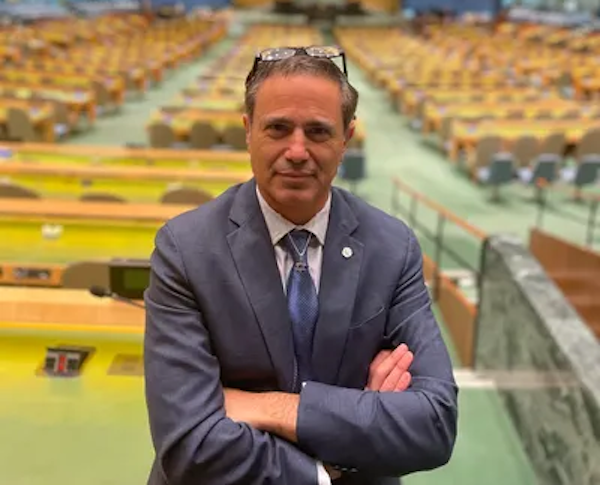
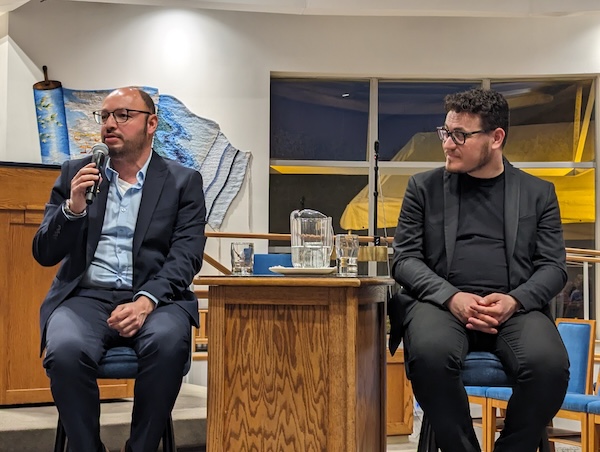
Dr. Gil Murciano of Mitvim, the Israeli Institute for Regional Foreign Policies, and Uri Weltmann of Standing Together, spoke April 17 at Temple Sholom. (photo by Pat Johnson)

For months, weekly rallies across Israel after Shabbat have demanded the return of the hostages from Gaza. These rallies have often coincided with separate protests, which have been going on much longer, against the government of Prime Minister Binyamin Netanyahu generally and its proposed judicial reforms specifically. These two streams of protesters have coalesced in recent weeks, according to an Israeli activist leader who spoke in Vancouver last week, because, he said, many Israelis are convinced that Netanyahu is not advancing freedom for the hostages, but hindering it, for his own political advantage.

Uri Weltmann, field organizer of Standing Together, made the claim April 17 during an event at Temple Sholom organized by New Israel Fund Canada. 

“What happened three weeks ago is that it stopped being two different protest movements,” said Weltmann. “They are basically changing their strategy. They are calling for early elections and for [Netanyahu’s] government to be removed and replaced with a different government. [Activists are] pointing their finger at him as the obstruction, as the obstacle toward advancing to a ceasefire agreement.”

Weltmann argues that Netanyahu is concerned not only for his political survival, but for his freedom.

“For Netanyahu, the protraction of this war, the continuation of this war, is in his political interest,” said Weltmann. “He knows that a temporary ceasefire might lead to a permanent ceasefire. A permanent ceasefire would mean an end to the war. An end to this war would bring an end to this coalition government because the extremists he huddled with have already said publicly that, if they will end the war before total victory, they will topple the government.”

The end of the current government and the ousting of Netanyahu, he said, would have more than just political ramifications for the prime minister, who opinion polls suggest would be soundly routed if an election were held now.

“New elections mean him losing the majority and him losing the majority is not only Netanyahu the politician being ousted from office. It’s also Netanyahu facing corruption charges, having his trial resume, [and he] might lose his personal liberty. For him, it’s intimately linked to the continuation of the war.”

The consensus among these activists is that Netanyahu is seeking to prolong the war and the captivity of the hostages to protect his political and personal interests, said Weltmann.

“It’s an incredibly important political development within Israel that a broad movement around the families and friends of the hostages have made this link,” he said.

Weltmann’s group, Standing Together (known in Hebrew and Arabic as Omdim Beyachad-Naqif Ma’an), was founded in 2015 and is one of the on-the-ground groups New Israel Fund supports.

Among the goals of the group is to build a grassroots movement for peace and progressive politics in Israel, including in rural and peripheral areas of the country. Making such a movement successful beyond the activist hub in Tel Aviv is the only way to advance Standing Together’s goals, Weltmann said. Even a more centrist or progressive government, if elected tomorrow, would not necessarily advance meaningful steps to peace and coexistence if there is not a broad popular movement in support of such a policy shift, he said.

Without a national movement for peace, he said, a new prime minister, however well-intentioned, would not feel the pressure to abandon the status quo and take steps for a changed future. 

“We must, as a strategic starting point in our process of progressive transformation of Israeli society, be present in the Negev, be present in the Galilee, be present in those parts of Israeli society that for too long have been the playing ground of the right-wing with left-wing actors completely non-present,” he said. “We must be there organizing local communities.”

Jewish citizens cannot do it by themselves, said Weltmann, and neither can Arab citizens. 

“We must have Jewish-Palestinian unity and cooperation within Israel for this change to be effective,” he said. An example of this strategy was a slogan adopted by a joint Jewish-Arab slate in Haifa during the recent municipal elections. The far-right Otzma Yehudit (Jewish Power) party of Itamar Ben-Gvir ran slates across the country trying to solidify the party’s roots at the civic level. The joint slate in Haifa played off Otzma Yehudit’s xenophobia with the slogan “Jewish Arab Power.”

“We are at a crossroads,” said Weltmann. “Every Israeli should choose which side am I on: the side that leads to a continuation of the status quo, a continuation of the state of affairs in which the Palestinians live in the occupied territories under military rule devoid of citizenship, devoid of rights, a situation that can lead to Oct. 7 one after another unless we put an end to it, or the reality of an Israeli-Palestinian peace that will guarantee both people safety, security and an imaginable, livable future?”

Weltmann spoke alongside Dr. Gil Murciano, an Iran expert and chief executive officer of the think-tank Mitvim, the Israeli Institute for Regional Foreign Policies, which one journalist has called “the diplomatic wing of the protest movement.”

Like Weltmann, Murciano longs for a “new majority” in Israel’s body politic. “A new majority that will allow us to advance toward a state where we live in peace, we live in dignity, we live in equality, without the occupation, without the injustices, throughout our society,” he said.

A fundamental shift in perspective is needed, argued Murciano.

“We used to speak about ‘wars of no choice’ in Israel,” he said. “We need to start thinking in terms of ‘peace of no choice.’”

On the one side, he said, the extreme right has a plan of annexation, with Bezalel Smotrich, Israel’s minister of finance and head of the far-right National Religious Party, calling for the government to “encourage” migration from Gaza to Egypt. On the other side, he said, since Oct. 7, people on the left have been motivated to seek an alternative to the status quo.

Dr. Maayan Kreitzman, a local food systems researcher and activist who moderated the event, challenged Murciano on this point. Rather than progressive voices calling for more coexistence, she said, she has heard the opposite. People that are “quite dovish” have had second thoughts about their worldview and transformed into a more hawkish, securitized attitude, she suggested.

Murciano acknowledged that all Israelis share one overriding priority. “For Israelis, it’s pretty clear,” he said. “The first, second and third priority of Israelis right now is security.”

That is a prerequisite to any advancement, he said.

Murciano proposes something he acknowledges to be “a little bit symbolic,” an international peace conference to kick off a new process between moderate Israelis and moderate Palestinians. This could be a first step to breaking an impasse that has existed in recent years, he said.

“Some people have described the last decade as the lost decade of Israeli diplomacy,” he said, a period where “conflict management” has been the priority; effectively, a maintenance of the status quo.

“I think that’s the right description, actually. It’s a strategy of not having a strategy,” said Murciano. “Coming to terms with the fact that there is no political way out and basically every couple of years we’re going to have a bit of violence.”

This approach sees Israelis forfeiting the initiative to Hezbollah and Hamas, he said, “Basically setting yourself in a situation where you only respond to a reality that is forced upon you.”

Oct. 7, he said, destroyed this conceptual framing.

Part of any future needs to include a multilateral project to “rebuild life-sustaining systems” in Gaza, he said, not a “peace-keeping force” but a “multinational force” that will be an on-the-ground part of a larger process toward peace and coexistence.

Ben Murane, executive director of New Israel Fund Canada, spoke of the emotional impacts of recent months.

“If you’re like me, what has been excruciating the past six months has been not just holding my pain, our Jewish pain, the pain of my Israeli coworkers, my family, my friends there, the pain of the Israeli people, but also, in my heart, holding the pain of the Palestinian people too,” he said.

Since the earliest days of the current war, Murane said, there have been countless glimmers of hope in the form of cross-cultural dialogue.

“In the first few months, we were astounded to see, across Israel, dozens of gatherings, conferences, events with hundreds of Jews and Palestinians standing together holding up those now-iconic purple signs saying ‘Jews and Arabs refuse to be enemies,’ ‘Jews and Arabs stand together’ or just simply ‘B’Yachad,’ together,” said Murane. “We were astounded to see Jewish citizens of Israel respond to the needs of the Palestinian citizens of Israel, Palestinian citizens of Israel making calls to families of the hostages, joint Jewish-Arab humanitarian aid missions to the south and to the north. As the war in Gaza accelerated, those Israeli voices also said, ‘We do have choices, even now. We have lots of choices with how we execute a just war justly.’”

Any long-term solution to the decades-long conflict must bring safety and dignity to both peoples, said Murane, “and anything else, anything short of fairness to both sides, will perpetuate this for another generation.”

New Israel Fund partners with and supports, according to its website, “organizations in Israel that fight for socioeconomic equality, religious freedom, civil and human rights, shared society and anti-racism, Palestinian citizens, and democracy itself.”

The April 17 event was hosted by Temple Sholom and co-sponsored by JSpaceCanada, which calls itself the advocacy voice of Liberal Zionism, Ameinu Canada, described as the voice of labour Zionism in Canada, and Canadian Friends of Peace Now, as well as the speakers’ organizations.

Rabbi Dan Moskovitz, senior rabbi at Temple Sholom, said he had received emails expressing concerns about hosting a perceived left-wing event. 

“I get the same emails when we host people to the right of centre,” he said. 

One of the purposes of a synagogue, he said, is to engage with ideas that “comfort the afflicted and afflict the comfortable.

“You may find your truth by agreeing with what you here tonight,” he said. “You may find your truth by disagreeing with what you hear tonight. The important part is to engage with it.”

Vancouver activist David Berson promoted the opportunity to listen to the Israeli guests as a chance to gain a perspective apart from the most common refrain he hears on social media and WhatsApp threads. 

“There’s another way you can look at what’s going on,” he told the Independent after the event. “Come out and hear a different perspective. I invited people to come tonight and listen to a different narrative.”

The 200 to 300 people at the event was about double what organizers had earlier expected, he said. 
A time for miracles

Hanukkah is a reminder that darkness can be transformed into light, and that miracles are possible.

With so much conflict, misery, anxiety and hopelessness in the world, we need some miracles.

There have been a few rays of hope in Israel in recent days – the release of hostages from Gaza has brought a world of relief to the families and friends of those freed and to Jews and others abroad. As a people, we will not rest until all those who have been kidnapped are returned home safely.

Even then, the war will likely continue, with the stated goal of eradicating Hamas. As catastrophic and heartbreaking as the war and the atrocities that sparked it have been, this is a single battle in a longer conflict that seems destined to go on, at least for the time being.

When we look at today’s events in the context of a larger history, it is understandable to conclude that things are not getting better, but worse. Silver linings in such a situation seem few and far between. To be honest, in this space we try to find something constructive and hopeful in every topic we confront, and it has rarely been more difficult than in the past two months.

As students of history, we can only offer this piece of hope: many times, in our individual lives, in the story of the world and in the 3,500 years of history of the Jewish people, seemingly intractable problems have been resolved in stunning and unexpected ways.

Consider three massive geopolitical examples that have happened in the living memory of most of us.

Many of us grew up under the shadow of nuclear catastrophe. Some of us may recall practising hiding under our desks in preparation for a nuclear explosion. All of us who are middle-aged or older certainly remember a world viewed as a binary of “us” (the capitalist West) and “them” (the communist East).

From the perspective of the child cowering under the desk, the idea that the defining global status quo would end not in a bang – the ultimate bang – but with the relatively peaceful dismantling of the Soviet Union and its client regimes, would have seemed unimaginable. The Cold War, which defined our worldview and, at times, threatened our very existence, ended peacefully more than 30 years ago. Just a short time before it did, nobody could have foreseen the unfolding of events.

Likewise, the end of the racist regime in South Africa and its apartheid institutions. One of the most venal systems ever imagined was ended not by bloody revolution, but by a relatively peaceful, collaborative transition to democratic majority rule.

A third example, the Irish conflict, understatedly referred to as the “Troubles,” largely ended with the successes of the Good Friday accords of 1998.

In all three of these instances, the resolution of what seemed like intractable, even existential, challenges were overcome with remarkably sudden and unanticipated events.

It should be noted as well that, in all three cases, events played out very much because of specific leaders who were involved, who took immense risks, were willing to compromise, and placed an immense amount of hope in the goodwill of their people to make their societies and, by extension, the world a better place.

We might say that we don’t see great figures on the horizon on either side of the conflict that presently consumes us with such intensity. But this is precisely the point. Vast historic changes have happened when least expected because movements and visionary individuals emerged and ushered in changes, upending the seemingly rigid status quo.

The Israeli leadership has promised that the current war will eliminate the terrorist autocrats who have run Gaza. The leadership in the West Bank is inevitably going to change before long as well, if only because the current president is aged 88.

Not incidentally, when this horrible war finally ends, Israelis will be undertaking a very serious review of recent events. It is entirely reasonable to expect significant changes at the top of both Israeli and Palestinian power structures in the very near future.

The truth is, in change there is hope. And, indeed, change is the only thing that is inevitable.

It might be also time to dig up an old chestnut from David Ben-Gurion, who said something that is relevant here not only because of the time of year – Hanukkah – but because of the time of history.

“In Israel, in order to be a realist, you must believe in miracles.” 

Contemplating the war

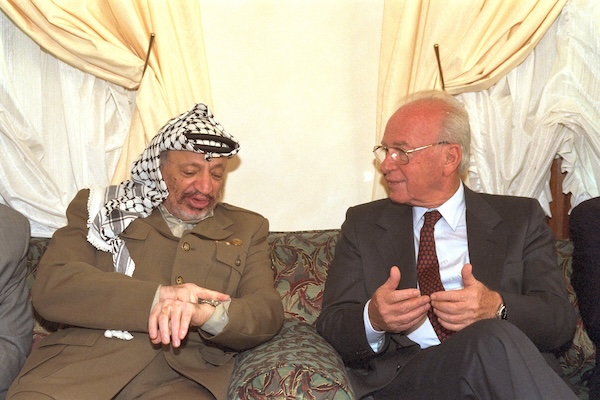
Prime Minister Yitzhak Rabin meets in Casablanca with PLO Chairman Yasser Arafat, 1994. (photo from flickr.com/photos/government_press_office/6324960139)

With all the darkness surrounding us since Oct 7, since the shattering of that tranquil Shabbat, have the people of Israel witnessed a miracle?

When Israel’s guard was fully down, when the south was under a vicious blitzkrieg by the monstrous Hamas, why did Hezbollah – with their 150,000 missiles pointed towards Israel – not exploit this excellent opportunity to open a second front? When Israel was existentially exposed, Hezbollah chose not to respond, at least not in any real-time, meaningful way. Complex geopolitical and military and conspiracy theories abound, attempting to explain why and why not. Pundits speculate and postulate and surmise. But maybe, just maybe, at some very esoteric level, the simplest and most logical answer, according to my close friend, a rabbi: it was a modern-day miracle. Pftt, pftt, pftt, as my great-grandmother would add.

***

The lights! Growing up, I was conditioned to shut the lights when leaving a room. I attempted to teach the same to my kids – and to my wife, although sometimes it seems she opens the lights when leaving a room. And then the missile sirens go off. Whoa! Slow it down. We have 90 seconds. Certainly time enough to shut the lights when racing to our shelter. My shouts muted by the screeching of the red alert, “Lights! Lights! Shut the lights!” I yell. To no avail, of course.

***

The day after … too soon to start thinking about it? That is where discussions about the war ultimately end up, each of us with our own theory, our own concerns, our own hopes. Once Israel achieves victory, in whatever form that takes, Gaza must then be rebuilt. But first it must be deradicalized – no more Hamas. Demilitarized – no more bombs hidden in schools, mosques and hospitals. And democratized – according to Winston Churchill, it’s the worst form of government … except for all others.

For this to succeed, Gaza should be divided into three cantons, similar to Germany, post-Second World War, each managed by a strong, Western or westward-looking country with enlightened self-interest for a stable and less radical Middle East. Maybe the United States. Maybe Britain. Maybe Germany. Maybe Egypt or Jordan. Escorted by a massive 21st-century Marshall-like plan. Maybe the Blinken Plan. Channeling the equivalent of $15 billion in 1948 purchasing power, that’s $191,569,917,012.48. OK, not that much, as the Gaza Strip is tiny compared to Germany, but enough funds to restore its economic infrastructure, to rebuild the Strip and rehabilitate its citizens, and make Gaza the Singapore of the Middle East – shipping, tourism, industry, maybe even offshore natural gas – like it could have become in 2005, when Israel fully withdrew. But then, what do I know.

***

Well before the day after, we need to take care of the Israeli hostages, including babies, children and octogenarians, both those still held in unknown condition by Hamas and other terrorists in Gaza, and those who have been returned. Interesting, but not necessarily surprising, is that neither the United Nations General Assembly nor UNICEF nor even the Red Cross demanded their unconditional release. Let alone a humanitarian visit.

As related by Liat Collins of the Jerusalem Post, Guelah Cohen – a 1980s right-wing parliamentarian, 2003 Israel Prize winner and mother of current senior Lukid lawmaker Tzachi Hanegbi – summarized this tragic situation best. Back during the First Lebanon War, when Tzachi was a combat solder, Cohen was asked what she would do if he were taken prisoner. She thoughtfully responded that, as a mother, she would be outside leading the protests to bring her son home, shouting with a megaphone outside the Prime Minister’s Office for the government to do anything and everything in its power to achieve his release. But, as a member of the government, she would be sitting quietly in the Prime Minister’s Office, advising him not to listen to the public. 

Prime Minister Yitzhak Rabin, during the controversial days of the 1993 Oslo Peace Accords process and accompanying Palestinian terror, said, “We must fight terrorism as if there’s no peace process and work for peace as if there’s no terror.” How utterly profound.

So, with the tragic circumstances of the hostages, the government must listen to the cries of the hostages’ families. But they also must lead and not be swayed by public opinion. The government must fight the war on Hamas as if there were no hostages and must, at the same time, bring all the hostages home. Alive.

***

As for economic recovery, I share a very micro, personal anecdote. About 18 months ago, we redid our condo, buying much of our furniture from BaKatzer, a wonderful and unique boutique furniture store located in a moshav (agricultural community) just outside the Gaza periphery, not too far from Ashkelon, which receives the brunt of the rockets from Gaza. While not the easiest of customers – I can be very demanding on price and service – I recently sent the owner a WhatsApp message. “Hey!” I wrote. “Hope all is well during these difficult times and hope to be back soon for more shopping.” Given my unforgiving consumerism, maybe she saw that as another threat. Alas, I can also be a very loyal consumer.

***

And there we were, my wife and I sitting around our Shabbat table with my daughter and her best friends, one with a brother who is a paratrooper and fighting in Gaza, the other an intelligence officer whose service was just extended, and still another, who was on a weekend leave from his Golani unit stationed up north. The conversation quickly moving from the trivial and benign to questioning and 

responding to issues and concerns that should be far away from them, that should not trouble the young minds of these 20-somethings, who should not deal with the complexities of miracles and hostages and day-after theories. Alas, there we were, talking of war and survival, looking hopefully to tomorrow. Am Israel chai. 

Bruce Brown is a Canadian and an Israeli. He made aliyah … a long time ago. He works in Israel’s high-tech sector by day and, in spurts, is a somewhat inspired writer by night. Brown is the winner of the 2019 AJPA Rockower Award for excellence in writing, and wrote the 1998 satire An Israeli is…. Brown reflects on life in Israel – political, social, economic and personal.

Hope amid the conflict

We are still reeling from what happened in Israel on Oct. 7 and the war that has ensued.

Hamas carried out a brutal terror attack on Israel that targeted civilians, murdering 1,400 people and kidnapping more than 200 Israeli hostages. Jews worldwide are grief-stricken, angry and scared. It is hard to see the hope, as images of dead Israelis mix with images of dead Palestinians.

There is no doubt in our minds that Hamas needs to be incapacitated – its covenant explicitly states their intention to eliminate Israel and kill Jews. On Oct. 7, they reasserted their intention with a vengeance that cannot be ignored. Their unambiguous goal is genocide.

Posters we see around Vancouver that simultaneously accuse Israel of genocide for defending itself and call for the genocide of Israelis – “From the river to the sea, Palestine will be free!” – are abhorrent. People who support Hamas’s genocidal actions, implying, or outright stating, that Israelis deserve such cruelty do not care about humanity, do not believe in peace.

The people who are putting up the posters that ask, “Do you support indigenous rights? Then you support Palestine” are implying that Jews are colonizers and, therefore, deserve to be expelled, no matter how. But the Jewish connection to the land goes back thousands of years; we were dispossessed of it but never ceded it.

There are some two million Palestinians in Gaza, and they cannot be similarly dispossessed. More than half the population has been asked to leave their homes. Reports are that more than 4,500 have been killed from Israel’s bombing campaign.

Our hearts break at the type of war that fighting Hamas entails. The terror group uses civilians and civilian infrastructure as shields, ensuring that hundreds or thousands of innocent Palestinians die every time Israel defends itself militarily, even when it adheres to international law in its actions, including allowing humanitarian aid into Gaza.

One way or another, the people who live between the river and sea must find a way to coexist. That is quite literally the only way forward. As simplistic as this sounds, it is nevertheless true. That is impossible with Hamas as the controlling force in Gaza. But, when they are removed, what then? Replacing the figures at the top – whether in Gaza or in the Israeli government, the latter of which is something that will certainly be discussed in the aftermath of this horror – will not automatically negate deep mutual distrust among populations.

There are so many complexities and no end of theories as to how we have arrived at this point. What will happen next is less discussed, though there is the all-too-real possibility that the conflict will become regional – already the 22,000 residents of Kiryat Shmona, the largest community in the Vancouver Jewish community’s partnership region of the Upper Galilee, are being evacuated because of terrorist attacks from Hezbollah in Lebanon, which are expected to increase once Israel begins its ground offensive in the south. Some fear that the Hamas attack is less the main event than a distraction, a trap to lure Israel into an even more existential fight on multiple fronts.

Closer to home, there are security threats to Jews in the diaspora. Thankfully, Hamas’s call for a day of rage on Oct. 13 did not result in serious incidents. But the fear is real, and that is the purpose of terrorism. Jewish organizations and law enforcement agencies are working together to keep us safe. We must continue to live our lives as Jews, and not hide.

Some of our local community members have gone to Israel to fight. Other community members are rallying, marching and postering to make sure that the Israeli hostages being held captive in Gaza are returned home. More than $15 million was raised for Israel in just two weeks by the Jewish Federation of Greater Vancouver’s emergency campaign.

And, there are Israelis (Jewish, Muslim, Christian and others) and Palestinians who, despite the terrorist attacks and the war, continue against so many odds to work for peace. Groups such as Standing Together, Women Wage Peace, the Parents Circle, and others are working to shore up hope for peace, equality and coexistence. These groups deserve our support, moral and financial.

At the same time as we support our family and friends in Israel and one another here, as we call for the immediate return of the hostages and as we raise funds for aid, we must also support those activists and dreamers on the ground who advocate for a better postwar world.

Gallup poll concerning

A Gallup poll released last week shows that, for the first time, Democratic voters in the United States sympathize more with Palestinians than with Israelis.

Among Democratic voters contacted, 49% sympathize more with the Palestinians and 38% with Israelis. Among Republicans, sympathy for Israel remains overwhelming, at 78%.

The poll should raise concerns – but not only for the most obvious reasons.

Halie Soifer, head of the Jewish Democratic Council of America, hit the nail on the head when she told the Jewish Telegraphic Agency that the question paints a false dichotomy. (First, though, she noted that the Democratic Party’s leadership is overwhelmingly pro-Israel, whether that is reflected across the grassroots or not.)

“Democrats – from President Biden on down – strongly support Israel’s safety and security,” she said. But, crucially, she added: “There is no contradiction between being pro-Israel and supporting Palestinian rights, which is why Democrats continue to support a two-state solution to the Israeli-Palestinian conflict, as well as security assistance for Israel and humanitarian assistance to the Palestinians. The Israeli-Palestinian conflict is not a zero-sum game, and thus polling that presents it as a binary choice is inherently flawed.”

Calling people on the telephone at dinnertime to ask them how to solve an intransigent international conflict is not likely to advance the most constructive ideas for resolution. Simplistic formulations are inevitable, nuance flies out the door. Questions become self-reinforcing, a sort of unintentional “push poll.” (A push poll is an unethical strategy used sometimes in political campaigns intended not to gauge public opinion but to influence it: “If you knew that Candidate A had a history of drowning puppies and pulling wings off flies, would that make you more or less likely to vote for them?”)

This is not to blame Gallup, an established and respected polling firm. Their question unfortunately, reflects a common narrative, an either/or. That, as Soifer said, is a false dichotomy.

To be genuinely pro-Israel demands we be pro-Palestinian because finding a resolution to 75-plus years of conflict requires some sort of resolution to the statelessness of Palestinians. Equally, being pro-Palestinian demands we be pro-Israel, because compromise and coexistence is the only thing that will result in Palestinian self-determination.

Of course, acknowledging this is the easy part. How to behave in “pro-Israel” and “pro-Palestinian” ways is the muddy part. Those who call themselves “pro-Palestinian” often behave in ways that preclude the very thing they claim to advance. By denying Israel’s right to exist, for example, they ensure that compromise is taken off the table and, since that is the route to Palestinian self-determination, they betray the very definition of “pro-Palestinian.”

Those who are “pro-Israel” also need to temper their extremes. It is fair to say that, during the Oslo process, Israelis demonstrated a consensus toward coexistence that has understandably waned since the violence of the Second Intifada. But, for example, the common and senseless mantra we see from some commentators on social media that “there is no such thing as a Palestinian people” is a fruitless – and racist – squabble. Deny their history, reject the legitimacy of their land claims – there are still people there whose present and future demands a serious form of address and dignity.

To be clear: the sometimes-stated idea that the status quo cannot hold is simply not true. It has, by and large, held since 1967 and it could continue for another generation or more unless mutual compromise emerges to change that. The status quo arguably harms Palestinians more than it harms Israelis, which has led to an assumption that Israel must be in favour of the status quo. As a consequence, overseas activists have blamed Israel for the situation on the assumption that, as the perceived powerful party, it is the only one that can break the impasse. This is partly, if not mostly, untrue. Compromise must come from both sides and chants like “From the river to the sea …” and “Intifada! Revolution! There is only one solution!” the latter of which echoes Nazi slogans, will not “free Palestine.” They will, however, influence public opinion.

We should be concerned by the results of the Gallup poll – it indicates that decades of building multilateral support for Israel’s security among Americans (and, by extension almost certainly Canadians and Europeans) is failing. But, we should be concerned for another reason. It reinforces a false belief that we can only call ourselves pro-Israel or pro-Palestinian. Until we can legitimately call ourselves both, none of us deserves to call ourselves “pro-peace.”

Peace is breaking out

Avi Benlolo will screen a film at Beth Israel on Feb. 13. (PR photo)

There is a fundamental disconnect between what is happening in the Middle East and what observers in Europe and North America perceive, according to Avi Benlolo, founder and chairman of the Abraham Global Peace Initiative. He aims to close that gap, and will be in Vancouver next month to bring his message – and a new documentary film – to West Coast audiences.

“Peace is unfolding in the Middle East,” Benlolo told the Independent. “The Abraham Accords have completely revolutionized Israel’s relationship with some of the neighbouring countries like the [United Arab Emirates], Bahrain, Morocco and so on. This new development hasn’t yet registered here in the West.”

On university campuses and in the social movements of Europe and North America, he said, the narrative remains mired in the decades-old conflict and tired rhetoric of “apartheid,” “colonization” and BDS, the movement to boycott, divest from and sanction the state of Israel.

“The truth of the matter is that that rhetoric isn’t rhetoric in the Middle East,” Benlolo said. “In the Middle East, BDS is nonexistent. You now have trade in the billions of dollars between Israel and its Arab neighbours, so clearly BDS has lost.”

The film that Benlolo produced and directed, The Future of Israel and its Defenders, approaches the issues through the lenses of experts, military strategists, entrepreneurial leaders, journalists and current and former political leaders.

“The message I’m trying to transmit,” he said, “is one really of hope for change.… If we are reinforcing that message that this is happening, that will help build on the peace process.”

A growing global realization of Mideast peace will also help reduce antisemitism and empower Jews, especially young people, everywhere, Benlolo hopes.

The film will be screened, and Benlolo will participate in a question-and-answer session, at Congregation Beth Israel Feb. 13, 7 p.m., in a celebration of Israel’s 75th birthday.

Benlolo founded the Abraham Global Peace Initiative after many years of working in the Jewish communal sector, including as chief executive officer of Friends of Simon Wiesenthal Centre for Holocaust Studies. AGPI became a registered charity in late 2021.

While there are many Jewish and Zionist organizations in Canada, Benlolo said his is unique.

“There is no voice for Canadian Jews internationally,” he said. “We are taking the Canadian voice global and working with the United Nations, working with the [European Union], working with multiple leaders around the world. Antisemitism and defamation of Israel is a transnational phenomenon. The swastika that you see painted on a school wall is not just localized, it’s being motivated globally.

“We are also saying, we as Canadians can stand up for ourselves,” Benlolo continued. “Canada itself is an incredible brand globally…. What AGPI is doing is optimizing the Canadian brand and we’re doing it very successfully. Every two minutes – I’m not exaggerating – there is a subscriber onto our website from somewhere on the planet, Italy, Brazil. Every two minutes. That’s because people love the Canadian brand, they love everything that we are saying, so we can be, as Canadians, an international voice with quite tremendous strength.”

While Benlolo is hoping that the Abraham Accords mute some of the condemnation Israel experiences on the world stage, defending Israel’s rights internationally may be entering a new phase, he said. The old tropes are being replaced with the phrase “Israel’s most right-wing government ever,” including in mainstream media sources.

“It’s a challenge, I’m not going to kid you,” said Benlolo. “The thing is, the media is never a fan of Israel, particularly here in Canada, outside of the National Post and maybe the Jewish [community] media. They are using any opportunity to grab hold and to make Israel look bad. They love it.”

The characterization of Israel’s new government clouds the reality, he argued. Israelis who voted for right-wing parties did so mainly on security grounds, he said, because they are deeply concerned about terrorism.

“That has driven them to move to the right,” he said, adding that Israeli society in general “is fairly secular, is not right-wing and is very pro-human rights.” He noted that the new Knesset features the country’s first openly gay speaker.

“Just because you’ve got this government right now that’s made up of a coalition doesn’t mean that it represents Israeli society and it doesn’t mean that it’s everybody in Israel that believes in this. That needs to be articulated as well,” said Benlolo. “Finally, we’re going to put pressure to bear as a Jewish community and friends of Israel, we’re going to continue to pressure Israel to make sure that it stays the course and stays true to tikkun olam.”

More details, and tickets for the event, which is presented by Beth Israel and the Jewish Federation of Greater Vancouver, are available at bethisrael.ca.

ההגירה מישראל לקנדה צפויה לגדול

(IDF Spokesperson’s Unit / CC BY-SA 3.0: צילום)

לאור תוצאות הבחירות הכלליות האחרונות שנערכו בישראל בראשית חודש נובמבר, צפוי שההגירה אל קנדה תגדל. יש ישראלים שיתייאשו מהמצב החדש בישראל, כאשר ממשלת ימין קמה בהשתתפות המפלגה הימנית קיצונית הציונות הדתית, והם מבקשים לעזוב את ישראל. כך ישראלים מתבטאים בפייסבוק

בשנים האחרונות ההגירה מישראל לקנדה נמצאת במגמת עלייה ועתה צפוי שיותר ישראלים יעברו אליה. לפי פייסבוק תומכי בנימין נתניהו, שקראו למתנגדיו “שמאלנים בוגדים” קוראים להם עכשיו “שמאלנים למטוסים”. ואכן יש סברה ישראלים לא מעטים יעזבו לחו”ל. אחד אנשי הימין כתב בפייסבוק: “לאור תוצאות הבחירות אנשי השמאל עוזבים את הארץ ולכן משבר הדיור מגיע לקיצו”. אחר מאלה שרוצים לעזוב שואל באמצעות פייסבוק: “איך עוזבים את ישראל ומהר?” התגובות: “מבקשים מקלט מדיני, משיגים דרכון פורטוגלי, זה הרבה יותר קל ממה שחושבים”. משפחה ישראלית שעברה להליפקס לפני חמש שנים כותבת בפייסבוק לאחר קיום הבחירות: “למדנו לאהוב את החיים כאן בקנדה. את השלווה, את הנופים, את האדיבות ואת השקט. אז נכון שלא הכל מושלם. ולא הכל קל. ולא הכל מרגישים שייכים. אבל בשורה התחתונה, מרגיש שכנראה עשינו את הדבר הנכון. ישראל עומדת היום בצומת דרכים, ואים להסתמך על הבחירות האחרונות, כנראה שאנחנו כבר אחרי הפניה”. תומך נתניהו שואל בפייסבוק היכן הם אלה שטענו כי אם ביבי חוזר הם יעזבו את הארץ?”

כאשר היאוש גבר ולא רואים אופטימיות בטווח הקצר או אפילו הרחוק יותר, וכאשר ערכי הדמוקרטיה של ישראל הולכים ונמסים ולעומתם ערכים ימניים קיצוניים שתופסים מקום מרכזי במדינה, יש כאלה החושבים שהגיע הזמן לעזוב. כאמור קנדה היא אחד היעדים החמים בעולם כיום עבור ישראלים, שלא רוצים לעבור לאירופה או לארצות הברית

חברת דיווידשילד המתמחה במתן שירותי ביטוח עבור ישראלים הגרים בחו”ל, מסבירה מי זו קנדה: מדובר במדינה הצפונית ביותר בצפון אמריקה, המעוררת אצל רבים אסוציאציות של קור ושלג, אבל במציאות מדובר באחת המדינות הנחשקות בעולם להגירה ולרילוקיישן עם אוכלוסייה רב תרבותית, כלכלה יציבה, טבע מרהיב, נופים עוצרי נשימה ואיכות חיים גבוהה. קנדה נחשבת לאחת ממדינות ההגירה הפופולריות ביותר בקרב ישראלים, אם זה בזכות הכלכלה החזקה שלה, אפשרויות התעסוקה הרבות, קשרי המסחר הטובים ואיכות החיים הגבוהה. קנדה נחשבה למדינה ליברלית בעלת חוקי הגירה נוחים מאוד, שמטרתם למשוך אליה כוח עבודה משכיל ומקצועי. במהלך השנים עברה מדיניות ההגירה הקנדית שינויים רבים וכיום היא מתבססת בעיקר על קריטריונים כמו השכלה, גיל, ניסיון מקצועי ושליטה בשפות. המקצועות המבוקשים בקנדה, שעבורם הסיכוי הגדול ביותר לקבל אישור עבודה, הם בתחומים הבאים: רפואה וסיעוד, מחשבים, הנדסה, חינוך לגיל הרך, מרצים באקדמיה, תרגום, פסיכולוגיה וניהול בכיר

קנדה היא מדינה ענקית, השנייה בגודלה בעולם, עם צפיפות אוכלוסייה קטנה יחסית לשטחה הגדול – מה שמהווה אטרקטיביות רבה עבור ישראלים המעוניינים ברילוקיישן. כלכלתה של קנדה נחשבת ליציבה מאוד, שוק העבודה מגוון ושכר העבודה נחשב גבוה ביחס לשעות העבודה

אפשרויות התעסוקה בקנדה עבור מהגרים ישראלים נעות בין עבודות של צעירים, כמו: עבודה בעגלות ובמכירות, עבודת שיפוצים, טיפול בילדים והדרכות נוער בקהילות היהודיות; ועד משרות בחברות ההייטק הגדולות, בתחומים כמו הנדסת תוכנה; כמו כן, משרות בתחומי הסיעוד והרפואה בבתי החולים המתקדמים ביותר בקנדה

ישראלים המעוניינים ברילוקיישן לקנדה צריכים קודם כל למצוא מעסיק חוקי שידאג עבורם לויזת עבודה. החברה המעסיקה צריכה להיות בעלת משרדים הנמצאים בקנדה ועליה לקבל היתר ממשרד העבודה הקנדי להעסקת עובד שאינו קנדי

עם איכות חיים גבוהה, שירותי בריאות טובים, חינוך איכותי, כלכלה יציבה, חברה מקבלת, קהילה יהודית ענפה, שיעור פשיעה נמוך יחסית וטבע מרהיב – החיים בקנדה נחשבים בהחלט לנוחים ומלאי הזדמנויות

מערכת הבריאות בקנדה נחשבת לאחת מהטובות בעולם ומורכבת בעיקרה ממערכת ציבורית, הממומנת על ידי הציבור (בקנדה אין כמעט בכלל רפואה פרטית, כולל בתי החולים). כל אזרח קנדי, מהגר או תושב קבע זכאי לכיסוי רפואי מלא, כלומר כל ביקור רפואי, אשפוז בבית חולים וביצוע בדיקות רפואיות ניתן בחינם ובאופן שוויוני (למעט תרופות וטיפולי שיניים). העובדה כי כל השירותים הרפואיים ניתנים בחינם, אינה גורעת מאיכותם – ההפך: תקציב הבריאות בקנדה הוא גבוה מאוד, מה שמבטיח שירותים רפואיים איכותיים ויחס אישי

הדבר הראשון שעליכם לחשוב עליו כאשר אתם מתכננים מעבר מגורים לקנדה הוא כמובן עניין המגורים. אם אתם נשלחים לרילוקיישן, סביר להניח שהחברה המעסיקה תדאג עבורכם למגורים מסובסדים על חשבונה באזור העבודה. אם אתם עצמאיים או שעליכם למצוא מקום מגורים בכוחות עצמכם, זכרו כי גובה שכר הדירה משתנה בהתאם לאזור המגורים, הביקוש וסוג הדירה. פעמים רבות משתלם יותר לבחור במקום מגורים מעט רחוק מהמרכז ולהשתמש בתחבורה הציבורית היעילה

עניין נוסף שיש לדאוג לגביו כאשר עוברים עם ילדים לקנדה הוא החינוך. קנדה נחשבת למדינה שמשקיעה רבות בחינוך ומערכת החינוך שלה נחשבת לאחת הטובות בעולם. בקנדה יש מבחר גדול של בתי ספר ציבוריים ולצדם בתי ספר פרטיים, חלקם הגדול הוא בתי ספר יהודיים. ההרשמה לבתי הספר נעשית ישירות דרך מוסד הלימודים

הבחירה בין חינוך ציבורי ופרטי תלוי בשיקולים אישיים וכלכליים, אך שתי האופציות יבטיחו לילדכם חינוך איכותי. הלימודים במערכת הציבורית הם ליברלים יותר ויחשפו את ילדיכם למפגשים עם תלמידים ממגוונים אתניים שונים. הלימודים במערכת החינוך היהודית הפרטית אינם זולים וכוללים לצד הלימודים במקצועות הכלליים גם לימודי עברית ויהדות. חשוב לדעת, כי כל תלמיד חדש הנכנס למערכת החינוך הקנדית צריך לעבור מבחן באנגלית ובמתמטיקה כדי לקבוע את רמתו. מומלץ לקבוע מועד לראיון עוד בטרם הגעתכם לקנדה

אם חשובה לכם הקהילתיות, השמירה על הצביון היהודי והקרבה לישראלים נוספים, בקנדה אתם בהחלט תרגישו בבית. יהדות קנדה היא הרביעית בגודלה בעולם (אחרי ארה”ב, צרפת וישראל) וכיום חיים בקנדה למעלה מארבע מאות אלף יהודים. הקהילות היהודיות במדינה נחשבות מפותחות מאוד, בעלות קשרי קהילה חזקים והן מעניקות תמיכה רבה וסיוע למהגרים חדשים. המוקד המרכזי של ישראלים בקנדה היא העיר טורנטו, העיר הגדולה בקנדה ובירת מחוז אונטריו, בה מתגוררת הקהילה היהודית כוללת כמאתיים אלף אלף יהודים. יעד נוסף מרכזי עבור מהגרים ישראלים היא העיר מונטריאול הנמצאת במחוז קוויבק, המחוז הגדול בקנדה. במונטריאול נמצאת הקהילה היהודית השניה בגודלה בקנדה שמונה קרוב לכמאה אלף איש. בערים נוספות שבהן תמצאו קהילות יהודיות הן: ונקובר, ויניפג, אוטווה וקלגרי

מעבר מגורים עם כל המשפחה הוא לא קל אף פעם, אבל כשמדובר במדינה כמו קנדה סביר כי לצד קשיי המעבר, תחוו קליטה נעימה בזכות החברה הקנדית המקבלת והקהילה היהודית והישראלית המחבקת. עם זאת, יש לקחת בחשבון את כל ההשלכות והאתגרים העומדים בפניכם בעת מעבר למדינה רחוקה וקרה כמו קנדה

קושי נוסף עמו אתם צפויים להתמודד הוא מזג האוויר. קנדה היא מדינה קרה מאוד, עם חורף סוער וטמפרטורות שצונחות אל מתחת לאפס, לישראלים המגיעים ממדינה חמה לוקח זמן להתרגל לקור הקנדי. היתרון כאן הוא שכל שנה תזכו לראות שלג, הילדים יוכלו לבנות בובות שלג וללמוד לגלוש

Extremism not helpful

Over the Labour Day weekend, while many Canadians were soaking up the declining rays of summer or doing last-minute back-to-school shopping, Middle East politics eclipsed everything else – well, for those of us who track these things closely, which, it turns out includes Jagmeet Singh, leader of Canada’s New Democratic Party.

In fairness, it is not clear when Singh hit send on an email that made the rounds over the holiday weekend. But the contents led the Centre for Israel and Jewish Affairs to send out not one but two urgent emails on the issue, both of which included the word “outraged” in the subject line.

And “outrage” is a fair reaction to the contents of Singh’s missive.

“We believe Israel’s illegal occupation of the Palestinian territories is at the centre of the challenges facing the Palestinian and Israeli people,” wrote Singh. This essentialist view ignores the reality that the occupation continues due to a complex interplay between anti-Israel terrorism, a lack of political will, and intractability around a two-state solution or some other coexistence plan that would lead to greater peace, which includes a lack of willingness to coexist from factions on both sides of the conflict.

“We all want to see a future where Israelis and Palestinians can live side by side, in peace,” Singh writes. But then he goes on to outline a list of grievances that places responsibility only on Israelis and which, therefore, is unlikely to do anything to realize such a future.

The demands include that the Canadian government increase funding to the United Nations Relief and Works Agency, “which supports Palestinian refugees.” The letter makes no reference to the controversial nature of UNRWA’s definition of refugees, which has refugee status passing down generations, thereby continually increasing their number, perpetuating rather than ameliorating the problem. Nor does the NDP letter mention the organization’s Palestinian education curriculum, which contains antisemitic elements that directly impede any progress towards peace in the region; allegations of corruption and mismanagement of the agency; and even UNWRA’s witting or unwitting aid of the terrorist group Hamas, with tunnels reportedly being found under UNRWA schools and rockets stored on their premises. Instead, the letter calls on Canada to “condemn the Israeli government’s attacks on civil society in Israel and Palestine, including the recent designation of six Palestinian human rights groups as ‘terrorist.’”

There are wishes for “peace in Israel and Palestine” in the NDP letter, but the lack of peace is blamed solely on one side, without acknowledging the violence and harms inflicted on Israelis. The fundamental fact of the issue is that no blatantly one-sided position will make things better for either Palestinians or Israelis and any position that places all the blame on one side will not lead to a resolution. Such a stance will only perpetuate conflict. Peace and coexistence in that region will depend on compromise on both sides.

In the larger scheme of world events, an imbalanced missive from the leader of a Canadian political party is largely irrelevant. Singh’s catalogue of blame will move the dial in Israel and Palestine not an inch. What it does is inflame the issue here at home and reinforce the trend in Canadian politics that sees this issue as a political football. At the same time as there are legitimate and important critiques of Israel’s behaviour and treatment of Palestinians, particularly those under occupation, Jewish self-determination should not be anyone’s campaign talking point.

There is a lesson here for those who support Israel, too. There is a strain that sees Israel supporters as more moral, more fair and more realistic than the activists who march against “apartheid,” “genocide” and what Palestinian leader Mahmoud Abbas recently called “50 holocausts” against Palestinians. However, the incessant and dishonourable contesting of the very existence of Palestinian people – if you haven’t seen it, you’re not on Jewish social media – does nothing to advance the cause of Jewish self-determination or end the human suffering or move anyone towards peace.

Extremism is not a Canadian value, nor a Jewish one  – and it will not result in an end to the Israeli-Palestinian conflict. Nor will it solve any of the countless challenges we are facing around the world. We need to resist the attraction of simplistic solutions to complex human problems. We need to do, think and behave better. And we need to demand that our leaders to do so, as well.

Play tackles Israeli/Palestinian conflict

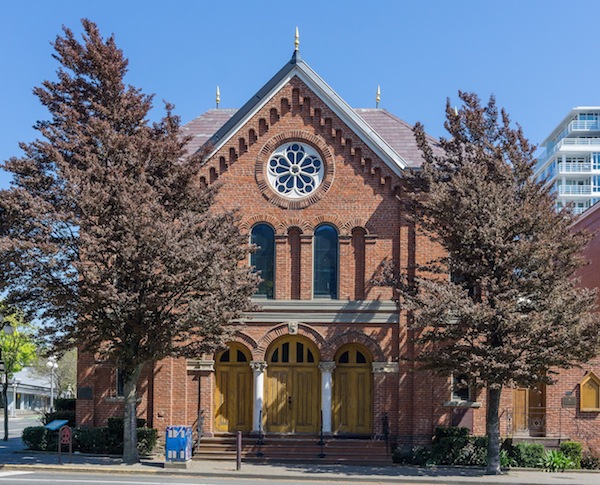
Congregation Emanu-El Synagogue (photo from Bema Productions)

Bema Productions, directed by Zelda Dean, is bringing the play Peace Talks to the Victoria Fringe Festival, Aug. 25-Sept. 4. Performances will take place at Congregation Emanu-El Synagogue’s Black Box Theatre, 1461 Blanshard St., pictured above.

Written and performed by Izzy Salant and Ryan Dunn, this run will be a world première of the work that saw a virtual staged reading in early 2021. Since that time, the playwrights continued to develop their play and raise the necessary funds to meet their goal of touring the show to university and college campuses in both Canada and the United States.

Peace Talks addresses the Israeli/Palestinian conflict. Noam watches helplessly as his best friend Andrew dies in an explosion right in front of him in a hookah bar in Israel. Noam believes he was responsible. After the catastrophe, Andrew’s bereaved American brother James sets out on a revenge plot against Israel and against Noam, as he also believes Noam is responsible for Andrew’s death. He puts his plan into action, actively sabotaging Israeli advocacy and promoting anti-Zionism to anyone who will listen, ultimately attempting to attain his true goal: to kill Noam.

James and Noam find themselves in a bitter internal and external struggle with Israel, Zionism, death, human rights, and Andrew’s memory. As they clash, they both discover some harsh realities of the Israeli/Palestinian conflict and that it is a world that isn’t as clear-cut as they thought.

For tickets to Peace Talks, visit victoriafringe.com.

– Courtesy Bema Productions

Diverse allies critical

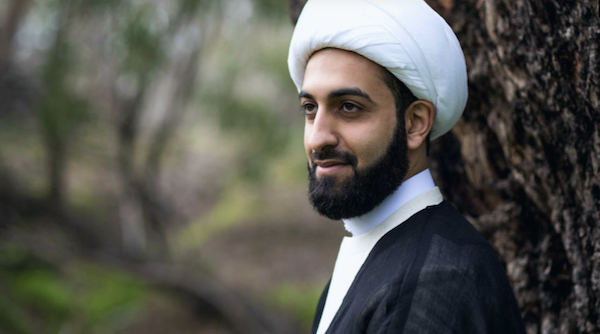
Imam Mohammed Tawhidi once preached hatred, but now is known as “the Imam of Peace.” (photo from imamtawhidi.com)

Imam Mohammad Tawhidi once preached hate towards Jews from the pulpit, and believed the very worst stereotypes about the Jewish people. He was indoctrinated by the Ayatollah’s preachers in Iran. But, today, Tawhidi is known as “the Imam of Peace” for a reason. He’s preaching coexistence and common ground for Jews and Muslims.

In late May, Tawhidi spoke at a United Grassroots Movement event at Beth Emeth Bais Yehuda, a Toronto synagogue, on how people of all backgrounds can – and should – unite against antisemitism and extremism.

An Iranian Muslim of Iraqi origin, Tawhidi sees his former peers actively engaging in hate-filled rhetoric. For example, as in years past, the politics of division and derision were widespread at the Al Quds march in Toronto earlier this year – chants included slurs against Israel and Jews.

Government officials are either incapable of preventing hatred on city streets and property, or unwilling to do so, he said. To answer problems such as these, he encouraged talk attendees to find, and bring together, as many allies as possible, to speak out and even take legal action wherever warranted.

Tawhidi’s change from preaching hatred, to becoming a friend of Israel and the Jews, did not come overnight.

First, he spoke out against ISIS war crimes in the Middle East and Africa. When he was met with condemnation from his peers, he said it opened his eyes to the radical elements that existed within his circle.

“I was still a fundamentalist, an extremist and antisemite,” he said of his views until then. “I thought I was doing this on behalf of God.”

And yet, he began thinking of how he could reconcile the slaughter of innocents in the name of Islam.

The next significant moment for the imam was when he met a Jew. Needing roadside assistance one day in England, it was a visibly Jewish man who helped him.

Later, Tawhidi was invited to a synagogue for an interfaith dialogue. Although he was skeptical, initially, of the people he was communicating with, he left the event feeling a special connection.

His decision to criticize ISIS and radical Islam and preach for peace with Israel and Jewish people was met with a severe backlash.

“I knew I would lose my community, but I also knew I would be welcomed into a new one,” he said.

If he could turn a corner, so can others, Tawhidi maintained. But if they can’t do quite that, then it’s important, he said, to at least defend the truth in public, so that the people who are on the fence or ignorant of the issues can be exposed to all sides.

It’s hopeful for us to note, he said, that the kinds of beliefs he once held are no longer normative in many parts of the Arab world. He highlighted the signatories to the Abraham Accords with Israel, which is breathing new life into modern coexistence, he said.

Further proof of the power of allies, said Tawhidi, is that he received nearly three-quarters of the vote in favour of him winning the position of vice-president of the Global Imams Council, a transnational nongovernmental body of Muslim religious leaders.

Tawhidi stresses that Islam is not a religion that hates Jews, and anything to the contrary is a perversion of the Quran.

To defend against antisemitism, he insisted that Jews and non-Jews must call it out, take legal action when merited, and bring together many communities: “Do not underestimate the power of your allies!” he said.

A staunch supporter of Israel and what he sees as Israel’s right to Judea and Samaria (the West Bank), Tawhidi said, in response to a question from the Jewish Independent, “There can be no circumstances where the Israeli government should give away any land that belongs to the Jewish people. The holy Quran has made it very clear that God, the God of Abraham, wants Jews to live in that region and for Jerusalem to be their capital. That is the teaching of my Quran, and it is clearly stated in Chapter 5, verse 20 onwards.”

As for developing allies out of those who do not support Israel, yet will speak out against antisemitism, Tawhidi said, “You can’t hate a people and you can’t hate a whole country, but I guess they have issues with certain policies of that government, so they need to provide productive and constructive criticism, so that the problems can be solved, and that solutions can be placed forward.”

However, he continued, “a blanket hate on a nation or a people does not come from a person that is worth making a friend, I don’t believe.”

Jon Wasserlauf is a freelance writer, and a political science major and law student based in Montreal.