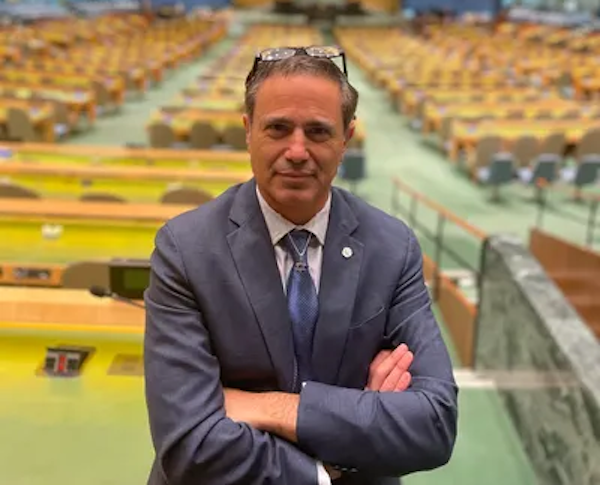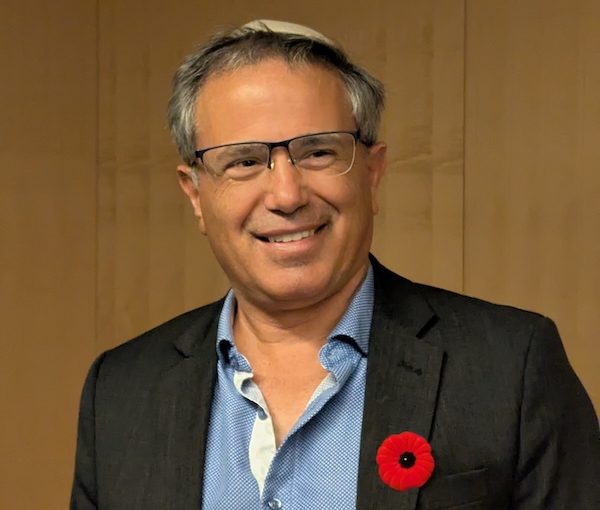
Avi Benlolo of the Abraham Global Peace Initiative was in Vancouver Nov. 5 to screen the AGPI’s new film, Heart of Courage, about Jewish resilience in the wake of the Oct. 7, 2023, terror attacks. (photo by Pat Johnson)
Against a “tsunami” of anti-Israel and antisemitic content online and in the broader society, Jews and pro-Israel voices need to do a better job getting their message out, according to Avi Benlolo.
Benlolo is founding chair and chief executive officer of the Abraham Global Peace Initiative (AGPI), whose mandate is to study and research international human rights, fundamental freedoms, democracy, global peace and civil society in Canada, Israel and around the world. He was previously founding president and CEO of Friends of Simon Wiesenthal Centre and writes weekly in the
National Post. He was in Vancouver screening AGPI’s new 40-minute film, Heart of Courage and spoke with Rabbi Jonathan Infeld at Congregation Beth Israel Nov. 5. He was introduced by Diane Friedman, the congregation’s adult program director.
The film features a soldier playing John Lennon’s “Imagine” on a piano in Tel Aviv’s Hostages Square.
“His music becomes his voice, a testament to the resilience of his spirit and the strength of his people,” the narrator intones. “His teary eyes remain wide open, reflecting the weight of his generation’s struggle. He plays for a world he longs to see, a world of peace. In that moment, his dreams reach beyond the darkness, yet his resolve remains unshaken. This soldier is part of a chain, a line of defenders stretching back through history, each bound by an unyielding commitment to Israel’s survival.”
Produced prior to the ceasefire, the film includes Benlolo interviewing people at the weekly rallies that drew hundreds of thousands of people in Tel Aviv, many of them family members of hostages. Some have risen to prominence as voices for those held in Gaza and their relatives.
Benlolo visits an art installation that serves as a memorial monument adjacent to the Ministry of Foreign Affairs’ building in Jerusalem. The work, titled “Memory Pomegranate 7.10.2023,” is a sculpture of a pomegranate with multi-coloured glass and ceramics, visual shards and fragments that metaphorically reference broken lives, trauma and loss, but together form a hopeful whole, emphasizing life, resilience and collective memory. The artwork integrates electronic tags that allow a smartphone or other device to access digital content to learn more about the events of 10/7 and the people and communities affected.
Sharing stories of non-Jews who saved lives on 10/7, the film declares, “In Israel, heroism knows no bounds of religion, ethnicity or background. On Oct. 7, amid the chaos, countless stories emerged of Muslims, Druze, Christians and Bedouins risking everything to protect their fellow citizens.”
After the screening, Benlolo and Infeld spoke of the hurdles to getting the message out.
Benlolo, who has worked extensively in multicultural and interfaith sectors, plans to screen Heart of Courage for diverse audiences, as his organization has done with previous films.
The biggest challenge, Benlolo said, may be reaching younger audiences, for whom anti-Israel activism has become “cool.”
“We have to go to them and get to them through the technology that exists today,” he said. “Social media in particular.”
This presents its own challenges, he noted, as there is a “tsunami” of anti-Israel and antisemitic content.
The silver lining of this era, according to Benlolo, is a new generation of engaged Jewish young people.
“What we all saw as a result of Oct. 7 was Jewish youth for the first time ever walking proudly with Magen Davids around their necks, fighting back, distancing themselves from people who have rejected them and reject the state of Israel,” he said.
While the film paints a picture of a unified Israeli society, Benlolo acknowledged divisions, rifts that will likely be exacerbated in next year’s national elections.
One of the most visible points of discord is the debate over Haredi conscription. Benlolo is unequivocal on this topic. Asked by Infeld what he would say to the Haredi community, Benlolo said, “What’s wrong with you? I mean, honestly.… To not participate in defending the country and to insist that others do it for you, I think, is wrong.”
Benlolo also pulled no punches on issues closer to home. He said Canada’s government is “pretty much siding with Hamas” and other leaders, such as Toronto’s mayor, are “emboldening the other side.” This inspires violent people to act out, he said, citing a vicious attack on Jewish students near Toronto Metropolitan University earlier that day.
“What gives them permission to do that?” Benlolo asked. “It’s the environment that feeds it. It’s the political leadership that allows it. That is the central problem.”
Responding to a question from Infeld on the future of Jewish life in Canada, Benlolo noted that Jewish schools and other institutions in parts of Europe are protected by armed guards and he warned that North American Jews may find themselves “in a much more defensive posture.”
“I can’t promise you that there’s going to be a good future here in Canada,” he said. “But, in Israel, at least, we have an ability to wear the uniform and protect ourselves, and that’s an important distinction. It doesn’t mean Israel is 100% safe, as we all know, it doesn’t mean that’s an easy life, but at least it’s a place where we can stand up for ourselves.”
He has plenty of hopefulness for Israel.
“I think that the next chapter for Israel is an optimistic one,” he said, suggesting that more countries will normalize relations with Israel and join the Abraham Accords. He suggests also that Israel’s economy will skyrocket, in part because of all the technology developed as a result of the war. He also predicts continued increasing levels of aliyah.