Settling in at Waldman Library

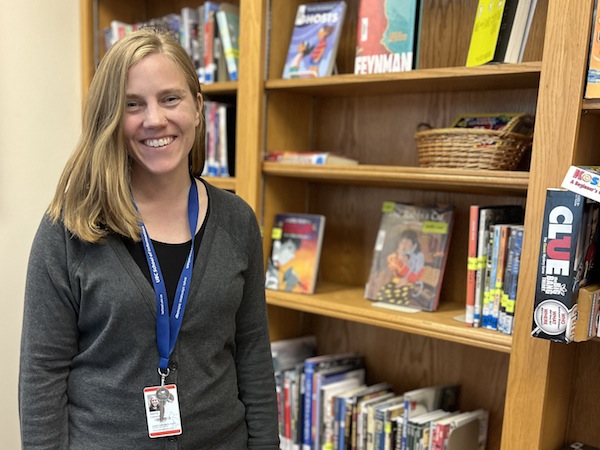
Maiya Letourneau has been head librarian of the Isaac Waldman Jewish Public Library since last November. (photo from Maiya Letourneau)

Maiya Letourneau, head librarian of the Isaac Waldman Jewish Public Library in the Jewish Community Centre of Greater Vancouver, has always wanted to work with books. “I grew up in Winnipeg,” she said. “My mom worked in a bookstore, and I always liked books.”

Letourneau received a bachelor’s degree in education before completing the two-year library program at the University of British Columbia last summer. Since November 2021, she has been head librarian at the Waldman.

“When I learned about the job at the JCC library, I was excited,” she told the Independent. “I often went to the JCC in Winnipeg as a child, and to work at the JCC in Vancouver felt like a great opportunity to reconnect. And to work with books was all I wanted.”

Before she started this job, Letourneau worked as a student librarian at UBC and as a teacher-librarian at the Vancouver School Board. “A teacher-librarian is a great job,” she said. “You teach the children how to use a library, both its paper and its digital resources. I worked with the elementary school children. We had story times often, and I taught them how to ask questions about the stories we read.”

Letourneau considers reading one of the highest needs and pleasures of any human being. “Not every school has a library,” she said, “but I think all schools should have one. It helps with students’ literacy rates. Reading helps kids down the road in their lives.”

Books have certainly defined her life. She reads a wide variety of genres and on a broad array of topics. She talks about books with shining eyes, like a person with a sweet tooth enjoying a selection of treats in a cake shop. “I’m reading a lot of the books from the Waldman Library. It is an amazing collection. I might not have a deep knowledge of Jewish literature yet, but I have a deep appreciation of it. It’s been great fun for me to read our books, to learn our collection.”

Her latest read was Gary Shteyngart’s Our Country Friends. “It was a bit humourous and very relatable,” she said. “The story was about COVID and the isolation we all experienced recently because of the pandemic. A wonderful novel.”

Passionate about her job, she not only wants to offer patrons the best books and movies but also to find great new material for the collection. “I often go to GoodReads to get a feel of what people are reading, but my main resource is the Jewish Book Council,” she said. “I regularly log into their website. Another resource is when people come in and ask about a book they want to read. Listening to our readers is paramount.”

Letourneau gives a lot of thought to improving everyone’s reading-related experience. “One of our programs involves authors visiting the library. Another is a monthly Jewish Book Club, led by the former head librarian, Helen Pinsky. We also have a grant for an iPad learning program – people could borrow an iPad from the library for several months, and our volunteers would teach them how to use those iPads to access the Waldman’s digital resources. We have over 600 digital books in our collection, and not all of them are duplicated in the paper format.”

Letourneau’s concern over library accessibility is profound. “During the pandemic, we were closed for several months,” she said. “Now, we are open, and more people are feeling comfortable coming to the library in-person again, but I want to do more, to bring books to the people, like bookmobiles. COVID taught us to look for ways to bring the books outside the library.”

One of the new ways to connect readers to books will be a cart the library ordered recently. “We are on the second floor of the JCC,” explained Letourneau. “Nobody is passing the library on the way to their meetings or the gym or the swimming pool. The library is not often a destination by itself, but our research suggests that people would be glad if the books came to them. We are going to have the library mobile book cart roaming around the JCC, in the atrium on the first floor or near the café. I’m sure it will increase our book circulation.”

She also initiated a major change at the Waldman: it is now free to access books, and not only for JCC members but for the general public as well.

“We have something they don’t,” she said, referring to most other libraries. “We offer Jewish authors and Jewish content the city public library might not have. It is especially important for newcomers to Canada. We have many Hebrew books and, when people just arrive from Israel, they want to read the language they know. Their children want the familiar language, as well, before they learn English. That’s why our Hebrew collection is so important.”

Letourneau is not alone in her dedicated work. She has the library’s volunteers to help her.

“The volunteers are the backbone of this library,” she stressed. “The credit goes to the previous librarians. They built such a great group of volunteers. Some of them, about 70%, are over 55, seniors who want to help for various reasons.

“Others are young students who want to learn how a library works. The Waldman is the best place for them. We are a small library and, here, they can learn every aspect and every task in a library, not just one activity, like shelving or front desk, which they might learn from a larger library.”

While many older and longtime users consider the library an access point to information, a quiet refuge and a serious place, she wants to add some new features to attract younger readers.

“I’d like to add a sense of playfulness for the kids,” she said. “Maybe some games, like Dungeons & Dragons. I’m thinking of ways to make the genre of fiction more visible on the shelves, too. There are some wonderful genres of books – fantasy and science fiction – by Jewish authors. Teenagers like those books.”

In general, Letourneau regards it as her duty to promote reading as much as possible and is willing to consider many possibilities of what a library can offer and be. “Whatever gets people reading,” she said with a smile.

Olga Livshin is a Vancouver freelance writer. She can be reached at olgagodim@gmail.com.

Accessibility seems improved

(image from flickr / Province of British Columbia)

Last November, the American advocacy organization Respect Ability announced some good news. New research it had conducted in 2021 suggested that disability awareness and inclusion was improving in Jewish communities across North America and Israel. According to its most recent survey, more synagogues, Jewish community centres, schools and private institutions are designing programs that consider the needs of people with disabilities. And more individuals are able to find Jewish organizations that support individuals with invisible disabilities like autism and attention-deficit/hyperactivity disorders.

Respect Ability’s goal for the survey was to determine the health of disability rights in diverse Jewish communities, particularly in countries where there were laws against employment and housing discrimination. Its last survey had been in 2018, and researchers wanted to know whether accessibility and acceptance had improved in the past three years.

There were just over 2,000 respondents in total, primarily from Canada, the United States and Israel. The overall message was that inclusion and accommodation was expanding. Accessibility for wheelchairs and improved opportunities for individuals with sight or hearing challenges were on the rise, as were outreach efforts for individuals with disabilities in general.

What is more, the number of faith organizations hiring rabbis and staff who had disabilities and, therefore, understood firsthand the challenges of a physical or cognitive disability, had increased by more than 73%. More than half (57%) of the survey-takers also said that the organizations had made public commitments to support diversity.

But the survey also identified a key obstacle: many community leaders wanted to help expand opportunities for inclusion, but “didn’t know how.” Roughly one-fifth of all respondents said that expanding opportunities in their faith communities was limited by leaders’ lack of knowledge or experience in making settings more accessible. This meant, in some cases, that members with invisible disabilities like autism or ADHD didn’t have access to resources or were turned away from programs and activities.

Most of the responses to the survey came from Respect Ability’s home base: U.S. states like California and New York, where laws and advocacy initiatives are different from those in Canada. Only about 7% of the responses came from Canada, where disability rights are protected by the federal Charter of Rights and Freedoms. The survey also did not reveal how much, or if any, of the Canadian data came from the Vancouver area. So, are the survey’s findings reflective of diversity inclusion here?

The last three years have been challenging for many, but particularly for organizations that rely on in-person community participation. The 2020 shutdown of schools, synagogues and community centres due to COVID forced many organizations in the Vancouver area to suspend programs that offered disability-inclusive services. Still, the Jewish Independent found that a number of organizations were able to develop creative ways to maintain their inclusive classes and programs.

Trying to inspire inclusion

In 2018, the Jewish Federation of Greater Vancouver launched its Inspiring Inclusion grant program to assist community organizations in designing or improving inclusive programs. The grant competition was created as part of its 2020 Strategic Priorities, and it offered up to $2,500 to organizations that developed a new program or idea that would expand disability inclusion.

Four one-year grants, which were awarded in 2020, went to Vancouver and Richmond applicants. Each offered a unique way for engagement, ranging from new educational strategies that catered to individual learning approaches to special equipment that helped expand creative participation in the classroom.

The Jewish Community Centre of Greater Vancouver’s Family Yoga Fundamentals program was designed to appeal to a variety of abilities and offered options for in-person family participation. It later gave rise to a virtual format that attendees could link up with from home. According to the JCC’s adult programs coordinator, Lisa Cohen Quay, Family Yoga Fundamentals integrates adaptable exercises that are non-stigmatizing and fit a variety of abilities. Quay said the program has also been shown to help with pandemic stress and loneliness.

Richmond Jewish Day School turned to music as a way to inspire inclusion. According to principal Sabrina Bhojani, the grant provided funding for specially adapted Orff percussion instruments, or xylophones that could be used by students with special needs. “Music education is an integral component of both our B.C. and Hebrew curriculum at RJDS,” Bhojani said. “Weaving music into [the] curriculum is a meaningful way to help our students develop their Jewish identity and better understand their culture.”

Congregation Beth Tikvah used the funding to help develop Kavod. According to Rabbi Susan Tendler, the program aims to ensure that the synagogue’s services and activities are open to everyone, “regardless of personal physical, financial, or accessibility limitations.” Kavod’s development is ongoing.

Congregation Beth Israel received a grant to create new Hebrew school programming. Beth Israel’s director of youth engagement, Rabbi David Bluman, said the funding helped make the Hebrew reading program more inclusive to children with learning challenges. “We always strive to be [as inclusive] as we can,” he said, adding that many of Beth Israel’s youth programs are adaptable to students’ abilities, such as the use of “shadow” companions who function as a “big brother or big sister” for a child during activities and lessons. The shadow program can be used for age levels. “We want our teens to be as independent as possible,” Bluman said.

B’nai mitzvah programs

Both Beth Israel and Temple Sholom tailor their b’nai mitzvah programs to meet the specific abilities of the child. Temple Sholom School’s principal, Jen Jaffe, said about 10% of the student body have varying needs.

“All b’nai mitzvah-aged children are given the opportunity to have a b’nai mitzvah, and the clergy works with each family to make sure expectations and goals are feasible and met. Each child is given the chance to shine regardless of any disabilities,” Jaffe said. The school also trains madrachim, or helper students, to support students with invisible disabilities.

Beth Israel is also known for its inclusive b’nai mitzvah program, which is led by ba’allat tefilla Debby Fenson. She said the program is designed to ensure that a child, irrespective of ability, can participate in the service: “I think that the expectation is that every child should be called up to [the bimah]. It’s not about how well they read the Torah, it’s about welcoming them into the community.”

Fenson said the community has celebrated more than one b’nai mitzvah in which a child’s medical challenges needed to be considered. In one case, the child, who was nonverbal, was aided by his mother in saying the Shema. “There was clear understanding on his part,” Fenson said. “His mother helped him in forming the words and saying along with him. He was welcomed into the community.”

Leadership by inclusion

Respect Ability’s survey of North American and Israeli Jewish communities highlighted two factors that are often important to creating inclusiveness: the top-down commitment to diversity and a leader’s personal experience. All of the above synagogues, schools and community services – as well as others – benefit from clear initiatives that attract families with accessibility needs and see inclusion as an expanding mission. In some cases, they also benefit from leadership that is open about their own health challenges as well.

Beth Israel Rabbi Jonathan Infeld said he is aware that his willingness to talk openly about his own challenges can help create a supportive environment for others. Infeld was born with a congenital heart defect.

“Unfortunately, I have firsthand experience with health issues that I am happy to share with people about, certainly because I want to be transparent about who I am as a human being…. I would hope, had I been born with a whole heart and not a hole in it, that I would still have a whole heart,” he said, noting that when we’re forced to reflect on our own abilities and limitations, it can inspire empathy for others faced with similar challenges.

One area that was not addressed in the survey was accessible housing, which helps expand disability inclusion. Tikva Housing Society’s very first housing project in 2008 contained accessible units. The organization’s third inclusive property, Dogwood Gardens, opens this year in the West End. This will be the subject of a future story in the Jewish Independent.

Jan Lee is an award-winning editorial writer whose articles and op-eds have been published in B’nai B’rith Magazine, Voices of Conservative and Masorti Judaism and Baltimore Jewish Times, as well as a number of business, environmental and travel publications. Her blog can be found at multiculturaljew.polestarpassages.com.

JCC team welcomes Cristall

Alison Cristall is the new assistant executive director of the Jewish Community Centre of Greater Vancouver. (photo from Alison Cristall)

Alison Cristall feels that she has come full circle, as she assumes her new job as assistant executive director of the Jewish Community Centre of Greater Vancouver. Among her earliest recollections are times at the Davis YM-YWHA in Montreal: going to preschool, taking swimming lessons and attending summer camps.

“I used to wait for my mom to finish her aerobics class while I hung out at the café eating French fries and doughnuts. Needless to say, I have extremely fond memories of my childhood, and our JCC was a very big part of it. My hope is that I can be a part of creating memories for others that are foundational to their lives,” she said.

Cristall officially started at the JCC on Feb. 7 and, in a recent interview, she affirmed her excitement about the new role and shared some of her thoughts.

“My priority is to listen to the staff, the community, members and stakeholders,” she said. “We are at an interesting time. In this time of change, I think understanding where our community is at, where our funders and stakeholders are, and understanding what their priorities are, is going to be foundational to how I proceed with the team.”

Cristall will be taking over many of the same responsibilities as Debbie Tabenkin, the recently retired director of programming and strategic initiatives, though in a reprised assistant executive director’s position. The last person to hold that job was current JCC executive director Eldad Goldfarb.

Cristall arrives at 950 West 41st Avenue with a wealth of experience around recreation centres and helping people be physically active. The Montreal native moved to British Columbia to obtain a degree in human kinetics and pursue her passion of health promotion and recreation.

While at the University of British Columbia, she developed Active U, a student-led health promotion program designed to increase physical activity and healthy eating for students living on campus. Upon graduation, she started work immediately on ACTNowBC, an initiative run by the provincial government to encourage a healthy and active lifestyle.

After the 2010 Winter Olympics, Cristall held a position with SportMedBC, where she oversaw the Sun Run in Training Program and its sister program, Aboriginal RunWalk, a provincially funded initiative to bring health and wellness programming to 100 Indigenous communities in the province.

For the past six years, she has been the recreation supervisor of the Trout Lake Community Centre, a job that did not get any less hectic due to the pandemic, because a building with an ice rink still needed to be maintained and some operations, such as summer day camps, continued.

“I had the time of my life at the centre,” Cristall said. “It solidified for me that running a community centre is my true passion.”

She added, “I am completely motivated by creating a safe, vibrant and relevant space for people to feel connected. When the opportunity came up to take this position at the JCC, I knew it was the right choice to leave the Park Board.”

Cristall recognizes that these are unprecedented times, and she hopes to take part in the development of new programs as the JCC begins to restart activities.

“The way centres have traditionally operated will change. We need to move forward and provide services that people need and are ready to participate in,” she said, emphasizing that an understanding of where people are emotionally, psychologically and spiritually in the return to some semblance of normalcy is crucial.

She points out that with this transition come opportunities for the JCC to grow. For example, a switch to providing some hybrid activities could open up what the JCC has to offer to a broader group of people around the city and beyond.

“It’s a good time to do an evaluation of programs and services and conduct needs assessments around the community, and to think towards the future,” she said.

Cristall spoke in glowing terms regarding her connection to the Vancouver Jewish community, from the time she first met her husband at a Hanukkah party to the present.

“This is such a lovely Jewish community and you can really find the areas where you fit in,” she said. “It is a community that is integrated yet still very close, and they take care of each other in a very amazing way, and the JCC is at the centre of it. There is something so grounding about having a JCC that can be the home for programs and services or some need within the community.”

The JCC board and staff are equally excited to have Cristall join them.

“Alison is an accomplished and experienced professional,” said Goldfarb. “She will help set the course and lead our team as we continue serving our community as well as gearing up towards the creation and building of our new JCC and community hub…. I look forward to working with her, our dedicated team and board as we shape the future of our community.”

Sam Margolis has written for the Globe and Mail, the National Post, UPI and MSNBC.

Uprising observed

The Vancouver Holocaust Education Centre and the Jewish Community Centre of Greater Vancouver were among 125 partners presenting a global commemoration of the 77th anniversary of the Warsaw Ghetto Uprising recently.

Beginning and ending with stirring renditions of the “Partisans’ Hymn,” the online event, which also commemorated the end of the Second World War 75 years ago, featured a long list of singers and performers from Hollywood, Broadway and elsewhere, including Dr. Ruth Westheimer, Mayim Bialik, Whoopi Goldberg, Adrien Brody, Lauren Ambrose and dozens more.

We Are Here: A Celebration of Resilience, Resistance and Hope, which took place June 14, was produced by the Museum of Jewish Heritage: A Living Memorial to the Holocaust, Sing for Hope, the National Yiddish Theatre Folksbiene and the Lang Lang International Music Foundation.

Zog Nit Keyn Mol” (“Never Say”) is generally called “The Partisans’ Song” or “The Partisans’ Hymn” in English and is an anthem of resilience amid catastrophe sung at Holocaust commemorative events. Written in the Vilna Ghetto by Hirsh Glik after he learned of the six-week uprising by Jews in the Warsaw Ghetto, its stirring concluding lines translate as, “So never say you now go on your last way / Though darkened skies may now conceal the blue of day / Because the hour for which we’ve hungered is so near / Beneath our feet the earth shall thunder, ‘We are here!’”

Other musical performances included a Yiddish rendition of Leonard Cohen’s “Hallelujah,” adapted and performed by pianist and singer Daniel Kahn; “Over the Rainbow,” from the 1939 film The Wizard of Oz, composed by Harold Arlen with lyrics by Yip Harburg, two friends from the Lower Eastside of Manhattan, against the spectre of a darkening Europe; and “Es Brent” (“In Flames”), a musical cri de coeur written in 1936 by Mordechai Gebirtig after what he viewed as the world’s indifference to a pogrom in the Polish town of Przycik.

Andrew Cuomo, governor of the state of New York, spoke of his father, the late former New York governor Mario Cuomo, who helped ensure the creation of the Museum of Jewish Heritage, the world’s third-largest Holocaust museum.

One of the other presenting partners, the National Yiddish Theatre Folksbiene, is the longest continuously producing Yiddish theatre company in the world, now in its 105th season. It was founded to entertain and enlighten the three million Jews who arrived in New York City between 1880 and 1920.

Sing for Hope, another partner, believes in the power of the arts to create a better world. Its mission is to “bring hope, healing and connection to millions of people worldwide in hospitals, schools, refugee camps and transit hubs.”

The Lang Lang International Music Foundation aims “to educate, inspire and motivate the next generation of classical music lovers and performers and to encourage music performance at all levels as a means of social development for youth, building self-confidence and a drive for excellence.”

The program, which runs approximately 90 minutes, is available for viewing at wearehere.live.

Young Lamplighters 2015, and other December milestones

Surrey Mayor Linda Hepner, left, White Rock Mayor Wayne Baldwin and Simie Schtroks of the Centre for Judaism present the 2015 Young Lamplighters Award to Sarah and Amy Aginsky on Dec. 13. (photo from Lauren Kramer)

Sarah and Amy Aginsky, 12-year-old identical twins from Richmond, are this year’s recipients of the Centre for Judaism of the Lower Fraser Valley’s Young Lamplighters Award. With this annual award, the Centre for Judaism honors individuals between the ages of 5 and 18 who have performed outstanding community service.

In March 2015, Sarah and Amy, Grade 7 students at Homma Elementary in Richmond, hosted a Street Store for the homeless and impoverished. The Street Store concept was founded in Cape Town, South Africa, in January 2014 to help the homeless. Based on retail shopping, it involves collecting clothes and other items, organizing a pop-up, one-day store and giving shoppers the opportunity to select apparel and shoes without the exchange of money. The Street Store provides people located all over the world with an infrastructure, support and inspiration to host their own such stores.

The twins’ parents were born in Cape Town and their grandparents and relatives live there to this day. They saw how the Street Store had helped the homeless in cities including Sao Paulo (Brazil), Kentucky, Brussels, Tepic (Mexico), Grande Prairie (Alberta), Tucuman (Argentina), Oslo (Norway) and Vancouver, among others, and were inspired to host a Street Store of their own.

Between January and March, Sarah and Amy collected truckloads of donated clothing and footwear, distributing them to the needy on March 6 at the Lighthouse Mission in Bellingham, Wash.

“It was humbling to see how much people were prepared to give and how eagerly they wanted to help us help others,” said Amy. “Seeing the appreciative faces of our Street Store shoppers was heartwarming and beautiful. Many of them have very little and are living difficult lives. It felt great to know we were helping others and that, as a result of our mitzvah project, their lives might get a little bit easier.”

Rabbi Falik and Rebbetzin Simie Schtroks, directors of the Centre for Judaism, with Surrey Mayor Linda Hepner and White Mayor Wayne Baldwin, presented the Lamplighters Award to Sarah and Amy at a public menorah lighting at the Semiahmoo Shopping Centre in White Rock on Dec. 13.

“Chanukah celebrates the victory of light over darkness and goodness over evil,” said Simie Schtroks. “This is a most appropriate opportunity to motivate and inspire young people to make this world a brighter and better place. By filling the world with goodness and kindness, that light can dispel all sorts of darkness.”

***

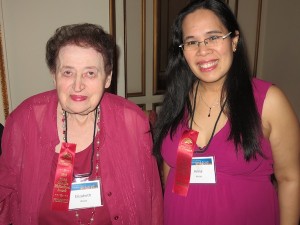
photo - Elizabeth Wolak and her daughter-in-law Anna Wolak
Elizabeth Wolak and her daughter-in-law Anna Wolak (photo from Arthur Wolak)

Elizabeth Wolak and her daughter-in-law Dr. Anna Wolak were both nominated for the 2015 British Columbia Multicultural Awards. As nominees, they were honored to attend the official awards gala evening, together with representatives from the provincial and federal governments, which took place at the Fairmont Hotel Vancouver in November.

The B.C. Multicultural Awards is an annual event hosted by the provincial government and the Multicultural Advisory Council to recognize and honor the multicultural accomplishments of individuals, organizations and businesses throughout the province. Elizabeth Wolak was nominated for her decades of multicultural work bringing the beauty of Jewish choral music to the attention of diverse ethnic communities through her numerous annual concerts. Dr. Anna Wolak was nominated for her health-care work, treating and educating patients and medical practitioners in British Columbia’s multicultural setting.

***

Leila Getz has been selected by Musical America Worldwide as a 2015 Influencer and is profiled in its MA 30 Professionals of the Year: The Influencers special report, released this month, which lists 30 honorees. The report’s editors, “recently asked the MA community to nominate 30 people who are making a difference in our business, either by virtue of their position, their creativity and/or their dedication – folks about whom you could say, ‘When they speak, we listen.’”

“Leila Getz looms large as one of the primary driving forces on the classical music scene in Vancouver, B.C.,” reads her profile in the report. “In 1980, at the age of 40, this South African native founded the Vancouver Recital Society, a presenting organization that has consistently aimed high and brought many of the world’s leading artists to a relatively isolated region.

“It seemed like a foolhardy project at first, especially since there was an economic recession in Canada in the early 1980s…. But the series gradually expanded from five events at the beginning to 20 in 2015….

“Most striking is Getz’s knack for finding major artists before they become widely known. She presented the Canadian debuts of mezzo-soprano Cecilia Bartoli, who reportedly stopped the first rehearsal cold after she sang her first note (the baton flew out of the amazed conductor’s hand), and pianist Lang Lang, who was all of 15 at the time. Other Canadian debuts on this series include those of violinists Joshua Bell and Maxim Vengerov, Anne Sofie von Otter and, one of Getz’s earliest discoveries, pianist András Schiff.”

For the full profile, visit musicalamerica.com/specialreports.

***

The Jewish Community Centre of Greater Vancouver has announced that Sharon Dwek has joined the centre as director of development.

photo - Sharon Dwek has joined the Jewish Community Centre of Greater Vancouver as director of development
Sharon Dwek has joined the Jewish Community Centre of Greater Vancouver as director of development. (photo from JCCGV)

Dwek comes with more than a decade of experience in development, fundraising, community service and marketing, in Vancouver, Israel and the United States. She most recently worked as the director of development at King David High School.

Eldad Goldfarb, JCCGV executive director, said the appointment of Dwek to this new position was a positive step for the centre. “Sharon’s wealth of experience and knowledge has already made her a key addition to the JCC family,” he said. “We view her appointment as a sign of our commitment to being a leading communal organization in our Jewish community.”

Goldfarb suggested the hiring was as much about the centre’s future as it was about its current success. “Our growing programs and our evolving vision for the future led us to look for an addition to our team who will fit in with our values and exceptional service,” he said. “It is very fortunate that we were able to find someone of Sharon’s calibre to fulfil this role.”

For Dwek, coming to work at the centre was a natural fit. “Five years ago, my family and I relocated to Vancouver and we turned to the JCC and immediately felt at home and connected,” she said. “As a place of connecting, care-giving and learning, the JCC has truly become our second home and I am honored to help usher the JCC into the next stage of its future growth and development.”

For more information on JCCGV programming or staff, visit jccgv.com.

***

The 613th mitzvah of the Torah is the obligation for every Jew to write a Torah scroll. In the words of the verse: “And now, write for yourselves this song, and teach it to the Children of Israel. Place it into their mouths, in order that this song will be for Me as a witness for the Children of Israel.” (Deuteronomy 31:19)

Congregation Beth Israel has been blessed to receive a generous gift of a new sefer Torah with the opportunity for its members to complete it by scribing the last 100 letters. As space is limited, participation is by lottery. For more information on the project, visit bethisraelvan.ca/asitiswritten. The deadline for entry into the lottery is Jan. 18, 2016.

Under the guidance of sofer Rabbi Moshe Druin of Florida, families will participate in scribing and other activities for all ages Feb. 19-21. The following weekend, Feb. 26-27, the dedication of the congregation’s new sefer Torah will take place, as will a celebration of Debby Fenson’s 10th anniversary as BI’s ba’alat tefillah.

There are 304,805 letters in the Torah and, if any is missing, the whole Torah scroll must be wrapped up and put away until it is repaired. Every letter in a Torah is vitally important. Now imagine all the Jewish people as one Torah scroll. Each person, big or small, rich or poor, a pious scholar or just a simple Jew, is one letter; all of us as important as each other.

מונתה לרכזת התרבות הישראלית

איילת כהן מונתה לרכזת התרבות הישראלית של הג’ואיש קומיוניטי סנטר

photo - Ayelet Cohen
איילת כהן (צילום: LinkedIn)

לתפקיד רכזת התרבות הישראלית הקבועה של הג’ואיש קומיוניטי סנטר של מטרו ונקובר, מונתה בימים אלה הישראלית איילת כהן. היא מחליפה בתפקיד את אליין זהבי, ששימשה ממלאת מקום זמנית. זאת מאז שדפנה זילברשטיין יצאה לחופשת לידה (ולא תחזור למלא את התפקיד). כהן במקצועה היא בימאית, מפיקה ועורכת סרטים בתחום הקולנוע והטלוויזיה. היא סיימה לימודי תעודה בהפקות דוקומנטריות בלנגרה קולג’ שבוונקובר, והוציאה תואר ראשון בתחום המדיה ותקשורת המונים במכללה למנהל בתל אביב.

בחמש השנים האחרונות עובדת כהן כבימאית, מפיקה ועורכת עצמאית בתחומי הקולנוע והטלוויזיה, באזור ונקובר. בשנת 2011 היא עבדה בהתנדבות כמפיקה ומתאמת בפסטיבל הסרטים הבינלאומי של ונקובר. בישראל עבדה כהן כמפיקה עצמאית בתחום הטלוויזיה במשך כשבע שנים. וקודם לכן היא עבדה במשך כשנתיים בזכיינית של ערוץ 2 קשת. היא דוברת עברית, אנגלית וצרפתית.

על רשימת האירועים שכהן מארגנת בימים אלה לקראת ראש השנה: ערב שירה בציבור עם מרים בני, משה דנבורג ויונה בר סביר. האירוע יתקיים ביום ראשון ה-20 בחודש בשעה שבע בערב.

מתחתנים סידרתיים: זוג קנדי שהתחתן כבר שתיים עשרה פעמים נערך לאירוע נוסף – חתונת ההמזל

זוג מהעיר ויניפג פשוט מכורים לטקס החתונה. הם הספיקו להתחתן כבר לא פחות שתיים עשרה פעמים במקומות שונים ברחבי העולם. ובימים אלה איך לא, השניים נערכים לחתונה השלושה עשר במספר, שתתקיים בקרוב במונגוליה. עדיין לא ברור אם “חתונת המזל” כפי שהם קוראים לה, תהיה גם החתונה האחרונה שלהם, או שחתונות נוספות צפויות לבוא אחריה.

קרל פיקס (65) הוא פנסיונר ובעבר היה בעלים של חברת בנייה, ואשתו היפה סנדי באג (55) שהיא רופאת שניים, התחתנו לראשונה בחודש ינואר שבשנת 2004 בדרום אפריקה. אך כיוון שבאג איך שהוא איבדה את תעודת הנישואין שלהם, הם קבעו מייד להתחתן שלוש פעמים נוספות. מתברר שטקס החתונה וירח הדבש כל כך מצא חן בעיני פיקס ובאג, עד שהם הם התמכרו לנושא, והתחתנו עוד אחת עשרה פעמים נוספות, כאמור במקומות שונים בעולם. אגב את כל החתונות אירגן פיקס לבדו ללא התערבות באג. על חלק של החתונות הוא עבד במשך חודשים בסודיות מרובה, ובאג גילתה את דבר החתונה החדשה שבפתח ממש ברגע האחרון. רשימת המקומות בעולם הם המתחתנים הסידרתיים התחתנו כדלקמן: גרמניה, קנדה (בעיר ריג’יינה בה בנו את ביתם החדש ובו הם גרים עד היום), סורינאם, אתיופיה, נפאל, מוזמביק, בגו’נגל של יערות האמזון, לאס וגאס, טימבקטו שבבאלי ומונטה. החתונה האחרונה בסידרה עד כה צריך לציין, התקיימה לפני כחודש, על אוניית שייט במסגרת קרוז מול הקרחונים של האי גרינלנד. יצויין שבכל טקסי החתונות פיקס ובאג לובשים בגדי חתן וכלה מסורתיים, הנהוגים באותו מקום. עד היום מתברר שהזוג המאושר טס כבר למאה מקומות שונים ברחבי העולם, וניסיון העבר מלמד שידם עוד נטויה.

פיקס מציין כי בסך הכל יש להם רק חמש תעודות נישואין רשמיות, ובשאר טקסי החתונות לא הנופקו להם שום מסמכים. הוא מוסיף כי החתונות הרבות מבטיחות לו שבאג תישאר עימו לעד, כיוון שיהיה לה מאוד קשה למצוא עורך דין שיוכל להשיג כל כך הרבה תעודות גירושין, מכל כך הרבה מדינות בעולם. שלא לדבר שוזה יעלה לה גם הון. ואילו באג מוסיפה כי טקסי החתונות הרבים מוכחים את אהבתו הגדולה של פיקס אליה וזה כל מה שחשוב לה באמת.

Retiring from the JCC

In her retirement, Jocelyne Hallé plans to keep working as a photographer. (photo by Rachel Lando)

Members of the Vancouver Jewish community know Jocelyne Hallé. For years, she has been the official photographer of the Jewish Community Centre of Greater Vancouver, taking pictures at gala dinners and art presentations. As well, her smiling face and helpful optimism have enhanced the centre’s membership desk and greeted many members, new and old, whenever they enter the building. But, after June 25, she will no longer be there. She is retiring.

“I came to work at the JCC in 2001,” Hallé said in an interview with the Independent. “Before, I used to work for several engineering firms, as a translator or executive assistant, but, by 2001, I grew unhappy with my job. I wanted a change, so I applied to an employment agency.”

She had never thought about a job at the JCC. “My agent took me for an interview but she didn’t tell me where she was taking me,” Hallé recalled. “She just said it would be a new environment for me and that I would like it. She brought me to an interview with Gerry Zipursky [executive director of the centre at the time]. The interview lasted for two hours, the longest interview of my life, and, after that, he hired me to be his personal assistant.”

When she started her new job, Hallé didn’t know anything about the local Jewish community or Jewish culture, or even about working at a community centre in general.

“I asked him why he hired me, a non-Jew,” she said, wondering aloud. “But he said he only wanted his assistant to be competent and sensitive to the situation in the Middle East. I guess I was both, although I don’t remember talking much during the interview. He did most of the talking.”

She admitted that the adjustment period wasn’t easy. “I had to learn so much. But the more I learned about the community and the Jewish culture, the more I fell in love with it. When, in 2005, I went with the others for a working trip to Israel, I felt very comfortable, as if it was home.”

The year 2005 was a milestone for her in many respects. She took thousands of photographs in Israel, and the experience propelled her lifelong passion for photography to a new level. Her photos of Israel adorned an entire wall of the JCC atrium for three years. Her affection for the country and the people reverberated through the images she captured. “It was so gratifying to see people standing in front of that wall, looking at my pictures,” she said. (In 2009, Hallé landed a show at the JCC’s Sidney and Gertrude Zack Gallery. “My friends told me that if they didn’t know better and only judged by my photos, they would’ve thought Israel a green country,” she confided happily.)

Another, sadder event also happen in 2005 – she was diagnosed with breast cancer soon after she returned from Israel. “Cancer changed me, in a good way,” she said. “Contrary to everyone’s expectations, it was a positive experience. I realized what was important in life. I learned who was a real friend and who wasn’t. Before, I was working too much, always tired and heading for depression, but my illness gave me leave to take care of myself.”

She took time to recover and, after two years, returned to the JCC. Her former boss was no longer there, so she started working at the membership desk. “It was a different environment,” she explained. “I finally met many community members and I was away from all the politics. I loved it. Everyone was very friendly and helpful; I felt almost a part of the family.”

She continued learning about the community, immersing herself in the culture and traditions. “By now, I know so much about Jewish ways, people often ask me questions. I explain to them about Rosh Hashana and Shabbat and other celebrations. Many are surprised to learn that I’m not Jewish. To tell the truth, sometimes I feel that I’m kind of Jew-ish. We joke about it.”

In January this year, Hallé turned 60, and decided it was time to retire.

“In the last couple of years, a few of my friends died,” she shared. “It was very upsetting, but I’m alive. I’m ecstatic to be 60. I want to travel, to take some class, to work more on my photography. Recently, I went to Nicaragua for a month; I worked there as a volunteer and I want to do it again. I want to visit Galapagos and Kenya. I might volunteer with the JCC Seniors.”

Hallé is sure that her work for the JCC created an opportunity for her to develop as an artist photographer. With the support and encouragement of her colleagues and friends, she continues to explore her chosen art form. “I have nine photographic events booked this summer, right after I retire,” she said. “I’ll do a bar mitzvah, a wedding, a fundraiser, even a dance festival.”

Hallé’s plans are still in flux, but they expand every day, perhaps enough to fill the next 60 years.

To learn more about Hallé, the photographer, visit her website, jocelynehalle.com.

Olga Livshin is a Vancouver freelance writer. She can be reached at olgagodim@gmail.com.
Israelis skate into Vancouver

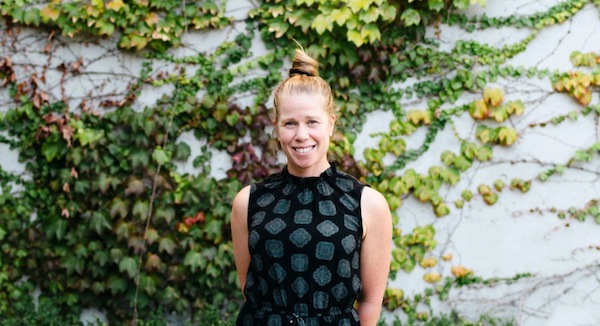
Canucks alum Eddie Hatoum, originally from Lebanon, with several Arab Israeli athletes. (photo from Jewish Community Centre of Greater Vancouver)

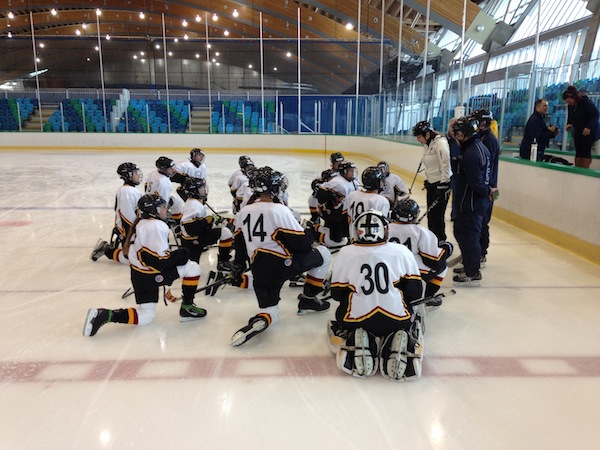
Anyone who caught a glimpse of the 20 young hockey players during their week-long training camp in Vancouver March 4-10 probably didn’t think much of it. That is until they looked a little closer and saw the Canada Israel Hockey School (CIHS) logo all over their jerseys, jackets and bags.

In a joint venture of the Jewish Community Centre of Greater Vancouver and the Jewish Federation of Greater Vancouver, the 10-to-14-year-old boys and girls were hosted by local families, trained by special guest coaches, toured around the city and treated to an unforgettable night by the Vancouver Canucks.

photo - Canada Israel Hockey School students listen to skating coach Barb Adelbaum.
Canada Israel Hockey School students listen to skating coach Barb Adelbaum. (photo from JCCGV)

Aside from its being a hockey school in a country where that sport is as foreign as olive trees are to Vancouver, CIHS is also special for using hockey as a cultural bridge: half the participants touring Vancouver were Jewish and half Arab. Here are a few stories that stood out from the week-long adventure.

Skate like NHLers: After arriving late the night before, the kids wasted no time hitting the ice at the Richmond Olympic Oval. Their first practice was led by Barb Adelbaum, power skating consultant for the Vancouver Canucks and various NHL players around the league. After taking them through some skating drills, Adelbaum noted that many of them had dull skate blades. She connected the team with Cyclone Taylor Sports in Vancouver and arranged to have all 20 pairs of skates sharpened, as well as a much-needed new stick for one of the goalies.

KDHS meets CIHS: On day two, thanks to a Purim-themed professional development day at King David High School, several hockey-playing students from the high school joined the CIHS kids on the ice. Instead of playing against each other, each team was formed from members of both schools, which made for a spirited community game.

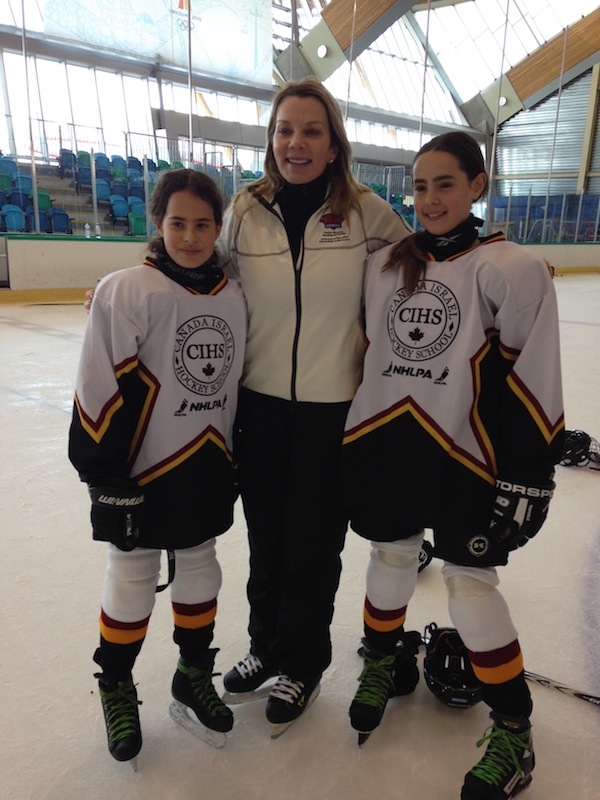
photo - CIHS students with skating coach Barb Adelbaum
CIHS students with skating coach Barb Adelbaum. (photo from JCCGV)

Flying like a Raven: When the JCC found out that the CIHS squad included two girls, talks began with the Richmond Ravens Girls Hockey Association on bringing them all together. The Ravens happily obliged, donating one of their ice times to a scrimmage and practice with the Israelis. After fitting the two Israeli girls into Ravens jerseys, a boys versus girls game was played.

All they have is love: Sunday afternoon was spent touring the city. The group walked along the water from Granville Island to Kitsilano Beach. As they approached the beach, Virgin Radio was there, with a large balloon-like ball with “LOVE” written on it, offering folks the chance to be photographed with it. As the Israeli kids swarmed for their photo, the radio station reps were told of the special meaning behind the Jewish and Arab group, standing shoulder to shoulder, symbolizing the love of a game and being a team overcoming other boundaries.

CIHS meet JCC hockey: The Israeli athletes had the opportunity to see what Jewish community hockey was all about in Vancouver. They took in one of the final regular season games of the JCC’s Adult Ice Hockey League, providing a cheering section the local weekend warriors weren’t used to. After the game, the students had their chance to show the JCC league the skills they had brought from Israel, and to play a little hockey with them. Led by the generosity of Daniel and Ariel Wosk, several members of the JCC league donated money for new equipment for the CIHS players (more to come on that below). The Wosk brothers had visited CIHS in February 2014 as part of a hockey team tour and wanted to be involved when the Israelis came to Vancouver.

“The joy and passion that [Jewish] and Arab children were exhibiting together was a sign that with the right influences and opportunities there could be a better future there,” said Ariel. “When we heard that some of the kids were coming to Vancouver, we knew that we wanted to do something for them.”

“A highlight for me was not knowing who was who on the ice, yet their teamwork was excellent,” added Daniel of his time playing with the kids here. “It’s awesome to see their relationships grow in a positive direction … [that] will translate into their daily lives.”

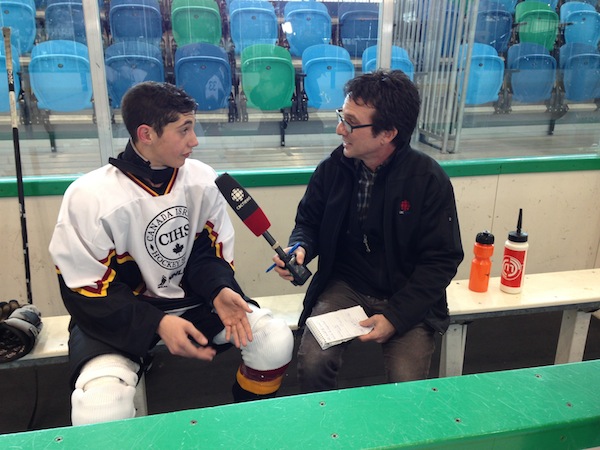
photo - CIHS student being interviewed by CBCs Shane Foxman for Citizen Shane
CIHS student being interviewed by CBCs Shane Foxman for Citizen Shane. (photo from JCCGV)

The final day: The last full day of the CIHS visit had more highlights than an evening news report.

The morning started on the ice, with two members of the Vancouver Canucks Alumni Association as guest coaches, along with local hockey pro and JCC member Harrison May and his brother Kevin.

One of the alum, Eddie Hatoum, was born in Beirut and still speaks Arabic at home. Upon arriving and learning of the mix of the CIHS athletes, he entered the locker room and asked, “Who speaks Arabic?” in his native tongue. Half the room raised their hands with huge smiles on their faces. “We’ve done a lot of work with young groups as the Canucks alumni, but this really warms my heart,” Hatoum said, also smiling. “When I tell my siblings in Ottawa that I got on the ice with these kids, they won’t believe it.”

Hatoum was joined at the practice by B.J. (Blair) McDonald, who once scored 46 goals playing with Wayne Gretzky in the early 1980s.

After the practice, the group headed to Sports Exchange in Vancouver for a shopping spree. With the money from the JCC hockey league players in hand, along with several donations and great deals from the store managers, the team packed six bags’ worth of brand-new gear. The kids also had a chance to pick up some items of their own that they can’t get in Israel.

While it seemed almost impossible for the day to get any better, the CIHS kids and several of their host family friends were treated to an evening with the Canucks that started with a meeting with team president Trevor Linden and chief operating officer Victor de Bonis. De Bonis led the group on a tour of the facility in advance of the Canucks versus Anaheim Ducks game, which they watched from a hospitality suite, where they were offered a buffet dinner and all the popcorn they could eat. Visits to the suite from Adelbaum, McDonald, de Bonis and Canucks mascot Fin topped it all off.

The trip continues: The group said goodbye to Vancouver and hello to a week in Calgary before heading back to Israel. Several JCC league players will meet the kids again next February at an annual recreational hockey tournament in Israel. The Vancouver squad, as usual, will get on the ice with the CIHS for a couple of practices and continue their friendship.

Kyle Berger is Jewish Community Centre of Greater Vancouver sports coordinator, and a freelance writer living in Richmond. For more information on this visit or future hockey trips to Israel, contact Berger at 604-638-7286.

Positivity is vital to life

The 15th annual Chutzpah! Festival of the Jewish Performing Arts concluded on Sunday with the group Diwan Saz. Their main message: music has no borders. And, “Don’t believe the news,” i.e. Israel is more than a conflict zone.

Yet, our brains are hardwired to find the negative in life. As one neuropsychologist writes, “the brain is like Velcro for negative experiences but Teflon for positive ones.” It is no coincidence that the news the media mainly reports is bad. It not only titillates, but it sticks with us. However, there are good news stories, and they should not be dismissed as “fluff,” or as less significant than the “serious” news. On the contrary.

The arts are vital to our lives, as are sports and other cultural endeavors. They are not merely for entertainment or to escape from reality. Among other things, these pursuits encourage creativity and propel innovation, they nurture our souls and provide ways in which we can connect to each other. They can be catalysts for all types of change in the world, making people aware of issues they might not otherwise consider, bringing people together to speak out against injustice or in favor of peace, for example.

The multicultural Bedouin, Israeli Arab, Turkish, Jewish Israeli (Ashkenazi and Sephardi) group Diwan Saz, comprised of nine musicians, is a prime example of how people of different places, beliefs and backgrounds can live, play and travel together – by choice, and happily, enriched by one another’s friendship and musicianship.

Since its beginnings, Chutzpah! has shown how arts and culture can bring diverse people together. In recent years, Israeli performers have graced the cover of the Georgia Straight in its Chutzpah! coverage. What better ambassadors of Israeli and Jewish culture, and the cross-cultural possibilities of the Middle East?

This week’s JI cover stories provide another couple of examples.

Twenty kids from the Canada Israel Hockey School, a joint venture of the Jewish Community Centre of Greater Vancouver and the Jewish Federation of Greater Vancouver, visited last week – Jewish Israeli, Arab Israeli, girls and boys, the hockey players see each other as teammates, playing for the love of the game. Not only are positive bonds and memories being formed among the players, but also between them and their coaches in Israel and in Vancouver, the local hockey players they met, both from the Jewish league and from the Canucks. Interviewed by CBC’s Shane Foxman, these kids were representing not just themselves, but the sport of hockey and their country of Israel – and they are cause for pride.

Sholom Scouts are also not “just” scouts. Not to put too much pressure on them, but they are Jewish ambassadors to the larger Scouts community as well as the general community. Within the Jewish community, they represent a spectrum of Jewish beliefs, all coming together to become good stewards of the land and good citizens.

It is healthy to see the negative: it helps us to be safe, to become aware of what isn’t quite right, what needs adjustment and what areas of justice still need to be pursued. As Leonard Cohen sings, “there is a crack in everything, that’s how the light gets in.” But, focusing exclusively on the negative – the crack instead of the light – isn’t healthy, not for ourselves personally or for society at large. This does not imply blocking out the reality of the suffering that does exist, but instead recognizing that we ignore the beauty, loving kindness and bright spots of reality to our detriment.

Whether it’s by being more mindful, cultivating more loving kindness, reducing stress and anxiety, re-balancing our middot, being open to new and challenging experiences or learning more about something that interests or concerns us, we can find more good. It takes time and effort to “hardwire happiness” in our brains and in our lives, but it’s possible.

It helps when we consciously draw out the positive, such as the stories mentioned here, and engage in the positive cultural and social behaviors that make us more than mere human animals, and more fully and happily human.

New advocate at JCC

Eliane Nevares (photo from Jewish Community Centre of Greater Vancouver)

The Jewish Community Centre of Greater Vancouver welcomes Eliane Nevares as the new youth outreach coordinator. Serving Jewish teens throughout the Lower Mainland, Nevares hopes to bring her diverse skill set to the forefront. Born and raised in Vancouver, Nevares has an undergraduate degree from the University of British Columbia in sociology and geography, and the goal to return to school in September 2015 for social work. Additionally, Nevares brings volunteer and work experience from various organizations, including the Vancouver Crisis Centre, Downtown Eastside Women’s Centre and Family Centred Practices Group, to help strengthen the work she will do at the JCCGV.

Nevares aims to connect with as many teens as possible through various programs, including more vulnerable teens. For example, Chill Chat develops partnerships between Jewish mentors and mentees, the Sunday Funday initiative helps combat hunger and advocates for change and leadership, and Banot Girls Club provides a space for preteen girls to meet and engage in meaningful activities. Other services include but are not limited to consultations and assessments, information and referrals, advocacy and support, and educational workshops and speakers.

With a goal to promote the social and emotional development of youth through individual support and community partnerships, Nevares said she is excited about her new position. She encourages those interested to connect with her at outreach@jccgv.bc.ca or 604-257-5111, ext. 308.