Skip to content
  • Home
  • Subscribe / donate
  • Events calendar
  • News
    • Local
    • National
    • Israel
    • World
    • עניין בחדשות
      A roundup of news in Canada and further afield, in Hebrew.
  • Opinion
    • From the JI
    • Op-Ed
  • Arts & Culture
    • Performing Arts
    • Music
    • Books
    • Visual Arts
    • TV & Film
  • Life
    • Celebrating the Holidays
    • Travel
    • The Daily Snooze
      Cartoons by Jacob Samuel
    • Mystery Photo
      Help the JI and JMABC fill in the gaps in our archives.
  • Community Links
    • Organizations, Etc.
    • Other News Sources & Blogs
    • Business Directory
  • FAQ
  • JI Chai Celebration
  • JI@88! video

Recent Posts

  • עשרים ואחת שנים בוונקובר
  • Supporting the Iranian people
  • The power of photography
  • A good place to start
  • When boundaries have shifted
  • Guitar virtuosos play
  • Different concepts of home
  • Broadway’s Jewish storylines
  • Sesame’s breadth and depth
  • Dylan Akira Adler part of JFL festival
  • Mortality learning series
  • A new strategy to brighten up BC
  • Sharing latkes and light
  • Johnson awarded for human rights work
  • Cherished tradition ensured … Silber Family Agam Menorah
  • Nothing as lovely as a tree
  • Camp welcomes new director
  • Popular family camp expands
  • A life-changing experience
  • Benefits of being a counselor
  • Camper to counselor
  • האלימות בישראל מורגשת בהרבה מגזרים
  • טראמפ עוזר דווקא לנושא הפלסטיני
  • New rabbi settles into post
  • A light for the nations
  • Killed for being Jewish 
  • The complexities of identity
  • Jews in time of trauma
  • What should governments do?
  • Annie will warm your heart
  • Best of the film fest online
  • Guitar Night at Massey
  • Partners in the telling of stories
  • Four Peretz pillars honoured
  • History as a foundation
  • Music can comfort us

Archives

Follow @JewishIndie
image - The CJN - Visit Us Banner - 300x600 - 101625

Tag: Israel-Hamas war

Go on offensive: Levy

Go on offensive: Levy

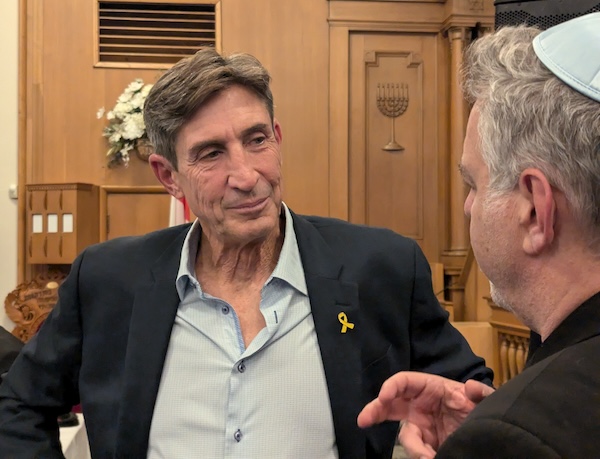
Pro-Israel activist Eylon Levy speaks with an audience member before his Oct. 30 talk at Schara Tzedeck, which was presented by StandWithUs Canada. (photo by Pat Johnson)

The terrorists who perpetrated the Oct. 7 attacks were products of schools paid for in part by the Canadian government, according to Eylon Levy, a former Israeli government spokesperson who addressed an audience at Schara Tzedeck Synagogue last week.

“The Oct. 7 terrorists all went to Canadian-funded schools,” he said. “That is outrageous. It’s disgusting. You need to hold [the Canadian government] accountable and say there are consequences.” 

Most schools in Gaza are run by the United Nations Relief and Works Agency (UNRWA), which is funded by UN member-states, including Canada.

Levy spoke here Oct. 30 as part of a cross-Canada tour sponsored by StandWithUs Canada, a pro-Israel educational organization focused on campuses.

Levy said Israel’s recent announcement that it was banning UNRWA from operating in Israel was the right move because the agency exists to perpetuate the Palestinian refugee problem, not resolve it, to keep the Israeli-Arab conflict alive, to indoctrinate Palestinian children and to provide the financial safety net terrorists need to engage in violent attacks like Oct. 7.

Israel has been widely condemned for the imminent ban, which came after Israel repeatedly informed the UN that UNRWA’s staff includes known terrorists, some of whose names were provided to the UN by Israel.

“They just don’t care,” Levy said of the UN’s response that terrorists are on their payroll. “Now they claim UNRWA is irreplaceable. Well, you should have thought about that when Israel gave you the evidence that it is riddled with terrorism and you chose to deny that it was a problem.”

According to Israeli authorities, 12 UNRWA staff members actively participated in the Oct. 7 attacks, with allegations that more than 30 additional UNRWA workers were involved in activities such as facilitating hostage-taking and looting. Israel’s Defence Minister Yoav Gallant has alleged that, of the 13,000 UNRWA employees in Gaza, at least 12% are affiliated with Hamas and Palestinian Islamic Jihad terror groups.

In conversation with Michael Sachs, Western regional director for Friends of the Simon Wiesenthal Centre, Levy said many people are inverting right and wrong when it comes to the Israel-Hamas war and they are trying to sway young people especially. 

“The world is trying to tell them that the cause of their generation, the great cause of this century, is the fight for Palestine, which means the destruction of the state of Israel,” Levy said.

Contesting these messages is tough, he said, especially when the agencies that represent the moral high-ground are on the wrong side.

Levy recalled a debate he had against broadcaster Mehdi Hasan.

“I knew he was going to come on the stage and say, ‘Well, the UN agrees with me, Oxfam agrees with me, Save the Children agrees with me, Red Cross agrees with me. How is it possible the whole world is wrong and you are right?’” Levy said. “That’s Jewish history: the courage to look around and say, ‘You’re all crazy. This isn’t right.’”

Levy noted that UN Secretary-General Antonio Guterres issued a statement on social media mourning the death of Muhammad Abu Atawi, who was killed by the Israel Defence Forces.

Atawi was an employee of UNRWA but, according to Israel, he was also a Hamas terrorist who led the attack on the bomb shelter near the Nova music festival, in which Hersh Goldberg-Polin and others were sheltering. 

“This is a leader I’m supposed to take seriously?” Levy asked. “The Red Cross that hasn’t lifted a finger to try to save the hostages is an organization that I am meant to take seriously? The NGOs that wouldn’t even shed crocodile tears on Oct. 7, that never tried to do any sort of campaign for the hostages, they are the ones I am meant to take seriously?”

Young people and other activists in the West who insist they are anti-Zionist and not antisemitic are deluding themselves, Levy suggested.

“You are expressing a hatred and a prejudice against the same people,” he said. “The fact that they believe that they hate the same people that their grandparents hated but it’s a complete coincidence shows a tragic lack of self-awareness.”

Getting the pro-Israel message out is especially challenging on social media, said Levy, but Jews and their allies can’t give up the battle.

Social media is problematic at the best of times – even when it is not a platform controlled by the Chinese regime, as TikTok is – because it maximizes engagement by provoking outrage and amplifies the most extreme viewpoints.

“We’re not going to win the social media battle,” he said. “But we can’t afford not to fight it.”

If the only thing that people see on social media are anti-Israel messages, what conclusion will people come to? he asked.

“But what if their friend, the person they know is a good, decent person, stands up and presents a contrary view?” said Levy. “Then at least you’ve made that person think this is complicated and there’s a case to be made on the other side. So, it requires all of us to be there, to fight the fight, to be as loud and vocal and produce as much stuff as possible.”

That battle of ideas also needs to be taken offline, he said.

It is further complicated, he added, because the Israeli government has effectively given up communicating to the world.

Levy, who was born in England to Israeli parents and made aliyah as a lone soldier, was effectively conscripted to serve as an English-language spokesperson at the beginning of the war. He was fired after a social media spat with Britain’s then-foreign secretary David Cameron. Levy cofounded the Israeli Citizen Spokespersons’ Office, which tries to fill the information gap he said the Israeli government has left.

Pro-Israel voices in the West need to change tack, according to Levy. Rather than being on the defensive and explaining Israel’s actions, Canadians and others should be calling out governments and NGOs.

“Other people owe us answers,” he said. “UNRWA owes us answers. The Red Cross owes us answers. The UN owes us answers. I think we have to go on the offensive and demand those answers from other people instead of constantly trying to defend ourselves and say, ‘I can explain.’”

Levy dismisses calls for a ceasefire. The war needs to end in the defeat of Hamas – and it’s all over but the surrender, he argued.

“Hamas has lost,” he said. “It’s game over.”

But Hamas needs the world to help it understand that fact. 

“The problem is, when international actors step in to demand a ceasefire, as opposed to Hamas’s surrender, they tell Hamas to keep fighting,” he said. With Hamas on its knees, “It’s outrageous that some countries are trying to get it back up on its feet.”

Hezbollah has also been largely eliminated, according to Levy. 

“All of its top leadership are dead,” he said. “The infrastructure along the border has been destroyed.”

Iran, of course, remains unbowed, even in the face of the damage Israel has inflicted on its proxies.

Levy said one outcome from the current crisis is that Jewish communities have come together. In Israel, individuals instantly mobilized on Oct. 7 to do whatever they could and, in the diaspora, Jews have united as they rarely have before.

“That sense of responsibility, that sense of solidarity, being there for each other and having each other’s backs, I find incredibly inspiring,” he said. “That awakening of responsibility and self-reliance and leadership in Jewish communities around the world has been an inspiration to people in Israel.”

Jesse Primerano, executive director of StandWithUs Canada, which brought Levy to Vancouver, said his group has 106 interns and fellows on campuses across Canada this year – an increase over past years and a happy surprise for Primerano. He was afraid for the organization’s programs this year, he said, concerned that they wouldn’t be able to recruit students to stand for Israel on campuses. The opposite happened.

“Numbers skyrocketed,” he said. “The truth is that they are not scared. They are empowered. They are emboldened … and they are so brave and ready to stand up.” 

SWU has also hired more staff across Canada, including a full-time position in Vancouver funded by the Diamond Foundation.

Three students from Vancouver-area campuses who are part of the SWU Emerson Fellowship program spoke to the audience, drawing ovations. 

Format ImagePosted on November 8, 2024November 7, 2024Author Pat JohnsonCategories Israel, LocalTags antisemitism, Eylon Levy, Friends of the Simon Wiesenthal Centre, Israel, Israel-Hamas war, social media, StandWithUs, terrorism, United Nations, UNRWA

A different new year

The experience of the Jewish calendar is ever-changing because, while the week’s parshah is the same every year, the people experiencing it have changed. This seems especially true for the year just passed.

Pesach held stark resonance this spring, as Jews worldwide held in our hearts the captives in Gaza and pain around the ongoing war. Every happy moment in the calendar was darkened by the shadow of Oct. 7. Every solemn moment seemed laden with deeper significance.

It is a rare Jew whose life has not changed dramatically since that day. Israelis and Jews had ripped from us a sense of historical, collective and personal security that the Jewish state was supposed to provide. While 75 years of conflict and insurrection have reminded us that Jews have never been entirely free from the hatred of others, the collective defence embodied in the state of Israel massively reduced the vulnerability experienced by previous generations. We also understand that this security has come at a cost and that the last 75 years have also been a source of suffering for our Palestinian neighbours and cousins. This is a juxtaposition we struggle with daily.

And then Oct. 7 ripped away our sense of communal security in a profound way. For Jews worldwide, it provoked what can be considered significant intergenerational trauma, recalling times when soldiers and their civilian collaborators could enter Jewish homes, perpetrate atrocities, annihilate families, separate us from our loved ones, loot our possessions, force conversions, exile and expel us, and take us captive.

Worldwide today, Jews have experienced a different, related trauma. In too many cases, Jews in Canada and elsewhere have been betrayed by our neighbours, let down by our ostensible friends and had our awareness wrenched open to the potential for abrupt changes in political climates.

This will be the first Rosh Hashanah since Oct. 7. It will be followed by the anniversary of the terror attacks, a commemoration that will be added to the black dates of Jewish history over millennia.

Day after day we hope for the return of the captives, and it will be a joyous moment when surviving hostages come back home. Between this writing and your reading, may that dream have become real. If not by then, let us hope for their redemption by the new year or certainly before the calendar turns on a full annual cycle since their capture. Every moment is a moment too long for their captivity. And every moment is a moment too long for continued war, and the destruction experienced by innocent Palestinians who are caught in it.

We can all well remember the holy days of just a few years ago when a global pandemic kept us from celebrating in person with our loved ones. For most of us, that forced separation has passed. That togetherness is reason enough to celebrate. Even so, it is precisely the idea of togetherness – when we know that so many families have been torn apart either temporarily or permanently – that adds sad resonance to our own sense of unity. 

While we mourn those who will never again celebrate with their loved ones and we hope and pray for the return of the hostages so that they can rejoice in freedom with those they love, we should also take special appreciation for the gifts of those with whom we gather.  

In Jewish fashion, the changed reality in which we find ourselves is already being woven into a sort of makeshift liturgy, as more than one article in this special issue of the paper describes. Thoughtful people have developed ways to memorialize and hold spiritual space for the hostages and all affected by this historical moment.

As we complete another cycle of the calendar, the immutable foundations of our tradition provide strength and familiarity. At the same time, as individuals and as a people, we are profoundly changed. 

Posted on September 20, 2024September 18, 2024Author The Editorial BoardCategories From the JITags hostages, Israel-Hamas war, Jewish calendar, memorial, Oct. 7, Rosh Hashanah

A solemn anniversary

The Vancouver and Victoria Jewish communities will each hold a memorial ceremony Oct. 7 to honour and remember the victims of the attacks on Israel a year ago. 

Led by the Rabbinical Association of Vancouver (RAV) and in partnership with the Jewish Federation of Greater Vancouver and many others, an evening event in Vancouver will be an opportunity for people of all ages to come together.

A special gathering for young adults will take place from 6 to 7 p.m., providing a space for reflection and connection. The main ceremony will begin at 7 p.m., and will include what is being described as a poignant tribute led by our community’s rabbis. The location of the event will be emailed upon registration. Register at  jewishvancouver.com/october-7th-memorial.

Following the ceremony, Jewish Family Services will offer “living rooms,” in both Hebrew and English, where attendees can share their thoughts and find comfort. An Israeli sing-along will also take place, with the intention of helping participants find strength in unity and to support one another.

Relatives of Oct. 7 victims will present representative stories of the heroes and victims and organizers are planning interactive elements so participants can actively memorialize. There is an intention to ensure that all the victims’ names, as well as fallen soldiers’ names, can be articulated in the course of the program. 

Politics – local or international – are to be kept out of the program. Elected officials may attend but the focus is on memorializing and honouring the dead.

While Oct. 7 created an unprecedented new world, in many ways, there is a precedent for the sort of memorial event planned, according to Beth Israel’s Rabbi Jonathan Infeld, who is head of RAV.

The Yizkor service will be the template for this commemoration, said Infeld.

“We know that the Yizkor service is something that the synagogue-going Jew can relate to, but we know that not all the members of our community go to synagogue on a regular basis,” he said. “We want to make sure that it works for everyone. Yizkor is the framework, but there will be creative pieces in it as well that will work for everyone in the community.”

As the anniversary approaches, Infeld said the community should be “thinking first and foremost of the memory of those who were murdered in this horrific, horrible terror attack.”

There are 97 hostages still being held in captivity in Gaza of the more than 240 Israelis and others kidnapped by Hamas on Oct. 7. (Four other hostages have been held since 2014/15.)

People need to be reminded of the absolute necessity to support the people of Israel at this moment, and to support fellow Jews here in Canada and around the world against the rise of antisemitism, said Infeld. “We would like to see everyone really rally together and gather together to support each other and to show our support for Israel and the Jewish people, and to comfort each other as well.”

A memorial in Victoria will take place at the same time on Oct. 7, at the Esquimalt Gorge Pavilion. Pre-registration is mandatory at jewishvictoria.ca.

On Sept. 28, as part of Beth Israel’s Selichot service, Rabbi Infeld will lead a conversation with Thomas Hand, whose daughter, Emily, was a hostage in Gaza. Emily, who turned 9 in captivity, was kidnapped along with her friend and the friend’s mother. The two girls were released in November. Hand will talk about the “spiritual, emotional and moral roller coaster” of his daughter’s captivity and eventual freedom.

Posted on September 20, 2024September 18, 2024Author Pat JohnsonCategories LocalTags commemoration, hostages, Israel-Hamas war, Jewish Federation of Greater Vancouver, Jonathan Infeld, memorial, Oct. 7, Rabbinical Association of Vancouver, RAV, terrorism, Vancouver, Victoria, Yizkor
Israeli envoy hopeful

Israeli envoy hopeful

Iddo Moed, Israel’s ambassador to Canada, was in British Columbia to promote partnerships. (photo by Pat Johnson)

Iddo Moed, Israel’s ambassador to Canada, was in Vancouver last week, meeting with businesspeople, university administrators and the Jewish community. It was his second visit to Vancouver since his appointment as ambassador a year ago.

Moed hopes to establish and expand collaborations between Israeli and Canadian academic institutions in the fields of medicine, agriculture, artificial intelligence, cybersecurity and applied research in many disciplines, as well as introduce business leaders from both countries to one another to encourage possible partnerships. He plans to bring some of the leading figures in various Israeli sectors on a cross-Canada road show, possibly early in 2025.

In a discussion with the Jewish Independent and three other media outlets, the ambassador focused on antisemitism in Canada and especially the climate on campuses. 

“Most disturbing me at this time is the rise of antisemitism in Canada,” he said. “It’s something that is beyond what has happened in the past.… I am concerned because I see that Jewish communities feel less protected. Jewish students at universities feel intimidated. They don’t want to go to campus or they want to hide their identity and I think this is wrong.”

He has met with university administrators – he took heart in the resounding rejection of an anti-Israel motion by the University of British Columbia senate earlier this year – and discussed with them the need to balance academic freedom with security for Jewish, Israeli and all students.

Moed urges Canadian students to make a more thorough investigation of the roots of the current conflict and not mistake the current war as a battle between Israelis and Palestinians.

“At this point in time, we’re fighting against something else, against Hamas, against hatred,” he said. “I would challenge students to look at … both sides and try to understand.”

When speaking with students, Moed said, he emphasizes stories of coexistence in Israel.

On Oct. 7, he noted, many of the ambulances that day were driven by Arab first responders, because it was a Jewish holiday. 

“Those Arab drivers that were caught by the Hamas terrorists were executed because [the terrorists] felt – just like they killed Israeli Jewish [people] – these are Israelis,” he said. “The solidarity in Israel is something that passes much of media’s attention.”

The ambassador also urges students and anyone who is engaging in discussion of the conflict to understand what the combatants represent.

“Hamas doesn’t want any deviance from their core concept of how religions should be practised,” he said. “So, there is no room for LGBTQ and there is no Queers for Palestine among Palestinians. It doesn’t exist because they don’t let them. It’s forbidden to be gay there.”

Overseas activists would do well to speak to people in the region, Moed said.

“I wish that people here would communicate with peers in the Middle East, Jews and non-Jews, hear from them, to educate themselves. That’s very, very important at this time.”

The ambassador acknowledged that relations between Israel and Canada have always been strong, but that the current conflict is causing diplomatic friction.

“The relations have always been very good and strong because they are based on a very solid foundation of shared values between Canada and Israel and that has been the case since Canada officially recognized Israel 75 years ago,” he said. “What we have today … is a growing distance between how both our countries see the conflict in the Middle East. Israel is fighting for its survival. Canada has become more and more critical of, and concerned about, the situation when it comes to the Palestinians.

“We have very good channels of communication and those are very solid and strong,” he said. “Right now, a year from the massacres [of Oct. 7] and when there are still 101 hostages being held in Gaza for which we will continue to fight until they will all come back home, dead or alive, the relations are strained by the fact that both our countries don’t always see eye-to-eye on how Israel is defending itself against a concerted effort by Iran, directly through its proxies, to annihilate the state of Israel.”

Moed, who was born in Amsterdam, has had diplomatic postings in the Netherlands, the Dominican Republic, Singapore and the People’s Republic of China, and he has held senior positions in the foreign ministry in Israel.

These are unprecedented times, he said, but he is confident that the situation will improve for Israelis and Jews.

“It will take time, but I’m very hopeful,” he said. “Humanity always prevails. It takes more time, but it does prevail. So, I’m hopeful. Yes, I’m an optimist.”

Format ImagePosted on September 20, 2024September 18, 2024Author Pat JohnsonCategories LocalTags ambassador, antisemitism, campuses, diplomacy, global politics, Iddo Moed, Israel, Israel-Hamas war, Oct. 7

Resolving Gaza dilemma

Israel needs to adopt a long-term objective in its response to Hamas’s attack of Oct. 7. Israel’s immediate objective is the defeat of Hamas. The question becomes what is to happen not only to Gaza but also to the West Bank when that happens.

For Israel simply to withdraw from Gaza would lead to a resuscitation of Hamas. For Israel to stay in Gaza would revive the problems which led to its withdrawal in 2005.

The recent negotiations around a ceasefire, release of the hostages, an Arab peacekeeping force and Israeli recognition of a Palestinian state, if accepted, would keep Hamas in power. The May 31 proposal of US President Joe Biden, which would keep Hamas in power in Gaza, is a non-starter. A ceasefire was already in place on Oct. 6, before the Hamas attack of Oct. 7. For Hamas, a new ceasefire would be a rearmament pause before its next attack on Israel. The Hamas leadership has said as much.

Simply putting the Palestinian Authority nominally in charge of Gaza leads to the same dead end. In the 2006 Palestinian elections, Hamas won. There have been no elections since then. With a new election, the result would likely be the same.

For peace negotiations to reach a plausible agreement, both an ideal result in mind and a strategy to reach that result must be in place. The ideal solution is well known – two states living side by side in peace with each other. The strategy should be directed to overcoming the widespread animosity among Palestinians to the existence of Israel and the resignation of Israelis to the reality of that animosity.

To want to live side by side in peace with each other, both populations must want peace. The continued terrorism against Israel and Israelis emanating not only from Gaza but also from the West Bank, as well as the Palestinian Authority’s failure to accept one Israeli peace plan after another, has made the Palestinian Authority not a credible peace plan partner and has generated radicalism within Israel opposing peace.

Among the Israeli residents of the West Bank, there are groups who engage in terrorism against Palestinians in pursuit of the integration of the West Bank into Israel. The government of Israel has been remiss in preventing this terrorism and remedying the consequences.

Current negotiations with Arab states may give the Palestinian Authority again a peace plan offer, this time, one they may accept. The suggestion that they would or even could implement a peace plan effectively is a lot harder to credit.

Instead, those Arab states currently proposed as contributors to a possible peacekeeping force after a ceasefire should agree, along with the Palestinian Authority, on something different. They should agree to deny Hamas’s propaganda, counter Hamas’s allies, and stand against Hamas’s physical and military survival. In areas of Gaza where Hamas has been defeated, the Israel Defence Forces would withdraw, to be replaced by Arab coalition forces, led by Egypt, as governing trustees. The same coalition, led by Jordan, would advise and assist the Palestinian Authority to act consistently in the West Bank with what the coalition is doing in Gaza. The United Nations General Assembly, if the proposed Arab coalition and the Palestinian Authority took the initiative, could authorize the UN Trusteeship Council to supervise the trusteeship over Gaza.

The proposed trusteeship would step into the shoes of the Palestinian Authority, with sole control over Area A outlined in the Oslo Accord, joint control with Israel in Area B and no control over Area C. The boundaries of the West Bank trusteeship, under this arrangement, could be shifted to take into account territorial swaps proposed in various peace negotiations.

To Israel, that sort of agreement would signal commitment by the Arab coalition to the defeat of Hamas and a lasting peace. From an Arab coalition perspective, Hamas’s defeat would mean victory over a common enemy, reining in terrorism based on distortions of Islam, a form of terrorism that has plagued the Arab world. From a Palestinian perspective, such an agreement could provide security for distribution of aid and medical supplies, which, despite the abundance of deliveries, has been to date difficult and dangerous.

Eradicating the terrorist threat completely is unrealistic even in the most peaceful of states. An Arab coalition Gaza trusteeship and a West Bank advice and assistance role would remain in effect until such time as Gaza and West Bank can form a functioning state; until the terrorism threat emanating from these territories is marginalized; and until Palestinians generally are ready to accept Israelis as their neighbours.

This Arab coalition trusteeship for Gaza and advice and assistance role for the West Bank may be lengthy, lasting even a generation. The education of children in Gaza and the West Bank has motivated many Palestinians to seek death through killing or trying to kill Jews in order to become religious martyrs who have earned afterlife redemption. That education must be undone.

Peace between Israel and a Palestinian state is an ideal. Realizing that ideal requires taking steps which address directly the causes of failure of all peace efforts to date. 

David Matas is an international human rights lawyer based in Winnipeg and senior honorary counsel to B’nai Brith Canada. Noemi Gal-Or is a retired professor of international relations and an international law lawyer based in Vancouver.

Posted on August 23, 2024August 22, 2024Author David Matas and Noemi Gal-OrCategories Op-EdTags Arab coalition, Gaza, Israel-Hamas war, peace, postwar, two-state solution

Living amid continuing war

Band-aids – check. Bottled water – check. Tinned foods – wait. No sooner do I buy canned tuna, pickles, corn and peas and they’re eaten. Need to refresh that one. Flashlight – check. Portable radio – check. Now, this is a cool one. While not available in the groovy colours of the 1970s – bought it in a staid brown – the small, palm-sized handheld radio conjures up fond memories of those catchy songs from Billboard’s Top 10. Although the reason for the checklist is anything but fanciful. With the Islamic Republic of Iran and Lebanon’s Hezbollah threatening a major reprisal attack.

In the Star Trek movie Wrath of Khan, the Klingons said “revenge is a dish best served cold.” I can certainly attest to that. As can my more than 9.5 million fellow Israelis. It feels like an eternity since the ayatollahs promised mighty revenge for Israel’s assassination of Hezbollah’s military chief, Fuad Shukr, and Hamas’s military chief, Mohammed Deif, and the alleged Israeli assassination of Hamas’s politburo chief, Ismail Haniyeh. When Iran’s authoritarian regime said at a place and time of their choosing, they weren’t kidding. We are still waiting…. Actually, I think the Klingons were probably quoting Pierre Ambroise François Choderlos de Laclos, the 18th-century French novelist and army general who is credited with first analogizing revenge as a cold dish.

Speaking of proverbs, I think its origin is Chinese, some claim Yiddish. Regardless, whoever said “may you live in interesting times” was certainly cursing someone. Give me boring. Give me dull. Give me mundane. Give me monotonous. Give me colourless and bland. You can keep the gripping. The riveting. The fascinating. The stimulating. I just want to wake up to another simple day.

This waiting game is immensely stressful. It has the whole world on edge, with an alliance being built between Israel, the United States, Britain, France and Italy to thwart a second potential direct attack on my little shtetl. The first attack – of some 300 drones – was launched against Israel in April. We went to bed facing potential Armageddon and, thankfully, woke up able to just go to work, as Israel, with the help of its allies, knocked each drone out of sky before they reached Tel Aviv and Haifa.

Speaking of work, I am a self-confessed workaholic. And I find myself working even more during this very stressful period, where I fear my fate is out of my control. Will Iran attack? Where? And when? And how? No idea. No authority. No power. Simply unable to influence, in any way. Whereas work, which I am pretty good at, gives me all those things. I am largely in control, able to influence within my environment. Work gives me a calming sense and, if nothing else, allows me to escape into my purchasing processes and contracts. This is my own industrial and organizational psychotherapy. As good an excuse as any for my wife, when she again finds me tapping away at my keyboard at all hours or in another early morning or late evening Teams meeting.

As for preparations, I find myself obsessed with buying bottled water, toilet paper and Ajax. The first couple of items, you probably understand. But floor cleaner? I think it’s the Jewish mother in me. I don’t want to leave behind a dirty home. Kind of like Golda from Fiddler on the Roof, who insisted on sweeping their little Anatevka farmhouse before leaving. Although – and I say this loud and clear – we ain’t  going nowhere!

Another quirk in dealing with the stress is that I love the music from the hippie generation. For the longest time after that dreadful Oct. 7, I wouldn’t – couldn’t – listen to music. I felt a very deep sadness. Maybe a type of mourning. But now, over the last few days, I find myself blaring my tunes. One of the first songs to pop up in my feed just after Iran’s rulers made their threat of retribution was “Bad Moon Rising” by Creedence Clearwater Revival. How foreboding can you get? “I hear hurricanes a blowin’. I know the end is comin’ soon.… I hear the voice of rage and ruin. Don’t go around tonight. Well, it’s bound to take your life. There’s a bad moon on the rise, alright.”

And, I find myself listening again and again – at pretty high volume – to the dark and wonderful song by our own Edan Golan, “October Rain,” otherwise known to the world as “Hurricane”: “Every day, I’m losing my mind…. Dancing in this storm, I’ve got nothing left to hide….  Baby, promise me you’ll hold me again.… I’m still broken from this hurricane….” And then, with hope: “Don’t have words. Just prayers. Even if it’s hard to see, you always leave me one small light.”

On another music note, I find myself chanting, to no one in particular, that snappy little line “From the river to the sea, Palestine will be free.” Now, why can’t we come up with something as catchy? With an impressive gene pool of great Jewish songwriters: George Gershwin, Irving Berlin, Burt Bacharach, Carole King, Neil Diamond, Leonard Cohen, Bob Dylan, Paul Simon, Amy Winehouse, Gene Simmons. Come on! And still, gornisht, nothing. No wonder we’re losing the global PR battle.

Please continue donating to the war and revival efforts. You may have given earlier, when hostilities first erupted and the Gaza war was headline news. Almost 10 months later, war continues – on several fronts. Sderot and Metula – and maybe Tel Aviv and Haifa – are Israel’s front line and Israel is the diaspora’s front line. Am Yisrael chai (yeah, that’s the extent of our solidarity anthem). Bring them home now! 

Bruce Brown, a Canadian-Israeli, made aliyah more than 25 years ago. He works in high-tech and is happily married, with two kids. He is the winner of a 2019 American Jewish Press Association Simon Rockower Award for excellence in Jewish writing.

Posted on August 23, 2024August 22, 2024Author Bruce BrownCategories IsraelTags Israel, Israel-Hamas war, music, Oct. 7, wartime, work

Federation’s latest transfer of aid to Israel

Last month, Jewish Federation of Greater Vancouver transferred $9.3 million from its Israel Emergency Campaign. Additionally, the allocations committee approved a further $1.4 million for transfer.

It has been more than 10 months since Oct. 7, and the situation in Israel remains dynamic and unstable as a full-scale war looms in the north. Rachel Sachs, director of Federation’s Israel office, provided the following update: 

“Over the past few months, as the situation in the south stabilized and transitioned into rebuilding, the situation in the north has escalated, creating more complex challenges for displaced communities. 

“Mutual fire along the northern border has been steady since October 2023 but has escalated over the past few weeks. This means hundreds of homes along the border have been hit and damaged. Thousands of residents, who were evacuated … are still living in temporary housing or have settled in new homes in new communities, and do not plan to return to the Galilee when the war is over. The communities that were not evacuated have been living in an active war zone since then, under the threat of rockets, drones and missiles.”

Federation was notified by Elad Kozikaro, chief executive officer of the Kiryat Shmona Community Centres, “that a rocket hit close to Beit Vancouver causing some damage to the building. Thankfully, no one was hurt, but Beit Vancouver is home to thousands of children and teens and has left the community unnerved.”

Considering these developments, the IEC Allocations Committee, chaired by Stephen Gaerber, realigned its strategy to focus on the north. The following organizations are recipients of IEC allocations from February through June 2024: Society for the Protection of Nature in Israel (SPNI), Tzafon Medical Centre, Taglit Birthright Israel, Galilee Medical Centre, Kiryat Shmona Community Centre, Kiryat Shmona High School, Upper Galilee Regional Council, Tel-Hai College, municipalities in the East Galilee Cluster, Israel Medical Association, Dror Israel, Healthy Minds, JDC and Magen David Adom Israel.

For a full summary of the support, visit jewishvancouver.com/iec-allocations. 

Posted on August 23, 2024August 22, 2024Author Jewish Federation of Greater VancouverCategories LocalTags Hamas terror attacks, Israel Emergency Campaign, Israel-Hamas war, Jewish Federation, Oct. 7, philanthropy, rebuilding

We must keep asking “why?”

Our short Canadian summer is full of wonder. We try to spend lots of time outdoors, finding things to marvel at on dog walks and even on errands. While we might not be out in the bush too often, we still can spot foxes, deer, woodpeckers, butterflies and moths, as well as magnificent gardens, in our neighbourhood in Winnipeg’s city core. As toddlers and preschoolers, children go through a “why?” phase. Everything is a question. Parents must come up with meaningful but short answers every time. However, as our tweens transition to teens, I have been pleasantly surprised to discover there are still a lot of “whys” being asked.

On a practical level, sometimes I end up saying “that’s a Google question” because I cannot remember every detail of European history. If our resident biology professor dad isn’t home, we’re trying to figure out flora and fauna on our own. (Hint: there’s an app for everything now.) Most of all, I am thrilled that intellectual curiosity is still a thing. Our household still finds space to wonder about how things work, what things are called and why events evolved in one way or another. 

Just the other evening, I admonished our kid about being gracious about gifts. He didn’t know what I meant. We stopped to discuss the phrase “Don’t look a gift horse in the mouth” and take apart what it means. This kind of daily learning is an exciting part of life, and especially in summer, when we have hours at a stretch to talk and think about things, as well as seeing natural wonders, going to museums, meeting new people, reading and listening together. Pursuing this kind of informal learning makes a well-rounded education.

I continue to study Daf Yomi, a page of Talmud a day, and right now we’re studying the tractate of Bava Batra, one of the three Bavas (translated as “gates”) that deal in civil law. I find nuggets of wisdom in these tractates, even as some of them seem dry to other students. If you’re wondering, for instance, who pays for a fence, or making the decisions about erecting a fence across a shared courtyard? The beginning of Bava Batra will help you figure out whether this is possible, and how to get along with your neighbour in the process. Each issue is examined with a “why?” lens.

How does one decide where you’re from? If you’ve lived in many places (I have), this is a real question. Do you define home as where you were born? Where you lived the most years? Which kitchen or garden you liked best? This is examined on Bava Batra 11, which suggests that, if you’ve lived in a city for 12 months, you can be considered a resident. However, if you buy a house earlier than that, or even, according to Rabban Shimon ben Gamliel, land that would be suitable for building a house, you’re immediately considered a resident. This bit of ancient law discussion struck me as useful in an age where so many decisions are made based on where one lives: where one votes, gets health care, sends kids to school and other bureaucratic needs. Establishing residency is still often up for discussion.

There is an advantage to maintaining intellectual curiosity and nurturing critical thinking when it comes to negotiating the world. As recently as a year or two ago, I would have been upset to think that one should be getting news from social media or email newsletters. Now, however, I find access to multiple reports about the Israel-Gaza war in English and Hebrew, through Instagram and X (formerly Twitter). I then end up satiating my curiosity by clicking through to read from multiple other news sources, finding out about elections in Europe, antisemitism worldwide, or even locating (and avoiding) possibly violent protests in my own city. Asking “why? why? why?” becomes a daily necessity in trying to decipher both what’s happening and the political angle of those who write the articles, blogs or tweets.

A recent piece covering humanitarian aid distribution in Gaza on the CBC, for instance, used the word “Hamas” only once, when mentioning “Hamas-led militants” on Oct. 7. The word “Israel” could be found on the page 18 times. While 18 is a lucky number, in this case, it sounds like an uncritical reader could lay blame on one side simply through repetition. One might completely lose sight of why Gazans are in this mess in the first place. If, perhaps, Hamas chose to stop firing rockets into Israel? It might be easier to distribute supplies and return to normality. Also, the journalist mentioned Egypt only twice. Egypt also shares a border with Gaza. Egypt could choose to facilitate humanitarian aid. Whose responsibility is this? The article’s slant, and the journalist’s bio, made me suspect a bias. When examining the journalist’s X posts online, I saw only one side of this conflict emphasized. It didn’t reference anything about Oct. 7 or Israel’s experience.

It can be hard right now to maintain an even keel while facing the barrage of information about the Gaza war, Russia’s war on Ukraine, politics in Canada, the United States and Europe, and the famines and violent conflicts elsewhere in the world. Unplugging and getting out to see and do things with family, taking a vacation, exploring wild places, helps us recalibrate. It can also boost our “why?” skills so we can return refreshed, with energy to analyze all the new craziness as it erupts.

I’ve just begun Bava Batra, but one topic hit early on is where and how to donate charity to do the most good. Bava Batra 8b reminds us that money donated towards “saving captives” is a great mitzvah, the biggest commandment/good deed that one can do. Sometimes, an ancient text can remind us to readjust our priorities. Reading critically and asking “why?” are essential to Talmud and rabbinic discourse. It’s also essential for us. We must keep helping our children ask “why?” We ourselves must maintain the wonder that enables us to stay curiously critical thinkers. 

Joanne Seiff has written regularly for the Winnipeg Free Press and various Jewish publications. She is the author of three books, including From the Outside In: Jewish Post Columns 2015-2016, a collection of essays available for digital download or as a paperback from Amazon. Check her out on Instagram @yrnspinner or at joanneseiff.blogspot.com.

Posted on July 26, 2024July 25, 2024Author Joanne SeiffCategories Op-EdTags bias, critical thinking, Israel-Hamas war, Judaism, lifestyle, Oct. 7, questioning, Talmud
Vigil marks nine months

Vigil marks nine months

The weekly rally at Vancouver Art Gallery marked nine months since the pogrom of Oct. 7. (photo by Anna-Mae Wiesenthal)

Selina Robinson, the former BC cabinet minister whose planned speech at Vancouver’s weekly rally for the hostages was canceled over security concerns earlier this year, was the surprise speaker Sunday at the vigil marking nine months since the pogrom of Oct. 7.

“I was out here nine months ago, representing government and the Jewish community … as we mourned together the slaughter of young people, the rape of women, the death of so many innocent people perpetrated by Hamas,” Robinson said. “I took it upon myself to make sure that we did right by the Jewish community and I took that honour with great reverence and commitment. I did so at the request of [then-premier] John Horgan and then I did it at the request of [current premier] David Eby and I did it diligently, as best I could. And we watched as a government what happens when hate goes unchecked. I never thought in my life, really, that I would see this level of hatred directed toward Jews.”

photo - Selina Robinson speaks at the July 7 vigil
Selina Robinson speaks at the July 7 vigil. (photo by Anna-Mae Wiesenthal)

She lauded fellow elected officials who stand with the Jewish community and said there should be unanimity.

“On this issue, we should not be divided,” said Robinson, a former minister of finance who was minister of postsecondary education when Eby, the premier, demanded her resignation after comments she made on a webinar calling pre-state Israel a “crappy piece of land.”

She credited Jewish organizations and allies for the work they are doing, but warned of a steep road ahead.

“We have a lot of work to do, my friends,” she said. “The antisemitism that has been unleashed is going to be hard to put back in the bottle.”

Congregation Beth Israel’s Rabbi Jonathan Infeld had harsh words for Robinson’s treatment at the hands of colleagues.

“Let’s tell the truth of why Selina was kicked out of cabinet,” Infeld said. “The reason is because Selina was the one representative of the Jewish people in cabinet. Selina was the one person in cabinet, in our government, willing to stand up not for some people’s human rights but for all of our human rights. Selina was kicked out of cabinet because she was a strong woman who stood for all that our province is supposed to stand for and she was kicked out of cabinet because she is a Jewish hero.”

BC Conservative Party leader John Rustad spoke, and was joined at the rally by fellow Conservative MLA Elenore Sturko and a number of Conservative candidates standing in October’s provincial election.

“I am proud to say that I stand here with you,” said Rustad. “I stand against terrorism. I stand against Hamas and what they have done.”

The government in British Columbia needs to do more to counter antisemitism, he said. 

“People who come to this province, to live here, come here with the expectation that they will live in peace,” Rustad said. “They come with the expectation to be able to raise a family, to be able to build the future, and what we are seeing today, with the antisemitism that is happening throughout our communities, I just find completely wrong.”

Ezra Shanken, chief executive officer of the Jewish Federation of Greater Vancouver, expressed pride in the community he serves. He urged elected officials to stand with the community. 

“We remember who was there on day one and we see who’s there now and that’s something that we have to stand up for here in our province and in our country,” he said. “We need them side-by-side by us and you need to be the ones to continue to tell them at all levels of government that we need them now more than ever.”

photo - Approximately 120 hostages are still being held in Gaza, more than nine months after the Hamas attacks on Oct. 7
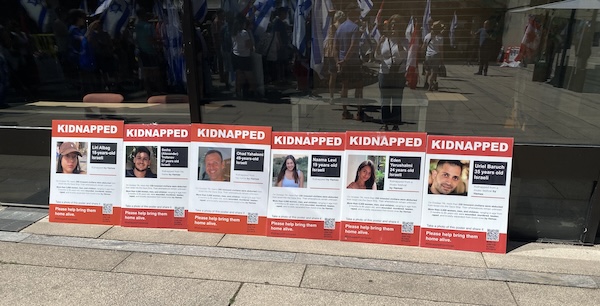
Approximately 120 hostages are still being held in Gaza, more than nine months after the Hamas attacks on Oct. 7. (photo by Anna-Mae Wiesenthal)

Lior Noyman, an Israeli-Canadian educator and filmmaker, expressed sorrow for victims of violence in Israel and Gaza. He warned the audience to be vigilant against expanding antisemitism.

“Leaders, teachers, parents, Canadians, I am calling to you all,” he said. “Don’t let them walk us back in time.”

Dov (David) Rosengarten, a Vancouverite who is chief of staff for donor communications at United Hatzalah, Israel’s network of 7,000 volunteer first responders, brought greetings and gratitude from Israel. 

“Your display of unwavering solidarity every weekend here continues to give us strength through this difficult period,” he said. 

Noting the nine-month period since Oct. 7, Rosengarten drew parallels with the human pregnancy term, except that these past 40 weeks have been a time of unprecedented trauma. He sees hope in news of a ceasefire plan and hopes that “these painful birth pangs will end and the citizens of Israel and the Jewish people at large, including here in Vancouver, will be reborn again. After these many painful months, these cries of sorrow will be transformed to jubilation and we will finally hold our beloved hostages and loved ones again and celebrate the victory of unity and, like with a newborn child, we will shape for ourselves a bright future full of new dreams and possibilities.” 

Format ImagePosted on July 12, 2024July 10, 2024Author Pat JohnsonCategories LocalTags Dov Rosengarten, Ezra Shanken, hostages, Israel-Hamas war, John Rustad, Jonathan Infeld, Lior Noyman, Oct. 7, Selina Robinson, solidarity, weekly rally

Small wins amid gloom

The rescue of four Israeli hostages from Gaza last week and their reunions with their loved ones is a bright spot amid much dismal news – though there remain 120 hostages whose reunions with their families we dream of and hope will happen soon.

This rescue has been a source of tempered joy for Israelis and others. In a time of tragedy and despair, these moments are worth appreciating. Amid the relief, we mourn the life of the Israel Defence Forces officer who died from wounds received during the operation and we mourn the lives of the many innocent Gazans lost. Holding this tension is weighing mightily on many of us, knowing that placing hostages among civilians is a deliberate and overwhelmingly cruel strategy of Hamas.

Closer to home, we are not without bleak news, but neither are we bereft of hopefulness.

The arson attack on Schara Tzedeck Synagogue two weeks ago is deeply troubling and scary. The outpouring of support and empathy from so many is a silver lining. Clergy, elected officials, multicultural community leaders and ordinary folks have expressed solidarity with Schara Tzedeck and the broader Jewish community.

A few less monumental but hopeful items crossed our desks recently.

The Vancouver Comic Arts Festival, which had earlier canceled the participation of artist Miriam Libicki, issued an apology for their actions – and announced that “the vast majority” of individuals who had perpetrated Libicki’s banning had resigned from the organization’s board.

Suffice to say, this is not the foremost news story this year. But it is surprisingly uplifting when a glimmer of common sense emerges where intolerance had once prevailed.

Libicki had been canceled ostensibly because she had served, once upon a time, in the Israeli army. IDF service was also the excuse used when inspirational speaker Leah Goldstein, a BC resident, was canned from an International Women’s Day event in Ontario in March. 

Assertions that an artist (or performer or whoever) is being excluded because they served in a military that we see every day in the news engaged in a tragic conflict may seem legitimate, or at least not quite as blatant as, say, posting a sign that reads “No Jews allowed.” Notably, though, no such litmus test, to our knowledge, has ever been applied to any artist (or whoever) in Canada based on their service in any other national armed forces – and, given the diversity of our country, we can be pretty much assured that we have citizens who have served in many of the world’s most tyrannical and nasty, even genocidal, militaries.

Other excuses to ban Jews or pull Jewish- or Israel-related work from events, exhibits, performances, etc., have also included enough plausible deniability to steer just clear of indisputable antisemitism.

Goldstein’s cousin, local photographer Dina Goldstein (it’s sadly becoming a family affair), was recently removed from a group exhibition. In this instance, the gallery claimed financial considerations were the deciding factor.

Then there are cases where venues pull an event or performer based on security concerns, as the Belfry Theatre in Victoria did with their scheduled performance of the play The Runner. They had reason to fear violence – the theatre was vandalized amid the controversy. But cancelations based on security concerns, as valid as they may seem, give an effective veto to those who are potentially violent.

In the shadow of the Belfry decision, The Runner was pulled from the PuSh Festival in Vancouver, the stated reason being that another artist threatened to pull their work from the event if the play was mounted. 

In addition to cancelations, there is plenty to raise alarm bells about anti-Israel bias in the public education system, as well, as we are forced to outline in discouraging detail elsewhere in this issue, with the BC Teachers’ Federation making some controversial decisions. But, again, here some reason prevails, though not from the BCTF.

The Burnaby school district took what it called “immediate action” when it became known that elementary students had been given an exam question asking them to make a case for and against the existence of the state of Israel. We could fill volumes with outrage about the unmitigated nerve of a teacher thinking this was a legitimate subject for grade sixers (if it was on the exam, one can only imagine what the same educator said in the classroom) but let’s take some solace that there were reasonable people in a position of authority to respond when this became public.

In further good news in the education realm, on June 1, the University of British Columbia’s Vancouver Senate soundly rejected (by a vote of 49 to 16) a motion urging the university to cut ties with institutions in Israel.

In challenging times, it is even more necessary to acknowledge and celebrate small victories and acts of decency. It is an act of individual and communal resistance to remain hopeful and steadfast in pursuit of peace and justice. 

Posted on June 14, 2024June 13, 2024Author The Editorial BoardCategories From the JITags antisemitism, arson, BC Teachers' Federation, BCFT, cancelations, Dina Goldstein, education, Gaza, hope, hostages, IDF, Israel Defence Forces, Israel-Hamas war, Leah Goldstein, Miriam Libicki, PuSh Festival, Schara Tzedeck, The Belfry, UBC, University of British Columbia, Vancouver Comic Arts Festival

Posts pagination

Previous page Page 1 Page 2 Page 3 Page 4 … Page 8 Next page
Proudly powered by WordPress