Skip to content

  • Home
  • Subscribe / donate
  • Events calendar
  • News
    • Local
    • National
    • Israel
    • World
    • עניין בחדשות
      A roundup of news in Canada and further afield, in Hebrew.
  • Opinion
    • From the JI
    • Op-Ed
  • Arts & Culture
    • Performing Arts
    • Music
    • Books
    • Visual Arts
    • TV & Film
  • Life
    • Celebrating the Holidays
    • Travel
    • The Daily Snooze
      Cartoons by Jacob Samuel
    • Mystery Photo
      Help the JI and JMABC fill in the gaps in our archives.
  • Community Links
    • Organizations, Etc.
    • Other News Sources & Blogs
    • Business Directory
  • FAQ
  • JI Chai Celebration
  • JI@88! video
image - Weizmann Canada Physics Tournament 2025
image - The CJN - Visit Us Banner - 300x600 - 101625

Recent Posts

  • Vrba monument is unveiled
  • Music to build bridges
  • A better future possible
  • Anne Frank exhibit on now
  • Human rights in sport
  • Telling the story of an icon
  • Crawl bigger than ever
  • JCC Maccabi in Toronto
  • A way to meet fellow Jews
  • Time to include
  • Add Jewish joy to the mix
  • Reminder of humanity’s light
  • From the archives … editorials
  • Year-round holiday recipes
  • מדוע עזבתי את ישראל ואינני חושב לחזור ארצה
  • OJC hosts Oct. 7 memorial
  • A journey beyond self
  • Antisemitism a problem
  • Young man is missed
  • Orr action sparks complaint
  • Prison sentence for hate
  • Etgar Keret comes to Vancouver
  • New fall lecture series
  • Series explores music
  • Doc on Zapiro screens Nov. 6
  • Joy of shared existence
  • Community milestones … October 2025
  • MAID vs Jewish values
  • Cheshvan a great month, too
  • Bull, bear or bubble?
  • From the archives … a coin, etc.
  • מדוע האנטישמיות הולכת וגואה בעולם
  • New bio gives Vrba his due
  • Joy brighter than ever
  • When approaches differ
  • New leadership at the JCCV

Archives

Follow @JewishIndie

Tag: Canadian Shaare Zedek Hospital Foundation

Harper speaks at local event 

Harper speaks at local event 

At the Canadian Shaare Zedek Hospital Foundation (CSZHF) event on Sept. 7, which marked the foundation’s 50th anniversary: left to right, Col. Ilan Or, Israeli defence attaché to Canada; Rafi Yablonsky, CSZHF national director; Dr. Marla Gordon, CSZHF Western region board member; Dr. Arthur Dodek, CSZHF Western region board member; former prime minister Stephen Harper; Dr. Robert Krell, 2025 Western Region recipient of the Kurt and Edith Rothschild Humanitarian Award; Rabbi Andrew Rosenblatt of Schara Tzedeck Synagogue; Ilan Pilo, CSZHF Western Canada director; and Sam Sapera, CSZHF board chair. (photo by Alina Ilyasova)

Former prime minister Stephen Harper was on friendly ground when he addressed a packed sanctuary at Congregation Schara Tzedeck earlier this month. The former Conservative leader, who led the country from 2006 to 2015, is known as a stalwart ally of Israel and the audience of mostly Jewish Vancouverites welcomed him heartily.

The Sept. 7 event was the first fundraising gala for the newly formed Western region of the Canadian Shaare Zedek Hospital Foundation. The event and the surrounding campaign succeeded in funding nine incubators for the hospital’s pediatric department.

The event featured Harper in conversation with former BC premier Gordon Campbell, who told the audience that, of the prime ministers he served with concurrently when he was premier from 2001 to 2011, Harper was his favourite.

Harper said people ask him why he supports Israel so strongly.

“Has it got to do with religion or your view of the Jewish community?” he asked rhetorically. “I mean, there are a million reasons, but, as prime minister of Canada, the reasons were really simple. Here is this one country in the Middle East that shares our values and that is a friend of this country – and the people who are the enemies of that country are enemies of this country.”

Harper told the audience that there are a lot of loud voices condemning Israel and threatening Jewish Canadians, but, he said, they are not unanimous. “There are still a lot of people in this country that understand the value of our Jewish community, that are friends of the state of Israel, and that thank you for everything you do,” he said.

Harper lauded Israel for its actions to set back Iran’s nuclear program, arguing that the brief Israel-Iran conflict has positively realigned the region. People had warned that Israel’s attack on Iran’s nuclear capability was a dangerous escalation that could “lead to World War Three,” he said. 

“We know that not only was [the nuclear program] set back considerably, but the United States and Israel sent a real message that, if we see it again, we’re going to do the same thing again.” 

The results of the Israeli actions were overwhelmingly positive, Harper said. There was a very limited Iranian response – and, notably, no other nations coming to Iran’s aid, he said.

There were broader repercussions around Israel’s action against Iran and in the larger regional conflict, he added. Hezbollah was decapitated and the Lebanese government is now trying to push Hezbollah out. Hezbollah’s allies in Syria lost power. Hamas is massively degraded. 

Campbell expressed dismay at Prime Minister Mark Carney’s statement that Canada would recognize Palestinian statehood at the United Nations if the Palestinians meet a number of conditions. 

“My problem with that … the Palestinian Authority has never done one of the things that the prime minister said,” Campbell said.

“I’m trying to give the new government a chance,” Harper replied, calling the Carney government a “kind of improvement” on the previous administration. “The only interpretation you can put on it is in fact rewarding the events of Oct. 7th.”

Harper said he cannot recall any precedent for Canada, or any other country, recognizing a state that does not exist.

“But, on top of that,” he said, “Who exactly are you? … There is no leadership among the Palestinian populations, including the [Palestinian Authority], that actually unequivocally recognizes the right of a Jewish state to exist. It’s great to say, ‘I favour theoretically a two-state solution,’ but the problem is this other state would be a state that does not support a two-state solution. You’d actually be moving further away from that objective.”

While Israel’s military actions have improved the geopolitical situation in the Middle East, Harper acknowledged there has been a concurrent spike in antisemitism in Canada.

“I really feel a lot of sympathy for ordinary Jewish people who face this in their private [and] professional lives and feel intimidated,” he said. “I guess that the only advice I can give you is to be resolute.… You can’t let those occasions slip. You can’t let them go by.”

Harper said he has been accused of dismissing criticism of Israel as antisemitic, an assertion he rejects.  

“Being opposed to policy of the government of Israel is not antisemitic,” he said. “But being opposed to Israel because it is the only Jewish state in the world is the definition of antisemitism.”

Harper spoke, as he has previously to Jewish audiences, of his father, Joseph, who came of age during the Second World War, when the world was existentially threatened by fascism.

“One of the consequences of that is he grew up just as a very determined opponent of antisemitism in a period – we’re talking the ’40s, ’50s – where some of these things were expressed openly. He was very vocal in opposing that. And, frankly, he is just turning over in his grave watching some of what is happening today.”

Despite almost a decade out of office, the former Conservative prime minister did not shy away from politics, crediting the Liberal party with running an excellent campaign earlier this year and identifying shortcomings in the Conservative party’s approach.

Harper cited Donald Trump’s intervention in the campaign as a factor and anxieties around the Canada-US relationship for upending conventional wisdom, including polls that had predicted a Conservative landslide before former prime minister Justin Trudeau resigned.

“I do think the [Conservative] party has to take a hard look at what went right and what went wrong,” said Harper. “The Liberals displayed incredible tactical flexibility, and we did not show the same level of flexibility.”

Of the Conservatives, he said: “We ran a very principled campaign, but we need to show a lot more adaptability when circumstances change.”

Harper and Campbell also addressed economic issues. The former prime minister said the challenges presented by the current American administration are a chance to diversify Canada’s trade relationships.

“If we have an opportunity to be a genuine globally connected economy, instead of just kind of an economic appendage to the United States, which in some ways we have become, I [see] opportunity,” he said. 

Both Harper and Campbell, in their time, were advocates for the economic benefits of resource extraction.  

“Resources are not the only thing we have, but it’s a big, big comparative advantage,” Harper said. “We’re the country that has an unlimited range of natural resources in a rule-of-law environment, far removed from conflict zones. Do you know how rare that is in the world when it comes to vital resources? And that’s what we have. And we’re not getting them out of the ground, and we’re not getting them around the world.… We’ve got to get our energy to Asia. We’ve got to get our energy to Europe.… It will bring billions of dollars into Canada, create thousands and thousands of jobs in Canada. We are up against the clock, and the clock doesn’t care much about us.”

The Sept. 7 program began with a video showcasing Shaare Zedek Hospital’s achievements in maternal and neonatal care, as well as the range of advanced medical procedures for which the hospital is known. The religious and ethnic diversity of the hospital’s staff and patients is a particular source of pride for the facility’s leadership and their Canadian supporters. 

Harper spoke highly of the hospital, which treats more than a million patients a year.

“The Shaare Zedek Hospital is, to me, emblematic of just so much of what has made Israel a remarkable country,” he said. “[It has] become a world-leading institution that services people beyond politics, race, religion, ethnicity … just a tremendous institution.”

The event was presented by the Canadian Shaare Zedek Hospital Foundation in partnership with the Jewish Federation of Greater Vancouver, Congregation Schara Tzedeck, the Jewish Independent and the Jewish Medical Association of British Columbia. Organizers expressed special thanks to CJPAC, the Canadian Jewish Political Affairs Committee, for their community support.

Ilan Pilo, Western Canada executive for Canadian Shaare Zedek Hospital Foundation, announced the success of the event, which resulted in funding for nine “Giraffe” incubators – each one costing $50,000 – for the hospital where 22,000 Israeli babies are born annually.   

Dr. Robert Krell was awarded the Kurt and Edith Rothschild Humanitarian Award. (See jewishindependent.ca/harper-speaks-at-gala.) The award was presented by Dr. Arthur Dodek, a member of the board of the Jewish Medical Association and of the CSZHF, and Sam Sapera, chair of the board of the CSZHF, which marks its 50th anniversary this year.

The event was co-emceed by the Jewish Medical Association’s Dr. Marla Gordon and Zach Segal, who was a Conservative candidate in this year’s federal election. 
Format ImagePosted on September 26, 2025September 24, 2025Author Pat JohnsonCategories LocalTags Canadian Shaare Zedek Hospital Foundation, fundraising, Gordon Campbell, Ilan Pilo, Iran-Israel war, Israel, Oct. 7, Palestine, philanthropy, politics, Robert Krell, Stephen Harper
Harper speaks at gala

Harper speaks at gala

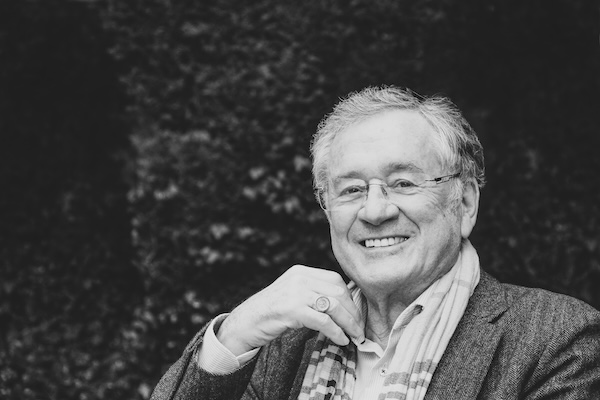
Dr. Robert Krell will be honoured at the Sept. 7 gala of the Canadian Shaare Zedek Hospital Foundation’s Western region. (photo from CSZHF, Western region)

Ilan Pilo had recently arrived in Canada from Israel in 2013 when he attended a Jewish National Fund gala in Toronto honouring Stephen Harper, Canada’s then-prime minister. Pilo thinks it may have been the largest kosher dinner ever on Canadian soil – but what struck him most was the rapturous enthusiasm among attendees for the country’s head of government.

“Harper was, and has been, one of the most genuine and strong allies and voices on behalf of Canadian Jewry and Israel,” said Pilo, now Western Canada executive for the Canadian Shaare Zedek Hospital Foundation.

Pilo will dine again with Harper, when the former prime minister is the keynote speaker at the first-ever gala of the Canadian Shaare Zedek Hospital Foundation’s Western region, which takes place Sept. 7. 

“In these challenging times, we all deserve to get some hope and strength by having a strong ally like him speaking in front of us,” said Pilo. “We all were astonished and so proud to hear his great support, his genuine support for Israel, and just now we need it more than ever.”

The gala, which also marks the 50th anniversary of the Canadian Shaare Zedek Hospital Foundation, will see the Kurt and Edith Rothschild Humanitarian Award bestowed upon Dr. Robert Krell.

The founding president of the Vancouver Holocaust Education Centre, Krell is a child survivor of the Shoah and a renowned Vancouver-based psychiatrist, academic, author and educator, who has devoted his life to supporting survivors, educating on genocide and combating intolerance. In 2020, he was inducted into the Order of Canada.

The Kurt and Edith Rothschild Humanitarian Award is named in memory of the late Kurt Rothschild, a Canadian philanthropist, Jewish community leader and co-founder of the Canadian Shaare Zedek Hospital Foundation. Along with his wife Edith, Rothschild devoted his life to strengthening the Jewish people, the state of Israel and institutions like Shaare Zedek Medical Centre in Jerusalem; he also served as president of the World Mizrachi movement. The award recognizes exceptional individuals whose integrity, leadership and service have left a meaningful impact both locally and globally. 

Krell told the Independent that he has felt a special connection with Shaare Zedek Medical Centre in Jerusalem since he read Dr. Gisella Perl’s 1948 memoir, I Was a Doctor in Auschwitz.

Imprisoned in the death camp, Perl, a gynecologist, was forced to work under the notorious Dr. Josef Mengele in the camp’s women’s infirmary. She performed countless life-saving – but excruciating – procedures without anesthesia, including secretly conducting abortions to save pregnant women from certain execution. Later, while serving in the maternity ward at Shaare Zedek Medical Centre, she would say a silent prayer before every delivery, “God, you owe me a life.”

“So, Shaare Zedek has been on my mind for a long time and, therefore, to be asked to be an honouree of that particular hospital talked to me,” Krell said.

The hospital’s maternity ward delivers 20,000 babies annually – by comparison, that’s three times as many as Vancouver’s BC Women’s Hospital & Health Centre. About 1,000 of those newborns are premature and the Sept. 7 gala is the culmination of a campaign to generate revenue to purchase five new $50,000 incubators for the Jerusalem hospital.

Krell is especially honoured, he said, to receive the award in the presence of Harper.

“It’s a great honour to be with someone who is truly admired for their statesmanship,” he said. “It’s been a long time since we’ve seen a statesman in Canada.”

Pilo noted that Krell’s selection for the award was unanimously supported by the award committee, which was chaired by Rabbi Andrew Rosenblatt, and included Dr. Arthur Dodek, Marie Doduck, Shannon Gorski-Averbach and Dr. Jonathon Leipsic, as well as Pilo.

“We were aiming to find the right person to be awarded for the first time ever with the Kurt and Edith Rothschild Humanitarian Award in the Western region,” Pilo said. “The committee agreed, without any hesitation, that our award recipient should be Rob Krell, since he is renowned for support of Canadian Jewry and Israel. His lifelong efforts at preserving the memory of the Holocaust and his dedication for children, which aligns with our incubator drive, [made it] so natural that he is the right person to receive this award.”

Pilo credited the foundation’s national executive director, Rafi Yablonsky, for securing the former prime minister’s presence at the celebration, which will be emceed by Dr. Marla Gordon. Dinner co-chairs are Yael Segal and Carol Segal. Community partners for the event are the Jewish Federation of Greater Vancouver, the Canadian Jewish Political Affairs Committee, Congregation Schara Tzedeck, the Jewish Medical Association of British Columbia and the Jewish Independent. Tickets are at hospitalwithaheart.ca. 

Format ImagePosted on August 22, 2025August 21, 2025Author Pat JohnsonCategories LocalTags anniversaries, Canadian Shaare Zedek Hospital Foundation, fundraising, Ilan Pilo, milestones, philanthropy, Robert Krell, Stephen Harper
How hostages survive

How hostages survive

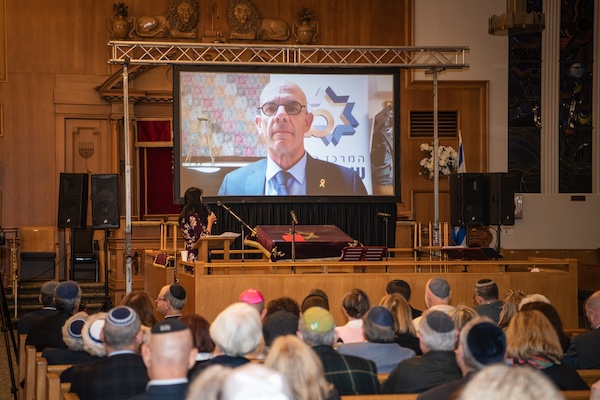
Dr. Ofer Merin, director general of Shaare Zedek Hospital, spoke at the event via video. He was expected to be in Vancouver in person but stayed in Jerusalem due to intelligence that Iran might strike Israel during the time he was scheduled to be away. (Adele Lewin Photography)

A top Mossad psychologist who has interviewed hostages released from captivity in Gaza explained to a Vancouver audience this month the traits that allow some people to survive and overcome unimaginable conditions.

Dr. Glenn Cohen, who made aliyah in 1982 after growing up in New York, served seven years in the Israeli Air Force as a pilot, then 25 years in the Mossad. His reserve duty has been in the hostage negotiation unit. He spoke at Schara Tzedeck Synagogue Nov. 10 as part of a national tour titled Voices of Resilience. The Vancouver event marked the inauguration of the Canadian Shaare Zedek Hospital Foundation Western region. The hospital’s director general, Dr. Ofer Merin, spoke via video from Jerusalem.

The first hostages to be released after Oct. 7 were vital to intelligence-gathering for Israel’s military, but Cohen quickly realized that the psychological well-being of the former hostages presented challenges to obtaining the information that could help locate and free others.

“We have two goals here,” said Cohen. “One is to get lifesaving, critical intelligence about the other hostages. But, at the same time, these people came out of captivity. We have to give them a soft landing and tender loving care.”

Cohen wrote a protocol to receive civilians from situations like these.

When more than 100 hostages were released through an agreement last November, Cohen and his team of 30 psychologists met each one and debriefed them. 

“The first thing we asked them was, who did you see?” Cohen said. “What condition physically, mentally? And,  with this information, we brought a sign of life for some people who had no idea if their loved one was alive or not.”

Some news was good, while other reports confirmed the worst fears of some families.

Cohen has trained soldiers for the potential of being held hostage and he was surprised that, without this sort of training, human instinct told some of the hostages how to respond.

A core trait among those who successfully survive such scenarios, he said, is hopeful certainty that they will be released. Too much optimism, though, can lead to crushing depression when hopes are not met. Those who are certain of imminent release or rescue may succumb to heartbreak and even give up on life as days and weeks tick by, he said.

It is necessary, Cohen said, to balance hope with realistic expectations.

A 16-year-old boy who was among the released hostages remembered the story of Gilad Shalit. The boy told himself: “How long was he in captivity? Five years. I’m in for five years. A day less is a bonus.”

“A 16-year-old kid,” said Cohen. “Wow. What type of resilience is that? He didn’t go through any POW training. He was just a 16-year-old Israeli boy and he’s got that in his DNA.”

Maintaining any sense of control or normalcy is a small victory. Some hostages counted the days and weeks by listening to the muezzin, the Muslim call to prayer, which is different on Fridays. A seven-year-old boy was given three dates to eat each day, and he kept the seeds to measure how many days he had been in captivity. Others made fun of their captors, secretly referring to them by disparaging names.

Generally speaking, Cohen explained, it is psychologically better for a hostage to be held with other captives, even if underground without natural light, than to be held above ground alone.

Also advantageous, Cohen said, is recognizing the captors as human beings.

“There is another person on the other side,” he said. “Even though we call Hamas animals or … monsters or whatever, the point is, they are human beings who can be influenced. When you realize that, that this is an interpersonal situation, that gives you power.”

Cohen shared one story of hostages who told their captors, “Put your gun down, you’re scaring the children,” and they did.

In another instance, a woman with a cardiac condition asked to get some exercise by walking down the tunnel she was held in. She came across two other hostages and asked why they couldn’t be brought together. They were.

“A lot of the hostages actually managed to bond with their captors and because of that bond they survived better,” said Cohen. 

News of such incidents has led to unfortunate events, he said.

“I heard not too long ago that hostages were cursed on the streets of Israel because they talked about their relationship with the hostages and didn’t call them animals,” Cohen said. “I feel like I have a mission now to educate people to realize that if people are speaking like that, as a hostage, it means it’s a healthy survival mechanism and God forbid we be critical of any of them.”

photo - Dr. Glenn Cohen speaks with an audience member at Schara Tzedeck Synagogue Nov. 10. He was in Vancouver as part of a national tour titled Voices of Resilience
Dr. Glenn Cohen speaks with an audience member at Schara Tzedeck Synagogue Nov. 10. He was in Vancouver as part of a national tour titled Voices of Resilience. (photo by Pat Johnson)

Merin, the director general of Shaare Zedek Hospital, was expected to be present in Vancouver but remained in Jerusalem due to intelligence that Iran might strike Israel during the time he was scheduled to be away. Merin also serves as head of the medical intelligence committee involved with the current hostage situation in Gaza.

“The day after the war started, we opened a designated emergency room just to treat the many, many hundreds of patients who came in the first week in need of mental health support,” he said, estimating that tens of thousands of Israelis will be diagnosed with some form of post-traumatic stress disorder in the coming months.

Amid the extreme physical and mental health demands, the hospital has also faced human resources challenges, with hundreds of staff members called up for duty and 15 experiencing the deaths of immediate family members during the war. The anxiety of having family on the frontlines adds to the stress for everyone, said Merin. The multicultural nature of the staff, which roughly mirrors the demographic makeup of Jerusalem, is also a factor. 

“How do we preserve the cohesion between these people?” he asked. “This is a major daily challenge in times of normal emotions among staff people, how to keep this amazing cohesion of people who are working for years, for decades, shoulder to shoulder together. How to keep it during times of war is a major challenge.”

Hinda Silber, national president, and Rafi Yablonsky, national executive director, of the Canadian Shaare Zedek Hospital Foundation, traveled from Toronto for the event, which was co-chaired by Dr. Marla Gordon and Dr. Arthur Dodek. The evening was presented by Canadian Shaare Zedek Hospital Foundation Western region, in partnership with Congregation Schara Tzedeck. The Jewish Medical Association of BC was the educational sponsor, with King David High School and Hillel BC participating in the program. Schara Tzedeck’s Rabbi Andrew Rosenblatt welcomed the audience. 

“Since Oct. 7, the mental health landscape in Israel has been profoundly affected,” said Ilan Pilo, Western region director of the organization. “The nation is navigating an unprecedented surge in psychological distress as individuals and communities cope with the aftermath of trauma and uncertainty.”

Proceeds from the evening will support a new mental health facility. 

Format ImagePosted on November 29, 2024November 28, 2024Author Pat JohnsonCategories LocalTags Canadian Shaare Zedek Hospital Foundation, fundraising, Gaza, Glenn Cohen, hostages, Israel, Israel-Hamas war, mental health, Oct. 7, Ofer Merin, Schara Tzedeck, Shaare Zedek Hospital
New role, familiar face

New role, familiar face

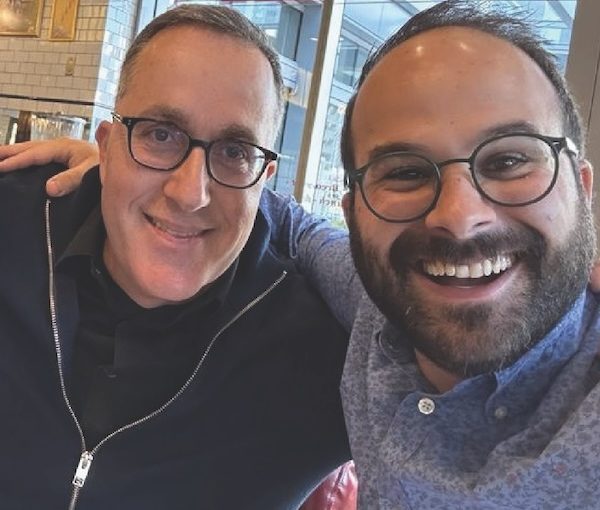
Ilan Pilo, left, and Rafi Yablonsky of the Canadian Shaare Zedek Hospital Foundation. (photo from CSZHF)

In Jerusalem, Yad Vashem stands as the foremost memorial centre to the Holocaust, dedicated to the millions of Jews murdered during the Shoah. Across the street, as if in defiant answer to the past, is one of the world’s busiest maternity centres, where 22,000 newborns meet the world every year, strengthening the future of the Jewish people. 

The maternity section is just one of Shaare Zedek Medical Centre’s many specialized departments, advancing health not only at the start of life but all through the lifespan of patients. Shaare Zedek is home to an emergency preparedness and disaster response centre. It offers a one-stop multidisciplinary and comprehensive diagnostic breast health centre. There are departments focusing on heart health, medical genetics, digestive diseases, oncology and an array of other specializations – more than 30 in-patient and 70 out-patient departments in all. The hospital sees a million patients annually and has 1,000 beds. Located in the centre of west Jerusalem, it is, among so much else, a teaching and research facility.

Western Canadians will likely be hearing more about this particular facility as the Canadian Shaare Zedek Hospital Foundation has just opened its first office in this part of the country. But, while the organization may be a newcomer as a physical presence in Vancouver’s Jewish community, it will be a familiar face sharing the Shaare Zedek story.

Ilan Pilo, who served as shaliach (emissary) and regional executive director of Jewish National Fund of Canada from 2013 to 2021, has returned from Israel as the Western Canada executive director for the Canadian Shaare Zedek Hospital Foundation.

“I was thrilled and honoured to be offered the opportunity to be the first to launch the Western office in Canada,” Pilo said.

During his time back in Israel, Pilo served as principal of a postsecondary trades and skills school and, most recently, ran the campaign for Yariv Fisher, who won an upset victory to become mayor of Herzliya, north of Tel Aviv. Municipal elections across Israel were delayed twice due to the war and, almost immediately after seeing his candidate elected, Pilo jumped on a plane and headed for Canada, spending 10 days in Toronto orienting to his new role before landing in Vancouver in March.

The hospital is 120 years old and was founded to ensure medical adherence to halachah (Jewish law), providing appropriate care for Orthodox Jews in the pre-state era. While it still provides everything religious Jews need, including minyanim, it is also, Pilo said, a “safe zone” for all people, regardless of ethnicity, nationality or religion. 

“When you look at the population in Jerusalem, you see that there are one million people – 300,000 of them are ultra-Orthodox, 400,000 are Arabs and the rest are, let’s say, secular Jews,” Pilo said. “It’s the most interesting and complex mix of people.”

That diversity is reflected not only in the patients but in the doctors and staff, Pilo said.

Right now, the hospital’s specialists in trauma are dealing with soldiers and civilians injured in the war. Since Oct. 7, Shaare Zedek has treated 300 wounded civilians and more than 700 Israel Defence Forces soldiers. In addition, hospitals in the north and the south of Israel have transferred 60 of their neonatal intensive care unit patients out of conflict regions to Shaare Zedek, where the NICU is housed in completely sheltered areas.

Rafi Yablonsky, national executive director of the Canadian Shaare Zedek Hospital Foundation, said he and the foundation’s board decided to expand operations across Western Canada because of the region’s philanthropic and Zionistic reputation. 

“We hope that more Canadians learn about the transformative and world-leading work of Shaare Zedek Medical Centre in Jerusalem,” he said. “Our goal is to grow our donor base and volunteer base with business and philanthropic leaders out West.”

This is not the first time Pilo and Yablonsky have worked together.

“Ilan and I were colleagues when we worked at JNF Canada together,” he said. “I witnessed firsthand how Ilan is highly skilled as a world-class fundraiser, also motivating groups of volunteers to do their part in our community.

“Shaare Zedek is a public hospital that is privately funded,” said Yablonsky, “and it receives very limited support from the Israeli government to upgrade equipment and technology, develop groundbreaking international research and ensure state-of-the-art medical training is available to staff. As such, the hospital relies heavily on the generosity of donors around the world to supplement $30 million needed annually.”

For more information, visit hospitalwithaheart.ca. 

Format ImagePosted on April 26, 2024April 26, 2024Author Pat JohnsonCategories Israel, LocalTags Canadian Shaare Zedek Hospital Foundation, fundraising, health care, Ilan Pilo, Israel, medical care, philanthropy, Rafi Yablonsky, Shaare Zedek
Proudly powered by WordPress