
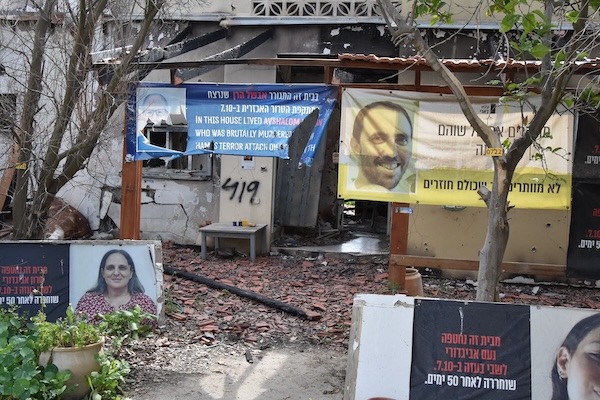
Hundreds of terrorists entered Kibbutz Be’eri. Of the 1,000-plus residents, 101 kibbutz members were killed, 30 people were abducted and one-third of the houses were severely damaged or destroyed. (photo by Larry Barzelai)
My wife and I frequently travel to Israel to visit our three grandchildren. Our interest in Be’eri comes from its special connection with Kibbutz Hatzerim, the birthplace of our daughter-in-law. I feel that the story of Be’eri is a paradigm for the story of the Jewish people, the story of building something magnificent, experiencing a great
destruction and rebuilding afterwards to create something even better. It also illustrates how, when people work together, they can accomplish greater things.
Through a mutual friend, I arranged to meet Yaron, a lifelong member of Kibbutz Be’eri and one who had survived the Oct. 7 massacre. He graciously took me on a tour of the kibbutz as he described the events of that day. Much of what follows are descriptions of the events in his own words. He’s given me permission to share them with you.
On the evening of Oct. 6, Yaron and other kibbutzniks were celebrating the anniversary of the founding of Kibbutz Be’eri. Sharing drinks later with some of his closest friends, they started planning a summer hiking trip in the French Alps.
At 6:30 in the morning of Oct. 7, Yaron heard unusual noises, as he slept with his wife and two young children – both under 5 years old. It sounded like shelling and bombing. When the red alert siren went off, they ran to join their kids in their home’s mamad (reinforced security room), which is also the kids’ bedroom.
Initially, Yaron wasn’t too concerned, even after receiving a text that the kibbutz may have been infiltrated by enemies. “OK, I guess we’ll be cooped up in here for a couple of hours,” he thought.
“Messages in the different kibbutz WhatsApp groups start reporting about terrorists walking inside Be’eri,” he writes. “It is close to 8 a.m. Someone writes a message that she hears gunshots.”
Shortly after that, someone reports hearing “terrible screams from the apartment above her, then silence.” Another says that one of the houses in the kibbutz is burning.
Yaron tries to stay calm. The power goes off. Their dog, who is not inside the room, is unusually silent. They hear that someone is in their house.
“They get to the room and try to open the door. I fight over the handle, heart pounding,” writes Yaron. “They don’t succeed! Every time they try, I swing the door handle back to the upright, ‘Safe’ position.”
Eventually, the terrorists give up on opening the mamad. Yaron ignores the calls in Arabic and English to come out of the room. He and his family listen, as the terrorists sing, while wrecking the house. First, there is the smell of gasoline, then smoke enters the room.
A neighbour advises them, via Yaron’s phone, that they should close the gap under the door with wet clothes.
“I take the sheet from my daughter’s bed, pour the bucket of urine on it and jam it under the door,” Yaron writes. “Outside the room, the fire grows fierce, it consumes five years of our lives in minutes…. We are in a closed room, we have no electricity, the children are coughing. I realize that the fire in our home is probably so crazy that even those inhumane monsters can’t still be waiting outside the door. I let go of the handle and I take a deep breath and feel some oxygen flow to my brain. So far, it was the pressure and fear of the terrorists that was suffocating me, but now the smoke is becoming the main problem.”
Yaron’s wife continues to text with neighbours, calling emergency team members repeatedly.
“All of our children’s books are burning outside,” Yaron shares. “Amidst all the terror we hear one of our favourites, a sound book of Arik Einstein songs, catching fire. The fire makes it play, chillingly, one of the happiest songs we know: ‘It’s Saturday morning, a beautiful day….’”
Suffocating on the smoke, the family has no choice but to open a window of their second-floor apartment. Despite the fear of what awaits them outside, the smoke is too much and they climb out onto the metal awning below.
“The four of us are sitting on the metal. We can breathe but we are exposed 2.5 metres (eight feet) above the ground. OK, now what?” Yaron recalls.
They can’t reach the emergency team, so they jump to the ground and hide in a nearby shed. Yaron jumps first, his wife hands him the kids, then follows.
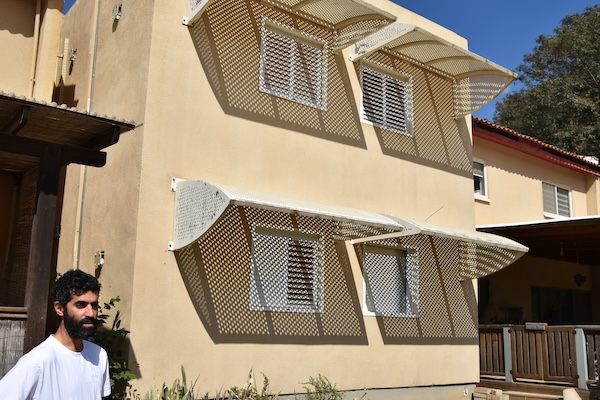
“Another neighbour reaches out, ‘Come to my place.’ I call him. I ask him to risk his life, leave his mamad and open his house for us. He does this while we’re on the phone. We are hesitant to come outside, we are debating with our eyes, and can’t decide if we should stay hidden in an unsafe shed or try to reach a safer place but risk exposure. I ask him to risk his life even more, to take a look outside and verify there are no terrorists in sight. He bravely obliges and says it’s clear. We were in the shed for maybe five, maybe 10 minutes, maybe it was two years, who knows. The kids are silent…. My heart is racing, I open the shed door and we sprint to the neighbour’s house.”
The fire has consumed their own home, and their beloved dog. Temporarily safe at the neighbours’, Yaron sees that the fire might cross over to where they are hiding. “We decide we need to evacuate,” he writes. “At a distance, we spot a few IDF soldiers. A small company or a team…. They escort us to a nearby building where my brother lives. We contact him and he let us in together with two more kibbutz members who had gotten stuck in a similar situation.”
Around 11 p.m., soldiers returned to Yaron’s brother’s place. “They helped us out, they asked us to cover our children’s eyes to shield them from the horrors on the kibbutz lanes and they escorted us to the yellow gate.”
“We made it out,” he writes. “We made it out.”
Most of Yaron’s extended family survived the massacre, except for an aunt who was murdered. In total, hundreds of terrorists entered the kibbutz. Of the 1,000-plus residents, 101 kibbutz members were killed, 30 people were abducted and one-third of the houses were severely damaged or destroyed.
Another victim of the massacre was Winnipeg-born Vivian Silver, who had, prior to Oct. 7, driven patients from the Erez border crossing to hospitals in Israel. She learned Arabic so that she could better communicate with her Bedouin neighbours. She truly believed in a peaceful future between the residents of Israel and the Palestinians of Gaza. Sadly, she was killed on Oct. 7. Her remains were so badly burned that it took weeks to identify her by DNA analysis.
Eli Sharabi, another resident of Be’eri, was kidnapped and taken to Gaza. In his book Hostage, he describes 491 tortuous days in Hamas captivity. He was looking forward to reuniting with his family once he was freed. Instead, upon his release, he discovered that his wife and daughters had been killed on Oct. 7. He cried at their gravesites for two hours, before making the decision that he had to move forward.
Immediately after Oct. 7, Yaron and his family spent many months living in an apartment in the Dead Sea area. They were alive and they were safe, relatively free from missile attacks, but life was far from normal. To say nothing of the trauma they were dealing with, reestablishing a kibbutz lifestyle, while living in a crowded hotel with none of the amenities that glue kibbutzniks together, was challenging.
The family has since relocated to a temporary custom-built village adjacent to Kibbutz Hatzerim. Be’eri and Hatzerim are sister kibbutzim, both founded in 1946. Be’eri was named for Berl Katznelson, a founding father of Labour Zionism, whose nickname was Be’eri; Hatzerim, after a verse in Deuteronomy (2:23) that mentions hatzerim (farms/enclosures) “as far as Gaza.”
Be’eri and Hatzerim are both traditional socialist kibbutzim, populated mainly by people on the left of the political spectrum. Thus, it was natural for Kibbutz Hatzerim to offer to build a temporary kibbutz adjacent to them for people from Be’eri to live until their kibbutz was rebuilt over a two-year period.
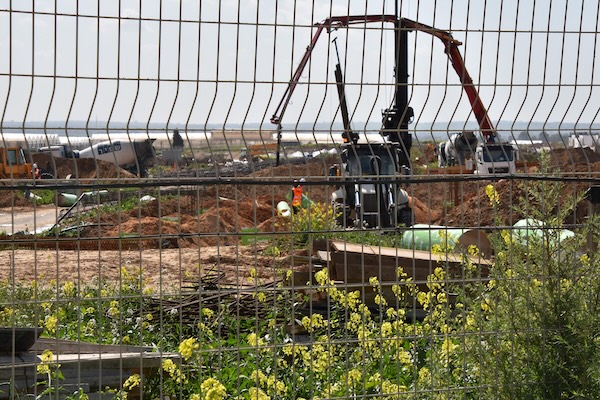
Most former residents of Be’eri are now living in the temporary kibbutz. Some facilities, such as medical clinics and administrative offices, are shared by the two kibbutzim. Otherwise, the temporary Be’eri has its own houses, schools and offices. Hatzerim expanded its dental clinic, seniors lounge and grocery store to accommodate the increased needs of the larger population. In typical kibbutz fashion, members of both communities met many times to jointly plan this project.
Every day, Yaron leaves his family on the temporary Kibbutz Be’eri to commute 45 minutes to the original. About 60 kibbutz members are living there now, while it’s being rebuilt, and the plan is for most members to return by the start of the school year this September. A printing factory and agriculture are the two sustaining industries on Be’eri.
Yaron’s home, along with 140 others, was destroyed on Oct. 7. Recently, members of Kibbutz Be’eri made a collective decision to tear down all the damaged buildings. They want to try and wipe away the terrible memories of Oct. 7 and build anew. As one part of the construction work, the kibbutz is building a new subdivision, where Yaron and his family are planning to live.
But Yaron isn’t sure that he wants to return. He was born on Be’eri and has lived most of his life there. However, the memory of the trauma of Oct. 7 is very strong. He’s not sure he wants to move back to this place, where so much death and destruction happened. He confided that he may want to live outside of Israel, somewhere he can anticipate a more peaceful future for his children.
Larry Barzelai is a Vancouver family physician, specializing in care of the elderly, who travels to Israel frequently to visit his three grandchildren there. He is presently co-chair of the Jewish Medical Association of British Columbia.